
Home Blog Page 29

Multifamily Applicant Fraud Becoming a Widespread Challenge

Multifamily fraud is becoming a challenge as fraudsters become more inventive to avoid vulnerabilities in traditional verification systems

Multifamily applicant fraud is becoming a widespread challenge for the industry as fraudsters become more inventive, according to the State of Applicant Fraud Report from Snappt, an AI document-fraud-detection company for multifamily property managers.

The report exposes the alarming rise of sophisticated fraud tactics targeting multifamily properties, highlights vulnerabilities in traditional verification systems, and introduces actionable solutions to protect your business, according to a release.

Using AI To Sneak Through Leasing Process

The release says fraudsters employ a range of tactics to sneak through the leasing process:

  • Some manipulate documents directly in the form of first-party fraud
  • Others take a third-party fraud approach by impersonating another individual on their documents
  • In addition, applicants are utilizing AI technology to generate entirely fake documents and synthetic IDs from scratch.
Multifamily applicant fraud is becoming a challenge as fraudsters become more inventive to avoid traditional verification systems

These tactics come at a time of high housing demand and the climbing rate of rental costs. In tandem, the digitization of rental applications has made it easier for applicants to remotely submit falsified documents, making it harder for property managers to verify their authenticity.

As part of this report, Snappt surveyed 900 property managers to gain insights into their daily challenges. They learned that 72% believe that multifamily applicant fraud is just as much of a problem this year as last, while more than 60% ranked security and accuracy as their top priorities.
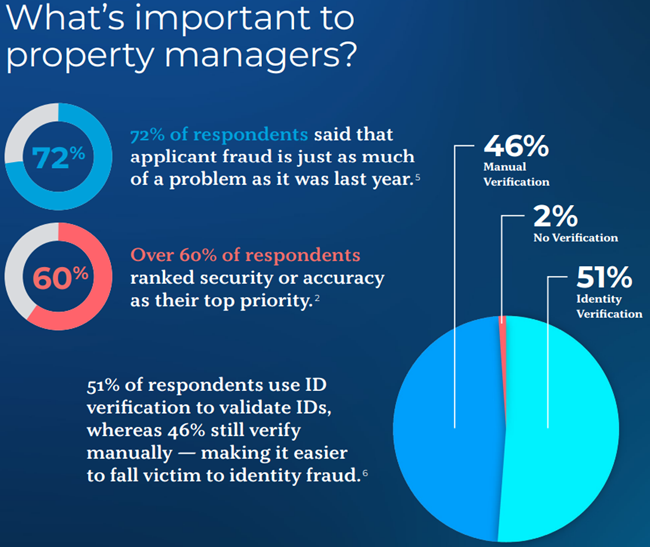
Multifamily applicant fraud is becoming a challenge as fraudsters become more inventive to avoid traditional verification systems

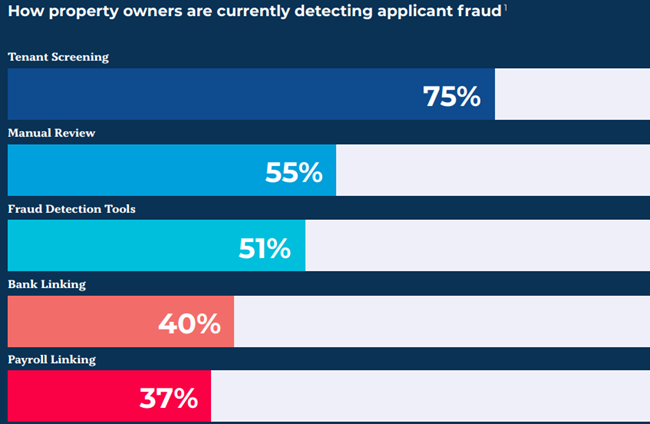
The release says multifamily organizations must invest in a multi-layer fraud-defense system equipped with document-fraud detection, ID verification, income verification, threat-list checks, and a fraud forensics team.

“Fraud is evolving at an unprecedented rate, putting immense pressure on multifamily property managers to keep up,” writes Daniel Berlind, CEO of Snappt, in the release. “Our latest report and new solutions empower the industry to tackle fraud head-on while maintaining a frictionless application process for prospective renters.”

To read the report, visit www.snappt.com/blog/applicant-fraud-report.

Sign Up For Our Weekly Newsletter And Get Rental Property And Apartment News And Helpful, Useful Content Each Week.

* indicates required

Why People Moved In The Last Year – Fewest In 25 Years

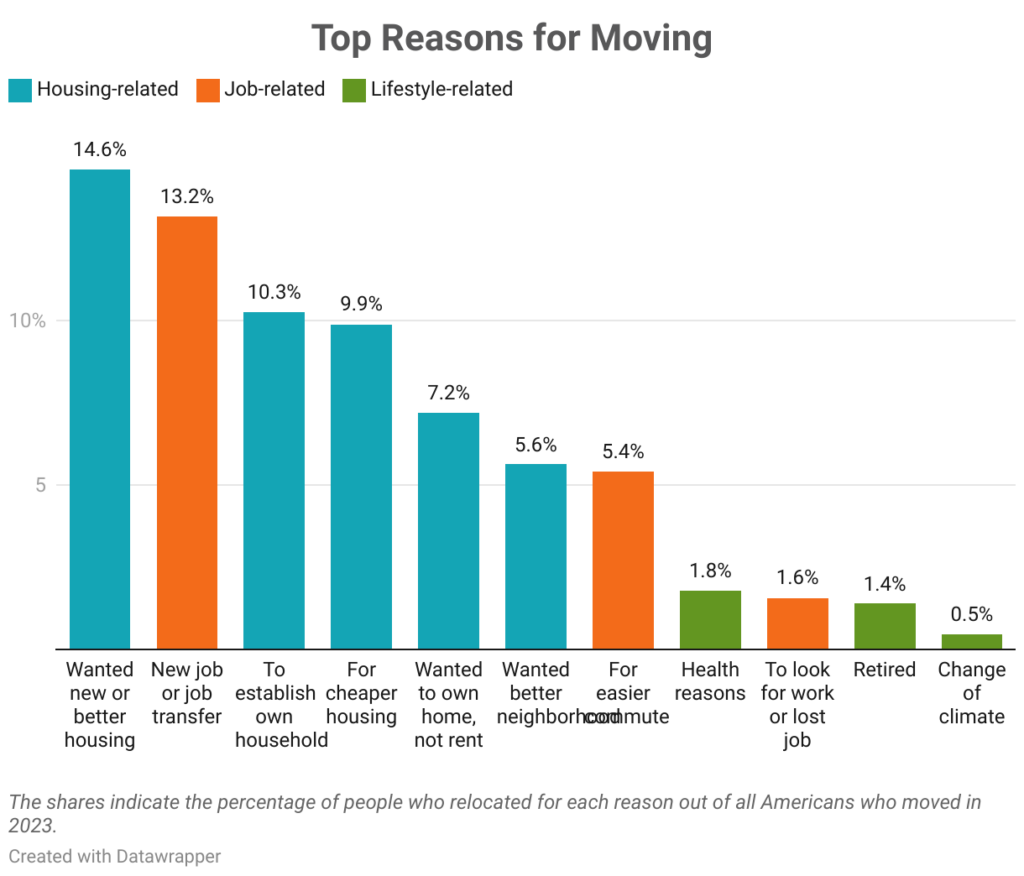
A new study on why people moved confirms that the main reasons people move are for better housing and jobs, according to Rent Café.

A new study on why people move confirms that the main reasons people move are for better housing and jobs, according to Rent Café.

The number of people moving last year – 24 million – was the lowest number in 25 years.

More than half of those who moved last year (13 million) packed up for better housing. Another five million chased job opportunities.

Overall, the pursuit of better homes represented 15% of all moves, along with the search for more affordable housing, which drove 10% of relocations.

“Instead of compromising more, Americans are now strategically relocating to balance career opportunities with quality-of-life and housing costs,” the RentCafe research team writes.

A new study on why people moved confirms that the main reasons people move are for better housing and jobs, according to Rent Café.

This trend reveals how housing and career choices continue to reshape America’s cities, the study says.

“This trend reveals an intriguing paradox of the remote-work era: Despite the widespread adoption of work-from-home policies, job-related relocations remain strong.

“It suggests that workers are leveraging the flexibility of remote work to seize career opportunities across broader geographic areas. This trend aligns with the post-2020 job-hopping phenomenon, in which nearly one in five workers stayed in their role for a year or less by 2022. Plus, an easier commute drove more than 5% of all moves last year, which reinforces the paradox,” RentCafe says in the study.

A new study on why people moved confirms that the main reasons people move are for better housing and jobs, according to Rent Café.

Solo renters fasting moving group

While moving out and living on one’s own seems to be less appealing or achievable compared to pre-pandemic times, solo renters are the fastest-rising renting group.

Then, cheaper housing comes in as the fourth most popular reason for relocating, with a share of nearly 10%. This is far from unexpected in the context of record-high home prices.

A new study on why people moved confirms that the main reasons people move are for better housing and jobs, according to Rent Café.

A few highlights from the report:

  • 7% of Americans who moved last year did so to achieve homeowner status.
  • 6% of movers sought a better neighborhood.
  • 8% of moves were for health concerns.
  • 4% of moves for retirement
  • 1% of moves were for a change of climate

Read the full report from RentCafe here.

Sign Up For Our Weekly Newsletter And Get Rental Property And Apartment News And Helpful, Useful Content Each Week.

* indicates required

Can I Use Pet Deposit Money To Pay For Other Rental Damages?

Can a landlord use pet deposit money to pay for other tenant rental damages is the question this week for Ask Landlord Hank.

Can a landlord use pet deposit money to pay for other tenant rental damages is the question this week for Ask Landlord Hank. Remember Hank is not an attorney and he is not offering legal advice. If you have a landlord question for him please fill out the form below.

Dear Landlord Hank,

I have a tenant that left before we did the walkthrough. The place was full of old beds, sofas, broken cabinets and wood pallets, and loads of garbage. It took multiple trips to the dump.

She is asking for her pet deposit back. However,  it is going to cost me $1,000 just for garbage and junk removal. She paid $500 plus $100 pet fee. Can I hold her pet fee or is that only for pet damage?

-Elaine

Hi Elaine,

From your question, I am guessing you have a refundable pet deposit for any damage caused by the pet.

That is the intention for the use of these funds, for pet stains or damage to carpet or other flooring, scratches or chewing on walls, cabinets, etc., pet smells, fleas – any issues related to keeping this animal in the unit.

If you can tell that some of the damage was caused by the pet, you can keep money to take care of that issue.

If you have a pet fee then that is normally a fee paid by the tenant for the right to have the pet in the property. Normally a pet fee is nonrefundable, but your lease should describe whether you have-a refundable pet deposit or non-refundable pet fee.

I hope you are doing background screening on possible tenants to check credit, criminal history, employment history and residential history to hopefully avoid this kind of abuse in the future.

Good luck!

Sincerely,

Hank Rossi

As a child, Hank Rossi sometimes helped his father take care of the family rental-maintenance business.  In the mid-’90s he got into the rental business for himself. After he retired, he started a real-estate brokerage business with his sister that focuses on property management and leasing. Visit his website: https://rentsrq.com.

Editor’s note: Check your local laws on vehicles on rental property or other issues as many cities and states have different rules.

Can a landlord use pet deposit money to pay for other tenant rental damages is the question this week for Ask Landlord Hank.
Landlord Hank says, “If you can tell that some of the damage was caused by the pet, you can keep money to take care of that issue.”

Ask Landlord Hank Your Question

Ask veteran landlord and property manager Hank Rossi your questions from tenant screening to leases to pets and more! He provides answers each week to landlords.

  • This field is for validation purposes and should be left unchanged.

Each week I answer questions from landlords and property managers across the country in my “Dear Landlord Hank” blog in the digital magazine Rental Housing Journal.   https://rentalhousingjournal.com/asklandlordhank/

Tenants With Too Many Vehicles What Can I Do?

Tenant Cut Off Electricity And Moved Early What Do We Do?

Do I Have to Paint and Replace Flooring for a Long-Term Tenant?

Tenant Refuses To Return Keys After Leaving My Rental

A Tenant Poured Grease Down Drain Who Is Responsible?

Sign Up For Our Newsletter And Get Rental Housing And Apartment News And Helpful, Useful Content Each Week.

* indicates required

photo credit Solovyova via istockimages


California Cities Push Back on Rent-Setting Software

California cities including San Diego are pushing back on rent-setting software programs used by apartments, according to reports.

California cities, including San Diego, are pushing back on rent-setting software programs used by apartments, according to reports.

Some landlords use a single company’s software – which uses an algorithm based on proprietary lease information – to help set rent prices.

San Diego’s city council president is the latest city to join the movement, proposing to prevent local apartment owners from using the pricing software, which he maintains is driving up housing costs.

The proposed ordinance, now being drafted by the San Diego city attorney, comes after San Francisco supervisors in July enacted a similar, first-in-the-nation ban. It put the ban in place on “the sale or use of algorithmic devices to set rents or manage occupancy levels” for residences. San Jose is considering a similar approach.

The San Diego council president, Sean Elo-Rivera, explained it like this to ABC eyewitness news:
“In the simplest terms, what this platform is doing is providing what we think of as that dark, smoky room for big companies to get together and set prices,” he said. “The technology is being used as a way of keeping an arm’s length from one big company to the other. But that’s an illusion.”

San Diego has the fourth-highest percentage of renters of any major city in the nation.

Arizona and 7 other states have sued also

California and seven other states have also filed lawsuits against the leading rental pricing platform, Texas-based RealPage. The complaint alleges that “RealPage is an algorithmic intermediary that collects, combines, and exploits landlords’ competitively sensitive information. And in so doing, it enriches itself and compliant landlords at the expense of renters who pay inflated prices…”

A RealPage spokesperson, Jennifer Bowcock, told CalMatters that a lack of housing supply, not the company’s technology, is the real problem .

She said its technology benefits residents, property managers, and others associated with the rental market. She later wrote that a ” misplaced focus on nonpublic information is a distraction… that will only make San Francisco and San Diego’s historical problems worse.”

The California Justice Department contends RealPage artificially inflated prices to keep them above a certain minimum level. Department spokesperson Elissa Perez this was particularly harmful given the high cost of housing in the state. “The illegally maintained profits that result from these price-alignment schemes come out of the pockets of the people that can least afford it.”

Arizona AG Sues RealPage and Landlords For Price-Fixing

Sign Up For Our Weekly Newsletter And Get Rental Property And Apartment News And Helpful, Useful Information Each Week.

* indicates required

Justice Department Sues RealPage Over Apartment Pricing

Photo credit Cavan Images via istockphoto

National Rents Dip Again In November

National rents dipped again in November dropping 0.8% and experts expect them to continue to fall in coming months Apartment List says

National rents dipped again in November dropping 0.8% and experts expect them to continue to fall in coming months, Apartment List says in the December report.

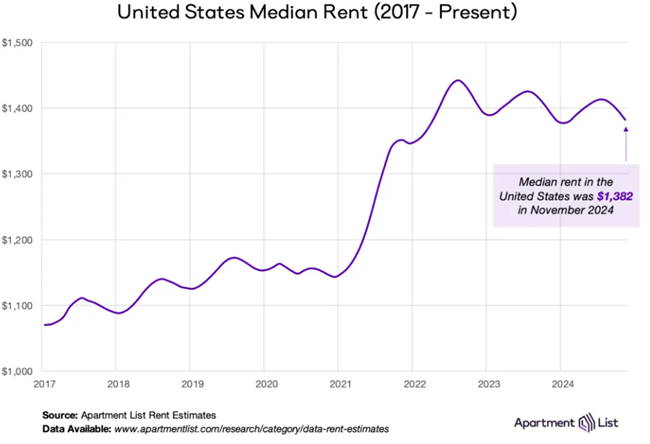
Nationwide rent fell $12 to $1,382, and “we’re likely to see that number dip one more time before the year ends,” the Apartment List research team says.

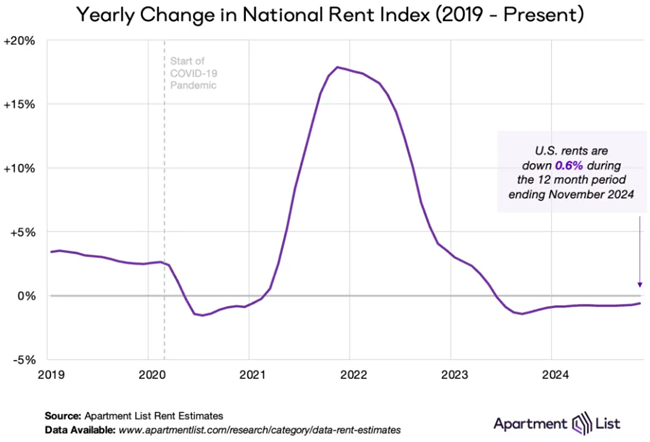
The analysis says, “The seasonal declines in rent prices that take place during the fall and winter have been steeper than usual and seasonal increases of the spring and summer have been milder. As a result, apartments are on average slightly cheaper today than they were one year ago.”

National rents dipped again in November dropping 0.8% and experts expect them to continue to fall in coming months Apartment List says

What is happening is that the influx of new supply has collided with softer demand over the past two years. This has caused rents to increase modestly during the peak moving season, and have seen more pronounced dips during the off-season.

Still, national rents are $200 a month higher than just a few years ago.

Overall rents are down 0.6% year-over-year as November brought the fourth consecutive and largest monthly dip of the off-season.

In November 88 of the nation’s 100 largest cities saw rents fall, in line with the broader national trend. But on a year-over-year basis, rent growth was negative for just 47 of these cities, as more individual markets gradually return to positive rent growth.

National rents dipped again in November dropping 0.8% and experts expect them to continue to fall in coming months Apartment List says

“We are likely to see continued price dips to close out the year, as property owners offer modest discounts to fill vacancies during a time of year when fewer renters are looking to move,” Apartment List says.

Apartment vacancies remain elevated

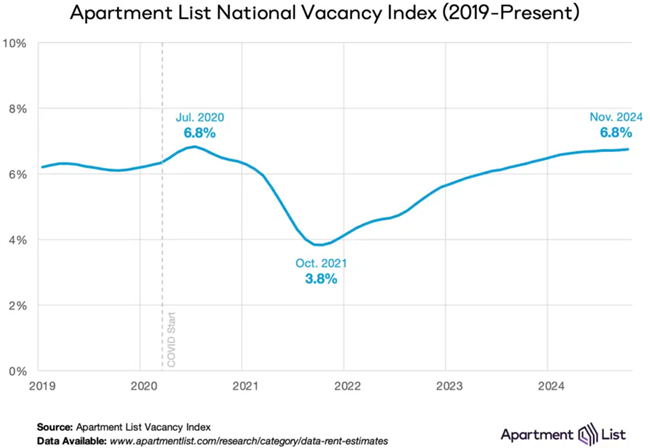
The Apartment List national vacancy index continues trending up slowly and sits at 6.8 percent, the highest reading since the onset of the pandemic

This rise in the vacancy rate is coming on the heels of the strongest quarter for new apartment completions in five decades as 180,000 thousand new apartments hit the market in the third quarter, a 21 percent increase over the previous quarter and the most since 1974.

However, keep in mind vacancy trends can be highly localized.

National rents dipped again in November dropping 0.8% and experts expect them to continue to fall in coming months Apartment List says

Conclusion

Rents should continue to dip for the remainder of the year.

Rent increases are currently being moderated by a robust construction pipeline that has already delivered a decades-high number of new apartment units in 2024, with considerable runway still to go in the boom.

“While rental demand has bounced back a bit this year, recent signs of labor market softness could dampen demand going forward. With this in mind, we expect that new supply will continue to outstrip demand into 2025,” Apartment List researchers say.

Sign Up For Our Weekly Newsletter And Get Rental Property And Apartment News And Helpful, Useful Content Each Week.

* indicates required

Justice Department Sues Rental Property Owner for Sexual Harassment

Justice Department Sues Rental Property Owner for Sexual Harassment

The Justice Department has filed a lawsuit against Joseph E. Johnson the owner and operator of rental properties in Lexington, Kentucky, for engaging in sexual harassment and retaliation in violation of the Fair Housing Act, according to a release.

The lawsuit filed in the U.S. District Court for the Eastern District of Kentucky alleges that, for decades, Johnson has sexually harassed numerous female tenants.

According to the complaint:

  • Johnson has offered housing-related benefits in exchange for sexual contact
  • Made unwelcome sexual comments and advances to female tenants
  • Subjected female tenants to unwelcome touching and groping
  • Taken adverse housing-related actions against female tenants who refused his sexual advances
  • Failed to act when made aware of similar harassing behavior by one or more of his employees.

“For decades, this landlord used his position of power to sexually harass vulnerable women who simply wanted roofs over their heads,” Assistant Attorney General Kristen Clarke of the Justice Department’s Civil Rights Division said in the release. “Women should not live in fear when they pay their rent or seek repairs. The Justice Department will continue to vigorously enforce the Fair Housing Act’s prohibition on this conduct.”

The lawsuit, which is the result of a joint investigative effort of the Justice Department with the Department of Housing and Urban Development (HUD)’s Office of Inspector General, seeks monetary damages to compensate persons harmed by the alleged harassment, a civil penalty against the defendant to vindicate the public interest and a court order barring future discrimination.

“It is unacceptable for landlords to threaten or commit sexual harassment or abuse against tenants,” said HUD Inspector General Rae Oliver Davis. “The defendant allegedly preyed upon vulnerable tenants and retaliated against them when they spurned his sexual advances. My office will continue to work with our law enforcement partners to hold housing providers accountable for this type of horrible conduct.

Sign Up For Our Weekly Newsletter And Get Rental Property And Apartment News And Helpful, Useful Content Each Week.

* indicates required

Can I Charge Tenants For Carpet Cleaning If I Put Down New Carpet?

What to do when tenants move out and leave a carpet cleaning problem in your rental property is the question this week

What to do when tenants move out and leave a carpet cleaning problem in your rental property is the question this week for Ask Landlord Hank. Remember Hank is not an attorney and he is not offering legal advice. If you have a landlord question for him please fill out the form below.

Dear Landlord Hank,

If the previous tenants left stains on the carpet, and haven’t removed the stains.

Can I charge them for cleaning, even if I put new carpet down?

-Faye

Dear Landlady Faye,

If the tenants stained your carpeting and then it should be cleaned and stains removed at their expense.

Carpeting in a rental may have a lifespan of only 5 years depending upon usage, initial quality, pad quality and installation so if this carpeting was at its end of life and you are going to replace it anyway I would not charge the tenants for staining a carpet that you are not going to keep.

Just be fair and treat your tenants like you’d want to be treated.

Sincerely,

Hank Rossi

What to do when tenants have too many vehicles on your rental property and what should the lease say is the question for Landlord Hank
Landlord Hank says, “Just be fair and treat your tenants like you would want to be treated.”

www.rentsrq.com

Ask Landlord Hank Your Question

Ask veteran landlord and property manager Hank Rossi your questions from tenant screening to leases to pets and more! He provides answers each week to landlords.

  • This field is for validation purposes and should be left unchanged.

Each week I answer questions from landlords and property managers across the country in my “Dear Landlord Hank” blog in the digital magazine Rental Housing Journal.   https://rentalhousingjournal.com/asklandlordhank/

Tenant Cut Off Electricity And Moved Early What Do We Do?

Do I Have to Paint and Replace Flooring for a Long-Term Tenant?

Tenant Refuses To Return Keys After Leaving My Rental

A Tenant Poured Grease Down Drain Who Is Responsible?

Sign Up For Our Newsletter And Get Rental Housing And Apartment News And Helpful, Useful Content Each Week.

* indicates required


Ohio Would Make Tenants, Not Landlords, Pay Unpaid Utility Bills

Ohio legislators are considering a bill to make tenants responsible for unpaid utility bills and other municipal bills but cities oppose it

Ohio legislators are considering a bill to make tenants responsible for unpaid utility bills and other municipal bills, and to allow cities to collect unpaid bills directly from renters, according to reports.

Currently, Ohio law allows municipalities to collect overdue utility bills – such as water, sewer and trash – from “an owner, tenant, or other person who is liable to pay the rents or charges.”

One of the bill’s sponsors, Rep. Mark Johnson (R-Chillicothe) said unpaid bills often fall on landlords rather than renters.  “To me, it’s personal responsibility,” Johnson said. “You run up the bill, it’s your job to pay it.”

Johnson said he felt compelled to support the bill after talking with landlords who said they had been hit with utility fees exceeding $1,000 after a tenant had moved away without paying.

“A lot of them (renters) know the law and they do this repetitively and often run up huge water bills because the cities do not go out and valve the water off like your electric company takes your meter if you don’t pay the bill,” Johnson said.

Johnson said the current system does not only negatively affect landlords but can also result in higher costs for tenants.

“It increases rental costs,” Johnson said. “It’s a common business practice. If a landlord is hit with this, they’re going to recover it with [higher] rent for everybody.”

Cities may not be in favor of the bill

However, multiple Ohio municipalities and city water departments are not on board with the bill. Andrea Yang of Greater Cincinnati Water Works said in written testimony that landlords are better positioned than utility entities to manage nonpayment risks through security deposits and tenant screenings.

“[Municipal utilities] have no knowledge or control over the lease terms, including when the tenant has vacated the property, which makes it exceedingly difficult for the utility to pursue unpaid amounts from a tenant,” Yang said.

Sign Up For Our Weekly Newsletter And Get Rental Property And Apartment News And Helpful, Useful Content Each Week.

* indicates required

Seattle Rents Show Steady Improvement with Strong Demand

Demand drove rent growth up in Seattle, according to Yardi Matrix, with advertised asking rents up 1.2 percent year-over-year to $2,216

Demand drove rent growth up in Seattle, according to Yardi Matrix’s November report, with advertised asking rents up 1.2 percent year-over-year to $2,216, outperforming the 0.9 percent U.S. rate as of September.

The occupancy rate also rose, up 20 basis points to year-over-year 95.5 percent, as construction moderated.

Occupancy is also healthy as new construction is absorbed.

“Seattle’s multifamily fundamentals maintained generally healthy performance in 2024, despite ongoing challenges in the financial landscape,” the report says:

  • Seattle employment was good, up 1.1% in the past 12 months.
  • Nearly half of the 27,600 jobs added during the first seven months of 2024 were registered in the education and health services sector.
  • Apartment construction delivered 8,758 units in 2024 through September and had another 22,846 units under construction.
  • Investment activity surpassed last year’s total, amounting to $1.3 billion, with the per-unit price dropping below the $300,000 mark.

Rent growth across the metro

Year-over-year through September Seattle rent growth was positive in 28 of the 53 submarkets tracked by Yardi Matrix. Bellevue–West (up 4.0% to $3,052), Issaquah (up 4.9% to $2,810) and Belltown (up 2.3% to $2,765) were the most expensive.

Overall, 28 submarkets had average advertised asking rents above the $2,000 mark. The largest rent declines were reported in Burien (-2.1% to $1,792) and Greenlake/Wallingford (-2.0% to $2,180).

Read the full report at https://www.yardimatrix.com/Publications

About Yardi Matrix

Yardi Matrix researches and reports on multifamily, office and self-storage properties across the United States, serving the needs of a variety of industry professionals. Yardi Matrix Multifamily provides accurate data on 18+ million units, covering more than 90 percent of the U.S. population. Contact the company at (480) 663-1149.

Sign Up For Our Weekly Newsletter And Get Rental Property And Apartment News And Helpful, Useful Content Each Week.

* indicates required

Suit Charges Large Private-Equity Landlords with Discrimination

A suit charges private equity landlords with discrimination in tenant screening policies through use of arbitrary criminal-history policies

The Fair Housing Center of Central Indiana (FHCCI) and an Indianapolis resident have filed a class action complaint against two private equity landlords Progress Residential and Tricon Residential, alleging discrimination in tenant-screening policies, according to a release.

The complaint alleges discriminatory practices perpetuated by Progress and Tricon against Black renters through arbitrary criminal-history policies. The lawsuit alleges the companies enforce blanket bans on certain justice-involved applicants without assessing individual circumstances, disproportionately affecting Black applicants who are systematically overrepresented in criminal- justice statistics.

NBC news reports the new litigation centers on Tricon Residential, a California-based landlord recently acquired by the Blackstone Group of New York City, one of the country’s more prestigious private-equity firms, and Progress Residential, a landlord owned by Pretium Partners, which is overseen by Don Mullen, a former Goldman Sachs executive.

The suits were brought by the Fair Housing Center of Central Indiana, an advocacy group serving residents of 24 counties in the state. Both Tricon and Progress denied tenant applications based on inaccurate information generated by a third-party screening service, the lawsuits say, and they allege that neither landlord verified the information.

A spokesman for Tricon Residential said in a statement: “Tricon adheres to all fair-housing laws and believes the allegations in this suit are baseless.” The events detailed in the lawsuit occurred before Blackstone purchased the company; a Blackstone spokesman declined to comment. A Progress Residential representative provided this statement: “As a leading professional property manager, we are committed to promoting a fair and equitable screening process for all applicants. Although we do not comment on pending litigation, we take these allegations seriously and are currently reviewing the claims made in the lawsuit.”

Private-equity landlords have bought up large swaths of housing across the country in recent years, acquiring both single-family homes and apartment complexes. Such acquisitions have diminished the supply of affordable starter properties in many communities, research shows. Together, Tricon and Progress own at least 130,000 single-family homes throughout the country, the lawsuit says.

Sign Up For Our Weekly Newsletter And Get Rental Property And Apartment News And Helpful, Useful Content Each Week.

* indicates required