Home Blog Page 29

National Rents Dip Again In November

National rents dipped again in November dropping 0.8% and experts expect them to continue to fall in coming months Apartment List says

National rents dipped again in November dropping 0.8% and experts expect them to continue to fall in coming months, Apartment List says in the December report.

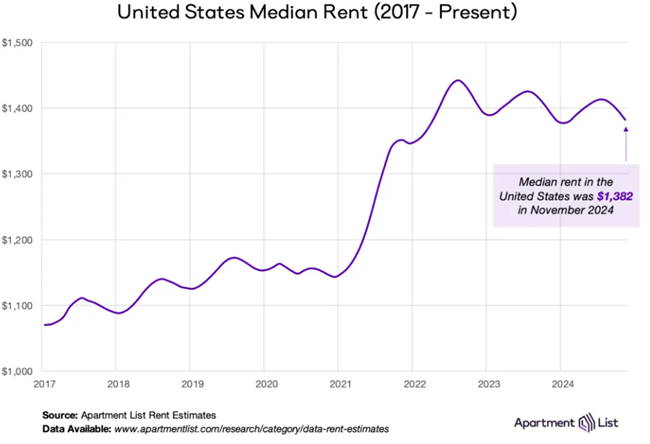
Nationwide rent fell $12 to $1,382, and “we’re likely to see that number dip one more time before the year ends,” the Apartment List research team says.

The analysis says, “The seasonal declines in rent prices that take place during the fall and winter have been steeper than usual and seasonal increases of the spring and summer have been milder. As a result, apartments are on average slightly cheaper today than they were one year ago.”

National rents dipped again in November dropping 0.8% and experts expect them to continue to fall in coming months Apartment List says

What is happening is that the influx of new supply has collided with softer demand over the past two years. This has caused rents to increase modestly during the peak moving season, and have seen more pronounced dips during the off-season.

Still, national rents are $200 a month higher than just a few years ago.

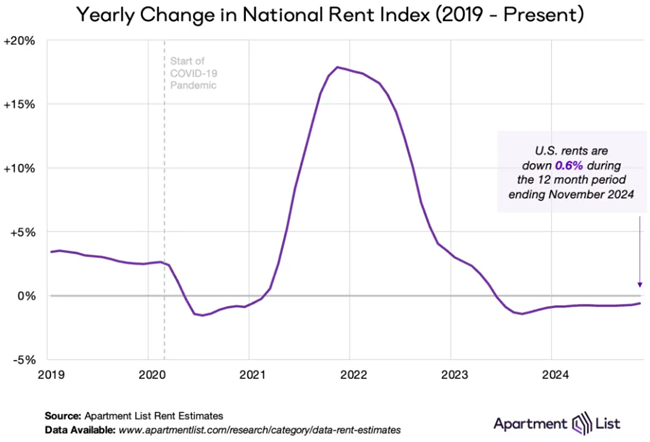
Overall rents are down 0.6% year-over-year as November brought the fourth consecutive and largest monthly dip of the off-season.

In November 88 of the nation’s 100 largest cities saw rents fall, in line with the broader national trend. But on a year-over-year basis, rent growth was negative for just 47 of these cities, as more individual markets gradually return to positive rent growth.

National rents dipped again in November dropping 0.8% and experts expect them to continue to fall in coming months Apartment List says

“We are likely to see continued price dips to close out the year, as property owners offer modest discounts to fill vacancies during a time of year when fewer renters are looking to move,” Apartment List says.

Apartment vacancies remain elevated

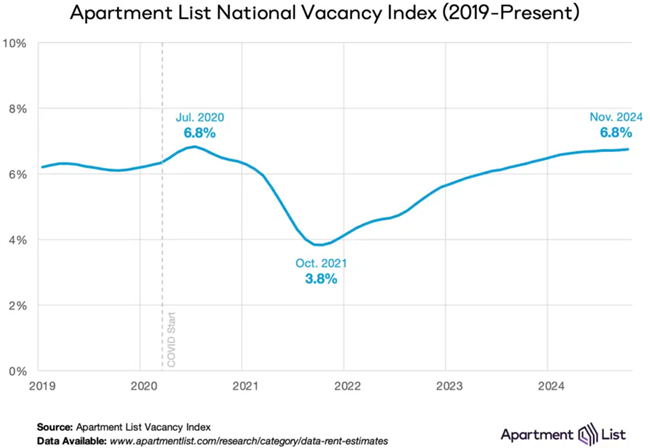
The Apartment List national vacancy index continues trending up slowly and sits at 6.8 percent, the highest reading since the onset of the pandemic

This rise in the vacancy rate is coming on the heels of the strongest quarter for new apartment completions in five decades as 180,000 thousand new apartments hit the market in the third quarter, a 21 percent increase over the previous quarter and the most since 1974.

However, keep in mind vacancy trends can be highly localized.

National rents dipped again in November dropping 0.8% and experts expect them to continue to fall in coming months Apartment List says

Conclusion

Rents should continue to dip for the remainder of the year.

Rent increases are currently being moderated by a robust construction pipeline that has already delivered a decades-high number of new apartment units in 2024, with considerable runway still to go in the boom.

“While rental demand has bounced back a bit this year, recent signs of labor market softness could dampen demand going forward. With this in mind, we expect that new supply will continue to outstrip demand into 2025,” Apartment List researchers say.

Sign Up For Our Weekly Newsletter And Get Rental Property And Apartment News And Helpful, Useful Content Each Week.

* indicates required

Justice Department Sues Rental Property Owner for Sexual Harassment

Justice Department Sues Rental Property Owner for Sexual Harassment

The Justice Department has filed a lawsuit against Joseph E. Johnson the owner and operator of rental properties in Lexington, Kentucky, for engaging in sexual harassment and retaliation in violation of the Fair Housing Act, according to a release.

The lawsuit filed in the U.S. District Court for the Eastern District of Kentucky alleges that, for decades, Johnson has sexually harassed numerous female tenants.

According to the complaint:

  • Johnson has offered housing-related benefits in exchange for sexual contact
  • Made unwelcome sexual comments and advances to female tenants
  • Subjected female tenants to unwelcome touching and groping
  • Taken adverse housing-related actions against female tenants who refused his sexual advances
  • Failed to act when made aware of similar harassing behavior by one or more of his employees.

“For decades, this landlord used his position of power to sexually harass vulnerable women who simply wanted roofs over their heads,” Assistant Attorney General Kristen Clarke of the Justice Department’s Civil Rights Division said in the release. “Women should not live in fear when they pay their rent or seek repairs. The Justice Department will continue to vigorously enforce the Fair Housing Act’s prohibition on this conduct.”

The lawsuit, which is the result of a joint investigative effort of the Justice Department with the Department of Housing and Urban Development (HUD)’s Office of Inspector General, seeks monetary damages to compensate persons harmed by the alleged harassment, a civil penalty against the defendant to vindicate the public interest and a court order barring future discrimination.

“It is unacceptable for landlords to threaten or commit sexual harassment or abuse against tenants,” said HUD Inspector General Rae Oliver Davis. “The defendant allegedly preyed upon vulnerable tenants and retaliated against them when they spurned his sexual advances. My office will continue to work with our law enforcement partners to hold housing providers accountable for this type of horrible conduct.

Sign Up For Our Weekly Newsletter And Get Rental Property And Apartment News And Helpful, Useful Content Each Week.

* indicates required

Can I Charge Tenants For Carpet Cleaning If I Put Down New Carpet?

What to do when tenants move out and leave a carpet cleaning problem in your rental property is the question this week

What to do when tenants move out and leave a carpet cleaning problem in your rental property is the question this week for Ask Landlord Hank. Remember Hank is not an attorney and he is not offering legal advice. If you have a landlord question for him please fill out the form below.

Dear Landlord Hank,

If the previous tenants left stains on the carpet, and haven’t removed the stains.

Can I charge them for cleaning, even if I put new carpet down?

-Faye

Dear Landlady Faye,

If the tenants stained your carpeting and then it should be cleaned and stains removed at their expense.

Carpeting in a rental may have a lifespan of only 5 years depending upon usage, initial quality, pad quality and installation so if this carpeting was at its end of life and you are going to replace it anyway I would not charge the tenants for staining a carpet that you are not going to keep.

Just be fair and treat your tenants like you’d want to be treated.

Sincerely,

Hank Rossi

What to do when tenants have too many vehicles on your rental property and what should the lease say is the question for Landlord Hank
Landlord Hank says, “Just be fair and treat your tenants like you would want to be treated.”

www.rentsrq.com

Ask Landlord Hank Your Question

Ask veteran landlord and property manager Hank Rossi your questions from tenant screening to leases to pets and more! He provides answers each week to landlords.

  • This field is for validation purposes and should be left unchanged.

Each week I answer questions from landlords and property managers across the country in my “Dear Landlord Hank” blog in the digital magazine Rental Housing Journal.   https://rentalhousingjournal.com/asklandlordhank/

Tenant Cut Off Electricity And Moved Early What Do We Do?

Do I Have to Paint and Replace Flooring for a Long-Term Tenant?

Tenant Refuses To Return Keys After Leaving My Rental

A Tenant Poured Grease Down Drain Who Is Responsible?

Sign Up For Our Newsletter And Get Rental Housing And Apartment News And Helpful, Useful Content Each Week.

* indicates required


Ohio Would Make Tenants, Not Landlords, Pay Unpaid Utility Bills

Ohio legislators are considering a bill to make tenants responsible for unpaid utility bills and other municipal bills but cities oppose it

Ohio legislators are considering a bill to make tenants responsible for unpaid utility bills and other municipal bills, and to allow cities to collect unpaid bills directly from renters, according to reports.

Currently, Ohio law allows municipalities to collect overdue utility bills – such as water, sewer and trash – from “an owner, tenant, or other person who is liable to pay the rents or charges.”

One of the bill’s sponsors, Rep. Mark Johnson (R-Chillicothe) said unpaid bills often fall on landlords rather than renters.  “To me, it’s personal responsibility,” Johnson said. “You run up the bill, it’s your job to pay it.”

Johnson said he felt compelled to support the bill after talking with landlords who said they had been hit with utility fees exceeding $1,000 after a tenant had moved away without paying.

“A lot of them (renters) know the law and they do this repetitively and often run up huge water bills because the cities do not go out and valve the water off like your electric company takes your meter if you don’t pay the bill,” Johnson said.

Johnson said the current system does not only negatively affect landlords but can also result in higher costs for tenants.

“It increases rental costs,” Johnson said. “It’s a common business practice. If a landlord is hit with this, they’re going to recover it with [higher] rent for everybody.”

Cities may not be in favor of the bill

However, multiple Ohio municipalities and city water departments are not on board with the bill. Andrea Yang of Greater Cincinnati Water Works said in written testimony that landlords are better positioned than utility entities to manage nonpayment risks through security deposits and tenant screenings.

“[Municipal utilities] have no knowledge or control over the lease terms, including when the tenant has vacated the property, which makes it exceedingly difficult for the utility to pursue unpaid amounts from a tenant,” Yang said.

Sign Up For Our Weekly Newsletter And Get Rental Property And Apartment News And Helpful, Useful Content Each Week.

* indicates required

Seattle Rents Show Steady Improvement with Strong Demand

Demand drove rent growth up in Seattle, according to Yardi Matrix, with advertised asking rents up 1.2 percent year-over-year to $2,216

Demand drove rent growth up in Seattle, according to Yardi Matrix’s November report, with advertised asking rents up 1.2 percent year-over-year to $2,216, outperforming the 0.9 percent U.S. rate as of September.

The occupancy rate also rose, up 20 basis points to year-over-year 95.5 percent, as construction moderated.

Occupancy is also healthy as new construction is absorbed.

“Seattle’s multifamily fundamentals maintained generally healthy performance in 2024, despite ongoing challenges in the financial landscape,” the report says:

  • Seattle employment was good, up 1.1% in the past 12 months.
  • Nearly half of the 27,600 jobs added during the first seven months of 2024 were registered in the education and health services sector.
  • Apartment construction delivered 8,758 units in 2024 through September and had another 22,846 units under construction.
  • Investment activity surpassed last year’s total, amounting to $1.3 billion, with the per-unit price dropping below the $300,000 mark.

Rent growth across the metro

Year-over-year through September Seattle rent growth was positive in 28 of the 53 submarkets tracked by Yardi Matrix. Bellevue–West (up 4.0% to $3,052), Issaquah (up 4.9% to $2,810) and Belltown (up 2.3% to $2,765) were the most expensive.

Overall, 28 submarkets had average advertised asking rents above the $2,000 mark. The largest rent declines were reported in Burien (-2.1% to $1,792) and Greenlake/Wallingford (-2.0% to $2,180).

Read the full report at https://www.yardimatrix.com/Publications

About Yardi Matrix

Yardi Matrix researches and reports on multifamily, office and self-storage properties across the United States, serving the needs of a variety of industry professionals. Yardi Matrix Multifamily provides accurate data on 18+ million units, covering more than 90 percent of the U.S. population. Contact the company at (480) 663-1149.

Sign Up For Our Weekly Newsletter And Get Rental Property And Apartment News And Helpful, Useful Content Each Week.

* indicates required

Suit Charges Large Private-Equity Landlords with Discrimination

A suit charges private equity landlords with discrimination in tenant screening policies through use of arbitrary criminal-history policies

The Fair Housing Center of Central Indiana (FHCCI) and an Indianapolis resident have filed a class action complaint against two private equity landlords Progress Residential and Tricon Residential, alleging discrimination in tenant-screening policies, according to a release.

The complaint alleges discriminatory practices perpetuated by Progress and Tricon against Black renters through arbitrary criminal-history policies. The lawsuit alleges the companies enforce blanket bans on certain justice-involved applicants without assessing individual circumstances, disproportionately affecting Black applicants who are systematically overrepresented in criminal- justice statistics.

NBC news reports the new litigation centers on Tricon Residential, a California-based landlord recently acquired by the Blackstone Group of New York City, one of the country’s more prestigious private-equity firms, and Progress Residential, a landlord owned by Pretium Partners, which is overseen by Don Mullen, a former Goldman Sachs executive.

The suits were brought by the Fair Housing Center of Central Indiana, an advocacy group serving residents of 24 counties in the state. Both Tricon and Progress denied tenant applications based on inaccurate information generated by a third-party screening service, the lawsuits say, and they allege that neither landlord verified the information.

A spokesman for Tricon Residential said in a statement: “Tricon adheres to all fair-housing laws and believes the allegations in this suit are baseless.” The events detailed in the lawsuit occurred before Blackstone purchased the company; a Blackstone spokesman declined to comment. A Progress Residential representative provided this statement: “As a leading professional property manager, we are committed to promoting a fair and equitable screening process for all applicants. Although we do not comment on pending litigation, we take these allegations seriously and are currently reviewing the claims made in the lawsuit.”

Private-equity landlords have bought up large swaths of housing across the country in recent years, acquiring both single-family homes and apartment complexes. Such acquisitions have diminished the supply of affordable starter properties in many communities, research shows. Together, Tricon and Progress own at least 130,000 single-family homes throughout the country, the lawsuit says.

Sign Up For Our Weekly Newsletter And Get Rental Property And Apartment News And Helpful, Useful Content Each Week.

* indicates required

Rents Fell In October As Election Heralds Change

Multifamily and single-family rents fell in October as supply growth continues to delineate the direction of rents by metro

Multifamily and single-family rents fell in October as supply growth continues to delineate the direction of rents by metro, Yardi Matrix says In the Multifamily October Report.

“At the same time, the drop in starts presages another wave of rent growth in 2026 and beyond. Meanwhile, the market has begun to anticipate changes from the new administration in 2025,” the report says.

Highlights of the report

  • As the market prepares for a change of administration and policies, multifamily advertised rents fell $3 in October to $1,748. Year-over-year growth, 0.9% in October, has been range-bound between 0.7% and 0.9% since January.
  • The regional dividing line caused by supply growth continues. In the Matrix top 30 metros, the top 11 metros for rent growth are all in the Northeast, Mid-Atlantic and Midwest, while the bottom nine are all in the Southeast or Southwest, where deliveries are high.
  • Single-family rental rates had their worst performance in years in October, as advertised rents fell $8 nationally to $2,164, dropping the year-over-year growth rate 30 basis points to 0.3%. Like multifamily in general, high-supply markets are feeling a (likely temporary) pinch.

Demand strong as occupancy drops

Through September 2024, 329,000 apartment units have been absorbed, putting the market in line for one of its better recent years.

Supply has grown slightly more than absorption, prompting the U.S. occupancy rate for stabilized properties to drop 10 basis points to 94.7%.

“While it’s too soon to forecast specific policy changes, financial markets braced for higher inflation owing to Trump’s promise to increase tariffs on many imported goods. The 10-year Treasury rate rose 20 basis points to 4.45% during the day after the election. Higher Treasury rates are an impediment to transaction activity and make it more difficult to refinance underwater mortgages,” Yardi Matrix writes in the report.

Read the full report here.

About Yardi Matrix

Yardi Matrix researches and reports on multifamily, office and self-storage properties across the United States, serving the needs of a variety of industry professionals. Yardi Matrix Multifamily provides accurate data on 18+ million units, covering more than 90 percent of the U.S. population. Contact the company at (480) 663-1149.

Multifamily New Construction Supply To Remain Sizable In 2025

Sign Up For Our Weekly Newsletter And Get Rental Property And Apartment News And Helpful, Useful Content Each Week.

* indicates required

Rent Growth Continues in Secondary Markets

Seattle Hires Law Firm To Defend Against Landlord Lawsuit

A Seattle landlord sued the city alleging tenant protection laws passed in the last few years have financially strapped his housing units

The City of Seattle has hired a law firm to defend against a Seattle real estate investor suit alleging the city “destroyed” its ability to sustainably operate an affordable apartment property in the Chinatown International District, according to reports.

The company alleges the city passed ordinances between 2018 and 2022 that hurt its ability to successfully operate a low-income apartment building.

The city has retained the law firm Bryan Cave Leighton Paisner.

The city council has been active the past few years in passing tenant protections such as caps on move-in fees, first qualified applicant rules, eviction rules, lease renewals and tenant screening rules.

Goodman Real Estate, through a subsidiary that owns a 254-unit apartment building near Fourth Avenue South and South Jackson Street, filed the lawsuit, calling for unspecified financial damages and a change to city regulations.

“Our goal is to create the highest level of quality affordable and sustainable housing in downtown Seattle for our residents,” CEO George Petrie said in a statement, “but the city has placed so many restrictions on our ability to do that, it is placing our residents at risk.

The lawsuit alleges the tenant protection laws have forced the building to accept tenants who caused safety issues, added new maintenance and security costs, increased tenant and staff turnover, limited evictions and discouraged rent increases that might help cover the increased costs.

The suit claims this is a “taking” of the landlord’s property.

Sign Up For Our Weekly Newsletter And Get Rental Property And Apartment News And Helpful, Useful Content Each Week.

* indicates required

Salt Lake City Ranks As A Top Place For Landlords In 2025

Salt Lake City ranks as a top place for landlords and real estate investors as they are looking to identify the 2025 most promising markets

Looking ahead to the real estate landscape of early 2025, landlords and property investors are looking to identify the most promising markets and Salt Lake City and Phoenix rank high as great places for landlords.

Laure Beck with MSN writes, “ While our previous analysis of the best cities for landlords in 2024 provided valuable insights, the dynamic nature of real estate means new opportunities are always emerging.”

Seamus Nally, CEO of TurboTenant, puts Salt Lake City in the spotlight. “Salt Lake City is a pretty great city to be a landlord,” he said.

“There are minimal rent control regulations and pretty relaxed landlord laws, plus homeowners insurance costs are well below the average,” Nally added. “A lot of Salt Lake City landlords actually benefit from the demand, as it frequently leads to bidding wars.”

Along with Salt Lake City, other cities in the top list for landlords in 2025 are Columbus, Ohio, Phoenix, Nashville, Charlotte and Denver.

While these cities show promise, it’s important to remember successful real estate investing requires more than just picking the right location. Derrick Barker, CEO of Nectar, is all about making sure you have good people around to help out. “Surrounding yourself with the right team — real estate agents, mortgage brokers, property managers and contractors — makes all the difference,” he said.

Phoenix also a top place for landlords in 2025

Sebastian Jania, owner of Ontario Property Buyers, sees Phoenix as a hot spot for landlords. “Phoenix also offers a robust employment market and a cheap cost of living, which draw more and more individuals to the region.

For landlords, this means a constant flow of prospective tenants and a low vacancy rate,” he explained.

The article originally appeared on GOBankingRates.comBest US Cities To Be a Landlord in Early 2025.

Rents Fell In October As Election Heralds Change

Sign Up For Our Weekly Newsletter And Get Rental Property And Apartment News And Helpful, Useful Content Each Week.

* indicates required

photo credit f11photo via istockphoto

Navigating Unreasonable Accommodation Requests

Unreasonable accommodation requests require special navigation of the issues by property managers to stay compliant with fair housing laws

Unreasonable accommodation requests require special navigation of the issues by property managers who want to stay compliant with Fair Housing laws and find fair solutions.

By The Fair Housing Institute

The Fair Housing Act (FHA) requires property managers to provide reasonable accommodations for residents with disabilities to ensure equal access and enjoyment of their homes. However, not all requests are deemed reasonable.

Understanding how to navigate accommodation requests that may be considered unreasonable is essential for property managers who want to stay compliant with the law while also effectively managing their property.

What Makes an Accommodation Request Unreasonable?

An accommodation request is considered unreasonable if it places an undue financial or administrative burden on the property or fundamentally alters the nature of the property’s services. Determining whether a request is unreasonable requires property managers to assess several factors, including cost, available resources, and the impact on the property’s operations.

For example, a request for extensive structural modifications, such as installing an elevator in a small two-story building, may be deemed unreasonable due to the significant financial burden it would impose. Similarly, requests for personal services, such as requiring property staff to provide daily care for a resident, can be classified as unreasonable because they fundamentally alter the services typically provided by housing providers.

Examples of Unreasonable Accommodation Requests

  • Undue financial burden: A resident requests modifications that require extensive construction, such as widening all hallways in a property to accommodate a larger wheelchair. For smaller properties with limited budgets, this request could impose an undue financial burden.
  • Administrative strain: A resident asks for a 24/7 on-call maintenance service to accommodate their needs. This request could be considered unreasonable because it would require significant staffing adjustments that may not be feasible for the property-management team.
  • Fundamental alterations: A request that requires the property to provide services beyond its typical offerings—such as providing specialized transportation or personal caregiving—is often classified as unreasonable. Property managers are not required to alter the fundamental nature of their operations to accommodate a resident.

The Interactive Process: Finding Alternatives

Even when a request is deemed unreasonable, property managers should not simply deny it and move on. Instead, the Fair Housing Act encourages managers to engage in an interactive process with the resident. The goal of this process is to explore alternative accommodations that meet the resident’s needs without imposing an undue burden on the property.

For instance, if a resident requests a modification that is too costly, such as installing a ramp at every entrance of the property, a reasonable alternative might be to install a ramp at one entrance that is accessible to the resident. Engaging in this kind of dialogue not only shows a willingness to accommodate but also helps ensure compliance with fair-housing regulations.

The interactive process should be approached with empathy and a genuine desire to find a solution. Documenting every conversation and action taken is critical, as it demonstrates that the property manager made an effort to accommodate the resident in a fair and reasonable way.

Consistency is Key

Property managers should establish consistent criteria for evaluating accommodation requests to maintain fairness and compliance with fair-housing laws. Every request must be assessed individually, but having clear guidelines helps ensure that decisions are made fairly and objectively.

Consistency can be maintained by:

  • Creating written policies: Establishing clear, written policies regarding accommodation requests helps set expectations for residents and provides a consistent framework for property managers to follow.
  • Training staff: Regular training on fair-housing requirements and the process for evaluating accommodation requests helps ensure that all staff members understand how to handle such requests consistently.
  • Documenting decisions: Keeping detailed records of each request, the evaluation process, and any follow-up discussions or alternative accommodations offered is crucial. Documentation helps protect the property from liability if a resident claims their request was unfairly denied.

Best Practices for Navigating Unreasonable Requests

Engaging in dialogue with residents is crucial, even when a request seems unreasonable, as it helps to understand their needs and may lead to a minor modification or adjustment that resolves the issue without undue burden.

Being transparent is also important—communicating openly about why a particular request may be considered unreasonable helps set realistic expectations and prevents misunderstandings. If a request cannot be granted, offering alternative solutions demonstrates a willingness to work with the resident and can help avoid potential fair housing complaints.

Additionally, consulting legal counsel specializing in fair housing is advisable if there is any uncertainty about the reasonableness of a request or how to proceed.

Conclusion: Striving for Fair Solutions

Navigating unreasonable accommodation requests can be challenging, but by engaging in the interactive process, maintaining transparency, and striving for fair alternatives, property managers can create a more inclusive community while managing their responsibilities effectively. The key is to treat each request with care, document all actions, and remain committed to finding reasonable solutions wherever possible. By doing so, property managers not only uphold fair housing principles but also foster a community of trust and mutual respect.

About the author:

In 2005, The Fair Housing Institute was founded as a company with one goal: to provide educational and entertaining fair-housing compliance training at an affordable price at the click of a button.