Home Blog Page 192

HUD Warns California Landlords To Comply With Lead Regulations

Lead regulations and HUD warning to California rental property owners

The U. S. Department of Housing and Urban development has issued notices of violations against the owners of eight HUD-assisted properties throughout California for violations of HUD’s lead regulations and safety rules, according to a release.

“Landlords have a responsibility to ensure the homes they rent to their tenants are safe and healthy places to live,” HUD Secretary Ben Carson said in the release.

“These rules are designed to protect families and their young children from the preventable dangers associated with lead poisoning.”

These latest enforcement efforts are part of HUD’s Protect Our Kids! campaign, which was announced by  Carson in June. This enforcement campaign is working to ensure that all federally assisted homes are lead-safe and that landlords of older homes are fulfilling their responsibilities to disclose lead-based paint hazards in their properties.

Lead regulations

HUD’s enforcement campaign seeks to ensure compliance with the Lead Disclosure Rule and Lead Safe Housing Rule, which are intended to reduce the potential of lead poisoning in children in both privately owned homes and those that receive federal assistance.

Under HUD’s and the Environmental Protection Agency’s (EPA) Lead Disclosure Rule, most landlords and home sellers of homes built before 1978 are required to inform tenants and purchasers of any known lead-based paint or lead-based paint hazards in the home. HUD’s Lead Safe Housing Rule requires providers of most pre-1978 housing that is federally owned or receiving Federal assistance to make certain their units are lead safe.

As part of the Protect our Kids! campaign, HUD is taking the following actions to ensure compliance with these rules:

    • HUD issued a Pre-Penalty Notice to S&J II Ltd., the owner of S&J Limited II, a 73-unit HUD-assisted housing complex in Los Angeles. The owner knew that the property contained lead-based paint but failed to disclose this to tenants and failed to conduct necessary risk assessments and re-evaluations of lead-based paint hazards. The owner of the property is potentially liable for up to $506,924 in civil money penalties for failing to comply with its obligations under the lead regulations and safe housing rule and lead disclosure rule.
    • HUD issued a Pre-Penalty Notice to Harrison Bryant Kearney Cooley Boulevard Plaza, Inc., the owner of Kearney-Cooley Plaza, a 139-unit HUD-assisted housing complex in Fresno, California. The owner of the property failed to conduct risk assessments and re-evaluations of lead-based paint hazards and is potentially liable for up to $165,984 in civil money penalties for failing to comply with its obligations under the lead regulations and safe housing rule.
    • HUD issued a Pre-Penalty Notice to Oak Center Homes Partners LP, the owner of Oak Center Homes, an 89-unit HUD-assisted housing complex in Oakland, California. The owner of the property failed to conduct risk assessments and re-evaluations of lead-based paint hazards and is potentially liable for up to $165,984 in civil money penalties for failing to comply with its obligations under the lead safe housing rule.
    • HUD issued Pre-Penalty Notices to the owners of five (5) HUD-assisted housing complexes in Oakland, Los Angeles, San Diego, and Fresno, California. The owners of these properties failed to produce documentation to HUD demonstrating compliance with the lead safe housing rule in violation of their contractual obligation to produce such records. The owners of these properties are each potentially liable for up to $203,380 in civil money penalties for failing to comply with the lead safe housing rule and failing produce records as requested by HUD.

If you have a tip or complaint or require additional information about the Lead Disclosure Rule or the Lead Safe Housing Rule, contact us at leadregulations@hud.gov or call our information line at 202-402-7698; if you are deaf or hard of hearing, or have speech disabilities, teletype us at (800) 877-8339.

To support these local efforts, and to expand the public’s awareness about the dangers of lead, HUD developed a toolkit that underscores the importance of lead testing and provides tips on how to prevent lead poisoning. Learn more about National Healthy Homes Month 2018 and ways you can protect your children from lead and other home health and safety hazards.

5 Multifamily Investing Predictions And Expectations For 2020

Rental Housing Maintenance Company Keepe Comes To Portland

4 Ways to Reduce Rental Property Maintenance and Repair Costs

A new rental housing maintenance company is up and running in Portland to lend an extra maintenance hand to property managers trying to keep up with tenant repair requests.

Keepe, a maintenance company which is already in Seattle, San Francisco and other markets, said they chose Portland as their next city to enter after being asked by some of their existing customers.

“What really turned us on to Portland, was having a few key players that ended up lobbying us,” Liz Koser, head of business development said in an interview with Rental Housing Journal.

“We received phone calls saying, ‘Hey you should really come to the Portland market. You’re already in the Seattle, in the Bay Area, we really have a need here.’  We were told if we come to Portland, we’ll have automatic customers, that we would have introductions to some of their boards, and so the lobbying effort made the difference,” Koser said.

3 reasons the rental housing maintenance company chose to focus on Portland

    • “We have some existing customers that have portfolios in Portland. They are betting their future right now on the Portland market. They see it as a market with growth potential. Seattle and the Bay Area might be on the higher end already. Portland has the growth potential,” Koser said.
    • Then, the clear supply and demand need. “There is low supply, high demand and that’s a perfect equation for us.”
    • Traffic.”Portland has a lot of traffic. So using an app-based system for us, we’re bringing efficiency to the table here for everyone involved, both the contractors and the property managers,” she said.

“We work closely with Multifamily NW, which is probably the largest of the associations,” Koser said.  We have worked with the National Association of Residential Property Managers (NARPM)and met the NARPM president and others through the Washington State conference. “

What are the big rental housing maintenance issues in Portland?

“I have heard that plumbing is a big pain point. And tree roots – that’s been a big problem in the Portland area with older pipes,” Koser said.

“And I think the fact that there’s traffic running through several key bridges is an issue,” she said which creates transportation bottlenecks.

“This isn’t necessarily a maintenance-specific issue but getting contractors from point A to point B” is an issue she said.

Also, “I think there are a lot older buildings in Portland. Both older homes and older apartment buildings. And there’s an effort to update buildings, which takes capital expenditures, as well as just the day-to-day maintenance involved.”

She said the maintenance company started its rollout in Portland earlier in June to provide rental housing maintenance.

“We went to the Portland NARPM chapter meeting and we visited four potential accounts and actually all four were onboard for signing up with Keepe. And we already received a couple of jobs.

“So, in terms of getting new customers on board I think this has been the fastest path we’ve had so far. Part of that is that we had some warm introductions into the market being a Seattle-based company,” she said and added the company plans to be at the Spectrum 2018 Educational Conference and Trade Show in September.

Hiring and partnering with contractors and rental housing maintenance personnel

Rental Housing Maintenance Company Comes To Portland

“We have a number of contractors already signed up as keepers,” said Rishi Matthew, Founder and CEO of Keepe. “Any time they become active on our network, we call them keepers and they are all licensed. They are all insured.

“We run background checks on them so we know that they are high-quality. And our goal is to make sure that there are enough property management companies and enough contractors to make those projects go successfully. They both need each other” to make rental housing maintenance work right he said.

“Property managers want enough technicians so that their work orders are completed fast and the maintenance techs need a lot of property managers to hand them jobs so that they can keep themselves busy. Keepe makes that marketplace work smoother and faster,” Matthew said. “The managers are pretty much our only audience at this point. Everybody else is kind of secondary. So, we focus pretty much on property management.”

Matthew said some property management companies might have “one maintenance tech or two maintenance techs but it doesn’t make any sense for them to keep hiring” when Keepe can handle the extra rental housing maintenance requests.

“And it’s not just about the hiring. It’s also about the retention of the employees,” Matthew said. ”As they (employees) decide to move on, the property management companies are having to spend a lot of time just recruiting instead of getting the appointments taken care of. And so with Keepe, they have this network. We expand their network of available maintenance techs and we also take care of the quality level.

“So, keeping the high quality technicians on the network and then weeding out the bad ones is what we can do for the property managers. They don’t have to do it for themselves and they don’t have to do it on a scale of one and two. We do it at the scale of hundreds,” Matthew said.

Koser added, “In the multifamily space I think, in general, they are having trouble recruiting maintenance techs and so that creates demand for a maintenance company like Keepe.

“Even beyond the current high demand, the Keepe model has made sense for the apartment buildings that might be in the sub-hundred unit range, where it might not make sense to have a maintenance tech at every property. So then you end up with the problem of driving from one location to the next and lose efficiency that way.

“When you have an employee, there’s a certain amount of overhead that goes with that. So at Keepe, we’ve been able to play a factor in helping companies grow their portfolio as well because they can scale up with Keepe and they can add techs” as they need.

“And in some cases, they’ve decided not to move forward with hiring maybe their fourth or fifth tech for a nine-building complex where you’re talking about hundreds of units. They might decide that two techs is enough and using Keepe can handle the rest. So, it has changed that hiring decision process,” she said.

On-demand solution and communication with tenants and property managers on repairs

“At Keepe, we are on the quick side,” Koser said. “We solve the quick problem in that we are an on-demand solution.”

Koser gave the example of a Portland property manager who asked about a roof leak and some other maintenance issues and said, “Is this going to be one week, two week turnaround?”

“I said ‘No, we can get it done today or tomorrow. We can have someone out to look at it.’ So we definitely solved this issue with utilizing technology to match people efficiently.

“On the communication front, our default for scheduling with tenants is via text message. So, tenants can select a time via text. We do all our confirmations for the tenant via text message except for the call that comes half an hour to forty-five minutes before arrival. The contractor will reach out. But all other communication is via text message.

“On the property manager side, we give them email notifications letting them know when the job’s been scheduled, when it’s been completed, and so they get regular status updates as well,” Koser said.

“Portland is our fifth metro,” Matthew said. The company is also in Phoenix and San Diego. “So we’ve gotten a lot better at going into new cities and being able to successfully on board with contractors and property managers. We are super excited about Portland. We love the city and we’re excited to be here.”


Potential Regional Multifamily Supply Overload In Key U.S. Housing Markets

Outsize multifamily deliveries and development activity in some major metros could increase vacancy rates and stagnate rent growth, according to a new report by Yardi® Matrix focusing on regional multifamily supply in some key U.S. housing markets.

Yardi Matrix conducted a study to determine which areas might be at risk of oversupply or undersupply over the next five years.

The research revealed that deliveries in 2016 and 2017 helped compensate for the construction shortage in the wake of the great recession.

Multifamily supply research key points

    • With significant supply expected to be delivered over the next two years, multifamily deliveries may outpace demand in some of the top 30 metros in the U.S. Expect volatility, as some markets and submarkets with outsize development activity experience rising vacancy rates and stagnating rent growth.
    • In the near term, markets at risk of oversupply include Denver, Seattle, Charlotte, Dallas, Phoenix and Miami, where deliveries are expected to outpace demand. Investors and developers can still find attractive deals in those markets, but submarket and sites election will become even more important.
    • The converse holds true in markets where supply and demand appear to be in balance. In many markets, the majority of development is taking place in the urban core, which may create opportunities in growing and urbanizing suburban areas.
    • Over the longer term, the supply picture is more balanced. We expect construction will moderate after the more than 600,000 units currently under construction are completed.
    • Most of the metros that are at short-term risk of oversupply have strong economies and healthy multifamily demand, so units coming online should be absorbed by growing populations. Plus, developers will pull back the throttle if occupancy rates wane much.
    •  Metros with the most deliveries relative to projected demand long term include Seattle, Charlotte, Dallas and St. Louis. Metros with the most favorable demand/supply metrics include Los Angeles, the Inland Empire, San Diego, Houston and Chicago.

      Regional multifamily supply

“Most of the metros that are at short-term risk of oversupply have strong economies and healthy multifamily demand, so units coming online should be absorbed by growing populations,” the report concludes.

Markets and submarkets with outsize development activity, however, “can expect volatility” that will give rise to higher vacancy rates and stagnant rent growth. Achieving market equilibrium going forward will require developers to “intelligently calibrate the amount and location of new projects” to accommodate finite demand.

Read the full report here:  “U.S. Multifamily Supply and Demand Forecasts by Metro” to learn more about homeownership, population shifts, social trends and other factors affecting the multifamily market.

Yardi Matrix offers comprehensive market intelligence tools for investment professionals, equity investors, lenders and property managers who underwrite and manage investments in commercial real estate. Yardi Matrix covers multifamily, industrial, office and self storage property types. Email matrix@yardi.com, call 480-663-1149 or visit yardimatrix.com to learn more.

About Yardi

Yardi® develops and supports industry-leading investment and property management software for all types and sizes of real estate companies. Established in 1984, Yardi is based in Santa Barbara, Calif., and serves clients worldwide. For more information on how Yardi is Energized for Tomorrow, visit yardi.com.


Portland Multifamily View At Midyear 2018 And Outlook

Here is a look the Portland multifamily activity half way through 2018 and the forecast going forward.

By Greg Frick

HFO Investment Real Estate

We anticipate a lack of on-market product even though significant capital remains available for investment.

With rent growth slowing, potential changes to landlord-tenant laws at the city and state level, and recent federal tax changes—many owners are taking a wait-and-see attitude.

Permits and housing not meeting demand

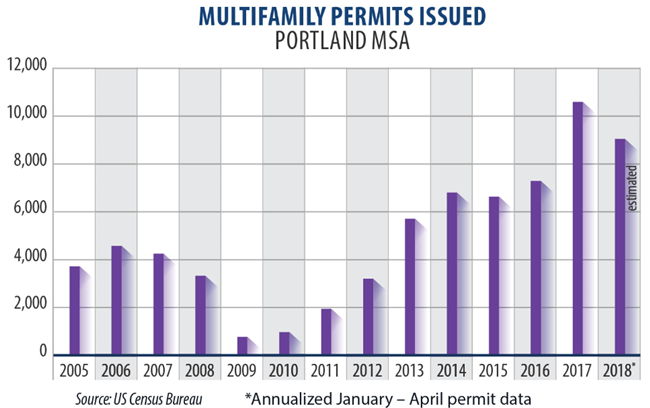
Permits have risen steadily from a low of 1,007 units permitted in 2009 to 10,319 in 2017. Despite this, experts say housing has not accelerated enough to meet anticipated demand.

Meanwhile, amid Greater Portland’s housing and affordability crisis, the Portland City Council implemented inclusionary zoning (IZ) on February 1, 2017. Since then, permit applications in the City of Portland have dropped significantly. Of an estimated 25,000 affordable units needed, only 170 units have been permitted under the IZ guidelines.

Publicly, city leaders appear unconcerned by this drop-off in permitting activity—citing a pipeline of approximately 19,000 market-rate pre-IZ units. It will be interesting to see how many projects that were permitted pre-IZ will be shelved as a result of increased cost of labor and materials.

Vacancies up slightly in Portland multifamily

Since 2015, there has been a significant increase in vacancies—but remains below five percent.

Portland multifamily

Concessions appear largely in Class A close-in projects. Portland has new supply that has yet to be absorbed.

Portland multifamily rents per square foot

For the first time since 2009, rents were basically flat in April over a year earlier according to Multifamily NW.

Meanwhile, the national data firm REIS pegged Portland’s calendar year 2017 rent growth above three percent.

Portland multifamily transactions

Portland saw high transaction volume in 2017, but not as high as in 2016. Much of that has to do with institutional properties above $10 million. There were 51 institutional transactions in 2016 compared to 37 in 2017.


On the private client side—properties valued at less than $10 million—we saw only a slight decrease in transactions from 2016 to 2017. Trends for 2018 appear more or less flat but cannot yet be reliably identified.

Government activity and Portland multifamily

Recently, the City of Portland began requiring all landlords to pay tenant relocation fees ranging from $2,900 to $4,500 based on unit size.

This fall, the city council will vote on adopting a warning notice to be posted on unreinforced masonry (URM) buildings, and next June will vote whether to require seismic retrofits. Portland has budgeted funds for a landlord registry, and Commissioner Chloe Eudaly has proposed adoption of a mandatory—and contentious—tenant screening assessment.

Regional government

Greater Portland’s metro government is under pressure to expand the area’s urban growth boundary and appears more willing to do so than in years past.

State government may take up ending rent control and no-cause evictions

When a new Oregon legislative session begins in early 2019, rental property owners will face a legislature composed of members more inclined than ever to scrap the state ban on rent control and to perhaps end no-cause evictions.

About Greg Frick:


portland multifamily Greg Frick

Greg Frick is a partner with HFO Investment Real Estate, now celebrating its 19th year in business. HFO has brokered over 25,000 units valued at $2.5 billion throughout Oregon and Washington. Greg works with both private market and institutional clients and can be reached directly by phone at (503) 241-5541 or e-mail at greg@hfore.com.


4 Reasons HVAC Should Be Top Of Your Maintenance List

HVAC System Ready For Spring

Air conditioning, ventilation and heating, referred to as HVAC,  issues top the maintenance list for many property managers who say it is the No. 1 issue they have to deal with. And, the No. 1 issue that leads to the most tenant complaints, so this week the maintenance checkup from Keepe takes on this issue.

Here are four reasons heating, ventilation and air conditioning (HVAC) should be at the top of your maintenance list, and five best practices to keep everything running smoothly.

Tenants react more quickly to the lack of cooling or ventilation than some other maintenance issues, so it makes sense to stay on top of this issue and avoid tenant complaints.

No. 1 – Health and legal obligations

In most states, existing laws establish that rental properties must have proper ventilation and heating. The law states the property’s owners and/or managers are in charge are responsible for guaranteeing that.

A rental space that is properly ventilated pushes mold, moisture, odors, hazardous gases, dust mites and other toxic airborne pollutants outside and keeps them from becoming stagnant indoor hazards. These pollutants can cause severe breathing problems/infections or even death to those exposed.

Providing acceptable indoor heating is necessary and mandated by the law. Landlords are obligated to ensure that tenants are living in heated spaces.

Tenants are entitled to working air conditioning

While these laws to not apply to air conditioning – in most states, air conditioning is considered an amenity and not a required service that must be provided.

However if you are providing air conditioning in some states, like Arizona, then Under Arizona’s Residential Landlord and Tenant Act, air-conditioning is considered an “essential” need, much like water. It is the landlord’s responsibility to fix the problem — usually within 48 hours after the tenant has complained

No. 2 – Bills and operating costs

HVAC systems that are not properly maintained will suffer significantly more as they experience greater wear and tear.

Worn systems are strained – they require the same amount of energy to run (or more) but their performance is reduced, resulting in increasing operating costs while their actual output is not meeting expectations.

In the long run, investing in more efficient systems or in the scheduling of regular servicing allows to actually save a considerable amount of money.

No. 3 – Protecting your investment

HVAC systems are not cheap to purchase and install. Proper maintenance is necessary to ensure they are long-lasting.

They can last up to a decade when maintained.

No. 4 – Peace of mind and avoid maintenance emergency

HVAC systems that have not been maintained are worn and thus strained and prone to breakage.

This makes them immensely more likely to suddenly stop working.  And that, can create tenant issues along with inconvenient, costly and stressful  maintenance emergencies.

5 best practices for an HVAC maintenance list


4 Reasons HVAC Should Be Top Of Your Maintenance List


Created by Evening_tao – Freepik.com

The following five tips outline the best practices for keeping your HVAC systems in optimal working condition, and avoid the headaches discussed above.

    • Trust your instincts. If you – or your tenants – are able to notice that something does not feel right, it’s always a good idea to take it seriously. Follow up and investigate.  Is the HVAC system suddenly more noisy than usual? Is the heating slower or spotty? Are air flows weak? Do you smell weird odors, especially musty ones? If any of these things are going on, it’s best to call an HVAC professional right away to sort out whether there is an issue that should be addressed and the space is safe.
    • Schedule regular maintenance. HVAC professionals are loud and clear when it comes to scheduling maintenance/servicing. Heaters should be checked up every fall. Air conditioners every spring, no excuses. This allows  a professional to determine whether the HVAC at your property is running as best as it can, suggest ways for improving efficiency, and most importantly, warn you about potential issues that you were not aware of. Studies have found that up to 95% of all HVAC emergencies could have been avoided if owners had scheduled the recommended seasonal checkups.
    • Regularly replace air filters. Air filters should be replaced every 30 to 90 days. Check monthly for any stuck debris or clogs. Households with pets or numerous cohabitants require more frequent changes. Air filters directly contribute to the overall air quality – and thus safety – of the space as they literally filter out impurities and pollutants. Regularly switching used filters with new ones secures proper air flow, which contributes to the working efficiency of you HVAC system. A system operating with clogged or dirty vents can be as much as 50% less efficient.
    • Monitor vents and outside units.  It’s important to remind tenants that visible indoor vents should not be blocked by furniture or other items. They should regularly cleaned and/or dusted to prevent buildups (dust and various debris are then re-circulated within a space). Outside units need even more care. They should not be obstructed by trees and shrubs, and should be checked regularly to ensure that dirt, leaves and other debris is not inhibiting air flow. Our professionals suggest seeking advice from a professional HVAC company on how to perform safe and effective cleanings, which can then typically be performed without needing to hire added help.
    • Ductwork inspections. If your property has ductwork, it should be regularly inspected by a professional. Over time, ducts can become coated in, and even clogged by dust and other debris. They can contain dust mites and other pests. Leaks can also develop, which require sealing to avoid air to escape. Professional HVAC technicians can take care of cleaning and duct sealing, which ensures the HVAC system is performing efficiently and safely.

Most HVAC repairs are caused by poor or lacking maintenance. Our expert HVAC technicians encourage you to invest in regular checkups to keep your HVAC systems running smoothly, for as long as possible.

Summary:

Indoor heating, ventilation, and air conditioning (HVAC) are controlled by technologies that specifically work to provide safe air quality and comfortable temperatures for living spaces.

For property or maintenance managers, making sure that HVAC systems are working efficiently should be a priority. Failing to adequately check and upkeep HVAC systems can not only directly lead to costly maintenance emergencies and uncomfortable, angry tenants, but also potentially implicate legal action from those who feel that management has allowed them to become exposed to poorly ventilated/heated spaces.

Other recent rental property maintenance Keepe posts you may have missed:

4 Outdoor Flooring Options For Your Rentals

20 Easy, Affordable Maintenance Projects To Update Your Rentals

Keepe is an on-demand maintenance solution for property managers and independent landlords. The company makes hundreds of independent contractors and handymen available for maintenance projects at rental properties. Keepe is available in the Greater Seattle area, Phoenix, San Francisco Bay and San Diego areas.


Property Managers Challenged By Renters Thin, Limited Credit History

Credit Reporting and the CARES Act

Property managers have a lot of balls in the air and many problems to deal with, but potential renters with thin, limited credit history is one of the bigger issues.

In a survey across all geographic areas of the country conducted by MMR Research Associates, Inc. earlier this year on behalf of Equifax, the company received feedback from nearly 200 nationally-based landlords and property managers of varying size apartments.

Respondents were asked about the pain points they experience in areas such as screening processes and online payments and how they rank them on level of importance.

According to the results, most managers expressed a range of issues with tenant screening that seem to cause the most grief. These included verifying income and employment, uncommitted potential tenants, renters thin limited credit history files, prior landlord verifications, unclear credit reports and fraudulent information all ranking as above average issues and problems.

Landlords rank thin credit history as problem 77 percent of the time

“One of the things we certainly saw as one of the largest pain points for sure was that thin or limited credit history, Tyler Sawyer, Vice President, Rental and Real Estate Sector, Equifax, said in an interview about the survey.

“In fact, that came in as our second – just by a hair – pain point as you take a look at all the different managers. It was mentioned about 77 percent of the time. They’re dealing with that as a very significant issue and it has a number of ramifications associated to it,” Sawyer said.

Casual callers who waste landlord and property manager time

“One of the other things that we saw that seemed to resonate with everybody was that there’s a lot of casual callers and there’s a lot of folks that are not showing up for properties,” Sawyer said.

“Quite frankly, I’m not sure that’s too surprising, but that was really number one and number three. Number one being the casual callers just wasting a lot of time.

“You know how busy these people are, trying to run around and handle all their properties and their tenants. And, to have to deal with potential tenants who aren’t necessarily showing up, or just going fishing.”  He said property managers “found that to be a very challenging part of the process as well as, obviously, just not showing up at the property itself. Those are all very closely related to one another.”

Getting job verification from employers is a struggle

“One of the other areas that we saw is, they really struggle with obtaining job verification with employers,” Sawyer said.

“There’s a number of different solutions that we’ve seen and are a part of as well, but they really said about 50 percent of the time they’re really struggling with that process. It seemed like some of that had to do with time, that in many cases it’s taken five to 10 days to be able to get this information back. It could be automated and really help people make decisions a lot faster. But it really became a problem with a lot of them,” Sawyer said.

Renters thin, limited credit history and the need for cosigners

“We saw a lot of them saying that they’re really having a hard time finding a cosigner, which surprised me,” Sawyer said. “But we’re finding that around 45 percent of the time tenants are really having a hard time trying to find that cosigner.

“In scenarios where you’ve got thin credit history or you’re having struggles with trying to find some sort of job verification or employee or income,that can be very challenging. That could really be the difference between somebody getting into a property and not getting into a property,” he said.

The survey was broken down this way across the country:

    • 35 percent South
    • 14 percent Northeast
    • 24 percent Midwest
    • 28 percent West

Women were the majority of landlords and property managers in the survey

Property Managers Challenged By Renters Thin, Limited Credit History

“We did find that the majority of the landlords and property managers we’re dealing were female, just a little bit over 70 percent were female,” Sawyer said.

He added the survey was also spread out in terms of companies’ annual revenue.

“We really broke it up between a couple of different areas. Less than $10 million and over $25 million. We found that the majority of them, about 59 percent,  were under $10 million, but it was really spread evenly.

“We started the process through a qualitative exercise, where our focus was really centered around the process of getting somebody into a home,” Sawyer said.

“Our goal here is to be able to put people in homes and certainly make sure we’re putting them in the right ones. We really explored what that process is all about, and not so much what happens once they’re in there, what are some of the challenges that we’re dealing with? We didn’t capture any of those types of data, but I can absolutely see that being a problem, especially having been a landlord myself in my past.”

Summary: Prioritizing solutions from the survey

“Considering that renters thin, limited credit histories really popped to the top in a very powerful way, we then looked underneath the covers a little bit to see what are some of the issues associated with it. Then, what we can we do to help with the short and long term,” Sawyer said.

“In addition to the issues with thin or limited credit, they’re dealing with things like requiring a larger deposit or a cosigner. But we’re also taking some additional time to try and figure out whether or not this tenant can come on board.”

Tenant decline rate of 26 percent is unfortunate

Sawyer said the survey shows landlords and property managers are “doing things like reviewing previous rental payments. They’re taking a look at a deeper insight into income and employment. What we found also is that 26 percent of the time, they’re just getting declined.” He said going deeper into a potential tenant’s credit history can sometimes make a difference.

“If we go back to what we want to be able to do, which is put people in homes, that decline rate is unfortunate, especially because a lot of those thin or limited credit people absolutely have a background as far as paying their bills, positive or negative, but some of our initial analysis we’re finding in a positive way, to be able to make a decision.

“That really does bring us to some of those opportunities that we saw. Really, the first the one that we’re taking a look at is to raise that thin credit or limited credit into something a little bit more palatable through the ingestion of additional rental payments,” Sawyer said.

Past rental payments may not make it on to tenant credit history reports

“What we found and I’m sure you’ve heard elsewhere, is that a lot of rental payments don’t make its way into a credit report. Us and our competition. We’re all looking to try and solve that.

“We have a team who is dedicated to trying to continue to expand our assets of bringing in rental payment information that will work its way into the credit reports.

“When you’re dealing with people who are paying their rent – the number one priority maybe outside of food – it’s important that gets recognized. The landlord is going to make a decision based off of whether or not they’re paying their rent first and foremost.  The fact they might not pay their credit card comes into play, but rent is key. That’s one area that we are spending some more time on,” Sawyer said.

“There’s a lot of ways by which we’ll be able to collect data, but I think one of the key areas is by working with property management firms and being able to collect it in a very confident and confidential manner.”

He said New York City is “working on a program where in both scenarios, they have goals of being able to bring additional rental payment information into the credit file, because what they found is that a majority of the time, it is enhancing to the credit file. How they go about doing it, through an opt-in program or a certain selection criteria is still being determined by those certain authorities, but we certainly have found that the majority of the time, it does come up positive.

“We’ve done some of our own analysis as well to see what the correlation is there, but certainly, having the insights, which we believe so strongly in just to make sure that people are matching up just the right way is key and critical.

He said trying to fill in rental payment information is one thing, “but we have access to some other information that is fairly unique within the industry.  We’re also trying to drive out other pinpointed solutions to the thin credit environment that we think will differentiate us in a very positive way and provide insights into other key components to what people are paying for,” Sawyer said.

About Equifax Multifamily Solutions:

Equifax delivers speed, security and confidence through a suite of solutions that address rental and multi-family industry challenges. With the US population continuing to shift towards renting, it is important for property managers to know to whom they are renting so they can assess ability to pay and help protect themselves from fraud.

Soft Credit Pulls Help Property Managers Attract Better Applicants

What Is The No. 1 Reason Renters Move?

Jobs in locations with strong economies are the main reason renters move, according to a survey of more than 10,000 renters from across the country.

Sydney Bennett, Senior Research Associate at Apartment List, said in an interview the company decided to do the research because, “We’re a rental platform. We’re kind of helping people move all the time, and we got curious. We wanted to talk to our renters and better understand when they’re making these moves.

“Moving to a new state, or even a new city across the state can be a big life change, and we wanted to know if they’re moving because they had a job offer there that kind of retracted them away from their current city? Or, if it was because they’re ready for a change, and they just kicked up and decided on a new city and started looking for jobs there,” Bennett said.

Jobs are the main reason renters move

What Is The No. 1 Reason Renters Move?

“Jobs are kind of the main driver of the places people want to move. Regardless if they picked it based on the location, or they got drawn by a specific job, is is places with strong economies that are where people are moving.

“I think one interesting finding is that a lot of these cities with fast-growing economies- but not what you think of as traditionally the strongest job markets – are where people are picking up and moving to. Maybe without a job already lined up. So, places like Phoenix, and San Antonio, and Las Vegas that have good job markets, but they also are cheaper than New York, San Francisco, and Los Angeles that may have jobs. But, but maybe not jobs that pay enough to afford the rent in those cities,” she said.

Renters move to stretch their money

So places like Phoenix and Las Vegas “we see renters moving because a lot of times people, especially people that might be in more low-wage or mid-wage jobs, decide to pick up and move to those places, even if they have a job where they live, because they can stretch their money further.

Commuting impact on renters move and prices

“We’ve done some other research around commutes as well,” Bennett said.

“I definitely think there’s a trade-off there” when people move to a new city.

“If they live in Phoenix, they can live 30 minutes from work. If they’re going to stay in LA, they’re going to commute an hour and a half, and maybe even still pay more. “And, so, I think there are definitely people where that commute affordability balance weighs in. People moving for jobs to the most expensive cities may have been recruited by companies there, she said.

“So they had a company recruit them. Or they found a job that happened to pay enough to make the move worth it. Maybe the company paid for their relocation. And so, those are the types of people who are willing to relocate to New York or San Francisco or Boston.

Renter moves planned earlier in the year take longer


Jobs Are The Main Reason Renters Move, Survey Says


“We can use our data to see when people start searching versus when people actually end up moving. What we do see is that, overall, people who start looking earlier in the year tend to take longer.

So, renters searching in January are more likely to spend a few months looking than someone who starts looking in June, and is trying to move right in that summer season.

So, there’s kind of a ramp-up to summer.

Good news for property managers as a mover is probably going to be a renter

The survey holds some good news for landlords and property managers.

“I think if you’re a property manager in one of these fast-growing places, it’s a good sign for you,” Bennett said.

“Most people moving to a new place end up renting, at least for a while, during that transition period. So, I think it’s a good sign if you have a healthy growing economy that people want to move to – not just because they have a job that drives them there.

“And, we also see that, in these places that have a lot of these location movers, they’re more likely to want to stay, which can also be a good thing if you’re a property manager. If you have less tenant turnover, people will maybe want to stick around for a couple years instead of moving every year.

“And so, you’re better able to pick an apartment in your budget if you know where you’ll be working, and in your right location.

“I think, if you were moving without a job, you might try and find somewhere to stay for a few weeks while you search, because if you get a job across town, you might want to live somewhere completely different. It’s hard to pick an apartment without knowing what your salary will be, and without knowing where you’ll live,” she said.

How did the renters move survey work?

“We surveyed renters, and then we whittled the pool down,” she said. “So, we looked at renters who are new to where they’re living.

“So, for example, if you grew up in Houston and you still live in Houston, we excluded that from our population. And then, we also removed any students, because looking at colleges is a very different process than jobs. You may go to a college somewhere you don’t want to live because of the school, or vice-versa,” she said.

Resources:

Making Moves: Why Some Renters Chase Jobs & Others Chase Locations


Methodology:

The online survey was conducted from last August through April of 2018 with responses from 10,000 renters. Homeowners or people living with their parents were excluded, along with college students.

About Sydney Bennett

Sydney is a Senior Research Associate at Apartment List, where she conducts research on economic trends in the housing market. Sydney previously worked on a U.S. Senate race in Nevada, and has a BA in Economics and Political Science from UC Santa Barbara.

About Apartment List

Apartment List is a fast-growing online apartment rental marketplace on a mission to make finding a home an easy and delightful process. The company currently has over four million units on the platform and has reached more than 66 million users in over 40 cities since launch.  Apartment List uses a business model that only charges properties for listings that have been rented.


Pet Friendly Companies Help Engage, Retain Employees

Employees at pet friendly companies are highly bonded to their job and more engaged in their work when employers offer pet-friendly benefits to workers, according to a new study.

The recent study by Nationwide Insurance and the Human Animal Bond Research Center shows more than three times as many employees at pet friendly workplaces report a positive working relationship with their boss and co-workers, significantly more than those in non-pet friendly environments.

The pet friendly companies study also shows

    • 90 percent of employees in pet friendly workplaces feel highly connected to their company’s mission.
    • They are fully engaged with their work.
    • They are willing to recommend their employer to others.
    • The plan to stay at the company for at least the next 12 months.

Pet friendly companies and workplaces are defined in the study as those that allows pets in the workplace (regularly or occasionally) and/or offers a pet friendly employee benefit, such as pet health insurance.

The study also shows that employees in pet friendly companies are more likely to stay with a company long term. The findings held true even among non-pet owners in both pet friendly and non-pet friendly workplaces.

Pet friendly companies engage, attract employees

“The results of the Nationwide/HABRI study clearly indicate a significantly higher level of employee engagement, retention, attraction and presentism among employees that work in pet friendly work environments,” Scott Liles, president and chief pet insurance officer for Nationwide, said in the release about the study.

“In consideration of the discernable cost of employee turnover, adding pet friendly benefits, such as allowing pets in the workplace or offering pet health insurance as a voluntary benefit, can provide significant savings to a company’s bottom line.”

“Pet owners increasingly think of their pets as members of the family,” Steven Feldman, executive director of HABRI, said in the release.

“When employers offer pet friendly benefits, it sends an important signal that the company cares about every member of the family, even the ones with four legs.”

With more than 700,000 insured pets, Nationwide is the first and largest provider of pet health insurance in the United States. Nearly half of all Fortune 500 companies, and more than 6,000 U.S. companies overall, offer Nationwide pet insurance as a voluntary employee benefit, according to the release.


Pet Friendly Companies Help Engage, Retain Employees

Resources:

Millennials are Picking Pets Over People

Pet insurance information from Nationwide

Human Animal Bond Research Institute

7 Questions Landlords Have About Pets and Pet-Friendly Apartments

Going to the Dogs: Profitable Pet-Friendly Amenities

Methodology

Nationwide and Human Animal Bond Research Institute (HABRI), a not for profit organization, commissioned Lieberman Research Worldwide (LRW) to conduct a 20-minute, online survey between December 15-21, 2017, among a sample of 2,002 U.S. full-time employees in businesses that have 100+ employees. Employees surveyed were between 18-64 years old, spent a majority of their time working in an office environment, and were not employed in a research-sensitive industry. Statistical confidence intervals are given throughout the study and are reported at the 95% and 99% confidence level. As a member of The Insights Association in good standing, LRW conducts all research in accordance with Market Research Standards and Guidelines


About Nationwide

Nationwide, a Fortune 100 company based in Columbus, Ohio, is one of the largest and strongest diversified insurance and financial services organizations in the U.S. and is rated A+ by both A.M. Best and Standard & Poor’s. The company provides a full range of insurance and financial services, including auto, commercial, homeowners, farm and life insurance; public and private sector retirement plans, annuities and mutual funds; banking and mortgages; excess & surplus, specialty and surety; pet, motorcycle and boat insurance.


Can You Legally Maintain A Marijuana-Free Workplace Around Your Rentals?

If marijuana is legal in your state, can you maintain a marijuana-free workplace around your rental properties? The Grace Hill training tip of the week focuses on some of the confusing issues around marijuana and rental properties.

By Ellen Clark

Landlords and property managers face confusing legal issues when it comes to marijuana use and their rental properties, especially in states where marijuana is legal.

Tenants using marijuana in your rental properties is one issue.

What about the employees and people you hire to work on and around your rentals when marijuana may be legal in your state?

It is important to know that no state law requires employers, including landlords and property managers, to tolerate on-the-job marijuana use.

Property managers can maintain a marijuana-free workplace

Landlords and property managers can legally maintain a drug and alcohol-free workplace and implement policies prohibiting the use of marijuana by employees and prospective employees.

Thirty states plus the District of Columbia have legalized marijuana either for recreational or medicinal uses. This conflict between federal and state law may create confusion in the workplace.

Marijuana possession is illegal under federal law. Pursuant to the Controlled Substances Act, it is classified as a Schedule I substance, which is defined as drugs with no currently accepted medical use and a high potential for abuse. According to the Office of National Drug Control Policy, marijuana is the most commonly used illicit drug in the United States.

Marijuana use can take many forms

One thing to keep in mind is that the passage of new laws in some states means that it is much easier for people to buy marijuana and in many different forms.

Instead of smoking, some people are using oils and creams as well as eating marijuana-laced products such as candies and brownies (known as edibles).

This can cause problems as it can be difficult to know if someone is eating a regular brownie or a marijuana-laced brownie. And you may need to be more aware of changes in behavior and performance, which could be indicators of marijuana use.

Like other drugs, marijuana affects different people in different ways. This can depend on size, weight, and personality, as well as the amount consumed and their environment.

Behaviors landlords property managers should look for in the rental workplace

    • Short-term memory problems
    • Loss of concentration
    • Decreases in reaction time and alertness
    • Difficulty learning new skills

What does this mean for you as a landlord or property manager?

    • Review, maintain and enforce consistent and clear drug, alcohol and marijuana-free workplace policies. If you think a worker’s behavior might be an indication of substance abuse, follow your company’s policies and procedures for addressing the situation.
    • It’s important to remember, however, that not all performance problems in the workplace are a result of substance abuse. There could be other causes for changes in behavior. Try not to jump to conclusions.
    • If you believe you have a substance abuse problem, talk to your supervisor, and seek counseling and rehabilitation if necessary.
    • Pay particular attention to your company’s policies on drug testing. In most states, employers can still choose to test employees for marijuana use, even if the use occurred legally outside of the workplace.
    •  It remains an employer’s right to enforce a drug-free and marijuana-free workplace at their rental properties.

Most people want to feel healthy, safe, and productive at work.

Knowing your role in reducing substance abuse can improve the health and well-being of everyone in your workplace.

Read Ellen’s full blog post here.

Resources:

Recent Grace Hill training tips you may have missed:

7 Ways To Stay Out Of Trouble When Checking Criminal History

5 Ways To Protect Applicants, Residents And Employees From Sexual Harassment

Do You Have A Smoke-Free Policy That Adequately Protects Residents?

How To Handle Suspicious Documentation For Assistance Animals

How A No Pet Policy Can Be Discriminatory

Property Management Cyberattack Risks Overlooked, Underestimated

Do You Know How To Respond To a Sexual Harassment Complaint?

Have You Reviewed Your Criminal Background Checks Policy Lately?

Multifamily Managers And Marijuana: Caught In A Pot Crossfire

Fair Housing Discrimination Against Someone You’ve Never Talked To?

About the author:

Ellen Clark is the Director of Assessment at Grace Hill.  Her work has spanned the entire learner lifecycle, from elementary school through professional education. She spent over 10 years working with K12 Inc.’s network of online charter schools – measuring learning, developing learning improvement plans using evidence-based strategies, and conducting learning studies. Later, at Kaplan Inc., she worked in the vocational education and job training divisions, improving online, blended and face-to-face training programs, and working directly with business leadership and trainers to improve learner outcomes and job performance. Ellen lives and works in Maryland, where she was born and raised.

About Grace Hill

For nearly two decades, Grace Hill has been developing best-in-class online training courseware and administration solely for the Property Management Industry, designed to help people, teams and companies improve performance and reduce risk.


Landlords To Pay $6,000 To Settle Assistance Animal HUD Complaint

Ultimate guide to assistance animals in rental property

A landlord who told a woman with an assistance animal she could not rent an apartment because there was a no-pet policy due to new hardwood floors, has settled a discrimination complaint with the U.S. Department of Housing and Urban Development (HUD).

HUD said in a release the conciliation agreement was between Delta House Investments, LLC in Reno, Nevada, and Premier Realty, Inc., of Carson City, Nevada, and a prospective tenant to resolve allegations that they denied the applicant’s request to have an assistance animal.

Under the terms of the agreement, respondents will pay the woman $6,000 and obtain fair housing training and adopt reasonable accommodation policies that assess requests on a timely basis and maintain records related to such requests.

“The agreement is the result of a complaint a woman filed with HUD alleging that Delta House Investments and Premier Realty denied her request to keep an assistance animal in the apartment she was attempting to rent, even though she provided documentation from her doctor attesting to her need for the animal due to her disability

“According to the woman’s complaint, the leasing agent told her that the owner did not allow pets because the floors had been recently upgraded to hardwood. After that interaction, the woman did not pursue the rental,” according to the release.

“Forcing persons with disabilities to live without the assistance animals they depend on denies them the opportunity to fully enjoy their home,” Anna María Farías, HUD Assistant Secretary for Fair Housing and Equal Opportunity, said in the release.

“This case was resolved quickly and represents our continued commitment to protecting the rights of persons who require such accommodations and ensuring that housing providers meet their obligation to comply with the nation’s fair housing laws.”

Assistance animal discrimination and disability

Disability is the most common basis of fair housing complaint filed with HUD and its partner agencies. Last year alone, HUD and its partners considered over 4,900 disability-related complaints, or more than 58 percent of all fair housing complaints that were filed.

HUD writes in the notice that, “An assistant animal is not a pet. It is an animal that works, provides assistance or performs tasks for the benefit of a person with a disability, or provides emotional support that alleviates one or more identified symptoms or effects of a person’s disability. Assistance animals perform many disability-related functions, including but not limited to, guiding individuals who are blind or have low vision, alerting individuals who are deaf or hard of hearing to sounds, providing protection or rescue assistance, pulling a wheelchair, fetching items, alerting persons to impending seizures, or providing emotional support to persons with disabilities who have a disability-related need for such support. For purposes of reasonable accommodation requests, neither the FHAct nor Section 504 requires an assistance animal to be individually trained or certified.”

“Housing providers are to evaluate a request for a reasonable accommodation to possess an assistance animal in a dwelling using the general principles applicable to all reasonable accommodation requests. After receiving such a request, the housing provider must consider the following:

    • Does the person seeking to use and live with the animal have a disability — i.e., a physical or mental impairment that substantially limits one or more major life activities?
    • Does the person making the request have a disability-related need for an assistance animal? In other words, does the animal work, provide assistance, perform tasks or services for the benefit of a person with a disability, or provide emotional support that alleviates one or more of the identified symptoms of a person’s existing disability?

If the answer to those two questions is “yes,” then the housing provider is to modify or provide an exception to a “no pets” policy.

More on pet discrimination and pet-friendly apartments

Read the full document, “Service Animals and Assistance Animals for People with Disabilities in Housing” here.

For more information, read our story 7 Questions Landlords Have About Pets and Pet-Friendly Apartments.

You can also download our eBook here, The Landlord’s Free Guide To Pets And Pet-Friendly Apartments.

Resources:

HUD approves agreement between Nevada real estate companies and applicant resolving claims of disability discrimination

Conciliation agreement

Landlord To Pay $20,000 To Settle Pet Discrimination Case