Home Blog Page 193

Rent Bidding Company Sues Seattle Over Ordinance Banning Bidding

rent bidding

A startup company that connects landlords and renters through a rent bidding system on its website has sued the City of Seattle in federal court over a city moratorium that bans rent bidding.

The lawsuit was filed in U.S. District Court for the Western District of Washington by Rentberry, a San Francisco startup. The suit was filed suit through the Pacific Legal Foundation arguing the city moratorium prohibits free speech rights of Rentberry, as well as the landlords and renters who would like to use such sites to communicate.

“The explicit purpose of the moratorium is to suspend all rent-bidding services while the city investigates if they comply with the first-in-time rule and other city regulations,” according to a release from the Pacific Legal Foundation.

“The city also wants to study the possible effects of these services on the housing market before allowing landlords and renters to use them. The ordinance allows the city council to extend the moratorium for another year if city officials request more time to complete the study.

“Thanks to the moratorium, Seattle renters and landlords cannot use this cost-effective means of meeting housing needs,” the PLF said in the release.

Rent bidding like eBay for apartments

“We basically offer the same type of market-based pricing as eBay, only in the rental markets, Rentberry CEO and co-founder Alex Lubinsky said in a release. “Restricting Rentberry really just hurts tenants and landlords, promotes under-the-table bidding wars, and at the end of the day leaves even fewer housing options which are more expensive. This is not something I think the government of Seattle wants.”

The mayor signed the ordinance on March 30 after the Seattle City Council in an 8-0 vote put a moratorium on the use of rent bidding apps for rental housing in Seattle until the council could study the impact of the technology.

“Innovation in technology has been a key component of what makes Seattle such a great city, adding to our economic diversity. At the same time, we must have the opportunity to learn about new platforms, such as these ‘rent bidding’ platforms, and ensure that they live up to the equity and housing access values of our city,” Councilmember Teresa Mosqueda said in the release at the time the moratorium was passed.

Mosqueda’s legislation puts a one-year moratorium on the technology’s operation in Seattle while the City’s Office of Housing, in conjunction with Office of Civil Rights and Department of Construction and Inspections, evaluates the potential impacts of the rent auctioning applications, specifically how they abide by equitable access to housing laws

As a result, Rentberry “has abandoned plans to expand in Seattle, depriving the city of this innovative, cost-effective way to establish and maintain landlord-tenant relationships,” the company said in a release.

According to the lawsuit, “Rentberry facilitates communications between landlords and renters regarding lease terms, including rent, deposits, and lease duration, through its online bidding process.

“Rentberry’s bidding platform is designed to facilitate communication of price information in real time, to ensure that landlords price their properties optimally in both hot and slow markets, while potential tenants enjoy complete visibility on competing offers and the ability to seamlessly negotiate rental terms online.

“As well as lease terms, including rent, deposits, and lease duration, Rentberry also facilitates communication on a wide variety of topics related to housing between landlords and renters regarding maintenance requests, housing references, search engine functions, and reviews. Many of these communications do not propose a commercial transaction,” according to the lawsuit.

Rentberry has said in a release that, “One of the revolutionary blockchain technologies the team is working on this year is the Rentberry Auctioning Technology. The Auctioning Technology’s core purpose is to ensure that landlords price their properties optimally in both hot and slow markets, while potential tenants are afforded complete visibility on competing offers and offered the ability to seamlessly negotiate rental terms online. It acts as a pricing oracle that allows tenants to bid, sign legal rental documents, and settle payments using BERRY tokens, all in one place.


Stick To The Facts In Documentation At Your Property

documentation at your property training tip from Grace Hill

When dealing with accusations of discrimination, documentation at your property is key. The Grace Hill training tip of the week focuses on documentation and what you need to know.

By Ellen Clark

Documentation is extremely important when dealing with accusations of discrimination. Should you or your community ever be accused of discrimination, you must be able to defend your decisions, policies, and practices, as well as demonstrate that all persons were treated equally regardless of membership in one of the protected classes. Accordingly, your documentation should offer a full accounting of facts, including events and actions that were taken, all people involved, and specific dates and times.

As you document, it is important to be mindful of what you write. Even a well-intentioned note you jotted down to jog your memory or that you thought might help you provide more personalized customer service could be problematic. Remember, discrimination doesn’t have to be intentional for it to be illegal.

When filling out any type of documentation used at your property:

    • Do not include physical descriptions of customers, such as straight hair, or dark skin.
    • Do not include references to things that may be related to national origins, such as strong accent.
    • Do not include references to things that may be related to a resident’s disability, such as uses a wheelchair or doesn’t hear very well.
    • Do not include descriptions of family, such as small children, or twin daughters, or new baby.

If you find yourself writing something that would identify your customer as a member of a protected class, think again. The seven classes currently protected by the federal Fair Housing Act are race, color, national origin, race, religion, sex, disability status, and familial status.

Some states, cities, and municipalities have expanded fair housing protection to include additional protected classes such as sexual orientation, ancestry, marital status, age, source of income, or military status. While it’s important to know if there are additional protected classes in your area, it should not change your policies and practices. All persons should be treated fairly and equally.

A good rule of thumb for documentation is “just the facts.” Avoid documenting any opinion or observation that is not a fact of the situation at hand. Omit unnecessary references and notes, and just stick to the facts.

Read Ellen’s full blog post here.

Resources:

Recent Grace Hill training tips you may have missed:

4 Ways To Avoid Tenant Screening Pitfalls With Applicants 

About the author:

Ellen Clark is the Director of Assessment at Grace Hill.  Her work has spanned the entire learner lifecycle, from elementary school through professional education. She spent over 10 years working with K12 Inc.’s network of online charter schools – measuring learning, developing learning improvement plans using evidence-based strategies, and conducting learning studies. Later, at Kaplan Inc., she worked in the vocational education and job training divisions, improving online, blended and face-to-face training programs, and working directly with business leadership and trainers to improve learner outcomes and job performance. Ellen lives and works in Maryland, where she was born and raised.

About Grace Hill

For nearly two decades, Grace Hill has been developing best-in-class online training courseware and administration solely for the Property Management Industry, designed to help people, teams and companies improve performance and reduce risk.

Sign Up For Our Newsletter And Get Apartment News And Helpful, Useful Content Each Week.

* indicates required

7 Drivers Affecting Multifamily Growth Going Forward

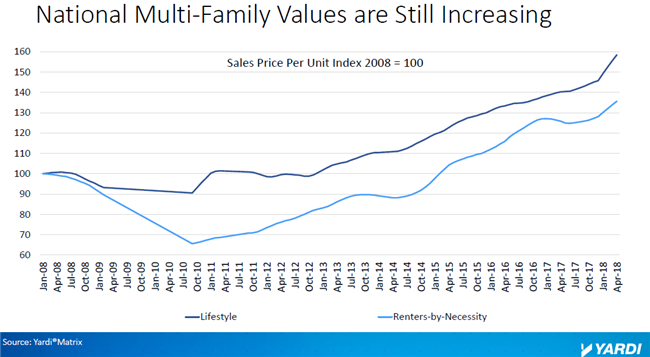
The drivers affecting multifamily growth in the next two to five years involve several issues that were discussed by leading experts from Yardi Matrix in a recent webinar.

The Yardi Matrix 2018 U.S. Multi-Family Market Update was presented by  Jack Kern, Director of Research and Jeff Adler, Vice-President of Yardi Matrix, who discussed what they see upcoming in the multifamily market in the next few years.

“The apartment markets are not in bad shape but localized. If you are an asset manager, what is your key issue going to be? Adler said. Some of his key takeways about multifamily growth from the webinar which can be downloaded here.

    • The domestic economy is strong and accelerating, as wages are rising steadily and the labor market is very tight.
    • Inflation has shown signs of increasing, which will allow the Fed to increase short-term rates. It will also allow longer term rates to drift upward without an immediate inversion of the yield curve.
    • Demand for multifamily units remains strong, although the strongest demand is emerging in secondary markets with lower costs of living. Job growth is faster in secondary markets than primary markets.
    • Tech hubs are emerging in formerly non-tech metros, as well as often overlooked metros.
    • A few markets may be on the brink of short-term over supply in the next 18-24 months.

“Where’s the new supply coming?  How shielded are you from new supply pressures?  What are you going to do at the site level to get your costs down, your sites buttoned up to be able absorb this influx?  If you’re an operations manager you’ve got to be at the top of your game, particularly in places where a lot of the supply is coming because you’re going to be challenged.

When it comes to multifamily growth the market “really faces an increasing set of crosswinds,” Adler said on the webinar. ”The demand picture in jobs and population is really good but it’s shifting to lower cost cities and the home ownership rate I think is, and will continue, to gradually rise.”

7 Drivers Affecting Multifamily Growth Going Forward

The drivers affecting multifamily growth involve a lot of discussion on the analysis of overflow out of gateway cities and into secondary cities, Adler said.

    • The economy is accelerating
    • Tightening labor market
    • Multifamily facing crosswinds
    • Development capital is available
    • Overflow from gateway cities to secondary and tertiary cities
    • Development of intellectual capital hubs
    • Lack of business culture and rent control

The economy is accelerating

“The U.S. economy is in very good shape,” Adler said. “Gross domestic product (GDP), employment is up, and growth is actually accelerating. You see that obviously, in pressures in the labor market as well as in the market for money, such as interest rates. Oil prices are up, $70 a barrel. I think they could even get to 80-ish, which is kind of a different call for me, but only for about 18-24 months, then there’s a supply response, it kind of comes back down.”

Kern added, “The economy was pretty strong, and we were thinking oil prices were contributing to it, especially in the industrial base.Now, we’re at $80 and the economy is really strong and getting stronger.”

Adler added, “You see it happening in Houston and in oil-related cities. Occupancies are up. Wages are rising 2.5%. The labor market is really tight and people are being pulled off the sidelines. Inflation is rising at 2-ish but I don’t see it going the 2.5. Short-term rates are up. I would very much watch the yield curve, very much so,” Adler said.

Labor market is tightening

“Wage pressures are increasing. Unemployment is down at 3.9%. Pressures are increasing and I would tell you that in fact the wage improvements of the younger workforce is actually higher than what we’re seeing in the headline numbers because we have retiring boomers,” Adler said.

“That’s basically dampening the effect of what’s actually occurring. We’re able to have good times longer because if you were just looking at 4-5% wage growth, you’d throw a lot of alarm bells off. The demographics are actually helping us to keep this expansion going, so it’s kind of good news.

“Then we see it all over the economy that there are labor shortages in certain places among certain trades, particularly at lower end less educated roles, which is actually helping that earning group get some wage growth back.

“Labor force participation has stopped declining,” Adler said.

“It has started somewhat rising and the same thing for productivity. This is a rolling six-year average so it’s at 0.7% but again it’s moving up, which is again, positive trends for overall economic growth and productivity growth at 1.3.

“The key issue we’re going to have to watch here is the fact that population growth overall isn’t increasing because of lack immigration. The labor force participation will see a somewhat positive. It’s really going to come down to productivity.”

Multifamily growth facing crosswinds

“The multifamily market really faces an increasing set of crosswinds,” Adler said.

“The demand picture in jobs and population is really good but it’s shifting to lower cost cities and the home ownership rate I think is and will continue to gradually rise.

“Our take on this is about 10 basis points a year in the secondary cities and that’s a little bit of a headwind. Financing costs are up. Bottom line, if you’re in the multifamily business, you’ve really got to focus where your NOI increase outruns the increased cost of debt,” he said.

“There are a handful of markets that are at risk of multifamily growth oversupply or the next two years, not so much in the next five. We’ve laid them out:

    • Denver
    • Seattle
    • Charlotte
    • Dallas
    • Phoenix
    • Miami

When it comes to multifamily growth, these cities are in for “a little bit of a rough ride,” he said.

Kern added, “I think on our last call we felt that the supply was coming but it wasn’t fully evident just yet. Now, it seems like it’s much more evident.”

“I kind of view this as this is an 18- to 24-month kind of thing. There’s stuff that has to get absorbed, there’s new stuff that’s coming that has to get absorbed,” Adler said. “It has to get re-stabilized. You’re talking about a good two years, a good two years of riding this stuff out. It is very localized in where it’s coming. They’re beautiful buildings. It is going to be great for the economy overall and the country overall. These are revitalized downtowns. But if you’re owner of existing assets, you’re going to struggle. You have to focus on cutting your costs.”

“Overall when you look at it on a market level, I think ‘Hey, with the exception of five of six cities, that’s not so bad.’ However, I do expect the ride to be rocky and we’re seeing this now and I think we’ll continue that,” Adler said.

Development capital is available and sharpshooters game

“Multifamily capital is abundant, both equity and debt and the cap rates are steady, which means the spreads are compressing,” Adler said.

“The new supply deliveries are absolutely weighing down on the market and very tightly submarkets within those.  The level of new supply is flattening.

“The discussions I’ve had with a lot of market participants and financiers is that development capital is there,” Adler said.

“It’s now at the point of whether the developers themselves want to take on the squeeze of increasing construction costs and decreasing rents and whether they’re going to build just for fees and keep themselves in business. My view is as long as the capital is there, stuff is going to continue to get built. It doesn’t appear as if there’s a drop off in 2019 but more of a leveling at 280,000 to 300,000 a unit. The key issue is it’s new supply. This is with or without a mild recession. You just run it out and if you want to make money in this business, you’re going be focusing on places where the supply isn’t, that’s pretty much it. That becomes a sharpshooter’s game,” Adler said.

“As an investment officer, it’s about being a sharpshooter, finding the places that there’s a lot of capital to deploy. Everyone I have spoken to, almost bar none, has a lot of money to put out. The question is, how do they put the money out without shooting themselves in the foot?

“They don’t want to come back with having these bad investment decisions. You’ve got to dig harder, you’ve got to dig deeper, and you’ve got to focus on where the supply isn’t and where places have intellectual capital and where there’s creative work going on,” Adler said.

7 drivers of multifamily growth

Secondary cities and intellectual capital hubs

“We took the Amazon 20 as a jumping off point and we added a couple of other markets to round out this notion,” Adler said. “Then we began looking at that approach.

“You’re trying to achieve very high quality at less cost. The question is how much less and how much you want to play? You can see that as an investor, this is an interesting way of thinking about this because it’s based upon at what stage do you want to enter into a city in its development as a tech hub in terms of the quality of the labor and the cost of labor?

“Then as an investor, you can look and say aha, if I think about where I want to play, either high quality at moderate cost is Salt Lake, Orlando, Minneapolis, Sacramento, Phoenix or do I want to really throw the dice and go off of Indianapolis, Pittsburgh, or Detroit where it’s very low cost, very high quality, but maybe perhaps underappreciated. It may take a little more of a longer timeframe to come to fruition.

“The longer an expansion runs out, the better the returns to secondary cities are. But, you do need to understand that if you’re in a secondary city, you’re going to see a sharper correction in values and you need to make sure you’re not caught in a liquidity trap in that moment.

Development of intellectual capital hubs

“When I think about cities, you really think about it in four quadrants.

    • Public and private partnerships that bring things together
    • A business friendly environment
    • A community and amenities that attract talent particularly creative, artistic and STEM (science, technology, engineering and math)
    • An educated workforce.

“The tech hubs are emerging in both formerly non-tech metros and traditionally overlooked cities,” Adler said.

“ It’s really about the development of intellectual capital hubs and the cost advantages associated with them as jobs and companies move those jobs to places that have a lower cost of living. The longer this expansion goes on, the more established that infrastructure becomes.

“I think the tax reform will only accelerate this. The good news for investors is that this is a slow pitch and you really have an opportunity to decide at what stage of development, with multiple points of entry, you want to play in one of these emerging hubs and so it does take some time.

“One thing we noticed in our 27-year study is that property values in the secondary markets are more volatile. No question about it. So your capital structure has to be prepared for that level of potential volatility in a downturn. But with that, actually returns are actually better in secondary cities than primary cities.

“The development of a tech city takes time. Maybe, you could argue, that time will be compressed because the playbook is now quite well known and it is quite well known.

“But for Austin, it took a long time for the infrastructure, the tech infrastructure to coalesce before suddenly it went crazy right before the GFC and it has really taken off since then. That allows you as an investor to basically have multiple different entry points.

Some cities a surprise for multifamily growth

“Some cities that quite frankly surprised me when we were doing this work.

“I had never thought about Phoenix as a high tech city. And yet, Arizona has become, because of regulatory environment, a center of autonomous vehicles. Notwithstanding the tragedy that occurred with the fatality there, that is a step back, but it’s a step back but not a knockout blow. It’ll come back. I also found really interesting this whole notion of the autonomous trucks, which I think is really going to take off. All of that is happening in Phoenix as well as advanced manufacturing. There are clusters in Phoenix that you just never thought Phoenix was a high tech city and yet, around Tempe and other areas of technological talent, things are happening,” Adler said.

7 Drivers Affecting Multifamily Growth Going Forward

“Inside of our service, Yardi Matrix, you can drill into this and visualize the cities and drill further into micro markets,” he said.

Lack of business culture, rent control and whackadoodle responses

Adler said it is unfortunate that rent control has become an issue. “You’re seeing this obviously in California with Costa Hawkins, the proposed repeal of a law that would enable localities to put local rent control in place – it’s unfortunate.

“But you have pressures that have built, particularly in California where there has been job growth, there’s been wealth creation because of intellectual capital, and there has been a very restrictive ability to build, both in northern California and in southern California.

“The political culture being what it is, rather than look at free market approaches to resolving these issues, it is ‘Let’s go blame those dirty capitalists.’

It can for a short time benefit people in place. It is in the long run horrific from a creation and balancing of a functioning effective marketplace. I have spoken to a lot of people about Costa Hawkins and I’ve been in California and talked to a lot of people in and out of the industry. If there is a chance for it not to succeed, it’s only because single family rentals are included. But I would say it’s a 50-50 thing, I’ve heard people say 60-40 either way. It’s even money. In the Wall Street Journal, there was an article by Laura Kusisto about a bunch of folks in Santa Monica, landlords just selling out and moving to Las Vegas.

“The question is, ‘How do localities respond to economic growth’ and the concentration of wealth. Unfortunately, if you don’t have a positive business culture, a positive business climate, you get these whackadoodle responses,” Adler said. He cited the Seattle tax that was imposed on the top companies of $275 a person that they employ, “which again, was kind of whackadoodle. That’s why business climate and long-term business climate is so important.”

“Seattle had been just rocking in terms of growth and a great tech hub. That change in business climate took a little bit of the bloom off the rose. No one is going to leave and the sky isn’t falling but it’s a chip away at what had been a very pro-growth environment and had been really rewarded in an expansion in their economy,” Adler said.

Summary multifamily growth

Adler said in his multifamily growth summary that if you are not in the right places “where NOI growth is outdistancing the movement in cost capital, you could be exposed to value headwinds, let’s put it that way.”

He added 5 things to watch for that would indicate a recession is coming:

    • Hourly earnings growth goes from 2.5% to 4%
    • Cyclical sector share of GDP goes from 24%  to 28% of GDP
    • GDP deflator goes from less than 2% to 2.5%
    • Operating capacity utilization rate  goes from 76% to 80%
    • The yield curve inverts – 10-year treasury less than fed funds rate

“I don’t see any of things happening yet,” Adler said.

“We’re at a stage of the real estate cycle where it truly is a sharpshooter’s game. That we’re looking for places where intellectual capital is developed or emerging, where you can have a good entry point, and where you’re basically attempting in the short to medium term to be insulated from supply.

“If you’re in the path of supply and you can’t avoid it, just get prepared, get your cost structure under control, get your operations tight, particularly as an asset or property manager, and basically ride it through.

“I think if you were looking for lessons, you would probably go to the folks in Washington, DC who have been through this sort of cycle for a number of years and have worked on ways to survive through that cycle.

“I think the multifamily asset class is a great place to be. I think every market goes through challenges and evolutions and I think multifamily will continue to do it. It is a great market to be in but at this stage, you’ve got to know where to put your capital. That means you’re going to have to dig harder and dig deeper in order to uncover opportunities,” he said.

Download the full webinar and slides here.

Contacts:

Jeff Adler: Vice President & General Manager, YardiMatrix, Jeff.Adler@Yardi.com, 1-800-866-1124 x2403

Jack Kern: Director of Research and Publications, YardiMatrix, Jack.Kern@Yardi.com, 1-800-866-1124 x2444

Phoenix’s Strong Tailwind For Multifamily Growth

Man Awarded $20 Million After Fall Through Portland Apartment Walkway

A jury has found a Portland apartment complex failed to make proper repairs to a walkway and awarded $20 million to a man who fell through the Portland apartment walkway, according to reports.

The man, Robert Trebelhorn, plunged waist-deep into a rotting, second-story walkway in February 2016, according to the lawsuit. He tore the meniscus in his knee, causing ongoing pain and therapy even after he underwent surgery.

Trebelhorn filed suit against Wimbledon Square Apartments and its parent company Prime Group, a Los Angeles-based real estate firm, after construction crews discovered serious dry rot and cracking concrete in the walkway.

His attorneys Jason and Greg Kafoury said Prime Group refused to make repairs for at least a decade.

“[Prime Group] was not just not fixing things, it was actively covering up rotten wood by painting over it,” Jason Kafoury told katu.com. “They were giving an illusion of safety, when in reality, they were just trying to make tenants think it was safe.”

Landlords need to get the message about repairs

“We’re going to attempt to get national media attention so landlords across the country get the message that they need to make situations safe for their tenants,”  Kafoury said according to Williamette Week.

The attorneys said that after at least a decade of deferred maintenance, the owners of the Wimbledon Square apartments refused to spend about $750,000 to $1 million to repair the walkway and other deteriorating stairways, balconies and walkways at the 600-unit complex.

Instead, the owners, Los Angeles-based Prime Group, approved spending about $250,000 on the problem, the attorneys said.

Portland apartment walkway given appearance of safety

The management also had a history of telling maintenance workers to paint over rotting wood that supported the walkways and to apply a thin veneer of concrete over cracking walkways or stairs to give them the appearance of safety, Trebelhorn’s attorneys said.

“It was bubble-gum fixes — bubble gum and tape — and that’s how it was for years at this place,” Portland attorney Jason Kafoury told a Multnomah County Circuit Court jury, according to OregonLive.com.

During the trial, Prime Group’s Portland attorney, Matthew Casey, contended that this was a case about a man who injured his leg and not an example of some “evil intent” by the complex’s owners to hurt people.

“We agree that this event happened,” Casey said. “We’re sorry that it happened, and we’re taking responsibility that it happened.”

Attorneys for Trebelhorn said property management and apartment employee testimony was key.

“We had four former employees who had the courage to come into the courtroom and tell the truth,” Jason Kafoury said according to katu.com. “All of them said that Prime Group had serious rot issues for over a decade and would not send the money to make the place safe.”

The attorney pointed to a July 2014 email between the apartments’ then-property manager and the former head of capital investments.

The property manager wrote, “I think it’s important that if it comes up, we inform ownership of the severe dry rot we have continuing at [Wimbledown Square Gardens and Wimbledon Gardens].”

The Wimbledon Square Portland apartments cover multiple blocks and 72 buildings, with a street address of 2837 S.E. Colt Drive — just north of the Crystal Springs Rhododendron Garden.

Resources:

Portland jury awards $20 million in ‘reprehensible’ landlord case

Jury sides with tenant in $20 million lawsuit against landlord over fall, safety hazards

Man awarded $20 million after fall through walkway at SE Portland apartment

Portland Jury Awards More Than $20 Million For California-Based Landlord’s Failure to Make Repairs


Portland City Commissioner Seeks To Regulate Tenant Screening

Portland City Commissioner Chloe Eudaly is seeking to regulate tenant screening by following a similar path to Seattle’s first-in-time ordinance and require Portland landlords to take a first-come, first-served approach to tenants, according to reports.

Eudaly’s proposal is similar to one passed by the Seattle City Council, called first-in-time. That ordinance was struck down in April by King County Superior Court Judge, Suzanne Parisien, who said in her ruling that “choosing a tenant is a fundamental attribute of property ownership.”

Willamette Week first reported that  Eudaly is working on a measure to require landlords to rent to tenants on a first-come, first-served basis.

“There is so much subjectivity. Housing access relies exclusively on landlords’ feelings about a tenant,” Eudaly policy director Jamey Duhamel told Willamette Week. “The goal is to create clear channels to access housing of choice for all renters that are consistent, fair and equitable.”

“This policy needs the input of the community at large, and I’m willing to spend as much time as needed with any organization that wants to engage on this policy and provide direct and honest feedback about how it would work in real life,” Duhamel told Willamette Week.


Duhamel said that alternatives will be discussed during a series of workshops planned on the proposal in May.

“We are currently workshopping alternatives to first-come first-serve that may accomplish the same goals, but in reality many landlords do this now anyway as best practice. We will see if something else arises,” Duhamel told the newspaper.

According to northwest apartment investor blog, she plans to propose standardized tenant screening criteria based on a point system, which would score tenants based on credit, criminal, and housing history. If prospective tenants score above a 5 using the new system, landlords would be prohibited from denying their application. If they do not score above a 5, tenants would be given a 24-hour window to provide documentation of “offsetting considerations” that could potentially raise their score. Eudaly is also proposing to link the new tenant screening process with security deposit reform.

Resources:


Sign Up For Our Newsletter And Get Apartment News And Helpful, Useful Content Each Week.

* indicates required

Reasonable Accommodation vs. Modification And Who Pays?

When a potential tenant asks for a reasonable accommodation or a modification for your apartments, do you know the difference? The Grace Hill training tip of the week focuses on reasonable accommodation vs modification and what you need to know.

By Ellen Clark

Knowing the difference between an accommodation and a modification when you get a request from a tenant is important.

    • Reasonable accommodations are changes in rules, policies, practices, or services so that a person with a disability has an equal opportunity to use and enjoy a dwelling unit or common space.
    • reasonable modification is a structural modification that is made to allow people with disabilities the full enjoyment of dwelling units and related facilities.

55% of discrimination complaints involve people with disabilities

According to The Case for Fair Housing: 2017 Fair Housing Trends Report by the National Fair Housing Alliance, nearly 55% of all reported housing discrimination complaints in 2016 involved discrimination against people with disabilities

This statistic is a reminder of how important it is to handle reasonable accommodation and modification requests properly.

“One type of disability discrimination prohibited by the Fair Housing Act is the refusal to make reasonable accommodations in rules, policies, practices, or services when such accommodations are necessary to afford a person with a disability the equal opportunity to use and enjoy a dwelling,” according to HUD.

“The Fair Housing Act’s protection against disability discrimination covers not only tenants and home seekers with disabilities but also buyers and renters without disabilities who live or are associated with individuals with disabilities.

“The Act also prohibits housing providers from refusing residency to persons with disabilities, or placing conditions on their residency, because they require reasonable accommodations.  Since rules, policies, practices, and services may have a different effect on persons with disabilities than on others, treating persons with disabilities exactly the same as others will sometimes deny them an equal opportunity to use and enjoy a dwelling,” according to HUD.

Examples of an accommodation vs a modification

Some examples of reasonable accommodations are changes in rules, policies, practices, or services so that a person with a disability has an equal opportunity to use and enjoy a dwelling unit or common space such as:

    • Allowing a resident who is blind to have a seeing eye dog when the policy is “no pets allowed”
    • Reserving a parking space close to a resident’s apartment when the parking policy is “first-come first-served”
    • Waiving guest fees for a resident with a disability who requires a live-in nurse

Some examples of a reasonable modification is a structural modification that is made to allow people with disabilities the full enjoyment of dwelling units and related facilities such as:

    • Installing grab bars in bathrooms
    • Installing visual doorbells or fire alarms
    • Lowering kitchen cabinets

Who is responsible for the cost of an accommodation vs a modification?

The housing provider is typically responsible for costs associated with accommodations.

However, the person with a disability is typically responsible for the cost of a modification (though not, for example, in cases where the housing provider receives federal financial assistance).

If modifications to a dwelling unit will interfere with the next resident’s use, the person with a disability is responsible for returning the apartment to its original condition before moving out. The person with a disability cannot be required to restore modifications to common areas or the exterior of the apartment home.

What does “reasonable” mean in an accommodation vs a modification?

    • It must not cause an excessive financial or administrative burden to the housing provider
    • It must not cause a basic change to the nature of the housing programs available
    • It must not cause harm or damage to others
    • It must be technically possible.

Summary of accommodation vs. modification

You do not have to provide a requested accommodation or modification when it does not meet the above standards for what is considered reasonable.  However, you should try to find an alternative that might help your customer.

Read Ellen’s full blog post here.

 Resources:

Reasonable Accommodations Under The Fair Housing Act

About the author:

Ellen Clark is the Director of Assessment at Grace Hill.  Her work has spanned the entire learner lifecycle, from elementary school through professional education. She spent over 10 years working with K12 Inc.’s network of online charter schools – measuring learning, developing learning improvement plans using evidence-based strategies, and conducting learning studies. Later, at Kaplan Inc., she worked in the vocational education and job training divisions, improving online, blended and face-to-face training programs, and working directly with business leadership and trainers to improve learner outcomes and job performance. Ellen lives and works in Maryland, where she was born and raised.

About Grace Hill

For nearly two decades, Grace Hill has been developing best-in-class online training courseware and administration solely for the Property Management Industry, designed to help people, teams and companies improve performance and reduce risk.

Photo credit gpetric via istockphoto.com


accommodation vs modification in rental housing


California Landlords Settle Over ‘No Criminal Record’ And Discrimination

California landlords have reached a settlement and agreed to pay $8,000 after a complaint alleging they used a policy of “no criminal or police record of any kind,” and in addition discriminated on the basis of race and national origin.

The U.S. Department of Housing and Urban Development (HUD) charged in the conciliation agreement that the landlords discriminated on the basis of race, national origin and prior criminal history, according to a release. The agreement names the Grand Oaks Apartments and Sierra Vista Apartments in Atwood, California, and MacBeth Apartment Systems in Carlsbad, California.

“Denying someone an apartment because of how they look or where they come from not only deprives them of a home, it is against the law,” Anna María Farías, HUD Assistant Secretary for Fair Housing and Equal Opportunity, said in the release. The “agreement reaffirms HUD’s commitment to ensuring that every person, no matter their race or national origin, has access to the housing of their choice.”

The agreement is the result of two complaints the Fair Housing Council of Riverside County (FHCRC) filed with HUD after it conducted fair housing tests.  The complaints alleged that the owners and managers of Sierra Vista and Grand Oaks Apartments discriminated against applicants because of their race and national origin. According to the complaints, tests conducted by FHCRC allegedly showed that property managers at the two complexes refused to rent, cited different terms and conditions, and misrepresented the availability of units to testers based on their race and national origin.

California landlords to pay $8,000 in settlement

Under the terms of the agreement, the owners and property managers will pay FHCRC $8,000, require that their employees take fair housing training, amend their rental qualification criteria to remove the requirement that applicants have “No Criminal or Police Record of Any Kind,” and develop and implement a nondiscriminatory criminal record policy.

The agreement also says MacBeth Apartment Systems must delete from their qualifying criteria “no criminal or police record of any kind” and provide HUD a copy of the revisions. Also “develop a criminal records policy that complies with the Fair Housing Act to be used in evaluating potential applicants at all properties,” according to the settlement. It also requires the company to distribute the new policy to all company executives and staff responsible for screening applicants and tenants.

Resources:

Application Of Fair Housing Standards To the Use Of Criminal Records

U.S. Department of Housing and Urban Development Conciliation Agreement

HUD APPROVES AGREEMENT RESOLVING ALLEGATIONS OF HOUSING DISCRIMINATION INVOLVING TWO CALIFORNIA APARTMENT COMPLEXES


Why Is It So Hard To Build Affordable Housing In Portland?

A leader in the Portland affordable housing industry talks about why it took four years to get 40 units of affordable housing done from concept to opening and why it is so hard to build affordable housing in Portland.

By John Triplett

Rental Housing Journal

Tom Brenneke has a passion for building affordable housing in Portland, the community where he lives, and is proud to talk about his latest 40-unit project when recently opened – a triumph of affordable housing.

“I have a particular passion for affordable housing,” said Brenneke, who is president of Guardian Real Estate Services LLC. “I enjoy the complexities,” he said in an interview with Rental Housing Journal.

“We are a housing organization that runs the range from very low income to market rate. We have the highest priced housing in town that we operate and the lowest priced housing in town. In terms of affordable housing, I enjoy the complexities, I enjoy the mission. It is a very high barrier to entry business. So it is what has distinguished us in the marketplace as a developer and operator. We love the concept of intergenerational housing. I think that’s a winner,” he said.

Brenneke was discussing his most recent affordable housing project, the NAYA (Native American Youth and Family Center) Generations, in Portland’s Lents neighborhood.

“At a time when affordable housing is a particularly controversial subject in Portland, we’re especially proud to launch NAYA Generations. This is more than housing, it is a true community that promotes stability, collaboration and caring relationships,” he said.

How did this all get started?

There is a prject in Portland called Bridge Meadows, 36 units of intergenerational and foster family housing and “we developed that for the Bridge Meadows organization,” he said. “This is how it kind of all started. They had an idea and we brought all the development expertise, we created the green project for them and it worked out great. That was in 2010.

“After completion of that project, the NAYA group (Native American Youth and Family Center) approached us, took a look at Bridge Meadows, and said, ‘We want one of these for us’ – and I said, “Sure.”

“So that is what we do. We take those kinds of wishes, wants and challenges” and turn them into a project like this.

“We started looking for a site and connected with a city commissioner, Dan Saltzman, who helped us locate and acquire an old public school site in a neighborhood called Lents in Portland.”  It is one of the poorer neighborhoods in Portland.

Frustrations of getting the deal done


Why is it so hard to build affordable housing in Portland Oregon?


NAYA Generations apartments exteior photos © Cathy Cheney

Getting the deal done between the Portland Public School district, the city, which are separate entities completely was frustrating.

“It was piece of work. We ended up with a complicated master lease of the land, indirectly, from Portland Public Schools. The lease passes through the city and it goes to us.”

Many of us do not know the foster system – it’s tragic

“When you couple of the intergenerational concept with both Bridge Meadows and now NAYA Generations, it especially helps the foster families. We all love seniors. But many of us do not know or understand the foster system.  And it’s tragic. And it’s not just Portland, Oregon, but everywhere.

“So if you look at projects like Bridge Meadows and NAYA Generations, Bridge Meadows focused on the adoption process so if you were living in Bridge Meadows as a foster family you got a break on your rent, but you had to agree to adopt up to three children in five years. We don’t have that at NAYA Generations. But we have a disproportionately high number of Native Americans in the foster system. So there is a preference there.

“I have a passion for the children. The foster system. And affordable housing at the end of the day,” Brenneke said.

Naya Generations was developed as an intergenerational, cooperative community that supports families of foster children. Residents can contribute to this collaborative community in a variety of ways, including teaching cultural values and history, indigenous storytelling, being a mentor and more.

“NAYA services Portland’s urban Indian population in many vital ways, from our precious youth to our respected elders, “Paul Lumley, NAYA executive director, said in a release. “We are blessed to have this culturally specific inter-generational housing that was made possible through this unique partnership.”

The units range from one bedroom to four bedrooms depending on family size. The mission was to address the over-representation of Native American youth in the foster care system.

Why is it so hard to build affordable housing in Portland Oregon?

Kitchen in Naya Generations apartments photos © Cathy Cheney

Gentrification is the buzz word

The Lents district historically is the lowest priced housing in Portland. “Guess what’s happening.  In East Portland suddenly you get people going out and buying $250,000 starter-type homes, putting $50,000 in them, and flipping them for $400,000.” Brenneke said, “That is what is going on in that area. But gentrification is a concern. It makes the demands for affordability even higher.

“These developers and these landlords. I am one of them who is acquiring buildings – substandard buildings – and putting them in good condition. And charging market rates. I do not have a problem with that.  We see people living in squalor. Is that fair? Reasonable? No.

“It certainly makes the demand for affordability even higher. We are seeing just huge demand for affordability here.”

Why is it so hard to build affordable housing in Portland, Oregon like this apartment at NAYA Generations?

I would not blame the landlords- but some are doing “dumb stuff”

“I blame some landlords because some landlords are doing dumb stuff. When you go into the middle of a school year in a building full of low-income households full of kids and you double the rent – that’s dumb stuff.  You can do it. It’s just insensitive. It’s just dumb. You just don’t do that.  A good landlord would not do that.

“He might put them on a path to essentially improving their units and gradually increasing their rent over time or giving them lots of notice,” he said. “And, voluntarily paying relocation fees. We’ve done that before.

“The other dumb thing these landlords do, is they go in and clear the whole building out with no-cause notice evictions. That’s hard. I have mixed feelings about that. Once again – would you do that in the middle of a school year? No. But if you give them six-months notice – six months from now I am going to ask you to vacate your unit. I am going to give you the opportunity to transfer to a new unit. We are going to put your unit in market-standard condition and charge a market price for it. And I’m ok with that. It puts more burden on our city to figure out affordability.  It offers opportunity for groups like ours to create affordable housing but it’s the market and the way the market works.”

Government getting in the way or our business

“Unfortunately, our city and our government is kind of getting in the way of our business now.

“Things like rent control. Those kind of things being floated. Inclusionary zoning. Those kinds of things are going to put a damper on the market and hurt us and at the end of the day hurt affordability,” he said.

Four years to produce 40 units of affordable housing, really?

Brenneke discussed the difficulty, the barriers and the time it takes to produce affordable housing as a reason more is not getting built.

“It takes nine months to get a permit here. On the NAYA Generations project I bet we were four plus years from the conversation I had with the executive director to opening the front door on this thing. I was an honest four years.

The construction process is the easy part. That’s a year. We know that. But if you back it up from there, it’s four years.

He said in the case of NAYA Generations they were working on affordable housing in an area that is not even in what is called a design review district. “Those districts can be found in some of the nicer areas of Portland – closer in areas, Pearl district, in those areas you are going to see a design review process where we go through a commission of six or eight volunteer types – architects – that are going to critique your project. And I bet that process can easily take a year or two on its own. You have to sit there and hear commissioners give you conflicting signals on your own project. That is slowing the whole system down here. And God help you if you are in an historic district.”

Challenges of affordable housing in Portland

“I do these grand openings,” Brenneke said in summary.

“I stand on the podium and thank all the people.  This is 40 units. Why is this such a difficult thing?

“This is something we ought to be producing every day or every month – not a once every four years event. Why is it so damn difficult?”

And that is another story at some point.

Tom Brenneke of Guardian Real Estate Services asks why is it so hard to build affordable housing in Portland Oregon?

Tom Brenneke at Naya Generations apartments dedication photo © Cathy Cheney

About Guardian Real Estate Services

Locally owned and operated out of Portland, Oregon, for more than 40 years, Guardian Real Estate Services has evolved into a leading management, development and investment firm in the Pacific Northwest. Defined by a deep commitment to the communities in which it invests, Guardian continues to advocate for housing across the entire spectrum.

About NAYA

Founded by the community, for the community, NAYA is a family of numerous tribes and voices who are rooted in sustaining tradition and building cultural wealth. The organization provides culturally-specific programs and services that guide people in the direction of personal success and balance through cultural empowerment. Find out more here.

Resources:

NAYA Generations affordable housing

Guardian Real Estate Services

Bridge Meadows affordable housing

Lents Neighborhood Association

Five myths about gentrification

Portland’s Pearl District

NAYA Family Center

Affordable Housing Community in Downtown Seattle Purchased by Security Properties

Sign Up For Our Newsletter And Get Apartment News And Helpful, Useful Content Each Week.

* indicates required


Landlords Sue Seattle Over Criminal Background Check Restrictions

Three small landlords have banded together with two organizations to sue the City of Seattle over a criminal background checks ordinance that keeps landlords from considering certain criminal histories of tenants during the tenant screening process.

Sean Martin of the RHAWA, left, Ethan Blevins and William Shadbolt

By John Triplett

The Pacific Legal Foundation and the Rental Housing Association of Washington (RHAWA) have filed suit against the City of Seattle over the ordinance which bans landlords from most criminal background checks when screening an applicant. The suit argues the ordinance violates due process and free speech.

Seattle’s Fair Chance Housing Ordinance, passed by city council in 2017, forbids landlords from considering applicants’ criminal histories when selecting tenants. In other words, landlords cannot base a rental decision on concerns over their own safety or the safety of other tenants and neighbors. Violators face fines and penalties of up to $55,000.

The Rental Housing Association of Washington said in a release, “The ordinance is based on the flawed reasoning that inequities of our criminal justice system can be solved by limiting the rights of property owners from making informed decisions about the person(s) with whom they enter into rental agreements.

“Rental property owners recognize the struggle for applicants with criminal convictions history and the industry supports measures like Certificates of Restoration of Opportunities and simple “ban the box” legislation to ensure that an individual’s full list of qualifications are considered. However, the ostensibly blanket restrictions imposed by the City put rental property owners at too high of a risk of exposure to the safety of other tenants and their property,” RHAWA Interim Executive Director, Sean Martin, said in the release.

Landlords Sue Seattle Over Criminal Background Check Restrictions

Sean Martin, Interim Executive Director, RHAWA

“RHAWA supports second-chance housing and educates its members on HUD guidelines and state law which restrict how criminal records history may be considered, including an individualized assessment which consider factors such as the nature and severity of a criminal conviction,” Martin said in the release.

The RHAWA and the Pacific Legal Foundation held a joint press conference where they set out the reasons for the lawsuit and took questions from the media.

“Pacific Legal Foundation filed a complaint to King County Superior Court challenging Fair Chance Housing Ordinance on behalf of the Rental Housing Association of Washington and three small time landlords: Chong and MariLyn Yim, Kelly Lyles, and Scott Davis,” attorney Ethan W. Blevins with the Pacific Legal Foundation said at the press conference.

“The Fair Chance Housing Ordinance forbids landlords and organizations like RHA from asking about criminal background of housing applicants or denying someone tenancy on the basis of their criminal history. The law’s intent is to help former convicts reintegrate. It’s effect, however, is to deny landlords and screening organizations of their basic constitutional rights,” Blevins said.

Blevins also explained the due process and free speech aspects of the complaint.

“The due process claim argues that the Fair Chance Housing Ordinance pursues its objective in an unreasonable and unduly oppressive manner. The free speech argument says that the First Amendment embodies a right to receive information, and landlords rely upon that right when selecting their tenants. The city can and should help those emerging from criminal confinement, but it cannot do so at the cost of others’ constitutional rights,” Blevins said.

Average RHAWA member landlord owns two rental properties

William Shadbolt, President of the RHAWA Board of Directors, said at the press conference, “I’m a small time landlord. The Rental Housing Association represents the interests of independent rental owners. We’re the small mom-and-pop landlords.

“Our members live, work, and own rentals in the local community. Our average member has roughly two rental properties, and are very much part-time landlords. They teach our children, they design our planes, and they drive our buses. Many who were born and raised in this area purchase property in Seattle to help put their kids through school and provide for themselves in their old age.

“Our members provide the only organically affordable housing left in the city,” Shadbolt said.

Landlords sue city of seattle

William Shadbolt President of the RHAWA Board of Directors

City has dropped the ball on housing affordability

“Over the last few years, we’re seen a barrage of legislative attacks on our industry by the City of Seattle,” Shadbolt said.

“Rather than crafting policies to combat real housing issues, such as affordability and homelessness, the City of Seattle Council is more inclined to pass legislation that forces small mom-and-pop landlords to struggle to deal with larger societal ills that they’re just simply not able to cope with.

“If the city of Seattle is serious about reforming the criminal justice system, it should focus on reforming the criminal justice system. Continually adding regulations and cost to our local landlords does nothing to resolve the root causes of the injustices we all seek to remedy.

“Prior to the passage of this legislation, the Rental Housing Association reached out to the city of Seattle and suggested a variation on a local Certificate of Restoration of Opportunity. This was something that RHA supported on a state level, and it was passed on the state level. So a person with a criminal record could apply to an impartial panel and get a certificate. They could then take that certificate to a small landlord. Unfortunately RHA found no willing partners on this solution,” Shadbolt told the press conference.

“Our members are long time citizens of this city. Most of whom are concerned about reforms of the criminal justice system, and finding better opportunities to provide safe and affordable housing to everybody. We believe the best was to increase a housing opportunity is through partnership and the exchange of honest information, not through the concealment of public records,” he said.

Small landlords forced to sell their rental properties

“The impact of this and other short-sighted ordinances passed by the city council is that thousands of mom-and-pop landlords can no longer afford to operate their units,” Shadbolt said.

“They’re being forced to sell their rental properties in the thousands. Fatigued by over regulation and demonization, they’ve thrown up their hands and voted with their feet.

“It’s important to recognize that these tens of thousands of units have gobbled up by developers in large corporations, and turned into fancy condos and boxy town homes. The city council needs to understand they’re causing a reduction in the number of housing units by these actions.

“These laws are destroying the affordability in our city. Making criminals a protected class, and other ordinances like it, that makes the city council directly responsible for increasing people’s rent,” Shadbolt said.

Questions and answers at the press conference

Q: And what’s our timeline? How long do these things take? What are our next steps? What can we expect going forward?

A: Blevins said, “Well, this is a fairly straight-forward legal issue, so we don’t, hopefully, have to go through the long process of discovery that you might typically have to go through. It’s going to depend somewhat on the city’s willingness to move forward at pace, so it may depend on the particular Deputy City Attorney that we have, but if it moves at the pace, for example, that the First-in-Time litigation went, then I would anticipate we probably have a summary judgment hearing in about six months or so.”

Q: In the media all the time you hear constantly about the issues that special populations not being able to find housing. If this isn’t the policy to help folks with criminal records get more housing, what are the solutions?

A: Shadbolt said, “You know, we have an affordability issue because there just simply is not enough housing. There is just not enough supply to meet the demand that we have in the city. So that’s kind of the affordability issue side of it. But if the city is serious about people with criminal records, they need to look at the criminal justice system. Rather than going and putting the burdens on small landlords, they need to be asking questions, and on the federal level, of why this country imprisons more people per capita than any other developed nation. It’s just wrong. But putting the burdens on small landlords to deal with that symptom, rather than dealing with the cause, is not the way to do it.

Q: The ordinance … makes no differentiation, in terms of criminal convictions, for, say, a pot conviction of a 21-year-old or a repeat assault conviction or domestic violence, somebody who’s got multiple offenses, for example, who would have a serious impact on the way that you’d be able to operate your apartment building. There’s no differentiation there?

A: Blevins said, “That’s correct. There’s no consideration of the gravity of the offense. The only, very limited, exception is if someone’s on the sex offender registry, and they committed the related crime as an adult, then if you can prove to the CR office for civil rights you have a legitimate business reason for denying them tenancy, then you can deny them tenancy because of that criminal background.”

Q: But only for sexual offenders?

A: Blevins said, “That’s correct. Only if they’re on the sex offender registry, and only if they committed that crime as an adult, and only if you can prove to the Civil Rights Office you have a good reason. In that context gravity of the offense is one of the factors the civil rights office will consider, but it’s in this very, very narrow context.”

Martin added, “I think one thing that people need to understand is that this is not the Wild West out there in the screening world, where landlords can just deny someone and have a blanket policy to say, criminal records I’m not going to even look at anything. We have the Federal HUD Guidelines that make it very prescriptive, and already you have to make the business case justification outside of Seattle, where this law is not in place, as well as state limitations on how far someone can look back. So really if someone’s saying they were convicted of an offense 20 years ago, that’s really not even in the discussion for being denied tenancy at this point. It’s too old of a conviction. So there are a lot of restrictions and regulations in place already for how people are using criminal records.”

Q: How does this law affect the roommate situation?

A: Shadbolt said, “We actually had a member who had a senior citizen, she was in her 70s, her rent had gone up, mainly because of the property tax increases, and she asked her landlord if she could have a roommate. The landlord said, ‘Yep, that’s fine.’ And the tenant turned around and said, ‘You do a background screening if I find somebody?’ And because of this law, she couldn’t do a background screening on criminal records, so they turned around and said, ‘What happens if we do a formal sublet. Can you do a screening on that?’ And the answer to that was ‘No’ because the only exception is owner occupied. So if you have a roommate situation where it’s a rental property, you cannot screen. So literally the people that you’re sharing very close space with, you can’t do it. The upshot of what happened with that person, she moved out of the city. She loved living in West Seattle. She could walk to her doctors, she had all the facilities here, but she ended up moving to Maple Valley to a small accessory dwelling unit because of this law.”

Q: Is the city considering any protections for landlords with regard to potential civil action from a tenant who is harmed by a former criminal who has a violent past?

A: Blevins said, “I certainly haven’t heard of any. One of the great ironies behind this is the studies that the city relies upon, one of the things that is suggested by those studies, is that before this kind of burden can be placed on landlords, tort reform has to occur, because landlords can be criminally or civilly liable for crimes committed by tenants against other tenants. And so, a lot of these studies have said, ‘If we’re going to do something about this, and force landlords to take individual criminal backgrounds, or not allow them to look at that, then we need to at least reform tort law, so that they’re not going to be liable for crimes committed by those tenants.’ “

Martin added, “I would add to that ‘No’ there are no considerations for landlords coming from the city, and that’s not something that’s been discussed. And I wouldn’t anticipate the city going that direction, at least not in the current setting that we’re in.”

Q: What can we, as citizens and landlords, do to express our discomfort and concern with this law?

A: Shadbolt said, “Ultimately, a lot of our members have simply just sold their properties in the City of Seattle. So they just left the city. So that is a reduction of housing. And the impact of that is quite dramatic. The people that have single-family homes, they’re invariably becoming owner-occupied as post rental properties. So they’re gone. The small two, three, four-unit buildings are getting scraped and townhouses going up. You can go along California and Fauntleroy Way and see tons of them have been built. And even the small apartment buildings, what typically happened was that they were artificially low rents.

“There’s a former board member that had two small apartment buildings in Queen Anne, and her rents were significantly below market. In reality, she was subsidizing her tenants’ rents for a period of time. And she and her family that had owned them for 40 or 50 years, just turned around and said, ‘We just can’t continue.’ It’s not just the regulations that have already been passed, which are onerous, it’s what’s going to be next? So she sold those properties, and prior to the sale she actually took three of her tenants to find new places. That was their relationship. What happened after the sale, is that the rents went up because the new owner suddenly had a very large mortgage payment to make. Whereas prior, they didn’t. So those affordable units have just disappeared out of there.

“For the people that want to keep their rental units, I think they just need to contact their city council members. Put it in writing that they’re upset with these issues. We’re open to any discussion of solutions that work for both sides, but what it seems with the city council is ‘Let’s put the burden on the mom-and-pop landlords and let them deal with it.’ And the reality is, we supported the Housing Levy strongly. We think that the whole of society should take responsibility for the issues that we have in the city, not just this one segment,” Shadbolt said.

Q: Did the city council come to RHA and try to get input and sort of work together on this Fair Chance Housing issue, or did they just act alone in their offices?

A: Martin said, “The ordinance was kind of born out of the process originally, and so a sub-committee was formed. We’re at the table for that, but we’re one of many voices, and when you have dozens of advocates and one landlord organization at the table, you’re not going to see equitable legislation. And, in fact, what happened with this ordinance in particular, was that council took the draft proposal, which would have allowed a two-year look back to still consider recent convictions, they took that and just said ‘We’re going to wipe everything out altogether.’ So it actually was maybe even worse after hearing what our concerns were.”

Shadbolt added, ”So there was actually a panel public hearing last year that I was the only landlord on that panel, and there was, I think there was about six or seven activists. I was quite horrified that when a particular council member started to speak, her reaction was, ‘Isn’t there anybody else other than the Rental Housing Association that could be here?’ She simply just did not want to listen to the small landlord’s point of view.”

Q: The criminals as a protected class in the ordinance, and combined with the series of other things that have been passed in recent years, do you see that affecting the standard that small landlords are using, for the criteria that they’re using in selecting tenants? For example, is the landlord making it more difficult for maybe a middle of the road tenant to access housing?

A: Shadbolt said, “Absolutely. I’m a small landlord, and my rental criteria before First-in-Time came into effect was half a page and it was pretty liberal. I’ve housed former offenders, I’ve housed people in Section 8, people with the Landlord Liaison Project. When First-in-Time came into effect our half page of rental criteria went to five pages long. And I legally could not rent to somebody if they didn’t meet that threshold of those criteria. So even though the city has lost the First-in-Time lawsuit, but the house appealed it, I’m looking at those and I’m actually probably going to keep most of those additional rental criteria. I have to protect my property, and I have to protect the residents that are in my duplexes and the other units.”

Q: So this is limiting access for maybe the middle- of- the-road tenants? Not just the criminals?

A: Shadbolt said, “Yes very much so.” Martin added, “I hear that every day from our members. ‘If I can’t run a criminal background check, and that was one of the criteria I relied upon, what can I look at instead?’  And things like credit score, that requirement goes up, employment references, income, things like that. So now not only is it probably still difficult for an ex-offender to qualify, you don’t get to have the conversation with the person because the criteria are so much higher that they’re not going to apply in the first place. And now you’re disadvantaging other people who aren’t even in the category that this law is intended to protect. Lower income individuals who effectively are being priced out, or kind of regulated out by the unintended consequences that we have.”

Q: Why are the constitutional challenges important here?

A: Blevins said, “The Constitution is a particularly good format for this kind of a law, because we have what I think are ultimately good intentions, where a city is so committed to its particular end that it’s willing to go through an extraordinary means to get there.

landlords sue city of seattle

Ethan Blevins, Pacific Legal Foundation

“And that’s what the Constitution’s built to prevent. So the Constitution limits the means the government can use to achieve certain ends. So there’s no question that the government has a legitimate interest in preventing recidivism, helping people reintegrate into society who have been in criminal confinement for a long time, but to do so while imposing this extreme burden on a particular segment of society is directly contrary to what the Constitution built, which is a situation in which everyone’s rights are due equal respect by the government.

“Here, with this particular challenge, we’re raising two constitutional issues: the speech issue and the due process issue. Due process just says you can’t deprive someone of a property interest, like the right to lease their property to an individual that they choose with an informed decision making process. You can’t take that property interest away from them without due process of law, which means you can’t do so in an arbitrary or unreasonable or unduly oppressive way, which is what occurs here, because there’s no question that this is vital information that landlords want, and they have a right to access it.

“And that’s very similar to the speech claim, which is just that First Amendment has consistently been interpreted to mean you have a right to receive information, you have a right especially to receive information from public records, and that’s consistently been held to be part of the First Amendment. And landlords rely upon that information to make really important long term decisions. And so they have a First Amendment right to seek that information, and screening companies have a First Amendment right to share that information, which they can’t do under this ordinance,” Blevins said.

Q: Are there any other cities or counties who’ve attempted this type of overreaching law?

A: Shadbolt said, “Nope. First in the nation.” Martin added, “An outright ban of the use of criminal records, this is the first in the country. And we’re seeing council push the envelope. First-in-Time, first in the country. This is first in the country as well. That’s just kind of the environment that we’re in right now,” Martin said.

Resources:

Hear press conference announcing the lawsuit here

New lawsuit in Seattle: Housing ordinance is unfair and unconstitutional


Landlords Sue Seattle to Overturn Ban on Criminal Records When Screening Applicants


Fair Chance Housing Law


About the Rental Housing Association of Washington

Rental Housing Association of Washington with 5,300 members, is a state-wide trade association representing landlords and property managers. RHAWA has existed in some form or another since 1935, starting out as a Seattle based association that grew into a regional resource throughout the Puget Sound area. In an effort to serve all those in the rental housing industry regardless of geographic location in Washington, RHAWA expanded to become a statewide association in 2012.

 

5 Ways To Protect Applicants, Residents And Employees With Sexual Harassment Training

Do you know best practices when it comes to avoiding sexual harassment complaints? The Grace Hill training tip of the week focuses on 5 ways to protect your applicants, residents and employees from sexual harassment.

By Ellen Clark

Recent high-profile sexual harassment allegations have highlighted the need for increased sexual harassment training, education, and awareness.

The Fair Housing Act (FHA) protects individuals against discrimination because of sex. In 2016, the U.S. Department of Housing and Urban Development (HUD) published a final rule, formalizing legal standards under the FHA for sexual harassment and other forms of harassment in housing.

HUD commentary on this rule noted that sexual harassment may violate a variety of provisions of the Fair Housing Act.

How to protect your applicants, residents, and employees from sexual harassment

Courts have consistently recognized sexual harassment as a form of discrimination that violates the FHA.

No. 1 – Have strong written policies

The FHA, Title VII, and most state and local laws require that you have a written sexual harassment policy.

The precise contents of the policy vary greatly depending upon your jurisdiction.

However, most require that you at least prohibit sexual harassment, adopt a comprehensive complaint process that allows for multiple channels of reporting, prohibit retaliation against those who file complaints, provide precise investigation procedures, and provide confidentiality (to the extent possible).

No. 2 – Provide meaningful training sexual harassment training

Demonstrating that your employees and managers have been trained is one of the best ways to show compliance with sexual harassment laws.

The frequency and detail of the training will depend greatly upon your particular jurisdiction

No. 3 – Conduct thorough investigations

If a sexual harassment allegation is lodged against someone within your organization, the law requires that the company conduct a thorough, good-faith investigation.

This typically would include interviewing and getting statements from all parties involved, including talking with other residents or employees to see if they have ever witnessed similar behavior.

No. 4 – Discipline offenders

The company that overlooks sexual harassment and continues to employ a harasser risks great liability in the future.

If a harassment victim can prove that the company knew of previous allegations and failed to take steps to address the issue and stop the behavior, then the company could find itself subject to legal penalties.

In the current environment, HUD, the U.S. Department of Justice, and juries will likely not have sympathy for organizations that overlook harassing behavior.

No. 5 – Consult an attorney early

It is never too early in the process to consult an attorney or consultant to help guide you through the process.

 Summary:

Many have argued that companies are not doing enough to proactively address the harassing issue, and the potential cost for property managers is high. Having a strong anti-harassment is important, but the implementation is important too. It is best to demonstrate good-faith compliance with the sexual harassment laws through a comprehensive policy of written guidance, thorough training, and effective response.

Read Ellen’s full blog post here.

Recent training tips you may have missed:

Do You Have A Smoke-Free Policy That Adequately Protects Residents?

How To Handle Suspicious Documentation For Assistance Animals

How A No Pet Policy Can Be Discriminatory

Property Management Cyberattack Risks Overlooked, Underestimated

Have You Reviewed Your Criminal Background Checks Policy Lately?

Multifamily Managers And Marijuana: Caught In A Pot Crossfire

Fair Housing Discrimination Against Someone You’ve Never Talked To?

About the author:

Ellen Clark is the Director of Assessment at Grace Hill.  Her work has spanned the entire learner lifecycle, from elementary school through professional education. She spent over 10 years working with K12 Inc.’s network of online charter schools – measuring learning, developing learning improvement plans using evidence-based strategies, and conducting learning studies. Later, at Kaplan Inc., she worked in the vocational education and job training divisions, improving online, blended and face-to-face training programs, and working directly with business leadership and trainers to improve learner outcomes and job performance. Ellen lives and works in Maryland, where she was born and raised.

About Grace Hill

For nearly two decades, Grace Hill has been developing best-in-class online training courseware and administration solely for the Property Management Industry, designed to help people, teams and companies improve performance and reduce risk.

5 Ways To Protect Applicants, Residents And Employees From Sexual Harassment

Photo credit microgen via istockphoto.com