
Home Blog Page 191

7 Questions And Answers On Canine Liability Insurance

Debbie Turner got into the canine liability insurance issue after she adopted a schnauzer, named Jazz,  who had personality issues.

She began to learn the different aspects of canine behavior so she could try and figure out why Jazz was so broken.  Jazz led a long and healthy life and ultimately died of old age.

“But somewhere it just hit me that the insurance industry is not underwriting the canine exposure,” she said. She became interested in canine behavior and “found insurance companies just do not know how to underwrite this risk,” she said in an interview about what led her to start Dean Insurance Agency and the website dogbitequote.com.

Jazz the Schnauzer

“I started working on this pet insurance and canine liability issue in the summer of 2010 doing a research paper. When a friend read it and said, ‘That’s not a research paper that is an insurance policy.’

“For me this is a passion. As a child I saw my mother dump our family pet on the side of the road. I looked back and saw him trying to catch us.  I can remember screaming and crying. I  guess there were not a lot of options back them. I did rescue for 10 years. So my passion – I think I am still trying to save that dog that was dropped off by my mother in the wilderness. That is how it all came about,” she told Rental Housing Journal in an interview.

“Now I am saving pets every day all over the country,” Turner said because research shows the main reason pets end up in animal shelters is owners cannot find rental housing for themselves and their pets.

Matthew Wildman, former pet retention manager for The Humane Society of the United States told Rental Housing Journal last year, “There is so much misinformation out there. Our position is allowing pets in rental housing is good for business. Hundreds of properties allow dogs and cats without restrictions on breed.” He said the number one reason animals are sent to shelters is because of rental situations where they cannot keep a pet.

Turner said she gets a lot of questions from multifamily property owners, landlords, apartment property managers and tenants. So she put together a list of seven of the most asked questions about pet insurance and canine liability insurance.

1.  Can a landlord or property manager require that tenants buy canine liability insurance? What about service dogs, emotional support dogs and therapy dogs? 

Answer: Generally but they cannot require it if the dogs are any of the labels that the Fair Housing Act protects, like seeing eye or emotional support.   The key to a  true service dog, is  one who has been trained to do one thing to improve the life of the owner.   If it is a service dog you are allowed to ask what the dog does?  If it is a dog being used as any of the many titles now being used the landlord could agree to pay for the policy ( a reasonable accommodation) the policy would be in the owner’s name but the landlord would still be named as an additional insured.  I also think there may be different rules if there are less than four units.

2.   How much does it cost a year?

Answer: Each dog is rated as an individual so it varies, small dogs could be under $200 annually a Cane Corso just rated out, he weighed 130 pounds, for the $50,000 insurance limit at around $650 including the fees and taxes.

3.  Can a landlord or property manager buy a canine liability policy to cover the whole apartment complex and all dogs in it?

Answer:  Right now the only way is to require each dog owner to purchase a policy and add the Landlord as an additional insured, much the way typical renters insurance works.

4. How many people with dogs in apartment complexes have canine liability insurance?

Answer: More every day, the lawsuits are no longer just about bites. If your dog scratches, trips or knocks someone over you are liable.  Worst one yet was a child who knew the dog lived on a near-by property. The child approached the property knowing the dog would be there. The dog never left its property, but when the child turned to run, he broke his ankle to the tune of $175,000.

5.  Can you insure all breeds and types of dogs?

Answer: Yes, but I do not insure wolf hybrids as they are not considered a “dog.”

6.   Can you insure a dog that has bitten someone in the past?

Answer: I review the applications individually when certain behavior histories come up.  For example, if the dog has killed another animal and the owner reached in to separate the dogs and was bitten, there is a surcharge but I would probably write the policy.

7. What important advice do you have for landlords and property managers?

Answer:  One of the most important things landlords should do is print out exactly what limit, $25,000, $50,000, $100,000, or $300,000 they want and the exact wording of the additional insured’s information.  Otherwise every tenant will buy $25,000 without an additional insured endorsement.  We can change that but it can take several weeks to get the evidence from the insurance company. Also, all of these policies are not created equal I would urge the landlords to review the coverages.  It is great to say you have insurance but quite another to find out when there is a claim that the policy was so narrowly defined that there is no coverage.


Canine liability insurance and Debbie Turner and Jazz

Debbie Turner and Largo

Dogs are still animals and they can bite in certain situations

Turner says she has found out a lot from talking with animal control officers around the country.

“Many people say, ‘oh my dog won’t bite, or my dog will lick you to death.’ There is a total innocence among dog owners that their dog won’t hurt or bite anyone for any reason. I had a trainer tell me his dogs were bullet proof. But they are still animals and given the right set of circumstances will bite. That is scary when people say their dog is bullet proof because means they do not have any concept their dog could bite,” Turner said.

“I have written about 2,500 policies. The majority of the dogs insured are on the dangerous lists. I have very few little dogs.

Turner can offer solutions for several different situations.

“I tell landlords if they cannot get through my underwriting criteria, think twice about allowing that dog to come into the property,” she said.

She said some commercial liability policies are starting to take canine liability insurance out of those policies so owners, landlords and property managers should check.

Insurance companies and dog breeds they insure can vary

“I started doing the statistics on what is the likelihood that any given dog will injure a person. There are 83 million dogs, more than 400 million people, and about 400,000 got to the hospital in a year because of an injury from a dog.

“It was difficult to convince the insurance companies that this would not have large loss ratios because they  are positive that this is all about pit bulls and the list of dangerous dogs has grown from one or two to 10 or 15. But they are not the same for every company.

“One company will declare a Weimaraner is a dangerous dog. No other company will declare it a dangerous dog. So what that tells me is they had a really bad claim with a Weimaraner. Now to fix it they are not going to insure any more Weimaraners. There is no logic in that, but I think that is the way this all ends up,” she said.

Canine liability and service dogs, emotional support dogs and therapy dogs

“There are now a psychiatric care dogs and the things we are finding they can assist with grows by the day.   Service dogs are consideredby FHIA as a medical device. You cannot request a person with a service dog to do anything,” Turner said.

“Landlords asked me how to do this. If they make it mandatory for tenants to buy canine liability insurance, most will be happy to do it because they are delighted to live there with their dog. There might be a small percentage that know they cannot be required to buy canine liability insurance in that case I have suggested – it says you have to make “reasonable accommodate” and I am writing pit bulls for $300 – would that be considered a “reasonable accommodation?” By a court? I am thinking so.

“So I have suggested to landlords here is an option – if a tenant is resisting buying a policy go tell them what you would like to do is buy it on their behalf. It will be in their name and the landlord will be added as an additional insured and they will have the coverage for $300 a year. That is a huge solution to a major problem.

I have talked to people with true service dogs who have said they know they cannot be required to buy the insurance, but they like the idea anyway because they will be protected and the landlord will be protected so “ I am just going to buy it,’ they said. “

Turner thinks most people will buy the policies because of the difficulty of finding a place to rent with a pet.

Education is a still a huge issue.

Ultimate Guide To Assistance Animals In Rental Housing

Resources:

Pets and rental housing

The Humane Society of the United States

Recommended Pet Policies For Apartments and Condominiums

About Debbie Turner:

Debbie developed the Canine Liability Policy offering protection for dog owners in the event their dog(s) injures a person or another animal. Each dog is individually underwritten examining those characteristics that play a part in the propensity for dog biting. Policy limits range from $25,000-$300,000. Debbie also has the ability to include additional insureds if required. In stark contrast to other programs, Canine Liability insurance does not exclude any particular breed of dog; this approach is central to Debbie’s unique understanding of dog behavior that has turned underwriting this risk on its floppy ear. You can contact her at 800-721-3326 ext 101 and reach her at www.dogbitequote.com.

 

Portland Plans Pilot Program To Expunge Criminal Records For Renters

Mayor Ted Wheeler is planning to have the City of Portland launch a pilot program designed to help potential renters expunge criminal records in an effort to give them access to better housing options, according to reports.

In Oregon, violations, misdemeanors and low-level felonies can be expunged, according to the Oregon State Bar, and only after 10 years without another conviction. Prosecutors and victims may object to the expunction, according to Oregonlive.com.

Landlords are not the cause of the problem

Ron Garcia, president of the Rental Housing Alliance Oregon, a group of rental owners, said the proposal feeds into a narrative that landlords are the cause of the region’s housing problems.

And, he said in a statement, it will do little to relieve the broader shortage of affordable homes.

“Those that would otherwise qualify are left looking for still other vacancies,” he said in an email to the Oregonian. “It seems to follow that this policy does nothing to solve the housing crisis, but in fact creates additional demands that pressure the market even further into an upward cycle of rent hikes.”

Move to expunge criminal records for renters an uphill fight

Staff Attorney Sonja Good Stefani with the Metropolitan Public Defender’s Office Community Law Division told Fox12 news it’s an uphill battle for people with a criminal past.

“It’s very difficult to get out of public housing with a criminal record because Portland’s housing market is so tight right now and it’s so easy for landlords to just run a background check and if you’ve got anything on there, anything at all even arrests they’re just no we’re not going to rent to you because we have a million other people that we could rent to,” Good Stefani told the television station.

Good Stefani has been working extensively with Anderson through a similar program to what the City of Portland is piloting this year, giving free legal services to people living in public housing and a chance at expunging their criminal record.

In many cases, people in these programs can’t afford the fines or legal fees they’re facing either, so the partnerships give people the chance to the pay back the money through community service.

The city says it’s in the early stages of developing the program but plans to help roughly 100 households in similar situations to Anderson.

Seattle Bars Landlords From Using Criminal Records To Screen Tenants

7 Ways To Stay Out Of Trouble When Checking Criminal History


Multifamily Market Finishes First Half Of The Year With A Bang

The multifamily market had a healthy first half of the year, setting an all-time high, and easing fears that new apartments coming on line would slow growth, according to new report.

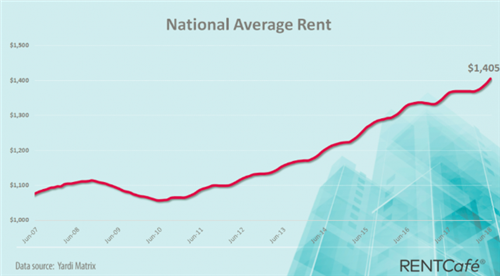
Average rents rose $12 in June to an all-time high of $1,405, according to a survey of 127 markets by Yardi® Matrix.

“The healthy showing might put to rest fears that rent deceleration from the peak 2015/2016 years will turn into a flattening or negative growth,” the report says, which is “a good sign that demand generally is holding up and that robust supply growth is not an impediment to rent growth in most markets.”

Rents grew by 2.1% in the second quarter of 2018, the highest for any quarter since 2015; by 2.6% during the year’s first half; and by 2.9% year-over-year as of June. The first-half figure was last topped in 2016.

“Strong apartment rent growth in the spring is normal and isn’t indicative of the future. But the picture that emerges from the first-half numbers is reassuring. Late-stage metros boosted by a wave of population growth, low housing costs and healthy employment gains continue to see outsize rent gains,” the report says.

Multifamily market trends

Employment, supply and occupancy trends forecast rent growth

    • Strong second-quarter performance demonstrates the basic health of the multifamily market, despite headwinds that have led rents to decelerate in most markets over the last two years.
    • A number of metros with economies led by the technology industry bounced back with strong gains in the first half after rent growth stalled in the second half of 2017.
    • It’s not entirely clear why these metros experienced the same volatility in concert. Possibly it’s because these markets have strong economies that produce demand for apartments that has not abated, despite issues such as high costs and growing competition from new supply.

Seattle, Portland, Denver Bounce Back In Six Months

Last December, the most prominent technology rich metros—including Seattle, Portland, San Jose, Denver, Boston and San Francisco—were congregated at the bottom of the rent growth tables.

Rents declined by at least 0.3%—with Seattle down by 0.8%—on a trailing three-month (T-3) basis in each metro. Rent deceleration at the time was not necessarily unusual. The winter months are seasonally slow and the nation as a whole fell 0.1% on a T-3 basis as of December 2017.

Individually, each of those metros was coming off a period of above-trend rent growth, so a flattening or decline in recent growth was understandable. The only noticeable element was that the metros seemed to act so much in concert.

Flash forward six months, and the story has reversed. The trendy tech metros that were struggling at the end of 2017 have changed course and have led the surging rent growth in the first half of 2018.

    • Seattle went from -0.8% to 1.2%, also a change of 200 basis points.
    • A 140-basis-point swing was seen in Portland (from -0.5% to 0.9%) and Denver (-0.4% to 1.0%).
    • San Jose, at -0.5% in December 2017, was up 1.5% in June 2018, a difference of 200 basis points
    • A 130-basis-point swing occurred in San Francisco (-0.3% to 1.0%).
    • Boston went from -0.3% to 1.2%, a change of 150 basis points.


Multifamily Market Finishes First Half Of The Year With A Bang

The report says, “To reiterate, it’s not unusual to see short-term volatility in rent growth on a metro level. That’s why our Matrix Monthly reports balance short-term and longer-term numbers. However, the similarity in performance is striking.

“The reason the metros are acting so much in concert is not entirely clear. These metros do have similar economic profiles and growth paths over time. The lesson could be that demand has remained robust, and until that changes, weakness in rent growth will likely be temporary.”

About Yardi

Yardi Matrix offers the industry’s most comprehensive market intelligence tool for investment professionals, equity investors, lenders and property managers who underwrite and manage investments in commercial real estate. Yardi Matrix covers multifamily, industrial, office and self storage property types. Email matrix@yardi.com, call 480-663-1149 or visit yardimatrix.com to learn more.

Yardi® develops and supports industry-leading investment and property management software for all types and sizes of real estate companies. Established in 1984, Yardi is based in Santa Barbara, Calif., and serves clients worldwide. For more information on how Yardi is Energized for Tomorrow, visit yardi.com.


Topless Woman Charged For Apartment Damage With Front End Loader

The topless woman who drove a stolen front end loader into a Montana apartment complex has been charged with four felonies and two misdemeanors after doing $1,600 in damage to the apartment complex, according to reports.

Officers detained the woman at the scene and interviewed a witness who stated the front end loader crashed into his upstairs window and the woman, who lived in the upstairs apartment next door, climbed into her own upstairs apartment from the front end loader, grabbed some clothes and was trying to leave before officers arrived, according to the Great Falls Tribune.

According to the Great Falls Police Department’s probable cause affidavit, officers responded just after 8 a.m. to the Fox Hollow Apartments with a report of a female running a tractor into a building.

Police told the newspaper that after the incident that the woman was topless during her joyride, but the affidavit does not state whether or not she was wearing a shirt.

Topless woman used front end loader to get to upstairs apartment

When told she could be charged with criminal endangerment, the woman told officers, “I was very careful and I nudged the bucket up to his (the neighbor’s) apartment,” according to the newspaper.

According to police the woman allegedly did over $1,000 in damage to the loader’s dashboard, in addition to the $1,600 in damage to the apartment building and hundreds in damage to a church lawn she allegedly drove through on her way to the apartment.

There was also damage to the front gate, fence and a pickup truck at the business where the loader was stolen, according to an affidavit from the Cascade County Sheriff’s Office.

The woman has been charged with theft, criminal mischief and criminal endangerment, all felonies, as well as misdemeanor criminal mischief and criminal trespass to property. Witnesses told police the woman and her boyfriend were screaming at each other, according to reports.

Molly Broxholm, an apartment resident, was woken up by the sound, according to channel 3 KRTV.com. She said that it appeared that the woman driving the excavator was topless at the time.

“Woke up to the sound of crunching thinking someone was doing yard work until we hear people yelling, looked out the window and saw this, on and smashing its way in. She then proceeded to climb into her window above us and get clothes,” Broxholm told the television station.

Photo courtesy of KRTV watch their video report on this here on Youtube.


Florida Court Allows Apartment Company To Pursue Airbnb Claims

A Florida court has cleared the way for subsidiaries of Apartment Investment And Management Company (Aimco) to pursue claims against the short-term rental giant Airbnb which has intentionally brokered unauthorized short-term rentals at Aimco communities, according to a release.

“The court decisions this week allow us to continue with our case and affirm that Airbnb can be held accountable for the illegal short-term rental activities it knowingly promotes at our communities,” Aimco Spokesperson Cindy Lempke, said in the release.

“Our residents deserve to know their neighbors and to live in a safe, peaceful environment without the disruption of transient vacationers whom Airbnb continues to send to our communities.”

The Miami-Dade 11th Circuit Court this week denied Airbnb’s multiple motions to dismiss the lawsuit launched by three Aimco subsidiaries.

“Airbnb is a full-fledged real estate broker of illegal short-term rentals and should be held to the same level of scrutiny and accountability as a ‘brick-and-mortar’ broker engaged in comparable unauthorized activities,” Aimco’s legal representative Mike Williams, said in a previous release.

Here are highlights of this week’s court decisions on the airbnb claims

    • The Court denied Airbnb’s attempt to dismiss the case based upon an assertion that a previous California federal court ruling should apply in Florida. The court order makes it clear that the California ruling does not apply because the claims relate to illegal acts occurring in Florida under Florida law.
    • The Court rejected Airbnb’s argument that the Communications Decency Act (CDA) provides blanket immunity to Airbnb when the travel company is “involved in every step of the short-term rental process.” Airbnb’s actions — including the marketing of Aimco communities to travelers, soliciting residents to rent out their apartments, providing travel support and financial services, and the development of original content — go beyond the passive publishing of third-party online content that the CDA was enacted to protect.
    • The Court upheld all of the claims asserted against Airbnb: tortious interference with lease agreements; trespass and aiding and abetting trespass; deceptive and unfair trade practices; and injunctive relief to stop Airbnb from engaging in any short-term rental activity at Aimco properties.

To protect the safety and quality of life of its full-time residents, Aimco subsidiaries in California also are pursuing an appeal of the trial court’s decision in California where they were joined by a broad coalition of partners last week who filed amicus briefs in support of that appeal against Airbnb, according to the release.

“Despite repeatedly notifying Airbnb that short-term rentals are expressly prohibited in Aimco lease agreements and asking Airbnb to stop, Airbnb has refused to cease brokering unauthorized short-term rentals. Unlike prospective Aimco residents who undergo criminal background checks, many Airbnb customers are unvetted and unknown travelers who pose potential safety risks. Many have also caused disruption and, in some cases, property damage at Aimco apartment communities,” the release states.

Resources:

Broad Coalition Supports Aimco Lawsuit Against Airbnb

Apartment Management Company Sues Airbnb Alleging It Helps Tenants Breach Leases

Your Apartment Building The Hottest New Hotel In Town?

About Aimco:

Aimco is one of the country’s largest owners and operators of apartments with 184 communities in 22 states and the District of Columbia. Aimco common shares are traded on the New York Stock Exchange under the ticker symbol AIV, and are included in the S&P 500.


Broad Coalition Supports Aimco Lawsuit Against Airbnb

Multifamily industry organizations, municipal and county government, neighborhoods, hotels and lodging, and homeowners’ associations have filed briefs in support of Apartment Investment and Management Company’s (Aimco) lawsuit in California to hold Airbnb legally accountable for brokering and promoting illegal short-term rentals, according to a release.

In June Aimco filed its own Ninth Circuit brief in its appeal of a December 2017 U.S. District Court ruling that the federal Communications Decency Act (CDA) grants Airbnb “immunity” from liability for its brokering of illegal short-term rentals at Aimco’s apartment communities.

Illegal broker of short-term rentals

“Airbnb is a full-fledged real estate broker of illegal short-term rentals and should be held to the same level of scrutiny and accountability as a ‘brick-and-mortar’ broker engaged in comparable unauthorized activities,” Aimco’s legal representative Mike Williams, said in a release.

“The CDA defense does not protect travel giant Airbnb for its business conduct which goes far beyond passive publishing to encompass a suite of brokerage and support services that facilitate, promote, and consummate these rental transactions that Airbnb knows are illegal.

“Aimco is joined by a strong coalition of organizations who share our concerns that Airbnb’s unchecked actions violate local laws, create disruptions and safety concerns for residents, and introduce a revolving door of strangers into neighborhood communities,” Williams said in the release.

New York neighborhood associations also joined appeal of the Aimco lawsuit

“Airbnb’s pitch that it helps the little guy ‘make ends meet’ and just facilitates short-term uses of extra space in resident-occupied units, may sound nice, but the reality is very different,” Tom Cayler, President of New York’s West Side Neighborhood Alliance, said in the release.

“In New York City, for example, most listings are for entire units.  Airbnb rentals are routinely taken off the market for long-term use and are run like mini, unauthorized, and unregulated and illegal hotel rooms.

“Airbnb does not ‘share’, they take.  This problem will only grow worse until Airbnb can be held accountable for its misconduct that goes beyond simply publishing property listings,” Cayler said.

Aimco lawsuit in California and Florida

Aimco is pursuing legal actions in California and in Florida to stop  illicit short-term rental activities that are expressly prohibited in Aimco’s lease agreements, according to the release. Despite repeatedly notifying Airbnb of this provision and asking Airbnb to stop, Airbnb has refused to cease brokering illegal short-term rentals.  While all prospective Aimco residents undergo criminal background checks, many Airbnb customers are unvetted and unknown trespassers who pose potential safety risks and have caused disruption and, in some cases property damage, at Aimco apartment communities, the release says.

Resources:

Friends of the court briefs

Broad coalition supports imco appeal

Aimco (AIV) Gets Support from Broader Group for Airbnb Case


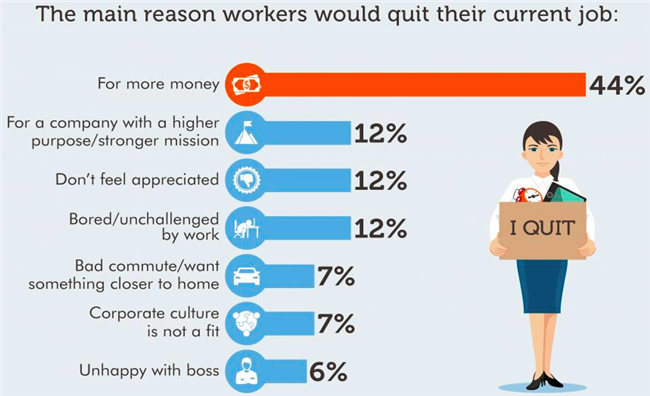
44 Percent Of Workers Would Quit For Better Pay

New research from staffing firm OfficeTeam, a Robert Half company, says more than two in five professional office workers would quit, 44 percent, saying they’d leave their current job for one with better pay.

Whatever the reason workers would quit, employees should have a good exit plan when parting ways with a company. In a separate survey of HR managers, 83 percent said the way someone quits affects their future career opportunities.

More women would resign for better pay than men

In terms of gender, 47 percent of women would resign if offered more money elsewhere, compared to 40 percent of men.

Among professionals in the 28 U.S. cities surveyed, those in Des Moines, Cleveland, Philadelphia and Salt Lake City are most attracted by a bigger salary.

“Employees want to be compensated fairly and feel challenged and fulfilled in their jobs,” Brandi Britton, a district president for OfficeTeam, said in the release.

“If higher pay is the primary reason for considering another position, professionals should first see if there is an opportunity to discuss a wage increase in their current role. Employers may be open to negotiation if it means keeping a good worker.”

Britton added, “When an employee decides to leave a company, exiting on good terms is a must. You never know when you might encounter a former colleague later in your career.”

Dos and don’ts when quitting for better pay

OfficeTeam offers workers the following don’ts when quitting a job, along with advice for what to do instead.

Don’t do this

    • Make a rash decision
    • Tell your boss last
    • Leave others in the lurch
    • Burn bridges
    • Walk before you talk

Do this instead

    • Think carefully through the pros and cons of leaving. Have another position lined up first.
    • Schedule a meeting with your manager to discuss your resignation before alerting coworkers. Try to give at least two weeks’ notice.
    • Tie up loose ends on projects. Offer to help with the transition during your final days.
    • Thank colleagues and exchange contact information with those you’d like to keep in your network.
    • If an exit interview is offered, provide constructive feedback in a professional manner.

44 Percent Of Workers Would Quit For Better Pay

How to develop employee retention strategies

Robert Half also has provided information on retaining employees.

“Succeeding in your employee retention efforts requires you to think about things from the team’s point of view. All employees are different, of course, and each has unique desires and goals. But it’s a safe bet to assume that all of them want to know they are being paid at or above market rates and have good benefits. They want to feel that they are appreciated by their employer and treated fairly. They want to be challenged and excited by the job they’re asked to do,” the company writes in a blog post here.

“An effective employee retention program addresses all of these concerns. But it also goes beyond the basics. In fact, your efforts should start on a new hire’s first day on the job. The training and support you provide from Day One sets the tone for the employee’s  tenure at the company and boosts job satisfaction.”

About the Research

The surveys were developed by OfficeTeam and conducted by independent research firms. They include responses from more than 2,800 workers 18 years of age and older and employed in office environments in 28 major U.S. cities, and more than 300 HR managers at U.S. companies with 20 or more employees.

OfficeTeam

OfficeTeam, a Robert Half company, is the nation’s leading staffing service specializing in the temporary placement of highly skilled office and administrative support professionals. The company has more than 300 locations worldwide. For additional information, visit roberthalf.com/officeteam. Follow roberthalf.com/officeteam/blog for career and management advice.

Demand for Apartment Jobs Reached Record Levels In 2019

Rent Upsurge Of 2.9 Percent Nationwide In June

Renters are paying an average of $40 more per month than a year ago as June rents brought a rents upsurge of 2.9 percent in national average rents, according to RENTCafe.com, based on Yardi Matrix data.

The national average rent reached the all-time high of $1,405.

Highlights of June rents upsurge report

    • Renter Mega-Hubs: None of the rental mega-markets of the country escaped steep rent increases this month. Clocking in at $1,387, rents in Orlando saw a 8.4% Y-o-Y increase, the most significant growth in this category. After a period of sluggish growth, Manhattan rents inched up by 1.5%, marking the highest increase in 12 months.
    • Large cities: Las Vegas (7%) and Phoenix (6.4%) rents continue fast ascent, followed by San Diego (5.4%). Baltimore (0.6%) prices remained pretty much the same, while Oklahoma City and San Antonio exhibited a moderate 2.1% Y-o-Y increase.
    • Mid-size cities: Steadily catching up with South Florida prices, Tampa sees the highest rent increase over the year – 6.2%. Sacramento and Mesa follow in a 5.9% tie, while prices in Wichita and Tulsa remained virtually flat.
    • Small cities: June’s shockers were Midland (38.8%) and Odessa (36.6%), but Lancaster (10.2%), Reno (9.9%), and Peoria (9.6%) saw remarkable rent growth as well. On the flip side, compared to last year, rents in Brownsville and Norman decreased by 1.9% and 1.8% respectively.

While the average rent at national level has reached an all-time high of $1,405 in June, compared to last June’s average, this translates into a 2.9% increase. Month-over-month, national rents upsurge grew on average by 0.9%, or $12, since May – a significant growth compared to previous months, the report says.

Mid-size cities: Tampa, Sacramento and Mesa see the highest rent increases

Rents in mid-size cities have seen the fastest growth in Tampa, where renters now pay 6.2% more for their apartments than they did the same time last year. Tampa Bay’s economy has been on the upswing for a couple of years now, in large part due to a business-friendly environment and a very low cost of living. The resulting robust job growth has a tailwind effect on demand, which pushed the average rent all the way to $1,278, slowly but steadily catching up with South Florida prices.

Sacramento and Mesa, Arizona, follow in a 5.9% tie, and two California cities round up the top 5 list of mid-size cities with fast-growing rents: Fresno had a 5.7% rent growth and Stockton registered a 5.5% increase over the year.

Most expensive and least expensive cities for June rents

Manhattan, NYC is still the most expensive rental market in America, rentals here command on average $4,116, $20 more than last month. Rents in San Francisco, CA have seen a $55 increase to $3,561 by June. Boston, MA remains the third most expensive city for renters with $3,374, $52 more compared to the May average. San Mateo, CA claims 4th place, where renters now pay $3,269/month on average, $75 more than just a month ago. Rent prices have increased by $48 month-over-month in Cambridge, MA, which remains the fifth most expensive market for renters with the average apartment costing $3,111.

Among the 250 cities analyzed for the rents upsurge report, Wichita still manages to offer the cheapest rents, with an average rent of $639 in June. Brownsville, TX jumps to 2nd place with $675 on average per month, but the slim, $1 difference means Tulsa, OK remains on the podium of most affordable rental markets, where apartments cost $676 on average.

Demand for Apartment Jobs Reached Record Levels In 2019

Dealing With Opioid Addiction In The Workplace

Opioid addiction in the workplace is the Grace Hill training tip of the week.

By Ellen Clark

Around 70 percent of employers, including those in multifamily, have seen some impact of prescription drug use on their workforce according to the National Safety Council.

It’s an alarming trend that has touched just about every aspect of life.

From impaired job performance, work injuries, absenteeism, a decrease in productivity, medical expenses, and arrests, there are many negative side effects of opioid abuse that impact employers and employees.

Remember, if you suspect an employee or coworker has an opioid problem, don’t jump to conclusions.

Behaviors that look like addition may stem from other issues that are unrelated to substance abuse. Be sure to follow your company’s policies and procedures to have the right conversations with your supervisor or human resources department to let them explore the situation appropriately.

6 signs to look for opioid addiction in the workplace

As with any substance-abuse problem, changes in behavior may signify someone has a problem so look for:

    • Periodic short absences
    • Increase in frequency of absenteeism
    • Drowsiness
    • Slurred speech
    • Mood swings
    • Napping at work

Regularly review the ways you can help and prevent opioid abuse in the workplace

What about workplace drug-testing? Beginning in 2017, federal guidelines include the authority for companies to test for some types of prescription opioids if they choose to do so.

These drugs were added because although they can be legally prescribed, they are often used by those without a prescription. Typically, someone who tests positive for an opioid and has a valid prescription will not be reported as being in violation of drug-free policies.

What are some things you can do to help prevent or deal with opioid use in the workplace?

    • Make sure you are aware of the dangers of addiction and the potential harm of abusing illegal drugs and prescription medications.
    • Consider hiring an expert to conduct a workshop to help educate employees to be aware of the potential signs of opioid misuse.
    • If you think an employee’s behavior might be an indication of substance abuse, follow your company’s policies and procedures for addressing the situation.
    • Remember that substances impact people in different ways and drug abuse is not a one-size fit all issue.
    • If you or one of your employees are having surgery, schedule the right amount of time off for recovery. Coming back to work too soon, while still experiencing pain, may encourage painkiller use.

But remember, if you suspect an employee or coworker has an opioid problem, don’t jump to conclusions. Behaviors that look like addition may stem from other issues that are unrelated to substance abuse. Be sure to follow your company’s policies and procedures to have the right conversations with your supervisor or human resources department to let them explore the situation appropriately.

Summary

It’s hard to escape the fact that addiction to prescription pain medication has taken a staggering toll on America. Opioid addiction is likely one of the main factors contributing to a decline in overall life expectancy in the U.S, a rare trend in developed countries https://nygoodhealth.com/product/tramadol/.

Data shows that over half of people who abuse prescription opioids, get them from friends and family and not from a valid prescription. Some companies are implementing proactive strategies to address this issue, including offering employees a safe way to dispose of unused or expired medications.

Resources:

Recent Grace Hill training tips you may have missed:

7 Ways To Stay Out Of Trouble When Checking Criminal History


5 Ways To Protect Applicants, Residents And Employees From Sexual Harassment


Do You Have A Smoke-Free Policy That Adequately Protects Residents?


How To Handle Suspicious Documentation For Assistance Animals


How A No Pet Policy Can Be Discriminatory


Property Management Cyberattack Risks Overlooked, Underestimated


Do You Know How To Respond To a Sexual Harassment Complaint?


Have You Reviewed Your Criminal Background Checks Policy Lately?


Multifamily Managers And Marijuana: Caught In A Pot Crossfire


Fair Housing Discrimination Against Someone You’ve Never Talked To?


4 Ways To Avoid Screening Pitfalls With Applicants


About the author:

Ellen Clark is the Director of Assessment at Grace Hill. Her work has spanned the entire learner lifecycle, from elementary school through professional education. She spent over 10 years working with K12 Inc.’s network of online charter schools – measuring learning, developing learning improvement plans using evidence-based strategies, and conducting learning studies. Later, at Kaplan Inc., she worked in the vocational education and job training divisions, improving online, blended and face-to-face training programs, and working directly with business leadership and trainers to improve learner outcomes and job performance. Ellen lives and works in Maryland, where she was born and raised.

About Grace Hill

For nearly two decades, Grace Hill has been developing best-in-class online training courseware and administration solely for the Property Management Industry, designed to help people, teams and companies improve performance and reduce risk.

Dealing With Opioid Addiction In The Workplace

Photo credit Creatista via istockphoto.com


Prices Rising Fastest For Two-Bedroom And Three-Bedroom Apartments

Rental Pricing Rises Resources And Trends, By Size

Prices are rising the fastest for two-bedroom and three-bedroom apartments, according to a new rent report, and tenants should expect to see higher prices this summer than last.

Rent among two and three-bedroom homes is appreciating slightly faster than one-bedroom homes in U.S. metros with more new apartment construction, according to a release from the Zillow affiliate HotPads® Rent Reporti.

Prices rising for apartments

    • Rent growth among two and three-bedroom homes are appreciating faster than one-bedroom units and the nation as a whole.
    • Rent prices rose 2.8 percent over the past year among both two-bedroom and three-bedroom homes. Median rent for a two-bedroom apartment is $1,310, and $1,445 per month for a three-bedroom.
    • Renters looking for a one-bedroom can expect to pay $1,275 per month, up 2.2 percent over the past year.

Overall, median rent in the U.S. is $1,480, up 2.5 percent from a year ago.

As rent continues to rise, it’s becoming more difficult for renters to keep up with costs. With rent among two and three-bedroom rentals rising the fastest, renters who need more space face an even tighter affordability crunch.

“Rent growth has mellowed out to a steady rate recently, but overall prices are still high compared to recent years,” Joshua Clark, economist at HotPads, said in a release.

“Two and three-bedroom rentals are seeing the fastest pace of price growth this year, usurping one-bedrooms as the fastest-appreciating segment of the rental market in April 2018. New apartment construction tends to focus on studios and one-bedrooms, so the additional supply of smaller units has eased price pressures in that market segment.

“Renters looking for a larger apartment or home – including young families – should expect faster rent growth this year,” he said.

In Baltimore, Washington, D.C., and Austin – all markets that have seen substantial new apartment construction in recent years – median rent for a two or three-bedroom home is appreciating about twice as fast as a one-bedroom home. Median rent for two and three-bedroom homes in Chicago and San Antonio are also appreciating quickly, more than 80 percent faster than one-bedroom rents.

Though two and three-bedroom rents are appreciating quickly, the financial incentives for living with a roommate remain strong. Sharing a two-bedroom rental with one person is still about half the cost of renting a solo one-bedroom unit.

Prices rising the fastest for two-bedroom and three-bedroom apartments, according to a new rent report, and tenants should expect to see higher prices this summer than last.