Multifamily market rent declines in November reflected the normal seasonal fluctuation, are no cause for alarm, and demand remains strong, according to the latest report from Yardi Matrix.
“Multifamily rent growth in 2018 stands at 3.1%, higher than most estimates coming into the year. Rents have stalled in the fourth quarter, a typical pattern, declining by $3 from their September peak,” Yardi Matrix said in a release.
Highlights of the multifamily market report
U.S. multifamily rents fell by $2 in November, dropping to $1,419, while year-over-year growth fell by 10 basis points to 3.1%. Rents are down $3 from the peak of $1,422 in September.
The small decline can be chalked up to normal seasonal fluctuation. Demand has remained strong as the occupancy rate has stayed stable for the last six months despite the growth in supply in many metros.
Rent growth continues to be strongest in the West, Southwest and Southeast. Las Vegas and Phoenix have the highest rent growth, and five of the top 10 metros are in California.“Demand continues to be the main driver of the robust market, as new household formation helps fill new multifamily supply. “It’s a testament to the economy’s strength that most of the metros with the highest supply pipelines are maintaining occupancy rates and moderate rent growth,” the report says, including:
Nashville
Austin
Denver
Miami
Year-over-year rent growth leaders for November were:
Las Vegas
Phoenix
California’s Inland Empire
Atlanta
Orlando
What is the outlook for capital in multifamily markets
“One of the strengths of the multifamily market in recent years is the availability of capital, especially debt,” Yardi Matrix says in the report.
“Despite some concerns about the durability of the economic expansion, the healthy capital environment should continue through 2019. If anything, the worries might be working in favor of multifamily, as lenders are increasingly looking to book loans on less risky assets and property types. Plus, Fannie Mae and Freddie Mac have dominated the apartment debt market since the recession, which makes other lenders more eager to originate multifamily loans.”
Capital trends in commercial real estate are likely to remain healthy, and multifamily stands to benefit.
Lenders are discriminating among property types and trying to incorporate less risky asset classes into portfolios. That means more multifamily and industrial and less retail and niche property types.
Lenders are acting much differently at this stage of the cycle than the last time around, when loan terms became ever more aggressive until the market collapsed. In the next downturn, debt sources will have much less capital at risk.
About Yardi Matrix
Yardi Matrix offers the industry’s most comprehensive market intelligence tool for investment professionals, equity investors, lenders and property managers who underwrite and manage investments in commercial real estate. Yardi Matrix covers multifamily, industrial, office and self storage property types. Email matrix@yardi.com, call 480-663-1149 or visit www.yardimatrix.com to learn more. Yardi® develops and supports industry-leading investment and property management software for all types and sizes of real estate companies. Established in 1984, Yardi is based in Santa Barbara, Calif., and serves clients worldwide. For more information, visit www.yardi.com
8 ways to reduce winter slips and falls is the rental property maintenance checkup this week provided by Keepe.
In the winter, snow, ice and freezing cold temperatures create the perfect conditions for accidents like slips, trips and falls, well except for our friends in Arizona and parts of California who have to deal with wet weather at times in the winter.
These winter-related accidents are very common and can be extremely dangerous, especially for senior citizens. Use these 8 tips to ensure your tenants stay safe this winter season.
How to reduce slips and falls at your rental properties
Watch for things at your rental properties that can cause winter slips and falls.
Non-slip tapes: A simple way to add protection to your floors are by adding peel and stick non-slip tapes. These tapes are easy to apply and provide increased security on floors and stairs.
Stair Treads: Tread covers and nosing are another great preventative solution for stair-related accidents. Indoor and outdoor stairs of any material can benefit from stair tread nosings. The long-lasting material resists chips, scratches and stains.
Absorbent mats: Absorbent mats are great solutions for walkway areas and entry areas throughout the property. These mats will absorb all liquids while preventing floor stains.
Lighting: Make sure there are good lighting systems throughout your outdoor and indoor property. Use motion-sensor lights if you’d prefer an energy efficient solution.
Clean up: Keep common areas and walkways clean and tidy. Keep electric cords and telephone wires near walls and away from walking paths. Clean up indoor spills and puddles immediately.
Spot check for hazards: Identify potholes and cracks outdoors that may cause issues and arrange repairs before it snows. Check entrance steps and handrails for damage and repair accordingly.
Indoor snow removal: When snow is tracked indoors, interior surfaces can become dangerous. Use a floor fan to keep walkways dry and place “wet floor” signs in needed areas to alert incoming residents of caution areas.
Outdoor snow removal: Discuss with your maintenance staff which areas you expect snow and ice accumulation to be removed and treated. Ensure snow is piled in a low area to prevent melting and refreeze.
Snow removal at your rental properties can help reduce winter slips and falls.
Prevent winter accidents at your rental property by making your space safer with these easy and affordable solutions. Maintaining a safe place during dangerous wintry conditions will go a long way in tenant relations.
Other recent rental property maintenance Keepe posts you may have missed:
Keepe is an on-demand maintenance solution for property managers and independent landlords. The company makes a network of hundreds of independent contractors and handymen available for maintenance projects at rental properties. Keepe is available in the Greater Seattle area, Greater Phoenix area, San Francisco Bay area, Portland, San Diego and is coming soon to an area near you. Learn more about Keepe at https://www.keepe.com
Landlords and tenants in Seattle have filed a class action lawsuit challenging the city’s use of warrantless mandatory rental inspections, according to a release from the Institute for Justice.
The lawsuit, which was filed in King County Superior Court, argues that the city’s program is a clear violation of the Washington state constitution’s mandate that “no person shall be disturbed in his private affairs, or his home invaded, without authority of law.” Yet, in Seattle, that is exactly what happens when the city forces landlords and tenants to submit to a warrantless search, according to the release.
“By subjecting tenants to random, government-mandated inspections that would not occur if that same person owned their home, Seattle is treating renters like second-class citizens,” William Maurer, the managing attorney of the Institute for Justice’s Washington state office, said in the release.
Attorney William R. Mauer
Tenants should be able to just say ‘No’ when inspector shows up
Tenants should be able to say no to mandatory rental inspections when inspectors show up.
“Your home is your castle, regardless of whether you rent or own it. It is plainly unconstitutional for Seattle to force renters to open up their homes to government inspectors when nothing is wrong inside,” Maurer said. “The lawsuit seeks to do one simple, but important, thing—allow tenants to exercise their constitutional rights and say ‘no’ when an inspector shows up without a warrant.”
“It should be up to tenants to decide whether they want a stranger entering their home” Institute of Justice attorney Rob Peccola, said in the release. “The fact that someone rents, rather than owns their home should not give the government the right to disrupt their life, invade their privacy and search their homes even when there is no evidence that anything is wrong.”
Attorney Robert Peccola
Law makes landlords to the city’s work
“The law makes landlords do the city’s dirty work when a tenant says no to an inspection,” Peccola said in the release.
“The city has never attempted to get a warrant—that would mean forcibly entering over the objections of people the law was meant to help—so instead it fines landlords upwards of $500 per day until they can coerce their tenants to allow the inspection. The city is essentially fining landlords for refusing to violate their tenants’ privacy.”
This lawsuit does not seek to stop the city from inspecting rental units where the tenants agree to the inspection or keep the city from addressing problem properties. Rather, the suit seeks to stop the city from entering the private homes of Seattle’s renters unless the city gets the tenant’s consent or obtains a warrant based on evidence of a specific problem, according to the release.
John B. Heiderich and Gwendolyn A. Lee, have owned and operated rental properties in Seattle for more than forty years. They are Keena Bean’s landlords and plaintiffs in the lawsuit.
How the Seattle inspection law works
Under Seattle’s program, each year the city randomly chooses roughly 10% of the rental units in Seattle for a mandatory inspection.
Owners of buildings with more than one rental unit may choose to have a sample of at least 20 percent of the units in a building inspected (up to 50 total units), with the city choosing which units to inspect.
Anyone renting an apartment or home chosen by the city must allow inspectors into their home to inspect it for housing code violations, even if they do not consent and the city does not have a warrant. The law offers no options for tenants or their landlords to object to the search.
For many years, Seattle addressed housing code violations in rental housing using a complaint-based system. But in 2013, Seattle, like an increasing number of municipalities, switched to a proactive rental inspection system, the Rental Registration and Inspection Ordinance, or RRIO, which took effect in 2015.
What the tenants have to say about the mandatory rental inspection law
Plaintiffs Matthew Bentley, Wesley Williams (pictured above), and Joseph Briere—along with their landlords, plaintiffs Sarah Pynchon and William Shadboldt—know firsthand that Seattle does not respect tenants’ privacy.
Earlier this year the city informed the landlord for renters Matthew Bentley, Wesley Williams, and Joseph Briere, that their home needed to be inspected. Bentley, Williams, and Briere, along with their three other roommates, have nothing to hide. But because their home is in great shape and they all value their privacy, they informed the city that they did not want their home inspected. The city responded by threatening fines upwards of $500 per day if their landlords did not somehow coerce the housemates to allow the unconstitutional inspection.
Plaintiff Keena Bean is a tenant in an apartment home that is currently subject to Seattle’s rental-inspection program. Ms. Bean is a young professional who cares about maintaining privacy in her home.
“For me, it’s not only a matter of privacy but also of security,” Keena Bean, one of the tenants who filed suit said in the release. “I’m a young woman living alone in the city, and I take my personal safety very seriously.
“Deciding whether or not to let a stranger into my home is something that should be left 100 percent up to me. Just because I rent doesn’t mean the government can force its way into my bedroom and through all of my personal belongings,” she said in the release.
Bean’s landlords, plaintiffs John B. Heiderich and Gwendolyn A. Lee, have owned and operated rental properties in Seattle for more than forty years.
“They care deeply about their tenants and cultivate long-term relationships with their renters. They are unwilling to act as the vehicle by which the city will intrude into Ms. Bean’s home without her consent and are committed to helping their tenant protect her constitutional rights,” according to the release.
About the Institute For Justice
The Institute for Justice, which has an office in Seattle, is a nationwide, public interest law firm that stands up for citizens’ constitutional rights and liberties. It has filed three previous lawsuit challenging rental inspection laws in Redwing, Minn., Golden Valley, Minn., and Pottstown, Penn. Through strategic litigation, training, communication, activism and research, the Institute for Justice advances a rule of law under which individuals can control their destinies as free and responsible members of society. IJ litigates to secure economic liberty, educational choice, private property rights, freedom of speech and other vital individual liberties, and to restore constitutional limits on the power of government
October and November now look like a short-lived two-month hiatus from rent increases as December apartment rents for one-bedrooms rose nationally by .57 percent or a modest $6, according to the Abodo National Apartment Rent report.
“Two-bedroom units rebounded slightly, also close to their January levels with a $13 or .08 percent increase. These minimally meandering prices don’t look like they are trying to break out of the 2018 doldrums, however,” the report says.
One-bedroom apartment rents recap
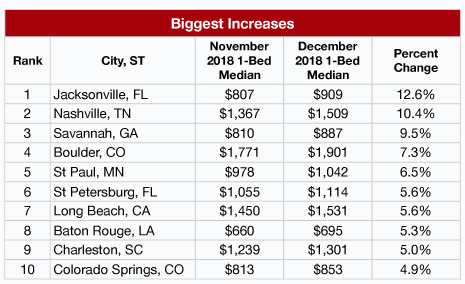
“Let’s get specific. Sometimes we see a statistical anomaly like the top ten December increaser, Jacksonville, FL, with a strong move of $102.00 or 12.6 percent. Music City Nashville, TN came in a strong second with a 10.4 percent increase.
“Savannah, GA was not far behind, moving from $810 to $887—a 9.5 percent rise. Batting cleanup was pricey Boulder, CO with a solid 7.3 percent rise to $1,901, perilously close to the magic $2000 mark.
“More reasonable St. Paul, MN followed with its $1,042 median December rent increasing by 6.5 percent, and St. Petersburg, FL and Long Beach, CA tied for sixth place both reporting 5.6 percent increases.
“Baton, Rouge, LA, Charleston, SC and Colorado Springs, CO called in increases of 5.3, 5.0 and 4.0 percent respectively. Conspicuously missing was Milwaukee WI, as WI average state rent declined in December by an average of $16,” the report says.
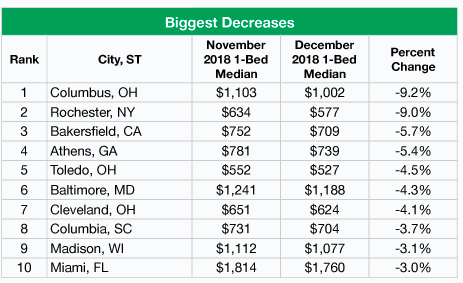
“The top losers were significant as Columbus, OH and Rochester NY lost around 9 percent. Dwight Yoakum’s favorite, Bakersfield, CA came in third with a 5.7 percent decrease to $709, and Athens, GA pulled up in fourth place as median two-bedroom rents there decreased by 5.4 percent.
“Toledo, OH, Baltimore, MD and Rock n’ Roll Hall of Fame host Cleveland OH, showed an average decrease of 4.1 to 4.5 percent, and the bottom three one-bedroom losers were Columbia, SC with a decrease of 3.7 percent, Madison, WI reporting a 3.1 percent slide, and internationally loved Miami, FL posting a 3.0 percent decline to a still stratospheric $1,760 rate per month,” the report says.
Courtesy of AbodoCourtesy of Abodo
Two-bedroom apartment rents recap
“There must be something about Nashville because like the city’s one-bedroom units, two-bedroom Nashville, TN apartments shot up significantly; the two-bedroom units rose by 12.2 percent to $1,715. Athens, GA was hot in the two-bedroom area with an increase of 10.3 percent, and college town Gainesville, FL saw two-bedroom rents rise by 5.8 percent to $1,210.
“Milwaukee two bedrooms bucked the Wisconsin trend as Brew City reported a 5.8 percent gain here.
“The next four cities were tightly bunched as Tampa, FL, Fargo, ND, Los Angeles, CA and El Paso, TX all reported increases within the 4.0 to 4.4 percent range.
“Scottsdale, AZ came in 9th with a modest 3.9 percent increase, and Colorado Springs rounded out the top ten increasers with a similar 3.8 percent rise.
“The Saints are doing well, but New Orleans two-bedroom units led the losers with a big 10.3 percent loss.
“Houston, TX and Buffalo, NY were not even close, though they posted 7.4 and 7.2 percent respective declines. Baltimore, MD, Syracuse, NY and warm Miami, FL all lost between 4.0 and 4.6 percent, although Miami’s median two-bedroom rent that clocked in at $2,211 per month is still high.
“Cleveland OH, and Memphis, TN showed almost identical 3.6 and 3.5 percent decreases, and two Texas towns—Fort Worth and Dallas—decreased by 3.2 and 2.5 percent,” the report says.
Methodology
Each month, using over 1 million ABODO listings across the United States, we calculate the median 1-bedroom and 2-bedroom rent prices by city, state, and nation, and track the month-over-month percent change. To avoid small sample sizes, we restrict the analysis for our reports to cities meeting minimum population and property count thresholds.
In a new survey 19 percent of current renters say rising mortgage rates are their biggest obstacle to buying now so many renters will now continue renting.
“Almost one in five (19 percent) renters who wish to buy said rising mortgage rates were their biggest obstacle to home buying – up from 13 percent in April, before rates hit seven-year highs,“the report says based on a Harris Poll in November.
Mortgage rates will continue to climb keeping renters as renters
Mortgage rates on 30-year, fixed rate loans have been less than 5 percent since the end of the recession, helping to buoy housing demand and keep monthly payments relatively cheap even as prices themselves rose.
But those record-low rates will come to an end in 2019, according to the Trulia report.
Housing affordability issues will keep more people as renters
Trulia says the financial impediments of homeownership are acutely felt among renters who wish to buy:
53 percent of renters say that saving enough for a down payment is the number one obstacle to homeownership.
36 percent of renters say home prices is the obstacle.
Over the past several years, home price growth has largely outpaced income growth, making for an increasingly unaffordable home-buying environment. And next year, even as growth in home prices cools, limited supply will continue to help push prices up to some degree.
“Even if inventory begins to pick up in more markets, it will be rising from multi-year lows and will take a long while to get back to a more balanced level between buyers and sellers.
“With the construction industry facing significant headwinds from the higher cost of materials and labor as well as rising interest rates, we do not expect much if any growth in new construction starts in 2019 to help alleviate inventory woes,” Trulia says in the report.
Renters summary:
“Using insights from a new Trulia survey of more than 2,000 U.S. adults aged 18 and older, conducted online by The Harris Poll, and our housing research and analysis from the past year, we are making the following predictions about the U.S. housing market in 2019:”
Nationwide housing inventory will remain tight
Worsening affordability will slow down home buying activity
Mortgage rates will continue to rise in 2019, reaching 10-year highs
Expect natural disasters to impact more communities in 2019, but have a moderate effect on the housing market overall
More millennials will become first-time homebuyers in 2019
Methodology
This survey was conducted online within the United States by The Harris Poll on behalf of Trulia from November 7-9, 2018 among 2,021 U.S. adults ages 18 and older. This online survey is not based on a probability sample and therefore no estimate of theoretical sampling error can be calculated. For complete survey methodology for this survey or previous surveys, including weighting variables and subgroup sample sizes, please contact trends@trulia.com.
A new study shows the average size of apartments has declined over the past 10 years and Seattle has the smallest apartments in the U.S.
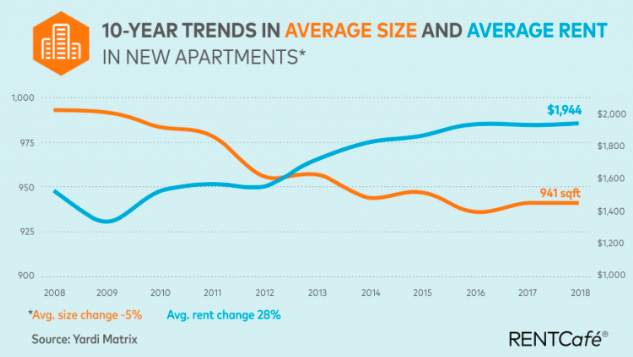
In its latest study, RentCafe, says the average apartment size has shrunk by 52 square feet over the past 10 years, now coming in at an average of 941 square feet.
Highlights of the smallest apartments in U.S. study
The average size of new apartments in the U.S. in 2018 is 941 square feet, 5 percent smaller than ten years ago, with studio apartments shrinking the most, by more than 10 percent; meanwhile, overall rents have increased by 28% over the same period of time.
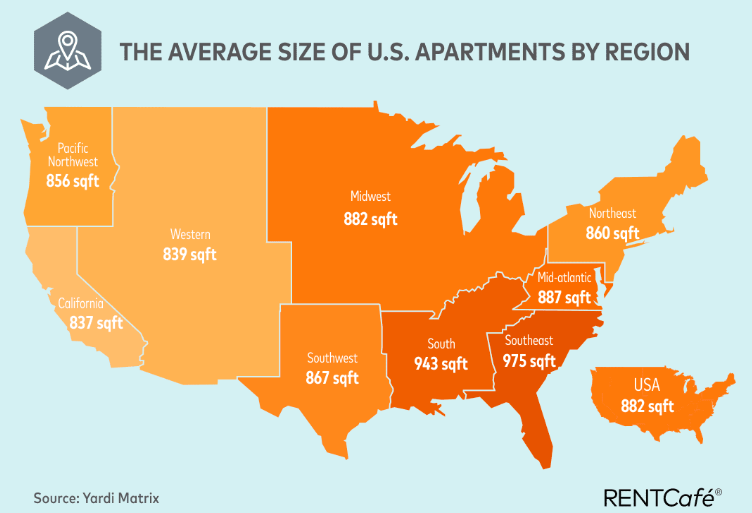
The average size of apartments regardless of year built is 882 square feet, with the largest apartments in the Southeast boasting 975 square feet of living space and the smallest in California, measuring 837 square feet.
Seattle has the smallest apartments in the U.S. with an average size of 711 square feet, Manhattan and Chicago the second smallest rentals, 733 square feet, while Tallahassee, FL offers the most spacious rentals in the U.S., 1,038 square feet on average.
Rents in newly-built apartments have increased by 28%, but their size has gotten 5% smaller compared to 2008.
Apartments in Detroit and Phoenix have suffered the biggest cuts in size over the last 10 years, 27% and 19% respectively. Los Angeles and Boston apartments are also in the top 5 in terms of size reduction.
Although rentals in San Francisco and Manhattan are among the smallest in the nation, they have been increasing in size in recent years, up by 13% and 12% respectively, compared to 10 years prior.
Denver, Colorado Springs and San Jose have seen dramatic changes in rents and size in opposite directions over the past decade. Rents here jumped 60%, while rental sizes went down between 4% and 11%.
Living habits lead to changes in apartment size
Changes in renters’ living habits are literally redrawing floor plans, according to the RentCafe study.
The largest share of apartment dwellers, millennials prefer living in locations close to restaurants and entertainment rather than having a large kitchen or living room to cook or entertain at home.
Studio apartments — the symbol of downtown living — have been cut down the most. The average studio apartment is 10% smaller than 10 years ago, reduced from 573 sqft in 2008 to 514 sqft this year.
Contrary to the growing interest in smaller units, studio apartments continue to represent a small piece of the rental market, only 5% nationally of all apartments. One-bedroom rental units make up the largest chunk of the national apartment stock (43%) and their floor plans have decreased by 4% over the last decade, while two-bedroom apartments have seen the least change in size, down by only 0.5% on average.
RentCafe ranked the top 100 cities with the largest rental stock in the country by the average size of their rental apartments.
Methodology
This report was compiled by RentCafe.com, a nationwide apartment search website that enables renters to easily find apartments and houses for rent throughout the United States. The apartment size and rent data were provided by Yardi Matrix, a RENTCafé sister company specialized in apartment market intelligence, providing up-to-date information on large-scale multi-family properties of 50 units or more in over 130 U.S. markets.
Unit types are categorized by the number of bedrooms (zero, one, two) as defined by Yardi Matrix. The regions included in this report coincide with Yardi Matrix’s market boundaries and may be different from regional boundaries as defined by other sources.
To have a pet friendly apartment, or not, is the maintenance checkup this week provided by Keepe.
As a landlord, one of the important decisions you have to make is outlining a pet policy for your property and whether you want to have a pet friendly apartment or rental.
Pets can cause damage to a property and disturb neighboring tenants, but are the pros worth it?
Here are the top pros and cons landlords should review when developing a pet policy.
4 pros for having a pet friendly apartment
Charge Higher Rent: If other rental properties in your area are not pet-friendly, you might be able to charge more for pet fees. Higher rent premiums can work in your favor long-term.
Happier Tenants: Animals can help reduce stress and be a great companion for people of all ages. Having a pet around can make your property feel more like a home for tenants.
Increase Renewals: Decrease tenant turnover and vacancy by investing in a pet-friendly property. Due to the scarcity of pet-friendly rentals, your property can remain competitive by choosing to allow pets.
Larger Tenant Pool: If you make your property pet-friendly, you will have more interested tenants interested due to demand for pet-friendly rental housing. Similarly, responsible pet owners often make suitable tenants.
3 cons of having a pet friendly apartment
Having a pet friendly apartment can help bring in a larger pool of renters.
Property Damage: Animals may damage wood flooring and carpets. Pet owners may not be very responsible at cleaning up after their pets which can lead to property damage throughout the building. Prevent this by screening pets for behavior prior to accepting a pet-owning tenants.
Odor: Pets that are not properly groomed or clean can spread unwanted pet odors throughout the building. Other tenants in the building might be allergic or move when an animal odor becomes overpowering and unpleasant.
Liability: Unauthorized pets at your property can cause a huge amount of damage towards your property and other tenants on your property if the pet bites or attacks others. With a pet policy, pet damage is covered through a pet deposit and liability coverage is covered through renter’s insurance. Without a clear pet policy, all of these potential issues will be the property owners’ responsibility.
Know the laws on assistance animals, service and emotional support animals
Remember know the law and stay out of trouble as assistance animals, service and emotional support animals are not “pets” and do not fall under a typical pet policy. Landlords are required to make reasonable accommodation for tenants with these animals.
Three laws relate to rental housing and service and assistance animals:
The Fair Housing Act (FHA)
Section 504 of the Rehabilitation Act of 1973 (Section 504)
The Americans with Disabilities Act (ADA
The FHA and Section 504 use “assistance animal” as a broad term to describe any animal that works, provides assistance, or performs tasks for the benefit of a person with a disability or provides emotional support that alleviates one or more symptoms or effects of a person’s disability.
Under the FHA and Section 504, service animals, emotional support animals, and companion animals are all considered assistance animals. An assistance animal may be any type of animal and is not required to have specific training.
Other recent rental property maintenance Keepe posts you may have missed:
Keepe is an on-demand maintenance solution for property managers and independent landlords. The company makes a network of hundreds of independent contractors and handymen available for maintenance projects at rental properties. Keepe is available in the Greater Seattle area, Greater Phoenix area, San Francisco Bay area, Portland, San Diego and is coming soon to an area near you. Learn more about Keepe at https://www.keepe.com
The Tacoma City Council has passed a new Rental Housing Code ordinance that sets out new rules for landlords who want to do extensive renovation of apartments and need to move tenants out.
The Rental Housing Code outlines notice requirements including:
• 120-day notice to vacate and relocation assistance for low-income tenants authorized by RCW 59.18.440, when a landlord intends to change the use, substantially rehabilitate, or demolish a dwelling unit.
• 60-day notice to vacate for no-cause eviction
• 60-day notice requirement for rent increase
The new Rental Housing Code also provides a requirement that landlords:
Distribute certain information
Prohibits retaliation
Allows installment payments for various deposits and fees
Provides authority to enforce violations, as well as codification of relocation assistance when the City declares a building uninhabitable.
The Rental Housing Code, which passed unanimously on November 20, permanently replaces the City’s temporary tenant protections that will sunset on January 31, 2019.
“In recent months, we have heard the stories of Tacoma residents whose lives were upended and put into crisis by eviction notices,” Mayor Victoria Woodards said in a release.
“… with the adoption of the rental housing code, we are taking a step to provide stability for renters in an increasingly expensive and tumultuous housing market,” she said.
The city said in the release “the Rental Housing Code was created through collaborative process that listened to both landlords and tenants to determine how to create policy that helps address protection needs while continuing to make Tacoma a place businesses want to operate.”
Some push back by landlords
However there was some push back by some landlords in Tacoma – some told city council the government overreach in the new ordinance could force property owners to sell their buildings and abandon their job as landlords altogether.
“I am proud the City has taken steps to prevent something like what happened at the Tiki apartments from happening again, and I appreciate the hard work from staff, landlords, and tenants that went into crafting these regulations,” Council Member Keith Blocker said in the release.
The “Notice to Increase Rent” portion of the ordinance will be effective 10 days after the publication of the ordinance, but no penalties will be issued before February 1, 2019 when the full ordinance goes into effect.
If you are managing properties, your goal is to try and put together a liveable space people will actually want to rent and knowing what eco-conscious tenants want can be important.
However, before you start, you should first try to determine your target audience, so to speak. Today, the majority of renters are, of course, young people who are just starting out in the world.
So, it’s important to keep in mind that these young people are much more eco-conscious than the previous generations and they have fully embraced the green mentality, implementing it in every single aspect of their lives. That, of course, means that you should offer them a chance to rent out green living units.
Greening up your rentals will not only boost you on the market, but it will also make your renters happier as they will finally get the chance to rent out a space that perfectly reflects their lifestyles. If you’re not quite sure how to do that, check out these tips.
Bring the nature indoors
Aside from making sure that you equip your properties with eco-friendly and energy-efficient appliances, which will only work to your advantage, you should also incorporate natural elements in your interior design as much as possible.
Natural materials such as wood, stone, brick, bamboo, jute, as well as various types of greenery, have the power to instantly transform any space, making it look and feel more soothing, cosier and homier. Therefore, implement as many of these elements as you can in your interior design, and here’s how to do it properly:
Create a statement wall with bricks
Create a statement with a brick wall and attract eco-conscious tenants. Photos credit KatarzynaBialasiewicz via istockphoto.com
Depending on the color of the brick you decide to use, you can pair it up with virtually any style. Use basic grey brick to make a statement wall in your monochrome living room, red brick if the living room style is a bit more rustic and yellow brick for an eclectic or industrial vibe. Alternatively, for a true Scandi vibe, you can even paint the bricks white. No matter which style you opt to go for, an exposed brick wall will work as an amazing backdrop, enhancing the natural vibe in the room.
Use wood in every room
Wood is one of the most versatile natural elements.
The raw beauty of wood makes it a highly sought-after element in the world of interior design. Wood comes in many finishes – from raw to high-gloss – which leaves plenty of room for imagination. So, don’t hide your wooden floors but expose them and make them work in your advantage. Also, consider adding a wooden wall panel in the bathroom to boost the spa-like feel. Finally, by using salvaged or reclaimed wood, you will add more character to your interior making it more sustainable at the same time.
Pay attention to rugs
Rugs are a somewhat controversial interior design element – people usually either love them or hate them – but that’s because a lot of people make the mistake of choosing the wrong kind of rug for their interiors.
The thing is that a good rug acts as the “it” element in any design and has the power to instantly boost any interior. Therefore, when choosing a floor covering option for your rental, you should check out natural jute rugs, not only to additionally accentuate the eco-friendly vibe in the space, but also to make cleaning and maintenance super easy.
Fill the space up with greenery
What better way to make the space greener than to actually fill it with greenery.
When choosing plants for your rental, make sure you go with the ones that are low maintenance and easy to take care of, as the last thing you want is to welcome your new tenants in an apartment filled with dead houseplants. You should also try to layer the plants instead of just randomly placing them throughout the space. The floors of your rental are reserved for tall plants with lush green leaves, window sills are the perfect place for smaller pants and succulents and there are amazing spider plants you can hang on the walls.
By including all of these solutions in your rental property’s interior design, you will make the space instantly look and feel more eco-friendly, which will help you significantly in attracting eco-conscious tenants and making your property more desirable on the market.
Seattle’s Avenue5 Residential, a private third-party multifamily property management services firm, has hired Catherrine Swaback-Jacobson as its vice president of property marketing.
In her new role, Swaback-Jacobson will lead Avenue5’s property marketing team, which includes nearly 20 multifamily experts nationwide who possess specialized knowledge of property marketing operations, holistic branding strategies, innovative demand-generation solutions, comprehensive client reporting, digital marketing automation, and in-house creative services.
“Catherine is a strategic hire for us, as we continue to focus on driving measurable marketing results by building high-performance teams and creating customized solutions that align with our clients’ diverse goals,” Kate Sibbern, chief marketing officer at Avenue5, said in a release.
“It’s critical to have the right marketing leadership in place at Avenue5, and Catherine’s expertise and technological acumen will help to support our clients in navigating a multifamily and marketing landscape that is constantly changing.”
Swaback-Jacobson is a multifamily industry veteran who has a proven track record in creating strategic marketing and branding initiatives that drive occupancy and revenue, planning and executing national marketing program rollouts, implementing successful multi-channel digital campaigns, measuring marketing program ROI, developing new business strategies and pitches, and hiring, training, and coaching associates.
She also served in marketing and operations roles at Alliance Residential for the past several years. Prior to joining the multifamily industry, Swaback-Jacobson held brand strategy and account management roles at former Phoenix-based advertising agencies E.B. Lane and Martz Agency.
Swaback-Jacobson is actively involved in industry associations, and has served as a panelist and thought leader at NAA Apartmentalize, NMHC OPTECH, the Apartment Internet Marketing Conference (AIM), and other key multifamily events.
Swaback-Jacobson’s hiring comes at an essential time for Avenue5’s marketing team, which continues to expand and develop technology-based solutions and partnerships that generate leasing traction and revenue for all properties. She will oversee Avenue5’s property marketing operations, digital marketing automation, and national programs and reporting.
“As Avenue5 continues to grow, we are committed to generating innovative marketing solutions and partnerships that ensure success across markets, property types, and asset strategies,” Sibbern said in the release. “We’re thrilled to have an industry veteran join our team, and we are confident that Catherine’s leadership vision and strong alignment with Avenue5’s culture will prove invaluable in accelerating leasing performance and revenue for the clients we serve.”
About Avenue5 Residential Avenue5, a multifamily property management services firm, oversees over 250 properties and 50,000 units in 11 states. The company is headquartered in Seattle, and has offices in Denver, Orange County, Phoenix, Portland, Salt Lake City, San Diego, Spokane, and greater Washington, DC. In addition, Avenue5 retains local experts in major markets including Northern California, Reno, Las Vegas, Albuquerque, Colorado Springs, Austin, San Antonio, Dallas, and Baltimore. The firm employs about 1,400 associates nationwide. www.avenue5.com