
Home Blog Page 169

Landlords Ask For More Changes to Proposed Portland Tenant-Screening Ordinance

Landlords Ask For More Changes to Proposed Portland Tenant-Screening Ordinance

Landlords again pushed back against a proposed Portland City Ordinance on tenant-screening criteria in a public hearing in late May asking for more changes and sharing concerns.

The council has set a vote on the ordinance for June 12. Commissioner Chloe Eudaly, sponsor of the measure, added an amendment to move implementation of the ordinance from October 2019 to March of 2020. The measure includes controversial rent-to-income ratios as well as criminal-background check requirements.

Some of the highlights of the landlord testimony included mom-and-pop landlords, larger corporate landlords and landlord organizations.

‘I did not know I was evil’

One landlord, Diane Ponti, told the council in the public hearing that she is a schoolteacher and that over 45 years she and her husband, also a schoolteacher, had bought nine rental properties.

“Tenants and landlords are both people. Like teaching school and grading papers, you can look at a bell curve and just like students you will find thoughtful and responsible landlords and tenants on one end of a bell curve. At the other end of the curve you frankly find tenants and landlords who give the industry a bad name.

“The proposed regulations do not take into account that most landlords and tenants fall somewhere on that bell curve as opposed to landlords at one end and tenants at the other. All landlords are evil and all tenants are good,” is what she is hearing.

“I did not know I was evil until I started reading the newspaper about how horrible landlords were. I came to this meeting with trepidation because I feel like the face of evil. I am a landlord. It is challenging to read that about myself. I care about the tenants I have rented to over the last 45 years. I care about the houses I bought and that the house is in good shape. And that my tenants and neighbors will get along.

“I have had tenants who have stayed in my homes for decades. I have had years where there have been no rent raises at all.  Rents have stayed flat,” Ponti said.
Landlords Ask For More Changes to Proposed Portland Tenant-Screening Ordinance
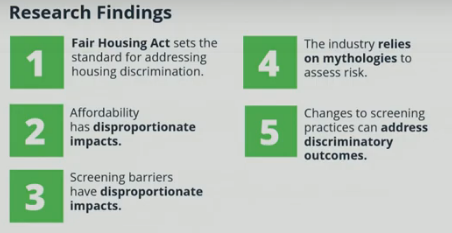
One of the slides presented at the hearing on the Portland tenant screening ordinance by Jamey Duhamel, Director of Policy, for Commissioner Eudaly.

Unintended consequences for the proposed Portland tenant screening ordinance

“The proposed regulations remind me of the bank standards that were lowered in the early 2000s when people who could not really afford to buy faced foreclosure,” Ponti told the council. “These regulations with lower income requirements are going to put tenants one paycheck away from eviction when a financial crisis arises and they cannot pay their rent.

“Mom-and-pop landlords like me will sell. I read the regulations five or six times and they are confusing, they are daunting, they are scary and they are expensive. And, I think you will reduce affordable housing when landlords like me sell,” she said.

Ward Green, an attorney in Portland, said he agrees “we share a moral obligation to provide affordable housing” but doubts this package of ordinances is the way to do it. “I know I won’t be popular when I say I would like to see the political will to raise taxes, especially on wealthy Portlanders, and business. The city is doing well. Many of us are doing well.”

He suggested “we allow more density,” more ADUs, faster, cheaper building permits for people who want to construct rental properties, to create a fast track. “We need to create more housing,” he said, using the example of rearranging the deck chairs on the Titanic.

Referring to the first-come, first-served provision of the Portland tenant screening ordinance, he said letting someone come ahead of someone else in the rental process “is not going to create more housing.

“I think this ordinance is wrong. I think it is demonizing landlords. And I think it is not going to increase the number of available rentals. I think it is going to encourage some private landlords to get out of the business,” he said.

Concern about having to take tenants who may not be able to afford the rent

Landlords objected in particular to having to wait 72 hours to advertise a unit before it can be rented, as well as new caps on the income-to-rent ratio landlords can require.

Jim Rostel, sales director for Anchor Property Group, said allowing someone to pay 50 percent of their income for a rental is just setting them up for failure. His company has 2,200 units in Portland.

The ordinance sets out two and a half times the rent for cheaper units that meet a federal standard of being affordable to someone making 80% of the area median income, or two times the rent for more expensive units.

“We had discussions this morning. Do we move to another market? Do we move to Boise and build in Boise?”  said Rostel of Anchor, a Portland area company that builds and manages apartments across the city.

Council should not water down consumer protections

Deborah Imse, executive director for Multifamily NW said, “While we share the city council’s goal of improving access to housing for vulnerable populations, we do not believe eliminating or watering down basic consumer financial protections is the way to accomplish that objective.

Landlords Ask For More Changes to Proposed Portland Tenant-Screening Ordinance

“What this proposal is doing is watering down industry safeguards that protect consumers from entering into housing contracts that they cannot afford. Contrary to the political messaging around this bill, a requirement that tenants earn three times (the) monthly rent is not designed to protect landlords. It is to prevent consumers from entering into housing contracts they cannot afford.

“When someone moves into housing that they do not have the income to support, they are far more likely to fail to make rent payments and ultimately to be evicted. We see this frequently even for tenants who earn more than three times the monthly rent. By eliminating that protection you are ensuring that the more vulnerable Portlanders will enter into housing contracts they cannot afford. That more Portlanders will be evicted. And those same exact Portlanders will then have a much harder time securing housing as a result of a ‘forlcause’ eviction. The chain of events will logically lead to more housing instability and ultimately homelessness. Please do not go down this path.

“Similarly, discretion in renting to individuals with egregious criminal backgrounds, in particular sexual offenders and violent domestic abuse crimes, is not to protect landlords. Most of our members do not reside in the communities that they operate. The discretion is to protect other tenants, including young families, seniors, and survivors of domestic abuse whose safety we also believe is incredibly important. I do believe it is important to acknowledge the deep racial disparities that exist in our criminal justice system and to also affirm that all criminal backgrounds are not equal. This is a very sensitive, difficult question that we all must work together to resolve. But this proposal addresses it in a way that is extremely unclear and essentially forces the housing provider to act as judge and jury on each individual case.  It will result in improper screening in and out, and ironically could ultimately lead to more discrimination.”

She urged the council to slow things down and take a more measured approach.

And “despite the political rhetoric of the past several years, we remain deeply open to partnering with the city and stakeholders on policies that will expand housing access while protecting the right and safety of Portlanders,” Imse said.

Final public hearing on Portland tenant screening ordinance

Eudaly said no further public testimony would be taken in order not to delay any further the June 12 vote.

The council had delayed action on the ordinance back in April.

At the beginning of the council meeting, Eudaly mentioned a “disappointing hearing” at the U.S. Department of Housing and Urban Development, saying potential rent increases and other statements by officials, such as removing “free from discrimination” from the HUD mission statement, were troubling.

Eudaly began by saying, “The federal government is not going to save us. The state government is not going to save us. The market is not going to save us. We need to take ongoing action to assert our local power on multiple fronts to solve our housing crisis.

She said robo-calls that went out in Portland during May were disappointing and spread misinformation. “I am requesting we stick to the facts and debate this on its merits.”


 

California Rent Control: Lawmakers Have Not Learned Their Lesson

Dear Landlord Hank: Tenant Cannot Pay Rent Due to COVID-19

By Ethan Blevins
Pacific Legal Foundation

Economist Thomas Sowell once quipped, “The first lesson of economics is scarcity” and “the first lesson of politics is to disregard the first lesson of economics.”

With California’s recent flirtation with statewide rent control, it seems Golden State lawmakers are treating Sowell’s warning as a game plan.

The results will be predictable: less affordable housing for all.

With the exception of lawmakers and a small crew of activists, almost everyone knows that rent control has never worked. All economists know it. And it seems most Californians know it, given that the state’s voters thoroughly trounced an initiative last November that would have repealed a 1995 law that limits local jurisdictions’ ability to impose rent control.

Yet the rent control myth persists. Oregon lawmakers have manifested their faith with a new statewide rent control regime, and California lawmakers are now toying with the idea.

California’s rent control bill, AB 1482, would impose a 5 percent cap ( later amended to 7 percent) on rent increases beyond the percentage of regional inflation. That’s stricter than Oregon’s recent law, which imposed a 7 percent cap, although last month California lawmakers offered a twig-sized olive branch by exempting newer rentals.

Unfortunately, however they may tinker with the specifics, the bill won’t overcome its most fundamental flaw: ignoring the aforementioned first lesson of economics.

When politicians shove down prices a shortage results

A lower price means more people want the good while fewer people produce it. So, rent control means more demand for housing and less housing supply.

Landlords will either bow out of the market, always max out on the rent increases available to them, or ratchet up the rent immediately when a new lease begins.

Meanwhile, inflated prices will spill out into the uncontrolled market, worsening the crunch.

California rent control will mean slower development of new multifamily housing

California rent control will cause apartment investment trusts to underperform, and investment dollars that may have gone toward new construction, in anticipation of solid returns, will go elsewhere. As various states have flirted with rent control in recent months, investors already have begun to flinch. This is an ominous sign, since multifamily housing is an essential tool in easing a housing crisis.

California’s bill not only will cause a housing shortage, it also will degrade the quality of the existing housing stock.

Rent control leaves landlords with little incentive to upgrade and improve their property. Plus, landlords operate at a narrow margin. Rent controls choke that margin even more, leading landlords to forego maintenance and improvements. The legacy of rent control is a crumbling housing stock, both figuratively and literally.

The bill’s recent amendment to exempt newer housing would do little to alleviate the problem. That amendment is likely designed to maintain incentives to build affordable housing. But the rent control measure will make new housing even pricier, whether or not it’s in the grip of rent control. After all, when you squeeze prices, they’ll inflate in the uncontrolled market.

Who does rent control help?

And who does rent control help, anyway? It helps people who can fight their way into a price-controlled unit and stay put. In most cases, those people are not the poorest among us, who are often left to struggle in the uncontrolled market while the beneficiaries of the rent control regime slide along in comfortable, affordable housing that’s not subject to market prices.

There are some sad ironies behind California’s wrongheaded rent control push. Some months ago, California Gov. Gavin Newsom took an encouraging step toward the right affordable housing solution: encourage new construction.

Newsom urged local communities to remove barriers to more housing construction, threatening to strip local jurisdictions of transportation funding if they didn’t comply with a state housing quota. However, late last month Newsom indicated that he’d sign a rent control bill if it reached his desk. He can’t have it both ways — his signature on a rent control bill will offset any good his construction initiative might do.

The other irony is California’s steady refusal to listen to the advice of its own experts. In 2015, the Legislative Analyst’s Office released a study about why California has become so unlivable. Their diagnosis was simple: over regulation of real estate. Their prescription was obvious enough: build more housing. But they were speaking the language of the first lesson of economics — and we know what the first lesson of politics says about that.

About the author:

Ethan Blevins is an attorney with Pacific Legal Foundation, which litigates nationwide to achieve court victories enforcing the Constitution’s guarantee of individual liberty. Follow him on Twitter @ethanwb.

California Rent Control: Lawmakers Have Not Learned Their Lesson says Ethan Blevins of the Pacific Legal Foundation

Solving The Pet Pee Needs In An Urban High-Rise Apartment

How to solve pet pee needs in the middle of the night when you live in a high-rise apartment can be a real challenge. A San Diego start-up company has come up with a unique product that helps both property managers and tenants.

By John Triplett
Rental Housing Journal

As an individual living in a high rise condo or apartment, one can imagine how difficult it can be when your pet needs to go out to pee in the middle of the night.

Tenants don’t have the option of opening the back door to a large grass backyard. It requires getting dressed, leaving the unit, going in the elevator, and eventually outside.

In a city like San Diego and other metro areas embracing and building denser multifamily housing, moving from suburban environments to urban neighborhoods creates issues and difficulties for dogs and their owners when they need a grassy spot.

Some dogs handle the adjustment to high rise living without incident. For others, it can be a challenge.

Solving the pet pee needs in apartments

A start-up company in San Diego has come up with a unique approach to pet pee issues that offers property managers and tenants the “backyard alternative for high rise living pooches.”  Urban Dog Solutions is subscription service that provides San Diego high rise dog owners with a fresh grass pee patch delivered to the door. In addition, a member of their team returns in person to clean and replace the grass on a weekly basis.

Founders Tricia Crespin and Oscar Urteaga started Urban Dog Solutions originally as  92101 Dog Solutions but changed the name of the business as it grew.

‘I changed the name to Urban Dog Solutions from 92101 Dog Solutions because our growth came very quickly. I never imagined to have grown so quickly. 92101 Dog Solutions was a need I saw when I moved to San Diego, but then I realized the need was much bigger than just Downtown San Diego,” Crespin said.

Here is the story on how it got started


How to solve pet pee issues in high-rise apartments
Example of the pet pee pad.


“I met Tricia, my business partner and co-founder, shortly after she moved to San Diego from Arizona and brought her elderly dog with her. The dog had a heart murmur and had to take medicine that caused the dog to frequently urinate.

“Living in high-rise condo in East Village, she was having to get up multiple times in the middle of the night, take him to the elevator, then downstairs outside where there were a lot of homeless people and it was not necessarily safe to take out the dog,” he said.

“So I recommended to her some different products. Most were dog pee trays you can buy at pet stores and online. We tried every product and service we could find, and nothing met our expectations, and the dog did not utilize it at all.

“One day we decided to buy a piece of sod and put it on one plastic tray. Given the texture and scent of real grass, the dog ended up going potty immediately. We realized that we needed real grass to curb the dog’s bathroom needs,” he said.

“Unfortunately after a couple days of use, it started attracting some flies. Tricia’s brother worked on a farm in Washington State and we collaborated with him to formulate a deodorizer – we call it the, ‘secret sauce’ to reduce smells and flies.  We can’t say what is in it, but we place the deodorizer under the grass to absorb all the liquids, prevent flies and it doesn’t smell.

“After much trial and error to develop our own real grass pee patch, our friends and neighbors started to inquire how to get one of their own and at that moment we realized we had a business idea,” he said.

How do property managers and leasing agents feel about this?


How to solve pet pee issues in a high-rise apartment building


“The property managers and leasing agents we have interacted with support our service because they see it as a way to help keep their existing units clean and prevent damage caused by dog residents,” Urteaga said.

“Unlike our competitors that just provide a product, our business is unique because we actually service and replace the grass patch. The grass patch has a five-layer system, so no liquids make it through to the floor or carpet.

“You would be very surprised, but some of our customers – the first time we walk into their unit and all they had put down newspapers and pee pads. It was pretty gross. So we believe 92101 Dog Solutions helps property managers and leasing agents keep their units much cleaner with residents that have dogs,” he said.

“Our business is nothing new. We are not re-inventing the wheel,” Urteaga said.

“What we did was we saw a need and a demand. We looked at some existing services and products that are out there and we figured out a way to make it better,” he said.

He said right now they only service San Diego and will soon be announcing plans to expand their service offerings to include a full service dog concierge list of amenities, such as dog walking, dog sitting and vet appointment pick up/drop offs.

“Before we decided to pursue it as a legitimate business, we looked at the market and numbers. We found that in the 92101 downtown zip code, there are approximately 35,000 residents, and about one-third of them have pets, mostly dogs. One of the biggest downsides of living in downtown San Diego is that there is not a lot of grass space and open parks. There are very few open parks or dog parks to allow these animals to do their business. So that is the demand we had identified.

“This service does not replace dog walking – all dogs need exercise but rather offers an easy and convenient option for the bathroom needs of high rise living pooches,” he said.

How does the service work?

Urban Dog Solutions uses high quality Fescue grass that is dense and lush which dogs really enjoy. Customers can choose deliveries to occur on Saturday mornings, typically between 10:00 a.m. and 12:00 p.m., or on Monday evenings between 5:30 and 7:00 p.m.

“Most of our customers are busy working professionals, so we arrive at our customers units and change/replace the pee patch in less than 5 minutes,” he said. They have a growing customer base.

Some of the top questions about the service


How to solve the pet pee issue in a high-rise apartment building


Question: Do tenants have to get property manager approval for this product? Have any apartments refused your service?

Answer: No. We have not ever needed property manager approval, and we have not received any critical feedback either. We have met with several leasing agents and property managers, and all welcomed our services. And now property managers/owners are calling us for our services.

Question: How much does the service cost?

Answer: For dogs 25 pounds or less, our standard size is $130 per month, which includes the pick up and delivery of the fresh grass pee patch for four weeks. For dogs between 25 pounds and 50 pounds there is an XL version that costs $180 per month. For dogs bigger than 50 pounds we can now customize their patches; for pricing please contact us.

Question: Should I pick up the poop from the grass pad?

Answer: We provide our customers with poop bags to clean up after their dogs.

Question: I have two dogs, do I need two pads? How many dogs can one pad handle?

Answer: Depending on the breed of the dog, some may become territorial of their grass patches. But most of our customers that have two or three small dogs typically share the grass pee patch. We always offer advice and solutions for any requests our customers bring us.

Question: Do I keep it inside or can it go on my outside balcony?

Answer:  Yes, you can keep it indoors or leave it on your balcony. Our unique five-layer system absorbs all liquids, and does not attract flies or create smells. Obviously, the grass eventually dies off after a full week of use, but we replace it the following week

Question: Do you plan to expand from San Diego?

Answer: Yes! July 2019 we launched Nationwide Shipping!

We still offer our in person service here in San Diego all the way up the coast to Los Angeles and launched our in service in Arizona.

  About Urban Dog Solutions

Here is a link to the website, or phone is 619-796-3647 or contact them here.


California Assembly Passes 7 Percent Rent-Cap Bill

California Passes Rent Cap Bill 0f 5 Percent

The California Assembly has passed a rent-cap bill that would limit annual rent increases to seven percent plus the annual increase in the cost of living, according to reports and it now heads to the Senate.

There were several last-minute amendments to the rent-cap bill including those that would:

  • Exempt property owners with no more than 10 single-family homes
  • Exempted properties that are less than 10 years old
  • Set the law to expire in 2023

“It’s a very moderate measure that will guard against some of the more egregious practices that we’re seeing,” Assemblywoman Buffy Wicks, D-Oakland, told the San Jose Mercury News before the vote.

The bill’s author, Democratic Assemblyman David Chiu, argued the measure would protect tenants from big rent increases while still allowing property owners to get a fair return on investment.

“We’re saying we’re in a housing emergency. And we’re saying while we’re in this emergency, we’re going to impose a reasonable cap to prevent rent-gouging,” Chiu, of San Francisco, told ABC 7 and reporters after the bill passed.

Rent-Cap Simply Rent Control With Another Name

Some lawmakers spoke against the bill, saying they felt it was not the answer to the housing crisis.

And that such steps would discourage investment in rental housing.

“This is rent control,” Assemblywoman Melissa Melendez, R-Lake Elsinore, told the newspaper. “I don’t care how you say it. I don’t care how you spin it.

“This is a disincentive for people to build and what we need is to build,” she said.

The bill now heads to the Senate

If the bill, AB-1482, clears the Senate, California could join Oregon as the second state in the nation this year to limit annual rent hikes, covering millions of properties not covered by local rent control rules.

The bill passed the Assembly 43-28.

California residents voted down a ballot measure last year that would have allowed cities to expand rent control.

Resources:

California Assembly Passes Rent-Cap Bill

California Rent Cap: How It Was Changed What It Would Do

Bill to cap rent increases in California advances

Governor Kate Brown Signs Landmark Oregon Rent Control Bill

7 Ways To Stay Out Of Trouble When Checking Criminal History

When you are reviewing your screening policies to avoid any discriminatory effects, especially criminal history, be sure to avoid your gut feelings. The Grace Hill training tip of the week focuses on tenant screening and the right way to do it especially when checking criminal history.

By Ellen Clark

The National Fair Housing Alliance’s recent publication, Making Every Neighborhood a Place of Opportunity: 2018 Fair Housing Trends Report  is full of useful information about the state of fair housing in our nation, 50 years after the passage of the Fair Housing Act.

Remember to review your screening policies to avoid any appearance of discrimination.

How to use criminal history

One of the things in the National Fair Housing Alliance publications is the highlighting of the U.S. Department of Housing and Urban Development’s (HUD) guidance on how to use criminal history if you are a housing provider.

“In 2015, HUD’s Office of Public and Indian Housing issued a notice that prohibits Public Housing Authorities and owners of federally-assisted housing from applying blanket exclusions of applicants with an arrest record in their housing decision.

“In 2016, HUD’s Office of General Counsel issued guidance on how the Fair Housing Act applies to the use of criminal history by housing providers and, specifically, how the discriminatory effects and disparate treatment methods of proof apply to fair housing cases in situations when a housing provider justifies an adverse housing decision based on someone’s criminal record.

In issuing this important policy guidance, HUD has helped provide housing stability for people with criminal records, a critical step toward the successful reintegration of people with criminal records into society.”

Here are a few practical tips to ensure your screening policies are in line with HUD guidance

7 Ways To Stay Out Of Trouble When Checking Criminal History

Keep these tips in mind at all times.

Everyone involved in the leasing process should be trained in screening policies. Everyone should consistently follow these policies, rather than make decisions based on assumptions or gut feelings.

    1. Do not deny an application based solely on an arrest record. An arrest is not the same as a conviction.
    2. Do not automatically exclude applicants just because they have a criminal history.
    3. Consider criminal history only after the applicant’s other qualifications are verified. If you do need to consider criminal history, conduct an individualized assessment that looks at several factors.
    4. The nature and severity of the crime.
    5. The time since the arrest or conviction.
    6. The applicant’s recent rental history.
    7. The applicant’s rehabilitation efforts.
  1. When consistently applied, policies that follow these guidelines are less likely to have a discriminatory effect.  Take time to review your applicant screening policies and procedures, particularly those relating to background checks, with your supervisor and legal counsel today.

Read Ellen’s full blog post here.

Resources:

Recent Grace Hill training tips you may have missed:

Have You Reviewed Your Criminal Background Checks Policy Lately?

Landlords Sue Seattle Over Criminal Background Check Restrictions

Related story: 7 Issues And Answers About Renting To Felons

About the author:

Ellen Clark is the Director of Assessment at Grace Hill.  Her work has spanned the entire learner lifecycle, from elementary school through professional education. She spent over 10 years working with K12 Inc.’s network of online charter schools – measuring learning, developing learning improvement plans using evidence-based strategies, and conducting learning studies. Later, at Kaplan Inc., she worked in the vocational education and job training divisions, improving online, blended and face-to-face training programs, and working directly with business leadership and trainers to improve learner outcomes and job performance. Ellen lives and works in Maryland, where she was born and raised.

About Grace Hill

For nearly two decades, Grace Hill has been developing best-in-class online training courseware and administration solely for the Property Management Industry, designed to help people, teams and companies improve performance and reduce risk.

7 Ways To Stay Out Of Trouble When Checking Criminal History

Photo credit thecrimsonribbon via istockphoto.com


Sign Up For Our Newsletter And Get Apartment News And Helpful, Useful Content Each Week.

* indicates required


Portland Putting Housing Crisis On Backs Of Landlords

Allowable Fees Under The Landlord Tenant Act

A Portland landlord shares her opinion.

By Sue Scott

The city is using legislation and threats of huge penalties, fines and fees to put the housing crisis on the backs of those who provide housing.

The proposed regulations for tenant screening and security deposits are 40-plus pages of verbiage and mandate huge fines only to rental providers. This will greatly increase risks for landlords.

It’s not fair.

Worse, the new proposals hit small investors hardest. That’s all wrong too. It is the mom-and-pop Portland landlords who are consistently most flexible with tenants. The big out-of-state providers are already here, and evictions are part of best practices for them in protecting their investors and bottom lines.

There are no risks here for the city. It makes the rules and dictates fines. It doesn’t offer to share the risk and gives us little or no respect Senate Bill 608, which imposed statewide rent control and prohibited landlords from ending most leases flew through all public hearings, and its legislative backers accepted no changes. While the proposed screening and security deposit regulations have had some small changes, it seems the policy as a whole is going down this same intractable path, which will only make the market worse for renters.

Portland City Commissioner Chloe Eudaly especially seems to enjoy pitting renters against the “evil” landlords that maintain the homes and safe places renters live in. We are apparently the biggest easy target. As landlords, we do not have enough political power or numbers. The us against them attitude needs to stop. A workable and sustainable solution needs to be a shared solution.

Writers of these regulations should include all sides. Tenants, housing providers (large and small), financial institutions, and non-profits. The changes must result in sustainable housing for our great city.

And what about property rights?

The city now says we must accept applicants who may not be able to afford the rent or are felons in our properties.

Felons are not a protected class, like race, gender, religion, families with kids, sexual preferences, service dogs, disabilities etc. etc. And tenants who are financially vulnerable are a great risk for any landlord.

As property owners, responsible for the debts and expenses related to those properties, we should have protected rights to assess the financial risk we are willing to take. We pay taxes, mortgages, repairs, legal and all other costs. It takes several years to break even on most properties. For most of us, the big financial rewards come only at the end of our careers and are part of our retirement.

There are more equitable, broader-based solutions that the city should consider.

I was asked what broad-based ideas I suggest so here is my list

  • Check out how Mercy Housing does affordable housing. Provide job resources, job training, life skills classes, budgeting help etc., so tenants are successful and have long term tenancies.
  • Provide more housing. Incentivize developers, especially “impact investors”, (community-oriented investors who take smaller returns and no public subsidies, but still provide affordable units in their projects). City should give commitments priority in development, decreased development costs and hurdles, or tax credits.
  • Spreading this housing solution throughout the city is a much better result than just building large tenements is “poor” neighborhoods, destined to be future ghettos, and shunned by all. Europe has this kind of model; it works well and makes for a healthier and more diverse city.
  • City should create more home ownership. Help residents become or stay home owners. Grants for down payments, repairs, and to develop ADUs (alternate dwelling units).
  • City should legislate that employers follow same rules as landlords; hire felons.
    The State could expunge felony records when there has been no new offenses after 3 or 7 years.
  • Legislate ways to reign in price increases at grocery stores, pharmacies, health insurances, and schools doing business in our city or state.
  • Encourage/incentivize subsidized tenants to respect the properties they live in. Encourage them to work more, or volunteer, or when successful, perhaps do peer counseling. . This would leave more money to help others.

Build more housing.  Stop Rent Control, it’s only driving out investors.

About the Portland landlord author:

A Portland landlord opinion: Portland Putting Housing Crisis On Backs Of Landlords
Sue Scott is a Portland landlord and owns 25 rental housing units in Portland. She lives in Happy Valley. She wrote this letter to Oregonlive.com.


4 Air Conditioning Maintenance Best Practices For Summer

4 Air Conditioning Maintenance Best Practices For Summer

Here are 4 air conditioning maintenance best practices for the upcoming summer from rental property maintenance company Keepe.

Air conditioning issues pose one of the top maintenance items in rental housing every year. Now is the time to check your air conditioning maintenance before you get that call from a tenant.

1. Don’t Defer Air Conditioning Maintenance

Prevention is key to keeping your air conditioning in working order.

Don’t defer regular inspections and air conditioning maintenance requests. Deferred maintenance issues are more expensive to repair later down the road. It’s best to keep up efficient operation and ensure your property is performing well by having an expert take a look at problems you may have otherwise missed.

2. Strive for Energy Efficiency

Energy efficiency is a key indicator for determining your air conditioning system’s performance.

Increasing the energy efficiency of your systems will extend the life cycle of your infrastructure and keep energy-related utility costs under control.

3. Add a Smart Thermostat

4 Air Conditioning Maintenance Best Practices For Summer

Consider adding a smart thermostat to allow your tenants to program the temperature settings in their units. This can save energy over time.

A programmable thermostat makes it easy to match your cooling needs to your schedule. It offers more flexibility and ease for tenants to minimize air conditioning use.

4. Remove Obstructions Around the Exterior System

4 Air Conditioning Maintenance Best Practices For Summer

Regularly inspect the air conditioner system outdoors at least twice a month. Remove any loose vegetation, yard waste, and other debris from the system.

A clear zone allows your air conditioner to pull in the air it needs to control the temperature in your property.

A simple maintenance checkup can make all the difference in the world.

Utility bills jump in the summer as tenants increase their air conditioning system use. Be ready. Put in place efficient systems and processes in your maintenance strategy to ensure optimal efficiency.

Other recent rental property maintenance Keepe posts you may have missed:

 How To Pick The Perfect Exterior Paint Color For Your Rental Property

4 Outdoor Flooring Options For Your Rentals

20 Easy, Affordable Maintenance Projects To Update Your Rentals

7 Tech Gadgets For A Safer And More Efficient Rental Property

5 Maintenance Tips For Long-Lasting Rental Carpet Flooring

Is The Water Heater At Your Rental Property Ready For The Big One?

7 Types Of Kitchen Countertops For Your Apartments

Which Cooktop Is Best For Your Rental Property?

A Guide To 4 Types Of Flat Roof Systems

6 Ways To Trash Your Apartment Waste Management Issues

Top 5 Apartment Maintenance Emergencies vs. Maintenance Requests

5 Tips for Preparing Your Apartments for the Summer Season

About Keepe:

Keepe is an on-demand maintenance solution for property managers and independent landlords. The company makes a network of hundreds of independent contractors and handymen available for maintenance projects at rental properties. Keepe is available in the Greater Seattle area, Greater Phoenix area, San Francisco Bay area, Portland, San Diego and is coming soon to an area near you. Learn more about Keepe at https://www.keepe.com


Arizona Governor Signs Bill Putting Some Restrictions On Short-Term Rentals

Arizona Re-Thinking Short-Term Rental Laws After Sedona Uproar

Putting some restrictions on short-term rentals, Arizona Governor Doug Ducey has signed Arizona House Bill 2672 which prohibits homeowners from allowing properties to be used for special events and parties that create noise in neighborhoods.

However, some legislators feel the bill did not go far enough to protect neighborhoods.

The sponsor of HB 2672, Rep. John Kavanagh, R-Fountain Hills, said that the bill will put an end to “party houses” where a home in a residential neighborhood suddenly becomes the site for dozens and dozens of guests.

There were a number of failed attempts to amend the bill during the session to deal with the number of guests permitted in a house. However, the main part of the bill that made it through prohibits vacation rentals from being used for non-residential purposes, like special events, retail operations, restaurants or banquet space.

Short-term rentals bill does not go far enough

“What originally was sold as a way for empty-nesters and other owner-occupants to make extra money by renting a spare bedroom to a foreign tourist has become a multi-billion dollar industry that heavily caters to large groups and special events where entire homes are rented out and treated like bars and concert halls,” Rep. Isela Blanc, D-Tempe, told the Arizona Capitol Times.

Blanc said the bill doesn’t go far enough. She suggested that cities be permitted to limit these rentals to houses where the owner is the resident or the house is a second home.

“However, if you are just a capital investor coming in and changing the neighborhood completely by buying up as many homes as possible so you can continue to profit by calling yourself an Airbnb business, then you should be treated as a hotel,” Blanc told the Arizona Capitol Times.

Data from the Denver-based research firm AirDNA shows the Airbnb market has exploded in Arizona during the past five years, according to the Arizona Republic.

In late 2014, Phoenix only had 687 properties for rent listed on Airbnb, and only 245 of them were rented even one night in December of that year.

By March of this year, that number had boomed to 4,224 listed properties.


Are You Confused By Requests For Service, Emotional Support And Assistance Animals?

Are You Confused By Requests For Service, Emotional Support And Assistance Animals?

Consider the scenario where a prospective resident who is blind makes an accommodation request for her service dog or assistance animal to live in her apartment, even though your property doesn’t allow pets. Are you required to grant this request? This week the Grace Hill training tip takes a look at this issue.

By Ellen Clark

The FHA prohibits discrimination based on disability and requires housing providers to make reasonable accommodations for people with disabilities.

You probably know that you would need to grant this request. But what if the prospect requested an emotional support bird in addition to a service dog? What if she gave you an online “certification” for the emotional support bird? What if the requested service dog was a restricted breed in your county?

Accommodation requests related to assistance animals are prevalent, yet they cause much confusion. This is understandable – multiple laws apply and use different terms and definitions, there are many kinds of assistance animals that help people with many types of disabilities (some of which are not obvious), and online sites have surfaced offering questionable documentation.

Are You Confused By Requests For Service, Emotional Support And Assistance Animals?

So, what you can you do? First, you can download The Multifamily Property Manager’s Guide to Handling Assistance Animals for a handy primer on this tricky topic. Then follow these suggestions for reducing your risk of discrimination when it comes to assistance animals.

Know the laws on assistance animals, service and emotional support animals

Three laws relate to rental housing and service and assistance animals:

  • The Fair Housing Act (FHA)
  • Section 504 of the Rehabilitation Act of 1973 (Section 504)
  • The Americans with Disabilities Act (ADA).

The FHA applies to almost all rental housing. Among other things, it prohibits discrimination based on disability and requires housing providers to make reasonable accommodations for people with disabilities, such as making an exception to a no-pet policy or a breed restriction.

Housing that receives federal financial assistance from HUD must also comply with Section 504. Like the FHA, Section 504 prohibits discrimination based on disability and requires housing providers to make reasonable accommodations for people with disabilities.

Whereas the FHA and Section 504 prohibit discrimination in housing, the ADA prohibits discrimination based on disability in all areas of public life, including schools, transportation, and all public and private places that are open to the public. The ADA requires you to let service dogs accompany their owners in any area of the community that is open to the public, such as the leasing office.

Are You Confused By Requests For Service, Emotional Support And Assistance Animals?

Know assistance animals terminology and definitions

An assistance animal may be any type of animal and is not required to have specific training.

The FHA and Section 504 use “assistance animal” as a broad term to describe any animal that works, provides assistance, or performs tasks for the benefit of a person with a disability or provides emotional support that alleviates one or more symptoms or effects of a person’s disability.

Under the FHA and Section 504, service animals, emotional support animals, and companion animals are all considered assistance animals. An assistance animal may be any type of animal and is not required to have specific training.

The ADA uses the term “service animal” and defines it specifically as a dog that has been individually trained to do work or perform tasks for people with disabilities. Emotional support animals, companion animals and animals other than dogs (and sometimes miniature horses) are not considered service animals under the ADA.

You cannot deny a reasonable accommodation request because an animal does not meet the ADA definition of a service animal. Under the FHA and Section 504, reasonable accommodations must be granted for assistance animals, which include service animals, emotional support animals, and companion animals.

Residents making accommodation requests are not required to use specific terminology

If an animal works, assists, or performs tasks for the benefit of a person with a disability or provides emotional support that alleviates one or more symptoms or effects of a person’s disability, it doesn’t matter what term someone uses, it is an assistance animal under the FHA and Section 504.

Think of assistance animals as working animals, not pets

Thinking of assistance animals as working animals, not pets, can prevent confusion. Under the FHA and Section 504, assistance animals may be cats, dogs, birds, turtles, rabbits, hamsters, fish, or nearly any other type of animal. It is not the type of animal that matters, but rather the function the animal serves.

Are You Confused By Requests For Service, Emotional Support And Assistance Animals?

Understand assistance animal documentation

Currently, there are no legally recognized organizations for registering service or assistance animals. Sites that claim to be certifying bodies or that offer official registrations are misleading because there is no such thing.

Under the FHA, there is no requirement that assistance animals be trained. Documentation only needs to establish that the person has a disability and that the animal provides disability-related assistance or emotional support. An animal’s training is not relevant when evaluating a reasonable accommodations request.

HUD states that you are entitled to documentation from a reliable third party that is in a position to know about the individual’s disability. If the organization or person who issued the documentation has never talked to or met with the person requesting the accommodation, it is likely reasonable to ask for supplemental information.

No matter what source the documentation is from if you are suspicious, do not immediately deny the accommodation request. Instead, start a conversation with the resident to gather more information, and consult your legal counsel.

Know how to handle accommodation requests

Remember these three criteria when considering accommodation requests:

  1. Under the FHA, there is no requirement that assistance animals be trained. The person must have a disability. If the person’s disability is obvious, you may not ask questions. If the disability is not obvious, you may ask for reliable documentation that the person has a disability. Never ask for details of a person’s physical or mental disability.
  2. The animal must serve a function directly related to the person’s disability. If the disability-related need is obvious, you may not ask questions. If the need is not obvious, you may ask for reliable documentation that the animal provides disability-related assistance or emotional support
  3. The request must be reasonable. You are not obligated to grant every request.

Continuously educate yourself

The best way to avoid confusion is to read as much as you can and get exposure to the scenarios that come up in real life. This is the best way to learn things like:

  • A resident may be entitled to multiple assistance animals.
  • You can deny a request if that particular animal has harmed someone in the past.
  • You can usually take action when residents with assistance animals violate community rules.
  • And more!

This stuff is complicated – and serious. You’ll find that The Multifamily Property Manager’s Guide to Handling Assistance Animals answers a lot of your questions about assistance animals, including how to tackle conversations with other residents. But when in doubt, ask your supervisor or legal counsel.

Read Ellen’s blog post here.

Recent Grace Hill training tips you may have missed:

What Do You Do When Assistance Animals Break The Rules?

How To Handle Suspicious Documentation For Assistance Animals

How A No Pet Policy Can Be Discriminatory

Red Flags In Evaluating Documentation For Assistance Animals

About the author:

Ellen Clark is the Director of Assessment at Grace Hill.  Her work has spanned the entire learner lifecycle, from elementary school through professional education. She spent over 10 years working with K12 Inc.’s network of online charter schools – measuring learning, developing learning improvement plans using evidence-based strategies, and conducting learning studies. Later, at Kaplan Inc., she worked in the vocational education and job training divisions, improving online, blended and face-to-face training programs, and working directly with business leadership and trainers to improve learner outcomes and job performance. Ellen lives and works in Maryland, where she was born and raised.

About Grace Hill

For nearly two decades, Grace Hill has been developing best-in-class online training courseware and administration solely for the Property Management Industry, designed to help people, teams and companies improve performance and reduce risk. Contact Grace Hill at 866.472.2344 to hear more


Good Landlord Pac Supports Landlord Efforts In Oregon Housing Issues

Ron Garcia Responds To Landlord Leaving the Business Good Landlord Pac Supports Landlord Efforts In Oregon Housing Issues

By Ron Garcia

My name is Ron Garcia. I am an Oregon landlord and property manager. I am the Past President of The Rental Housing Alliance Oregon and currently serve as its  Legislative Director. Several years ago I co-founded “The Good Landlord PAC” (www.goodlandlordpac.com)  which has supported pro-landlord lobbying efforts locally and statewide. I have worked many hours both in the background and in the foreground for local and statewide property rights in a highly charged political climate.

As I read Carlos Garcia’s “A Good Landlord’s Open Letter on Why He Is Getting Out of Business” in the Rental Housing Journal I felt compelled to respond. Although he and I are unrelated and we have never met, we seem to share some common background and sentiments. But we have some differences.

I applaud his commitment to being a “good landlord”; I empathize with his frustration towards new tenant protection laws; and I congratulate him on his decision to sell.

I am equally certain that he, (like so many other property owners today who are making that same decision to liquidate), has been able to cash in on the substantial gains and profits accumulated due to the great residential investment market Oregon has experienced in recent years.

This is a far cry from what we landlords and property owners were experiencing 10 years ago while in the midst of the “great recession”.  In 2009 anyone would have sold to any buyer for any price that would have pulled them out from being under water in their real estate investments. Today we can casually reflect on the notion (or cliché) that “real estate is cyclical” and chalk up our newfound wealth to some inherent truth that financial gains in real estate are a “divine right” and are ours to be expected.

From a tenant advocate’s viewpoint, landlords have been the entitled class for too long. Now they want to inject parity into the marketplace. Tenant advocates have the attention of the liberal party. The liberal party has a Super-Majority in our state government. They see a housing crisis in what owners view as a great housing market. They believe it needs to change. Government affects change through legislation. All legislation has “unintended consequences.” And as our society continually learns through the empirical science of economics, the market makes corrections.

I was told years ago that there is no such thing as a bad real estate investment…. But there is such a thing as bad real estate timing.

We are seeing many landlords today that are following Carlos Garcia’s reasoning and are “getting out of the business” – at least in Oregon. It is a rising tide and it will have an effect. The question is to what end?

For every unit we see go on the market, we see a new buyer ready, willing and able to perform. Our core issue of housing supply and demand is heavily weighted on demand with no relief in sight. Landlords have exasperatedly testified against rent control because it ultimately shuts down supply, while demand continues to grow and thus RAISES PRICES. We know this is true! So now we can all experience that truth together. Check every major city that has ever enacted rent control in the past and you will find the highest appreciation rates in the country.

Rent control creates a new reality: cap rates plummet yet values soar.

In Oregon, tenant regulations have created new business management realities. Have they gone too far? Most landlords don’t need much time to answer that. The real question is how will they affect our investments?  What time does our real estate clock say it is?

My watch says this: It’s time to work in our new reality. It is a hard time to be a rental housing provider and a great time to be a residential housing owner.

Ron Garcia is Principal Broker for The Garcia Group www.garciagrp.com

Ron Garcia, Principal Broker
The GARCIA Group
OR & WA Real Estate Service
Rental Property Management

Good Landlord Pac Supports Policy Makers’ Efforts In Oregon Housing Issues

Related story:

A Good Landlord’s Open Letter on Why He Is Getting Out of The Business