
Home Blog Page 120

7 Checklist Items For Spring Rental Property Maintenance Outside

Getting ready for warmer weather and rental property maintenance is the maintenance checkup this week, provided by Keepe.

Spring is the best time to plan and get to work on a rental property maintenance on the exterior.

As weather gets milder, it becomes easier to begin projects that would have been difficult or even impossible to complete during the wet and cold of winter plus summer heat is right around the corner.

7 spring rental property maintenance outside to-do’s


    1. Water Drainage. Those April showers might come in handy after all. They are the best way to test out the efficiency of a property’s drainage system. After rainfall, it is necessary to check whether any water remains undrained around the property. Noticing whether puddles fail to disappear after 24 hours is one way of gauging this. If water fails to properly drain, moisture can easily increase around the property’s foundations and walls, often causing heightened moisture levels within the property and water damage to walls and floors, which all facilitate mold growth. Our experts encourage turning to a professional who can evaluate the efficiency of a property’s drainage system and suggest any maintenance work to ensure that water is directed away from the property.


    1. Roof. While it’s best to hire a professional to climb on the roof and check for cracks that might cause interior leaks, the Do-It-Yourself and Climbing-Free option entails spraying water with a garden hose (if possible) onto the roof and checking whether it drains without leaks. Promptly turn to a roof cleaning and repair specialist if interior leaks are noticed. Additionally, natural debris – such as leaves and branches – can easily collect on the roof during the winter, which makes the spring a good time to schedule a roof cleaning service.


    1. Gutters and Downspouts. With strong winter winds, gutters will have likely accumulated sediments and debris. Check in with your trusted gutter cleaning specialist and schedule a cleaning service.


    1. Foundations.  If your property has an exposed brick or concrete foundation, check for cracks and signs of deterioration. Turn to a foundation professional for necessary repairs to guarantee that the property is properly and safely sealed.


    1. Windows, Entryways and Thresholds. Window sills and entryways can easily develop cracks. Those cracks make it possible for critters to enter the property while also contributing to straining the heating, ventilation and air-conditioning (HVAC) system as a poorly-insulated property fails to retain a desired temperature. A professional handyman can easily reseal cracked thresholds.


    1. Caulking. Similarly to entryways and windows, exterior caulking can wear off as a result of harsh weather exposure. To guarantee that a property is properly insulated, a professional should check the conditions of exterior caulking and re-caulk deteriorated areas.


    1. Siding. A cleaning and pressure washing specialist can assess the conditions of a property’s exterior siding and recommend whether it should be thoroughly cleaned. Cleaning dirt and debris from siding keeps mold and fungi from growing.

7 rental property maintenance to-do’s for summer


    1. Air Conditioning System. Ensure your tenants will be able to enjoy a functional air conditioning system in the summer, so check now instead of waiting for them to call later. An HVAC specialist can check whether the air conditioning system is in optimal shape and clean condensers and evaporators from debris that naturally accumulate after the air conditioning is not being utilized regularly.


    1. Painting. Good rental property maintenance includes tending to worn and discolored walls, doors, windows, fences and porches is a perfect activity for the spring. A professional can get your exteriors back to like-new condition with a fresh coat of paint.


    1. Window and Door Screens. All screens should be thoroughly checked for tears, as they represent an easy point of entry for those bugs and critters that start showing up as the weather gets hotter. Older, loose and worn screens or frames should be promptly replaced to avoid the annoyances of bugs’ activities within the home.


    1. Porches and Fences. Wooden fences and porches should be treated with protective sealant every four to six years. A professional can assess the condition of porches and fences to recommend necessary treatments, which protect wood from the cracks, warping, rotting and discoloration that can happen as a result of wet weather and/or direct sunshine exposure.
    1. Decks. Especially in older properties, exterior decks can begin to wear down, rot and become unstable and unsafe. A specialist can check the conditions of a deck’s structure and recommend necessary repairs to ensure that tenants can safely enjoy spending time outside as the weather gets warmer.
    1. Landscaping. If your property is surrounded by greenery, a professional should be hired to trim overgrown vegetation, remove debris and leaves, and inspect plants that are actively growing on the property’s structure or fencing. This allows for vegetation to grow neatly around the property, which is both aesthetically pleasant and safe, since overgrown surroundings make for perfect living spaces for pests and other wildlife.
    1. Garden Sprinklers: If you rely on a sprinkler system to maintain your property’s lawn check it after it was unused for several months and before it starts beings used often. A professional can check for leaky valves, inefficient lines, water pressure levels and faulty sprinkler heads.

Other recent rental property maintenance Keepe posts you may have missed:

7 Tech Gadgets For A Safer And More Efficient Rental Property

5 Maintenance Tips For Long-Lasting Rental Carpet Flooring

Is The Water Heater At Your Rental Property Ready For The Big One?

7 Types Of Kitchen Countertops For Your Apartments

About Keepe:

Keepe is an on-demand maintenance solution for property managers and independent landlords. Keepe makes hundreds of independent contractors and handymen available for maintenance projects at rental properties. Keepe is available in the Greater Seattle area,


7 Steps To Build Wealth Through Apartment Investing

7 steps to build wealth through apartment investing is the subject of this blog by veteran real estate investor and syndicator Vinney Chopra.

By Vinney Chopra

Apartment investing is an excellent way to build wealth because of the strong cash flow that is provided by owning multiple apartment rental units.

This type of investing builds wealth much faster than owning a single-family home because you have multiple tenants paying each month and a greater cash flow to use to grow your business.

And that is the key. How to grow your apartment investing business so that you build real wealth into your life.

I learned early in my investing career when my wife and I bought our first apartment building about 30 years ago and kept on purchasing lots of them over the years.

It was in 2004 that I became a real estate broker in California and wanted to scale up. At that time the single- family investing route seemed daunting and very hard. You had to acquire single-family homes across many states, and then manage them effectively and efficiently. That’s when I discovered the advantages of apartments and have never looked back. It’s been a very exciting and profitable journey even since.

7 steps to build wealth through apartment investing

The following are seven steps to building wealth through apartment investing.

No. 1 – Debt leverage

It’s only real estate where the banks, financial institutions, insurance companies, Fannie Mae and Freddie mac are willing to partner with you and give a loans up to 65%-80% of the value of the real estate you are purchasing. You have to only put down a 35% to as low as 20% to control the investment.

Let’s look at stocks, bonds, precious metals and even crypto currency, none of the above mentioned groups will be willing to give loans to purchase these. Real estate is an excellent vehicle of wealth building due to “debt leverage”.

No. 2 – Cash flow

Cash flow is king especially when it comes to apartment investing. By purchasing the asset in good job growth and better economic markets we realize cash flow on day one of purchase after acquiring with attention to details, due diligence and the actual performance numbers. It’s much better to have the investment that pays you daily rather than speculate on the increase in value over time. We should definitely look at the cash flow generating assets as we purchase them.

No. 3 – Depreciation

Depreciation is one great benefit of owning real estate. It’s a paper loss. Even though the asset is making cash flows due to collection of rents minus expenses and mortgage, we are able to depreciate the structures (usually 70- 80% of the value of the apartment buildings) over 27.5 years straight line. There are other avenues where we can deduct larger depreciation amounts through “cost segregation” in the first 5 to 15 years thus giving us more tax benefits.

No. 4 – Taxes

As mentioned above, owning apartments is a tremendous tax benefit. Like running a business, we are able to deduct all the expenses incurred in running the management of the apartment, and the benefit of deducting the depreciation, many times brings losses at the bottom line. This happens even when there is a lot of net income generated during the years of performance. This is a huge benefit that is not realized in other means of investing.

How To Build Wealth Through Apartment Investing

No. 5 – Appreciation of property

You can force appreciation in apartments. One way to force appreciation is to buy a poorly managed apartment complex with rents below market and then price accordingly. By improving management and raising rents to market rates, you increase the value of the property and your return greatly increases from the investment.

If you buy in strong rental locations, you will benefit from low vacancies also. As the neighborhoods improve due to more businesses moving to the area and pent up demand for the rentals, the market rents increase and the cap rates go down which also gives a boost to the value of the apartments.

How To Build Wealth Through Apartment Investing

No. 6 – Debt pay down

This is a great benefit. As the rental income and other incomes are collected monthly in apartments, the mortgage (interest on loan and the principal) is paid out monthly. Consequently, the loan balance amount is decreased monthly which is called principal (loan or debt) pay down. If we keep the asset over 30 years and pay down the debt for that long, we will own the apartment complex free and clear. Mind you it all got paid for by the rents collected with no money out of pocket.

No. 7 – Appreciating rental rates in the future

This is another great benefit. As the market improves where the apartment is located, a two- percent- to four- percent rent growth is usually expected. In certain hot markets the rent appreciations can even go as high as seven percent- to nine- percent for few years. But it is prudent to take a conservative approach and keep this appreciation to lower percentage.

I sincerely hope that you saw the major advantages in apartment investing, often called multifamily investing. With millennials liking portability and the down-sizing of the Baby Boomers population the demand for apartment rentals is predicted to be strong and sustained for a long time.

About the author:

Vinney Chopra is the Founder and CEO of Moneil Investment Group and President of Ideal Investments Group. His latest accomplishments include acquiring 12 multifamily assets in the last 28 months, worth $132 million. His last two syndications were sold out in just a few hours, and one in 36 hours raising $4.7 million and another one $6 million in eight hours. Between the two syndication companies he founded, Vinney’s team is controlling over $200 million worth of assets. He is a mechanical engineer. After entering USA with $7, he graduated from The George Washington University with Master’s in Business Administration in Marketing, he shifted his focus to marketing and motivation. He was a professional fundraising consultant and motivational speaker for more than 35 years with a wonderful private company. Vinney and his wife started their real estate investments in 1983. Many times, people call him “Mr. Enthusiasm” or “Mr. Smiles.” He likes to bring great value to everyone he comes in touch with. He likes to add value to everyone around him. You can also reach him at [email protected].

Sign Up For Our Newsletter And Get Rental Housing and Apartment News And Helpful, Useful Content Each Week.

* indicates required

6 Steps Every Investor Should Take Before Buying An Apartment Building

4 Ways to Balance the Needs of Pets and Residents in Multifamily Communities

4 Ways to Balance the Needs of Pets and Residents in Multifamily Communities

How one large multifamily operator can balance the needs of pets and residents with more than 4,000 pets living in their multifamily communities.

By Kris Servidio and Jacie Good
Mark-Taylor Properties

Pets have become more and more of a priority as so many people continue to spend significant time in their homes. Pets offer many wonderful benefits – companionship to residents who feel isolated, help in reducing stress during challenging times, and the enticement of physical activity through play and exercise.

A recent national study conducted by the American Apartment Owners Association revealed that nearly 90 percent of renters are pet owners and want pet-friendly apartments with access to pet amenities.

These trends are important for multifamily leadership teams to understand as they seek to create communities that are welcoming to pet owners. Additionally, a percentage of their residents will likely be non-pet owners, with preferences that are also important.

Mark-Taylor currently has more than 4,000 pets living in our 60+ portfolio of communities. While sometimes challenging, the four approaches below have allowed us to provide the best  customer service to all of our residents and balance the needs of pets and residents.

1. Communicate Pet Policies Clearly

In an Apartments.com article from 2018, 33 percent said they were influenced by pet policy when deciding whether or not to tour a community.

Communities should clearly communicate pet polices through websites, social media, review responses and tours.

Leasing teams should make sure pet policies, cleaning and deposit fees are thoroughly discussed prior to move-in.

For non-pet owners, limitations on the number of pets per unit and enforcing weight and breed restrictions gives peace of mind, and lets them know management knows their living experience is valued.

Communicating available onsite pet amenities and services also lets pet owners know how much you value their furry friends.

2. Create Pet-friendly Spaces

Pet amenities have moved from a perk to a necessity, as pet ownership has increased dramatically the past five years.

To accommodate this increase, think about creating special spaces at each community geared exclusively towards pets.

This helps to pamper pets while providing separation from non-pet owners who may want to distance themselves from high-traffic pet areas.

Amenities, such as doggy doors and back yards in single-family home rentals, or onsite pet spas complete with dog-washing stations and spacious dog parks, have become nearly standard in our communities, keeping both groups happy.

3. Keep Your Community Clean and Quiet

Swift and safe pet-waste disposal is something community management teams should prioritize.

Sanctioned spaces for pets – such as dog parks – help keep waste confined, while resources such as pet waste stations help pet owners maintain responsibility.

Maintenance and community management teams should be encouraged to walk the properties daily to remove anything owners may have missed. Additionally, in order to keep all residents happy, management should work with pet owners if their dogs are barking loudly or disturbing others.

 4. Remain Responsive to all Residents

Listening to the growing and changing needs of pet and non-pet owners must remain a priority if community management teams want to thrive and balance the needs of pets and residents.

Dogs barking during the day might not have been an issue in 2019, but as more people work from home, or participate in online school, this can be a challenge.

Take time to create ongoing conversations with residents to understand their needs and how management can help. As situations evolve, management may help residents find solutions through add-on “concierge” services such as Valet Living’s pet-sitting and pet-walking services, Ally Waste’s dog-walking options and other pet care solutions.

Pets will continue to be an important part of many resident’s lives, and communities that cater to pets will be top of mind to meet this trend.

Similarly, children and adults will still need their homes to be quiet places where they can work and participate in online school. Creating inviting spaces for pet-owners and non-pet residents to harmoniously coexist will require management teams to stay on top of industry trends and resident preferences as they thoughtfully balance all resident’s needs.

About the authors:

4 Ways to Balance the Needs of Pets and Residents in Multifamily Communities
Jacie Good
4 Ways to Balance the Needs of Pets and Residents in Multifamily Communities
Kris Servidio

Jacie Good is the associate director of facilities and service and Kris Servidio is the associate director of facilities and support for Mark-Taylor Residential. Established in 1985, Mark-Taylor Companies is a privately held, Scottsdale, Ariz.-based developer, owner and investment manager of multifamily communities. The company ranks as the largest apartment developer in Arizona’s history and the second largest owner of rental communities in the state, and is the investment manager to more than $3 billion in multifamily real estate on behalf of numerous third-party owners. For more information, visit www.mark-taylor.com.

The Benefits of Being Pet-Friendly For Rental Property Owners

Ultimate Guide To Assistance Animals And Emotional Support Animals In Rental Housing

Sign Up For Our Newsletter And Get Apartment News And Helpful, Useful Content Each Week.

* indicates required

How Do I Prove My Tenants are Legal with Medical Marijuana?

How Do I Prove My Tenants are Legal with Medical Marijuana?

This week the question for Ask Landlord Hank is about medical marijuana and tenants. Remember Landlord Hank is not an attorney and is not giving legal advice so check your local ordinances.

Dear Landlord Hank:

I have new tenants using medical marijuana. Only medical pot allowed in Florida. How do I legally verify it is medical marijuana?

This is a very good area and I do not want druggies here. The upstairs tenants are long-term lease holders and are about ready to call the police or move out.

Thank you for your kind consideration of this situation!

Hi Landlady Linda,

I’m sure your lease has prohibitions against criminal activity.

I’m afraid I like the straight approach with people. I would ask them for their medical marijuana card, otherwise they are engaging in illegal activity, which is in violation of the lease.

By the way, a new bill was introduced into the Florida legislature on Jan 22, 2021 to legalize marijuana for recreational use in Florida provided you are at least 21 years of age.

This may never pass and become law so you need to deal with this now.

If your new tenants can’t produce a medical marijuana card, I would tell them they are in violation of the lease and the law, and give them the chance to move out, quickly.

Sincerely,

Hank Rossi

How Do I Prove My Tenants are Legal with Medical Marijuana?
Landlord Hank says, “I’m afraid I like the straight approach with people. I would ask them for their medical marijuana card, otherwise they are engaging in illegal activity, which is in violation of the lease.”

Ask Landlord Hank Your Question

Ask veteran landlord and property manager Hank Rossi your questions from tenant screening to leases to pets and more! He provides answers each week to landlords.

  • This field is for validation purposes and should be left unchanged.

Do I Have to Paint and Replace Flooring for a Long-Term Tenant?

Sign Up For Our Newsletter And Get Apartment News And Helpful, Useful Content Each Week.

* indicates required

How Do I Get Tenants Out Who Have Damaged My Rental Property?

A Decade of Multifamily: 7.7 Million Apartment Units Trade for $912 Billion

A Decade of Multifamily: 7.7 Million Apartment Units Trade for $912 Billion

The price-per-unit for multifamily properties surged 156 percent over the past decade, reaching nearly $160,000 per apartment, surpassing both median home-sale prices and rental rates, according to the latest study from Commercial Search.

“Never have we spent so much time in our homes. Median prices are at their highest level in generations,” the company writes in a release.

“A supply shortage and interest rates that are on the floor — and likely to stay there for some time — mean prices continue to rise. The national median home-sale price is up roughly 58 percent since 2009 to $313,200. In the last decade, as prices rose, home ownership rates slowly declined. In 2016, the homeownership rate in the U.S. was 62.9 percent, the lowest level since 1965. Four years later, the homeownership rate neared its peak reached before the housing crisis, 67.9 percent, with much of the uptick being driven by cheap borrowing costs. However, the pandemic has caused rates to fall back to 65.8 percent as of Q4 2020.”

A Decade of Multifamily: 7.7 Million Apartment Units Trade for $912 Billion

Some key points from the study

  • Since 2009, there have been more than $912 billion in multifamily sales.
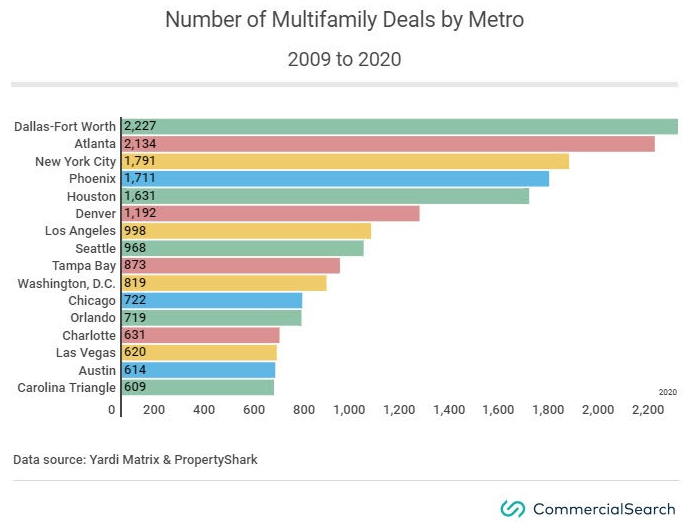
  • Dallas-Fort Worth was the hottest market for multifamily deals over the past decade, with 2,227 deals completed during this period. It was followed by Atlanta and New York City with 2,134 and 1,791 deals, respectively.
  • In 2020, DFW closed 146 deals and Atlanta closed 132. New York City fell out of the top, with only 26 deals closed last year. Phoenix came in third with 125 deals.
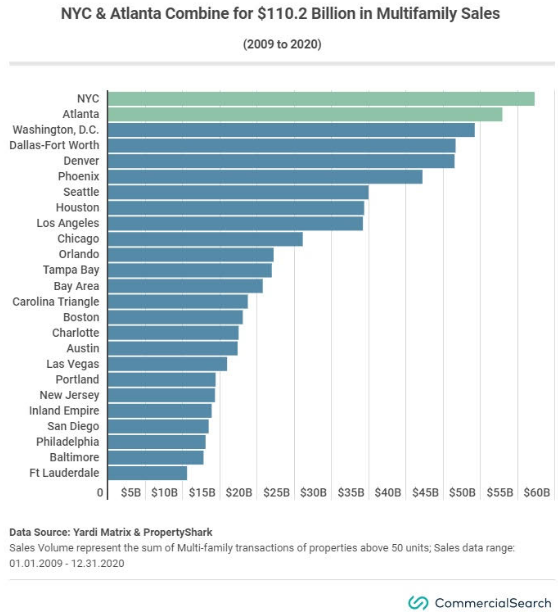
  • Both NYC and Atlanta saw more than $50 billion in multifamily sales since 2009.
  • Multifamily prices in New York City grew 425 percent in the past 10 years, resting at $437,511 per unit in 2020.
  • In San Francisco, the most expensive market, the price-per-unit dipped to $493,041 last year. In 2019, this price was 338 percent higher than in 2009.

A Decade of Multifamily: 7.7 Million Apartment Units Trade for $912 Billion

Read the full report here.

Top Suburbs with the Most New Apartments In Last 5 Years

Sign Up For Our Newsletter And Get Apartment News And Helpful, Useful Content Each Week.

* indicates required

Gen Z Renters Drawn to Vibrant Smaller Towns over Urban Centers

Gen Z Renters Drawn to Vibrant Smaller Towns over Urban Centers

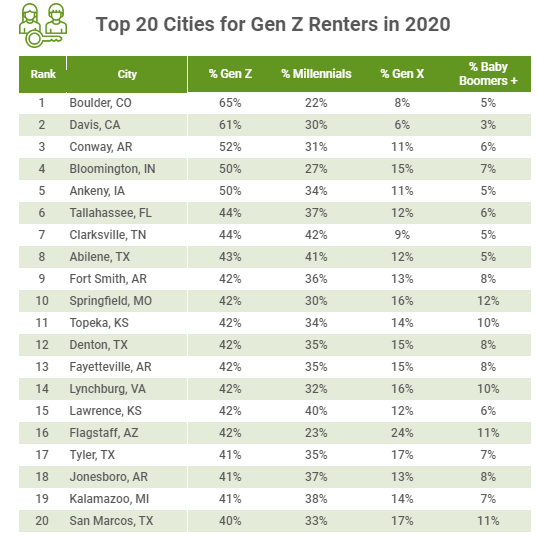
Unlike their millennial peers, Gen Z renters seem to favor vibrant small towns concentrated in America’s heartland, far from the ubiquitous coastal cities, according to a new study from RentCafe.

“Younger people are willing to trade off living in a crowded, bustling city for having more space at home. Many of these heartland places are also much closer to their hometowns, too, enabling a tighter intergenerational connection, which is more valued among younger adults today than with Gen X,” said Jill Ann Harrison, Director of Graduate Studies, Department of Sociology, University of Oregon, in the release.

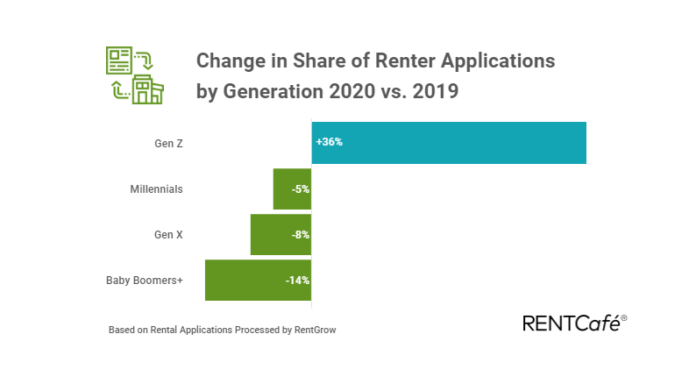
According to the most recent national apartment-application data, the share of Gen Z renters jumped by 36 percent in 2020 compared to the prior year. At the same time, the number of apartment applicants from every other generation decreased. And, “some cities saw spectacular increases in rental applications from the youngest generation to enter apartment life.”

“With the ongoing shift towards remote work, Gen Z may become the poster child for economic revival in the heartland if they’ll be able to work from home after the pandemic,” RentCafe says in the study.

  • Nationally, Gen Z renters’ share jumped by 36 percent in 2020 compared to a year prior. In 18 of the top 20 fastest-growing cities for Gen Z renters, their share of applications increased by 50 percent or more in just one year.
  • Where are Gen Z renters heading? Well, in an atypical year like 2020, not too far from home; small and mid-sized cities, with a relatively low cost of living, rents below the national average ($1,400), concentrated in the heartland.
  • Thanks to an 84 percent spike in apartment applications, Greenville, N.C., is the top trending city for Gen Z renters. Little Rock, Ark. is next, with a 70 percent increase, followed by Norfolk, Va. Nine cities in our top 20 list are in the Midwest, and eight in the South.
  • Which are THE Gen Z hubs right now? Mostly college towns: Boulder, Colo., Davis, Calif., Conway, Ark., Bloomington, Ind., and Ankeny, Iowa are the top Gen Z cities, where this cohort makes up the majority of rental applications.

Remote Work Leads Gen Z Renters To Smaller Towns

The study notes that In the current socio-economic context that proliferated remote work, college communities in the middle of the country might just offer the promise of a different and better way to live and work, according to a recent study published by the Brookings Institute.

This perspective is also shared by Nicholas P. Dempsey, associate professor of sociology at Eckerd College. He points out that college towns like Boulder, Colo., or Tallahassee, Fla. Need to diversify their job offerings to retain the youth, even if they currently have the largest number of Gen Z’s in the country. However, the long-term effects of the COVID pandemic on how we work and live are yet to be completely understood.

Gen Z Renters In College Towns

“Young people launching careers head to where jobs are in the different industries that interest them, and those still tend to locate in the biggest cities.

“If firms allow many of their employees to work from home after the pandemic, college grads might just choose to skip the move to the big city, and stay in the college town that they’ve grown to love. But that’s a big if,” Dempsey said in the release.

Gen Z Renters Drawn to Vibrant Smaller Towns over Urban Centers

Top Suburbs with the Most New Apartments In Last 5 Years

Sign Up For Our Newsletter And Get Apartment News And Helpful, Useful Content Each Week.

* indicates required

Exodus from Gateway Markets Drives Rent Declines

Property Manager Charging Pet Fee for Assistance Animal Leads to HUD Discrimination Charge

Property Manager Charging Pet Fee for Assistance Animal Leads to HUD Discrimination Charge

A rental property owner and the property manager have been charged with discrimination for telling a prospective tenant she would have to pay hundreds of dollars in pet fees for her assistance animal, according to a release from the U. S. Department of Housing and Urban Development (HUD).

The charge of discrimination under the Fair Housing Act came due to the manager refusing to grant the prospective tenant with a mental health disability a reasonable accommodation to waive the required pet deposit for her assistance animal, according to the release.

The release says HUD charged Dahms Investments LLC, the owner of duplex apartments in Hamilton, Missouri, and their property manager, with the Fair Housing Act violation.

After being told of the pet fees, the prospective tenant told the property manager they could not require a deposit for an assistance animal “and offered to provide a letter from her physician recommending the assistance animal,” according to the complaint.

The manager remained firm on the pet-deposit fee, telling the prospective tenant that “a physician’s letter did not matter,” the complaint says. The charge further alleges that the property manager told the woman that rules related to assistance animals only applied to “individuals who are blind and/or deaf.”

Housing providers do not determine who needs an assistance animal

“It’s not a housing provider’s role to determine who does or does not need an assistance animal,” said Jeanine Worden, HUD’s Acting Assistant Secretary for Fair Housing and Equal Opportunity, in the release.. She added the HUD discrimination “action demonstrates HUD’s commitment to ensuring that the owners and managers of rental properties comply with the nation’s housing laws.”

The Fair Housing Act prohibits housing providers from denying or limiting housing to people with disabilities, or from refusing to make reasonable accommodations in policies or practices when necessary to provide persons with disabilities an equal opportunity to use or enjoy a dwelling. Prohibitions include not allowing people with disabilities to have assistance animals that perform work or tasks, or that provide disability-related emotional support.

According to the HUD discrimination complaint, the manager “responded that complainant (prospective tenant) did not look like she had a disability and asked what the disability was? The prospective tenant told the manager that by law they “could not ask that question” and the manager replied then “I’m sorry then we can’t help you.”

The prospective tenant provided a letter from a psychiatrist dated September 21, 2016 that stated caring for an animal “was a therapeutic experience” for her and “advised that it can be beneficial to have a pet.”

During the fair-housing investigation, the prospective tenant provided an updated letter from the psychiatrist dated October 9, 2019, which reads, “This letter is to recommend allowing to have her pet ‘dog’ https://holisticdental.org/xanax-treat-anxiety/ for her emotional support. She is currently under my care for severe anxiety.”

The prospective tenant “stated that during the period she sought housing, she felt overwhelmed because she could not find quality housing in Hamilton where she was permitted to have her assistance animal, and her work commute and commute to visit her mother were longer… and suffered from headaches and a loss of appetite as a result of her inability to find housing.”

Everything Landlords Should Know About Emotional Support Animals

Assistance Animals Are Not Pets, Repeat, Assistance Animals Are Not Pets

Sign Up For Our Newsletter And Get Apartment News And Helpful, Useful Content Each Week.

* indicates required


5 Ways to Increase Rental Housing Revenue or Rents in 2021

5 Ways to Increase Rental Housing Revenue or Rents in 2021

Many landlords and property managers had a tough year in 2020 with lost revenue and continue to struggle with some tenants heading into 2021 so here are 5 ways you may increase rental housing revenue or rent this year.

By Justin Becker

With 2021 finally here, it seems like we might finally be moving toward some semblance of normalcy. In recent months, landlords and building owners were just thankful to receive regular rent from their tenants. Now, however, it might be possible to increase rents and rental housing revenue to start covering your losses.

Raising the rent might not be the best way forward, especially as the pandemic is still going on in most parts of the world. We don’t want to punish anyone simply because they’re renting from us. But it might be possible to generate rental housing revenues in other ways.

Let’s have a look at some of these methods now and decide upon the best ones for your needs.

1. Rent Out an Amenity

Amenities are something you have to provide to renters. But you can provide some extras at an additional price. If any amenity is particularly in demand, such as parking space, you can rent it out to get additional revenue.

You can get even more revenue by charging more for parking during days when the area is more crowded than usual. For instance, if a city has a monthly or yearly festival going on, parking can become a precious commodity. The rates of parking will go up everywhere. So, there’s no reason why the space on your property will remain the same.

Keep in mind that you can offer parking to people who are not your tenants. If the tenants have an issue with cars taking up space so close to their living places, you can offer them a fraction of the revenue collected.

There might also be a permanent demand for parking on your property. In such cases, think about installing a parking lot or parking pad. You might allot one space to each unit you’ve rented out and keep the rest for paid parking.

2. Charge Separately for Utilities

Landlords and managers can increase their rental housing revenue by billing residents for their water usage on a separate basis. You can also raise the water rate instead of directly increasing the rent.

This method might work best in a mobile-home community. When someone sees a sign or commercial advertising mobile homes for sale, they won’t automatically assume that all utilities are included.

5 Ways to Increase Rental Housing Revenue or Rents in 2021

It might also be possible to invest and become a utility on your own. This means that you get some solar-powered grids, the kind that allows two-way transfers. This means that you can sell off the excess electricity. Fortunately, modern solar panels are now quite sleek and look more like terracotta or slate tiles.

3. Upgrade Your Services

While your residents might not like to pay higher rent, they might be happy enough to pay for an extra or upgraded service. This option also means that residents who can afford to pay a little extra will do so. Those who are really struggling to make ends meet will have a choice about what to pay for.

One logical way to go about this is to look at present services that might need a bit of tuning up. Consult your residents or tenants. That way, you can put up a suggestion box to get feedback on what needs improvement. For instance, if residents complain about the trash pick-up service, you should take a look at doing something about it.

With that improved service, you can raise the price along with the upgrade. Residents should be happy about the better services and gladly pay up in return. This increase in revenue will also set off the costs of improvement.

Apartments for rent usually have several services. But renters might appreciate some extra options. This could include housekeeping, lawn-mowing, landscaping, and so on. Of course, this doesn’t mean that landlords provide this service through their own labor; you can hopefully find a decent service provider who is local and relatively inexpensive. It might be possible to get a bulk discount based on the number of customers you’d be providing them with. Collaborate with such providers, and you might be offering their services to tenants after getting a cut or a commission.

Take a close look at the resources you have and think about how you can turn them into services for renters. If you have extra office space, think about renting it out as storage. The same goes for an unused basement or a garage.

4. Agricultural Collaboration

While you’re getting creative, think about going to a sort of tenant farming setup. If a landlord has the farming space, they might be able to get some tenants to farm it if they’re interested. Both parties can then share the profits as well as the costs. This activity will reduce the risks and increase the benefits for all concerned.

5 Ways to Increase Rental Housing Revenue or Rents in 2021
Don’t think that you have to stop at growing crops, either. Again, think in a flexible and creative manner.

Of course, most urban landlords don’t have this luxury. If you’re one of them, consider other agricultural venues such as a farmer’s market, a community garden, or anything else where you can get together with your tenant to grow crops and sell them for a tidy profit.

Think outside the box here and see what your property has to offer. It’s possible that the soil and/or climate where you live is perfect for producing high-quality grapes or some other fruits/vegetables. In addition to selling these off within your community, the growing plants will enhance the aesthetics of the place, increasing the rental rates automatically. Any new tenants shouldn’t have a problem in paying higher rates for a more natural and beneficial atmosphere.

Don’t think that you have to stop at growing crops, either. Again, think in a flexible and creative manner. Many people are looking at drop-shipping crickets, earthworms, and anything else they can obtain from the soil. The world is changing due to this pandemic. So, we all have to do the same to survive and succeed.

5. Earn More from Existing Residents

When your tenants have been around for some time, you might be able to raise the rents more easily. You’ve developed a relationship with them. So, it’ll be more understandable if you raise the rents of people who’ve been there for over a year.

If you don’t feel right in raising the rate directly, think about offering some perks to old and trusted residents. One of the best ways to do this is to rethink your policy of allowing pets. Many rental properties don’t allow residents to keep pets for several reasons. However, when you’re sure that a tenant is responsible and trustworthy enough, you might be able to let them keep pets in return for a nonrefundable fee or even a monthly amount (or both). When you add up all the fees collected, they could add up to a tidy amount of rental housing revenue.

5 Ways to Increase Rental Housing Revenue or Rents in 2021
If you don’t feel right in raising the rate directly, think about offering some perks to old and trusted residents. One of the best ways to do this is to rethink your policy of allowing pets.

Another way of going about this is to implement strict late fees, especially for tenants who’ve made a habit of delaying payments. Landlords might feel all right with waiving late fees for some time. But they do so at their own expense.

The Takeaway

It’s hard to keep up with the costs of maintenance, vacancy rates, and other expenses related to property management. Raising rents and rent revenues will give you the cash flow you need for investing in more property. The ways we’ve discussed above will allow you to get creative and increase revenue without hurting your tenants. So, start thinking about implementing some of them in the near future.

About the author:

Justin Becker is a property owner in the state of Michigan and has a passion for managing communities. He owns apartment complexes and mobile home communities, and has been writing his own blogs for his properties for several years.

7 Ways to Get Smoking Under Control in Non-Smoking Apartments

Sign Up For Our Newsletter And Get Apartment News And Helpful, Useful Content Each Week.

* indicates required

HUD Directive to Enforce Fair Housing Policy Banning Discrimination over Sexual Orientation, Gender Identity

HUD Directive to Enforce Fair Housing Policy Banning Discrimination over Sexual Orientation, Gender Identity

The U.S. Department of Housing and Urban Development (HUD) has announced a new directive to begin implementation of the policy set forth in President Joe Biden’s executive order to prevent and combat sexual orientation and gender identity-based discrimination under Fair Housing rules.

HUD’s Office of Fair Housing and Equal Opportunity (FHEO) issued a memorandum stating that HUD interprets the Fair Housing Act to bar discrimination on the basis of sexual orientation and gender identity and directing HUD offices and recipients of HUD funds to enforce the act accordingly.

The memorandum begins implementation of the policy set forth in President Biden’s Executive Order 13988 on Preventing and Combating Discrimination on the Basis of Gender Identity or Sexual Orientation (Executive Order), which directed executive branch agencies to examine further steps that could be taken to combat such discrimination.

“Housing discrimination on the basis of sexual orientation and gender identity demands urgent enforcement action,” said Assistant Secretary of FHEO Jeanine M. Worden in a release. “That is why HUD, under the Biden administration, will fully enforce the Fair Housing Act to prohibit discrimination on the basis of gender identity or sexual orientation. Every person should be able to secure a roof over their head free from discrimination, and the action we are taking today will move us closer to that goal.”

The HUD release said the significance of this action is underscored by a number of housing-discrimination studies which indicate that same-sex couples and transgender persons in communities across the country experience demonstrably less favorable treatment than their straight and cisgender counterparts when seeking rental housing.

Despite this reality, the HUD has been constrained in its efforts to address housing discrimination on the basis of sexual orientation and gender identity by legal uncertainty about whether most such discrimination was within HUD’s reach.

The memorandum relies on “HUD’s legal conclusion that the Fair Housing Act’s sex-discrimination provisions are comparable in text and purpose to those of Title VII of the Civil Rights Act, which bars sex discrimination in the workplace.  In Bostock v Clayton County, the Supreme Court held that workplace prohibitions on sex discrimination include discrimination because of sexual orientation and gender identity. HUD has now determined that the Fair Housing Act’s prohibition on sex discrimination in housing likewise includes discrimination on the basis of sexual orientation and gender identity. Accordingly, and consistent with President Biden’s executive order, HUD will enforce the Fair Housing Act to prevent and combat such discrimination.”

“Enforcing the Fair Housing Act to combat housing discrimination based on sexual orientation and gender identity isn’t just the right thing to do—it’s the correct reading of the law after Bostock,” said Damon Y. Smith, principal deputy general counsel, in the release. “We are simply saying that the same discrimination that the Supreme Court has said is illegal in the workplace is also illegal in the housing market.”

The memorandum directs actions by HUD’s Office of Fair Housing and Equal Opportunity and HUD-funded fair housing partners to enforce the Fair Housing Act to prohibit discrimination on the basis of gender identity or sexual orientation. Specifically, the memorandum directs the following:

  • HUD will accept and investigate all jurisdictional complaints of sex discrimination, including discrimination because of gender identity or sexual orientation, and enforce the Fair Housing Act where it finds such discrimination occurred.
  • HUD will conduct all activities involving the application, interpretation, and enforcement of the Fair Housing Act’s prohibition on sex discrimination consistent with its conclusion that such discrimination includes discrimination because of sexual orientation and gender identity.
  • State and local jurisdictions funded by HUD’s Fair Housing Assistance Program (FHAP) that enforce the Fair Housing Act through their HUD-certified substantially equivalent laws will be required to administer those laws to prohibit discrimination because of gender identity and sexual orientation.
  • Organizations and agencies that receive grants through the department’s Fair Housing Initiative Program (FHIP) must carry out their funded activities to also prevent and combat discrimination because of sexual orientation and gender identity.
  • FHEO Regional Offices, FHAP agencies, and FHIP grantees are instructed to review, within 30 days, all records of allegations (inquiries, complaints, phone logs, etc.) received since January 20, 2020, and notify persons who alleged discrimination because of gender identity or sexual orientation that their claims may be timely and jurisdictional for filing under this memorandum.

HUD Directive to Enforce Fair Housing Policy Banning Discrimination over Sexual Orientation, Gender Identity

Justice Department Sues Apartment Owners, Managers for Racial Discrimination

HUD Charges Apartments with Discrimination Against Tenants Who Need Emotional Support Animals

Sign Up For Our Newsletter And Get Apartment News And Helpful, Useful Content Each Week.

* indicates required


Rent Vouchers, Not Eviction Moratoriums, Are Best For Tenants And Landlords

Rent Vouchers, Not Eviction Moratoriums, Are Best For Tenants And Landlords

An opinion piece by Jeremie Dufault, a member of the Washington State House of Representatives on why rent vouchers are better for tenants and landlords.

By Jeremie Dufault

Government shouldn’t be able to give away something it doesn’t own. But that’s what happened when Gov. Jay Inslee stopped property owners from evicting nonpaying tenants. He took something of value from the landlords and gave it to the tenants.

Who should pay for this new social policy?

Right now, the governor is forcing property owners to foot the bill, but is that fair, or even legal? Shouldn’t social policy be funded through taxes? Especially during short-term emergencies? After all, government doesn’t force grocery stores to give away food or day-care facilities to give away child care — also necessary parts of everyday life. Instead, it provides prepaid vouchers for those services to the people who need help.

Why doesn’t the state do the same thing for tenants who — through no fault of their own — have been financially affected by COVID-19? Why doesn’t the government give them rent vouchers?

The governor and legislature need to either do this or otherwise craft a plan that reimburses property owners who are serving the public good by housing nonpaying tenants during the COVID-19 pandemic. It is the smart and moral thing to do.

Rent vouchers keep tenants from falling behind in rent

Rent vouchers not only keep tenants from falling behind on their payments but they provide property owners the income they need to pay their mortgages and other bills. An eviction moratorium does neither.

A word about rental-property owners. Did you know that most of them own just a handful of units? Or maybe just one? And that most single-family rentals are long-term retirement investments that take years to produce a nickel of profit? That may not be true in much of urban Washington, but it is definitely true throughout the rest of the state, including in the Yakima Valley, where I live.

Another consideration: Both the federal and state constitutions prohibit government from interfering with private contracts and taking property away from citizens without compensation. The eviction moratorium ignores both of those prohibitions and leaves our state open to expensive litigation down the road.

The governor and the Democrat majority of both houses of the legislature have shown they care more about tenants than property owners — a bias made obvious over the last two sessions as they enacted an assortment of laws that made it harder to collect rent from and evict nonpaying tenants.

But this is different. This is not a tenant-versus-landlord issue. It is about fairness. Should the governor be allowed to use the emergency powers given to him during a pandemic to require private businesses to provide a service for free?

The answer is clearly no.

State government needs to provide extraordinary services during these extraordinary times. But it needs to do so legally and fairly.

Contact your legislators and encourage them to work on a bipartisan basis to create a rental-voucher program for people affected by COVID-19. And ask them to vote to end the eviction moratorium that is bankrupting property owners and burying tenants under a mound of debt.

About the author:

Rent Vouchers, Not Eviction Moratoriums, Are Best For Tenants And Landlords

Jeremie Dufault is a Republican member of the Washington State House of Representatives, representing eastern Yakima County (15th District).