Home Blog Page 114

Federal Judge Overturns CDC Eviction Moratorium

Federal Judge Overturns CDC Eviction Moratorium

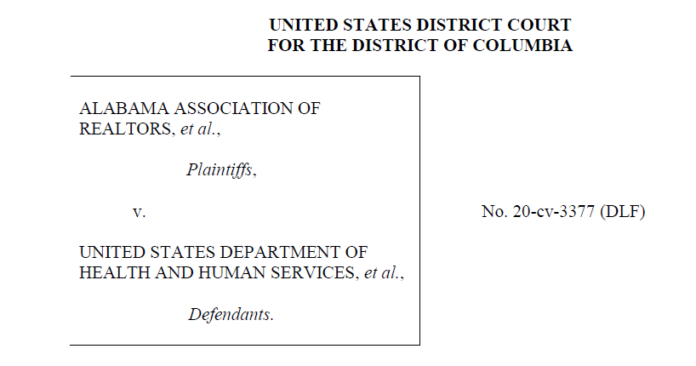
A federal judge has overturned the CDC eviction moratorium saying the agency exceeded its authority in issuing the nationwide eviction ban.

In a 20-page ruling, U.S. District Court Judge Dabney Friedrich, who was appointed by former President Donald Trump, ruled that the agency exceeded its authority with the temporary ban.

However the immediate impact of the decision is not clear. The government has appealed the ruling. It is uncertain whether the appeals court will stay the enforcement of this decision pending conclusion of the appeal. To the extent that decision is stayed pending appeal, compliance with the CDC Eviction Moratorium will still be necessary until the appeal is decided.

The court said in the ruling that the Public Service Act “authorizes the department to combat the spread of disease through a range of measures, but these measures plainly do not encompass the nationwide eviction moratorium set forth in the CDC order.”

The judge wrote in her opinion that she had questions about the constitutionality of the eviction ban and did not see the CDC “had the authority to insert itself into the landlord-tenant relationship without some clear, unequivocal textual evidence of Congress’s intent to do so.”

The judge said courts “expect Congress to speak clearly if it wishes to assign to an agency decisions of vast economic and political significance.”

Luke Wake, an attorney at Pacific Legal Foundation, which represents landlords in a number of related lawsuits, called the ruling a clear signal that the tide has turned against the CDC.

“The challengers have been right all along,” he said. “The government has no authority against any landlord. Full stop.”

The judge said in the ruling, “the court recognizes that the covid-19 pandemic is a serious public health crisis that has presented unprecedented challenges for public health officials and the nation as a whole. The pandemic has triggered difficult policy decisions that have enormous real-world consequences. The nationwide eviction moratorium is one such decision.

“It is the role of the political branches, and not the courts, to assess the merits of policy measures designed to combat the spread of diseases even during a global pandemic. The question for the court is a narrow one: ‘Does the Public Health Service Act grant the CDC the legal authority to impose a nationwide eviction moratorium?’  It does not.”

A number of other judges have ruled on the eviction ban’s lawfulness, with landlords holding a slight advantage in their win-loss record against the federal government.

But while some judges have limited the scope of their rulings to apply only to the parties involved in the particular lawsuits before them, Friedrich rebuffed the federal government’s request that she narrow the effect of her decision, indicating its reach would be nationwide.

The CDC eviction moratorium has been set to expire June 30.

Federal Judge Rules Landlords Do Not Have To Provide Free Housing

Sign Up For Our Newsletter And Get Apartment News And Helpful, Useful Content Each Week.

* indicates required

Denver Passes Law Requiring Rental Housing Inspections, Landlord Licenses

Denver Passes Law Requiring Rental Housing Inspections, Landlord Licenses

The Denver City Council has passed a law requiring rental-housing inspections and licenses for landlords beginning next year, according to reports.

Rental housing inspections will be required every four years. Before receiving a license, landlords must have their properties examined by certified inspectors, according to the measure. At least 10 percent of a property’s units must be inspected at random, according to the new rules.

Landlords can apply for early licenses starting next year. Landlords renting two or more units on a single property, like apartments and row homes, must obtain licenses by Jan. 1, 2023; it’s a year later for landlords who rent living spaces like homes or accessory dwelling units.

The application fee will be $50, and licensing fees will range from $50 for single units to $500 for properties with more than 250 units, the measure said. Landlords must renew their licenses every four years, paired with new inspections.

The Denver Post reported that as the council considered the new law in recent weeks, renters voiced concerns that requiring the licenses for an estimated 54,000 homes, condos, row houses and apartment complexes will increase their rents, while landlords complained of additional red tape that will impede business and lead to costly repairs.

Denver City Council President Stacie Gilmore said a phased approach was put in place to avoid a “bottleneck” of licensees coming in at once and overwhelming the department.

The new law will also create a database of landlords and their properties, Gilmore said. This will enable city officials to track available housing stock and communicate with property owners and tenants about rental- and utility- assistance efforts.

Officials will be able to fine problematic landlords, and suspend or revoke licenses. If the latter two happen, Gilmore said tenants would still be allowed to stay in place through the end of their leases.

10 Things To Check in a DIY Rental Property Inspection

Sign Up For Our Newsletter And Get Rental Property and Apartment News And Helpful, Useful Content Each Week.

* indicates required

Federal Agencies Warn Large Landlords About Tenants’ Pandemic Protections

Federal Agencies Warn Large Landlords About Tenants’ Pandemic Protections

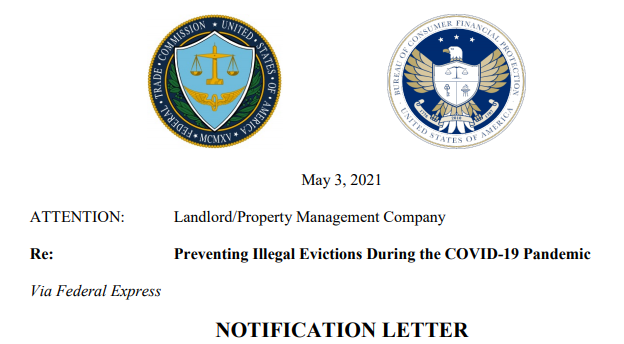
Two federal agencies have issued letters warning large landlords, who collectively own more than two million housing units, of federal protections in place to keep tenants in their homes and stop the spread of COVID-19, according to a release.

The Consumer Financial Protection Bureau (CFPB) Acting Director Dave Uejio and Federal Trade Commission (FTC) Acting Chairwoman Rebecca Kelly Slaughter sent notification letters to the nation’s largest apartment landlords. A recent CFPB report found that renters are particularly endangered, with more than 8.8 million tenants behind on rent.

“With millions of families nationwide at risk of eviction, it’s vital that landlords and the debt collectors who work on their behalf understand and abide by their obligations,” Slaughter said. “We are continuing to monitor this area and will act as needed to protect renters.”

“Landlords should ensure that [Fair Debt Collection Practices Act (FDCPA)]-covered debt collectors working on their behalf, which may include attorneys, notify tenants of their rights under federal law. Nearly nine million households are at risk of eviction due to the economic effects of COVID-19, but no one should lose their home without understanding their rights,” Uejio said. “We will hold accountable debt collectors who move forward with illegal evictions.”

Under the FDCPA interim final rule, debt collectors, as defined by the FDCPA, seeking to evict certain tenants for non-payment of rent must provide those tenants with clear and conspicuous notice that the consumer may be eligible for temporary protection from eviction under the CDC Moratorium. The notice must be provided on the same date as the eviction notice, or, if no eviction notice is required by law, on the date that the eviction action is filed. Debt collectors must provide the notice in writing. Phone calls or electronic notice such as text messages or emails are not sufficient, according to the release.

Neither the CFPB nor the FTC has determined whether the letters’ recipients have violated the law.

The Centers for Disease Control and Prevention (CDC) has extended until June 30 a temporary moratorium on evictions for non-payment of rent, and the CFPB has issued an interim final rule, which took effect May 3, establishing new notice requirements under the Fair Debt Collection Practices Act (FDCPA).

Reports of Multistate Landlords Forcing People from Homes

“Unfortunately, there are reports that major multistate landlords are forcing people out of their homes despite the government prohibitions, or before tenants are aware of their rights,” Slaughter and Uejio said in a statement.

“Depriving tenants of their rights is unacceptable. Many of the tenants at risk of eviction are older Americans and people of color, who already experience heightened risks from COVID-19.

“Staff at both agencies will be monitoring and investigating eviction practices, particularly by major multistate landlords, eviction-management services, and private-equity firms, to ensure that they are complying with the law.

“Evicting tenants in violation of the CDC, state, or local moratoria, or evicting or threatening to evict them without apprising them of their legal rights under such moratoria, may violate prohibitions against deceptive and unfair practices, including under the Fair Debt Collection Practices Act and the Federal Trade Commission Act. We will not tolerate illegal practices that displace families and expose them —and by extension all of us—to grave health risks,” they said in the statement.

“Neither the FTC nor the CFPB has determined whether you or your company is violating the law. Even though we’re sending this notice, the FTC or CFPB may still take action based on law violations. We will continue monitoring eviction practices to evaluate whether further action is appropriate,” Slaughter and Uejio said in the letter to landlords.

Tenants Can Hold Debt Collectors Accountable for Illegal Evictions

Will You Be Ready When the Eviction Moratorium Ends?

Sign Up For Our Newsletter And Get Apartment News And Helpful, Useful Content Each Week.

* indicates required


Senate Bill 282 – Oregon’s Newest COVID-19 Landlord/Tenant Changes

Senate Bill 282 Oregon’s Newest COVID-19 Landlord Tenant Changes

A new Oregon Senate bill 282 is going to impact landlord tenant issues if it passes so attorney Brad Kraus reviews some of its issues for landlords and property managers.

By Bradley S. Kraus,
Attorney at Law, Warren Allen, LLP

As the old saying goes, the more things change, the more they stay the same. As we continue into year two of COVID-19 related rules, restrictions, and issues, landlords and tenants are still struggling.

Unpaid mortgages, rent, and bills continue to accumulate. Assistance is still lagging, failing to reach those landlords and tenants who felt the most impact.  As of this writing, the Landlord Compensation Fund still has not commenced round two of its funding application process. Even still, the Oregon legislature is in the process of passing new legislation that  will affect landlord/tenant relations—this time in the form of Senate Bill 282.

While Oregon SB 282 has yet to pass, in its current form—and much in line with the statement above—SB 282 contains more of the same. It extends the grace period for the repayment of amounts that accrued during the applicable grace period of April 1, 2020 through June 30, 2021 until February 28, 2022. This means that unpaid amounts that accrued over the past year will not be actionable until next year.

Senate Bill 282 further restricts a prospective landlord’s ability to screen applicants for these unpaid amounts.

It states that when considering an applicant, landlords cannot consider an applicant’s unpaid rent, including rent reflected in judgments or referrals of debt to a collection agency that accrued on or after April 1, 2020 and before March 1, 2022. It also contains the vague and concerning language that landlords cannot consider eviction actions if they are based on “claims” that arose on or after April 1, 2020 and before March 1, 2022. The reason that this is concerning is because even evictions related to violent conduct are technically “claims” that would fall subject to this broad standard. To suggest that a landlord could not consider the fact that an applicant stabbed someone within the above timeframe would be absurd.

SB 282 also contains additional required disclosures that will require landlords to update their forms. More specifically, notices for non-payment of rent will need a disclosure related to the extended grace period and an additional disclosure related to a website containing information on tenant resources. Balance-due notices will also need an update due to the changing grace period. Should SB 282 pass in its current form, landlords should review their materials and procure updates where needed.

Finally, SB 282 also contains prohibitions on a landlord’s enforcement of rules related to unauthorized guests. SB 282 states that a landlord may not enforce a restriction by any means, including terminating the tenancy, if the restriction is based on “the maximum duration of a guest’s stay in the tenancy.” The bill does allow a landlord to screen the guest, if the guest resides in the premises more than 15 days in any 12-month period. The screening may not be based on credit reports or income. Finally, landlords can enter into temporary occupancy agreements with the guests, but that agreement cannot have an ending date earlier than February 28, 2022.

As the calendar turns every month, landlords and tenants continue to fall behind on rent, mortgages, and other payments they have not been able to make due to COVID-related shutdowns.

The Oregon Landlord Compensation Fund is/was intended to resolve those issues, but it remains shuttered due to numerous issues. Rather than address those issues head-on, the legislature hastily crafted—and will likely pass—this bill. SB 282 does not solve the issues brought on by COVID-19; it further kicks those cans down the road. As the saying goes, the more things change, the more they stay the same.

A new Oregon Senate bill is going to impact landlord tenant issues if it passes so attorney Brad Kraus reviews some of its issues for landlords and property managers.
Bradley Kraus, Portland attorney

Brad Kraus is a partner at Warren Allen LLP. His primary practice area is landlord/tenant law, but he also assists clients with various litigation matters, probate matters, real estate disputes, and family-law matters. A native of New Ulm, Minnesota, he continues to root for Minnesota sports teams in his free time. You can reach him via email kraus@warrenallen.com or 503-255-8795.

Fair Housing Matters – Landlord Liability for Tenant-on-Tenant Discrimination

Sign Up For Our Newsletter And Get Apartment News And Helpful, Useful Content Each Week.

* indicates required


A Bright Outlook For Suburban Rental Housing

A Bright Outlook For Suburban Rental Housing

The tight housing supply and rising costs will delay many renters from transitioning to homeowners, providing a bright outlook for suburban rental housing, according to Marcus & Millichap  in their most recent research brief.

Suburban rental housing market signals transformation

“Home buying is being driven in large part by changing demographic trends that have been accelerated by the health crisis.

“The aging of the millennial generation into the homeownership phase of life and more households seeking larger spaces in lower-density areas as they work and attend school from home have driven housing demand in the suburbs.

“Home sales are also being fueled by historically low interest rates and a surge in savings during the pandemic that are helping more prospective homeowners afford the associated down payment and mortgage. Lower land costs farther from metro cores are keeping many developers focused in suburban and exurban locales,” Marcus & Millichap say in the report.

Housing shortage reiterates value of apartments

 During March, the supply of both new and existing home sales remained near a historic low, resulting in many potential homeowners being repeatedly outbid as prices continue to soar.

“The median cost of an existing home jumped 3.0 percent in March alone to $342,400, a new all-time high. Over the past 12 months, the price has surged 18.4 percent, which is the fastest pace of annual price growth since at least the 1960s.

“As a result, the monthly payment for a 30-year loan on a median-priced home, with a 10 percent down payment and including taxes and insurance, rose to $1,926. In contrast, the average effective rent on a Class A apartment is $1,787 per month, underscoring the value of rentals.

“The tight supply and rising cost will delay many renters from transitioning to homeowners, providing a bright outlook for suburban rentals,” the report says.

Single-family rentals gain traction

Strong demand for single-family home rentals since the Great Recession and a lack of available homes to purchase for rentals have some investors constructing single-family communities for the purpose of renting. In recent years, the number of build-for-rent homes (BFR) accounted for five to 10 percent of the new homes constructed; however, the numbers are growing, especially in the Sun Belt metros with lower land prices, including Atlanta, Phoenix and Houston. These assets could increase competition for larger suburban apartments.

Strong demand activates developers; cost continue to rise

Housing completions surged 16.6 percent during March and single-family permitting jumped 4.7 percent.

“While permitting and construction activity are growing, rising production costs and a shortage of materials are delaying the groundbreaking on some homes.

“In the final week of April, the average cost of 1,000 board feet of lumber sat just under $1,300, up 232 percent since the onset of the pandemic. The rising costs have some developers focusing on higher-end residences, where these costs can more easily be absorbed into the sales price,” the report says.

Marcus & Millichap is a leading firm specializing in commercial real estate sales, financing, research and advisory services.

5 Trends Shaping the Future of Rental Housing After the Pandemic

Sign Up For Our Newsletter And Get Apartment News And Helpful, Useful Content Each Week.

* indicates required


How the Pandemic Will Affect the Future of Apartments And What People Rent

Rent Prices Show Largest Jump in April Since 2017

Rent prices National Rent Index Shows Largest Jump in April Since 2017

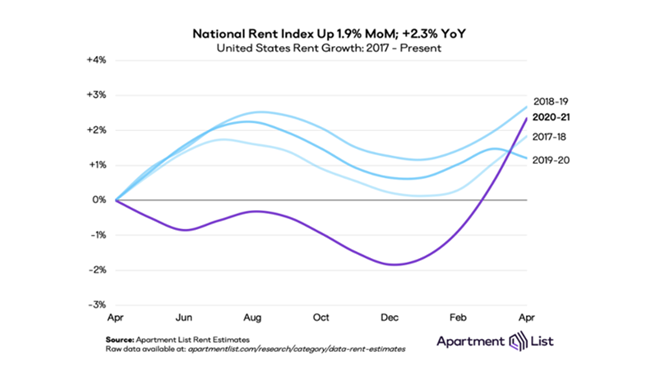
Rent prices are continuing to rebound with the national index up by 1.9 percent month-over-month in April, “the biggest monthly jump in our national index since the start of our estimates in 2017, breaking a record set just last month,” said Rob Warnock, senior research associate with Apartment List.

Rent growth has now been outpacing prior-year averages for several months, “indicating that this year’s moving season is set to be a historically busy one,” Apartment List says in the report.

“For comparison, in the pre-pandemic years of 2018 and 2019, month-over-month rent growth in March was 0.8 percent and 0.7 percent, respectively. This month’s sharp increase breaks a record set just last month, when rents jumped by 1.4 percent. In each of the past four months, our national index has not only had positive growth, but has outpaced the average growth of prior years.

“After the rapid growth of recent months, year-over-year rent growth now stands at 2.3 percent, in line with the rates from prior years,” Apartment List says in the report.

Days of plummeting rent prices have come to an end

“The data continues to show significant regional variation, but the days of plummeting rents in pricey coastal markets have come to an end.

“The cities with the sharpest year-over-year rent declines are now experiencing positive rent growth again, and in some cases, prices are rapidly rebounding. At the other end of the spectrum, many of the mid-sized markets that have seen rents grow quickly through the pandemic are continuing to boom,” Warnock says in the report.

In markets like San Francisco where rents had been falling fastest, prices have turned a corner and are now rebounding.

At the same time, booming markets like Boise continue to see prices climb. More broadly, as vaccine distribution continues to gain momentum, we may be starting to experience the release of pent-up demand from renters who had been delaying moves due to the pandemic. Whereas last year’s peak moving season was halted by the pandemic, this year’s seasonal spike appears to be making up for lost time.

Summary

“We are now seeing that the markets where rents had been falling sharply have turned a corner, and in some cases, prices in these cities have started to rebound rapidly. But although some may be moving back to superstar cities, affordable mid-sized markets are continuing to boom. As vaccine distribution continues to gain momentum, rental markets may be beginning to reflect the preferences of a post-COVID future,” Apartment List says in the report.

Sign Up For Our Newsletter And Get Apartment News And Helpful, Useful Content Each Week.

* indicates required


How the Pandemic Will Affect the Future of Apartments And What People Rent

The Case Study of a 1031 DST Specialist

The Case Study of a 1031 DST Specialist

By Steve Haskell
Vice President at Kay Properties and Investments

There are various strategies when using DSTs (Delaware Statutory Trusts) in a 1031 exchange. Some investments are as easy as a simple exchange from one property into a single DST. Other times DST’s are used to invest leftover equity from an exchange so the investor is not taxed on leftover funds, called “boot”. Investors will routinely use DSTs as a backup ID in case their target replacement property doesn’t work out. And occasionally, Kay Properties will assist an exchanger to utilize all said strategies in one sophisticated effort to mitigate risk and defer as much tax as possible. Read on for the experience of a highly skilled 1031 DST specialist.

A real estate investor sold an investment property for approximately $2M.  Roughly 25% of his property was leveraged. Therefore, $1.5M was sitting in his qualified intermediary account. He then contacted Kay Properties to pursue a partial 1031 DST exchange. The exchanger wanted to purchase a property on his own, but something smaller and easier to manage than the property he recently sold. He wanted to put part of his exchange into a completely passive DST option that would require no management on his part. The DST part was relatively easy. However, he was having a hard time finding a replacement property to own outright, and the 45-day clock was ticking. Kay Properties created a multifaceted strategy that supported the investor from a variety of angles.

First, the exchanger used the debt built into the DST to replace his mortgage. The Kay Properties representative created a DST portfolio for the investor with a loan-to-value of approximately 50% to match the exact debt required to satisfy the 1031 exchange regulation. The debt was non-recourse, meaning the investor did not need to apply or sign for the loan, nor did it show up on his personal balance sheet. This freed him up to purchase a smaller property to own outright without taking out a mortgage, which increased his probability of closing.

Next, the exchanger used a DST as a backup ID in case the target property did not work out. The due diligence period on the replacement property extended past the 45-day period. If inspections exposed an issue that compromised the deal, the exchanger would be vulnerable to over hundreds of thousands of dollars in taxes. However, since the Kay Properties representative advised the client to use a DST as a backup ID, the exchangers risk of a failed exchange was significantly mitigated.

Finally, Kay Properties assisted the investor to ensure there was no leftover equity by using the DST to invest the leftover boot. After the exchanger and the seller agreed on a price, he realized there was approximately $50,300 of exchange funds left over. Kay Properties found a DST to invest that exact amount to finish up the exchange.

When one has the knowledge and the assistance of a skilled DST 1031 specialist, an investor can mitigate risk and protect themselves from a failed exchange in a variety of ways. Through the assistance and guidance of Kay Properties, the exchanger in this case split funds into both DSTs and his own property, replaced his debt with a non-recourse loan, protected his exchange with a backup ID, and took care of the leftover boot. These high level DST skills often are not available to investors who choose to work with unaware financial planners with little-to-no understanding of real estate, 1031 exchange strategies and DST investments. Fortunately, the client was working with Kay Properties. If you are interested in learning more on how to use a DST to mitigate risk and defer taxes in your 1031 exchange, contact Kay Properties by registering at www.kpi1031.com.

About Kay Properties and www.kpi1031.com

 Kay Properties is a national Delaware Statutory Trust (DST) investment

firm. The www.kpi1031.com platform provides access to the marketplace of DSTs from over 25 different sponsor companies, custom DSTs only available to Kay clients, independent advice on DST sponsor companies, full due diligence and vetting on each DST (typically 20-40 DSTs) and a DST secondary market.  Kay Properties team members collectively have over 115 years of real estate experience, are licensed in all 50 states, and have participated in over $21 Billion of DST 1031 investments.

This material does not constitute an offer to sell nor a solicitation of an offer to buy any security. Such offers can be made only by the confidential Private Placement Memorandum (the “Memorandum”). Please read the entire Memorandum paying special attention to the risk section prior investing.  IRC Section 1031, IRC Section 1033 and IRC Section 721 are complex tax codes therefore you should consult your tax or legal professional for details regarding your situation.  There are material risks associated with investing in real estate securities including illiquidity, vacancies, general market conditions and competition, lack of operating history, interest rate risks, general risks of owning/operating commercial and multifamily properties, financing risks, potential adverse tax consequences, general economic risks, development risks and long hold periods. There is a risk of loss of the entire investment principal. Past performance is not a guarantee of future results. Potential cash flow, potential returns and potential appreciation are not guaranteed.

Securities offered through Growth Capital Services, member FINRASIPC, Office of Supervisory Jurisdiction located at 582 Market Street, Suite 300, San Francisco, CA 94104.

Do DSTs work for a 1033 Exchange due to eminent domain or involuntary conversion?

Understanding Debt Structures Prior to Investing

HomeVestors Renovates Dilapidated Multifamily Project

A HomeVestors franchise has moved from ugly houses to an ugly apartment complex makeover in partnership with the city of San Bernardino

A HomeVestors franchise has moved from ugly houses to an ugly apartment complex makeover in partnership with the city of San Bernardino, according to a release.

The franchise completed a dramatic $2 million makeover on a 44-unit apartment complex that had been a blight on its local community. The property, which neighbors an elementary school, had been a public health hazard and was shut down by the city of San Bernardino when franchisees Berto Ramos and Manuel Ramirez took it on with their “We Buy Ugly Houses” mentality.

Built in the 1960s, the complex spent years in a state of disrepair as one of the area’s most troublesome residential properties.

The properties were so far beyond code that apartments were left with no running water, windows or electricity, and the city had forced the mostly absentee previous owner to surrender the property. Ramos and Ramirez purchased it and completely renovated it to not only meet code, but to also reach the highest level of quality in local rentals. In addition to a new water and sewer system and heating and cooling upgrades, each unit now has its own heating and air conditioning system, water source, and shutoff valve.

“This property had been a challenge for the city on a daily basis for years before we took control. Given the extensive problems the last owner let go unaddressed, the city was weary about who to entrust it with – they knew its state at the time was wrong, needed someone to fix it, and didn’t want to end up with a similarly delinquent landlord,” said Ramos.

“The truth is, it takes real estate investors like us to help change these community situations. Law enforcement, the city and the courts can’t bear the full burden. Someone like us needs to invest the attention and capital, treat the neighborhood with respect, and give them what they need, which in this case was 44 quality homes for local residents that were previously not available.”

The project was handled by the HomeVestors franchisees as they would with any of their other ugly-house makeovers. Every asset was redone – kitchens, bathrooms, and bedrooms. Public areas were made over, including the addition of new courtyards, play areas, and barbecues. The property, once viewed with trepidation by teachers at the school next door became a clean and safe haven for families. Reopened in March, the renamed Golden California Apartments are already 80 percent full and expected to be at occupancy this month, according to the release.

“People are hurting, rents are skyrocketing, and that makes it even more important that we repair a property like that so people can live there,” said Councilman Damon L. Alexander, whose seventh ward includes the Golden California project. “There’s no reason any San Bernardino resident should not have a good place to live, and there’s no reason why other residential properties in the city can’t be upgraded the same way.”

More than 80 percent of houses HomeVestors purchases are less than 1,400-square feet and were built before 1980, though some are multifamily homes like the San Bernardino project. Franchises generally rehab and sell their homes or hold them as investment properties.

10 Things To Check in a DIY Rental Property Inspection

Sign Up For Our Newsletter And Get Rental Property and Apartment News And Helpful, Useful Content Each Week.

* indicates required

Property Managers, Take Note: Happy Pet Owners Mean Happy Long-Term Residents

Property Managers, Take Note: Happy Pet Owners Mean Happy Long-Term Residents

A guest post to help property managers understand pets and the connection with long-term happy rental residents.

By KC Theisen
Opening Doors

A few weeks ago, a graduate student at the University of Maryland interviewed me about the connection between pets and people. I often get to talk about the logistics of keeping pets and families together, as in the administrative aspects and guidelines for property managers. But since our chat, I’ve been thinking about our bond with animals and wanted to focus on one of the simplest facts about pets: They make us happy. Property managers, take note. When you have happy residents, you have long-term residents.

Look at the health statistics that spring from pet ownership. Pet owners report experiencing less depression and loneliness, and being more active, reducing heart disease. Spending time with a pet lowers blood pressure and heart rate, and having a companion animal to care for is the reason many seniors get out of bed in the morning despite aches and pains.

Pets make us more social. It’s clear from looking out a window that dog people are out and about, frequently stopping to chat with others about their furry family members. Visits to a pet-supply store, the veterinarian, and the park provide opportunities to meet new people. In rentals, the shared spaces become public meeting houses for dog owners, even while social distancing.

Cat owners are more social, too. They also go to pet-supply stores, grocers, and vet clinics, interact with other cat people. Creating a network of in-house cat sitters provides cat owners an amenity that makes them feel included in the building’s pet community. Especially for people with physical limitations or mobility issues, cats are a pathway to getting up and about indoors and to receiving affection. Hearing a purring cat makes it almost impossible for a human to cry.

How is your bottom line affected by physically healthy and socially adjusted residents? Happy people stay put. Happy people like living in a place where they feel welcomed and where they find comfort in being, especially when we are spending so much time at home these days. Happy people also invest in their happiness, and if they like living in your property, will tolerate moderate fees or rent increases to hold on to their happy place.

If you manage a property wracked by COVID-19 fatigue, how can you help alleviate your residents’ isolation and sense of loneliness while keeping the CDC guidelines in place? Welcome pets. Four-legged friends are a key reason people choose a rental, and better pet policies bring potential residents in droves.

Opening Doors has strategies to share so you can control which pets are welcome, and set standards of great care that translate to happier community residents, pet-owning or not. Make your property their happy place.

 About the author:

KC Theisen is the animal-management and pet-policy advisor for Opening Doors. She creates policies and programs for properties that enhance revenue potential while controlling potential conflicts and problems. KC has more than 25 years of experience working with animals and people. She obtained her undergraduate degree in Zoology from the University of Wisconsin. She was the Humane Society of the United States’ director of pet-care issues for many years. KC received her master’s degree in professional writing in 2007 and uses these skills to draft user-friendly policies and explanations for Opening Doors clients, bringing legal jargon into clear, concise rules and practices.

The Benefits of Being Pet-Friendly For Rental Property Owners

Ultimate Guide To Assistance Animals And Emotional Support Animals In Rental Housing

Top 10 Property Management, Landlord and Rental Housing Magazines in 2021

Sign Up For Our Newsletter And Get Apartment News And Helpful, Useful Content Each Week.

* indicates required

Does 90-Day No-Cause Notice Apply If Tenant Is OK With Moving?

Does 90-Day No-Cause Notice Apply If Tenant Is OK With Moving?

Ask attorney Brad is a feature with attorney Bradley S. Kraus and this week the question is about the 90-day no-cause notice and a tenant who is ok with moving.  If you have a question for Brad, please feel out the form below.

Ask Attorney Brad:

My tenant has been in my rental for a couple of years. It’s a mobile home and I’d like to move it to another property that is within a mile. The tenant is aware that the home may move and he is OK with relocating to the same house, once it’s moved. How might the 90-day notice figure into this arrangement? With our verbal agreement and the house simply going to another lot, it’s a unique situation. -Gary

Hello, Gary:

Quite a unique situation indeed!

The good thing about your particular situation is that (a) you don’t seem to want to get rid of your tenant, and (b) he’s okay moving to the new location.

Because of that, it may be as easy as working something out with the tenant in the form of a hotel stay or compensation for couch surfing while the mobile home is being moved. The particulars of this situation may not be fully apparent in your question, so if I’m missing something, let me know.

A 90-day no-cause notice for a qualifying landlord exemption (assuming that’s what you meant) is really only necessary if you want to remove the tenant. That doesn’t seem to be the case here.

So, a simple conversation with your tenant (and a well-crafted document reflecting the parties’ arrangement) will likely go a long way.

As adversarial as the landlord/tenant relationship has become recently, sometimes we forget that’s still an option.

–Brad

Ask Attorney Brad: Does 90-Day No-Cause Notice Apply If Tenant Is OK With Moving?
Bradley Kraus, Portland attorney

Brad Kraus is a partner at Warren Allen LLP. His primary practice area is landlord/tenant law, but he also assists clients with various litigation matters, probate matters, real estate disputes, and family-law matters. A native of New Ulm, Minnesota, he continues to root for Minnesota sports teams in his free time.  You can reach him via email kraus@warrenallen.com or 503-255-8795.

Ask Attorney Brad

Please enter your rental housing management question below for Ask Attorney Brad Kraus. Unfortunately he cannot answer questions from tenants.

  • This field is for validation purposes and should be left unchanged.

Sign Up For Our Newsletter And Get Rental Housing and Apartment News And Helpful, Useful Content Each Week.

* indicates required

Ask Attorney Brad: Why Can’t A Landlord Give a 30-Day Notice to Vacate?