Home Blog Page 114

Multifamily Markets Continue To Show Rent Growth

Multifamily Markets Continue To Show Rent Growth

Multifamily markets showed record-breaking year-over-year rent growth nationally in April, according to the latest report from Yardi Matrix.

“All Top 30 markets had positive month-over-month rent growth last month, the first time that has occurred since March 2020,” the report says.

Rents increased the most on a year-over-year basis since March 2020 and on a dollar-amount basis since June 2015, Yardi Matrix said.

Highlights of the April Yardi Matrix multifamily market report

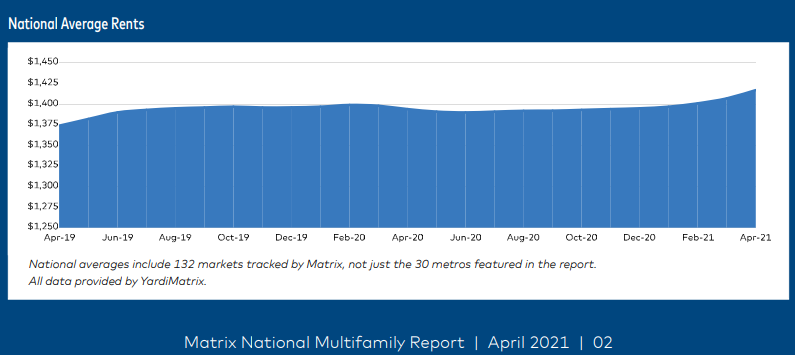
  • Multifamily rents increased by 1.6 percent on a year-over-year basis in April, “the largest increase that we have seen since the beginning of the pandemic.”
  • Overall rents increased by $10 in April to $1,417. The last time overall rents increased by that amount in a month was June 2015.
  • Out of our Top 30 markets, 24 had month-over-month rent growth greater than 0.5 percent.
  • Gateway markets continued their path to recovery this month, with all gateway markets showing positive month-over-month gains in April.
  • Only six markets out of our Top 30 had negative year-over-year rent growth this month. One of the six, Austin (-0.1 percent), is poised to turn positive next month, given the strong month-over-month gains. The other five markets, including Seattle and San Francisco, had solid gains as well, but are a little further behind in their rebounds.
  • Among the markets surveyed this month, 117 out of the 134, or 87 percent, had positive year-over-year rent growth in April.
Multifamily Markets Continue To Show Rent Growth

“The Inland Empire, Sacramento (8.4 percent) and Phoenix (8.1 percent) have been leading all markets for rent growth for the past few years, and the pandemic has only accelerated that trend.

“Over a five-year period, rents in the Inland Empire have increased by 31 percent. Rents in Sacramento and Phoenix have increased by 34 percent.

“To put that in perspective, national rents have increased by 12 percent over a five-year period. Five years ago, overall rents were extremely low in each of the three aforementioned markets, with plenty of room to run. But with such strong growth over the past five years, when will rents begin to taper off in these markets?

“The good news is that the distress seems to be extremely concentrated in select urban core submarkets, with the further potential distress discussed at the beginning of the pandemic not likely to come to fruition,” Yardi Matrix says in the report.

About Yardi Matrix:

Yardi Matrix researches and reports on multifamily, office and self-storage properties across the United States, serving the needs of a variety of industry professionals. Yardi Matrix Multifamily provides accurate data on 18+ million units, covering more than 90 percent of the U.S. population. Contact the company at (480) 663-1149.

Multifamily Market Growth Starts 2021 With a Strong First Quarter

Sign Up For Our Newsletter And Get Apartment News And Helpful, Useful Content Each Week.

* indicates required


10 Things To Check in a DIY Rental Property Inspection

10 Things To Check in a DIY Rental Property Inspection

Here are 10 things to check in a do-it-yourself rental property inspection from a veteran landlord and manager in the field.

By Phil Schaller

Conducting an informational inspection/walkthrough of your rental property is important periodically; we recommend at least once a year.

It allows you to understand how your tenants are treating the property, troubleshoot for larger issues, plan some preventative maintenance, and build trust with your tenants.

While there are hundreds of items you could inspect in a walkthrough, we’re going to focus on the low-hanging fruit and most important boxes to check.

Before we get into the list, here’s a few pointers:

  • Schedule this walkthrough far in advance with your tenants; they’ll keep it on the radar and (hopefully) focus on keeping the property in good shape. Washington State requires at least 48 hours written notice before anyone enters the dwelling.
  • Communicate to your tenants why you’re conducting this walkthrough. You want to know what’s going on with the property but you also want to make sure you’re providing a hospitable environment for your tenants.
  • We recommend conducting these walkthroughs with a general contractor or maintenance pro (RentalRiff can help) as an unbiased third party and someone who can easily diagnose/fix certain issues.

Without further ado, here we go on rental property inspection items

  1. Replace furnace filters: This is an easy one. You’ll need a filter on hand, but it’s easy and not expensive. Replacing a broken furnace, on the other hand, is very expensive.

10 Things To Check in a DIY Rental Property Inspection

2. Replace smoke and carbon-monoxide alarm batteries: Another easy one – aside from the liability you’ll have on your hands if these alarms don’t work during an emergency. Let’s keep everyone safe!

3. Clean out dryer vents: While cleaning out a dryer vent may require slightly more elbow grease than changing batteries, it’s another important safety precaution. Vacuum cleaners with a hose or dryer-vent kits work well. This can be a severe fire hazard.

4. Switch the GFIs: We can’t tell you how many calls we get for electrical work that can be solved with the push of a button. Get ahead of these issues by switching the GFI for your tenants.

5. Run water and check for leaks under the sinks: An easy way to do this is to turn on the water and throw a baking pan under the plumbing to see if any liquid is captured.

6. Turn on all appliances: Turn on all appliances for a quick check and listen for anything unusual. That weird sound your dishwasher is making may indicate a new one is in your future.

7. Run the garbage disposal: The No. 1 maintenance request landlords receive is for garbage disposals. We recommend giving them a tighten with an Allen wrench and/or a reset. Olive pits love giving landlords a headache.

8. Test the heating and air conditioning: You’re required as a landlord to provide a humane environment for your tenants – this means a livable temperature. We like to turn the AC on full blast to check, then switch to heat. It’s easy to inspect other items while checking these systems.

9. Inspect crawl spaces and attics: Pests love these areas. Look for poop, termite damage and small entryways – no one likes living with rats.

10. Check ceilings, walls, floors, doors and windows: OK, so we crammed a few into No. 10 here, but any sign of water damage (dark/wet spots, cracks in drywall, mold) is a big red flag and requires an immediate solution.

Many of our customers will schedule several walkthroughs throughout the year (based on the tenants and condition of the property). If you have any questions on how to conduct these informal walkthroughs yourself, we’re happy to chat or provide some more insight.

Phil Schaller is an experienced landlord and the founder/CEO of RentalRiff, an alternative service to traditional property management. RentalRiff’s licensed and insured property specialists provide oversight and upkeep of rental properties, while serving as the main point of contact for tenants. Maintenance and repair costs are included. Phil is a Pacific Northwest native, father of two, and fly-fishing addict. Contact him at www.rentalriff.com/contact-us.

7 Proactive Maintenance Tips That Keep Tenants Happy

Sign Up For Our Newsletter And Get Rental Property and Apartment News And Helpful, Useful Content Each Week.

* indicates required

The New American Dream Is A Dog-Friendly Home

The New American Dream Is A Dog-Friendly Home

Dogs have truly become a part of American families, so it follows that they factor heavily into moving decisions—and may even be a catalyst for them as the new American dream is a dog-friendly home.

According to a new survey from Rover and Zillow, 24 percent of dog owners in the United States have moved into a new home since March 2020. The majority of dog owners surveyed (62 percent) say they would consider moving to a new house or rental for their dog, with 86 percent stating that pet-friendly features are important factors in moving decisions.

  • This includes amenities like having a dog door already installed, proximity to a dog park, and fenced-in yards.
  • In fact, 84 percent of dog owners say they would spend more for these pet-friendly features, and 86 percent say that having private outdoor space is important to them.

The New American Dream Is A Dog-Friendly Home

Rover and Zillow also teamed up to introduce a list of the Top Emerging Dog-Friendly Cities for 2021.

The New American Dream Is A Dog-Friendly Home

To create the list of Top Emerging Dog-Friendly Cities for 2021, Rover – a website where dog owners can find pet care – looked at new dog accounts on their platform, whether from dog owners new to the area or longtime residents with a newly adopted dog, and Zillow dug into cities where dog-friendly rentals – and listings mentioning home features that dog owners covet – are on the rise.

“This year, we spent an extraordinary amount of time with our pets, and many of us relied on their companionship more than ever. As a result, our emotional bonds with our pets also strengthened,” said Kate Jaffe, trends expert at Rover. “Pets are taking on an even greater role in our families, so it’s no surprise that our dogs’ needs are a top priority for pet parents considering a new home.”

Top 15 Emerging Dog-Friendly Cities, according to Zillow and new Rover accounts:

  1. Denver, Colo.
  2. Orlando, Fla.
  3. Anaheim, Calif.
  4. Charlotte, N.C.
  5. Birmingham, Ala.
  6. Atlanta, Ga.
  7. Boston, Mass.
  8. Glendale, Ariz.
  9. New Orleans, La.
  10. Tampa, Fla.
  11. Fayetteville, N.C.
  12. Fort Worth, Texas.
  13. Miami, Fla.
  14. Nashville, Tenn.
  15. Saint Petersburg, Fla.

Denver takes the top spot largely because of the number of new Rover accounts created, followed by Orlando and Anaheim. Orlando saw strong growth (4 percent) in the number of rentals listed as dog-friendly during the pandemic, and has one of the highest shares of for-sale listings mentioning dog parks. Anaheim has among the highest share of for-sale listings that feature a dog run.

Research Methodology
Top Emerging Dog-Friendly Cities
ranking is according to Rover’s April 21 report of new dog accounts in U.S. cities from its database of millions of pet profiles, and Zillow rentals and for-sale listings data. The final ranking put equal weight on both Rover and Zillow data; within Zillow data, equal weight was given to data on frequency of pet-friendly features mentioned in for-sale listings and the share of pet-friendly rentals. Only cities with a population of 200,000 or greater according to 2019 U.S. Census Bureau estimates were considered.

Property Managers, Take Note: Happy Pet Owners Mean Happy Long-Term Residents

Sign Up For Our Newsletter And Get Apartment News And Helpful, Useful Content Each Week.

* indicates required

How Will Remote Work Affect Housing After the Pandemic?

How Will Remote Work Affect Housing After the Pandemic?

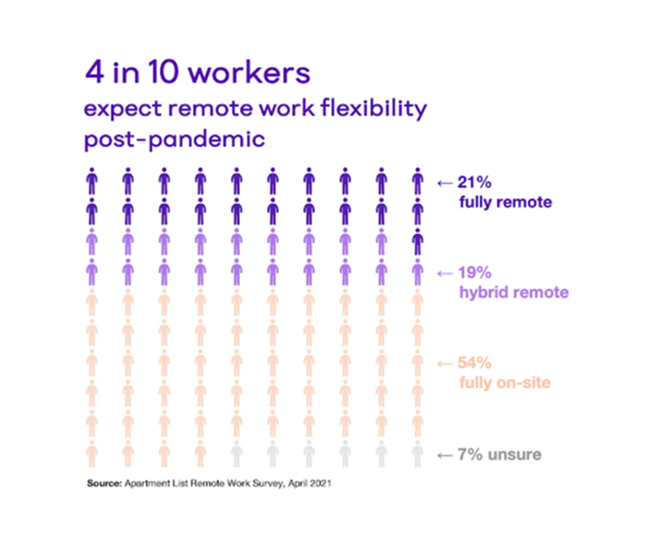
One in four American workers expect that they will continue to have either partial or complete remote-work flexibility after the pandemic, and a majority believe that remote work flexibility will have an impact on their housing preferences and location, according to a report from Apartment List.

“In a survey of 5,000 employed adults across the U.S., we found that four-in-10 workers expect to have some form of continued remote-work flexibility post-pandemic. Nineteen percent expect to have a hybrid arrangement that allows for remote work multiple days per week, while 21 percent expect that they’ll have the ability to work exclusively remotely,” Apartment List said in the report.

Apartment List Housing Economist Chris Salviati said, “I would say that this report provides a lot of valuable new data to confirm trends that we’ve been hypothesizing about for a while. Namely, a broad embrace of remote work will be an ongoing long-term trend that will outlast the pandemic, and this newfound geographic flexibility will have a direct impact on where these remote workers choose to live” and housing after the pandemic.

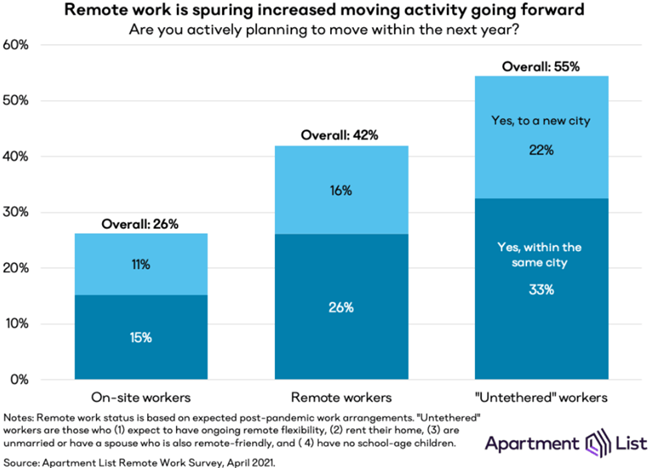
“Forty-two percent of remote workers tell us that they’re planning to move in the next 12 months, compared to just 26 percent of on-site workers,” Salviati said. “Among those likely movers, 35 percent of remote workers say that they plan to relocate to a more affordable market, more than double the rate for on-site workers. The prevalence of housing affordability as a motivating factor in upcoming moves planned by remote workers indicates that we are likely to see a continued outflow of remote workers from the nation’s most expensive markets (e.g. San Francisco, NYC, Boston, D.C., and Seattle).

How Will Remote Work Affect Housing After the Pandemic?

“As for where these folks will go, there are a wide range of preferences among remote workers. Many tell us that they value being close to family, and we observe a fairly even split between those who value urban amenities and those who value natural ones.

“In general, markets that offer a good mix of affordability and access to urban and/or natural amenities are good candidates to see an inflow of remote workers. Cities like Phoenix, Portland, Austin, and Nashville were quite hot even before the pandemic but still maintain an affordability advantage over the most expensive markets, and so likely still stand to gain. We are also likely to see other hubs emerge over time as this trend evolves,” Salviati said.

How Will Remote Work Affect Housing After the Pandemic?

A few highlights from the report on remote work and housing:

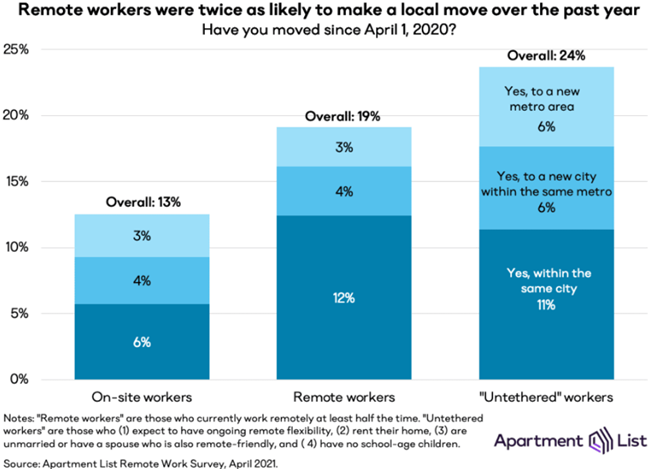
  • Remote work is already spurring increased moving activity; 19 percent of remote workers moved over the past 12 months, compared to 13 percent of workers whose jobs require them to be on-site. However, most of these additional moves were local — remote and on-site workers were equally likely to move to a new city or a new metro.
  • Looking forward, 42 percent of remote workers say that they’re planning to move over the next 12 months, compared to 26 percent of on-site workers. Remote workers are more likely to be planning local moves as well as moves to a new city.
  • Thirty-five percent of remote workers who are planning an upcoming move say that they plan to relocate to a more affordable market, more than double the rate for on-site workers, indicating that we may see an outflow of remote workers from the nation’s most expensive housing markets going forward. This finding also highlights the important equity implications of remote work — on-site jobs are lower paid, on average, but on-site workers have less flexibility to relocate in search of more affordable housing.
  • Overall, remote workers told us that the most important factors in their decision of where to live over the next several years are “access to a housing market where I can afford homeownership” and “access to natural amenities.”

The unprecedented change in how workplaces are organized is weakening the link between job choice and housing choice, and remote workers are already taking advantage of this newfound freedom to move at higher rates, Apartment List says in the report.

Understanding the geographic preferences of this group is now more important than ever, as their migration trends will have the potential to disrupt housing markets across the country.

“Our survey sheds new light on the factors that are motivating moves among remote workers and the attributes they value when choosing where to live. We find that the considerations of remote workers differ from those of on-site workers in important ways. These preferences will drive how remote work will impact the housing market over the next several years,” Apartment List says in the report.

5 Trends Shaping the Future of Rental Housing After the Pandemic

Sign Up For Our Newsletter And Get Apartment News And Helpful, Useful Content Each Week.

* indicates required


How the Pandemic Will Affect the Future of Apartments And What People Rent

Federal Judge Overturns CDC Eviction Moratorium

Federal Judge Overturns CDC Eviction Moratorium

A federal judge has overturned the CDC eviction moratorium saying the agency exceeded its authority in issuing the nationwide eviction ban.

In a 20-page ruling, U.S. District Court Judge Dabney Friedrich, who was appointed by former President Donald Trump, ruled that the agency exceeded its authority with the temporary ban.

However the immediate impact of the decision is not clear. The government has appealed the ruling. It is uncertain whether the appeals court will stay the enforcement of this decision pending conclusion of the appeal. To the extent that decision is stayed pending appeal, compliance with the CDC Eviction Moratorium will still be necessary until the appeal is decided.

The court said in the ruling that the Public Service Act “authorizes the department to combat the spread of disease through a range of measures, but these measures plainly do not encompass the nationwide eviction moratorium set forth in the CDC order.”

The judge wrote in her opinion that she had questions about the constitutionality of the eviction ban and did not see the CDC “had the authority to insert itself into the landlord-tenant relationship without some clear, unequivocal textual evidence of Congress’s intent to do so.”

The judge said courts “expect Congress to speak clearly if it wishes to assign to an agency decisions of vast economic and political significance.”

Luke Wake, an attorney at Pacific Legal Foundation, which represents landlords in a number of related lawsuits, called the ruling a clear signal that the tide has turned against the CDC.

“The challengers have been right all along,” he said. “The government has no authority against any landlord. Full stop.”

The judge said in the ruling, “the court recognizes that the covid-19 pandemic is a serious public health crisis that has presented unprecedented challenges for public health officials and the nation as a whole. The pandemic has triggered difficult policy decisions that have enormous real-world consequences. The nationwide eviction moratorium is one such decision.

“It is the role of the political branches, and not the courts, to assess the merits of policy measures designed to combat the spread of diseases even during a global pandemic. The question for the court is a narrow one: ‘Does the Public Health Service Act grant the CDC the legal authority to impose a nationwide eviction moratorium?’  It does not.”

A number of other judges have ruled on the eviction ban’s lawfulness, with landlords holding a slight advantage in their win-loss record against the federal government.

But while some judges have limited the scope of their rulings to apply only to the parties involved in the particular lawsuits before them, Friedrich rebuffed the federal government’s request that she narrow the effect of her decision, indicating its reach would be nationwide.

The CDC eviction moratorium has been set to expire June 30.

Federal Judge Rules Landlords Do Not Have To Provide Free Housing

Sign Up For Our Newsletter And Get Apartment News And Helpful, Useful Content Each Week.

* indicates required

Denver Passes Law Requiring Rental Housing Inspections, Landlord Licenses

Denver Passes Law Requiring Rental Housing Inspections, Landlord Licenses

The Denver City Council has passed a law requiring rental-housing inspections and licenses for landlords beginning next year, according to reports.

Rental housing inspections will be required every four years. Before receiving a license, landlords must have their properties examined by certified inspectors, according to the measure. At least 10 percent of a property’s units must be inspected at random, according to the new rules.

Landlords can apply for early licenses starting next year. Landlords renting two or more units on a single property, like apartments and row homes, must obtain licenses by Jan. 1, 2023; it’s a year later for landlords who rent living spaces like homes or accessory dwelling units.

The application fee will be $50, and licensing fees will range from $50 for single units to $500 for properties with more than 250 units, the measure said. Landlords must renew their licenses every four years, paired with new inspections.

The Denver Post reported that as the council considered the new law in recent weeks, renters voiced concerns that requiring the licenses for an estimated 54,000 homes, condos, row houses and apartment complexes will increase their rents, while landlords complained of additional red tape that will impede business and lead to costly repairs.

Denver City Council President Stacie Gilmore said a phased approach was put in place to avoid a “bottleneck” of licensees coming in at once and overwhelming the department.

The new law will also create a database of landlords and their properties, Gilmore said. This will enable city officials to track available housing stock and communicate with property owners and tenants about rental- and utility- assistance efforts.

Officials will be able to fine problematic landlords, and suspend or revoke licenses. If the latter two happen, Gilmore said tenants would still be allowed to stay in place through the end of their leases.

10 Things To Check in a DIY Rental Property Inspection

Sign Up For Our Newsletter And Get Rental Property and Apartment News And Helpful, Useful Content Each Week.

* indicates required

Federal Agencies Warn Large Landlords About Tenants’ Pandemic Protections

Federal Agencies Warn Large Landlords About Tenants’ Pandemic Protections

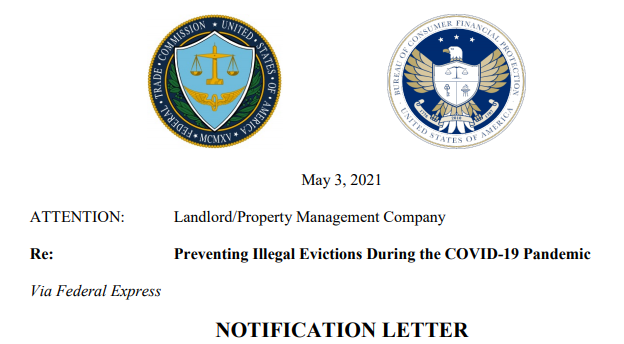
Two federal agencies have issued letters warning large landlords, who collectively own more than two million housing units, of federal protections in place to keep tenants in their homes and stop the spread of COVID-19, according to a release.

The Consumer Financial Protection Bureau (CFPB) Acting Director Dave Uejio and Federal Trade Commission (FTC) Acting Chairwoman Rebecca Kelly Slaughter sent notification letters to the nation’s largest apartment landlords. A recent CFPB report found that renters are particularly endangered, with more than 8.8 million tenants behind on rent.

“With millions of families nationwide at risk of eviction, it’s vital that landlords and the debt collectors who work on their behalf understand and abide by their obligations,” Slaughter said. “We are continuing to monitor this area and will act as needed to protect renters.”

“Landlords should ensure that [Fair Debt Collection Practices Act (FDCPA)]-covered debt collectors working on their behalf, which may include attorneys, notify tenants of their rights under federal law. Nearly nine million households are at risk of eviction due to the economic effects of COVID-19, but no one should lose their home without understanding their rights,” Uejio said. “We will hold accountable debt collectors who move forward with illegal evictions.”

Under the FDCPA interim final rule, debt collectors, as defined by the FDCPA, seeking to evict certain tenants for non-payment of rent must provide those tenants with clear and conspicuous notice that the consumer may be eligible for temporary protection from eviction under the CDC Moratorium. The notice must be provided on the same date as the eviction notice, or, if no eviction notice is required by law, on the date that the eviction action is filed. Debt collectors must provide the notice in writing. Phone calls or electronic notice such as text messages or emails are not sufficient, according to the release.

Neither the CFPB nor the FTC has determined whether the letters’ recipients have violated the law.

The Centers for Disease Control and Prevention (CDC) has extended until June 30 a temporary moratorium on evictions for non-payment of rent, and the CFPB has issued an interim final rule, which took effect May 3, establishing new notice requirements under the Fair Debt Collection Practices Act (FDCPA).

Reports of Multistate Landlords Forcing People from Homes

“Unfortunately, there are reports that major multistate landlords are forcing people out of their homes despite the government prohibitions, or before tenants are aware of their rights,” Slaughter and Uejio said in a statement.

“Depriving tenants of their rights is unacceptable. Many of the tenants at risk of eviction are older Americans and people of color, who already experience heightened risks from COVID-19.

“Staff at both agencies will be monitoring and investigating eviction practices, particularly by major multistate landlords, eviction-management services, and private-equity firms, to ensure that they are complying with the law.

“Evicting tenants in violation of the CDC, state, or local moratoria, or evicting or threatening to evict them without apprising them of their legal rights under such moratoria, may violate prohibitions against deceptive and unfair practices, including under the Fair Debt Collection Practices Act and the Federal Trade Commission Act. We will not tolerate illegal practices that displace families and expose them —and by extension all of us—to grave health risks,” they said in the statement.

“Neither the FTC nor the CFPB has determined whether you or your company is violating the law. Even though we’re sending this notice, the FTC or CFPB may still take action based on law violations. We will continue monitoring eviction practices to evaluate whether further action is appropriate,” Slaughter and Uejio said in the letter to landlords.

Tenants Can Hold Debt Collectors Accountable for Illegal Evictions

Will You Be Ready When the Eviction Moratorium Ends?

Sign Up For Our Newsletter And Get Apartment News And Helpful, Useful Content Each Week.

* indicates required


Senate Bill 282 – Oregon’s Newest COVID-19 Landlord/Tenant Changes

Senate Bill 282 Oregon’s Newest COVID-19 Landlord Tenant Changes

A new Oregon Senate bill 282 is going to impact landlord tenant issues if it passes so attorney Brad Kraus reviews some of its issues for landlords and property managers.

By Bradley S. Kraus,
Attorney at Law, Warren Allen, LLP

As the old saying goes, the more things change, the more they stay the same. As we continue into year two of COVID-19 related rules, restrictions, and issues, landlords and tenants are still struggling.

Unpaid mortgages, rent, and bills continue to accumulate. Assistance is still lagging, failing to reach those landlords and tenants who felt the most impact.  As of this writing, the Landlord Compensation Fund still has not commenced round two of its funding application process. Even still, the Oregon legislature is in the process of passing new legislation that  will affect landlord/tenant relations—this time in the form of Senate Bill 282.

While Oregon SB 282 has yet to pass, in its current form—and much in line with the statement above—SB 282 contains more of the same. It extends the grace period for the repayment of amounts that accrued during the applicable grace period of April 1, 2020 through June 30, 2021 until February 28, 2022. This means that unpaid amounts that accrued over the past year will not be actionable until next year.

Senate Bill 282 further restricts a prospective landlord’s ability to screen applicants for these unpaid amounts.

It states that when considering an applicant, landlords cannot consider an applicant’s unpaid rent, including rent reflected in judgments or referrals of debt to a collection agency that accrued on or after April 1, 2020 and before March 1, 2022. It also contains the vague and concerning language that landlords cannot consider eviction actions if they are based on “claims” that arose on or after April 1, 2020 and before March 1, 2022. The reason that this is concerning is because even evictions related to violent conduct are technically “claims” that would fall subject to this broad standard. To suggest that a landlord could not consider the fact that an applicant stabbed someone within the above timeframe would be absurd.

SB 282 also contains additional required disclosures that will require landlords to update their forms. More specifically, notices for non-payment of rent will need a disclosure related to the extended grace period and an additional disclosure related to a website containing information on tenant resources. Balance-due notices will also need an update due to the changing grace period. Should SB 282 pass in its current form, landlords should review their materials and procure updates where needed.

Finally, SB 282 also contains prohibitions on a landlord’s enforcement of rules related to unauthorized guests. SB 282 states that a landlord may not enforce a restriction by any means, including terminating the tenancy, if the restriction is based on “the maximum duration of a guest’s stay in the tenancy.” The bill does allow a landlord to screen the guest, if the guest resides in the premises more than 15 days in any 12-month period. The screening may not be based on credit reports or income. Finally, landlords can enter into temporary occupancy agreements with the guests, but that agreement cannot have an ending date earlier than February 28, 2022.

As the calendar turns every month, landlords and tenants continue to fall behind on rent, mortgages, and other payments they have not been able to make due to COVID-related shutdowns.

The Oregon Landlord Compensation Fund is/was intended to resolve those issues, but it remains shuttered due to numerous issues. Rather than address those issues head-on, the legislature hastily crafted—and will likely pass—this bill. SB 282 does not solve the issues brought on by COVID-19; it further kicks those cans down the road. As the saying goes, the more things change, the more they stay the same.

A new Oregon Senate bill is going to impact landlord tenant issues if it passes so attorney Brad Kraus reviews some of its issues for landlords and property managers.
Bradley Kraus, Portland attorney

Brad Kraus is a partner at Warren Allen LLP. His primary practice area is landlord/tenant law, but he also assists clients with various litigation matters, probate matters, real estate disputes, and family-law matters. A native of New Ulm, Minnesota, he continues to root for Minnesota sports teams in his free time. You can reach him via email [email protected] or 503-255-8795.

Fair Housing Matters – Landlord Liability for Tenant-on-Tenant Discrimination

Sign Up For Our Newsletter And Get Apartment News And Helpful, Useful Content Each Week.

* indicates required


A Bright Outlook For Suburban Rental Housing

A Bright Outlook For Suburban Rental Housing

The tight housing supply and rising costs will delay many renters from transitioning to homeowners, providing a bright outlook for suburban rental housing, according to Marcus & Millichap  in their most recent research brief.

Suburban rental housing market signals transformation

“Home buying is being driven in large part by changing demographic trends that have been accelerated by the health crisis.

“The aging of the millennial generation into the homeownership phase of life and more households seeking larger spaces in lower-density areas as they work and attend school from home have driven housing demand in the suburbs.

“Home sales are also being fueled by historically low interest rates and a surge in savings during the pandemic that are helping more prospective homeowners afford the associated down payment and mortgage. Lower land costs farther from metro cores are keeping many developers focused in suburban and exurban locales,” Marcus & Millichap say in the report.

Housing shortage reiterates value of apartments

 During March, the supply of both new and existing home sales remained near a historic low, resulting in many potential homeowners being repeatedly outbid as prices continue to soar.

“The median cost of an existing home jumped 3.0 percent in March alone to $342,400, a new all-time high. Over the past 12 months, the price has surged 18.4 percent, which is the fastest pace of annual price growth since at least the 1960s.

“As a result, the monthly payment for a 30-year loan on a median-priced home, with a 10 percent down payment and including taxes and insurance, rose to $1,926. In contrast, the average effective rent on a Class A apartment is $1,787 per month, underscoring the value of rentals.

“The tight supply and rising cost will delay many renters from transitioning to homeowners, providing a bright outlook for suburban rentals,” the report says.

Single-family rentals gain traction

Strong demand for single-family home rentals since the Great Recession and a lack of available homes to purchase for rentals have some investors constructing single-family communities for the purpose of renting. In recent years, the number of build-for-rent homes (BFR) accounted for five to 10 percent of the new homes constructed; however, the numbers are growing, especially in the Sun Belt metros with lower land prices, including Atlanta, Phoenix and Houston. These assets could increase competition for larger suburban apartments.

Strong demand activates developers; cost continue to rise

Housing completions surged 16.6 percent during March and single-family permitting jumped 4.7 percent.

“While permitting and construction activity are growing, rising production costs and a shortage of materials are delaying the groundbreaking on some homes.

“In the final week of April, the average cost of 1,000 board feet of lumber sat just under $1,300, up 232 percent since the onset of the pandemic. The rising costs have some developers focusing on higher-end residences, where these costs can more easily be absorbed into the sales price,” the report says.

Marcus & Millichap is a leading firm specializing in commercial real estate sales, financing, research and advisory services.

5 Trends Shaping the Future of Rental Housing After the Pandemic

Sign Up For Our Newsletter And Get Apartment News And Helpful, Useful Content Each Week.

* indicates required


How the Pandemic Will Affect the Future of Apartments And What People Rent

Rent Prices Show Largest Jump in April Since 2017

Rent prices National Rent Index Shows Largest Jump in April Since 2017

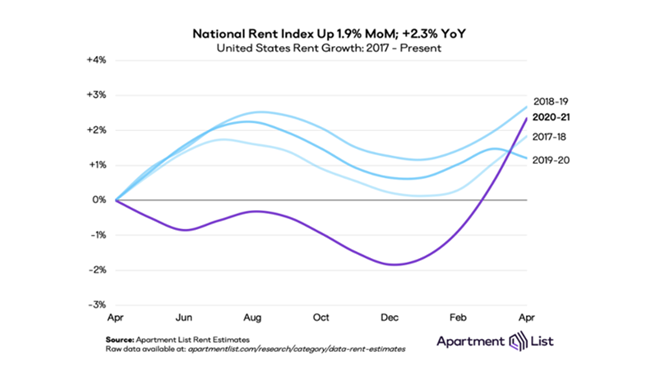
Rent prices are continuing to rebound with the national index up by 1.9 percent month-over-month in April, “the biggest monthly jump in our national index since the start of our estimates in 2017, breaking a record set just last month,” said Rob Warnock, senior research associate with Apartment List.

Rent growth has now been outpacing prior-year averages for several months, “indicating that this year’s moving season is set to be a historically busy one,” Apartment List says in the report.

“For comparison, in the pre-pandemic years of 2018 and 2019, month-over-month rent growth in March was 0.8 percent and 0.7 percent, respectively. This month’s sharp increase breaks a record set just last month, when rents jumped by 1.4 percent. In each of the past four months, our national index has not only had positive growth, but has outpaced the average growth of prior years.

“After the rapid growth of recent months, year-over-year rent growth now stands at 2.3 percent, in line with the rates from prior years,” Apartment List says in the report.

Days of plummeting rent prices have come to an end

“The data continues to show significant regional variation, but the days of plummeting rents in pricey coastal markets have come to an end.

“The cities with the sharpest year-over-year rent declines are now experiencing positive rent growth again, and in some cases, prices are rapidly rebounding. At the other end of the spectrum, many of the mid-sized markets that have seen rents grow quickly through the pandemic are continuing to boom,” Warnock says in the report.

In markets like San Francisco where rents had been falling fastest, prices have turned a corner and are now rebounding.

At the same time, booming markets like Boise continue to see prices climb. More broadly, as vaccine distribution continues to gain momentum, we may be starting to experience the release of pent-up demand from renters who had been delaying moves due to the pandemic. Whereas last year’s peak moving season was halted by the pandemic, this year’s seasonal spike appears to be making up for lost time.

Summary

“We are now seeing that the markets where rents had been falling sharply have turned a corner, and in some cases, prices in these cities have started to rebound rapidly. But although some may be moving back to superstar cities, affordable mid-sized markets are continuing to boom. As vaccine distribution continues to gain momentum, rental markets may be beginning to reflect the preferences of a post-COVID future,” Apartment List says in the report.

Sign Up For Our Newsletter And Get Apartment News And Helpful, Useful Content Each Week.

* indicates required


How the Pandemic Will Affect the Future of Apartments And What People Rent