
Home Blog Page 113

6 Factors Involved in Lease Renewals Post-Pandemic

6 Factors Involved in Lease Renewals Post-Pandemic

As we work through the pandemic, here are some lease renewals thoughts that could apply post-pandemic that landlords and property managers may want to consider going forward in  2021.

By Justin Becker

There is no doubt that COVID-19 has changed the way people occupy space and interact, which, as a result, has caused a decline in demand for space and property. The unprecedented crisis is expected to have lasting effects, depending on how long the virus persists.

In order to respond to the crisis, it is important that property managers and owners take action now rather than later. In the post-pandemic era, landlords should review some strategies regarding property leases.

COVID-19 has seen the closure of many retail locations, not just in the United States but across the globe. Since the duration of the pandemic is uncertain, landlords, tenants and lenders are all trying to figure out their next steps involving real estate inter-parties.

While the relationship between property owners and tenants depends on individual lease agreements , regarding leases to private and commercial properties, the post-pandemic era will require some changes that property owners can make to address the unique challenges brought about by COVID-19.

Below are some of the possible steps that property owners should consider during the post-COVID-19 period.

1. Rent Deferral

Considering rent deferral is one of the steps that landlords can take to address the challenges that most tenants, especially those occupying homes, apartments and townhomes for rent, are currently facing. The world has witnessed massive job losses, which means that people and businesses are facing financial difficulties.

An agreement to defer a portion, or the entirety, of the rent for a defined period of time would be most effective to address the situation. Deferred rent would then be paid after the agreed period lapses or over the duration of time, depending on how the situation resumes to normalcy.

Ideally, the issue of rent deferral is subject to several factors that guide the property owner’s decision to set the terms of such an agreement. For example, deferral on commercial property should be based on the tenant’s business operations.

There are certain businesses that are not self-sustaining, which means that there is no guarantee that you will be paid at the end of the deferral period. You need to set the terms in such a way that while the aim is to provide the tenant with financial relief, you are also able to maintain your cash flow under the lease.

2. Rent Reduction

Rent reduction might be perceived as unfavorable to landlords, but it works towards building a good relationship with the tenants. As a property owner or property manager, rent reduction should be one of the options, provided that it does not take place at the expense of the landlord’s cash flow.

Of course, rent-restructuring is more economically viable to the tenants, which is why many property owners would consider it as unfavorable to them. However, there is no actual telling how long the effects of COVID-19 will last.

This means that the financial burden on the tenants might extend for an unknown period. Considering rent reduction, no matter how unfavorable it might seem, is not entirely a bad option. An alternative to rent reduction to landlords is tolling the rent.

An agreement can simply be drafted detailing the abatement period that provides some rent relief to the tenant. However, property owners and managers should understand that rent abatement does not provide any relief on the part of the landlord in terms of cash flow, operating costs and other ongoing obligations.
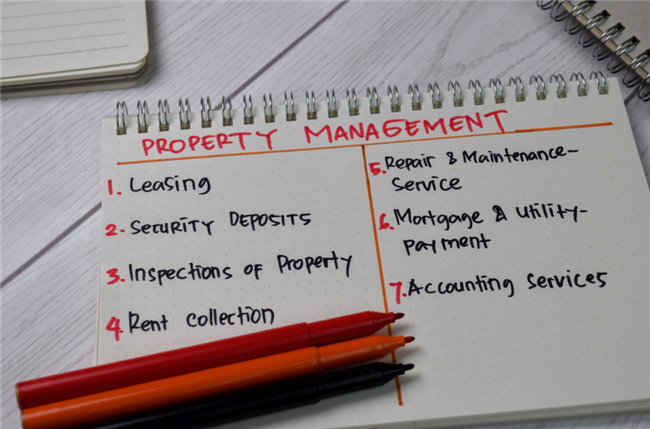
lease renewals post-pandemic
The current economic hardships are already difficult for both landlords. property managers and tenants, hence the need to establish workable goals that are practical and discernible.

3. Setting Realistic Expectations

One thing that COVID-19 has taught the world is that you can never be too sure about the future. For this reason, it is important for parties involved in property leases to set out realistic goals that address the unique nature of the current situation that they find themselves in.

Going forward, it is expected that it will take some time before the situation resumes to normalcy, especially in terms of income challenges.

The current economic hardships are already difficult for both landlords and tenants, hence the need to establish workable goals that are practical and discernible. This way, you won’t lose your tenants as a property owner due to financial constraints, as the challenges being experienced are not permanent.

The mutually acceptable solutions, in the short term, should leave you in a better position post-COVID when the harsh economic times change for the better.

4. The Need For Lease Transparency

Transparency is one of the key things that will be needed in real-estate deals during the post COVID-19 era. While leases are meant to guarantee that transparency is upheld in rental agreements, there are instances where certain clauses are left out by the property owners only for the tenant to be subjected to these clauses after signing the lease renewal agreement.

Tenants also have a tendency of leaving out crucial information that can affect the tenancy agreement in the long run.

It is such disputes that tend to escalate, especially when one party involved in the lease feels aggrieved. To avoid such disputes, full disclosure is important, especially on the parts of the tenants that are struggling with financial difficulties. Of course COVID-19 has affected property owners and their tenants alike. This is an issue that landlords understand too well.

In the event that the lease renewal can be altered to factor in emerging issues brought about by the pandemic, then such an eventuality would work to the benefit of the parties involved. Non-disclosure on either of the parties only causes unnecessary disputes that can easily be solved through consensus.

5. Consider Third-Party-Lender Approvals

With the demand for apartments and mobile homes for lease constantly changing, it is important that you consider third-party lenders as part of your plan to maintain a steady cash flow. With tenants yet to recover financially, post-COVID will require that you consider getting funds from alternative lenders to stay afloat.

For property owners and managers, such real estate requires a lot of maintenance. Even if the demand for apartments has been on the decline, the tenants residing there require basic services and repairs, in case of damage to the property. As outlined in most leases, it is the responsibility of the tenant to cover damages to the property they are residing in.

With that said, there are unique situations where the damage may be as a result of other causes other than the tenant. This means that the tenant cannot be charged for such damages. Availability of funds ensures that possible repairs are done fast, meaning the tenant is not affected in any way that would be in violation of the tenancy agreement.

6. What To Expect Post-COVID In The Real Estate Market

The current crisis has led to significant stress on both landlords and their tenants. Both parties have experienced a decline in cash flow, business interruption and overall suspension to some. To address the unprecedented challenges brought about by COVID-19, landlord-tenant agreements should be mutually beneficial. Landlords can offer some waivers, but tenants too should strive to fulfil their rent obligations.

This calls for a change in the way property owners and tenants interact post-COVID. With competent planning, the situation is likely to change sooner than expected. This means that every decision has to be accompanied by a shared goal between landlords and tenants.

Future leases  and lease renewals post-pandemic will need to factor in the need to have a plan regarding how both parties intend to address these types of issues. However, there is every need to be prudent regarding how the issues brought by COVID-19 are leveraged to address the current crisis.

The post-COVID era promises a lot of uncertainties to both landlords and tenants. With that said, it is better to deal with the crisis now through the strategies outlined above before focusing towards the future. This is how property owners can address the current crisis and also ensure that they do not lose their tenants.

About the author:

Justin Becker is a property owner in the state of Michigan and has a passion for managing communities. He owns apartment complexes and mobile home communities, and has been writing his own blogs for his properties for several years.

5 Ways to Increase Rental Housing Revenue or Rents in 2021

7 Ways to Get Smoking Under Control in Non-Smoking Apartments

Sign Up For Our Newsletter And Get Apartment News And Helpful, Useful Content Each Week.

* indicates required

If A Tenant Dies, Does His Emotional Support Dog Become A Pet?

Ask Landlord Hank If A Tenant Dies, Does His Emotional Support Dog Become A Pet?

A landlord asks this week about an emotional support dog and a tenant who has passed away, so that is the question for Ask Landlord Hank. Remember Hank is not an attorney and he is not offering legal advice.

Dear Landlord Hank:

A couple moved in 18 months ago. The husband had an emotional-support animal.

However, the husband has now died. Does the emotional support dog now become a pet? I don’t rent to people who have dogs. May I require the wife to get rid of the dog? May I now charge a pet fee? May I raise the rent? — Jerald

Hi, Landlord Jerald,

An emotional-support animal is meant to help a person who is disabled. The pet is meant to help the disability that affects a major life function for that person.

If that person is no longer alive, then the emotional support animal is not doing the job for which it was designed, and it becomes a pet.

In my opinion, you could require the wife to sign a pet addendum, and collect a pet deposit.

BUT, is that really the right decision?

Maybe from a strictly business sense, yes. But ask yourself these questions:

  • First, have these tenants been good tenants?
  • Has the emotional support dog been a problem, or caused any damage?
  • Would anything really change if you allow this grieving wife to stay until the end of her lease, with no changes?

I normally don’t allow pets in my properties either, but in this case, if they’ve been good tenants and there is no damage to the property from the pet, I’d let her stay through the end of current lease, but no longer.

I’d have a conversation with her though, so she knows you are making an accommodation for her, but only for this one lease.

Sincerely,

Hank Rossi

Ask Landlord Hank: If A Tenant Dies, Does His Emotional Support Dog Become A Pet?
Landlord Hank says, “If that person is no longer alive, then the emotional support animal is not doing the job for which it was designed, and it becomes a pet.”

Ask Landlord Hank Your Question

Ask veteran landlord and property manager Hank Rossi your questions from tenant screening to leases to pets and more! He provides answers each week to landlords.

  • This field is for validation purposes and should be left unchanged.

Do I Have to Paint and Replace Flooring for a Long-Term Tenant?

Sign Up For Our Newsletter And Get Rental Housing And Apartment News And Helpful, Useful Content Each Week.

* indicates required

Everything Landlords Should Know About Emotional Support Animals

If HUD Calls Do You Have Documentation To Defend Yourself?

If HUD Calls Do You Have Documentation To Defend Yourself?

The Grace Hill training tip of the week focuses on the issue of documentation to help property management professionals if HUD calls and to defend themselves in the event of a Fair Housing Act discrimination charge.

By Ellen Clark

Two years ago, the U.S. Department of Housing and Urban Development (HUD) awarded $37 million to more than 150 national and local organizations working to confront Fair Housing Act violations.

The enforcement will come through testing, filing fair housing complaints, and investigations by these organizations.

In order to successfully defend your decisions, policies, and practices, as well as demonstrate that all persons were treated the same, your documentation must be complete and contain relevant facts. This seems like a good time to talk about documentation.

If HUD calls, do you have documentation to defend yourself?

Documentation is extremely important if you find yourself dealing with an accusation of discrimination. You must be able to defend your decisions, policies, and practices, as well as demonstrate that all persons were treated the same, regardless of membership in one of the protected classes.

Accordingly, your documentation should offer a full accounting of facts. Describe all events and actions taken, all people involved, and provide specific dates and times.

Your documentation will not be effective if you do not keep the supporting paperwork: copies of service requests, guest cards, and availability reports. These records will be used to verify the dates and times of customer requests, availability changes, and rental rate changes.

When it comes to documentation, keep your records complete, organized, and on file for three to five years.

Tips for good documentation and record-keeping strategies

    • Use guest cards for consistent documentation on all prospective residents who call or visit.
    • Document all follow-up activity on the guest card.
    • Follow up both verbally and in writing with anyone whose rental application is declined.
    • Keep an organized file of your apartment availability reports.
    • Document the dates and times of any rental rate changes.
    • Keep all service requests on file. Be sure the work done, time completed, and technician’s name are noted on the request.
    • Keep important documentation, including guest cards, declined applications, availability reports, dates and times of rental rate changes, and all service requests on file for at least three years, though preferably for five  years.

Why keep records for three to five years?

It is becoming more common for unsuccessful HUD complaints to be filed as lawsuits.

In this case, the complainant has two years from the time the discriminatory housing practice ended or occurred to file a lawsuit.

However, the two years does not include any time in which administrative proceedings from the original HUD complaint were pending.

Also, if a conciliation agreement was reached between the two parties in a HUD discrimination claim, and the accused party violates the agreement, the complainant has two years from the time the agreement is violated to file a lawsuit.

So, long story short, proceedings related to a complaint could go on for a very long time!

Private organizations play a key role in enforcing fair housing laws, and that they are being provided with ammunition from the government to step up enforcement.

Of course, it is best to do all you can to prevent claims in the first place.  But if it happens, good documentation can help make the process go as smoothly as possible.

Read Ellen’s full blog post here.

About the author:

Ellen Clark is the Director of Assessment at Grace Hill.  Her work has spanned the entire learner lifecycle, from elementary school through professional education. She spent over 10 years working with K12 Inc.’s network of online charter schools – measuring learning, developing learning improvement plans using evidence-based strategies, and conducting learning studies. Later, at Kaplan Inc., she worked in the vocational education and job training divisions, improving online, blended and face-to-face training programs, and working directly with business leadership and trainers to improve learner outcomes and job performance. Ellen lives and works in Maryland, where she was born and raised.

About Grace Hill

For nearly two decades, Grace Hill has been developing best-in-class online training courseware and administration solely for the Property Management Industry, designed to help people, teams and companies improve performance and reduce risk.

Sign Up For Our Newsletter And Get Apartment News And Helpful, Useful Content Each Week.

* indicates required


How Your Terms, Conditions Or Privileges Could Mean Discrimination

How To Avoid A Fair Housing Claim Over Source Of Income Discrimination

The Grace Hill training tip of the week focuses on the issue of how your terms, conditions or privileges you provide prospective tenants and existing tenants could be discrimination under the Fair Housing Act.

By Ellen Clark

You must treat all prospects and tenants in a consistent way in how you use terms, conditions or privileges to avoid discrimination under the Fair Housing Act.

Setting different terms, conditions, or privileges for buying or renting housing is a little less direct than other illegal practices, such as an outright refusal to rent or sell to an individual.

But it is just as illegal.

Requiring higher security deposits from families with children and demanding higher application fees from minorities are examples of discrimination in terms, conditions, or privileges. These practices violate fair housing laws.

To avoid discrimination in terms, conditions or privileges, treat all prospects and residents fairly and consistently.

 3 ways in leasing to be consistent and avoid discrimination

    • If you require a photo ID from prospects to tour your community, be sure to get one from every prospect. No matter how non-threatening someone appears, it is important to require the same thing from all prospects.
    • If a prospect’s rental application is denied, follow-up with them both verbally and in writing. Follow this exact procedure for every application that is denied.
    • If you have a prospect who does not meet your income requirements but you let her sign a lease by pre-paying six months’ rent, you should offer this option to other prospects in a similar situation.

 3 ways in maintenance to be consistent and avoid discrimination

    • If you charge one resident for a lock change, you should charge all residents the same amount for the same service.
    • Respond to service requests in the order in which they were received.
    • Faster response to emergencies is expected, but be sure to clearly define and document what constitutes an emergency service request. Document all correspondence with residents in your records.

If you make an exception to any policy or procedure, make sure you provide the same information and options to all prospects and residents who are in the same situation.

Being consistent in how you apply policies and procedures will help you make a habit of treating all current and future residents fairly and equally. This will help you comply with the FHA, but just as importantly, it will create a more welcoming atmosphere for all people who meet your qualifications and wish to live in your community.

Summary on consistency and discrimination

The Fair Housing Act is intended to prevent housing discrimination.

The Fair Housing Act describes a number of illegal practices relating to housing discrimination. One of these is discrimination in terms, conditions, or privileges.

Discrimination is when a person, or a group, is treated unfairly or differently than others for a reason related to their membership in a certain category or group. In other words, if someone is treated in a different way than someone else because of the color of their skin, their age, their nationality, their ability to speak English (to name just a few) they are being discriminated against.

A person does not need to be harmed to have been discriminated against—just treated differently.

How Your Terms, Conditions Or Privileges Could Mean Discrimination

Read Ellen’s full blog post here.

About the author:

Ellen Clark is the Director of Assessment at Grace Hill.  Her work has spanned the entire learner lifecycle, from elementary school through professional education. She spent over 10 years working with K12 Inc.’s network of online charter schools – measuring learning, developing learning improvement plans using evidence-based strategies, and conducting learning studies. Later, at Kaplan Inc., she worked in the vocational education and job training divisions, improving online, blended and face-to-face training programs, and working directly with business leadership and trainers to improve learner outcomes and job performance. Ellen lives and works in Maryland, where she was born and raised.

About Grace Hill

For nearly two decades, Grace Hill has been developing best-in-class online training courseware and administration solely for the Property Management Industry, designed to help people, teams and companies improve performance and reduce risk.

Sign Up For Our Newsletter And Get Apartment News And Helpful, Useful Content Each Week.

* indicates required


If HUD Calls Do You Have Documentation To Defend Yourself?

High-Earners Moved the Most During the Pandemic

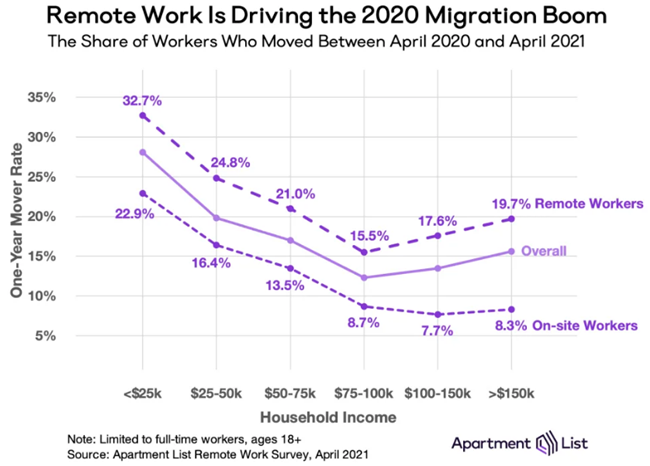
The percentage of Americans who move each year had been declining for many years until the pandemic hit when high-earners moved because remote work allowed many to look for a new place to live, according to a new study.

A remote-work survey from Apartment List shows the majority of movers between April 2020 and April 2021 were either higher-wage workers or those who could easily adapt to remote jobs.

“We find that COVID and the expansion of remote work have encouraged 16 percent of American workers to move during the past 12 months, the first time that mover rate has increased in over a decade,” said Igor Popov, chief economist for Apartment List.

“Perhaps unsurprisingly, wealthy remote workers saw the biggest jump in mobility this year, as they took advantage of remote work to scan the country for their ideal living arrangement,” Popov said.

Households where income was $150,000 a year or more saw the largest jump in relocation, the first time this has happened in a decade. The 16 percent migration represents a 39 percent increase over the estimate by the Census Bureau in 2019.

High-Earners Moved the Most During the Pandemic because of remote work

High- Earners Moved – Highlights From the Study:

  • In 2019, the move rate among full-time workers in the United States was 14 percent and had been declining for decades.
  • High-earners are historically the least likely to move, but this year they were the largest jump in residential migration.
  • In 2020, wealthy movers moved further from job centers to purchase homes, enjoy more physical space, and live in places with a lower cost-of-living.

“No longer tied by work to any specific city, remote workers earn higher wages and can take those wages across the country in search of desirable housing,” Apartment List says in the study.

“Specifically among the remote workers in the highest income bracket, the one-year mover rate jumps to 20 percent, more than twice that of on-site workers earning similar wages.”

The report concludes by saying the kinds of individuals who are moving “have the potential to further redistribute wealth if high-paying jobs are no longer concentrated in the nation’s largest, most expensive cities.”

How Will Remote Work Affect Housing After the Pandemic?

Sign Up For Our Newsletter And Get Apartment News And Helpful, Useful Content Each Week.

* indicates required

Why Now is the Time to Invest in Real Estate – FREE Zoom Seminar

Why Now is the Time to Invest in Real Estate - FREE Zoom Seminar

Are you interested in earning passive double-digit returns in real estate investments that are secured by real property? Do you really want to get to know who you are investing with before you pull the trigger? Then let us introduce you to Trust Deed investments at Ignite Funding!

Join us next week for a FREE virtual event hosted by Colby Trah via Zoom video conferencing on Thursday, June 3rd at 10AM PST.

Put a face to the name while learning WHY NOW is the right time to invest in real estate with Ignite Funding. Learn how you can earn 10% to 12% annualized returns with Trust Deeds, what you are investing in, and how Ignite Funding is different from the competition.

Why Now is the Time to Invest in Real Estate - FREE Zoom Seminar- on real estate investments

The morning of the event we will send you a link that will take you directly to where the Zoom meeting will be hosted. Important Note: Please make sure you already have the Zoom app downloaded on your computer or to your smartphone so you don’t show up late and miss any important information.

Click the button below to RSVP now for this free virtual event:

CTA “RSVP HERE” Link to: https://info.ignitefunding.com/ctrah-landing-rsvp

Unable to attend the event on that date? CLICK HERE to schedule a one-on-one Zoom session at a time that works best for you.

Why Now is the Time to Invest in Real Estate - FREE Zoom Seminar

High Demand for Apartment Jobs in Portland

High Demand for Apartment Jobs in Portland

There is a high demand for apartment jobs in Portland, according to the latest report from the National Apartment Association (NAA).

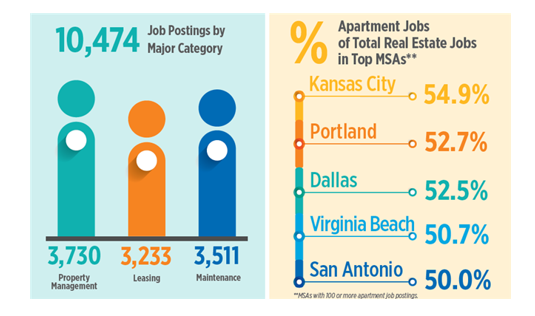
Apartment jobs are 52 percent of all the real-estate jobs in Portland in April 2021, says the National Apartment Association’s Education Institute (NAAEI). It takes an average of 48 days to fill these jobs in Portland.

Nationally, while multifamily operators are gearing up for another leasing season, more than 13,000 apartment jobs were available during April across the country, accounting for 37 percent of all real-estate jobs.

In addition to Portland’s jobs, more openings were driven in other secondary markets such as Kansas City, Dallas, Virginia Beach and San Antonio.

Property-Manager  Jobs in Demand

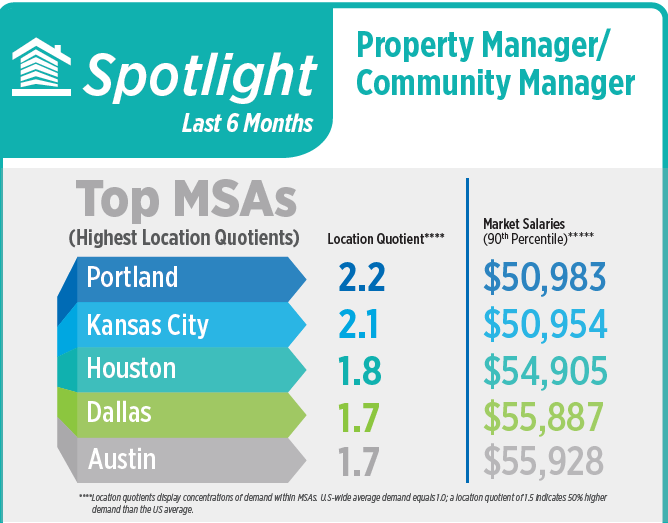
Property-manager and community-manager positions were also in high demand in Portland, with those jobs paying around $56,000 a year.

For those jobs, employers are seeking property-management experience, budgeting skills, staff-management skills, and experience with property-management software.

property managers
property managers top skills

The recent report said, “Multifamily talent was in high demand, likely due to increased leasing activity. According to RealPage, annual apartment absorption reached an outstanding 353,453 units during the first quarter of 2021.

“In gateway markets such as New York City, existing renters are signing new leases at historically high levels, although occupancy rates continue to weaken. This indicates that concessions and reduced rental rates are attracting existing renters instead of prospective renters,” the report says.

National apartment association jobs report background

“Our education institute is a credentialing body for the apartment industry. They hear often that one of the biggest problems keeping our industry leaders up at night is the difficulty in finding talent, attracting talent and retaining talent,” NAAEI’s Paula Munger said.

Assistant Property Manager Jobs In Demand

So NAA partnered with Burning Glass Technologies. “They have a labor-job posting database that is proprietary,” she said, and they can “layer on data from the Bureau of Labor Statistics (BLS). We looked at that and thought we could do something that is really going to help the industry and help benchmark job titles and trends as we go forward.”

The NAA says on their website, “The apartment industry offers a wealth of meaningful career opportunities that use a variety of skills and capabilities. Regardless of whether you are graduating from high school or college, leaving the military, or switching careers, the industry has a job that’s just right for you.”

Sign Up For Our Newsletter And Get Apartment News And Helpful, Useful Content Each Week.

* indicates required

Apartment Job Openings Strong in Seattle, Portland

Ask the Attorney About Tenant Notification in Oregon

Ask the Attorney About Tenant Notification in Oregon

Ask attorney Brad is a feature with attorney Bradley S. Kraus and this week the question is about tenant notification in Oregon. If you have a question for Brad, please feel out the form below.

Ask Attorney Brad:

I own a condo in Clackamas County, Oregon, which is currently renter-occupied. I would like to sell the property and am having a hard time determining what I am required to do regarding notifying the tenant and showing the property while the tenant is still living in the home. Help? Thank you, Lee

Hello Lee,

Thank you for your inquiry. In terms of entries and showing, your rights (along with the tenant’s) are governed and discussed in ORS 90.322.

In terms of tenant notification, that Oregon statute requires 24 hours’ actual notice prior to entry. Keep in mind that the tenant does have the right to deny entry, but cannot unreasonably withhold access. That is an amorphous standard, and when it comes to frequent entries, tenants can become frustrated by the multiple entries and notices.

When it comes to showings related to a sale, it may be best to work out an agreement with the tenant related to entry for showings that can be done without advanced notice. That process is also discussed in ORS 90.322, and states as follows:

(d) A landlord and tenant may agree that the landlord or the landlord’s agent may enter the dwelling unit and the premises without notice at reasonable times for the purpose of showing the premises to a prospective buyer, provided that the agreement:

  • Is executed at a time when the landlord is actively engaged in attempts to sell the premises;
  • Is reflected in a writing separate from the rental agreement and signed by both parties; and
  • Is supported by separate consideration recited in the agreement.

You can have those discussions with your tenant to see if they’d be amenable to entering into such an agreement.

You should speak with the attorney of your choice to assist you with the next steps, assuming your tenant is open to such an arrangement. If not, proper notice, complying with all the requirements in the ORLTA, will be important.

Ask Attorney Brad About Tenant Notification in Oregon
Bradley Kraus, Portland attorney

Brad Kraus is a partner at Warren Allen LLP. His primary practice area is landlord/tenant law, but he also assists clients with various litigation matters, probate matters, real estate disputes, and family-law matters. A native of New Ulm, Minnesota, he continues to root for Minnesota sports teams in his free time.  You can reach him via email [email protected] or 503-255-8795.

Ask Attorney Brad

Please enter your rental housing management question below for Ask Attorney Brad Kraus. Unfortunately he cannot answer questions from tenants.

  • This field is for validation purposes and should be left unchanged.

Sign Up For Our Newsletter And Get Rental Housing and Apartment News And Helpful, Useful Content Each Week.

* indicates required

Ask Attorney Brad: Why Can’t A Landlord Give a 30-Day Notice to Vacate?

HUD Charges Apartments Over Denial of Assistance Animal

HUD Charges Apartments Over Denial of Assistance Animal

A potential tenant who requested an accommodation, and provided a doctor’s letter confirming the necessity of the assistance animal, was denied the ability to rent an apartment leading to a charge of disability discrimination, according to a HUD release.

According to the complaint the potential tenant was told by an apartment employee that the apartments “did not allow pets, and when (the potential tenant) tried to explain that her cat was an emotional-support animal, the woman repeatedly interrupted her, stating, ‘We don’t allow pets.’ ”

The U.S. Department of Housing and Urban Development (HUD) is charging Bloomington, Indiana’s Burnham Rentals, LLC, Burnham Place Apartments, LLC, two of its employees and others, with violating the Fair Housing Act’s ban on disability discrimination.

HUD’s charge alleges that the housing providers refused to permit a rising Indiana University graduate student, who has depression and post-traumatic stress disorder, to keep an assistance animal in an apartment.

In addition, HUD’s charge alleges that the housing providers used the building’s no-pets policy as justification to deny the student’s request to live with her assistance animal, effectively denying her access to the housing.

HUD Charges Apartments Over Denial of Assistance Animal
“It’s not a housing provider’s role to determine who does or does not need an assistance animal,” said Jeanine Worden, HUD’s Acting Assistant Secretary for Fair Housing and Equal Opportunity.


The Fair Housing Act prohibits housing providers from denying or limiting housing to people with disabilities, or from refusing to make reasonable accommodations in policies or practices when necessary to provide persons with disabilities an equal opportunity to use or enjoy a dwelling.

This includes refusing to rent to people with disabilities who have assistance animals that perform work or tasks, or that provide disability-related emotional support.

“Not allowing someone with mental health disabilities to keep an assistance animal robs them of their independence as well as the opportunity to fully enjoy their home,” said Jeanine Worden, HUD’s acting assistant secretary for fair housing and equal opportunity, in the release. “HUD remains committed to ensuring that the owners of rental housing meet their obligations under the nation’s fair-housing laws.”

“Often people with mental health disabilities who request reasonable accommodations face discrimination because their disabilities are not visible, said Damon Smith, HUD’s principal deputy general counsel. “HUD works to ensure that the rights of individuals with ‘invisible’ disabilities are fully visible and enforced.”

HUD’s charge alleges that the graduate student used the assistance animal, a cat to help with her symptoms instead of medication that caused her side effects, https://neurofitnessfoundation.org/amoxil-treat-infections/. With her doctor’s support and monitoring, she found relief with the assistance animal. The housing providers, however, allegedly denied her request to keep the animal, resulting in the student being forced to rent another, more expensive, apartment farther from the university.

Landlord Settles with HUD Over Assistance Animal Discrimination Claim

Property Manager Charging Pet Fee for Assistance Animal Leads to HUD Discrimination Charge

Sign Up For Our Newsletter And Get Apartment News And Helpful, Useful Content Each Week.

* indicates required


Ask Landlord Hank: Should I Set Up A Legal Entity For My Rentals?

Ask Landlord Hank: Should I Set Up A Legal Entity For My Rentals?

A landlord asks this week about setting up a legal entity for his rentals, so that is the question for Ask Landlord Hank. Remember Hank is not an attorney and he is not offering legal advice.

Dear Landlord Hank:

I own five rental properties and plan to acquire more. Should I set-up a legal entity, i.e. a limited liability company (LLC), S-Corp for myself and these properties? Thank you in advance. –Richard

Hi, Landlord Richard:

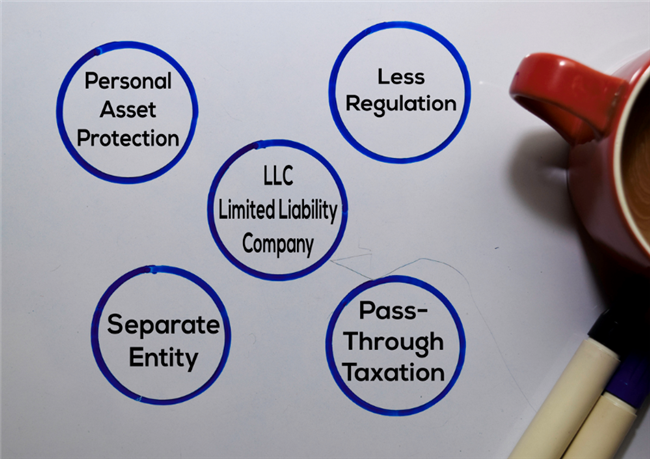
I like LLCs for a number of reasons, but the main reason is that they actually limit liability to the assets of the company, in this case one property – or however many you choose to put in the LLC.

Many folks will have an LLC for each separate property. If someone sues you at one of your rental properties, the most you could lose would be the value of your asset – in other words, that single property. Your personal assets or other properties can’t be used to satisfy a judgement against one LLC. Also, the LLC is not taxed itself;  the taxes flow through to you.

LLCs are easy and inexpensive to set up and run. You don’t have to have regular meetings, etc., but you do have to register every year, and you need an operating agreement.

In my opinion, LLCs are the way to go.  Good luck!

Sincerely,

Hank Rossi


Ask Landlord Hank:  Should I Set Up A Legal Entity For My Rentals?
Landlord Hank says, “I like LLCs for a number of reasons, but the main reason is that they actually limit liability to the assets of the company, in this case one property – or however many you choose to put in the LLC.”

Ask Landlord Hank Your Question

Ask veteran landlord and property manager Hank Rossi your questions from tenant screening to leases to pets and more! He provides answers each week to landlords.

  • This field is for validation purposes and should be left unchanged.

Do I Have to Paint and Replace Flooring for a Long-Term Tenant?

Sign Up For Our Newsletter And Get Rental Housing And Apartment News And Helpful, Useful Content Each Week.

* indicates required