5 proven methods to enhance your apartment community’s digital reputation as residents are increasing choosing their next rental online.
By Dustin Lacey
Across the multifamily housing industry, there is a heightened focus on establishing a positive rapport with residents online. Why the shift? While computers and smartphones have been around for a while, residents are showing an increasing appetite for choosing their next home online, even without an in-person visit. So much so that today’s potential multifamily community residents are turning to online reviews to make the final apartment decision.
US Digital Partners suggest that “In 2021, 93 percent of customers read online reviews before buying a product and 94 percent of all purchases are made for products with an average rating of four stars and above.”
Therefore, it is more crucial than ever that communities are establishing, maintaining, and improving their digital reputations year-round.
We at Mark-Taylor focus on five important brand management practices when interacting with online reviews to emulate their industry-leading digital reputation in an ever-growing marketplace.
1. Infuse your values into online interactions
Your brand’s online reputation is all about first impressions—are potential residents getting a good grasp on your community’s values and overarching commitment to its residents? Whether a review is positive or negative, your brand can be strategically crafted into a thoughtful response that displays and reinforces who you are as a community or organization.
By infusing your values into each online interaction, you are on your way to becoming a trusted brand to potential residents. You can also benefit from widespread awareness/understanding and a highly competitive edge in the marketplace.
Key takeaway: The way your community or organization interacts online sets the tone for how your consumer will perceive it.
2. Look and Sound Consistent
It is highly recommended to treat your brand, or said community, as a person. How would you want them to look, sound, interact? The language used in review responses should directly follow an established brand voice. This legitimizes a community’s brand reputation and further assists in making a direct connection with current and potential residents.
Key takeaway: Your brand voice is a direct representation of your community; consistency helps consumers identify with you and easily understand your brand wherever, whenever.
3. Respect Established Response Times
A tried-and-true rule of thumb is to respond to positive reviews within 24 hours and within 48 hours to a negative review. While these timeframes strictly serve as a reference point, it is important to define an internal response system that is not only timely but can be achieved with staff members on hand. Respecting such a system has the potential to build a good rapport with potential, existing or prior residents, as well as improve your community’s online ranking. All of which allows individuals to build a better connection to the community and its staff members.
Key takeaway: Response times can enhance or diminish your digital reputation.
4. Choose Quality Over Quantity
There will be times when a mass influx of online reviews occurs. While it’s important to keep up with the demand, it’s also vital that time is being taken to give each reviewer a 5-star, personalized response. For those with positive reviews, it means responding to them with gratitude and regard. Negative reviews require one to become educated on the ins and outs of a particular issue or concern, brainstorm practical solutions, and respond in a manner that doesn’t cut corners. The response should be personal, comprehensive and overwhelmingly understanding.
It’s all about quality control—the quality of a review response should never be sacrificed because of the desire to conduct a mass response for the sake of responding.
Key takeaway: The quality of your response directly reflects upon the character of your community. At the end of the day, thoughtful (and strategic) responses are more beneficial than quick, generic responses that don’t offer a personalized experience.
5. Have an Adaptable Attitude
Innovation on a continuous basis is key, including with online reviews. Regular strategy refreshes are important to consider and conduct to better connect with residents; brand awareness can assist apartment communities in effectively leasing up. One’s digital reputation can make or break it for someone on the fence, just as it can directly affect someone’s current living experience.
Key takeaway: Refreshing your digital strategy on a regular basis can continue to elevate your digital footprint by building top-of-mind awareness, attracting desirable consumers, and even reinforcing positive interactions with current residents.
Overall, consistent and effective brand management online creates an effective digital reputation for your apartment community in the competitive multifamily housing landscape, creating opportunities for exponential growth.
Dustin Lacey is VP of Technology & Marketing for Mark-Taylor Companies. He provides strategic direction for Mark-Taylor’s marketing, communications and technology, which reaches more than 20,000 units of residents across Arizona and Nevada. Lacey utilizes his expertise to embrace innovation and take a data-driven approach to advancing the Mark-Taylor brand while overseeing a talented team.
What are some Current Macro Real Estate Trends Impacting Investment Real Estate?
Why Should Delaware Statutory Trust Investors Be Aware of Current Real Estate Trends?
One of the common topics that frequently pops up in investment conversations these days involves questions about what stage of the “real estate cycle” is the market currently in, and how does the current real estate market cycle impact the world of Delaware Statutory Trust 1031 exchanges?
The first caveat that must be iterated here is that nobody can predict the future of any market, and there are always material risks associated with investing in real estate, which investors should carefully consider with their own tax and legal advisors. However, by taking a closer look at typical real estate cycles and why these cycles are important to understand, investors can be better prepared for the future, and maybe recognize why more and more real estate owners are selling their properties and moving into DST 1031 exchanges.
What is a Real Estate Cycle?
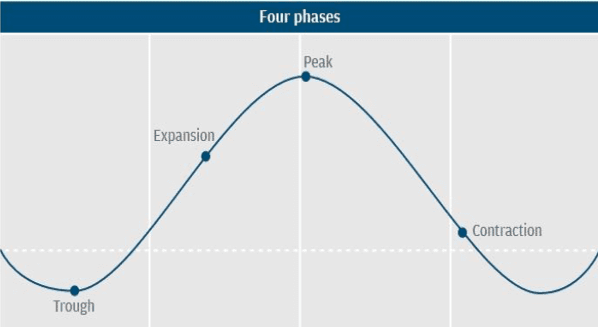
A market cycle basically refers to the periodic ebbs and flows that occur in the economy and across individual sectors, such as technology, stocks and bonds, and real estate. Real estate cycles typically include a wave pattern that moves across the four phases of trough, expansion, peak, and contraction. Understanding the real estate cycle can help people anticipate shifts in the market and make more informed decisions relating to their real estate asset, whether it’s single-family home, multifamily building, commercial building, or net leased property.
Understanding the Four Real Estate Cycles:
Trough/Recession: In the recession phase, supply has over-exceeded demand, and demand drops—causing downward pressure on values, high vacancy rates and negative rent growth. Anyone who owned real estate during the “Great Recession” faced dramatic events such as loan defaults, massive layoffs, and vacated homes that owners abandoned after property values plummeted. Still, some speculative investors look at this cycle phase as a good time to buy as property values will be at rock bottom. Some of the advantages of buying real estate during recessions include lower prices, less competition, and many sellers might be more willing to offer provisions as improvements and amenities. If successfully executed, a buyer who purchases during a trough or recession will wait and hold the investment property until the real estate cycle circles back, and the downturn is over—as the market begins to recover and eventually expand.
Recovery/Expansion: English theologian and historian Thomas Fuller once famously said, “It’s always darkest before the dawn”, which many real estate investors apply to the earliest moments of a recovery. In the recovery phase, the real estate market begins at a low point from the recession and gradually rises in strength. Some people who invest in the recovery phase look at Core real estate assets that will generate stable income with very low risk. These assets include a NNN property with a long-term lease or a fully leased office building in a prime location. Other assets that savvy investors target during a recovery phase of real estate investment include value-add real estate, and opportunistic investments like distressed properties or even raw land. While many people have a hard time identifying when the trough stage segues into the recovery phase, experts look at trends like gradual occupancy increases or growing demand to identify when the recovery stage has begun. The recovery phase is a popular time for real estate investment and speculation since prices of properties are typically high, which helps the potential for a solid return upon the sale of the asset.
Peak: The peak phase will be when supply catches up with and even exceeds demand pushing prices up. During this phase, assets are fully priced, and some real estate investors feel eager to sell at attractive prices and reap profits. However, the peak market can also be a good time for savvy investors to refinance any leverage while interest rates are low and fixed.
Contraction: The contraction phase generally occurs after the business cycle peaks, but before it becomes a trough. If growth stalls or becomes negative, it can fall into a recession, which is usually defined as two consecutive quarters of negative growth. During this period, investors need to act very cautiously while simultaneously monitoring the market for opportunities – because while contraction cycles can be difficult, they can also coincide with some great opportunities. For example, in a recessionary environment, the worst-performing assets are those that are highly leveraged, very speculative, and fraught with risk. For many years, Kay Properties has avoided the sectors of hospitality, senior care, and oil & gas for this exact reason.
While this cycle pattern is widely accepted to view the real estate market over the long-term, there are many variables that come into play with real estate. For example, real estate is a highly localized industry with different conditions in every state, market, and sub-market making real estate a constantly moving target.
Record-breaking expansion cycle and DST Investment Opportunities
Timing investments correctly may potentially help to increase returns. Yet getting market timing exactly right is never easy unless you happen to be a fortune teller. Right now, the length of the current economic expansion has many people suspecting that we are close to a peak market cycle. However, others suggest current slow and steady growth may be sustainable, and there doesn’t appear to be anything imminent that could derail that pattern. The peak could very well turn out to be more of a plateau than the beginning of the end. Even if there is a contraction or trough ahead, it could be a slight downturn rather than a sharp drop off a cliff. There are numerous variables that contribute to the shape of market cycles that range from Fed monetary policy to market bubbles that pop, such as the housing and Dot.com booms that caused the last two recessions.
But real estate experts point to several macro real estate trends that suggest it might be a good time for investment property owners to consider selling their buildings and consider DST 1031 investments. Even if we cannot know if we are currently experiencing a peak in the real estate market cycle, many real estate investors have seen their properties appreciate significantly and recognize an opportunity to sell and potentially unlock trapped equity.
Some Macro Real Estate Trends That Could Benefit DST Investors
Macro Real Estate Trend #1:Low Inventory –
According to the National Association of Realtors, inventory of available homes was down nearly 30% in 2021 compared to a year ago, multifamily buildings are attracting institutional real estate investors, and according to real estate firm CBRE in is first quarter 2021 report on the industrial and logistics market, demand for this type of asset is through the roof, after nearly 100 million square feet was absorbed during the first quarter – the third highest absorption rate on record.
How This Could Benefit DST Investors? Whether you are talking about a multifamily apartment building or a single-family home, low inventory means higher selling prices and shorter sales cycle – all good news for the seller’s position. However, this low inventory could also cause trouble for a seller who will find it hard to purchase a replacement property to avoid a large capital gains tax bill at the end of their sale. The DST marketplace allows sellers to easily find a 1031 like-kind exchange for nearly every level of transaction, providing sellers a strategy to not only defer their capital gains taxes but also gain access to a much more diversified portfolio with monthly cash flow potential. DST 1031 specialty advisory firms like Kay Properties & Investments has access to the largest menu of DST 1031 exchange properties in the nation and works with more than 25 different sponsor companies.
Macro Real Estate Trend #2:Rising Real Estate Asset Prices-
While real estate prices have slowed slightly in recent months, they have still grown by nearly 20% compared to last year, and according to a recent report on net leased real estate points out that net leased real estate is experiencing its highest level of demand in history, with billions of dollars flooding in from seemingly everywhere.
How Could This Benefit DST Investors? Rising real estate prices might indicate the real estate cycle is nearing its peak, and so it could be a good opportunity for investors to sell their multifamily investment buildings. However, selling in an expansion market cycle could trigger a significant capital gains tax bill! DST 1031 exchange investments help sellers defer their capital gains taxes while gaining access to institutional quality real estate assets with the potential for monthly income. DST 1031 exchanges can be structured with leverage for replacing debt, or all-cash/debt-free eliminating the risk of lender foreclosure..
Macro Real Estate Trend #3:Low Interest Rates –
With historically low interest rates in place, buyers are more motivated and capable of financing investment property more quickly.
How Could This Benefit DST Investors? According to the Quantity Theory of Money, any time the money circulation increases (either through government spending or lower interest rates) inflationary pressures tend to surface. DST 1031 properties may potentially help investors reduce the negative effects of inflation. For example, many DST investments have access to properties that have historically shorter lease terms that allow the investor to pass along any inflationary pressures to their tenants. On the other hand, most single-tenant net leased investment properties commonly have 20–25-year leases that generates flat to minuscule rental increases over the course of the lease term. Over time this flat rental structure could be devastated by inflationary pressures.
Today’s Real Estate Cycle Could Be a Good Time to 1031 Exchange into DST Properties
There is no doubt that mature market cycles are fueling an increase in property sales and 1031 tax deferred exchanges. Property owners who believe values may be at or near peak see it as a good time to take chips off the table and sell real estate that has experienced good appreciation. DST Properties are blessed by the IRS for use in a 1031 tax-deferred exchange. Individuals also have an opportunity to reinvest proceeds into a variety of different property types and geographic markets. For example, Kay Properties has DST opportunities with a minimum investment amount of $100,000 for investors with offerings that span multifamily, self-storage, net lease (NNN), industrial and medical office properties.
The Delaware Statutory Trust 1031 exchange vehicle can be a potentially smart strategy for investors who want to take advantage of the current real estate trends and leverage the tax deferral aspects of the 1031 exchange process.
About the author:
Jason Salmon, Senior Vice President with Kay Properties, a Commercial Real Estate Industry Leader and DST 1031 Exchange Expert
Jason Salmon
Jason Salmon is Senior Vice President Managing Director of Real Estate Analytics for Kay Properties & Investments New York City office where he applies his more than 20 years of commercial real estate and financial advisory experience in assisting thousands of property owners as they navigate their 1031 exchange transactions and direct acquisitions of securitized real estate investments. He is considered one of commercial real estate industry’s leading experts in providing high-net-worth clients DST 1031 exchange investment strategies, tax advantaged exit strategies and estate planning solutions.
Jason takes his deep and diverse expertise in identifying good real estate investment opportunities across multiple sectors including commercial, industrial, medical, and multifamily and combines it with Kay Properties & Investments’ dynamic platform that includes a full menu of DST properties and a complete team of 1031 exchange experts to provide his clients the best advisory and execution practices in the industry.
Kay Properties & Investments is a national Delaware Statutory Trust (DST) investment firm. The www.kpi1031.com platform provides access to the marketplace of DSTs from over 25 different sponsor companies, custom DSTs only available to Kay clients, independent advice on DST sponsor companies, full due diligence and vetting on each DST (typically 20-40 DSTs) and a DST secondary market. Kay Properties team members collectively have over 150 years of real estate experience, are licensed in all 50 states, and have participated in over 30 Billion of DST 1031 investments
Diversification does not guarantee profits or protect against losses.
There are material risks associated with investing in real estate, Delaware Statutory Trust (DST) properties and real estate securities including illiquidity, tenant vacancies, general market conditions and competition, lack of operating history, interest rate risks, the risk of new supply coming to market and softening rental rates, general risks of owning/operating commercial and multifamily properties, short term leases associated with multifamily properties, financing risks, potential adverse tax consequences, general economic risks, development risks and long hold periods. All offerings discussed are Regulation D, Rule 506c offerings. There is a risk of loss of the entire investment principal. Past performance is not a guarantee of future results. Potential distributions, potential returns and potential appreciation are not guaranteed. For an investor to qualify for any type of investment, there are both financial requirements and suitability requirements that must match specific objectives, goals, and risk tolerances. Securities offered through Growth Capital Services, member FINRA, SIPC Office of Supervisory Jurisdiction located at 2093 Philadelphia Pike Suite 4196 Claymont, DE 19703.
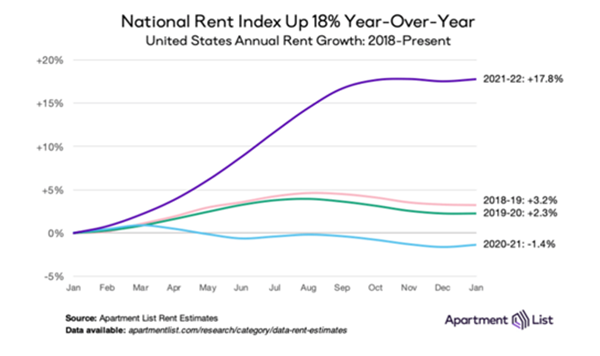
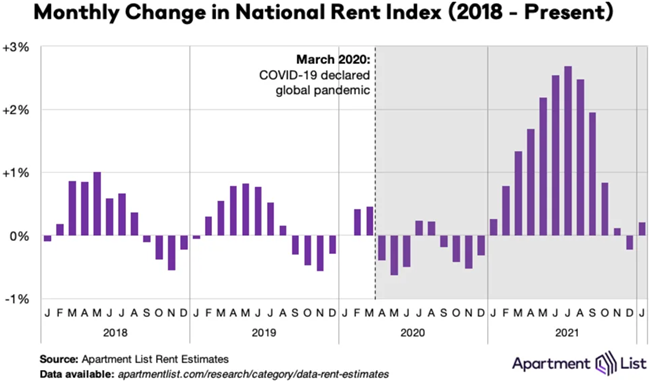
January rents inched back up into positive territory nationally overall, but many metros are still seeing declining rents, according to the Apartment List February report.
The national index was up a slight 0.2 percent over the course of January but 41 metros still saw falling rents in January. The report says even though month-over-month growth has moved back into positive territory, rent growth has still cooled substantially from last year’s peak.
However, not every city has seen a dip in rents. Many Sun Belt cities continue to show rent increases.
“Even though rent growth has been essentially flat over the past three months, it’s still pacing a bit ahead of the pre-pandemic trend. It’s likely that rent growth will pick back up in the coming months, though it’s still unclear just how much we should expect rents to rise in the year ahead,” write housing economists Chris Salviati, Igor Popov, Rob Warnock, and Lilla Szini in the Apartment List report.
New York City had fastest rent growth last year
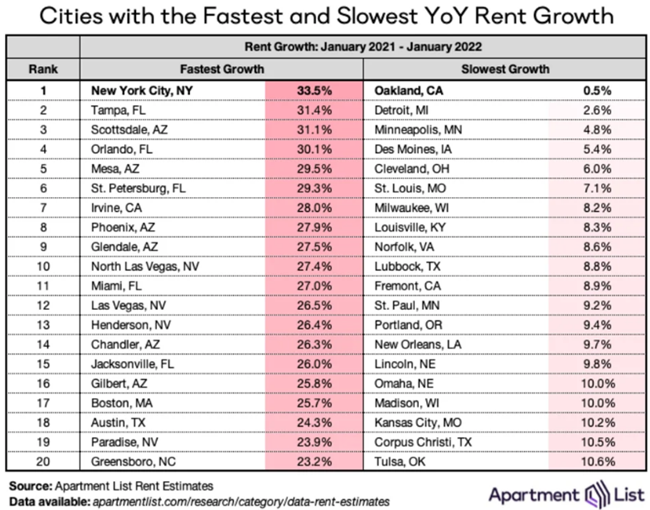
The nation’s largest city is also the place where rent prices rebounded from the pandemic and have grown the fastest over the past 12 months.
In New York City, the median price for an apartment increased from $1,575 one year ago to $2,101 today, a massive rent jump of 33.5 percent.
New York City narrowly edged out a number of smaller but rapidly-growing cities that absorbed significant rental demand throughout the pandemic, including Tampa, Fla., where rents grew at 31.4 percent, and Phoenix, Ariz., at 27.9 percent.
Vacancy rates continue gradual climb
The report says the vacancy increase has been modest and gradual, but “it represents an important inflection point, signaling that tightness in the rental market is finally beginning to ease. The vacancy situation remains historically tight, but the gradual easing of recent months has likely been contributing to the slowdown in rent growth.”
January Rents Summary
January brought a return to positive rent growth, with a modest 0.2 percent increase. “While the apartment market remains tight – the national vacancy rate sits just above 4 percent compared to 6 percent pre-pandemic – the winter season continues to bring signs that pressure is gradually beginning to ease.
“That said, at least part of the recent slowdown in rent growth is attributable to seasonality in the market, and the spring is likely to bring with it a return to faster price increases. Despite a recent cool-down, many American renters are likely to remain burdened throughout 2022 by historically high housing costs,” Apartment List says in the report.
It’s now February, a month many have waited for since last year. February 28, 2022 is officially the last day of the grace period as it is defined in the COVID laws passed last year. Until that date, any debts from the Emergency Period—defined from April 1, 2020 until June 30, 2021—are protected, leaving landlords unable to recover this balance until that time. That frustration has escalated for many landlords, as rent-assistance organizations no longer seem concerned about those balances when tenants apply for rent assistance.
As of March 1, and assuming no additional legislative changes, the Emergency Period Balance becomes due and owing once again. How landlords deal with these balances is something to discuss with their attorneys, as missteps (and current laws) can still provide some obstacles.
One approach, assuming those with a balance are still current tenants, is to serve a Notice of Termination for Cause with respect to the unpaid balance. While this notice cannot turn into any form judgment that could be utilized to garnish or collect those monies it can prompt the tenant to pay the amount owing or vacate. Even though some of these debts are very old at this point, waiver under ORS 90.412 is not a concern, as there is an express carve-out in the current renter-protection laws on that issue.
The important thing to keep in mind with respect to the above approach is that tenants are still allowed to apply for rent assistance pursuant to SB 891, unless they have already done so under that law. Assuming a tenant follows the proper procedure, SB 891 would cause a stay to remain in place while the tenants’ application for rent assistance is “pending.” It is unclear how rent-assistance organizations will handle these issues. Further, given the factual differences of every notice and balance ledger, it is difficult to predict how those issues will play out. Ultimately, readers of this column will remember that anything received from a tenant should be scrutinized with your attorney to evaluate whether or not it qualifies as “documentation” that could affect your rights.
Alternatively, another option for landlords is to simply exercise their civil remedies with respect to a small claims case or lawsuit. Once the law’s protections expire, the Emergency Period Balance becomes a debt that can be pursued civilly. This goes for both current tenants and former tenants who have moved out. While landlords are allowed to withhold security deposits for unpaid debts and damages under the current COVID laws, those deposits rarely (if ever) cover the entirety of the rent arrears left behind.
Many landlords continue to carry large balances from tenants. Those same landlords were not afforded the protections, grace periods, or other benefits afforded to other individuals affected by COVID. That was unfortunate, and further eroded the relationships between landlords and their tenants that current laws seem to continually exacerbate. Landlords will have additional rights and options at their disposal in the coming months, and unless rent-assistance agencies begin writing checks for these unpaid balances, landlords should prepare to assert them.
Bradley S. Kraus is an attorney at Warren Allen LLP. His primary practice area is landlord/tenant law, but he also assists clients with various litigation matters, probate matters, real estate disputes, and family law matters. You can reach him at kraus@warrenallen.com or at 503-255-8795.
Here are four ways technology can keep multifamily employees and onsite staff happier during the great resignation.
By Rachel Richardson
The Great Resignation has served up greater responsibility for onsite staff left to manage multifamily apartment communities. Like other industries nationwide, the multifamily industry has been hit hard by this period where record numbers of employees are leaving their current positions.
Rental owners and operators have reported up to 70 percent of their workforce resigning, a contrast to historical employee turnover of 30-50 percent annually. In roles that often require “wearing many hats” to keep up with prospective renters and resident requests, this puts added pressure on already busy leasing teams.
With technology solutions that alleviate daunting tasks for onsite staff, you can save your staff valuable time and unnecessary manual effort. Your leasing team can simplify tour scheduling, automate routine communication and set up seamless multifamily marketing campaigns that free up time to better connect with renters.
Automate apartment tour scheduling
The first step to helping your team thrive during this spike in demand is understanding where your team can easily automate communication in the early stages of a renter’s search. Online tour scheduling options on your apartment listings and property website take the back and forth out of finding the perfect time to showcase your unit.
Instead of the leasing agent having to reach the prospect directly and coordinate meeting times, find options that allow the renters to automatically schedule an appointment while they browse. Many ILS (internet listing sites) like Apartment Guide offer the option for renters to request a tour, select the most opportune times or even tour the apartment virtually.
Quickly qualify new leads with online applications and forms
Give renters the option to complete online applications early on in their evaluation of your property. This will allow your team to quickly screen new tenants and focus on quality leads that are most likely to become new residents. Tenant screening services like RentSpree automate the process of credit and background checks so leasing staff can focus on critical tasks like apartment tours, resident requests and answering in-depth questions from renters.
Give renters the option to complete online applications early on in their evaluation of your property to save onsite staff time later in doing background and credit checks.
Online applications can often be selected by the resident when they request a tour on ILS listings as well, so onsite staff can identify tenants that are most interested before they even show the unit.
For onsite teams that could use extra support, there are also options that fully cover prospect communication and early lead qualification. Virtual leasing centers like Contact Center offer services to book in-person and virtual appointments as well as qualifying leads on behalf of the property. These services are often available 24/7 to communicate with prospects via call centers, chat and email.
Advertise without duplicating efforts
Your team spends time gathering quality photos, descriptions, 3D videos and other content to showcase your vacant listings. Once all of the assets are ready, it can be daunting to duplicate efforts when it comes time to create the advertisements. That’s where integrated marketing solutions can help property marketers, or leasing staff, avoid unneeded busy work.
Automated advertising solutions integrate with your property’s ILS listings to source graphics and descriptions. So, ads are created without your team having to slog through countless revisions and come up with campaigns on the fly.
Solutions like Search Ads Express and Social Ads Express offer turn-key advertising services that target in-market renters based on ILS data, so your budget goes toward those who are actively looking for an apartment in your area. Finding a Fair Housing compliant advertising tool will also take the stress out of ensuring that your property’s audience targeting is within regulation.
Effortlessly communicate with renters
From your property’s voice mailbox to the inbox, inquiries can stack up while the team juggles multiple tasks. Training employees to keep up with these tasks can also be costly. According to Bersin by Deloitte, the average cost of onboarding a new employee is close to $4,000. For multifamily specifically, properties can also spend $2,500 to $3,500 a month on salary for each staff member that manages onsite communication.
Brainstorm ways that your team can cut down on manual communication and automate the most common requests that come through. An easy way to do this is through renter communication platforms that integrate with your PMS (property management system) and allow you to monitor and respond to email and texts in one place. Common ways that leasing teams use this is to automatically send a video tour, survey residents’ satisfaction, generate new reviews, and opt renters into marketing communications.
Recent resignations have brought on challenges for onsite staff but removing repetitive and monotonous tasks can free up your best talent to focus on the most rewarding aspects of their job. Without the burden of these simple and time-consuming tasks, your multifamily employees team’s skills can be better served, not to mention they will be happier. With more efficient processes, owners and operators can get more done while saving valuable dollars that can be invested in sustaining a strong, satisfied onsite team.
About the author:
Rachel Richardson is a Demand Generation Specialist with a mission to bring RentPath’s social media, marketing and communication efforts to life. She holds an MS in Brand Communications from the University of Colorado – Denver. Visit: https://www.rentpath.com/blog/
Being proactive to fight the winter cold in plumbing systems is the best way to avoid those unpleasant calls from tenants about frozen pipes, which is this week’s maintenance tip from Keepe.
No. 1 – Seal cracks near pipes
Survey the entire exterior of the building for small air leaks. Small air leaks, sometimes leaking around insulation, are often the first culprits leading to a frozen pipe. Seal the cracks using insulation or caulk.
No. 2 – Set indoor air temperatures of at least 65 degrees
Have your tenants keep an eye on indoor air temperatures. Make sure it doesn’t fall below 65 degrees to avoid freezing the pipes. See item No. 5 below in regards to this.
No. 3 – Put away outdoor hoses
And remember to completely shut off their indoor valve during the winter season. Before covering the hose bibs, make sure all water is completely drained out of them. Then once this is done, store the hose.
No. 4 – Let faucets drip with warm water
This is essential especially on nights when temperatures drop to an all-time low level. This practice prevents pipes from freezing. Just a trickle of warm water – dripping for hours on end – is enough to save the pipes from freezing during winter.
No. 5 – Leave cabinet doors open
Pipes under bathroom sinks and kitchen sinks are susceptible to cold air when the cabinet doors are closed. So leave them open to allow circulation of warm air in and around the pipes.
If your plumbing systems and pipes succumb to freezing during the winter season, turn off the main water supply first, and call professional plumbing services as soon as possible.
About Keepe:
Keepe is an on-demand maintenance solution for property managers and independent landlords. The company makes a network of hundreds of independent contractors and handymen available for maintenance projects at rental properties. Keepe is available in the Greater Seattle area, Greater Phoenix area, San Francisco Bay area, Portland, and San Diego. Learn more about Keepe at https://www.keepe.com
Multifamily appears poised for another bullish year in 2022 as healthy economic growth, rising apartment occupancy and capital flowing into multifamily, Yardi Matrix says in their winter report.
“We anticipate demand for apartments will remain robust, highlighted by strong economic growth and household formation. Meanwhile, capital conditions will be favorable, driven by investors’ insatiable appetite for stable income and low mortgage rates,” Yardi Matrix writes in the report.
The report says that supporting the multifamily performance is the economy, which grew by 6 percent in 2021, the highest rate in 40 years, driven by federal government stimulus and the increase in consumer wealth.
“While growth will almost certainly decelerate in 2022, the outlook for the economy remains bullish,” the report says.
Rent Growth Expected To Be Solid in 2022
“After asking rents rose 13.5 percent nationally in 2021, it’s an easy call to forecast a moderation in rent increases. However, we still expect overall U.S. rent growth to reach 4.8 percent in 2022, well above the long-term 2.7 percent average.
“The conditions that drove higher rents in 2021—including pent-up demand coming out of the pandemic, strong job growth, soaring home prices and healthy consumer savings—have not fully subsided,” Yardi Matrix says in the report.
The report points out that “headwinds” remain in 2022 such as labor force participation and inflation.
However the capital outlook is still strong.
“The amount of investment capital chasing multifamily, both equity and debt, is enormous. Property values are rising rapidly, driven by lower acquisition yields and increases in net income as asking rents shoot higher.
“Some $166 billion of multifamily transactions were completed in 2021, up 75 percent from 2020, and the only limit is the number of properties put up for sale. Debt availability is also robust, led by Fannie Mae and Freddie Mac, which have increased capital allocations in 2022. Multifamily debt has also driven record levels of lending by private equity funds,” the report says.
Conclusion
“We have every reason to believe, and expect, another two years of growth, until interest rate and monetary policy tightening designed to rein in inflation induce a recession in either 2024 or 2025.”
Yardi Matrix researches and reports on multifamily, office and self-storage properties across the United States, serving the needs of a variety of industry professionals. Yardi Matrix Multifamily provides accurate data on 18+ million units, covering more than 90 percent of the U.S. population. Contact the company at (480) 663-1149
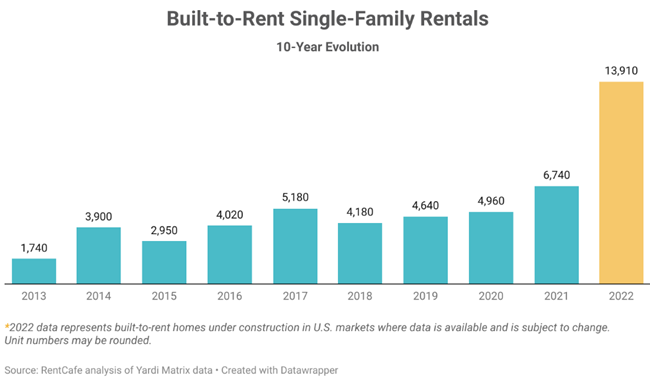
The popularity of single-family build-to-rent homes continues to grow and is expected to hit an all-time high in 2022, according to a new study from RentCafe.
The pandemic has pushed renters to look for more space and developers are responding by constructing more build-to-rent communities in cities such as Phoenix, Dallas and Columbus, Ohio.
Sometimes called “horizontal apartments,” the communities feature single-family homes with professional property management.
More Popular Than Apartments?
Single-family rentals are becoming more popular than apartments, RentCafe says in the report. There are about 90,000 existing single-family homes in built-to-rent communities with an occupancy rate of 97 percent, while multifamily occupancy is at 95 percent.
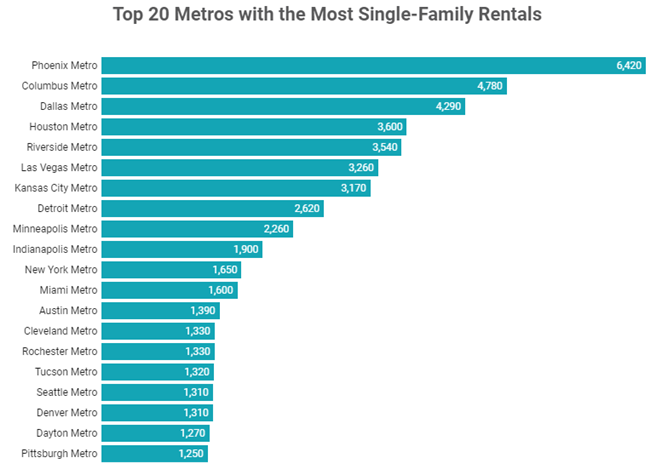
The top metro areas with the most single-family rentals reflect their ideal conditions for expanding on the horizontal. Phoenix metro takes first place with 6,420 homes for rent. It’s followed by Columbus metro – 4,780, and the Dallas metro area – 4,290 homes.
However, most rental communities are prevalent in low-density areas outside of the big cities – 61 percent of single-family rentals are spread out in the suburbs, particularly in the Midwest and Northeast. Meanwhile, in areas where land availability allows urban expansion, such as Texas and in the Southwest, built-to-rent communities are in urban locations.
Renting Provides More Flexibility Than Buying
The report says the appeal of built-to-rent homes as a trend combines the financial and leasing flexibility of a rental with the amenities and convenience of a professionally managed property, all while living a single-family-home lifestyle.
As a result, everyone is interested, according to Shannon Hersker with Walker & Dunlop: “There is a misconception that the majority of renters are millennials when, in reality, you have everyone — including college students, empty nesters, families with kids, pet owners, and those wanting to downsize,” she said.
Because builders need large parcels of land to build on, rental-home communities are prevalent in low-density areas, with the majority (61 percent) located in suburbs.
“Undoubtedly, coronavirus has also impacted upon this increased popularity,” said Christopher Michael, architect and founder of archisoup. “Many are now moving out of the cities and apartment living to seek out more space in rural and suburban locations.”
Beyond its potential to become a sizeable force in the rental-housing market, built-to-rent houses are also a welcome alternative for those who want to move up from renting an apartment or those who are unable to buy in a highly competitive market, but who are willing to pay more for a rental, Hersker said. “Typically, BTR units are larger than the average apartment, and renters see the value in paying more for increased space and additional storage.” She adds: “Living in a BTR community allows the renter to socialize and share amenities, but also have their own yard and space to entertain.”
RENTCafe.com is a nationwide apartment-search website featuring apartments and houses for rent throughout the United States. It regularly analyzes rental data from across the United States.
Earlier last year, American billionaire and real estate magnate Rick Caruso announced that a portion of his real estate portfolio is accepting bitcoins—a cryptocurrency—for residential and commercial rent payments. Caruso’s bold move is considered an industry first.
The real estate sector is well known as a laggard in adopting new technology. Accepting rent payments in a cryptocurrency, such as Bitcoin, is undoubtedly a step toward the future, but it is scarily experimental by today’s real estate industry standards.
That said, evolving market factors and shifting consumer sentiment and behavior suggest that moving toward the crypto future may hold genuine promise for growing numbers of CRE and multifamily property owners.
What is Crypto?
Cryptocurrency is a relatively new form of digital payment that consumers use to exchange goods and services online. Cryptocurrencies rely on what is termed blockchain technology, in which a computer network tracks and records digital transactions in a decentralized way through a distributed ledger.
For both consumers and commercial entities, the appeal of cryptocurrency lies in its strong privacy and user security, decoupling from government-controlled financial institutions, transparent record-keeping through blockchain technology, and freedom from added “middleman” transaction fees and costs.
Cryptocurrency holds tremendous promise for virtually every commercial industry in the world. Consumers are jumping on board, investing in and using crypto for all kinds of transactions, including buying and selling merchandise (even from top brands that support crypto sales), online investing, money transfers, travel, lodging … and, as Mr. Caruso has shown, even paying rent.
Crypto’s upside goes beyond the convenience of simple financial transactions for both consumers and businesses. It facilitates secure data sharing, streamlines collection and payment, provides secure due diligence, improves operational efficiency, and saves time and costs.
Its appeal is highly compelling, and consumers, merchants, and financial payment firms alike are boarding the crypto bandwagon, signaling an impending industry shift. CRE and multifamily property owners should, at the very least, participate by considering the benefits that crypto may offer the industry.
Crypto and Millennials
Consumer interest in (and adoption) of cryptocurrency is rising. Across all consumer demographics, millennials are currently the largest group investing in crypto.
Millennials make up history’s largest demographic of individuals aged 24 to 39. As consumers, they are entering their prime spending years and, by Wall Street standards, are poised to reshape the economy. These driven digital natives have an immense affinity for technology, which explains their avid interest and engagement in the world of cryptocurrency.
The following points are critical to the CRE and multifamily industry.
A September 2021 consumer survey by digital asset platform provider Bakkt Holdings found that “37% of survey respondents ages 18–29 and 30–44 who have not purchased cryptocurrency in the past six months are ‘somewhat’ or ‘very interested’” in investing in cryptocurrency. Furthermore, says Bakkt Holdings, the ubiquity of digital assets and cryptocurrency is revolutionizing consumer buying habits and driving a new, increasingly dynamic economy.
Millennials – CRE and Multifamily’s Bread and Butter
Matching these findings to U.S. renter demographics reveals an important overlap.
According to an annual rent report from Apartment List, the share of millennials expected to rent forever has nearly doubled in two years to almost one-fifth. The rental listing site’s 2021 Millennial Homeownership Report found that, in 2020, 18.2% of millennials who did not then own homes expected to rent forever, up from 12.3% in 2019 and 10.7% in 2018. The report combined data from the U.S. Census Bureau’s Current Population Survey and Apartment List’s annual renter survey.
Millennials, the bread-and-butter tenants of multifamily property owners, are embracing crypto en masse. Multifamily owners and operators need to take note and think about accepting cryptocurrencies.
This may not mean diving into the digital currency pool today but rather taking proactive steps to understand their tenants’, potential tenants’, and property managers’ perspectives on cryptocurrency and, at the very least, considering the pros and cons of this exploding new industry.
About the author:
Daniel Berlind is the Founder and Chief Executive Officer (CEO) of Snappt – a Los Angeles-based software company that helps multifamily housing companies prevent tenant and financial fraud. A former real estate executive, innovator and entrepreneur, Dan founded Snappt in 2017 after running his own property management company where he recognized a significant, industry-wide financial issue in the billion-dollar apartment rental industry. The company’s technology aids and streamlines the apartment rental process by reducing bad debt, increasing asset value and minimizing the application review process.
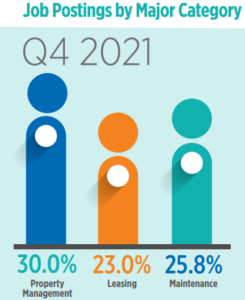
Job postings for skilled property managers accounted for 30 percent of all apartment jobs in the fourth quarter of 2021, according to the National Apartment Association.
Robust apartment demand led to only an 0.7 percentage points increase in leasing job postings. In contrast, hard-to-fill maintenance jobs significantly declined by 2.2 percentage points, signally that companies have decided to hire vendors due to maintenance talent shortages and high turnover rates.
In fourth quarter 2021 edition of NAAEI’s Apartment Jobs Snapshot, apartment job listings comprised nearly 37.0 percent of available real estate positions during the fourth quarter of 2021, well above the five-year average of 33.1%.
”Amid the Omicron variant surge apartment job postings declined compared to the fourth quarter of 2020. The downward shift could represent the fact that companies are delaying the hiring process to reduce risk,” the report said.
“Yet, healthy occupancy levels and rent growth during the quarter resulted in job postings exceeding the five-year average by 3.6 percentage points. According to RealPage, occupancy rates stood at 97.4 percent and average effective rent soared to $1,629.
Dallas, Los Angeles, Seattle, Washington, D.C. and Denver ranked highest in concentration of apartment job availabilities.
Demand for student housing property management professionals was greatest in Austin, Columbus, Gainesville, College Station and Houston.