Home Blog Page 80

4 Steps To Prevent Mold In Your Rental Property Attic

4 Steps To Prevent Mold In Your Rental Property Attic

Did you know mold can grow in the attic of your rental property and may have been made worse during the pandemic so here are 4 steps to prevent mold in your rental property attic.

By Certified Indoor Environmental

One area that is often overlooked while forecasting during budget season is the attic assessment.

For attics that are inspected yearly, the cost can be much smaller than waiting for a potential problem to ensue.  Benjamin Franklin said, “Beware of little expenses, a small leak can sink a big ship.” The same is true for attics; putting off this detail can likely cause a huge variance down the road.

The best way to remove mold is to not have mold in the first place! At Certified Indoor Environmental, we know the easiest way to prevent mold is to follow these 4 steps:

1. Check Attic Spaces Regularly

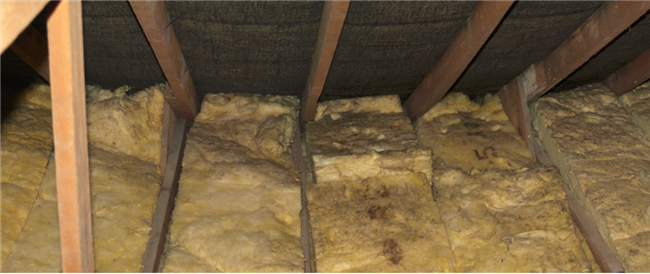
Conducting building-maintenance checks on a regular basis prevents unnecessary expenses for property owners and tenants.  It is important to look for roof discoloration, fan ducts blowing air into the attic, and moisture on the sheathing.

2. Check Humidity Levels in Your Building and Attic Spaces

Over a year ago when the pandemic began, tenants were stuck in their units, and some of these buildings were not equipped to have residents cooking, showering, and working remotely 24/7.  These COVID-induced lifestyles have led to excess humidity, which contributes to mold growth in attics and interiors. Mold left unchecked can result in tenant complaints, rent concessions, and costly repairs.

3. Ensure Your Building Is Properly Ventilated

Mold in attic spaces is common and fast-growing, but is also preventable with annual assessments and consulting with an expert in both mold remediation and ventilation.  Without proper ventilation, hot humid air escapes into the attic, creating condensation on the roof sheathing. Over time, this moisture degrades the sheathing, leading to costly roof replacements and remediation.

4. Determine What Is Causing the Mold and Correct It

Hiring a professional to assess your building’s attic can help identify potential problems before they happen.  If mold growth is present, an expert can locate the source of the mold, remediate, and make corrections to prevent the mold from returning.

Bottom Line: Taking a few minutes to doublecheck your attics regularly will be worth the thousands of dollars you will save not having to remove mold or implement costly roof repairs.

About the author:

Certified Indoor Environmental offers non-destructive mold remediation, which is the most cost-effective method for removing mold staining.  We do not paint over or encapsulate the mold, we remove it!  Other companies recommend replacing the building materials, which can be costly and take more time, or they simply paint over the mold.We also understand the dynamics of working with tenants and the budgeting challenges that property managers face.  Certified is recognized as the industry expert for identifying the cause and designing the ventilation to prevent future issues. Our experience is unmatched in the industry today.  We work with a variety of roofing companies and sub-contractors to help solve difficult ventilation problems.  We take you through the entire project-management process for your big projects from scope of work to completion, provide documentation of the project including before and after photos, and can finish on time and within your budget. If you need more reassurance, we have more than 1,500 5-star reviews that are a testament to the quality of our service we provide.  Schedule An Assessment Today! Certified Indoor Environmental | (503) 241-9199 | [email protected]


Sign Up For Our Newsletter And Get Rental Property And Apartment News And Helpful, Useful Content Each Week.

* indicates required


See the full report here.

Can I Say “No Pot In My Apartments” When It’s Legal In My State?

No Guns In My Apartments: Can A Landlord Say That And Put It In A Lease?

The Scoop On How Pet DNA Testing Fixes Your Apartment Poop Problem

Multifamily Rent Growth Hits A Wall In August

Multifamily Rent Growth Hits A Wall In August

After two years of rapid gains, U.S. multifamily rent growth hit a wall in August with national, asking rents dropping $1 during the month and year-over-year growth dropping to 10.7 percent, Yardi Matrix says in their national multifamily supply and rent cap report for August.

The drop represents the first month-over-month decline since June of 2020 during the pandemic.

“The numbers presage a slowdown in rent performance in the second half of the year as economic growth and the post-pandemic migration boom begin to slow,” the report says.

A summary from the Yardi Matrix report:

  • Multifamily rents finally hit a slowdown in August after a long run, presaging a deceleration that may extend through the second half of 2022. The economy is starting to feel the effects of higher interest rates, while migration is slowing and the increasing lack of affordability is affecting high-growth metros.
  • The average U.S. asking rent decreased $1 in August to $1,718, marking the first month since June 2020 without significant growth. Year-over-year growth decelerated by 170 basis points to 10.9 percent. Nationally, asking rents are up 6.6 percent year-to-date. The U.S. occupancy rate was steady at 96.0 percent.
  • The single-family sector continues to mirror the activity in multifamily. The average single-family asking rent decreased by $2 in August to $2,090, while year-over-year growth dropped by 170 basis points to 9.5 percent.

Traditional seasonality is present in the rental rates, but also the factors of a slowing economy and slowing migration.

Multifamily Rent Growth Hits A Wall In August
Chart courtesy of Yardi Matrix

Affordability Becoming An Issue

“Rent growth tends to slow in the fall, but this year comes at the tail end of the unprecedented increases. The deceleration in August was strongest in many of the markets that have had the most growth over the past two years, a sign that affordability is becoming an issue.

“The cooling housing market is a positive demand driver for multifamily, but inflation and a slowing job market are eroding residents’ ability to pay. Rent declines were concentrated in high-end Lifestyle properties, which dropped 0.2 percent nationally in August. Lifestyle rent growth was negative in 21 of Yardi Matrix’s Top 30 metros.

Get the full report here from Yardi Matrix
About Yardi Matrix

Yardi Matrix researches and reports on multifamily, office and self-storage properties across the United States, serving the needs of a variety of industry professionals. Yardi Matrix Multifamily provides accurate data on 18+ million units, covering more than 90 percent of the U.S. population. Contact the company at (480) 663-1149.


Rate Of Rent Growth Slows At Midyear But Multifamily Still Poised For Strong Year

With Traditional Multifamily Rent Drivers Disrupted What Is The Future?

Another Bullish Year For Multifamily In 2022?

Sign Up For Our Weekly Newsletter And Get Rental Property And Apartment News And Helpful, Useful Content Each Week.

* indicates required

Utah Apartment Association Officially Becomes Rental Housing Association of Utah

On Sept. 1, 2022, the Utah Apartment Association became the Rental Housing Association of Utah (RHA), as part of a rebranding initiative to articulate more accurately who we serve.

On Sept. 1, 2022, the Utah Apartment Association became the Rental Housing Association of Utah (RHA), as part of a rebranding initiative to articulate more accurately who we serve.

“Apartment units are half of the rental housing units in Utah. The other half are single-family rentals, duplexes, triplexes, fourplexes and accessory dwelling units,” says Executive Director Paul Smith. “Apartment owners, developers and management companies are an essential part of the rental housing domain, and our board wanted to acknowledge and honor that. At the same time, we wanted to make sure rental operators of all stripes understood our association advocates and provides resources for all rental operators in Utah.”

Smith says since rental owners started the first rental housing association in Utah in 1934, there have been several consolidations and name changes, and stresses that each time, the association has moved to the next level and provided better service and resources.

As a part of the rebrand, dues will increase slightly.

“It has been 15 years since our association has had to raise dues. That’s speaks to how seriously we have taken managing rental operators money,” says DJ Bruhn, incoming RHA board chair for 2023. During that time, rents have gone up 131 percent. Most members will see their dues go up about 20 percent, less than their rents have gone up just in the last two years!”

New Government Affairs Resources and Staff

Kirk Cullimore Sr., landlord attorney, past board chair and longtime association board member and legal counsel, says that as part of the increase in dues, RHA will be ramping up its government affairs program.

“We have probably never seen in this country and our state a more hostile environment for rental operators,” he says. “With the massive increases in inflation and rents, housing advocates have never had more leverage and sympathy from government officials to push anti-property rights and anti-property owner initiatives. These could not only increase operators’ costs by millions of dollars but could take away our private property rights and contract rights.”

Cullimore says that in Utah we have done a phenomenal job protecting our industry, while at the same time, providing enormous protections and rights for renters. “But it’s a new world. The amount of pressure on our industry has never been higher, and the association needs more money, more staff, and more focus on government affairs to be able to protect us from what will be coming in future years.”

Cullimore points to surrounding and other states who in the last few years have drastically shifted their landlord tenant law to be not just more tenant friendly, but outright anti-landlord. Many states have passed rent control, restricted fees, increased rental operating costs, and reduced our ability to protect ourselves by prohibiting essential resident screening processes.

“In order to continue to be successful, we have to be a coalition of more than just apartment operators. We need to be single-family owners, student and senior-housing providers, Realtor property management groups and more. This new name will help us with bringing those groups more into the fold,” he says.

Cullimore says within the next year, RHA will be hiring more government affairs staff and increasing its lobbying presence at all levels of government.

More Conferences and Meetings

“One of the things I am most excited about with the new RHA is our ability to get in front of more rental operators in more places,” says Cody Reeder, RHA Board Secretary and past Education Committee Chair. Cody owns several hundred rental housing units, and through his company, Reeder Asset Management, does property management for an additional 700 units, many single-family homes. “We will be having more meetings in more parts of the state which is so essential because the ownership of rental units in Utah really consists of tens of thousands of individuals and companies. They need our information and training!”

Reeder says many people think of landlords as big out-of-state corporations, but points to research done by the University of Utah Kem Gardner Institute that found that very few rental units in Utah are owned by out-of-state investors. To the contrary, the report showed that most rental units are owned by Utahans, and that over half of rentals in Utah are in building with four or fewer units, including 100,000 single-family rentals.

As part of the new RHA, Reeder says, the association will be holding regular meetings and education, including an annual conference in Cache Valley, where he is based. In addition, Reeder says there will be more meetings in Southern Utah, including the November 29th annual Southern Utah Housing Conference at the Dixie Center in St. George.

“I also am excited to say we will be starting to provide resources and education to our student housing providers, who we have not really served in the past. This will include monthly meetings in Provo/Orem and an annual student housing conference,” Reeder notes.

RHA will continue to provide all previous services

With a new name comes a new website www.rhautah.org but the organization’s office and staff will stay the same. “We will still have the leadership of our Association Executive Paul Smith, who this year celebrated his 20th anniversary with us. We are lucky to have him and his staff to continue to serve us,” says 2022 Board Chair Brad Randall.

If you are interested in becoming a volunteer or serving in a leadership position on our committees and board or have any questions about the name change or any of our services, please reach out to [email protected] or call us at 801-487-5619.


Do Your “No Smoking” And Odor Policies Stink?

do your no smoking and odor policies stink?

While most of us are familiar with no-smoking policies for our properties, with the invention of new types of inhalants and other innovations, it is time to take a deeper look at  those policies and odor policies as well.

By Scot Aubrey

“What’s that smell?” might be one of the worst questions a potential tenant can ask you as a landlord.

In my experience, the showing of a property almost always goes downhill from there.

Odors play a major role in our lives, with many of our most important memories tied to a specific smell, whether good or bad. Who doesn’t love the smell of bacon, fresh baked bread (my mouth just started watering) or a campfire?

Those smells instantly transport us to a time or place; that’s the power they have over us.  Knowing how powerful odors are should cause landlords to take a deep breath, preferably through the nose, and examine what their policy is regarding smells and obnoxious odors on their properties.

If you are like many landlords, this is probably something you have either overlooked or inadequately addressed with your current and future tenants.

While most of us are familiar with no-smoking policies for our properties, with the invention of new types of inhalants and other innovations, it is time to take a deeper look at the three major things to consider as you develop a policy around scents and odors in and on your property.

Create a Rental Criteria Regarding Odors

If you don’t already have one, now is the perfect time to start creating a criteria regarding scents and obnoxious odors.

You likely have a rule about smoking in the property, but how about even on the property?

If you’ve ever been in a public place that allows smoking, you are already familiar with how far and powerfully the smell associated with smoking can travel.  Does your criteria include a no-vaping in or on the property component?  How about smoking of marijuana?  Although you would expect that a no-smoking policy would cover all types of smoking, you are better off being very thorough and including specifics such as cigarettes, cigars, pipes, vaping and smoking or manufacturing of legal or illegal drugs.

Don’t stop there though, as other odor-causing items such as spices, incense, sprays and even candles can cause long-term damage to a property.  The more specific you are in your criteria, the better protected your property will be.

Advertise Your Criteria On Odors

Do Your “No Smoking” And Odor Policies Stink?

Now that you have taken the time to develop a criteria, put it to work.

In your property advertisements, point out that the property has specific rules regarding scents and obnoxious odors.

Then again at the time of showing, reemphasize to your potential tenant that you have specific no smoking policies and rules for your property and go over them in detail.

Lastly, always have a clause in your lease that addresses your rules.  Failure to do so can result in the property being damaged by your tenant, creating excessive expenses for you when you have to turn the property.  At a minimum you have to repaint, tear out the carpet and pad, clean out ductwork and perform a deep cleaning on all hard surfaces.  Eliminate the “I didn’t know” excuse by being specific and thorough in explaining and adhering to your property specific rules.

Know Your Neighbors And What They Smell

 As mentioned before, obnoxious odors travel well, including into your rental property’s neighbors’ homes and yards.

We always recommend knowing the neighbors of your investment properties as they can serve as an extra set of eyes, ears, and in this case a nose, since they are in daily contact with your property.

No one wants the peaceful enjoyment of their property to be destroyed by the offensive odors of a neighbor.  Share your contact information with the adjoining neighbors and enlist them in your efforts to maintain the value of your property.  At the least they will appreciate having someone to turn to if they see/hear/smell anything and at most they serve as a first line of defense if something that may affect the value of your property is taking place.

Rent Perfect has recently created a “Scent and Obnoxious Smells Clause” that can and should be added to your property lease.  This is available at no charge to you; just request it from [email protected] and we are happy to share.

By creating a rental criteria that addresses odors, advertising and emphasizing it to applicants, and engaging with the neighbors, you are taking the first critical steps to preventing damage to your property and protecting your investment.  That way the next time someone enters your property and asks, “What’s that smell?” it’s for the right reasons.  Smells like success to me.

About the author:

Scot Aubrey is vice-president of Rent Perfect, a private investigator, and a fellow landlord who manages short-term rentals.  Subscribe to the weekly Rent Perfect podcast (available on YouTube, Spotify, and Apple) to stay up to date on the latest industry news and for expert tips on how to manage your properties.


Using A Code Word Helps You Get the Right Tenant

Sign Up For Our Weekly Newsletter And Get Rental Property And Apartment News And Helpful, Useful Content Each Week.

* indicates required

Portland Update: Changes to FAIR Ordinance Bring (Some) Necessary Changes

Portland Oregon city officials say they plan to consider a proposal to spend millions of dollars to bail out landlords and pay off mortgages

Bradley S. Kraus
Partner, Warren Allen LLP

For years to come, no one will forget the year 2020 and the global pandemic it brought to our doors. However, just prior to COVID-19 reaching our doorsteps, a new piece of local legislation—Portland’s FAIR Ordinance—was passed. For the past two years, news about the same has obviously taken a back seat to the events of the world. Recently, a lawsuit against the City of Portland regarding the constitutionality of the FAIR Ordinance was settled, and as a part of that settlement, some much-needed changes were made the ordinance.

Most of the changes were made to PCC 30.01.087, the security-deposit portion of the FAIR Ordinance. Those who had the opportunity to review this ordinance as it was initially passed likely recall how absurd some of the provisions were as written. Some reason has now been injected therein.

One of those was the “condition report” requirement. Previously, landlords had to submit a condition report to their tenant prior to the “commencement date.” Simple enough, but the tenant thereafter was supposed to return their version of the condition report within seven days and, if the parties didn’t agree on the condition, and third-party validation was unsuccessful at resolving the dispute, “the tenant’s condition report” controlled (no matter what reality and the facts proved). Setting aside how ridiculous it is for anyone to believe that is how the law functioned, the new changes require landlords to attempt a “pre-commencement walk-through.” If one occurs, and the parties agree on the condition of the unit, there is no issue. If the parties do not agree, the dispute is simply preserved—as common sense dictates it would.

Another large change was to the requirements of the “Fixture, Appliance, Equipment, and Personal Property Addendum.” Previously, this required landlords to attach a value to each item in the unit that may be attached to a deposit—i.e., if any damages befell the same, the deposit could be withheld. This required a calculation of the depreciated value of each of those items, based upon an absurd formula whose origins are unknown to this author. Now, while landlords still must list all items in the rental agreement that the landlord intends to attach to the security deposit, should damage befall them, the items (a) do not need a depreciated value, and (b) they do not need to be categorized as “fixtures” vs. “appliances” or “equipment.”

Finally, additional changes were made with respect to repair/replacement of flooring material. FAIR previously contained restrictions to a landlord’s ability to charge for carpet cleaning, which was contrary to that listed in state law. That provision was removed, leaving only state law under ORS 90.300 with respect to carpet cleaning. Further clarification was also made to repairs/replacement attributable to a “discrete impacted area”, which now contains a necessary definition of the same.

The ordinance still has several issues and unnecessary burdens on landlords. Many of those burdens are overly cumulative due to state law requirements and court oversight already covering the same matters. The damages provision of the security-deposit portion of FAIR was also reduced to $250 per violation, which reduces some—but not all—of the punitive effects of the ordinance. However, Portland should consider additional changes in the same direction as the above, or risk further driving of small- and mid-sized landlords and “mom n’ pops” from the market. Small businesses such as those cannot absorb such unnecessary and punitive regulations, and research already shows it is negatively influencing the Portland rental market.

About the author:

Bradley S. Kraus is an attorney at Warren Allen LLP. His primary practice area is landlord/tenant law, but he also assists clients with various litigation matters, probate matters, real estate disputes, and family law matters. You can reach him at [email protected] or at 503-255-8795.
Portland Update: Changes to FAIR Ordinance Bring (Some) Necessary Changes
Bradley Kraus, Portland attorney

Sign Up For Our Weekly Newsletter And Get Apartment News And Helpful, Useful Content Each Week.

* indicates required

Fannie Mae to Include Rent Payments in Mortgage Approval Process

Fannie Mae to Include Rent Payments in Mortgage Approval Process

Datalinx clients have always known that reporting consistently on-time rent payments to the credit bureaus can have an incredibly positive impact on a consumer’s borrowing power. Now it seems that Fannie Mae — the nation’s leading source of mortgage financing — has also realized the power of rent payment reporting, and it could be a game-changer for first-time homebuyers.

Introducing “positive rent payment history”

In September 2021, Fannie Mae announced that it would be adding a new “positive rent payment history” feature to its Desktop Underwriter® (DU®) software. The feature allows the program to use verification of asset (VOA) reports to identify and factor in recurring rent payments when assessing a borrower’s credit.

Rent payments traditionally will not appear on consumer credit reports without a third-party reporting service like Datalinx — and Fannie Mae’s new feature won’t change that. However, through VOA reports (like bank statements), potential borrowers can prove to a mortgage lender that they have made their recurring rent payments on time and consistently. Fannie Mae’s DU software will also automatically identify rent payments in an applicant’s bank statement data, but only with the applicant’s permission.

Like the major credit bureaus’ recent addition of buy now, pay later (BNPL) loans to their credit reporting data, Fannie Mae’s new program was created to promote a more inclusive credit evaluation.

“This is one step in a series of efforts Fannie Mae is exploring to help expand sustainable homeownership opportunities for underserved populations and support a more equitable housing finance system,” the Fannie Mae website reads.

Your renters could already be benefiting from their positive rent payment histories with your firm if you were a Datalinx data furnisher! Reach out to us today to get started.

One Sure Way To Increase Tenant Selection Success Rates Part 2

One Sure Way To Increase Tenant Selection Success Rates Part 2

Creating A Clear And Concise Tenant Selection Policy

By Rebekah Near

In the first of these six articles we learned why creating a detailed Tenant Selection Policy is important and where to get help formulating such an affective policy.  Now we are going to learn how to define one.  This is simplified because some states such as Washington have passed laws specifically describing what is required.  In Washington State this law is called THE FAIR TENANT SCREENING ACT OF 2012.

It helps to keep in mind a landlord’s written policies are governed not just by the Fair Tenant Screening Act of 2012, but also by HUD Guidelines for Disparate impact, Credit Bureau Regulations and the Fair Credit Reporting Act as well as other federal, state and local laws and ordinances.  Belonging to a Landlord organization which keeps you up to date on these ever-changing laws is essential.

MINIMIZING YOUR LIABILITY WHEN SCREENING AN APPLICANT.  Lawsuits – Over the years I have seen lawsuits against landlords for not complying with one or more of the laws described in the Fair Tenant Screening Act of 2012.  In fact it seems to be a common occurrence.  In 2020 there was a class action lawsuit! The Defendant in the case was a large property management company.  The attorneys for the Plaintiff seemed to want to make an example out of this management company, so they made it a class action suit.  No doubt this was extremely painful for this management company to fight the case.  What did the management company fail to do?  We will get into the heart of this lawsuit a little later in these articles.

There have also been lawsuits against landlords for other reasons other than the Fair Tenant Screening Act.  One example is non-compliance with laws pertaining to emotional support animals.  Even though this type of lawsuit may not have anything to do with the Fair Tenant Screening Act (FTSA), any non-compliance with the FTSA may often be included in the lawsuit – just to beef up the charges against the landlord.   One of the first things an attorney representing a prospective tenant will require is an audit of the landlord’s compliance paperwork.  Each little mistake or oversight on compliance documents can be included in the lawsuit and will increase the amount the landlord has to pay the Plaintiff and his or her attorneys.  In other words, more costly to the landlord!  Therefore, landlord’s need to make sure they include all requirements of the Fair Credit Reporting Act of 2012 as well as other laws.

Simplifying, I will describe what we at Orca Information, Inc. recommend for our clients – BE FAMILIAR WITH the Fair Tenant Screening Act of 2012.  All clients at Orca have this information available to them.  Note:  Below is a partial description of the law.  For the law in its entirety, click the following link.

 RCW 59.18.257  FAIR TENANT SCREENING ACT OF 2012

  1. Prior to obtaining any information about a prospective tenant, the prospective landlord shall first notify the prospective tenant in writing, or by posting, of the following:

a. What types of information will be accessed to conduct the tenant screening – Example: Credit report?  Court records?  Rental references?  Employment verification?

b. What criteria may result in denial of the application – Example: Score of 500 or below?  $1,000.00 in unpaid judgments or collections in last 7 years? Criminal history which causes damage to persons or property?  Lack of rental history? False or misleading information on the rental application or omission of material fact?

c. If a consumer report is used, the name and address of the consumer reporting agency (tenant screening company) and the prospective tenants rights to a free copy of the consumer report in the event of denial or other adverse action (denial, increased deposit, co-signer) and to dispute the accuracy of information appearing on the consumer report; and

d. Whether or not the landlord will accept a comprehensive reusable tenant screening report made available to the landlord by a consumer reporting agency ..……

e. The landlord may charge a prospective tenant for costs incurred in obtaining a tenant screening report only if the prospective landlord provides the information as required….

f. If a landlord conducts his or her own screening of tenants, the prospective landlord may charge his or her actual costs ……

g. If a prospective landlord takes adverse action, the prospective landlord shall provide a written notice of the adverse action to the prospective tenant that states the reason for the adverse action. The adverse action notice must contain the following information in a substantially similar format, including additional information as may be required under chapter 19.182 RCW.  (For an example of the required format click the link).

2. Any landlord who maintains a website advertising the rental of a dwelling unit ….must include a statement on the property’s home page stating whether or not the landlord will accept a comprehensive reusable tenant screening report….

In the next article we will learn more about that class action lawsuit – exactly what was the complaint made by the Plaintiff and how much money were the attorneys asking for restitution?  By building a clear and concise Tenant Selection Policy we can learn how avoid similar complaints by rental applicants.

About the author:

Note:  Rebekah Near is not an attorney and is not qualified to give legal advice.  The above information is her opinion based on her work in the Tenant Screening industry.


One Sure Way To Increase Tenant Selection Success Rates- Part 1


August National Rent Growth Half of July Total

August national rent growth was 0.5 percent, half the rate of growth compared to last month, according to the September report from Apartment List.

August national rent growth was 0.5 percent, half the rate of growth compared to last month, according to the September report from Apartment List.

The slowing of rents in August fits more of the traditional rent growth patterns that existed before the pandemic.

“Rents increased in 79 of the nation’s 100 largest cities in August. But in 68 of those 79 cities, rent growth was slower this month than last month. Annual rent growth remains elevated (15+ percent) in Florida, as well as a handful of major metropolitan areas including San Diego and New York City,” the report says.

Slowing Rent Growth May Help Slow Inflation

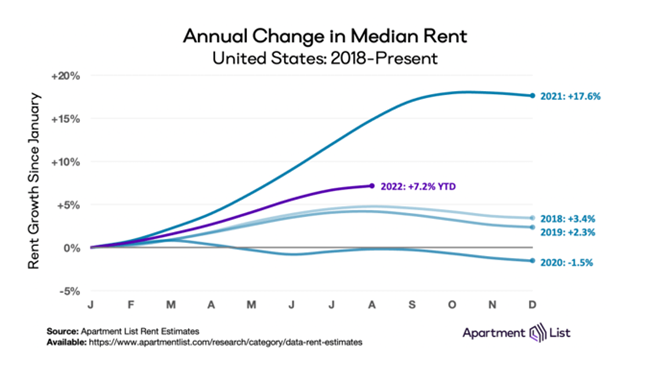
So far in 2022 rents are up 7.2 percent, compared to 14.8 percent at this point in 2021. Year-over-year growth has slowed to 10 percent, down from a peak of nearly 18 percent at the beginning of the year, the Apartment List report says.

The 17.6 percent rise in rents over the course of 2021 has contributed to inflation in housing costs.

“With inflation top-of-mind for policymakers and everyday Americans alike, our rent index is particularly relevant, since movements in market rents lead movements in average rents paid. As a result, our index can signal what is likely ahead for the housing component of the official inflation estimates produced by the Bureau of Labor Statistics. Thankfully for the country’s renters, our index shows that rent growth in 2022 has cooled from last summer’s peaks. At the same time, however, rents are continuing to rise faster than they did in pre-pandemic years.”

Slight Uptick in Vacancy Rate

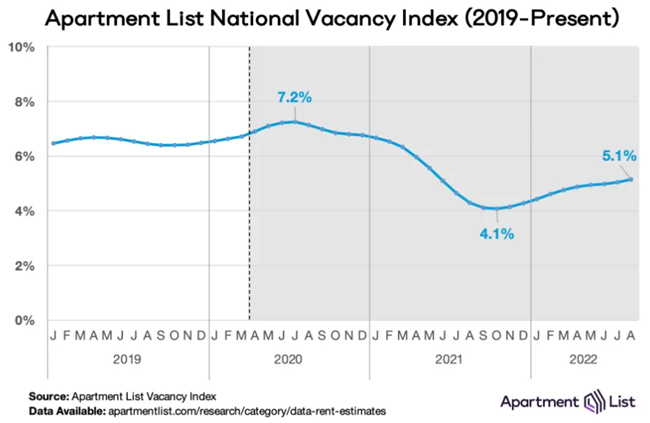
On the supply side, a deceleration in rent growth was matched with a slight uptick in apartment vacancies.

“Our vacancy index stands at 5.1 percent today and has gradually eased from a low of 4.1 percent last fall. That said, today’s vacancy rate remains below the pre-pandemic norm, which may be attributable to spiking mortgage rates that continue sidelining first-time homebuyers and keeping more households renting for longer,” the report says.

August national rent growth was 0.5 percent, half the rate of growth compared to last month, according to the September report from Apartment List.
Charts courtesy of Apartment List

Conclusion

“With a 0.5 percent increase in August, rent growth is continuing to pace ahead of pre-pandemic trends, even as it decelerates and falls in-line with expected seasonality. As we enter the fall and winter months, we expect rental activity will continue to slow and we will likely see modest price decreases in the coming months,” the report says.

Get the full report here.

Multifamily Rent Growth Slows But Still Strong

With Traditional Multifamily Rent Drivers Disrupted What Is The Future?

Another Bullish Year For Multifamily In 2022?

Sign Up For Our Weekly Newsletter And Get Rental Property And Apartment News And Helpful, Useful Content Each Week.

* indicates required

Can I 1031 Exchange Out of a Delaware Statutory Trust?

Can I 1031 Exchange Out of a Delaware Statutory Trust?

By Dwight Kay

CEO and Founder of Kay Properties and Investments, LLC

Key Takeaways:

  • Investors can 1031 exchange out of their DST Investments
  • What does it mean to have a DST 1031 exchange go Full-Cycle?
  • Investors must conform to all of the 1031 rules when a DST goes Full-Cycle
  • What is the Kay Properties DST Secondary Market?

Many investors that have participated in or are considering a DST 1031 exchange with Kay Properties will oftentimes ask us, Is it possible to 1031 exchange out of a Delaware Statutory Trust?  If you’re looking for a clear and concise answer to this question, here it is: Yes, you can 1031 exchange out of a DST.

But let’s dig a little deeper into this subject.

First Things First: What is a DST?

Let’s first look at exactly what is a Delaware Statutory Trust (DST)? DSTs are vehicles for passive real estate ownership that allow investors to remove themselves from day-to-day headaches of property management as well as the opportunity to diversify* their equity in an effort to potentially reduce risk. Each individual investor possesses his or her own share – sometimes referred to as a “beneficial interest”, including potential income, tax benefits, and appreciation of the DST property. A longer and more detailed article of exactly what a Delaware Statutory Trust is and why so many real estate investors are attracted to them can be found here.

Exchanging Out of a DST Following Full-Cycle Investment

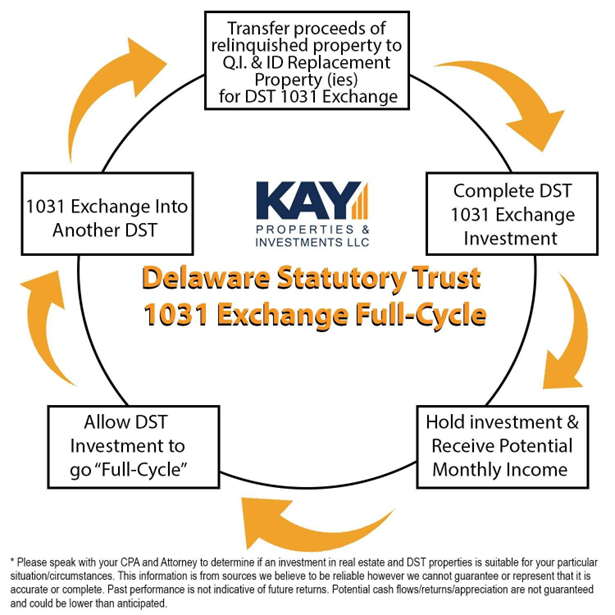
Now the question of “Can I 1031 exchange out of a DST?” can be addressed from two different perspectives. The first perspective involves when a DST property itself goes “full cycle”. The term “Full-Cycle” is used to describe a Delaware Statutory Trust asset that has been purchased and then sold on behalf of a group of accredited investors after a period of time. Once the DST sponsor has sold the asset per the DST’s business plan each individual investor then has the same options as they had when they first exchanged into the DST: They must use a Qualified Intermediary, identify the up leg within 45 days of the closing of the relinquished property and close on the up leg within 180 days of the closing of the relinquished property. If they choose to “cash out” following the full-cycle investment, they are required to pay their taxes.

A good example of a Kay Properties DST investment that went full-cycle is the Alexander Pointe Multifamily DST in Orange Park, FL.

Exchanging out of a DST Prior to the Investment Goes Full-Cycle

Exchanging out of a DST before the investment goes full-cycle is a bit more detailed. Because DSTs are real estate-based investments, they are considered illiquid. There is no stock market exchange that allows you to log online and sell your DST investment quickly. Therefore, investors should only purchase a DST via a 1031 exchange if they are willing to hold for the full life of the investment which could be 5-10 plus years.

However, it may be possible to sell your share of a DST and either cash out or pursue another 1031 exchange. While DST interests can be sold and transferred to an accredited investor, the most obvious purchasers of DST interests are other investors either in the same DST or outside investors who wish to acquire interest in the particular DST.

Please note that exchanging out of a DST prior to the investment going full cycle means that the investor must follow all the same rules as any traditional 1031 exchange. That is, investors must use a Qualified Intermediary, they must identify their up leg within 45 days of the closing of their relinquished property and they must close on their up leg within 180 days of the closing of your relinquished property.

Kay Properties Secondary Market

Because Kay Properties understands investors might need to exit a DST prematurely, they created a DST Secondary Market where investors who want to sell early have a potential market available to buy their interest in the DST investment. The Kay DST Secondary Market is made possible due to the fact that Kay Properties works with many DST buyers on a daily basis. Kay Properties helped clients purchase approximately $30 billion of DST investments since its founding. This volume allows us to be a resource for those wanting to sell a DST investment early as we are working with many, many DST buyers nationwide. Again, there is no guarantee that you will be able to sell your DST investment on the Kay DST Secondary Market however it may bea potential option.

For a list of 1031 DST properties please visit www.kpi1031.com as well as your will find more helpful articles and resources as you are considering 1031 exchange DST properties.

Ask Bill Exeter

Ask Bill Exeter and his team your questions about 1031 exchanges and he and his team will get back to you.

Name

About Kay Properties and www.kpi1031.com

Kay Properties is a national Delaware Statutory Trust (DST) investment firm. The www.kpi1031.com platform provides access to the marketplace of DSTs from over 25 different sponsor companies, custom DSTs only available to Kay clients, independent advice on DST sponsor companies, full due diligence and vetting on each DST (typically 20-40 DSTs) and a DST secondary market.  Kay Properties team members collectively have over 150 years of real estate experience, are licensed in all 50 states, and have participated in over $30 Billion of DST 1031 investments.

This material does not constitute an offer to sell nor a solicitation of an offer to buy any security. Such offers can be made only by the confidential Private Placement Memorandum (the “Memorandum”). Please read the entire Memorandum paying special attention to the risk section prior investing.  IRC Section 1031, IRC Section 1033 and IRC Section 721 are complex tax codes therefore you should consult your tax or legal professional for details regarding your situation.  There are material risks associated with investing in real estate securities including illiquidity, vacancies, general market conditions and competition, lack of operating history, interest rate risks, general risks of owning/operating commercial and multifamily properties, financing risks, potential adverse tax consequences, general economic risks, development risks and long hold periods. There is a risk of loss of the entire investment principal. Past performance is not a guarantee of future results. Potential cash flow, potential returns and potential appreciation are not guaranteed.

Nothing contained on this website constitutes tax, legal, insurance or investment advice, nor does it constitute a solicitation or an offer to buy or sell any security or other financial instrument. Securities offered through FNEX Capital , member FINRA, SIPC.

.

How this investor closed 15 DST 1031 Exchanges in 30 Days… without a hitch!

Six Ways to Ensure Your 1031 Exchange is Successfully Completed

Kay Properties & Investments Has Record Year With $610 Million In Equity Placed

Seattle rents increase sharply over the past month

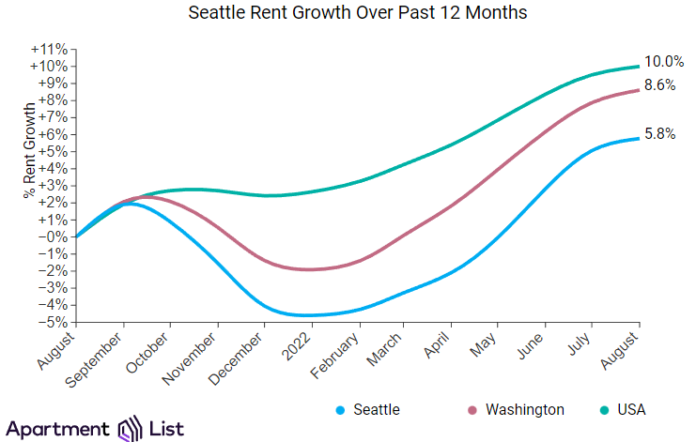
Seattle rents have increased 0.7 percent over the past month in August, and have increased significantly by 5.8 percent year-over-year

Seattle rents have increased 0.7 percent over the past month in August, and have increased significantly by 5.8 percent in comparison to the same time last year, according to the September report from Apartment List.

Now median rents in Seattle are $1,720 for a one-bedroom apartment and $2,079 for a two-bedroom.

This is the seventh straight month that the city has seen rent increases after a decline in January. Seattle’s year-over-year rent growth lags the state average of 8.6 percent, as well as the national average of 10.0 percent.

Rents rising across the Seattle Metro

Seattle rents have increased 0.7 percent over the past month in August, and have increased significantly by 5.8 percent year-over-year

Throughout the past year, rent increases have been occurring not just in the city of Seattle, but across the entire metro.

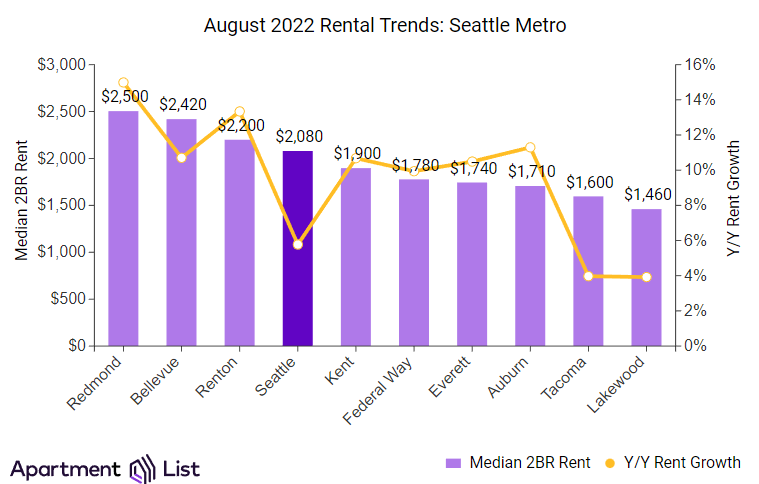
Of the largest 10 cities that Apartment List has data for in the Seattle metro, all of them have seen prices rise.

Here’s a look at how rents compare across some of the largest cities in the metro.

  • Redmond has the most expensive rents in the Seattle metro, with a two-bedroom median of $2,505; the city has also seen rent growth of 15.0 percent over the past year, the fastest in the metro.
  • Over the past month, Bellevue has seen the biggest rent drop in the metro, with a decline of 1.1 percent. Median two-bedrooms there cost $2,420, while one-bedrooms go for $2,168.
  • Lakewood has the least expensive rents in the Seattle metro, with a two-bedroom median of $1,459; rents increased 0.6 percent over the past month and 3.9 percent over the past year.


Multifamily Rent Growth Slows But Still Strong

With Traditional Multifamily Rent Drivers Disrupted What Is The Future?

Another Bullish Year For Multifamily In 2022?

Sign Up For Our Weekly Newsletter And Get Rental Property And Apartment News And Helpful, Useful Content Each Week.

* indicates required