Home Blog Page 67

How To Fix Noisy Upstairs Tenants Bothering Downstairs Tenants?

Noisy upstairs tenants bothering downstairs tenants can be a challenge for landlords so that is the question this week

Noisy upstairs tenants bothering downstairs tenants can be a challenge for landlords so that is the question this week for Ask Landlord Hank. Remember Hank is not an attorney and is not offering legal advice. If you have a question for him please fill out his form below.

Dear Hank:

I have a problem with a tenant on the top third floor that has two kids and all they do is run around all hours of the day and night.

The older couple live right underneath them and constantly complain about the noise.

They want to renew their lease. What can I do to help this matter?

-Marie

Dear Marie,

When you have apartments with wood framing instead of cement flooring, sound transmission is usually a problem.

In this situation, I’ve tried to put tenants with young children in ground floor apartments. But, since they are already living on an upper floor, can you modify the ceiling for some reduction in sound transmission?

It is not easy nor cheap, but you can add a second layer of 5/8 thick drywall and spread a liquid sound proofing product between the original sheetrock and the additional layer.

The sound proofing compound costs about $45-60 per sheet of drywall using two tubes of the compound per sheet. This may be enough relief for your current tenants underneath the noisy upstairs tenants and children to be happy residents again.

Sincerely,

Hank Rossi

Rent Sarasota

www.rentsrq.com

Each week I answer questions from landlords and property managers across the country in my “Dear Landlord Hank” blog in the digital magazine Rental Housing Journal.    https://rentalhousingjournal.com/asklandlordhank/

Noise from upstairs tenants bothering downstairs tenants can be a challenge for landlords so that is the question this week
Landlord Hank says, “It is not easy nor cheap, but you can add a second layer of 5/8 thick drywall and spread a liquid sound proofing product between the original sheetrock and the additional layer.”

Ask Landlord Hank Your Question

Ask veteran landlord and property manager Hank Rossi your questions from tenant screening to leases to pets and more! He provides answers each week to landlords.

  • This field is for validation purposes and should be left unchanged.

7 Ways To Handle Noise Complaints In Rental Housing

Do I Have to Paint and Replace Flooring for a Long-Term Tenant?

A Tenant Poured Grease Down Drain Who Is Responsible?

Sign Up For Our Newsletter And Get Rental Housing And Apartment News And Helpful, Useful Content Each Week.

* indicates required

36 Percent Of Remote Workers Planning To Move in 2023

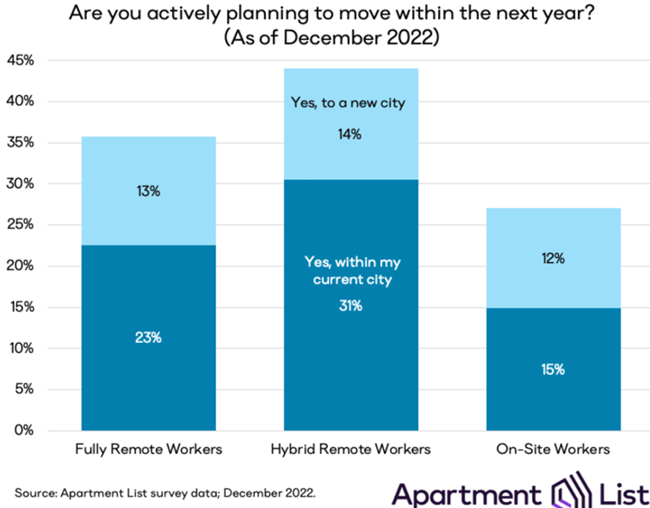
The remote worker migration in rental property is expected to continue in 2023 with 36 percent of remote workers planning to move in 2023

The remote worker migration in rental property that started in 2022, is expected to continue in 2023 with 36 percent of remote workers planning to move in 2023, a new Apartment List survey says.

The flexibility of remote work, despite bosses wanting workers to return to the office, is still a major factor in rental housing.

“We found that the flexibility afforded by remote work is indeed leading to higher rates of mobility and shifting geographic preferences,” Apartment List economist Chris Salviati writes.

“Given their heightened propensity to move, remote workers have been having a disproportionate impact on housing market trends, and this is expected to continue into 2023 and beyond,” he says.

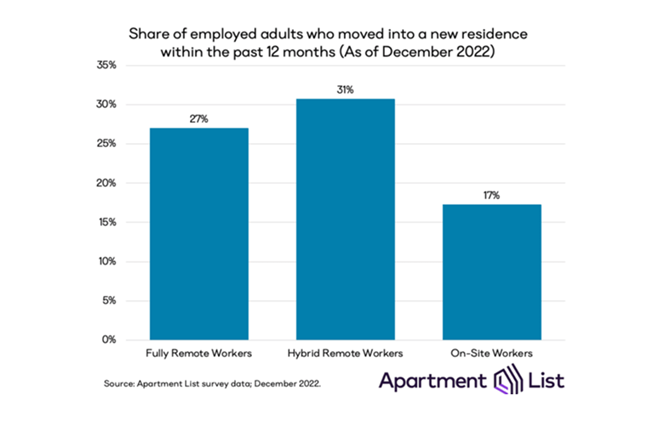
Compared to on-site workers, remote workers were more likely to move in 2022 and considered different factors when they did so, the report says.

Hybrid Workers Most Likely To Move

Salviati said the highest moving rates were observed among workers with hybrid remote arrangements – those who split time between working at home and on-site – 31 percent of whom moved in 2022, a rate of mobility that was 78 percent greater than that of on-site workers.

The remote worker migration in rental property is expected to continue in 2023 with 36 percent of remote workers planning to move in 2023
Chart courtesy of Apartment List

The survey was conducted of almost 6,000 employed adults in December 2022.

The results “imply that remote work, even in hybrid form, is allowing some workers to move to locations that better suit their preferences now that they are less bound by job locations.

“In fact, more than one-in-five remote workers who moved in 2022 specifically told us that their remote work status was a motivating factor for their move,” the report says.

Freedom Of Choice In Housing

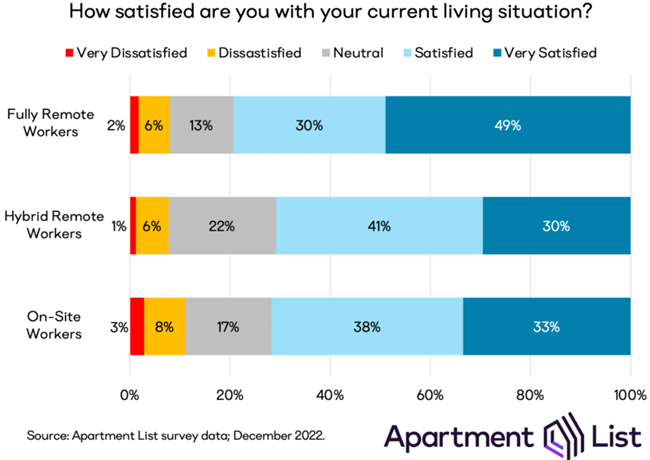
The freedom of choice in housing when not tied to an on-site job location result in “greater satisfaction in living arrangements for remote workers.”

Hybrid workers may be able to consider a wider range of geographic locations – assuming that they’re willing to commute longer distances if those commutes are not daily – however, their options are still largely contingent on their job location.

The remote worker migration in rental property is expected to continue in 2023 with 36 percent of remote workers planning to move in 2023

Knowledge Sector Jobs Can Be Performed Anywhere

The report concludes that the pandemic-caused change in how workplaces are organized proved that “a significant share of knowledge sector jobs can be performed from anywhere with an internet connection.

“The rapid uncoupling of housing choice from job choice has had profound implications for the housing market in recent years, and there is good reason to believe that the dust has yet to fully settle.

“Those with remote flexibility are still a minority in the workforce, but a rapidly growing one. And as they continue to account for an even greater share of moves, these workers will play a key role in driving domestic migration patterns this year and into the future,” Salviati writes.

Read the full report here.

Sign Up For Our Newsletter And Get Rental Property And Apartment News And Helpful, Useful Content Each Week.

* indicates required

When Will Sagging Multifamily Sales Rebound?

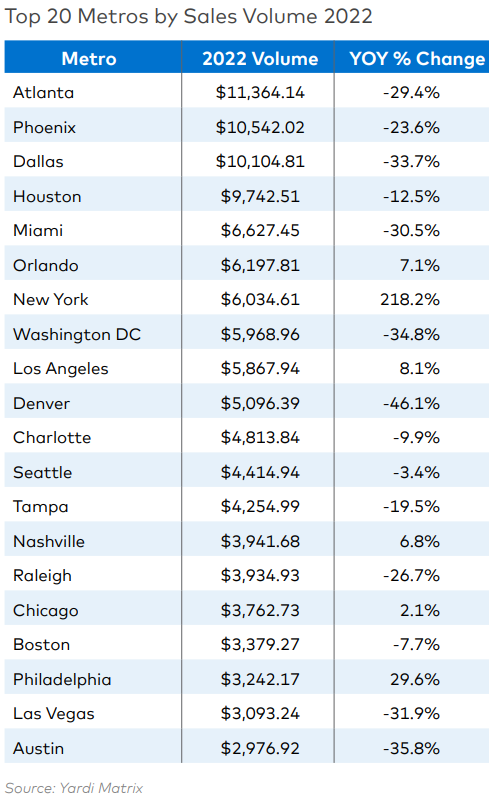
Yardi Matrix says in a new research bulletin that investor demand and multifamily sales are continuing to evolve in 2023.

Yardi Matrix says in a new research bulletin that investor demand and multifamily sales are continuing to evolve in 2023.

Multifamily property sales continued to shift toward secondary tech markets in 2022, as volume waned in the fourth quarter due to rising acquisition yields and pricing uncertainty.

This Yardi Matrix bulletin examines the prospect for deal flow in 2023 and what needs to happen for market activity to return.

Paul Fiorilla, Director of Research, Yardi Matrix, writes that at the moment deal flow is stalled by pricing uncertainty and multifamily investors are increasingly focused on markets with growth in jobs and population which is where investor demand and interest is.

Multifamily Sales Drop In Second Half Of 2022

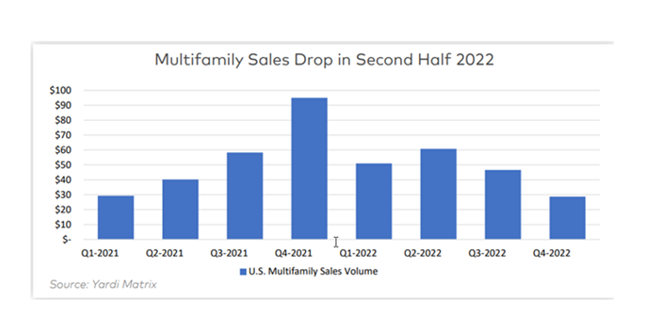
First-half 2022 volume was 60.4 percent above the first half of the 2021 record year. But volume in the second half of 2022 was 51.8 percent below the same period in 2021, with fourth quarter 2022 volume 70 percent below the fourth quarter of 2021. Rising interest rates were a big impact.

“The pricing uncertainty has created a large bid-ask spread between buyers, who are taking higher financing costs and projections of an economic downturn into account, and sellers, who are loath to accept what they perceive as a discount,” Fiorilla writes.

Yardi Matrix says in a new research bulletin that investor demand and multifamily sales are continuing to evolve in 2023.
Charts courtesy of Yardi Matrix

Now most apartment owners are holding on to properties unless there is an urgent reason to sell.

“Indeed, the biggest question the market faces is not whether we will see more distressed assets but by how much distress will increase. Banks have become conservative with the prospect of a widely projected economic downturn, so borrowers are facing both rising rates and less leverage,” the report says.

“As most economic scenarios contain mixed blessings for deal flow, volatility may be the most critical factor for transaction activity.

“Transaction activity will pick up when market conditions return to some semblance of stability and market players believe they can underwrite with a higher level of certainty than exists today,” Fiorilla writes.

About Yardi Matrix

Yardi Matrix researches and reports on multifamily, office and self-storage properties across the United States, serving the needs of a variety of industry professionals. Yardi Matrix Multifamily provides accurate data on 18+ million units, covering more than 90 percent of the U.S. population. Contact the company at (480) 663-1149.

Sign Up For Our Weekly Newsletter And Get Rental Property And Apartment News And Helpful, Useful Content Each Week.

* indicates required

Compliance Monitoring – A Fair Housing Must

Compliance monitoring is a checks-and-balances procedure to be done regularly to assure Fair Housing policies are met.

Compliance monitoring is a checks-and-balances procedure to be done regularly to assure Fair Housing policies are met.

By The Fair Housing Institute

When was the last time your office did a compliance audit of your documentation forms and procedures? Why is it a critical practice that should be done regularly? This article will explain why compliance monitoring is important, and will share some helpful tips to either get you started or fine-tune your process.

Compliance Monitoring – Fair Housing Implications

Let’s start by defining what compliance monitoring is: Just what it sounds like. It is a checks-and-balances procedure that should be done regularly to see if every staff member is following your predetermined policies and procedures, especially when there could be fair housing implications.

A large company may have an entire department dedicated to overseeing compliance. But for smaller companies, the responsibility will fall on a specific manager or person in a leadership role. Either way, compliance monitoring helps a company identify any potential problems and correct them before they snowball or, even worse, are discovered during a fair-housing investigation.

A Common Breakdown Point – Documentation

Consider this scenario: A rather irate resident calls to complain that they received a rent increase when their neighbor did not. You immediately check both residents’ files to see if there is supporting documentation as to why this happened, but find nothing. Now what? More than likely, this is just an oversight, but unfortunately, you now have no way to prove why one resident received a rent increase when another did not, and it could be construed as discrimination.

In this scenario, we have not one but two failures. First, there was the failure to document the reason for the difference in rent. Second, the failure could have been caught before a resident became involved if there had been a regular check or compliance-monitoring procedure in place.

Steps for Better Compliance Monitoring

The first and most important step in compliance monitoring is training! As a supervisor or manager, you should never assume that everyone knows what they need to be documenting or what your company’s policies and procedures are. Every staff member, whether they are new or a seasoned veteran, should receive training as to your policies and procedures. Also, training should not be a one-and-done thing, but a continual process instead.

Once you have established a regular training regime, you need to think about how you are going to check in to ensure that it’s working. As we mentioned earlier, some larger companies have entire departments dedicated to this, but if you are a smaller company, you need to clearly identify who will be responsible and how often they will be performing a spot-check or audit.

If a compliance issue is identified, the next step is to take a deep breath and use it as a teachable moment for all involved. Share where the breakdown happened, discuss better practices to avoid it in the future, and be sure to follow up that they are followed.

The final takeaway when it comes to proper compliance monitoring is that training and follow-up are essential to identify problems to avoid or challenge a fair housing complaint.

About the author:
In 2005, The Fair Housing Institute was founded as a company with one goal: to provide educational and entertaining fair-housing compliance training at an affordable price at the click of a button.

Newly Built Apartments Getting Smaller

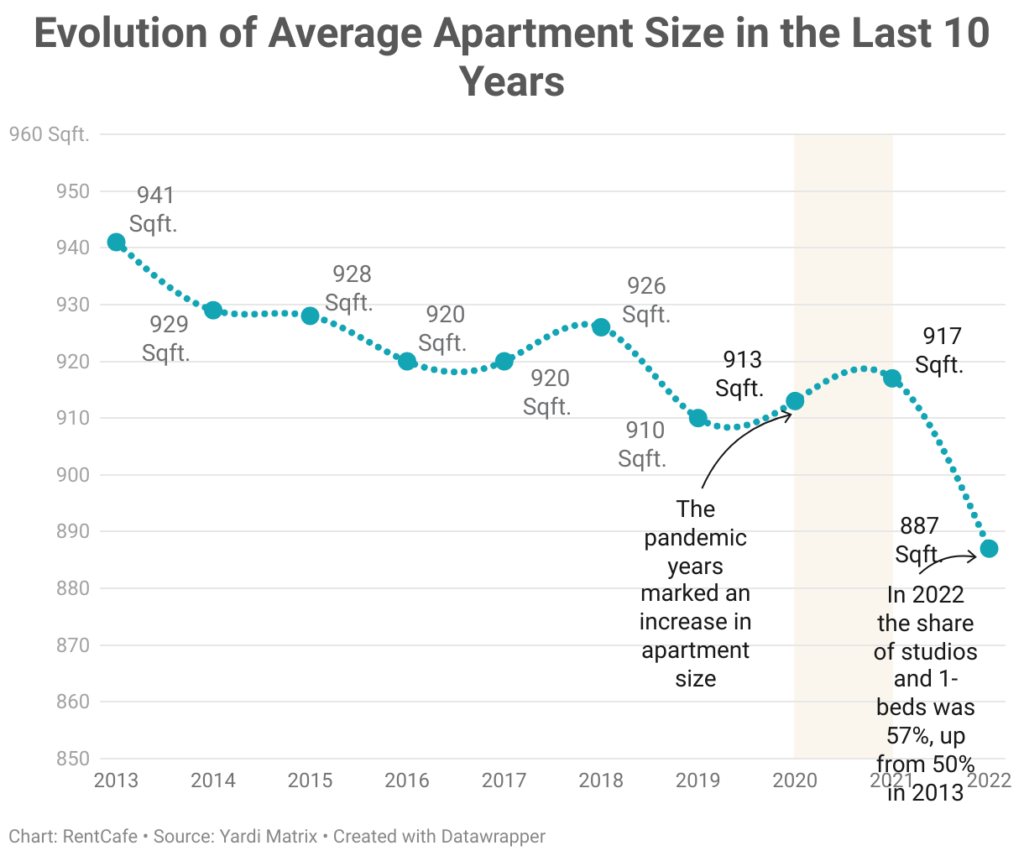
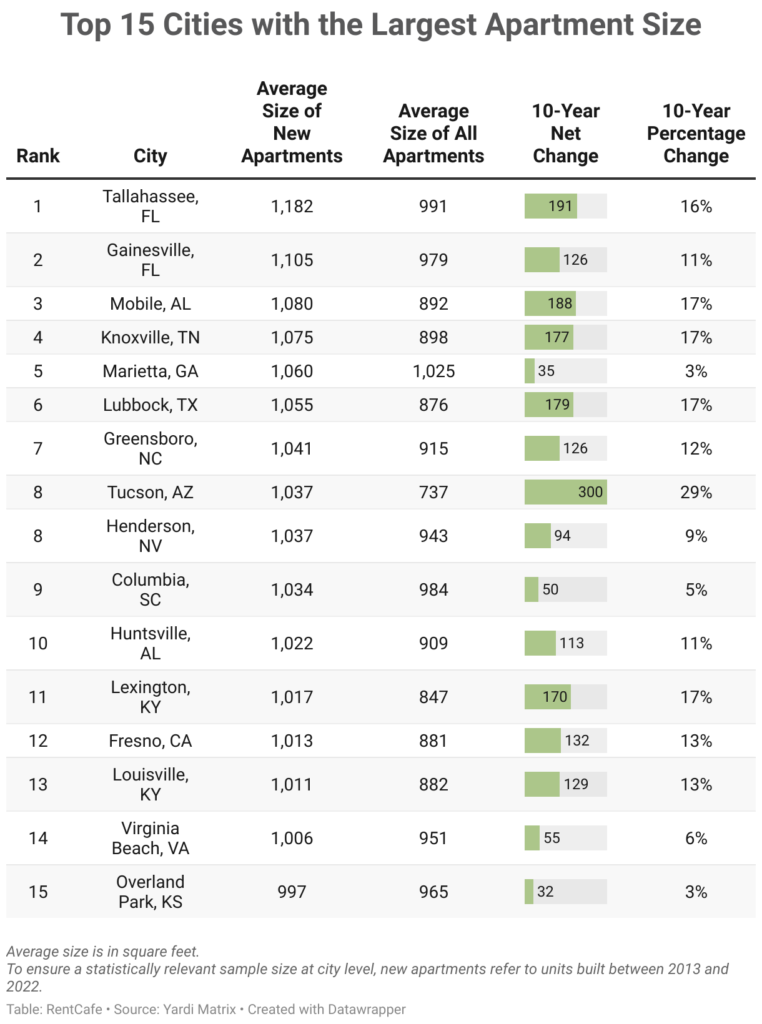
The average size of newly built apartments in 2022 has decreased to 887 square feet, down from the  941 square foot average 10 years ago

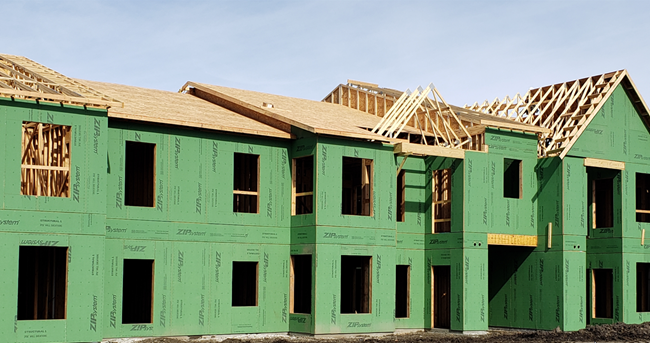
The average size of newly built apartments in 2022 has decreased to 887 square feet, down from the  941 square foot average 10 years ago, RentCafe reports.

In a report using Yardi Matrix data to analyze the top 100 cities and newly built apartments, the study found that the need for more housing created one of the highest levels of construction activity in 50 years.

Some highlights of the report:

  • Studios and one-bedrooms accounted for a record-breaking 57 percent of all new apartments built last year, amid a construction boom.
  • 2022 saw the largest year-over-year decrease in apartment size in a decade, down 30 square feet. Despite the pandemic putting a spotlight on the importance of elbow room, the trend persisted after some minor spikes in 2020 and 2021.
  • Seattle is one of the few large cities that continues to have the smallest apartments in the country — with an average of only 659 square feet in 2022, or 30 square feet less than 10 years prior.
  • Tallahassee, FL, boasts the largest apartments in the country (1,182 square feet), followed by Gainesville, FL; Mobile, AL; Knoxville, TN; and Marietta, GA. In fact, Tallahassee apartments increased by 191 square feet in the last decade (or 16.2%).
  • Apartments in Tucson, AZ, saw the largest increase in apartment size.

The average size of newly built apartments in 2022 has decreased to 887 square feet, down from the  941 square foot average 10 years ago

Not All Types Of Apartments Grew Smaller

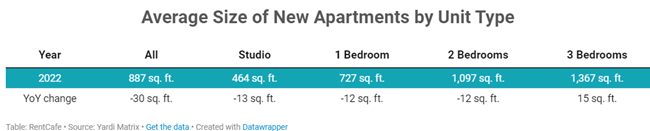
The 30-square-foot decline in the size of new apartments doesn’t mean that all types of units shrank when compared to 2021.

Rather, larger apartments with three bedrooms actually grew by 15 square feet.

The average size of newly built apartments in 2022 has decreased to 887 square feet, down from the  941 square foot average 10 years ago

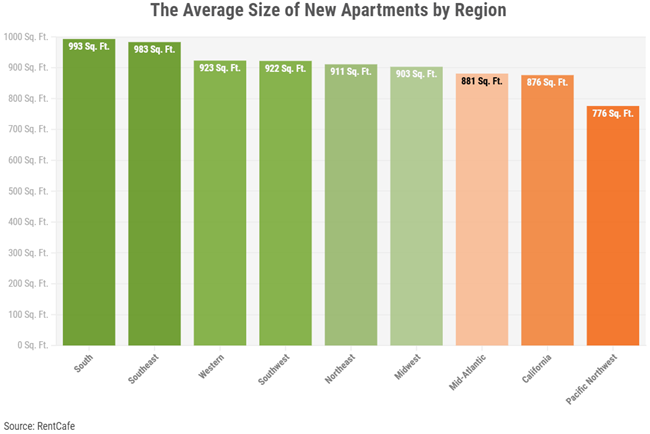
Apartments In The South Are Largest

In 2022, the average size of an apartment in the South was 993 square feet.

That means that renters in the South enjoyed an extra 106 square feet compared to the national average. On the other hand, renters in the Pacific Northwest had the least amount of space with only 776 square feet — 111 less than the national average apartment size.

Tucson was one exception

With the average size of apartments in Tucson, AZ, increasing by 300 square feet (29 percent), renters enjoyed the biggest gain in terms of space out of all 100 cities on our list. Moreover, the average size of new apartments during the last 10 years here was 1,037 square feet. This makes Tucson one of the best cities for renters who need the extra space.

The average size of newly built apartments in 2022 has decreased to 887 square feet, down from the  941 square foot average 10 years ago

Read the full report from RentCafe here.

Sign Up For Our Newsletter And Get Rental Property And Apartment News And Helpful, Useful Content Each Week.

* indicates required

Why Coliving Should Be Part of Your Rental Property Portfolio

Why Coliving Should Be Part of Your Rental Property Portfolio

Why coliving should be part of your rental property portfolio as this housing trend could provide real value for landlords.

By David Mazza

I’d love to give you a rock-solid, Merriam-Webster-esque definition of “coliving.” The truth is, I can’t.

Coliving is the newest buzz word in the housing market, and it might be a confusing concept for landlords and property managers to understand.

It’s a catch-all term that applies to many different new-age solutions to apartment renting. A coliving situation could encompass a group of roommates living together in an apartment, a pre-furnished room in a house meant for shorter-term stays, or a dormitory-style tower for adults.

The concept isn’t new, but it’s going to change the way the rental market works. For us at SplitSpot.com, we are often categorized as “coliving” since we enable tenants to rent individual rooms in a shared apartment.

No matter what way you slice it, anyone who has multifamily real estate in their portfolio should be exploring a form of coliving as a potential option for renters.

Let’s investigate more.

The demand for coliving is real

Data from the U.S. Census Bureau reveals that the number of 18- to 34-year-olds living alone decreased by 10.3 percent from 2005 to 2015. Estimates for the potential of the coliving market worldwide in the next decade have ranged as high as  $550 billion. Rising real estate prices, increased student debt and other factors have made buddying up the norm for young renters. Remote work is also increasing and workers are expecting the rest of the world to follow suit in terms of flexibility.

Coliving is a concept that helps meet the needs of these younger apartment hunters. While the term itself can refer to different housing structures, it’s hinting at a simpler reality: Renters are seeking more flexibility with shorter and/or more customized leases and veering away from the ultra-structured, long-term leases that used to dominate the market.

Landlords seeking to fill rooms across their entire portfolio need to adapt to this reality and find some creative solutions that work for apartment renters.

Coliving is a useful asset for property owners

Coliving is an asset class that is growing; it makes sense for any rental property owner to have some exposure.

Ground-up coliving developments are now part of the market. Research from CBRE shows that the United States had more than 5,000 beds in 150 coliving spaces in 2019. On top of that, it’s estimated that these spaces could bring in a premium, above-market rate – up to 38 percent higher than conventional apartments.

That’s a testament to the market need for a coliving solution, and whether it’s a new, purpose-built coliving facility or an existing multi-bedroom unit that allows renters to easily lease one bedroom without any hassle, consumers will be increasingly demanding this type of rental agreement.

Navigating coliving as part of a rental property portfolio

Most of the world is used to doing leasing in the traditional way: groups of roommates sign a 12-month lease and the property owner comes back half a year later to see if the group will stick around. This method of leasing has more or less worked for decades, but increasing demands for flexibility and the new realities of the urban multi-family landscape have made it more challenging to continue on with “business as usual.”

As the aforementioned need for flexibility increases among renters, landlords will have to adjust to some of the new realities of coliving. Finding tailor-made roommate groups and then managing the churn of more-constantly changing roommates is becoming more and more daunting. And standing out in the competitive urban rental market is a challenge in itself, especially considering the many new offerings coming to market, as mentioned above. Luckily, there are tools at a landlord’s disposal – tools that make coliving (and its accompanying above-market rates) a realistic, and advantageous, option for all parties.

How can SplitSpot help?

SplitSpot is a solution to landlords and renters to meet the growing demand for coliving situations. In addition to marketing and leasing your vacant apartment rooms to prospective tenants, SplitSpot will manage each household’s bill payment and collection, and provide landlords ancillary benefits (like triaging maintenance tickets) to make renting rooms easy. We’ll manage the churn of renters – all while providing the positive tenant experience that your renters crave.

About the Author:

David Mazza is the co-founder of SplitSpot, the flex-lease platform built to make apartment rentals easier for both tenants and landlords. David manages many of the company’s day-to-day operations, and is a key driver of SplitSpot’s strategy and mission to improve flexibility, affordability, and accessibility of renting in cities. Prior to SplitSpot, David worked at Amazon and at investment bank Sonenshine Partners. David holds an MBA from MIT’s Sloan School of Management and an A.B. from Harvard.

Sign Up For Our Weekly Newsletter And Get Rental Property And Apartment News And Helpful, Useful Content Each Week.

* indicates required

6 Takeaways From The National Multifamily Housing Conference

6 takeaways for readers from the National Multifamily Housing Council's conference by the John Burns Real Estate Consulting team

The John Burns Real Estate Consulting team attended the National Multifamily Housing Council’s recent conference and came away with 6 takeaways to share with our readers.

The report points out that both rent and occupancy are good in most markets compared to history, “the homeownership premium is over $1,000 per month in most major markets, and lead traffic is starting to improve.

“While all real-estate sectors are going through a reset, we think multifamily will outperform, but there are some things to watch out for too,” Dane Drewry, Jesse McConnico, and Chris Montgomery, research analysts and consultants, write in John Burns newsletter.

Here are the 6 takeaways

No. 1

Q4 2022: The market cooled, due in large part to massive rent growth of 14 percent YOY for those deciding to relocate (renewals were less).

No. 2

January 2023: Apartment market is off to a strong start in 2023, thanks to pent-up demand to move and a ridiculously high premium to purchase a home.

No. 3

Oversupply warning: More than 1.1 million apartments units are in the pipeline, which is far more than needed and will likely produce a supply surplus later in the year and next year.

No. 4

Demand warning: Most apartment owners are planning on a recession later this year, which is never good for apartment owners.

No. 5

Plunging values ahead: Cap rates have risen—but experts say not enough. Expect cap rates to rise and values to decline.

No. 6

Controlling expenses: Most apartment developers are focused on improving efficiencies to combat increases in expenses.

The Risk Of Oversupply

“Despite the current delays, the number of completions will be greatly elevated through 2024. The massive apartment pipeline has led many to speculate about oversupply risk.

However, new supply will be largely concentrated in markets with stellar job growth and overpriced for-sale housing,” the authors say.

Conclusion: 6 takeaways from National Multifamily Housing Council Conference

The authors say that the current challenge is “how to successfully build and execute a strong strategy around the changing environment. To remain competitive, developers and operators will need to be hyper focused on where they are going and the game plan to get them there.”

Read the full report here at John Burns Real Estate Consulting.

Sign Up For Our Newsletter And Get Rental Property And Apartment News And Helpful, Useful Content Each Week.

* indicates required

Economic Indicators Show Positive Multifamily Outlook

Multifamily demand remained steady in January, with rents leveling off after a fourth-quarter dip, to show a positive multifamily outlook.

Multifamily demand remained steady in January, with rents leveling off after a fourth-quarter dip, to show a positive multifamily outlook, Yardi Matrix said in their January report.

“The sturdy job market is creating optimism for a soft landing in 2023, though industry players are apprehensive about the growing number of rent control measures and rapidly rising expenses,” the report says.

“All things considered, the performance is a positive indicator for the sector. Going into the year—since it would be impossible to maintain the growth of the last two years—the debate was about how much demand would decline and the impact on rents,” the report says.

Highlights of the report

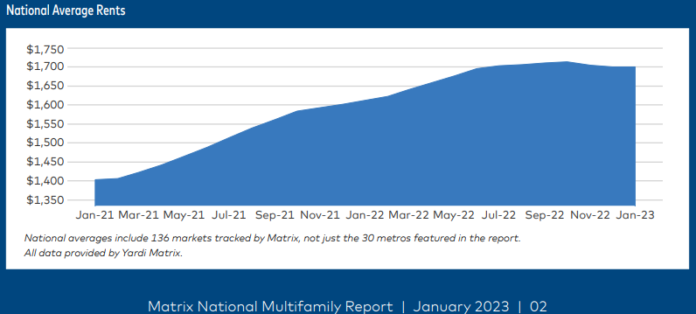
  • After declining in the fourth quarter as growth decelerates, multifamily rents were flat in January. U.S. asking rents averaged $1,701, unchanged from December. Year-over-year growth continues to decline, and is now 5.5 percent, down 70 basis points from the previous month.
  • Participants at the annual National Multifamily Housing Council conference in Las Vegas were generally optimistic about demand fundamentals, but concerns centered around issues such as the wave of proposed rent control measures, increasing expenses and high mortgage rates.
  • The single-family rental market remained strong amid volatility in the homebuying sector. The average U.S. asking rent increased $1 in January to $2,070, while the year-over-year increase fell by 85 basis points to 4.2 percent.

Rent Growth Steady In Yardi Matrix Markets

The report says that, “Early signs are encouraging. Rents remained consistent during the month in the middle of the seasonally slow winter season.

“And although markets where rents were well above trend in 2022—such as Miami, Tampa, Orange County and Nashville —have come back to the pack, overall growth is steady in most of Yardi Matrix’s top 30 metros.”

Multifamily demand remained steady in January, with rents leveling off after a fourth-quarter dip, to show a positive multifamily outlook.

Lease Renewal Rates Continue Decline

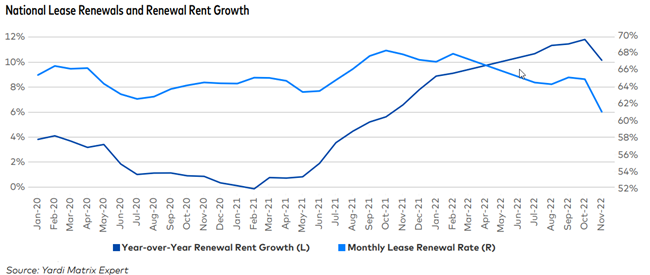
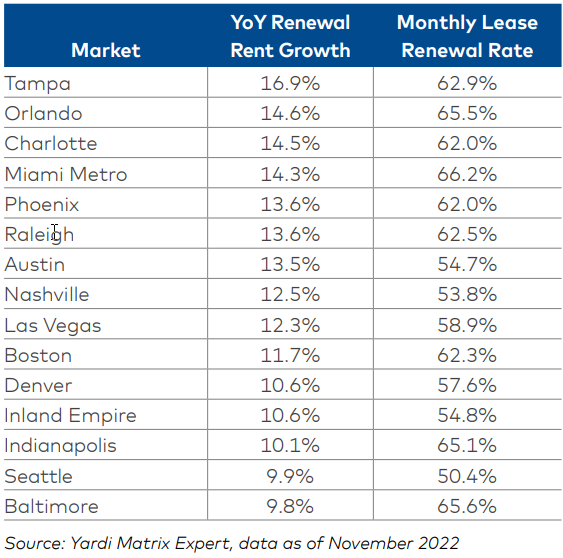
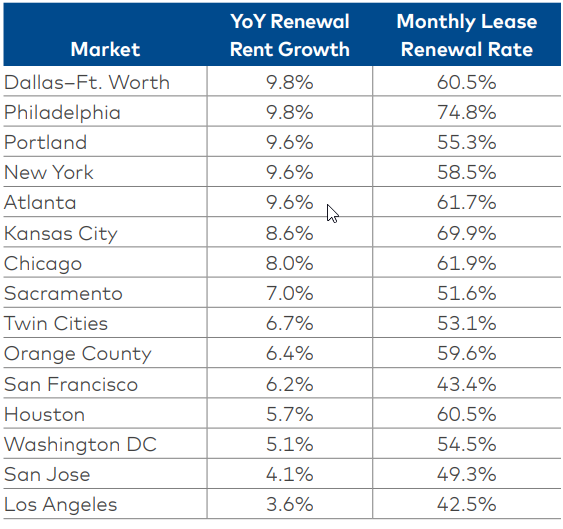
National lease renewal rates fell to 61.1 percent in November, down from 64.9 percent in October and the lowest level since before the pandemic.

The decline could reflect that tenants facing increases and lower wage growth are starting to shop for lower rents, although the month could be an outlier.

Multifamily demand remained steady in January, with rents leveling off after a fourth-quarter dip, to show a positive multifamily outlook.

Multifamily demand remained steady in January, with rents leveling off after a fourth-quarter dip, to show a positive multifamily outlook.

About Yardi Matrix

Yardi Matrix researches and reports on multifamily, office and self-storage properties across the United States, serving the needs of a variety of industry professionals. Yardi Matrix Multifamily provides accurate data on 18+ million units, covering more than 90 percent of the U.S. population. Contact the company at (480) 663-1149.

Sign Up For Our Weekly Newsletter And Get Rental Property And Apartment News And Helpful, Useful Content Each Week.

* indicates required

Rental Property Maintenance: Security, Pest Control, & Exteriors

Rental property maintenance checklist part two, security, pest control and exteriors, is the second in a series provided by Landlord Gurus.

Rental property maintenance checklist part two, security, pest control and exteriors, is the second in a three-part series provided by Landlord Gurus.

By Eli Secor

Keeping your rental property in top condition ultimately saves on maintenance costs, and helps attract and retain good tenants. This article is the second in our three-part series on routine maintenance, which focuses primarily on security, pest control, and exterior issues.

Security

Here are some of the ways you can improve the safety of your renters as well as your rental property.

  • Doors – Ensure all doors close securely, and have functional locking hardware such as deadbolts.  We do not recommend hollow-core exterior doors, and suggest making sure long screws secure the deadbolt plate on the door frame.
  • Re-keying – Change keying at every turnover to protect your renters and avoid the possible liability that could arise if a previous tenant re-enters a unit.  We use keypad entry deadbolts almost exclusively at this point, as they can be re-programmed easily.
  •  Windows – Ensure all windows latch securely. Use adjustable stops or wood dowels to limit how far sliding windows and patio doors can open in case they’re left unlocked.
  • Lights, alarms, and cameras – Consider using cameras, lights, and alarms to increase the security of your property.

Pest Control

It’s best to hire a professional for pest control. However, if you decide to handle everything on your own, we recommend the following measures:

  • Remove entry points – Cover or seal openings with materials that can’t be chewed. You can stuff a wire screen into smaller openings and fill the space with building spray foam.
  • Exterior bait – Place poison outside the building in child and animal-safe containers. You may use bait boxes for rodents or bait traps (such as gel products) for ants and insects.
  • Interior bait – For ants and insects there are solutions such as traps and sprays that are applied along baseboards. However, we don’t recommend this for rodents as you can end up with stinky dead critters in your building.
  • Bed bugs and fleas –Very high temperatures can kill pests and there are specialized heaters that can be used to treat belongings, furniture, and even rooms.  Often, however, we have found that hiring a professional is necessary.  Tidbit: dogs are often used to locate bed bugs!

Exterior

Here are some leak prevention and routine rental maintenance checklist measures to keep up the exterior of your rental buildings:

  • Roof –Keep an eye on moss growth, loose flashing, and broken shingles. Hire a professional to deal with roof maintenance, as they can spot separating seams and other signs of wear or failure.
  • Gutters – Clean gutters and downspouts every fall to avoid backups that can cause flooding.
  • Chimney – Monitor the condition of any chimney to avoid leaking. For old masonry chimneys, replace mortar before bricks come loose and fall.
  • Window and door sealant –Inspect caulking joints yearly and renew those that are cracked or separated from the surfaces they’re sealing.
  • Paint – Replace paint before it starts bubbling and flaking, as this will keep exterior surfaces from degrading in the weather.

Key Takeaway

We hope this checklist will help you create an effective rental maintenance plan. Check out our third part upcoming next month to learn about how to tackle electrical, fire safety, & HVAC-related issues.

About the author:

Eli Secor started LandlordGurus.com with long-time friend and fellow landlord Chris Lee.  After many a discussion about how to manage various tricky rental property issues, they decided to share their experiences and expertise with other independent landlords.  Along the way they are finding new answers and new tools, which they also share.

Sign Up For Our Newsletter And Get Apartment News And Helpful, Useful Content Each Week.

* indicates required

Rental Property Maintenance Checklist, Part One: Plumbing

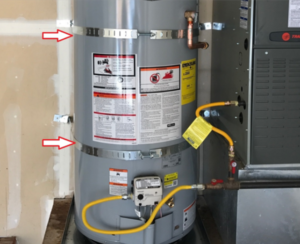
rental property maintenance plumbing and water heater secured with straps in earthquake prone areas of the country

3 Common Plumbing Emergencies In Rental Properties And What To Do

Rental Property Maintenance: 6 Items to Troubleshoot in Your Crawl Spaces

How to Waterproof Your Basement

One Sure Way To Increase Tenant Selection Success Rates Part 4

One sure way to increase tenant selection success rates part 4 By Rebekah Near, CEO of Orca Information, Inc on developing a policy

By Rebekah Near,
CEO of Orca Information, Inc
Nationwide Tenant and Employment Screening Service

Here we are at article number four on creating a detailed Tenant Selection Policy (TSP).  Now it is time for an example of a working policy described in my previous articles.  Each management company and or property has their own unique details in a policy.  Not one of our client policies are exactly alike!  However, the format and certain required legal information would be included.  Keep in mind, when it comes to legal wording, not all attorneys word things the same.  I am providing an EXAMPLE of what we help our clients create.  So far, they have been working like a charm!  I have been working with clients on their policies since 1996. IF YOU CHANGE YOUR POLICY DUE TO MY SUGGESTIONS OR ANY OTHERS, A LANDLORD TENANT LAW ATTORNEY NEEDS TO APPROVE IT BEFORE BEING USED.  IT IS ALSO IMPERATIVE YOU STAY ABREAST OF ANY CHANGES TO THE LAWS AND MAKE CHANGES TO YOUR POLICY ACCORDINGLY.  Your Tenant Screening company is required to assist you in providing you with any new rules and regulations affecting Tenant Screening.  It is also up to you to reach out to them periodically for such information.  This example policy is Washington State specific, however much applies to every State.

Due to size of the file, this policy is only a partial example.  This “example policy” will address numbers one and two of the four categories listed below.

There are at least four categories for Tenant Selection Policies.  They are as follows: 

  1. The requirements to apply for the property – the Application Process
  2. Rules of the Property
  3. Potential Disqualifiers identified on the Background Screening Report.
  4. Disclosure documents explaining laws governing the application process – Tenant Rights!


(YOUR LOGO, ADDRESS AND CONTACT INFORMATION WOULD BE AT TOP OF THE PAGE)

RENTAL CRITERIA

WE DO NOT ACCEPT REUSABLE TENANT SCREENING REPORTS

Thank you for applying to rent from our company.  This process should be completed within 72 hours (excluding weekends and holidays).  Want your screening report to come back to our office fast as possible?  Then fill it out thoroughly, include all phone numbers, type or write legibly.  We are happy to help you with any questions.

All rentals are on a “first come, first serve” basis.  The only thing that will “hold” a rental for you is a completed application and a paid screening fee.  *Screening Fee is non-refundable.

THE APPLICATION PROCESS

  1. Each person who is 18 years and older must fill out a Rental Application. The following applies:

a. Fully completed Rental Applications and $____ non-refundable processing fee needs to accompany each tenant/Lease Holder(s) application.

b. Rental Applications submitted online are charged an additional $3.00 processing fee.

c. The Tenant Screening process will include credit reports, rental references, court records and employment verification.

d. For screening services, ABC Management uses: ORCA Information, Inc., 120 E George Hopper Rd, Suite 108, Burlington, WA 98233, 800-341-0022.

2. For each property ABC Management accepts and processes one set of Rental Applications (or co-tenant applications) at a time. The following documents are required upon submission of each application:

    • Copies of government photo ID and
    • Equivalent proof of identity (Visa, Passport, etc.). See attached, Suggested Alternative Documents for Screening Immigrant Populations.
    • Documents proving income is 2.5 times the rent amount.
    • Signed document titled, WASHINGTON STATE FAIR TENANT SCREENING ACT OF 2012

3. Commercial Rentals – Complete a Commercial Rental Application. Application fee is $_____.

REQUIREMENTS

  1. A rental applicants gross monthly income must equal at least 2.5 times the rent. Income must be lawful and verifiable.  Documents proving earnings need to be submitted to the office BEFORE THE SCREENING PROCESS WILL BEGIN.
  2. Proof of Adequate Income – Example:
    • Most recent check stub with year-to-date earnings
    • Self Employed – Tax Returns for last two years
    • Retired – Copies of Deposit slips, Investment Earnings and/or Social Security Earnings Documents, Bank Deposit History
    • Additional Sources of Income – Ex: Child Support, Bank Deposit History, etc.

POTENTIAL DISQUALIFIERS (Overview)

  1. The following are issues that may cause a denial of your application:
    • Credit score below 600
    • Unpaid Collections
    • Bankruptcy within past two years
    • Less than two years of positive credit history.
    • Unlawful Detainer (Eviction)
    • Negative/Incomplete rental reference
    • Court Records – History of criminal activity on the part of any proposed occupant and which presents a danger to persons and/or property, or the peace and enjoyment of the others in the apartment/community could negatively impact your application. Example: drugs, sex offense, robbery, assault, etc.

Determinations as to criminal screening will be made on a case-by-case basis and based on several factors and information. There will be no automatic denials for arrests or criminal convictions.

  • False information and/or omission of material fact on Rental Application
  • Lack of information provided on Rental Application
  • Lack of proper documentation of earnings – 2.5 times rent amount
  • Lack of 24 months positive, consecutive, objective rental references.

Exceptions to Standards – “Adverse Action Options”

Due to extenuating circumstances – exceptions to one of the above standards may be considered.  A qualified co-signer or additional deposit may be required.

CONSUMER RIGHTS INFORMATION

  • Consumer Information is kept confidential.
  • A credit report is considered a “hard hit” by all three major credit bureaus.
  • In the event of Adverse Action (denial of tenancy, cosigner or increased deposit required) you have the right to a FREE copy of the background check we reviewed and processed by Orca Information, Inc. You also have the right to dispute the accuracy of any information therein.
  • Per FCRA, the company, Orca Information, Inc. provided all, or part of the information included in the background check. However, Orca Information did not make the decision to take Adverse Action.
  • Decision to rent is made solely by ABC Management.
  • You have the right to obtain a FREE copy of your credit report each year from every credit bureau. For a FREE copy log onto: www.annualcreditreport.com.
  • Orca Information obtains credit reports from Trans Union.

CO-SIGNER

  1. If applicant does not meet the minimum requirements a co-signer may be required. Required qualifications are the following:
    • Proper documentation of earnings/income
    • Proof of Adequate Income – Example:
      • Most recent check stub with year-to-date earnings
      • Self Employed – Tax Returns for last two years
      • Retired – Copies of Deposit slips, Investment Earnings and/or Social Security Earnings Documents, Bank Deposit History
    • Earn 5 times the rent amount

PET POLICY

  1. A $250.00 pet deposit is required for each pet. There is a $50.00 non-refundable fee retained to probe the carpet for pet urine upon vacating the property.  If there is no pet damage, deposit will be refunded, less the probe fee.
  2. Additional monthly pet rent is charged in the amount of $25.00.

 ASSISTANCE ANIMALS

  1. Assistance animals accepted with written verification of a disability related need.

MOVE – IN PROCESS

  1. A $_____ Nonrefundable Administrative Fee must be paid within 24 hours of approval notification.
    • The move-in costs are divided into three parts:
      • A $_____ Nonrefundable Administrative Fee
      • The Security Deposit
      • The Rent.
  1. CHECK-IN: An appointment will be scheduled at our office when the property is ready for occupancy. The deposit needs to be paid. The lease and all rental documents will be reviewed and signed.

3. RENT: Pro-rated rent will be charged from the date the property is “rent ready” and be paid on the date the lease is signed.

4. UTILITIES: Local utilities must be established in the tenant’s name by the tenant before the check-in. The utility company will require a deposit.

OFFICE USE ONLY – SUBMISSION CHECKLIST

____ Completed application(s) with signature

____ Documents proving 2.5 X’s Rent

____ WA State FTSA signature page

____ Screening fee payment

____ Gov’t issued photo ID

  The above example policy helps clarify how to make a Tenant Selection Policy more clear and concise for both applicant and management company staff.  There are many more documents included in my client Tenant Selection Policies but time and space will not allow all of them to be published here.  My objective in this series of articles is to address the different ways to keep the policy clear and easy to understand to applicants and staff.  The above example policy covers only the following:

  1. The requirements to apply for the property – the Application Process
  2. Rules of the Property

 Next article will describe – specifically the reasons a landlord might take adverse action against an applicant.  It is laid out in a special, easy to read form.  It applies ONLY to the information provided on a tenant screening report – credit, court, reference, etc

 The above is not legal advice.  Rebekah Near is not an attorney.  Questions may be directed to Rebekah Near at the following email address:  [email protected]  For training videos on this subject and others, log on to, http://www.Orcainfo-com.com  At the top of page is a menu. Click on Education.  One of your choices will be our educational and training videos.

Part 1: One Sure Way To Increase Tenant Selection Success Rates

One Sure Way To Increase Tenant Selection Success Rates Part 2

One Sure Way To Increase Tenant Selection Success Rates Part 3