Home Blog Page 59

Entrata Acquisition Can Help Property Managers And Build Tenant Credit

Entrata has acquired Rent Dynamics to benefit property managers and residents alike, enabling a more powerful and robust operating system

Entrata has acquired Rent Dynamics to benefit property managers and residents alike, enabling an even more powerful and robust operating system to support resident-focused owners and operators, according to a release.

Entrata says the acquisition can transform how multifamily residents build credit and improve financial health.

Entrata has acquired 100 percent of the equity in Rent Dynamics and will be able to provide residents with increased access to financial tools designed to positively impact their financial future, according to the release.

“Since Entrata’s founding, we have made tremendous strides in streamlining property operations by creating tools that improve both the operator and resident experience. Today, our vision for how we can drive the industry forward has greatly expanded,” Adam Edmunds, Chief Executive Officer of Entrata, said in a release.

“The combination of Entrata and Rent Dynamics will deliver a huge advance in providing much-needed tools to address a gap that has prevented millions of residents from building credit and long-term financial health. We believe this acquisition will give property owners and operators what they need to drive loyalty, financial well-being, and, ultimately, the very best resident experience,” Edmunds said.

Together, Rent Dynamics and Entrata will transform the way property managers can help residents create and grow their financial identity. The addition of Rent Dynamics’ RentPlus products to Entrata’s suite of resident services will further cultivate a powerful and robust operating system to support resident-focused owners and operators.

Rent Dynamics functionality will be partnered with Entrata’s existing features, enabling property owners and operators to provide their residents the capability to streamline utilities, obtain renters insurance, and build credit by making on-time payments, all through Entrata’s single-sign-on platform.

“We’re proud to have helped hundreds of thousands of residents to date, and are excited to be able to accelerate that effort by pairing with Entrata’s extensive suite of services,” Quincy Rich, Chief Executive Officer of Rent Dynamics, said in the release.

“Together, Rent Dynamics and Entrata will continue to build the most comprehensive, all-in-one operating system to create a better experience for every resident. We couldn’t be more excited to join a leader like Entrata to help residents take ownership of their financial situation to provide more rent payment options and get credit for paying rent on time – all through one application workflow,” he said.

The resident amenities are a true differentiator for property management companies—which may themselves benefit through a greater resident retention rate, minimized delinquent rent payments and additional revenue options. Rent Dynamics’ program to help residents build credit has been amplified by its participation in Fannie Mae’s new positive rent payment reporting program, which aims to improve equitable access to credit for residents by incentivizing owners and operators to support resident participation in reporting rent payments to credit bureaus.

“We look forward to Rent Dynamics complementing our product portfolio for years to come,” said Catherine Wong, Chief Operating Officer and Chief Product Officer of Entrata. “The interoperability of both platforms will drive increasing benefits for our customers and their millions of residents around the world, furthering our commitment to elevating the resident experience.”

Financial terms of the transaction were not disclosed. The Rent Dynamics team will assume new roles within Entrata to continue innovation and development across the platform.

This nine-figure, all-cash deal is a game-changer for the rental industry as it will allow more than three million residents to gain financial freedom through access to financial tools that can positively impact their future — with a much broader potential impact for the approximately 43.9 million multifamily residences in the U.S. , according to the release.

For more information about Entrata and its continually expanding platform, please visit www.entrata.com.

About Entrata

Entrata is a leading operating system for multifamily communities worldwide. Setting the bar for innovation in property management software since 2003, Entrata offers solutions for every step of the leasing lifecycle and empowers owners, property managers, and renters to create stronger communities. Entrata currently serves over three million residents across more than 26 thousand multifamily communities around the globe. Learn more at www.entrata.com.


About Rent Dynamics

Rent Dynamics provides value throughout the resident journey through technology providing solutions for the Multifamily Industry. Our RentPlus product provides rent reporting and financial resources designed to promote economic inclusion and financial health for renters.


 

HUD Makes $30 Million Available For Fair Housing Enforcement

HUD is making $30 million in funding available for fair housing enforcement to local and state partners to support and promote fair housing

HUD (U.S. Department of Housing and Urban Development)  is making $30 million in funding available for fair housing enforcement to local and state partners through the Fair Housing Assistance Program (FHAP) to support and promote fair housing nationwide, according to a release.

“The money goes to the partnership between the federal government and state and local agencies to provide protection to the public against discrimination in housing. The funding to State and local enforcement agencies supports fair housing complaint investigations and education and outreach activities to inform the public, housing providers, and local governments about their rights and responsibilities under both the Fair Housing Act and state and local fair housing laws,” HUD said in the release.

“This funding notice is crucial as it supports local organizations in the fight to root out housing discrimination in their communities,” said HUD Secretary Marcia L. Fudge. “It is HUD’s mission to combat unlawful housing discrimination, and programs like the Fair Housing Assistance Program give communities the resources necessary to protect them from all acts of housing discrimination.”

Related Story: Are You Prepared for Fair Housing Testing?

Fiscal year 2023’s funding supports the efforts of 77 State, county, and city agencies that administer fair housing laws that provide rights, remedies, and procedures that are substantially equivalent to those provided by the federal Fair Housing Act.

“Our FHAP agencies play a pivotal role in our enforcement efforts to address discrimination and inequality in today’s housing market,” said Demetria L. McCain, HUD’s Principal Deputy Assistant Secretary for Fair Housing and Equal Opportunity. “Discriminatory actions in an attempt to prevent fair and equal housing based on race, color, national origin, religion, sex (including sexual orientation and gender identity), disability, and familial status should not be tolerated in our society, and these agencies are essential partners in fighting against discrimination at the state and local levels.”

Through this funding cycle, HUD is providing an approximate 6.5% increase in both Case Processing Fund reimbursement rates and Administrative Cost Funds temporarily introduced last year, which are the two main sources of FHAP funding provided annually to the Department’s agency partners.

Fair Housing and Hoarding – What You Need To Know

Quartz Countertops: The 2cm Revolution

It’s becoming common knowledge that in the rental housing market, Quartz countertops are more and more the gold standard.

Quartz countertops are the miracle material that is more and more becoming the gold standard in the rental housing industry

By Precision Countertops

It’s becoming common knowledge that in the rental housing market, Quartz countertops are more and more the gold standard.

Other surfaces just can’t match the longevity, beauty, and affordability of this miracle material, and discerning renters ask for it by name. But there’s more to it than what a countertop is made of.

Here, we’ll explore the advantages of the sleeker 2cm (or ¾”) thick Quartz material vs the 3cm (1 ¼”).

New Market, New Look

On the forefront of modernity, a thinner, sleeker material is almost invariably being selected when it comes to countertop design, and a 3cm front edge is widely regarded as too bulky to fit in with the sharp lines that cutting-edge kitchens and bathrooms gravitate toward.

Practicality is key these days, and a 2cm backsplash makes for less crowded surfaces, giving tenants more space. Additionally, 2cm quartz, though thinner, is still quite durable and more than capable of handling the rigors that renters subject their countertops to.

Less Material, More Value

Quartz in general delivers massive return for an affordable investment, so it’s not hard to understand why thinner quartz could provide even more value. A thinner material equals a reduction in cost, and the prudent property owner can spend a significant amount less on remodels or new construction simply by choosing to design with 2cm material!

And because quartz countertops can drive higher rents in properties regardless of the thickness, this is a surefire strategy for larger margins.

What’s the Takeaway?

In summary, increasingly consistent selection of 2cm over 3cm thick material for countertops in rental properties nationwide represents one of the most drastic shifts in countertop design seen in recent years. It’s easy to see why this thinner, versatile and affordable surface option is taking the countertop world by storm and quickly becoming the undisputed way to go.

About the Author:

Precision Countertops is the leader in rental housing countertop replacement. With a track record of over 10,000 successful apartment countertop upgrades in the Portland metro area, Precision Countertops specializes in transforming apartments with durable and visually appealing quartz countertop.

Quartz: The Future of Countertops in Rental Housing

Tenants Moved Into Non-Smoking Rental With Belongings Smelling Of Smoking

What can you do if tenants move into your non-smoking rental with furniture and items that smell of smoking
Indoor shot of apartment with lots cardboard boxes, gray sofa full of carton parcels with personal belongings, flower pot with flower on floor, relocating, moving in a new flat.

What can you do if tenants move into your non-smoking rental with furniture and items that smell of smoking is the question this week for Ask Landlord Hank. Remember Hank is not an attorney and is not offering legal advice. If you have a question for him please fill out his form below.

Dear Landlord Hank:

A tenant and his family moved into our non-smoking rental home (the lease states no smoking on the property whatsoever). They are not yet living there. They moved their belonging in a week ago.

We received permission to enter the property to have electrical work done by a technician. An unexpected failure of the garage door occurred. It was bad timing, but it was fixed the day after the issue arose.

The electrician and later the realtor and I noticed the strong smell of cigarette smell from the furniture and bags and boxes the tenant moved into our non-smoking house. When the realtor screened them, she told them it was a non-smoking property, and this is stated in the lease.

When confronted, they simply stated that they didn’t smoke in the house or on the property. They do admit they moved their items from a house where smoking occurs. When I told them it was damaging my property, they got defensive and now want to move out. I also want them to move. I told them I would not have rented to them had I known they were smokers.

We recently painted every level of this 3-story home and installed all new carpeting in areas without hardwood flooring.

We are willing to let them out of the lease. I want to get a quote and retain the portion of the security deposit for the expense it will take to remove the smoke odors. It smells just like they smoked on the property.

What do you think about this situation? Thanks.

-Victoria

Hi Landlady Victoria,

I would definitely let these tenants break the lease and leave your place.

The old fashioned way to get rid of smoke was to wash walls with vinegar, etc. but now you can buy or rent an Ozone generator. This is a miracle. You put this in your house with the HVAC system running and then leave and let it clean the property.

It could take three days at your place but the smell will be gone.

Now, is it worth it to possibly go to court over this and perhaps lose?

The tenants’ furniture smelled of smoke but they didn’t smoke in the house, so a judge may say that reasonably the tenants didn’t smoke in your property so technically they complied with the lease.

I’d let them leave and use the deposit if there was any other damage beside the smoke odor.

Sincerely,

Hank Rossi

www.rentsrq.com

Each week I answer questions from landlords and property managers across the country in my “Dear Landlord Hank” blog in the digital magazine Rental Housing Journal.    https://rentalhousingjournal.com/asklandlordhank

What can you do if tenants move into your non-smoking rental with furniture and items that smell of smoking
Landlord Hank says about the non-smoking rental, “I would definitely let these tenants break the lease and leave your place.”

Ask Landlord Hank Your Question

Ask veteran landlord and property manager Hank Rossi your questions from tenant screening to leases to pets and more! He provides answers each week to landlords.

Can I Monitor Tenant Smoking In My No-Smoking Rental?

Can I Limit the Number of People in My Rental?

Do I Have to Paint and Replace Flooring for a Long-Term Tenant?

A Tenant Poured Grease Down Drain Who Is Responsible?


Sign Up For Our Newsletter And Get Rental Housing And Apartment News And Helpful, Useful Content Each Week.

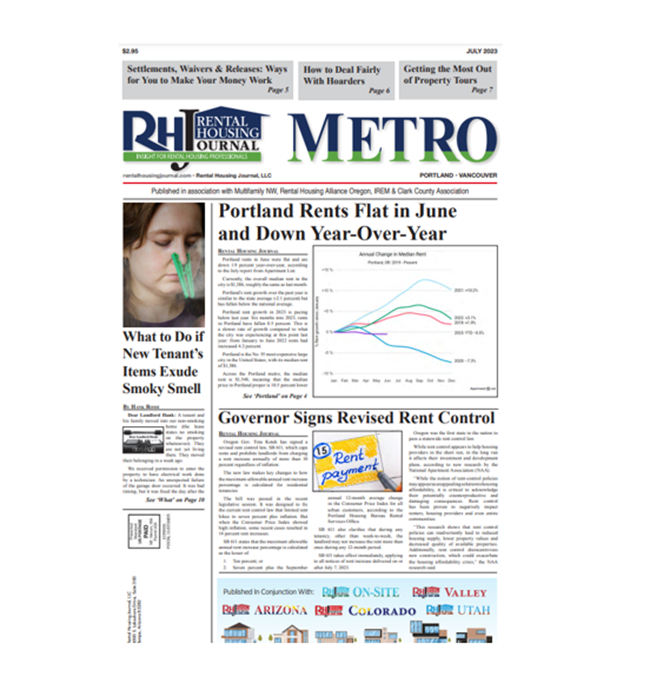
Portland Metro Rental Housing Journal July 2023

Touch or click here to see the July print edition of Portland Metro Rental Housing Journal for July 2023 featuring rental prices

Touch or click here to see the print edition of Portland Metro Rental Housing Journal for July 2023.

This is helpful, useful information for rental property owners, property managers, landlords and maintenance personnel.

This month’s edition discusses rental prices holding steady in Portland.

Also it features the story on the new rent control bill, SB611,  signed by Governor Tina Kotek in early July setting new caps on what rental property owners can charge for rent in Oregon.

See the latest from Multifamily Northwest as well as great ideas for countertops in rental properties.

See the Portland Metro Rental Housing Journal Issue Here.

“While the notion of rent-control policies may appear as an appealing solution to housing affordability, it is critical to acknowledge their potentially counterproductive and damaging consequences. Rent control has been proven to negatively impact renters, housing providers and even entire communities.

“This research shows that rent control policies can inadvertently lead to reduced housing supply, lower property values and decreased quality of available properties. Additionally, rent control disincentives new construction, which could exacerbate the housing affordability crisis,” the NAA research said.

Portland Update: Changes to FAIR Ordinance Bring (Some) Necessary Changes

Dealing with Habitability issues and Substitute Housing


Attracting Residents Who Pay and Stay with Incentive Optimization

Attracting residents with cash back rewards can be more effective than traditional rental concessions, such as a free month of rent or gift card, and incentive optimization platforms can help.

Attracting residents with cash back rewards can be more effective than traditional rental concessions, such as a free month of rent or gift card, and incentive optimization platforms can help.

By Andrew Ruhland

 Apartment operators everywhere are trying to maintain steady cash flow and, if plausible, increase revenue in today’s economic uncertainty.

Resident retention is key, and the best way to maintain ideal occupancy rates begins with meeting renters where they are and responding to them with immediacy. Operators are turning to incentive optimization tools that can not only enhance the lives of residents, but also help operators boost renewal rates and lower their operating costs.

Forward-thinking operators are tapping into technology-powered incentive optimization, such as cash back for renters who pay their rent on time. These tools garner higher resident engagement while empowering them to establish financial security. This is a significant resource for renters, especially with ongoing inflation, rising mortgage costs, skyrocketing rent and a looming recession.

Incentive optimization platforms notably work in the operator’s favor by promoting positive renter behaviors, such as paying rent on time, and adds another layer of financial security to communities. This multifaceted approach is a bonafide win-win for renters and operators. By maximizing renewals, reducing concession costs and mitigating delinquencies, incentive optimization is quickly becoming the industry’s next powerful resident engagement strategy.

Rethinking concession strategies

Traditionally, operators offer concessions as a means to attract as many residents as possible and boost occupancy rates.

The problem is, many of the typical concessions, like heavily discounted rent or one month free and gift cards, do not equate to increased revenue, nor higher renewals. They aren’t long-term solutions, and they’ll never yield long-term results.

“We frequently struggled with whether concessions, particularly at lease up communities, were the best value for ourselves and for our customers,” said Paul Seifert, Executive Vice President of Operations at Continental Properties Company. “Up front concessions come with enhanced delinquency risk for the owner while creating uneven cash flow for the resident.  We desired an approach that upended that structure and provided more value to each stakeholder.  Stake, a financial technology company had a mission that aligned with our goals and we decided to roll out Stake’s incentive optimization platform across much of our portfolio, substituting cash back rewards for our residents instead of concessions.”

The next generation of renters values financial stability and resilience, especially during economic volatility. By offering incentives that align between renters, operators and investors, incentive optimization platforms allow everyone to benefit long term. It also gives operators a more tactical approach to reducing concession costs.

Stake, which currently operates in more than 50,000 apartment homes across the U.S., has allowed its clients to significantly reduce spend on concessions by replacing traditional concessions with cash back on rent. Based on internal data, Stake clients in Class A communities reduced spend year-to-date by 21.3 percent while Class B and C communities reduced spend by 15 percent and 24.9 percent respectively.

“We’ve seen a lot of value from incentive optimization, and not just savings on concession expenses,” Seifert said. “We’ve also been able to tackle other challenges, like attracting more qualified residents and mitigating delinquency rates. Delinquencies are an industry-wide challenge, and a resource like cash back on rent is a really holistic approach. It really incentivizes residents to pay on time, in full, and allows them to benefit from making that largest monthly payment. In turn, it serves as a proactive delinquency mitigation tool because you’re encouraging those positive actions and rewarding residents for it. It creates a much better cycle that establishes a better community cycle and overall financial ecosystem for both residents and operators.”

Attracting residents who pay and stay

With economic uncertainty and income volatility, many renters struggle to make their largest monthly payment and simultaneously build financial stability.

Providing cash back on rent empowers renters to better manage their finances and accumulate wealth; it’s a life-enhancing amenity. Return on rent through cash back is a long-term benefit that operators can extend to renters, and a sustainable tactic that addresses many of the key challenges both renters and operators face.

Stake’s data also shows positive delinquency trends for operators who offer cash back to renters. Stake clients experienced a significant year-to-date reduction in delinquencies across Class A (44.6 percent), B (35.3 percent) and C (37.9 percent) communities.

Once a resident moves in, it’s only the beginning of a longer game. Incentives need to align with the long game, and operators are shifting their focus to creating an environment that enhances renters’ quality of life and one they want to stay in – they may not get the same experience elsewhere.

After Stake was implemented as an incentive at renewal time, clients’ year-to-date renewal conversions increased across all asset types: Class A (14.5 percent), B (22 percent) and C (19.3 percent).

“Typical concessions may get residents in the door, but beyond that, they don’t really serve the resident, nor the operator,” said Rowland Hobbs, CEO and co-founder of Stake. “There has been a massive shift within the industry to focus more on Environmental, Social, Governance factors and sustainability initiatives, but the social aspect of ESG can be really challenging for operators. Incentive optimization, at its core, is that social aspect; the S is essential to creating long-term revenue streams. Something like cash back on rent allows operators to effectively implement and track the social component and make a substantial financial impact within apartment communities and society as whole.”

Incentive optimization has quickly become a viable substitute for traditional concessions. By empowering residents to build financial health, rewarding them for on-time, in-full rent payments, building trust and soliciting feedback, operators are mitigating financial risks and tackling some of the industry’s biggest challenges.

While incentive optimization platforms create clear advantages for renters, they’re also helping operators increase their revenue streams, maximize rent collection, proactively reduce delinquencies and increase renewals.

This is the formula for more financially stable and resilient communities – even during tough economic times.

About the author:

Andrew Ruhland is an account executive and content writer for LinnellTaylor Marketing, which focuses exclusively on the rental housing industry, its trends and technology innovations.

Sign Up For Our Weekly Newsletter And Get Rental Property And Apartment News And Helpful, Useful Content Each Week.

* indicates required

Revamping Multifamily Pet Waste Management Efforts

Everything Landlords Should Know About Emotional Support Animals

How Pet Poop DNA Testing Fixes Your Apartment Poop Problem

Apartments Renting For Same Price As A Year Ago

National rent growth was flat year-over-year meaning apartments are renting for the same price as they did a year ago on average

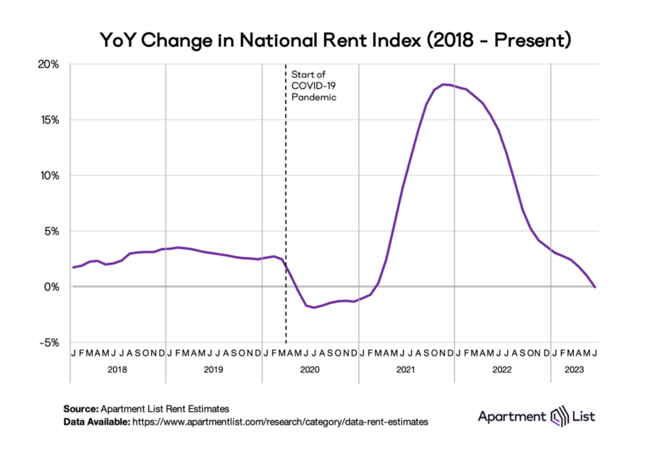
National rent growth was flat year-over-year meaning apartments are renting for the same price as they did a year ago on average, Apartment List says in its July rent report.

“This marks a major shift from the recent past, when annual rent growth topped out at nearly 18 percent nationally and over 40 percent in a handful of popular cities,” Apartment List economists write in the report.

Rent growth in 2023 has come in at a much slower pace than previous years thanks to a combination of sluggish demand and increasing supply.

While the average rents are flat year-over-year, rents did increase in June in 73 of the nation’s 100 largest cities, but thanks to sluggish rent growth this year, prices are down year-over-year in 57 of these 100 cities.

Vacancy rate remains elevated

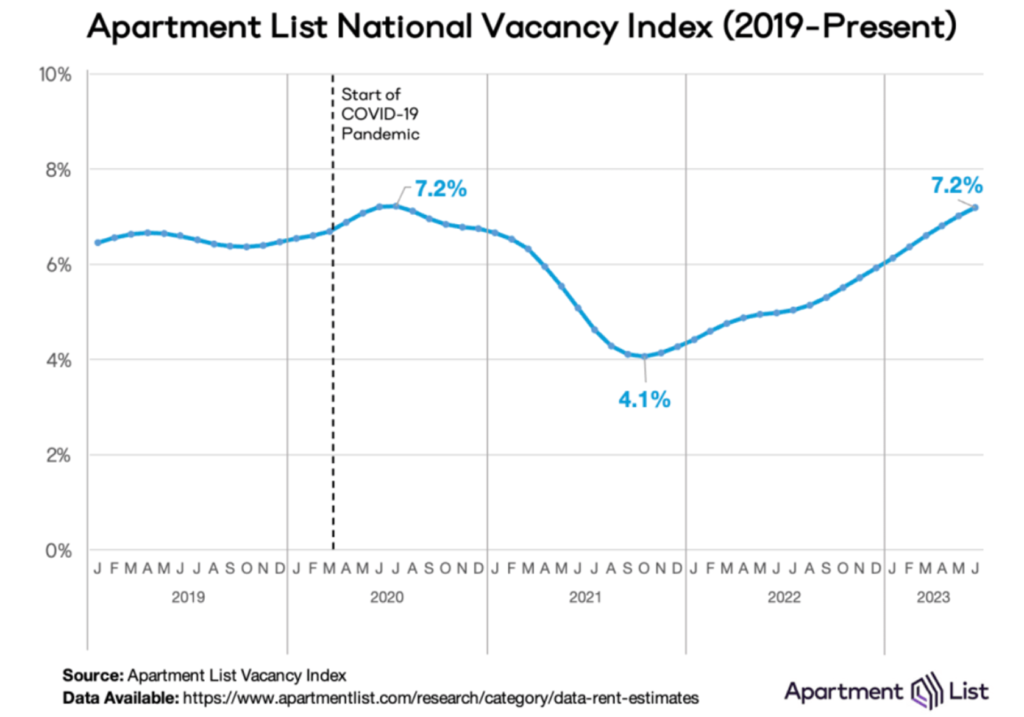
The supply side of the rental market also hit a major milestone this month: “Our vacancy index now stands at 7.2 percent, matching the peak vacancy rate that was measured at the height of the COVID-19 pandemic.”

With a record number of multi-family apartment units currently under construction, this vacancy rate will remain elevated and for the first time since the early stages of the pandemic and put pressure on property owners to find tenants, rather than the other way around.

National rent growth was flat year-over-year meaning apartments are renting for the same price as they did a year ago on average

Rental market slowdown in finally reflected in inflation numbers

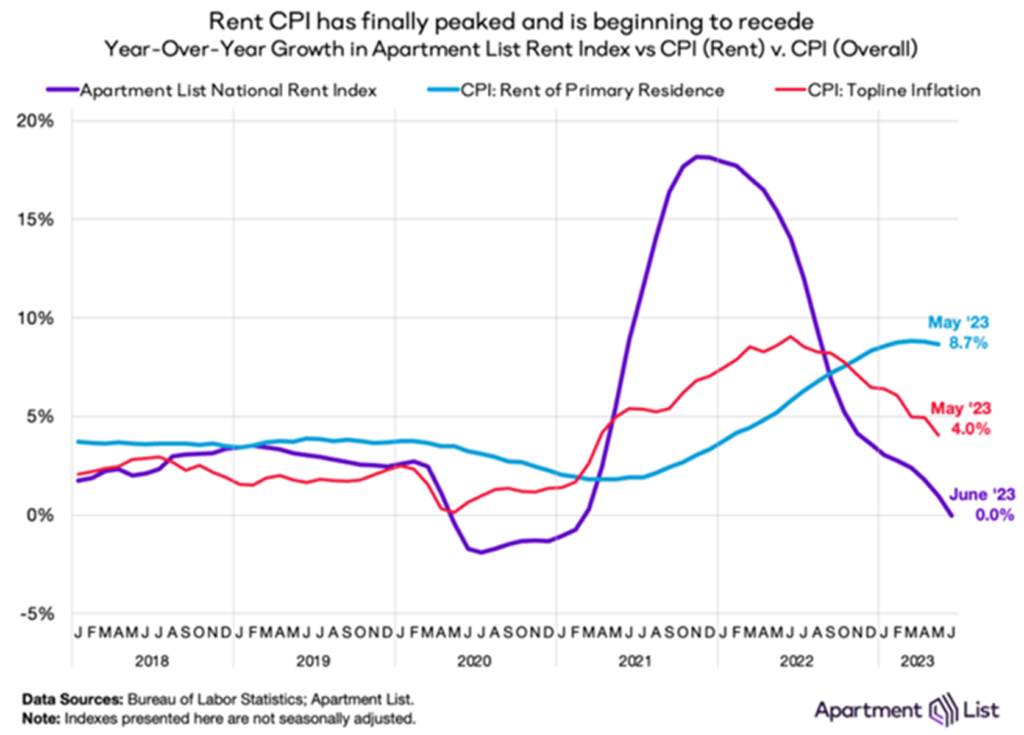
The rent component of the Consumer Price Index (CPI) has finally peaked as is beginning to recede.

“Our index shows that the rental market has been cooling rapidly for a year, but the CPI housing component has just recently hit its peak. Despite the CPI’s measure of housing inflation remaining elevated, topline inflation has already meaningfully cooled.

“As the CPI housing component now gradually begins to reflect the cooldown that we’ve long been reporting, it will help to further curb topline inflation in the months ahead,” Apartment List economists write.

National rent growth was flat year-over-year meaning apartments are renting for the same price as they did a year ago on average

Rent growth report conclusion

June’s 0.4 percent national rent increase represents a further deceleration of the rental market, indicating that the market remains sluggish throughout what should be the busy moving season.

“Year-over-year growth fell once again, this time reaching zero for the first time since early in the pandemic. Even if the end of this summer brings a resurgence in demand, a strong construction pipeline should temper rent growth for the remainder of the year,” Apartment List economists write.

Read the full report here.

Sign Up For Our Weekly Newsletter And Get Rental Property And Apartment News And Helpful, Useful Content Each Week.

* indicates required

Getting The Most Out Of Rental Property Tours

Renters want to see a rental property before making decisions and 30 percent want to see an online tour before contacting property management

Renters want to see a rental property before making any decisions and 30 percent want to see an online tour before contacting property management.

By Kevin Juhasz

Prospective residents will examine many aspects of a property as they research their next home, and what’s important will vary based on their lifestyle.

One thing is certain: Renters want to tour a property before making any decisions. Nearly 90 percent of all renters want to see a property before signing a lease, according to research by Rent.com/research, and 31 percent want the option of an online tour before they’ll even contact the property.

With the current economic landscape and new units coming onto the market, the balance of power is shifting toward renters. That means communities will need to compete for renters more than they have in the past few years.

Rental property tours are one of the most crucial tools required to outperform the competition and how they are handled could make or break whether a prospect decides to sign a lease.

Fast and Hassle-Free Rental Property Tour Scheduling is a Must

Renters might use a variety of sources to look at communities and will likely explore numerous locations.

They possess little brand loyalty; most search at least three rental websites, according to a Rent.com/research survey, and only 15 percent use a single app. After the initial search, many prospects will choose to lease at the first property they visited. This makes easy scheduling first and foremost among the necessary features of your tour framework.

While your leasing team will still receive calls about scheduling tours, a sizable segment of your prospects will opt to schedule a tour online.

This is particularly true among younger renters, who prefer renter journeys that complement their digital-centric lifestyles. It’s possible to use an internet listing service (ILS), the preferred method of apartment searching across all age groups, that incorporates tour scheduling for prospects and calendar management for onsite teams. This feature should also be easy to locate and use on a property’s website.

Your schedule should have plenty of options for scheduling tours as well. Younger renters lean heavily toward weekend opportunities, and the preference for weekday tours increases as the age of prospects increases, according to the study.

Morning and afternoon tours are the most requested, while lunchtime and evening options are generally less favorable.

Use Feature-Rich Online Tours to Peak Interest

Photos and descriptions are helpful, but they can’t compete with a 3D tour to give prospects a feel for their future home and the community.

Nearly one-third of prospects will take an online tour before they even contact a property, so offering a comprehensive overview of the community and a desirable resident experience is a perfect way to bring them to your property.

Tours must go beyond the unit in which prospects are interested, and most will want a complete look at the property, including all amenities, pet-centric offerings, green spaces, parking and more. Almost every portion of the property should be covered.

Potential renters will likely use Google Street View for a look at the exterior building, but they won’t stop there. Information gathering has reached new heights — literally. Google’s Aerial View provides visitors with an understanding of how a community is situated within a neighborhood and its proximity to grocery, retail, restaurants, entertainment establishments, parks, transit and any other items that might pertain to their lifestyles.

Other Important Rental Property Tour Factors

In-person tours are regaining appeal to many prospects, but a significant segment still prefers self-guided tours. This type of tour requires more upfront planning and a property needs a way to provide access to a unit.

Quality tours are an amazing way to augment future retention efforts, build trust and enhance online reputation. Providing as much insight as possible in virtual tours enables prospects to formulate the necessary questions to ask during an in-person tour and confirm that the community is right for them. Knowing they’ve made the best choice will reflect well in reviews and help to keep residents beyond their initial lease. It also lets future renters know that you’re open to sharing all possible information and that level of openness will build trust that could mean the difference in a lease-signing.

Offering a property that will appeal to renters is important, but nobody will know what your community has to offer unless a solid rental property tour structure is in place.

With the competition for prospects increasing and the number of people who rely on ILSs and digital means to study a property and schedule, tours are an area that nobody in multifamily can overlook or approach lightly.

About the author:

Kevin Juhasz is a content manager for LinnellTaylor Marketing and a writer, editor, and storyteller.

Sign Up For Our Weekly Newsletter And Get Rental Property And Apartment News And Helpful, Useful Content Each Week.

* indicates required

Revamping Multifamily Pet Waste Management Efforts

Everything Landlords Should Know About Emotional Support Animals

How Pet Poop DNA Testing Fixes Your Apartment Poop Problem

Top Considerations for Multifamily Training and Compliance

Multifamily training and compliance are top considerations as many new recruits venture from industries outside of property management

Multifamily training and compliance are top considerations as many new recruits venture from industries outside of property management and require more specialized and focused onboarding and training.

By Greg Lozinak

Multifamily is facing a hiring challenge significantly greater than in past decades.

The unemployment rate has hovered around the 3.5 percent since February 2022, making it more difficult for owner/operators to attract top talent to their communities. Companies of all sizes and in every market are continuously recruiting and onboarding new associates, hoping not only to attract them but also retain them.

Many new recruits venture from industries outside of property management and require more specialized and focused onboarding and training. To execute their programs efficiently, operators are clamoring to find a blend of technology and standard training to prepare their team members and retain them. To be successful, organizations must deliver the new onboarding processes and tech integrations seamlessly and add clarity to job roles and functions.

The real estate industry has always been people-centric.

Hiring and retaining talent is integral in growing tomorrow’s leaders and innovators in the space. Well-founded and purposeful training, in combination with today’s proptech and digital landscape, can be the ultimate catalyst for pushing our industry forward. These tools can help teams and management continue to engage and elevate the resident experience.

Create Solid Onboarding Right from Start

Starting off on the right foot is essential for a successful training program.

If your new team members have poor onboarding, this could create deficits in performance and future learning. Onboarding helps to establish your company’s goals, values and expectations, as well as provide insight into the distinctiveness of your organization. Entering a new position or joining a new company can be stressful and onboarding provides an opportunity to connect with new team members, make their transitions easier and reduce turnover risk.

Tailor Training for Your Organization’s Needs

Your company is unique, as are your teams, so a “one size fits all” approach to your training won’t work.

Tailoring your training better facilitates training materials and is more likely to keep team members engaged. A variety of methods can be used when designing training, including hands-on, virtual, individual and team-based. What’s important is crafting a program for your teams that provides a more effective outcome.

Communicating with each of them will provide insight into their preferences, and it’s important to solicit feedback after training to understand if it’s functioning to design.

View Training as a Strategic Company Investment

Training your teams well will cost money, but it doesn’t compare to how much you’ll spend recruiting and training a revolving door of team members.

The average cost to replace an employee is $4,700, according to data collected by the Society for Human Resource Management. This figure, however, does not include all the costs your HR department and leaders bear in finding replacements. This is time that could be spent training current teams or working toward the company’s goals. These real costs can soar into the tens of thousands.

Team members with high levels of engagement are five times more likely to be working at the same company in a year, according to data from the Grace Hill Kingsley Index, which can result in extensive cost savings. View your training program as an investment in your financial health, as well as your personnel.

Focus on Making Content Digestible and Retainable

Your teams have busy schedules including interacting with residents, strengthening their communities and growing net operating income.

The days of gathering your teams into the conference room for an afternoon of training are long gone.

Training should fit within the demands of your team members’ day. If you want your teams to be well-educated, the optimal approach is microlearning, which breaks training into small, highly-focused pieces of content.

Each team member will have an opportunity to apply their newfound knowledge in a real-world setting while it’s still fresh in their minds. They’ll also digest the information in a more beneficial way, and they won’t be stressed about how their training schedule will fit in with the rest of their work schedule.

Make it Easy to Access

Even if you’ve built the perfect training programs for your leasing and maintenance teams, it’s going to go to waste if they can’t use it.

Teams will be less engaged with training if they struggle to find training material, so it’s important to keep your files in a centralized location that’s easily accessible. Companies also shouldn’t restrict the devices that can be utilized during training. A digital platform makes training easy to complete at any time and on any device.

Your team members are seeking a prosperous career with opportunities for growth and advancement when they join your company. If your training doesn’t provide that, they most assuredly will move on.

Communication, feedback, support and mentoring are the key factors to grow your company and avoid the unwanted costs associated with the revolving door. Creating a solid training program that meets their desire to learn, as well as fits with their work lives, will encourage your team members to stay, providing you with a better return on the investment you made in them.

About the author:

Multifamily training and compliance are top considerations as many new recruits venture from industries outside of property management

Greg Lozinak is the SVP of Account Management at Grace Hill, joining the team in 2023. Having spent most of his career as a senior operations executive, Greg has a strong track record in commercial and multifamily real estate investment management, delivering above-benchmark investment returns.

Sign Up For Our Weekly Newsletter And Get Rental Property And Apartment News And Helpful, Useful Content Each Week.

* indicates required

June Shows Unusual Softening Of Rent Prices

June is usually a busy time for rental moves, but this June is showing a surprise as June demand typically leads to a rise in rent prices.

June is usually a busy time for rental moves, but this June is showing a bit of a surprise as June demand typically leads to a rise in rent prices.

Usually prices rise in tandem with this increased demand.  But not this June. Zumper reports, “Prices are softening across much of the country—an unexpected development given the seasonal trends we outlined in last month’s report.”

“This deceleration is, generally, good news for renters, but it does come with caveats,” Zumper CEO Anthemos Georgiades said in a release.

“Many cities are still stabilizing after long periods of sharp increases during the pandemic’s Great Migration, and though rents are softening they’re still at record highs in many markets.”

Notable trends

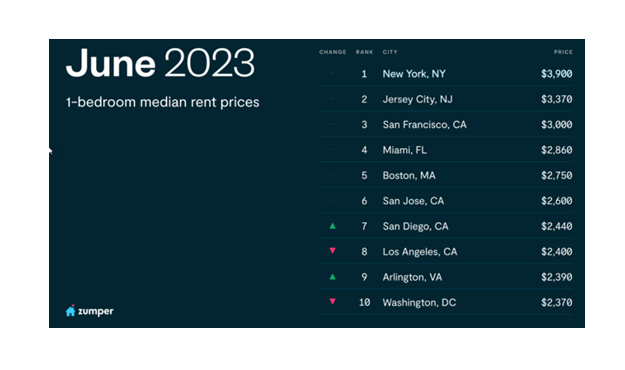
  1. At $1,504, Zumper’s National Index for one-bedrooms is flat over last month. The two-bedroom median is $1,891, an increase of just 0.3 percent. At 5.8 percent, the year-over-year increase in national one-bedroom rent is the smallest gain in nearly two years.
  2. Yet, renters in cities like New York and Jersey City are facing historic highs that show no sign of slowing down.
  3. San Diego’s median one-bedroom rent of $2,440 puts it slightly ahead of Los Angeles; prices in those two cities have been in close competition since early 2021.

“Of our top 100 cities, 46 are down over last month, 12 are flat and 42 are up month-over-month,” Zumper says in the release.

Here is some of what is going on:

  • Record numbers of new rentals are coming online in many markets.
  • In May, construction starts of multifamily units reachedthe highest rate since 1986.
  • However, high interest rates and a risk-averse investment climate may soften that building boom.
  • Billing at architecture firms specializing in multifamily projects is at its lowest level in two years.

Read the full report from Zumper here.

Sign Up For Our Weekly Newsletter And Get Rental Property And Apartment News And Helpful, Useful Content Each Week.

* indicates required