Home Blog Page 51

Where Was The Hottest Rental Market In 2023?

RentCafe took a look at the hottest rental markets in 2023 and while the Midwest has been getting more competitive, there was a clear winner

RentCafe took a look back at the hottest rental markets in 2023 and while the Midwest has been getting more competitive, there was a clear winner, according to a report.

Miami was the hottest rental market in the U.S. in 2023

“Fueled once again by sky-high occupancy and lease renewal rates amid a veritable building frenzy. Despite thousands upon thousands of new apartments being added to the market throughout the last few years, the metro continues to welcome new residents seeking better job opportunities and a tax-free lifestyle.

“Likewise, many wealthy domestic buyers purchased condos for themselves rather than renting them out, which only dwindled the number of apartments available for prospective renters this year.

“Although the number of apartments for rent in Miami has grown by a healthy 3.7% since January, the newly built units were still not enough to meet the demand for rentals this year. On top of that, 71.2% of renters choose to stay put, meaning apartment seekers had a very hard time securing an available unit in 2023. That’s why there were 22 applicants fighting for each vacant rental (more than double the national average), with apartments being taken off the market quickly, often within one month,” the report says

The Midwest was the most competitive region for renting in 2023

“Three Midwest markets making the top five nationwide. While most of the U.S. shows signs of softening in rental competitiveness, Midwestern markets are bucking the trend.

“Specifically, the region’s lower cost of living, ample living spaces that bode well with remote work, and almost instant access to the great outdoors are attracting more and more renters.

“In fact, the Midwest is experiencing an economic revival, fueled in part by the Rise of the Rest fund that aims to boost entrepreneurship and innovation outside of the coastal hubs. To that end, America’s heartland has seen thousands of startups emerging in recent years, showing its both potential and vitality,” the report says.

RentCafe took a look at the hottest rental markets in 2023 and while the Midwest has been getting more competitive, there was a clear winner

Read the full RentCafe report here.

Sign Up For Our Weekly Newsletter And Get Rental Property And Apartment News And Helpful, Useful Content Each Week.

* indicates required

Do I Have to Paint and Replace Flooring for a Long-Term Tenant?

Do I Have to Paint and Replace Flooring for a Long-Term Tenant?

When do rental property managers have an obligation to do upgrades for long-term tenants, such as replace flooring or painting, is the question this week for Ask Landlord Hank. Hank is not an attorney and is not offering legal advice. Please fill out the form below to ask him a question.

Dear Landlord Hank,

I have had a good tenant for more than 10 years. Is my responsibility to replace flooring and painting while he is living there?

-Sharon

Dear Landlady Sharon,

I would check the laws in your area to see if this is addressed?

The Department of Housing and Urban development guidelines are that carpeting should be replaced after 7 years. A paint job usually lasts 3 to 5 years.

I typically paint between tenants, and that is when flooring is dealt with as well.

It’s easier to work in an empty unit than one where furniture would need to be moved.

Replace flooring

I have replaced carpeting for a good tenant, during a lease.

We agreed that tenant would be responsible for moving all furniture so the job could be done and the tenant would pay for any delays or increased costs, if furniture was not moved as required.

So to answer your question, I don’t know if the law in your area requires flooring or painting while a tenant is still living in the unit, but if the carpet is in need of replacement, I would definitely consider this to keep such a good, long-term tenant.

Sincerely,

Hank Rossi

Ask Landlord Hank: Do I Have to Paint and Replace Flooring for a Long-Term Tenant?
Landlord Hank Rossi

Ask Landlord Hank Your Question

Ask veteran landlord and property manager Hank Rossi your questions from tenant screening to leases to pets and more! He provides answers each week to landlords.

  • This field is for validation purposes and should be left unchanged.

Sign Up For Our Newsletter And Get Rental Housing And Apartment News And Helpful, Useful Content Each Week.

* indicates required

A Tenant Poured Grease Down Drain Who Is Responsible?

Can I Enter My Rental If Tenant Moves Out Early But Lease Is Still In Place?

Who’s Responsible For Smoke Detector Batteries In Rentals?

Prioritizing Effective Fair Housing Education in Property Management

Fair housing education goes beyond mere compliance. It represents an investment in your company’s future and property management education

Fair housing education in property management goes beyond mere compliance. It represents an investment in your company’s future.

By The Fair Housing Institute

As we approach the new year, it is crucial for professionals in the property management industry to recognize the vital importance of fair housing education.

A well-rounded understanding of fair housing laws and practices is not just a best practice but a fundamental aspect of professional development that can significantly affect the success and integrity of your business.

Understanding the Essence of Fair Housing Training

Fair housing education goes beyond mere compliance. It represents an investment in your company’s future. Thorough training ensures that every team member is equipped with the knowledge to navigate complex situations, uphold the law, and provide exemplary service to prospects and residents from diverse backgrounds.

The Importance of Comprehensive Training

Superficial or incomplete training methods may seem sufficient in the short term, but they fail to impart the deep understanding necessary to handle real-world scenarios effectively. Effective fair housing training involves more than just taking a quick free course or watching a few basic videos.

A comprehensive training program includes detailed courses, engaging content, and practical assessments that ensure retention and understanding. It should encompass a range of learning methods, including interactive sessions, case studies, and regular updates on new laws and best practices. This holistic approach ensures that employees not only learn but also internalize the principles of fair housing.

Identifying Areas for Improvement

Regular evaluations of your training program are essential. If employees are making mistakes or showing a lack of understanding, it could indicate the need for a more robust or engaging educational approach.

Another common misconception is that once trained, always trained. As we all know, fair housing can be very complicated to navigate. Add to that the fact that emerging court cases can create new precedents or even complete changes in the law, resulting in adjustments to understanding. As a result, more and more companies are shifting to annual training. The benefits of this are easily identifiable. Having a property management team that is fully and annually trained reduces the risks of a costly fair housing complaint, some of which can cost into the millions of dollars.

The Cost of Not Training

The cost of defending a fair housing complaint can vary significantly based on the specifics of each case. Defending against a fair housing complaint can involve significant legal fees and compensatory damages for the plaintiff, along with civil penalties.

Beyond monetary penalties, there can be other costs, such as the impact on a company’s or landlord’s reputation, as HUD keeps a public record of all charges filed through it. This can affect future resident relations and business operations.

Commitment to Continuous Learning

The dynamic nature of fair housing laws and the diverse challenges faced in property management require a commitment to continuous learning. As we embark on a new year, it’s the perfect time to assess, update, and improve your fair housing training programs. This will not only protect your company from potential legal issues but also foster a culture of respect, inclusion, and excellence in service.

About the author:

In 2005, The Fair Housing Institute was founded as a company with one goal: to provide educational and entertaining fair-housing compliance training at an affordable price at the click of a button.
  

A Passion For Helping Tenants With Poor Credit Get Apartments And Homes

Bubba Grimsley founded his rent guarantee company because he had a passion to help people and tenants with poor credit get into apartments and homes, while guaranteeing the landlords and property managers get a good tenant. Above, Bubba Grimsley founder of Liberty Rent Guarantee

In a recent interview with Rental Housing Journal, Bubba Grimsley who has been a trial lawyer for 20 years, talked about how and why he got started in the business with Liberty Rent Guarantee and how it continues to expand to help both tenants and property managers.

By John Triplett

“During the housing crisis in 2007, I got mixed up with a crowd of trial lawyers that were all fighting to defend people who had been in bad foreclosures. From all the evidence in all of our cases we were finding that these people weren’t legitimately being foreclosed on. There’s a point, you can probably find it on the internet, where I was interviewed on MSNBC about the legal work that we were doing.

“We ended up doing a lot of work out in Las Vegas representing the State of Nevada in the housing crisis. There were just thousands of bad foreclosures where people couldn’t understand why they were being foreclosed on or why their house was being taken away.

“What you quickly find out when you deal with people in a foreclosure is that the foreclosure happens first and then typically there’s a deficiency judgment that’s filed and a lawsuit against the person who just lost their house. That’s basically a large debt. Then that typically is followed by bankruptcy by the person who was foreclosed on.

“All of that tends to destroy someone’s credit and then the next question is, once they move out of their home, where do we go now?”

After foreclosure and bankruptcy: How to find housing

“What happens in the rental world is the first thing that you find out when you walk into an apartment community and say, ‘I want to rent a house,’ or ‘I want to rent an apartment,’ is ‘Please fill out this application. We’re going to take a look at your credit.’

“When they see a foreclosure or a bankruptcy or a giant deficiency judgment against someone, that’s a giant red flag that says ‘don’t rent to this person.’

“That was the biggest crisis we were dealing with in Nevada, besides the fact that our customers, our clients were losing their homes. Their next question is, ‘Where do I go? I’ve got two kids. I’ve got a wife. My kids are in school here. We all work. We still have a job. We can’t find a place to live.’ ”

A start-up business and a failure

“We started with this idea and we kicked it off in Nevada about 2010. We made a good hard run at it for about 18 months but the company failed.  I was just an investor back then.  We just went at it the wrong way,” he said.

Early in 2014, Grimsley and two colleagues started talking about the failed start up and decided to try it again with a different approach to rent guarantee.

“We launched Liberty Rent Guarantee with a different approach and found the right recipe. We’re in our fourth year now. We’ve had 300 percent growth per year since we started the company.  We have zero debt. We’ve had a lot of success and we continue to grow in leaps and bounds. We’ve got thousands of families that we’ve helped find a place to live even though they have less-than-perfect credit.”

How does rent guarantee work for tenants with poor credit and property manager?

Typically this type of tenant shows up on paper first as a problem when the tenant screening report comes back.

“The credit reporting agencies, Equifax and Experian and TransUnion all love to preach about the ill effects of bad credit and what a giant risk it is,” he said.

But his company has “taken a good, hard look. We’ve studied the patterns. We have a risk profile that we think we understand risk a little bit more than people who just look at a rating in credit reports.

“What we like to say in our business is that you’re not just a number on a FICO score.

“What it means is that property owners who obviously have a vested interest in whether or not the contract performs, can keep their standards high as far as their credit screening goes. Then, if they find somebody who comes in who needs a place to live and doesn’t pass a credit screening, they can still put that tenant in if we underwrite them with a co-signing guarantee.

“They don’t have to bear the burden of that risk. That burden is now on us. If the tenant fails anytime during the contract, then we’ll make the property whole a maximum of six months or until they turn the unit. Most properties are going to turn the unit in less than six months,” he said.

Bubba Grimsley and why he started a rent guarantee company for tenants and property managers

Johnny Mims, Bubba Grimsley and Sharp Gillespy company partners.

How does rent guarantee work with a typical lease?

“We send a co-sign attachment that gets added to the lease,” Grimsley said.

“It’s just like an addendum to any contract and it’s a limited agreement that says we’re going to stand here as the co-signer. It is just like you would do if you co-signed for your child who’s buying their first car.

“We’re going to step in and be a co-signer on this lease and if they default, if they skip, or if you have to evict them, any time during the contract, then we’ll step up and pay the rent for a maximum of six months or until you turn the unit, whichever is less.

“We don’t get involved in the deposit, just the rent. Our experience has been that our tenants that have problems and default typically are not a problem tenant that’s going to go in and destroy the place or cause a lot of problems for the apartment community. Typically, they just fail for the standard reasons that you would expect. They move out and the property has to turn the unit and we make them whole on the rent until they do.

“We can’t fix criminal and we don’t get involved in criminal. Most all properties these days that we deal with screen for criminal on the front end and if a tenant fails because they’ve got a felony conviction or a drug conviction or a sex conviction, we can’t help you. That’s not what we do. That’s not our business plan,” he said.

How many customers do you have?

The company does business with more than 100 property management companies.

“The companies vary in size from the single-property owner who has one apartment complex with 150 doors on up. “We do a little bit of business with Greystar in Tennessee. Stonemark in Atlanta is a big customer of ours. They have 44 properties. We do business with Lincoln. We do business with SPM and SMP. We just have a lot of the larger, or I guess, medium sized management companies. Throughout the Southeast is primarily where our footprint is.”

In terms of customers, individual customers, “we’ve done a couple thousand. We’re now to the point where we’re doing a couple of thousand contracts a year.”

Liberty charges one month’s rent in order to co-sign a lease.

“We also charge a one-time application fee of $35, but that is AFTER the potential resident has gone through our “DO I QUALIFY” test, which is on our website and is free of charge,” he said. “The results of the test is revealed to the tenant in a score 0-100 percent chance that we will approve and co-sign their lease.   We forward an application to every applicant with better than an 80% chance,” he said.

How long does the rent guarantee last?

That’s really a question for the property manager.

“The way we work it is that we guarantee the one-year lease and then when the lease expires, that’s the end of our contract agreement with the property.

“Our experience has been if we move a tenant in and we guarantee the lease, and the tenant performs per the contract without any hiccups and they want to stay, typically the property’s more than happy to renew their lease for another year without our guarantee.

“Conversely, obviously if the tenant fails and we have to pay the guarantee, then we don’t guarantee them a second time and the property isn’t interested in renewing their lease,” he said.

Additional help for the tenant to repair credit

“Let me just add we do have tenants who kind of fall in between those two categories of a failure and perfection.

“To help those middle-of-the-road tenants we have a strategic partnership with GreenPath Financial Wellness , a non-profit company based in Detroit.  GreenPath is about a 60-year-old charity that was founded by all the credit unions in the Detroit area. What they were finding 60 years ago was that the typical automobile factory worker didn’t have a whole lot of financial literacy. The credit unions put together this organization to kind of teach financial literacy.

“What we’ve done is we’ve partnered with GreenPath and we’ve made a large contribution to GreenPath. We now have the ability for any tenant who we do business with to connect with GreenPath. The tenant can access all of GreenPath’s financial literacy educational tools. GreenPath has an Apple iPhone app that will help you with your budgeting process. Figure out where your money’s going. They also have 24-hour, seven-day-a-week crisis managers so if you do get into a financial pickle, you can call somebody who can help you work it out and figure it out.

“For those folks who fall in between perfection and abject failure, they can get on the phone with GreenPath as a resource that we provide to teach financial literacy and help our clients get to a place in their life where they don’t need us any longer.

Summary: 3 Questions on how this helps property managers

The company helps tenants with poor credit, but how does this help property managers who need to rent apartments?

No. 1 – How can property managers help tenants with weak credit into properties with less worry about payment?

“They can refer a potential resident with “less than perfect credit” to Liberty Rent Guarantee.  It’s as easy as putting them on the website at www.Libertyrent.com and having them click the “DO I QUALIFY” button.   If the company approves the resident, they will guarantee or co-sign the lease and if they default, skip or get evicted anytime during the lease, the company will make the property whole on lost rents.   Some restrictions apply.”

No. 2 – How does this help with occupancy for property managers?

“Properties today are spending a fortune on marketing to get a potential resident just to walk into the door.   It is discouraging to have to turn folks away for not achieving the screening level that the property demands.    Liberty can turn most of those turn-downs into residents, and with great results.    Our contract gives the property the ability to fill the unit today, rather than leave it vacant waiting for a more qualified tenant, without the down side risk of a potential default.”

No. 3 – What happens when tenants don’t pay the rent even though Liberty guaranteed it?

“If a resident breaches their contract with the property, the property just needs to take affirmative steps to evict the tenant.   Once the property is “rent ready” or back on the market “for rent” Liberty will make the property whole on all lost rents from the guaranteed resident.   Liberty will make a property whole until the unit is rented, or six months, whichever comes first.”

Liberty Rent Guarantee Partners With GreenPath Financial Wellness

About Liberty Rent Guarantee:

Liberty Rent Guarantee helps property owners fill units without risk of default, while simultaneously helping consumers find a good home and re-build their credit. Operating nationwide, Liberty Rent Guarantee has helped secure homes for thousands of families by serving as a limited co-signer on every lease it agrees to guarantee. To learn how it works, please visit www.libertyrent.com

About GreenPath Financial Wellness:

GreenPath Financial Wellness is a Michigan-based 501c3 with a 50-year history of teaching financial literacy to consumers. It offers live, certified financial analysts who can help tenants during times of financial crisis. Last year, GreenPath helped more than 200,000 people in all 50 states.  The company delivers licensed services throughout the United States over the Internet and telephone.  They also offer in-person services at about 60 branch offices in 16 states, including Michigan, New York, New Hampshire, Colorado, Florida, Texas, Illinois, Indiana, Wisconsin, Nebraska, Georgia, Ohio, Tennessee, Arizona and Wyoming.

Sign Up For Our Weekly Newsletter And Get Rental Property And Apartment News And Helpful, Useful Content Each Week.

* indicates required

Rent Slowdowns Continue into 4th Month

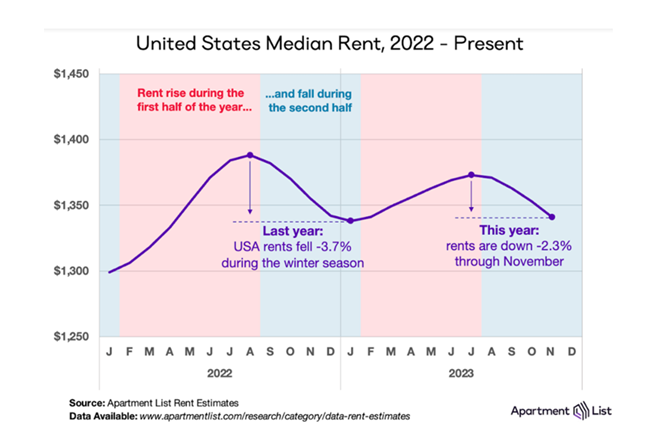
The seasonal slowdown in rents continued last month with the nationwide median rent falling 0.9 percent to $1,340, Apartment List says

The seasonal slowdown in rents continued last month with the nationwide median rent falling 0.9 percent to $1,340, Apartment List says in their December report.

The report says this is the fourth month of rent declines.

Seasonality, the low apartment demand during the winter holiday season, will likely continue to push rents down for another month or two. This year, the slow season started a month earlier than usual, with a slight 0.1 percent rent drop in August. Monthly declines have gotten progressively steeper in the months since, with rents falling by 0.6 percent in September, 0.8 percent in October, and now 0.9 percent in November.

“Year-over-year rent growth has bottomed out but remains in negative territory at -1.1 percent, meaning that on average, apartments across the country are slightly cheaper today than they were one year ago. This stands in sharp contrast to the prevailing conditions of 2021 and 2022, when rent prices were surging and year-over-year growth peaked at 18 percent nationally. But despite this cooldown, the national median rent is still nearly $250 per month higher than it was just three years ago,” the report says.

New construction produces an abundance of vacant units

With the construction pipeline of new apartments still near record levels, “we expect that there will continue to be an abundance of vacant units on the market in the year ahead,” the report says.

Regionally, rents fell in October in 89 of the nation’s 100 largest cities, and prices are down year-over-year in 68 of these 100 cities.

The sharpest rent declines over the past year are concentrated in California markets like Oakland, San Francisco, and Long Beach, where apartment demand remains sluggish.

Apartment vacancies are back above pre-pandemic levels

“Our national vacancy index has been easing steadily for two full years. Today the index stands at 6.4 percent, representing a return to pre-pandemic levels. This easing has plateaued in recent months, but we don’t expect it to tighten again anytime soon,” the report says.

Despite a recent slowdown in new building permits being issued, the number of multifamily units under construction remains near record levels. The report also says that vacancy trends can be highly localized.

Conclusion

November’s 0.9 percent rent decline puts us squarely in the rental market’s slow season, and keeps year-over-year rent growth in the negative at -1.1 percent. Monthly rent declines are expected to persist through the remainder of the year, consistent with the market’s typical seasonality.

“Looking further ahead, a robust construction pipeline should drive strong supply growth in the year ahead. On the other hand, the extent to which demand rebounds or remains sluggish will likely depend on broader macroeconomic conditions,” the report says.

Sign Up For Our Weekly Newsletter And Get Rental Property And Apartment News And Helpful, Useful Content Each Week.

* indicates required

Landlords Offering More Rent Concessions than in 2022

Free rent and parking are examples of concessions that more landlords are offering in some markets to attract tenants, according to Zillow.

Free rent and parking are examples of rent concessions that more landlords are offering in some markets to attract tenants, according to Zillow.

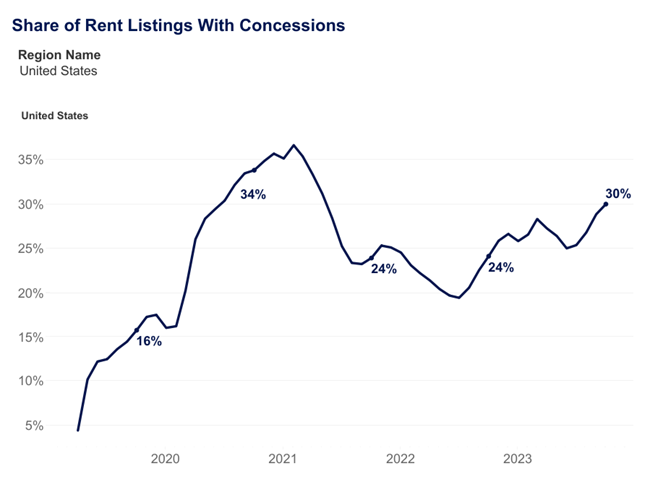
More of the site’s rental listings are featuring some sort of concession compared to last year, the company says, adding that about 30% of rentals on Zillow offer at least one concession, up from 24% last year.

In most cases landlords are not lowering the rental prices, just offering the rent concessions.

Where are apartment hunters getting the most sweeteners?

Rental concessions are more common than a year ago in 43 of the 50 biggest U.S. metro areas. Salt Lake City (54%), San Jose (51%) and Washington, D.C. (50%) all had half or more of the listings in their markets offering at least one concession on Zillow, followed by Charlotte (48%) and Minneapolis (47%).

Cities where renters will find the fewest concessions are New Orleans (9%), Providence (14%), Miami (14%) and New York (15%).

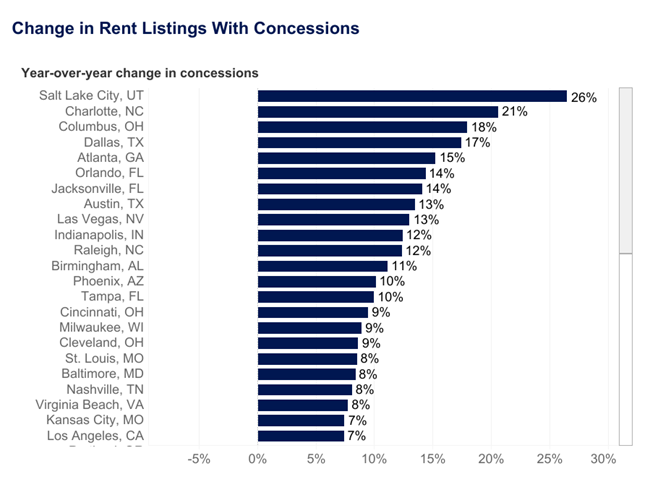
Markets where concessions have risen the most since last year — meaning the market is now friendlier for renters — are Salt Lake City, where the share of listings featuring a concession rose 26 percentage points, followed by Charlotte (+21 percentage points), Columbus (+18), Dallas (+17) and Atlanta (+15).

Renters are less likely than they were a year ago to find a rental listing on Zillow offering a deal in only a handful of markets. Richmond leads the way, where the share of listings offering a concession dropped by five percentage points from last year, followed by Louisville (-4 percentage points), Providence (-4), Sacramento (-2), Washington, D.C. (-1) and Hartford (-1).

Markets With Most Construction Have Rent Incentives

Zillow says markets experiencing a construction boom are more likely to have seen an upswing in concessions. According to Fannie Mae’s mid-2023 multifamily construction update, markets such as Washington D.C, Dallas, and Austin are seeing more new developments, with Dallas and Austin having 74,000 and 66,000 new units either recently completed or underway, respectively.

Zillow’s data reveals a similar rise in concessions in those metros and others, including Phoenix and Atlanta, which are also among the top markets for new multifamily construction. This correlation highlights how the influx of new apartments is compelling housing providers to offer incentives to attract renters.

Free rent and parking are examples of concessions that more landlords are offering in some markets to attract tenants, according to Zillow.

Read the full article here.

6 Ways To Deal With The Danger From Mold And Mildew

Here are 6 ways to both prevent mold and mildew and how to clean it if you find mold and mildew in your rental.

Here are 6 ways to both prevent mold and mildew and how to clean it if you find mold and mildew in your rental.

By Eli Secor

When it comes to property cleanliness, mildew and mold can cause hazardous health and living conditions. It can also lead to costly repairs and may even make the unit uninhabitable and leave you with the bill to provide alternate housing.

Here are a few ways to avoid mildew and mold, as well as what to do if it already exists in your unit and ways to clean mold and mildew.

No. 1 – Take care of ventilation in the building

  • Install bathroom and kitchen fans and remind tenants to use them regularly
    • Open the windows if not using the fans
  • Install moisture-detecting switches
    • Moisture-detecting switches will turn fans on when moisture levels become elevated
  • Use dehumidifiers and air conditioners to reduce moisture in the air.

No. 2 – Be proactive in preventing leaks

  • Replace water heaters according to the manufacturer’s instructions
  • Use a draining pan that drains outside
  • Install leak detectors under sinks to alert you of any leaks

No. 3 – Include clauses regarding mildew and mold in the lease

  • Have tenants sign a form stating that it is their responsibility to address mildew and mold problems and notify the landlord
  • Ensure that tenants are reporting water leaks so they can be fixed in a timely manner
  • Essentially, the responsibility is on the tenant to not allow moisture issues to happen in their unit. Having the right forms that are up to date is really important no matter where you get them.

No. 4 -Cleaning mold and mildew

  • If you decide to hire a contractor to clean up, be sure that they have the proper experience and knowledge.
  • Check their references and ensure that they are following the United States Environmental Protection Agency’s “Mold Remediation in Schools and Commercial Buildings Guide.”

No. 5 – Cleaning

No. 6 – Know when to contact a professional

  • If you believe that there is a bigger issue dealing with water and/or plumbing, be sure to contact a professional.

Mildew and Mold: Takeaways

Mildew and mold can do serious damage, especially when not taken care of right away. Therefore, be proactive.

Make sure that you prevent mildew and mold from occurring in the first place. Avoid leaks by replacing equipment when needed and install moisture detectors where you can; ensure that the unit has proper ventilation.

Lastly, if you are unsure of what to do or believe that there is a serious problem, contact a professional.

About the author:

Eli Secor started LandlordGurus.com with long-time friend and fellow landlord Chris Lee. After many a discussion about how to manage various tricky rental property issues, they decided to share their experiences and expertise with other independent landlords.  Along the way they are finding new answers and new tools, which they also share.

Should The Power Be On In a Vacant Rental?

Should you leave the power or the hot water on in a vacant rental is the question this week for Ask Landlord Hank. 

Should you leave the power on in a vacant rental is the question this week for Ask Landlord Hank. Remember Hank is not an attorney and is not offering legal advice. If you have a question for him please fill out his form below.

Dear Landlord Hank,

My rental does not have power or hot water at the moment. Should I set those utilities up for showings, and then cancel or close the accounts before tenants move in?

–Tina

Hi, Landlady Tina,

I would definitely have the power on so that your place shows as well as possible and looks homey, bright and cheerful, and that the indoor temperature is comfortable.

When I show a property to a prospective tenant, I make sure all the lights are on, etc. The water needs to be on too, in case someone needs to use the restroom, but hot water should be turned off at breaker panel – there’s no need to pay to heat the water when no one is using it.

Make sure your lease indicates that the tenant is responsible for the power and that you receive verification that that power has been transferred into the tenant’s name on the first day of the new lease.

You can get in trouble if you turn off the power after someone has moved in.

Sincerely,

Hank Rossi

Each week I answer questions from landlords and property managers across the country in my “Dear Landlord Hank” blog in the digital magazine Rental Housing Journal.    https://rentalhousingjournal.com/asklandlordhank/

Rent Sarasota
Owner/Broker
1000 East Avenue N.
Sarasota, Fl 34237
DIRECT  941-374-0675
Office  941-328-8999
Fax     941-538-7212
Should you leave the power or the hot water on in a vacant rental is the question this week for Ask Landlord Hank. 
Landlord Hank says, “The water needs to be on too, in case someone needs to use the restroom, but hot water should be turned off at breaker panel.”

Ask Landlord Hank Your Question

Ask veteran landlord and property manager Hank Rossi your questions from tenant screening to leases to pets and more! He provides answers each week to landlords.

  • This field is for validation purposes and should be left unchanged.

Do I Have to Paint and Replace Flooring for a Long-Term Tenant?

A Tenant Poured Grease Down Drain Who Is Responsible?

Sign Up For Our Newsletter And Get Rental Housing And Apartment News And Helpful, Useful Content Each Week.

* indicates required

One Of Your Tenants Smells Gas Leak? Here’s What To Do

One Of Your Tenants Smells Gas Leak? Here’s What To Do

A gas leak at your property is an emergency that requires immediate attention and action. This article will focus on what you or your tenants should do if they suspect a gas leak.

By Phil Schaller

Luckily it’s pretty easy to know if there’s a gas leak at the property. Gas companies inject a non-toxic odorant called mercaptan into the gas. This provides the rotten egg or sulfur smell to alert the resident that there’s a leak.

If you or your tenants smell gas, leave the property immediately. When you can no longer smell gas you should be safe – if you smell gas outdoors, leave that area as well. Keep your distance from the property until the issue has been resolved.

As you exit the property, leave the doors open if possible. This won’t stop the leak but it’ll allow some gas to escape and reduce the risk and potential damage to the property.

After you or the tenants are a safe distance away from the property and don’t smell any gas, call the fire department (911) and the gas company. They’ll be able to assist with shutting off the gas to the property.

Do not under any circumstances create a spark if you smell gas. Here are a few household items that can create a spark:

  • A telephone, or any mobile device that has a battery
  • Matches, a lighter, or another source of ignition
  • Electrical switches, including lights
  • Appliances
  • Car ignitions/spark plugs
  • Flashlights
  • Garage door

Once the gas has been shut off, it’s time to call in a pro to assess and repair the piping or appliance that caused the leak. Leaks are most likely caused by faulty appliances or because someone hits and/or ruptures a gas line. Your RentalRiff property specialist can help with this as can many HVAC companies.

Gas leak checklist for tenants

Here is a checklist you can provide tenants on what to do if they smell gas (often we’ll print cards with these instructions for our customers/tenants to put on the refrigerator):

  • If you smell rotten eggs or sulfur leave the property immediately.
  • Leave doors open as you exit the property.
  • Once you’re a safe distance away, call the fire department (911) and the gas company – they’ll be able to shut off the gas.
  • Call in a pro (either your RentalRiff property specialist or an HVAC company) to assess your gas pipes and make the necessary repairs.

Hope this quick guide is helpful and provides a baseline for what to do if there’s a gas leak. Any questions on this topic please feel free to reach out any time – your local gas company will also be a great resource.

Happy landlording!

About the author:

Phil Schaller is an experienced landlord and the founder/CEO of RentalRiff – an alternative service to traditional property management that provides ongoing oversight and upkeep of rental properties, while serving as the main point of contact for tenants. You can reach him at 541-600-3200. Maintenance and repair costs are included and property specialists are licensed/insured. Phil is a Pacific Northwest native, father of two, and fly-fishing addict.

Sign Up For Our Weekly Newsletter And Get Rental Property And Apartment News And Helpful, Useful Content Each Week.

* indicates required

Digital Leasing Requires a Precise Human Touch

Digital leasing still requires a human touch and it is essential to find ways to infuse the human element into virtual leasing.

Digital leasing still requires a human touch and it is essential to find ways to infuse the human element into virtual leasing.

By Kendall Pretzer

Digital leasing has revolutionized the way the real estate industry operates. Fading are the days of traditional leasing when prospects had to physically visit properties to see the apartment and make a decision. The entire process can be completed digitally, and prospects are taking advantage of these tools. Prospects will explore online and acquire extensive knowledge about a property before reaching out.

Leasing teams can shine in the digital leasing process by leveraging technology to enhance the customer experience.

From the initial inquiry to move-in day, there are countless opportunities to create a seamless and engaging journey for prospective renters. Prospects can tour apartments virtually, examine floor plans and sign a lease online without setting foot in a community until move-in day. While digital leasing offers many benefits, including convenience and flexibility, it doesn’t nullify the human touch and how it functions as an essential component of leasing in today’s digital environment.

The Human Touch and Blending Teams With Tech

Leasing teams play a crucial role in building trust and rapport with potential residents. It allows leasing professionals to understand a prospect’s needs, address concerns and provide recommendations. Without the human touch, the leasing process can feel impersonal and robotic, potentially deterring prospects from committing to a lease. It’s essential to find ways to infuse the human element into virtual leasing.

Today’s leasing teams play a vital role in bridging the gap between virtual and human interaction. According to the new 2024 NMHC & Grace Hill Renter Preferences Survey, half of residents prefer a digital renewal, and yet still 50% would prefer personal assistance. The goal is to provide everyone the ability to ask questions when answers are unavailable online, meeting the needs of residents and prospects regardless of their personal preferences.

Whatever solutions your teams employ for leasing, communication strategies need to be adapted to ensure that they are providing a smooth experience. This includes being responsive to inquiries, providing information about the property and addressing any concerns. By doing so, leasing teams can create a sense of trust and reliability, even in a virtual or hybrid setting.

Policies and Training for Digital Leasing

 While automation makes things easier, faster and more convenient in theory, the ability of teams to respond and troubleshoot can make all the difference when things don’t go as planned.

To ensure a seamless experience, owners and operators must establish clear policies for digital leasing. These policies should distinctly outline the procedures and guidelines for virtual tours, lease signings and communication. Policies should also address any potential challenges that may arise in the digital leasing process and provide solutions to overcome them. By having well-defined policies in place, companies can set expectations for both their leasing teams and prospects, creating a more efficient and transparent experience.

Procedures won’t be effective unless teams are equipped with the necessary skills and knowledge to handle digital leasing.

This requires comprehensive training programs that focus on understanding the platforms, effective communication techniques and problem-solving in a digital environment. Numerous online options are available for digital leasing training, allowing employees to learn at their own pace, offering quizzes to test their knowledge and, most importantly, keeping your teams up-to-date on the latest technology and trends. Companies can also utilize video conferencing tools for training and brainstorming, making sure all teams are on the same page on policies and procedures.

Regular assessments should be conducted to evaluate the leasing team’s performance and identify areas for improvement. By investing in training and assessment, owners and operators can ensure that their leasing teams are well-prepared to provide excellent service at the most valuable touchpoints in the digital leasing process.

Mystery shopping is also a valuable assessment tool for the quality of prospects’ digital leasing experiences. Acting as prospects searching online, mystery shoppers can offer insights into the leasing team’s performance and identify areas where teams can enhance the digital experience. Companies can also use surveys with prospects to gain an even greater understanding of their point of view. The feedback obtained from mystery shops and surveys can then be used to further enhance the digital leasing process in conjunction with leasing agents. These mystery shops and surveys also offer an opportunity to ensure that onsite teams are properly executing company policies.

The Digital Leasing Toolbox

The digital and in-person experiences must complement one another, providing potential residents with a smooth process that provides the contact and information needed at the right moments.

Video Tools — Zoom, Microsoft Teams and FaceTime are examples of must-have video-conferencing technology. During virtual tours with a leasing agent, prospects still have the opportunity to ask questions. They can also speak with leasing teams face-to-face, blending the human touch with tech to create trust. For those who prefer to tour on their own, 3D cameras can create an immersive walkthrough of apartment homes, amenities and all areas of the property at a time that is most convenient for potential residents. This still provides a general feel for what it would be like to live in the community.

Artificial Intelligence — AI and chatbots help collect the initial information about prospects, answering basic questions and scheduling virtual or in-person tours. Because not all queries can be handled by AI, the ability to connect prospects to leasing agents is a must. If people are looking after hours, then an option for leaving a voice or text message is needed.

Cloud-Based Document Management — Systems like Dropbox and Google Drive enable teams to securely store and share all leasing-related documents in a central location. This eliminates the need for paperwork and reduces the risk of lost documents. Document management can also be used to allow residents to sign leases and share other pertinent leasing items.

By appreciating the influence of digital leasing and the significance of human interaction, owners and operators can craft a quality experience for potential residents regardless of what avenue they choose. Residents and prospects are unique individuals with distinct desires in their living situations. Technology plays a practical and efficient role in disseminating information, but it is crucial to remember that personalization relies on the human touch.

About the Author:

Kendall Pretzer brings more than 30 years of experience in property management and supplier solutions to her role as the Chief Executive Officer at Grace Hill. Kendall joined the team in 2018 after Grace Hill purchased her company.

About Grace Hill

Grace Hill provides industry-leading SaaS technology solutions designed to make a positive impact in real estate and improve the lives of people where they work and live. Harnessing years of real estate experience and the understanding that people are better together, Grace Hill helps owners and operators increase property performance, reduce operating risk and grow top talent.

Do You Know The Changing Priorities Of Renters?