
Home Blog Page 52

Holiday Package Volume Means Hectic Season for Property Teams

Holiday packages can create headaches for property managers so some are turning to other solutions to handle the package volume.

Holiday packages can create headaches for property managers and property teams so some are turning to other solutions to handle the package volume.

By Doug Pike

The holiday season is known for its hustle and bustle, but for multifamily property teams trying to keep pace with the deluge of package deliveries, hustle doesn’t begin to describe it.

As e-commerce growth continues, the seasonal package surge easily overwhelms onsite associates tasked with package management. Entire workdays are consistently consumed with receiving, logging, storing and distributing resident deliveries.

For property teams, the annual timing of the package spike couldn’t be worse. Package volume soars just as team members start taking time off to be with their families and the onsite presence is limited. The situation leaves management companies with limited options. Due to current labor challenges and multi-industry competition for seasonal help, increasing manpower isn’t a quick and easy solution.

Physical solutions like package lockers and package rooms take time to install, as well, and prove no match for holiday package volume. But multifamily communities are finding success with third-party, offsite package management solutions that coordinate with residents to schedule delivery direct-to-door. And, unlike hiring and physical package system installs, third-party management systems can be implemented almost instantly.

The team at Bridge at Waters Park, a 442-home multifamily community in Austin, Texas, experienced instant relief when it deployed a third-party package management solution.

“It definitely opened up more time for us to be able to do our jobs and also to plan events and do the things that we need to do. We experienced the relief right away, not having to check in 100 packages a day,” said Liz Derouen, Community manager at Bridge at Waters Park. “It was mainly leasing that took care of package management, but we would bring in everyone to help when it got really busy. We had to dedicate team members to just checking in and organizing packages, and then getting them for the resident when they would come in to retrieve them. That really took up a lot of our time.”

Derouen said Bridge at Waters Park briefly considered installing package lockers but quickly identified the scalability shortcomings of onsite package infrastructure.

“We opted not to go the package locker route because we had heard so many nightmares about that, too. They get full, then packages get left in the open for someone to take,” Derouen said. “Our teams would have to go out and collect, log and sort those overflow packages anyway. It wasn’t a solution that would take the burden away from our teams.”

Multifamily operators are opting for third-party package management not only for its immediate implementation, but also due to its scalability. Organizations are looking to avoid the impact of seasonal online consumerism spikes, which include consumer-centric events like Prime Day and post-holiday gift card spending. But they’re also seeking to future-proof themselves against current and projected e-commerce increases. The offsite storage aspect of third-party package management effectively erases the storage capacity issues and clutter created by untenable package volume levels.

According to a report from Insider Intelligence, overall e-commerce growth is projected at 9.3% for 2023. In 2022, clients for third-party package management company Fetch saw a nearly 20% increase in package volume during November and December, compared to the same period in 2021.

“Seasonal shopping surges have always presented a challenge for the industry at the property level, but e-commerce trends aren’t slowing and increasing package volume is now an everyday reality,” said Michael Patton, Fetch CEO. “Package management responsibilities are taxing on onsite associates who weren’t hired to deal with residents’ deliveries. That’s not what they signed up for. But the growing package volume commands an inordinate amount of their time. We’re already at a breaking point for the industry, where operators choosing to handle packages onsite must decide whether to throw more people and square footage at the problem, or sacrifice resident services.”

Empowering residents to coordinate their delivery creates invaluable autonomy within a largely dependent living experience while freeing up significant time for team members and enabling them to focus on their primary responsibilities. The move has shown to increase satisfaction and retention rates for residents and associates alike, but also has ancillary benefits. The transition from onsite package management to third-party solutions also creates the opportunity to repurpose and leverage former storage spaces. Derouen said her property reclaimed leasing office space previously dedicated to package storage, making her team more efficient.

“There was kind of a domino effect when we made the switch. It wasn’t just a matter of convenience for our team, it also provided us with a better working space,” Derouen said. “It’s the little things that make an overall difference at the community level.”

During the holiday season, it’s the little things that alleviate stress and lift spirits that can make all the difference.

About the author:

Doug Pike is the content manager at LinnellTaylor Marketing.

Packages Piling Up Can Be A Headache For Apartment Property Managers

Fair Housing–Landlord Liability for Tenant-on-Tenant Discrimination

Increased indoor time in coming winter months can lead to more tenant-on-tenant discrimination and is landlord liability an issue?

Increased indoor time in coming winter months can lead to more tenant-on-tenant discrimination and is landlord liability an issue?

By Bradley S. Kraus
Attorney at Law
Warren Allen, LLP

Winter is almost upon us, which means many people will be indoors more often than not. Unfortunately, that increased indoor time can mean more tenant-on-tenant disputes. While seasoned landlords are no strangers to handling such situations, one particular situation, tenant-on-tenant discrimination, requires additional discussion—and immediate action.

Buried within the Oregon Administrative Rules is OAR 839-005-0206, which details specific theories of discrimination involving housing in Oregon. One particular section involves landlords:

(5) Tenant-on-tenant harassment: A housing provider is liable for a resident’s harassment of another resident when the housing provider knew or should have known of the conduct, unless the housing provider took immediate and appropriate corrective action.

What this administrative rule reads as is a theory of liability for tenants against their landlord if they are harassed by other tenants based on a protected status if the landlord did not take “immediate and appropriate corrective action.” Such exposure may seem strange, but some courts have already previously determined that the Fair Housing Act contains the same protections for tenants. If the landlord knew, or should have known, of tenant-on-tenant discrimination, and failed to take action, the victim tenant may sue the landlord based on this discrimination.

What does this mean for landlords? First, a landlord should do as they always do with tenant disputes. If complaints or disputes between tenants arise, take proper investigative measures to determine what actually happened. This would involve interviewing the parties, witnesses, and reviewing any other written statements or documents provided. Second, creating a log book and/or incident report can assist down the road in recreating what, if anything, happened. Landlords should use/create such items anyway as a best practice, as they are infinitely helpful in the event of litigation.

If it appears or is discovered that discriminatory language and/or conduct occurred, a landlord should take immediate action. This would include the proper termination notices under Oregon law. In the event of a he-said/she-said situation, it may behoove the landlord to defer on the side of aggressive action, as opposed to inaction. Fair housing lawsuits are no laughing matter, often involving substantial attorney fees, costs, and stressful discovery processes, all of which could potentially be avoided through affirmative action.

As a landlord’s attorney, I have learned that not all tenant disputes are created equal. Some are petty, and/or involve people that cannot be placated or made happy unless they live entirely away from each other. Some involve racism, discrimination, and/or bigotry, which should have no place in our world. While these are two extremes that do not encompass the entirety of tenant-on-tenant disputes, if a landlord finds themselves facing the latter of these two scenarios, working with your attorney on an aggressive response can be the difference between resolution and litigation.

Increased indoor time in coming winter months can lead to more tenant-on-tenant discrimination and is landlord liability an issue?
Brad Kraus

About the author:

Bradley S. Kraus is an attorney and partner at Warren Allen LLP. His primary practice area is landlord/tenant law, but he also assists clients with various litigation matters, probate matters, real estate disputes, and family law matters. You can reach him at [email protected] or at 503-255-8795.


Sign Up For Our Weekly Newsletter And Get Apartment News And Helpful, Useful Content Each Week.

* indicates required

SB 891’s Conclusion and What it Means for Landlords

Portland Update: Changes to FAIR Ordinance Bring (Some) Necessary Changes

Dealing with Habitability issues and Substitute Housing


10 Steps To Winterize Your Rental Property

Record freezing temperatures recently can be a challenge for property managers so here are 10 steps to winterize rental property

Record freezing temperatures recently can be a challenge for property managers and tenants so here are 10 steps to winterize your rental property in the maintenance checkup this week provided by Keepe.

Dealing with ice, snow and frost will be a common occurrence for many Americans this winter, which is why it is important to make properties safe for tenants, aiming to minimize slipping hazards and annoyances resulting from weather-damaged or malfunctioning amenities. Winter-proofing for the safety of tenants is just as important as Winterizing vacant rental properties.

Why winterize vacant rentals?

Whether tenants are on vacation or a property is simply waiting to be rented out, planning to prepare it for vacancy should be made a priority for safety reasons – and even more so when freezing temperatures and harsh weather also become a concern.

Snowstorms can become a frequent occurrence and bring along the burdens of snow buildup, drops in temperature can cause entire systems to freeze and become compromised, while the cold season itself makes it that much worse for both property managers and tenants to experience the discomforts of failing systems and amenities.

10 Steps To Winterize Your Rental Property

    1. Shutting off the water supply system is ideal because it is most vulnerable to breakage and damages caused by freezing temperatures. To avoid pipe bursting and leaks that could happen while the property is vacant, consult a professional and have a full water supply shut-off procedure, which is designed to “seal” the water supply system to prevent cracking, bursting and other issues caused by water freezing. After this procedure is complete, it is a good idea to leave all faucets open to both drain leftover water and prevent pressure buildup, as well as adding antifreeze fluid to toilets after they are flushed of remaining water.
    2. Servicing and setting up the heating system is important to save energy, prevent malfunctions and also supplement measures taken to protect the water supply system. Some older water supply systems are connected to the heating system, and particular circumstances might make completely shutting off the water supply system unsuitable: in this case, if a property is vacant indoor spaces do not need to remain warm and livable, but leaving the heating system on and setting temperatures to 55°F or slightly higher will make it warm enough to help prevent frozen pipes. Before the property is vacated, have a professional check both heating and water supply systems to ensure there are no pre existing damages or weaknesses that could be worsened by the harsh season.
    3. Having the electrical and HVAC systems checked, especially when planning to keep heating running. An electrician should check wiring, outlets and the main panel to make sure no system failures happen while the property is vacant – especially if the heating system and water systems also depend on it. An HVAC specialist can ensure that it is performing efficiently during the cold months and check for potential issues that could worsen while the property is vacant.
    4. Shutting off gas lines to prevent incidents related to gas leaks while the property is vacant. Having a professional check the state of gas lines is also a good way to ensure the continued safety of the system.
    5. Unplugging all appliances so they do not use unnecessary “phantom energy” while also keeping them from being the cause of a short out that could cause a fire.
    6. Having the gutters cleaned and the roof inspected to avoid ice and snow buildups that could add strain to the roof and flood the space. Record freezing temperatures recently can be a challenge for property managers so here are 10 steps to winterize rental property
    7. Repairing cracks, openings and drafts both prevents pests and wildlife from accessing the property as well as making sure that the indoor temperature does not drop, potentially leading the heating system to function inefficiently.
    8. Inspecting trees and surrounding vegetation allows a professional landscaper to check whether any dead trees or branches could become hazardous in extreme weather conditions.
    9. Installing a security system allows remote monitoring of the property, which helps prevent break-ins. Video, Bluetooth and sensor systems are able to send out real-time alerts that facilitate immediate responses following the detection of unexpected activity but also leaks and electrical faults. Even opting for a simpler system – such as automatic, pre-set outdoor lighting for the night time – can be helpful with making the property look occupied to potential burglars.
    10. Directing mail and packages to a new address makes the property look occupied by avoiding overflowing mailboxes and busy porches to become a clear sign of vacancy to passerby’s, which again can be an invitation for break-ins.


About Keepe:

Keepe is an on-demand maintenance solution for property managers and independent landlords.

Navigating The Shifting Rental Housing Market With Data-Driven Solutions

Using AI for the rental housing market is a forward-thinking approach, enhancing efficiency and financial success with data-driven solutions.

Using AI for the shifting rental housing market is a forward-thinking approach, enhancing efficiency and ensuring financial success with data-driven solutions for rental housing.

By Vidur Gupta
CEO, Beekin

In today’s changing landscape, artificial intelligence (AI) has taken center stage as a critical solution for the challenges the rental housing market faces.

Property operators increasingly turn to AI to enhance their leasing strategies, attracting and retaining residents effectively. Generative AI technologies, including ChatGPT and other popular tools, are garnering increased attention for their ability to empower property companies to make informed decisions, adapt swiftly to change, and achieve the perfect balance in their leasing strategies with data-driven solutions for rental housing.

Exacerbating these challenges, are the tectonic shifts in mobility and preferences in the rental housing market. Factors such as the exodus from expensive urban areas and persistent inflation have reshaped the industry. In 2020, the COVID-19 pandemic prompted a substantial migration from cities like San Francisco, with over 55,000 individuals — more than 6% of the city’s population — leaving. This trend has persisted, resulting in elevated vacancy rates and rents that have yet to recover. Even today, 7.6% of Bay Area residents are contemplating moves to different cities, creating unique challenges for the leasing sector in Northern California and echoing nationwide trends. These statistics underscore the urgency and relevance of AI solutions in the rental housing market.

The Changing Landscape

Traditional leasing strategies, which used to rely on supply and demand in stable markets, are no longer as effective.

Various socio-economic factors, including shifts in employment, the rise of remote work, and economic fluctuations, are driving this transformation.

Property owners and operators who once firmly held onto these traditional approaches, now see their limitations in a rental housing market that is in deep flux.

On one hand, millennials are forming new households, but saddled by debt they are unable to buy homes. This is causing operators to adopt new, innovative strategies as residents alter their housing preferences. In this era, when residents make quick (and sometimes unpredictable) housing choices, having access to the latest information is crucial.

Real-time data becomes the key to success, providing the flexibility to make well-informed decisions promptly. Property owners and managers must fully grasp the importance of real-time data to thrive in a landscape that values adaptability and responsiveness. The statistics underscore this urgency: as of 2023, 12.7% of full-time employees work from home, and 28.2% follow a hybrid work model. These numbers reflect the rapid normalization of remote work, driven by the desire for flexibility and work-life balance.

This trend reshapes the leasing sector and emphasizes the need for property developers to stay in sync with residents’ changing preferences to remain competitive in this dynamic environment.

AI-Driven Solutions

Lease optimization is critical to maximizing profitability and efficiency for property managers. Technological innovations are increasingly becoming indispensable tools for achieving these goals.

Below are just a few examples of what AI can do:

  • Data Analysis: The average 200-unit property generates 60GB of data every month

This volume of information is impossible to analyse manually. By analyzing historical and current lease data, maintenance orders, resident communications, and market trends      operators can stay on top of any changing fact patterns. This deep analysis helps in identifying opportunities for lease optimization and maximizing both resident satisfaction and property performance.

  • Predictive Analytics: AI can forecast lease renewals, vacancies, and rent fluctuations, allowing property managers to make informed decisions in advance, reducing downtime, which can significantly impact revenue.
  • Personalization: AI-driven solutions can tailor lease agreements to individual tenant needs. This personalization can lead to increased resident engagement, retention and longer lease terms. Much like eCommerce, Media and other digital engagement channels which win trust through hyper-personalized consumer offerings.
  • Dynamic Pricing: AI algorithms adjust rent prices based on demand, seasonality, and market conditions. This active pricing strategy optimizes rental income by ensuring that properties have competitive prices.
  • Risk Assessment: AI can evaluate the creditworthiness of potential tenants, minimizing the risk of lease defaults. It helps in creating more secure leasing agreements.
  • Operational Efficiency: AI streamlines maintenance scheduling, energy management, and security tasks. This efficiency can lead to cost savings and improved tenant experiences.
  • Lease Negotiations: AI can assist lease negotiation by providing market insights and suggesting terms that align with market standards, thereby optimizing lease agreements.
  • Compliance and Legal Support: AI ensures that leases comply with local and federal regulations, reducing the risk of legal issues. It can also help in managing compliance-related documentation, and reducing any bias that may prevail with human judgement.  Machine intelligence also comes with confidence intervals and an understanding of how right (or wrong) a certain prediction is.

Embracing AI for Future Success

Accepting AI in rental housing is a strategic move with many benefits.

By harnessing the power of AI, property managers can transition into a data-driven rental housing era, making decisions based on in-depth analyses that predict market trends and opportunities plus optimize rent pricing, resulting in more efficient rental housing operations.

AI also facilitates improved tenant experiences with its ability to provide round-the-clock support through chatbots and virtual assistants. These kinds of personalized and prompt responses make tenants feel valued. Knowing the impact of fixing a leaky faucet in record time can help manage renewal negotiations well and measure satisfaction.

AI also revolutionizes property maintenance by enabling predictive upkeep, preventing costly equipment breakdowns, and ensuring houses are in optimal condition.

Security is another aspect where AI shines, offering real-time surveillance and threat alerts, enhancing the safety of tenants and property. Beyond this, implementing AI translates to cost savings through energy optimization and streamlined operations, reducing the need for manual labor.

Tenant screening becomes more thorough and reliable through AI, assessing creditworthiness and rental history, which, in turn, minimizes the risk of lease defaults.

AI’s predictive capabilities extend to lease renewals, helping property managers identify tenants likely to renew, thereby reducing vacancies.

By continuously monitoring the local rental market, AI ensures that your properties remain competitive in terms of pricing and amenities. Sustainability is also on the agenda, with AI optimizing energy usage, reducing waste, and enhancing eco-friendly features. AI ensures that lease agreements comply with legal regulations and automates related documentation management, minimizing the risk of legal issues.

It’s also essential to consider the context of generational trends.

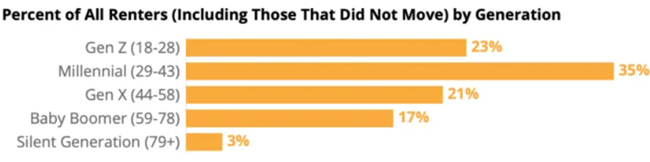
Over the past five years, the Gen Z demographic has witnessed remarkable growth, with an impressive influx of nearly 4.5 million new renters. This surge has propelled Gen Z to the forefront of the rental sector, commanding a substantial 74% share, while other generational segments have experienced declines in their renter populations.

This generational shift underscores the need for property managers to adapt and embrace AI as it aligns with the tech-savvy preferences of these new renters.

Using AI for rental housing is a forward-thinking approach, enhancing efficiency and ensuring financial success. Maintaining a focus on ethical implementation and tenant privacy is essential, contributing to improved tenant satisfaction. AI is a pivotal tool in catering to the evolving demands of the modern renting population, ensuring a competitive edge in the dynamic rental housing market.

About the author:

Vidur Gupta, Founder and CEO of Beekin, a data platform for apartments and rental homes, is a seasoned professional with prior roles as a Non-Executive Director at Notting Hill Genesis and Head of Capital Markets and Analytics at Future Finance. His career encompasses positions at HIG Capital and Deutsche Bank. Holding an MBA in Finance and Economics from The University of Chicago Booth School of Business, Gupta is a key figure in the real estate and finance industries, driven by a passion for empowerment.

Digital Leasing Requires a Precise Human Touch

Supply Growth Pushes Multifamily Rents Down

U.S. multifamily rent growth has turned negative, as strong supply growth eroded rent gains in many fast-growing Sun Belt metros

U.S. multifamily rent growth has turned negative, as strong supply growth eroded rent gains in many fast-growing Sun Belt metros, Yardi Matrix reports.

However, the report says despite negative rent growth, demand for apartments remains robust, “in line with the surprisingly strong economy and with homeownership increasingly out of reach as mortgage rates soar.”

Job growth may be slowing

The report says that while the economy continues to produce solid results, market attention is focusing on the seeming inevitability of slowing job growth and the capital markets conundrum of higher interest rates.

The longer rates stay in the 4.5% to 5% range (or higher), the more multifamily properties will face capital gaps when loans come up for refinancing.

Will apartment demand slow?

There is concern that apartment demand will slow if the economic growth turns negative in line with consensus forecasts.

A downturn would likely reduce renter activity. At the same time, multifamily demand is boosted by long-term trends that aren’t likely to fade. The cost gap between renting and homeownership has rarely, if ever, been higher, which keeps renters in apartments.

Demand is also created by the hybrid work trend as people seek more space for work.

Negative rent growth but strong absorption

Absorption remains strong in many markets such as Austin, Phoenix, Orlando, Raleigh, Charlotte and Nashville, while rent growth is negative.

Rents are receding in these metros due to the robust delivery pipeline and rapid rent increases in recent years that have reduced affordability.

Some highlights of the report

  • The U.S. economy grew at 4.9% in the third quarter, an unexpectedly high rate, led by consumer spending.
  • Multifamily rents have decelerated in 2023, due in part to the robust supply response to strong demand for housing.
  • Multifamily starts are dropping as deals don’t make economic sense right now, which could lead to more rent growth in coming years.

Summary

New multifamily and single-family starts are dropping, Yardi Matrix says in the report. This could set up another demand/supply imbalance and higher housing inflation after the supply surge ends.

“This is not to say the Federal Reserve was wrong to raise rates, which were too low for too long. But the effort to manage lower inflation without a downturn is difficult and carries with it unintended consequences, which are being felt in the economy and commercial property market,” the report says.
Read the full report here.

About Yardi Matrix

Yardi Matrix researches and reports on multifamily, office and self-storage properties across the United States, serving the needs of a variety of industry professionals. Yardi Matrix Multifamily provides accurate data on 18+ million units, covering more than 90 percent of the U.S. population. Contact the company at (480) 663-1149.

Justice Department: Rent-Setting Algorithms May Be Price-Fixing

The U.S. Department of Justice says RealPage rent-setting algorithms may be price-fixing that may be a violation of anti-trust laws.

The U.S. Department of Justice has filed a statement of interest in federal court in Nashville saying that software company RealPage’s rent-setting algorithms amount to a new kind of price-fixing that may be a violation of anti-trust laws, according to reports.

Multiple tenants across the country have sued RealPage claiming the tech company’s apartment software helped landlords collude to inflate rents. The lawsuits from around the country were consolidated in federal court in Nashville.

The Justice Department wrote that in the past, collusion has happened with “a formal handshake in a clandestine meeting,” they wrote. “Algorithms are the new frontier, and, given the amount of information an algorithm can access and digest, this new frontier poses an even greater anticompetitive threat than the last.”

A ProPublica investigation last year found that Texas-based software provider RealPage used rent-setting algorithms to recommend rents to landlords across the country to maximize profits — a practice that experts said may violate antitrust laws.

RealPage has denied the allegations.

“Antitrust enforcers have struggled to apply decades-old laws to new technologies such as RealPage’s rent-setting software, which have changed the way competitors interact with one another and with customers,” ProPublica says.

But, prosecutors said, whether firms use a software algorithm or human interactions to create the scheme “should be of no legal significance.”

“Automating an anticompetitive scheme does not make it less anticompetitive,” the DOJ said in the filing.

“As described in federal lawsuits filed by tenants, RealPage invited concerted action among landlords, including the sharing of nonpublic data with the software, with the purpose of raising rents,” prosecutors wrote in their memorandum. “The arrangement is still price-fixing regardless of whether competing landlords ever communicated with one another about prices,” ProPublica reported that prosecutors said.

“Put simply, RealPage allegedly replaces independent competitive decision-making on prices, which often leads to lower prices for tenants, with a price-fixing combination that violates” federal antitrust law, prosecutors wrote.

“Not every use of an algorithm to set price violates federal law,” they noted, but it is “unlawful when, as alleged here, competitors knowingly combine their sensitive, nonpublic pricing and supply information in an algorithm that they rely upon in making pricing decisions, with the knowledge and expectation that other competitors will do the same.”

Last year, 17 Democratic members of the U.S. House of Representatives sent a letter to the Department of Justice and the Federal Trade Commission asking the agencies to investigate RealPage’s rent-setting software, according to ProPublica.

Sign Up For Our Weekly Newsletter And Get Rental Property And Apartment News And Helpful, Useful Content Each Week.

* indicates required

Investigation Called For Over RealPage Rent-Setting Software

Managing Holiday Decor with Fair Housing in Mind

In the realm of property management, the scope of fair housing laws extends to holiday decor and the adornments associated with them.

Can you decorate the rental office and other common questions about holiday decor and fair housing laws this time of year.

By The Fair Housing Institute

In the realm of property management, the scope of fair housing laws extends to holidays and the adornments associated with them. Ensuring adherence to these laws is paramount, and decisions should be grounded in the principles of fair housing rather than personal judgment.

Property management professionals often encounter holiday-related items that may be perceived as offensive or insensitive by some, yet do not contravene fair housing laws.

This poses a dilemma for industry experts. To navigate this challenge effectively, it is crucial to establish best practices regarding holidays and holiday decorations, beginning with a comprehensive understanding of how fair housing law applies to these scenarios. To start, let’s consider HUD’s stance on holiday decorations.

HUD Weighs In

On January 9th, 1995, the U.S. Department of Housing and Urban Development (HUD) released a memorandum addressing Fair Housing holiday decorations. The memorandum titled, “Guidance Regarding Advertisements Under 804(c) of the Fair Housing Act” provides valuable insights into this matter. It states: “The use of secularized terms or symbols relating to religious holidays such as Santa Claus, Easter Bunny, or St. Valentine’s Day images, or phrases such as Merry Christmas, Happy Easter, or the like does not constitute a violation of the Act.”

So here we can see that HUD has essentially created two categories that decorations can be put under: secular and religious. So, while widely accepted secular decorations legally can be used, ones that represent a specific religion i.e., nativity scenes or The Star of David, should be avoided.

Now let’s consider some of the more common questions we come across as the holiday season approaches.

Common Holiday Decor And Fair Housing Questions

  • Is it acceptable to festively decorate the rental office?
  • What about common areas? Can they be decorated by staff or residents?
  • Can property managers prohibit or restrict what or how residents decorate their doors or patios during the holidays?

Leasing Office and Common Areas

It is very common for people to get in the holiday spirit by decorating. But caution is needed when it comes to your leasing office and common areas. As stated above, HUD has clearly indicated that secular decorations are permissible. That being said, taking a step further is an even better best practice. What does that mean? Try to ensure that the decorations chosen represent a wide variety of cultures or religions to ensure that there is never an appearance of discrimination or favoritism. And, of course, strictly prohibit using religious symbols, be it imagery or text.

Personal Residences and Outdoor Spaces

This is where having clear policies and guidelines is incredibly important and helpful. Some properties don’t allow any decorations regardless of the time of year, making this a nonfactor. However, if your community does allow residents to decorate their doors, patios, or balconies, the only thing you can do as a housing provider is prevent residents from displaying anything deemed offensive.

A Few More Holiday Best Practices

Property management communities comprise diverse individuals with various religious and cultural backgrounds. It is imperative to ensure inclusivity when organizing festivities and social events, especially during the holidays. Every effort should be made to create gatherings that are welcoming to all community members. This includes the language you use on event flyers or other displayed materials. While not explicitly mandated, choosing words like “Happy Holidays” vs. “Merry Christmas” can align with the spirit of promoting equality and fostering a sense of community. Strive beyond mere compliance with the law to make everyone feel genuinely welcome.

Despite all precautions, complaints may arise. Addressing these issues with a thorough understanding of fair housing laws and their applicability is imperative. Take all complaints of religious discrimination seriously. Actively listen to residents, address their concerns, and meticulously document all interactions and resolutions. Protecting the rights of individuals in protected categories should be a top priority.

Holiday Decor And Fair Housing In Conclusion

Fair housing laws apply throughout the holiday season and year-round. Housing professionals must foster welcoming communities that embrace the principles of equality embodied in the Fair Housing Act. Solid policies and proper training will aid in adherence to the laws governing the holiday season and help ensure a happy and inclusive time for all.

About the author:

In 2005, The Fair Housing Institute was founded as a company with one goal: to provide educational and entertaining fair-housing compliance training at an affordable price at the click of a button.
  

High Costs Continue to Challenge Buyers and Renters

High mortgage interest rates, high home values, and high rents continued to fuel affordability challenges for buyers and renters

High mortgage interest rates, high home values, and high rents continued to fuel affordability challenges for buyers and renters, Zillow says in a new survey.

Low vacancy rates that limit mobility and also put pressure on rental rates are also a challenge.

However, the report says, “Many renters’ behaviors, intentions, and preferences have remained relatively stable over the years.”

The 2023 Consumer Housing Trends Report (CHTR) provides a snapshot of what housing consumers were thinking and doing in early-to-mid 2023.

Here are some key findings:

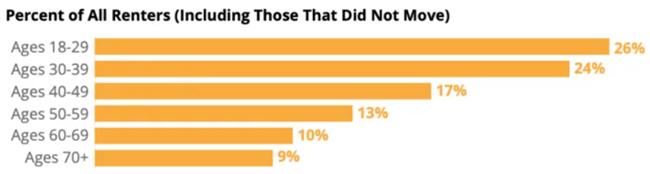
  • Renters make up 30% of the U.S. population. The typical renter is 39 years old. Compared with the adult population as a whole, the renting population tends to be younger, more racially diverse, less likely to have ever been married, and more likely to identify as LGBTQ+.
  • Most renters (53%) live in an apartment building.
  • About three in five renters (61%) say they are considering moving within the next three years.
  • The typical recent renter submitted two applications — one online and one on paper/in person. For these rental applicants, the typical application fee to apply for their current rental was $50 and the typical recent renter reported paying $60 in total across all the rentals they applied for.
  • About half (52%) of recent renters who moved from a previous rental say they disagreed with their landlord or property manager about something.
  • Almost half (45%) of renters say that they would be very or extremely likely to buy a home if rates fell, versus only one in five (20%) who say the same if rates rise.

High mortgage interest rates, high home values, and high rents continued to fuel affordability challenges for buyers and renters

Also, the survey says half of recent renters report at least one move-out disagreement with their previous landlord or property manager.

  • 27% said they disagreed about repair, damage or maintenance on the property.
  • 22% disagreed about the responsibility for utility payments such as electricity, heat, gas, or Internet access.
  • 19% said they disagreed about move-out costs or fees.

Renters that Stayed Put Cite Good Deals, Affordability as Their Reasons

When asked what encouraged them to stay at their current rentals, tenured renters were most likely to say that their rental costs were a good deal (72%), followed by not being able to afford to move somewhere else (66%).

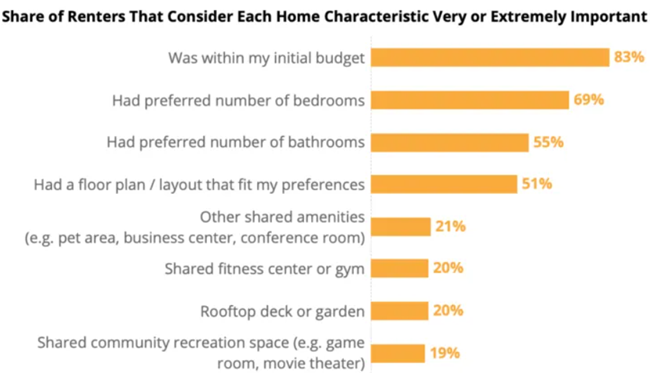
Smaller shares cited liking their landlord or property manager (60%), a floor plan or layout that fit their preferences (61%), and private outdoor space (50%). Tenured renters were least likely to cite their rental’s common amenities like a gym or conference room (33%) as encouragement for staying put.

High mortgage interest rates, high home values, and high rents continued to fuel affordability challenges for buyers and renters

What did renters say was most important in choosing a home?

High mortgage interest rates, high home values, and high rents continued to fuel affordability challenges for buyers and renters

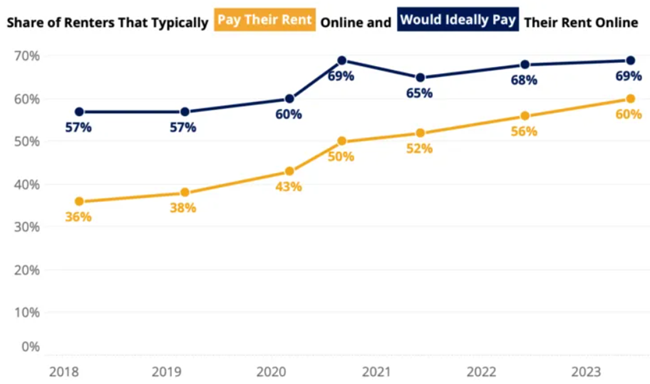
Half of Renters Pay Rent Online – More Would Like To

In fall of 2020, half (50%) of recent renters said they typically pay their rent online. Since then, the share has risen 10 points to 60%. Over the same time, the share of recent renters that said they would ideally prefer to pay their rent online remained similar: 69% in fall 2020 and 69% in spring/summer of 2023.

High mortgage interest rates, high home values, and high rents continued to fuel affordability challenges for buyers and renters

A majority of renters plan to move within three years

Similar to both before and after the pandemic, recent renters consistently consider moving; 72% say they are considering it within the next 3 years.

About a quarter (25%) say they are currently considering moving, and almost one in three (29%) say they’re considering moving in the next year.

Another fifth (19%) say they’re considering it within the next two to three years. About one in 10 (12%) say they might consider moving, but not within the next 3 years. And the remaining 15% say they have no plans to move

Read the full survey here.

Do You Know The Changing Priorities Of Renters?

Sign Up For Our Weekly Newsletter And Get Rental Property And Apartment News And Helpful, Useful Content Each Week.

* indicates required

Apartment Development Pipeline to Slow Dramatically In 2024

Apartment developers expect new starts to slow significantly now in the post-pandemic era as high interest rates have sidelined investors

Apartment developers expect new starts to slow significantly now in the post-pandemic era as high interest rates have sidelined investors, John Burns Real Estate Consulting says in a new survey.

The Burns Apartment Developer and Investor Survey, a new quarterly report, says, “We aim to cast light on areas of the apartment market where the industry has lacked clarity, including the long-term development pipeline, access to capital, and lease-up challenges.”

Apartment development survey

The report surveyed 56 developers, investors, and operators with a collective portfolio of 241,850 units in September and October. It confirmed the following:

  • Post-COVID construction has peaked, and developers expect starts to slow at least -20%, with 25% of participants believing apartment starts will slow at least -50%.
  • High interest rates and cautious lenders have sidelined investors.
  • Leasing has slowed in part due to rent hikes.
  • Thoughtful project design and competitive amenities drive demand.
  • A wave of under-construction apartments will finish in 2024 and into 2025.
  • 40% of the surveyed developers have 500+ units under construction.
  • Future apartment starts will slow dramatically, with the pipeline shrinking significantly once the current round of development is delivered.
  • Almost all respondents say securing development financing is becoming more difficult.

Very few apartment deals are taking place

The John Burns report says transactions and deals have stalled, with only 16% of respondents selling an apartment property in the last six months and no reported acquisitions.

Financing has dried up for new apartments and the current rising supply of apartments leads to soft fundamentals for revenue.

Affordability a key issue

The survey says affordability is a key issue in retaining tenants.

“Commonly cited reasons for non-renewal of leases include moving into a less-expensive apartment and moving in with roommates,” the report says.

John Burns invites those who would like to participate in upcoming surveys to fill out the form, below.

“For participating, you’ll receive the survey results and high-level proprietary JBREC analysis. Join us in refining the industry’s market understanding, and gain valuable data to guide your next venture.”

Fill out the form to participate here.

About John Burns Real Estate Consulting:

John Burns Research and Consulting produces independent research and custom consulting advice to help executives make the most informed decisions possible.

Multifamily Rents Drop Amid Supply Surge

Portland Rents Continue Downward Trend

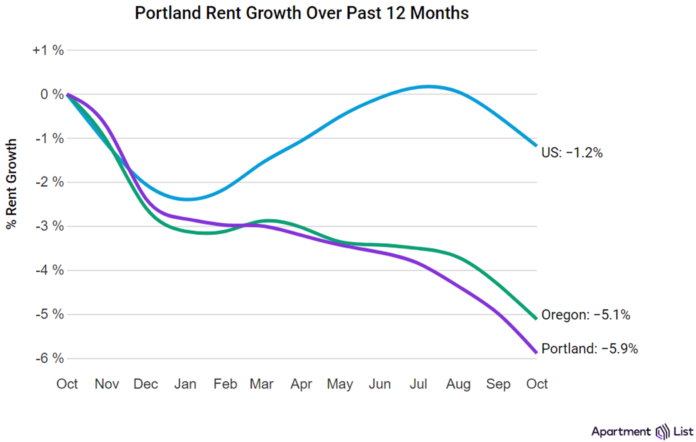
The median rent in Portland fell by 0.9% over the course of October, and has now decreased by a total of 5.9% over the past 12 months

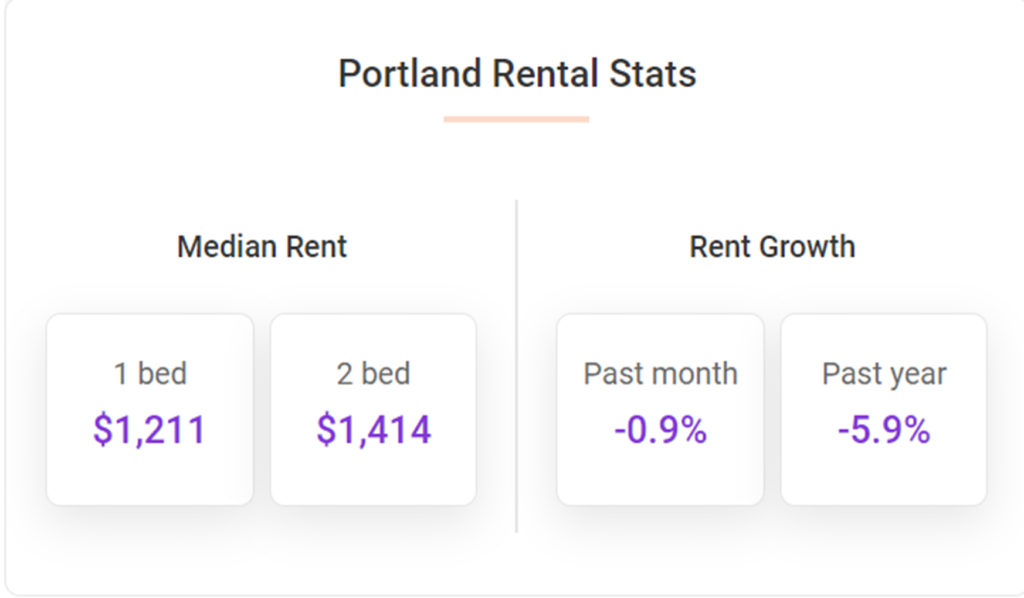
The median rent in Portland fell by 0.9% over the course of October, and has now decreased by a total of 5.9% over the past 12 months, Apartment List says in the November report.

Citywide, the median rent currently is $1,211 for a 1-bedroom apartment and $1,414 for a 2-bedroom. Across all bedroom sizes (i.e., the entire rental market), the median rent is $1,346. That ranks No. 60 in the nation among the country’s 100 largest cities.

Also, Portland rents are 10.8% lower than the metro-wide median.

The median rent in Portland fell by 0.9% over the course of October, and has now decreased by a total of 5.9% over the past 12 months

Across the metro outside the city of Portland, the median rent is $1,509. Metro-wide annual rent growth stands at -5.2%, above the rate of rent growth within just the city.

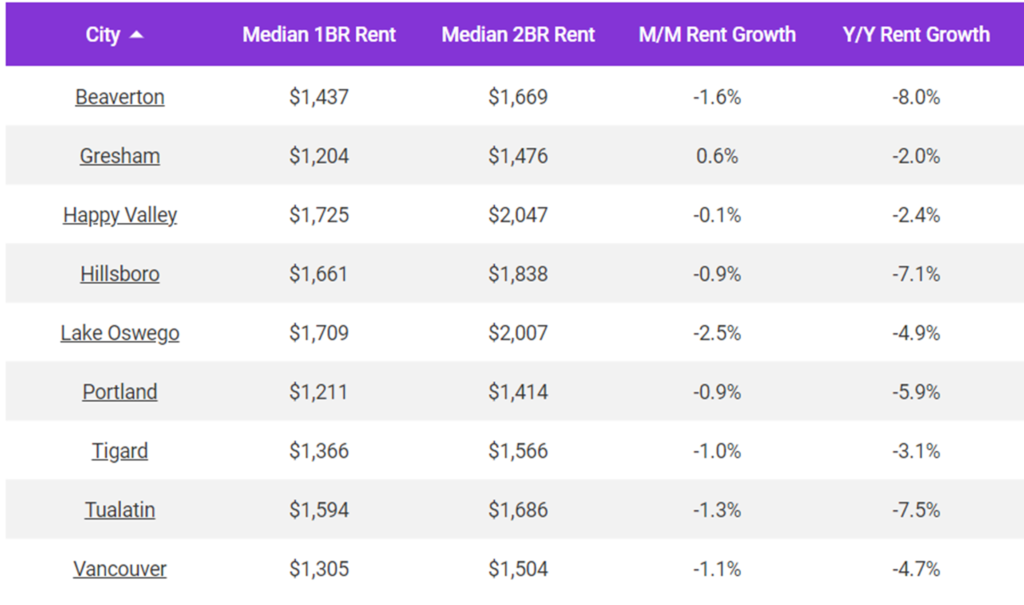
The table below shows the latest rent stats for nine cities in the Portland metro area that are included in the Apartment List database.

Among them, Lake Oswego is currently the most expensive, with a median rent of $2,009. Portland is the metro’s most affordable city, with a median rent of $1,346. The metro’s fastest annual rent growth is occurring in Gresham (-2.0%) while the slowest is in Beaverton (-8.0%).

The median rent in Portland fell by 0.9% over the course of October, and has now decreased by a total of 5.9% over the past 12 months
  

Portland Update: Changes to FAIR Ordinance Bring (Some) Necessary Changes

Dealing with Habitability issues and Substitute Housing