
Home Blog Page 50

Avoid These Two Applicant Background Checks At All Cost

There are two types of applicant background checks that you truly must avoid like the plague if you want to be a successful housing provider

There are two types of applicant background checks that you truly must avoid like the plague if you want to be a successful housing provider for very long.

By Scot Aubrey

Variations of the phrase “avoid like the plague” have been in use for more than 400 years.  It has become synonymous with staying away from something as much as possible.

In recent years, we could adopt a new phrase, “avoid it like COVID.”  No matter how we use it, when it comes to performing background checks on your new potential tenants, a necessity of our current times, there are two types of background checks that you truly must avoid like the plague if you want to be a successful housing provider for very long.

No. 1: The Applicant Background Check You Do Yourself

With an ever-increasing crime rate and the ability for people to steal another’s identity or change their own, these chameleon types should put you on notice.

You excel at investing and managing properties, and that should be good enough for you, so why then do so many of our fellow housing providers take it upon themselves to also perform background checks?

My advice is to stay in your lane and let the experts handle things.  I’ve heard countless times that people just “trust their gut” when it comes to doing background checks.  They rely on their investigative questioning and have full faith and confidence that the applicant is providing them with correct information.

Guess what?  Your “gut” can be wrong, and lie to you just as much as your applicants do.

Applicants, especially those who have been recently evicted or have something to hide, are masters of disguise and put their best face forward when it comes to meeting you and viewing your property.

You might be tempted to pepper your applicant with personal question, but beware: Becoming too familiar with the personal life of an applicant brings compassion into the equation… which is no good (especially when they tell a good story).

Lastly, you lack the real tools of an investigator who can receive and confirm proper ID, date of birth and Social Security numbers.  Remember, desperation drives creativity, and if someone is desperate enough, they will pull out all the stops to get into your property – and then they may be hard to get out.

No. 2: The Instant Applicant Background Check

Contrary to what a marketing department tells you, there is no “instant” database that holds all current records.

At best, you may be accessing 50% of available data, and that doesn’t guarantee accuracy or completeness.  Instant databases gather information from public sources and aggregate it into a single searchable source.

They do not update every second; rather, they update every other month or quarter.

Wouldn’t you want to know if your applicant had a criminal conviction last week, or even yesterday? Or if they are currently in the middle of an eviction?

Of course you would, and you just can’t have that kind of certainty with an instant report.  With the recent rise in stories of serial squatters in the news, having a complete, in-depth look at your applicant can help you avoid this alarming trend.

Also, if an instant report says “no records found,” it does not mean that the applicant doesn’t have a criminal history. It just means that they did not find any records in their particular database.

As a professional housing provider, trying to save money by doing one of these types of background checks is not worth the low – and often not so low – price.

In almost every market I know of, the applicant pays, so why expose yourself to the risk? This is one plague that you can and should avoid at any cost.

About the author:

Scot Aubrey is vice-president of Rent Perfect, a private investigator, fellow landlord and cohost of the Rent Perfect Podcast. Subscribe to the weekly Rent Perfect to stay up to date on the latest industry news and for expert tips on how to manage your properties.


Sign Up For Our Weekly Newsletter And Get Rental Property And Apartment News And Helpful, Useful Content Each Week.

* indicates required

Oregon Unsure Where Pandemic Rental Assistance Money Went

Oregon auditors say they are unsure where millions of dollars of pandemic rental assistance relief money for landlords and tenants went

Oregon auditors say they are unsure where millions of dollars of pandemic rental assistance relief money for landlords and tenants went, according to an audit from the secretary of state.

The Oregon Housing and Community Services (OHCS) agency was supposed to manage an emergency rental assistance program that spent $426 million during the COVID-19 pandemic, but auditors say they still can’t determine how many Oregonians were helped by the money.

“There is no doubt OHCS, like all of Oregon government, was working under unprecedented emergency conditions during the pandemic,” said Audits Director Kip Memmott in a statement. “As auditors, it’s our job to ensure public monies are being spent in accordance with program guidelines and properly accounted for. It’s extremely concerning that OHCS is unable to verify whether millions of dollars went to the Oregonians who needed and deserved this money the most,” according to the audit.

“As a result, the agency has no way of knowing how much of the $426 million went to eligible Oregon recipients and how much was sent to landlords, renters, and non-eligible recipients in error,” the audit report said.

The audit also found that the program itself had a rocky rollout, with glitchy new software, poor customer service and delays in application processing for both tenants and landlords.

What auditors found, according to the state report:

  1. OHCS distributed $426 million in emergency rental assistance as of June 2023. However, because of limited oversight and controls, OHCS cannot be certain that spending met federal guidelines, or how much emergency funding went to eligible applicants. Also, the agency has not reliably determined how many total applications were paid, or households helped.
  2. Material weaknesses regarding contract oversight and monitoring resulted in an adverse opinion for the program in the Statewide Single Audit — the first adverse opinion issued in more than 25 years by the Oregon Audits Division.
  3. Renters and landlords experienced application-processing delays because of rushed implementation of new software. A fragmented customer service system resulted in communication challenges.
  4. OHCS was not prepared to respond to disaster-housing emergencies, despite its responsibility to do so under Oregon’s emergency management framework.
  5. OHCS took an equity-based approach to distributing funds. In the wake of Oregon ERA, OHCS is moving toward outcome-based contracting, tracking outcomes, and has hired an ombudsperson to handle client complaints.

“The urgency with which OHCS acted to distribute rental assistance during a global crisis is laudable,” said Oregon Secretary of State LaVonne Griffin-Valade in a statement. “As auditors, it’s our job to ensure state agencies properly account for how they spend public money. I encourage OHCS to work speedily to implement the recommendations in this report in preparation for future emergencies.”

Read the report here.

New Year, New Laws, 2024 Oregon Edition


Portland Update: Changes to FAIR Ordinance Bring (Some) Necessary Changes

Dealing with Habitability issues and Substitute Housing


Welcoming More Pets Can Lead To Better Retention, More Revenue

Welcoming More Pets Can Lead To Better Retention, More Revenue

Lifting pet and breed restrictions and welcoming more pets can lead to higher tenant retention rates, an increase in pet-related revenue and building stronger communities.

By Judy Bellack
Michelson Found Animals

Lifting breed and weight restrictions for our four-legged friends and generally becoming more pet-inclusive can create significant financial gain for multifamily communities, such as increased NOI and higher resident-retention rates.

However, opening your doors to more pets requires planning in order to manage a larger pet population, and rental-housing operators may need to make an investment in pet-focused amenities, services and events to best accommodate their pet residents. But don’t fret –  even with these steps, the financial benefits of happier, longer-tenured residents have been shown to far outweigh the costs, since pet-friendliness not only means an increase in pet-related revenue but also helps mitigate the costs associated with bringing in new residents.

Below are a few steps apartment communities should consider in conjunction with lifting or easing breed and weight restrictions.

Establish clear pet policies and communicate to owners

While most communities already have some form of pet policies in place, broadening your pet community may necessitate adjustments. Establishing comprehensive guidelines as well as onboarding third-party resources to manage more pets responsibly are a few things to consider.

All of a community’s policies, along with any rent or fees associated with pets, should be clearly spelled out in the resident’s lease. Even better is a separate pet lease or contract that provides all the pertinent information and is easy for the resident to understand and access. Documentation, guidelines, rules and expectations should be easy to locate electronically and posted throughout the community.

Provide tools and amenities for responsible pet ownership

Some pet tools and amenities – such as pet-waste stations – may be deployed immediately when additional pets are on site, while others can be rolled out over time depending on resident preferences. While it’s not required to provide all of the items below, implementing as many as possible will increase the chances of success by mitigating a community’s risk and increasing resident responsibility. Certain amenities, such as dog parks, also give residents and their pets the chance to meet and bond, boosting the connection residents feel with their property and increasing the chances they will renew their lease.

Here are some amenities and services that result in well-managed pet populations and responsible pet owners:

  • Pet-waste stations: This is a feature that would be considered a must-have for any community with pets. Not only does it encourage responsible behavior, but it also helps to reduce risk. Pet waste is detrimental to the health of your community, and its presence can have consequences on resident retention and curb appeal.

dog parks and waste stations can help along with lifting pet and breed restrictions and welcoming more pets can lead to higher tenant retention rates, an increase in pet-related revenue and building stronger communities.

  • Dog parks or runs: According to a 2021 study from Michelson Found Animals Foundation and the Human Animal Bond Research Institute (HABRI), fewer than 10 percent of animals cause any damage to units, but a bored pet is more likely to exhibit destructive behavior. Dogs need to be active, so providing them with a convenient place for exercise can further reduce the risk of property damage. Parks are one of the primary areas where the pet community will bond. Creating this space should not be cost-prohibitive, and is sometimes as simple as repurposing a seldom-used area.
  • Dog-washing stations or services: Washing a pet in a home can be a hassle, especially for medium- to large-size dogs, and not everyone can afford or wants to use a grooming service. This amenity can be a factor for anyone considering a renewal. If an installation is not an option, consider partnering with a mobile service that provides self-washing or grooming for your residents’ pets.
  • Dog-training services: During the pandemic, many residents became first-time pet owners. Pet parents don’t become experts overnight, and improperly trained pets can increase risk. Providing dog-training resources and services gives an opportunity to pet owners to become the best stewards they can be.
  • Pet background checks: Third-party services are available to screen prospective pets, making sure that no incidents have occurred that might indicate potential future risk to residents or other pets. These services allow for onsite teams to feel confident that the pets in their community will be an asset and not a liability.
  • DNA analysis of pet waste: Even in a community with ample waste stations, there’s a chance that some pet owners won’t pick up after their dogs. Communities can request residents submit a sample of their pet’s DNA, which can be submitted to a service that uses the sample to identify any culprits of unattended waste. Communities can implement penalties to discourage future incidents and help offset costs.

  • Pet events: This is another opportunity for pet owners and pets to gather and meet each other, as well as a chance for non-pet owners to meet the furry residents of a community. Not all people are in a position to own a pet, so this is an avenue for them to experience the joy that pets bring. These can be handled by onsite teams if staffing permits, or communities can turn to third-party services that will handle set-up and promotion.
  • Pet adoption: There are millions of dogs and cats nationwide that are looking for good homes. Communities can do their part to reduce this problem by offering to connect residents with pet-adoption services.
  • A pet concierge: Third-party services that manage pet events may also offer concierge services that can provide information on local veterinary services, pet services and pet policies in a community.

Welcoming More Pets Can Lead To Better Retention, More Revenue

Prepare your residents for the upcoming changes

After completing the preparation work, current residents will need to be informed of any upcoming changes in breed and weight restrictions. To help this go smoother, it’s important to point out to residents the positives to the community that will result. Highlight how the removal of restrictions will strengthen the community and share all the steps being taken to help this be a wonderful experience for all residents.

Notices should include office contact information for any residents to ask questions and express concerns. Community managers should educate their leasing teams on all preparations, as well as information that will help answer any questions and dispel misinformation surrounding pets and breeds. Recent studies, including a recent study Science.org, have shown that pet breed has very little influence on behavior, which is primarily guided by owners and training.

This information can alleviate fears or concerns that other residents may have. Plus, it’s a chance to share with non-pet owners how to be courteous and safe around pets on the property, such as the best way to approach a dog.

Build resident and community connections

Having more pets in residential communities can be a great way to create ties between residents and onsite teams. Pet amenities provide the opportunity to interact and get better acquainted with staff. The opportunity to reward outstanding and responsible pet ownership is an excellent way to send a message of appreciation to residents, and also to set an example for all pet owners and foster retention. There are a variety of options for rental housing operators to reward responsible pet owners when renewing, including reduced pet rent, the forgiveness of two to three months of pet rent, discounts or gift cards to local pet businesses and pet-centric gift baskets.

As an added bonus, offering referrals and discounted pet services can build neighborhood connections that increase retention and build a strong sense of community. Local businesses are usually happy to offer discounts to residents in exchange for the exposure and potential future business.

In the end, an increased acceptance of pets can be a boon to net operating income, open a community to a wider pool of applicants and help increase the possibility that residents will stay. However, the path to success in this endeavor includes planning, preparing and executing in a way that maximizes the benefits and the investment.

About the author:

Lifting pet and breed restrictions and welcoming more pets can lead to higher tenant retention rates, an increase in pet-related revenue and building stronger communities.
Judy Bellack

Judy Bellack is the industry principal for the non-profit Michelson Found Animals Foundation, helping to advance the Pet-Inclusive Housing Initiative. She is a 30-year veteran of the multifamily industry, holding various executive leadership positions with some of the foremost supplier companies. Judy has served both as Chair of NAA’s National Suppliers’ Council and NMHC’s Supplier-Partner Alliance and was the recipient of NAA’s Outstanding Supplier in 2010. She currently operates a consulting practice advising start-up technologies in the multifamily space.

Sign Up For Our Weekly Newsletter And Get Rental Property And Apartment News And Helpful, Useful Content Each Week.

* indicates required


Welcoming Pets Is a Smart Financial Move In Rental Housing

Emotional Support Animals and the Fair Housing Act

Everything Landlords Should Know About Emotional Support Animals

Multifamily Demand To Stay Positive, But Market Faces Hurdles

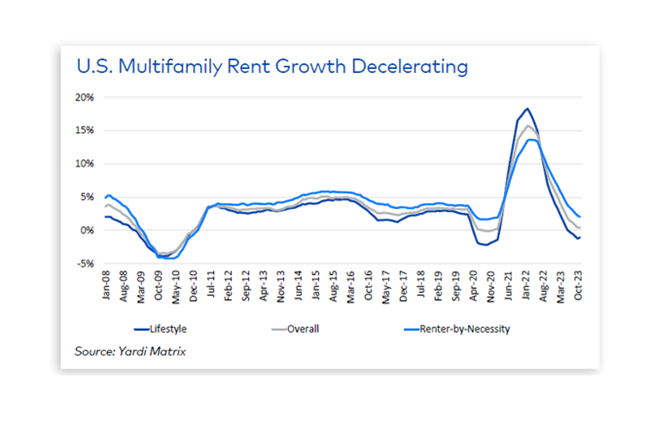
Multifamily demand is likely to remain healthy in 2024, though rent growth will be tested Yardi Matrix says in the 2024 Multifamily Outlook.

Multifamily demand is likely to remain healthy in 2024, though rent growth will be tested by decelerating economic growth and a rapid supply uptick in some markets, Yardi Matrix says in the 2024 U.S. Multifamily Outlook.

The report says the higher interest-rate environment will stress property values and threatens to increase loan defaults.  However, interest rates have probably peaked.

“Our expectations are that economic growth will be weak in 2024, with a soft landing the baseline likelihood, and that property owners should prepare for rates to remain higher than normal through most of the coming year,” the report says.

Multifamily rent growth also continues to decelerate and Matrix forecasts a tepid 1.5% rent growth nationally in 2024 for several reasons. Perhaps the biggest reason is the growth in supply. Another reason is affordability.

Highlights of the 2024 multifamily outlook

  • Multifamily faces a mixed outlook in 2024. Property performance remains healthy for most apartments, but challenges will come from a wave of deliveries, rapid growth in expenses, a potential economic slowdown, and mortgage rates.
  • The U.S. economy has remained surprisingly resilient, helping to maintain strong demand for housing, led by robust employment growth and moderate gains in consumer spending. However, economic growth is likely to slow in 2024 due to the effects of a higher-for-longer interest rate scenario. For commercial real estate, that means a market reset with higher acquisition yields, higher financing costs, and lower leverage and values.
  • “We expect rent growth will be positive in 2024 but diminished by slowing absorption, supply growth and declining affordability after extraordinary gains in 2021-22. Growth will be led by metros in the Midwest, Northeast and smaller Southern and Mountain areas where demand remains consistent and deliveries are subdued.”
  • Supply growth is at decades-long highs, with more than 1.2 million units under construction. Deliveries should top 500,000 units in 2024, with concentrations in rapidly growing markets in the South and West. However, the rise in construction financing is putting a lid on new starts, so 2024 is expected to be a peak year for deliveries.
  • Multifamily expenses—particularly insurance but also labor, materials and maintenance—are rising rapidly. With income growth slowing, operating efficiency and cost-cutting will be focuses of the industry.
  • Transaction volume fell by 70% in 2023 as falling values and rate volatility created pricing uncertainty. Activity is likely to remain weak in 2024, but could rebound later in the year if rate hikes have ended. Lenders are being cautious and borrowers are reluctant to lock in loans at high rates. Maturity defaults will be a growing issue as loans come due and properties qualify for proceeds that are less than the existing mortgages.

Read the full Yardi Matrix report here.

13 Trends That Will Shape Property Management In 2024

Sign Up For Our Weekly Newsletter And Get Rental Property And Apartment News And Helpful, Useful Content Each Week.

* indicates required

Salt Lake City Rents Dip In December

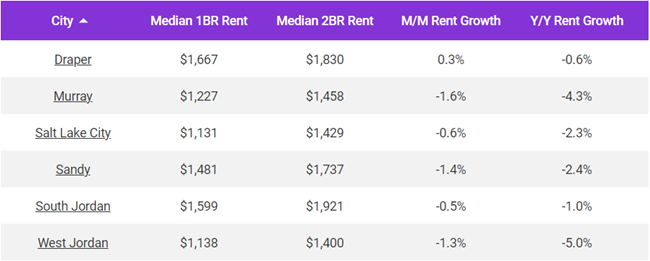
The Salt Lake City median rent fell by 0.6% over the course of December, and has now decreased by a total of 2.3% over the past 12 months

The Salt Lake City median rent fell by 0.6% over the course of December, and has now decreased by a total of 2.3% over the past 12 months, Apartment List says in their January report.

The city’s rent growth over the past year has is similar to the state average (-2.8%) but has fallen below the national average (-1.0%).

Rental stats for Salt Lake City


Rents in the city are 12.1% lower than the metro-wide median

Across the metro area, the median rent is $1,487 meaning that the median price in Salt Lake City proper ($1,307) is 12.1% lower than the price across the metro as a whole. Metro-wide annual rent growth stands at -3.2%, below the rate of rent growth within just the city.

The table below shows the latest rent stats for 6 cities in the Salt Lake City metro area that are included in the Apartment List database.

Among them, Draper is currently the most expensive, with a median rent of $1,885. Salt Lake City is the metro’s most affordable city, with a median rent of $1,307. The metro’s fastest annual rent growth is occurring in Draper (-0.6%) while the slowest is in West Jordan (-5.0%).

Salt Lake City suburbs

Sign Up For Our Weekly Newsletter And Get Rental Property And Apartment News And Helpful, Useful Content Each Week.

* indicates required

Multifamily Parking: Too Many People – Too Few Spots

Multifamily parking has a significant influence on reputation and is one of the most mentioned amenities in reviews of multifamily properties.

Multifamily parking has a significant influence on reputation and is one of the most mentioned amenities in all levels of reviews of multifamily properties.

By Kevin Juhasz

Metropolitan areas are awash in parking, which gives the impression that no parking issues should exist at all. However, many metropolitan areas have made a 180-degree turn in their approach to parking. Eleven cities, including Seattle and Lexington, Ky., reversed course in 2022 and switched to parking maximums. This is creating a parking environment in multifamily replete with challenges.

Fewer spaces don’t need to translate to parking problems. Proper management of available spaces is essential to keeping the peace in a community, causing owners, operators and developers to assess ways to increase housing and avoid parking shortages.

Why Multifamily Parking is Becoming an Issue

For decades, local officials in most cities enforced regulations requiring a minimum number of parking spaces for any commercial real estate or multifamily property constructed. Although it seemed appropriate at the time, this has created a landscape covered in asphalt, and it’s having a negative impact on the nation’s housing crisis. Multifamily developers are putting emphasis on the number of units, not parking. It’s expensive to construct lots, particularly in urban areas, and many developers prefer to forgo as much of that expense as possible.

Many metros are now reversing course, changing parking minimums to parking maximums. This attracts more developers since they’re no longer required to sacrifice a portion of their return on investment for additional spots. Unfortunately, the reduction in parking availability is coming when many residents still struggle with the cost of housing.

The sharp rise in rent growth over the last few years, spurred partially by a lack of housing supply, encouraged a greater number of residents to find roommates or enter into a co-living arrangement. While rent growth has slowed, there hasn’t been enough of a contraction to encourage more people to go solo. Depending on how many of them have cars, this can create a situation where a community has more cars than spaces or is mismanaging the spaces they have. Either way, it can lead to frustration, increasing complaints and conflict among residents.

Other factors that may influence parking availability are location and proximity to public transportation and bike routes. If the property is a mixed-use building, residents are forced to share spaces with the businesses.

The Impact on Reputation, Retention and Onsite Teams

Any community where residents cannot locate a spot or continually find someone illegally parked in their assigned parking space is going to face retention challenges.

People don’t want to live in a place where they need to speak to management on an ongoing basis or wait for a tow truck to finally make their space available again. They are more likely to move somewhere that has less hassles.

As a result, onsite teams will need to devote more time to finding new residents when they could instead be building solid relationships with members of the community.

Taking a look at online reviews of any multifamily community, it’s easy to see that the one- and two-star reviews of residents are very long. When one thing sets them off, there is a tendency to find anything else they can to express dislike. Multifamily parking has a significant influence on reputation and is one of the most mentioned amenities in all levels of reviews. A lower reputation score makes it harder to generate solid leads and makes attracting prospects even more of a challenge for onsite teams.

The Financial Impact of Bad Parking

When retention efforts are insufficient, owners and operators are faced with turnover costs, which can cost thousands of dollars per unit even with a quick turnover. Each day a unit sits unoccupied is a day where it isn’t generating any revenue.

Filling those vacant units is going to be a greater challenge if a community’s reputation score is low. To attract more residents, advertising and internet listing services (ILS) need to be increased, pushing costs even higher and chipping away at net operating income. Amounts are irrelevant when it comes to revenue losses that could have been avoided — any figure is dissatisfactory.

Increasing parking requires a hefty layout of capital and can reduce curb appeal if green space is reduced to provide more space. Building a parking structure is an even larger investment.

Communities are Seeking Relief

Communities, onsite teams and residents don’t want to deal with the headaches and friction a challenging parking situation creates. The Bella Mirage in Avondale, Ariz, faced a shortage of parking that was developing into a hazard with people parking in fire zones. Their team was also burdened with numerous complaints from residents about the parking issues.

“When any parking complaint came in, we would give them a flier explaining the system we use and how to reserve spots,” said Ashley Gayden, community manager at Bella Mirage. “We also put it in our move-in packets. Many of our residents are fine with using it, even with the low cost, and they end up using it the entire time they live here. The complaints have been drastically reduced. It’s few and far between at this point.”

There are any number of factors that will influence parking in a community and possibly create challenges for residents and the community management team.

According to Kohl Eisenhour, executive vice president at Avenue5 Residential, “Parking is one of the top three resident-experience issues.” Avenue5 has implemented an automated parking-management platform to address various challenges, including parking location, accessibility, and shortages. “A parking-management solution has alleviated onsite team stress while significantly reducing the time they had to devote to parking issues.”

The key is to be proactive to issues instead of reactive to them. Owners and operators, as well as property teams, need to gain a comprehensive understanding of pain points within their parking management before the issues create a negative impact on retention and reputation. Whether complex or simple, gathering this information can help teams implement solutions to save revenue and reduce stress for residents and onsite associates.

About the author:

Kevin Juhasz is a content manager for LinnellTaylor Marketing and a writer, editor, and storyteller.

Attracting Residents Who Pay and Stay with Incentive Optimization

Sign Up For Our Weekly Newsletter And Get Rental Property And Apartment News And Helpful, Useful Content Each Week.

* indicates required

7 Predictions For The 2024 Rental Market

Here are 7 predictions for where the rental market is headed in 2024 from economists at Apartment List as the rental market has now cooled

Here are 7 predictions for where the rental market is headed in 2024 from the economists at Apartment List as the once red-hot rental market of previous years has now cooled.

Here is a key topline summary for 2024:

  • 2024 will be the strongest year for new apartment construction in decades, giving renters more options and better opportunities to negotiate price and lease terms.
  • “We expect that year-over-year rent growth will crawl out of negative territory next year, but that it won’t rise above the low single-digits.”
  • Even though mortgage rates are expected to ease modestly, home prices will remain prohibitively high and continue to create more long-term renters.

No. 1 – 2024 will bring the most new apartments in decades

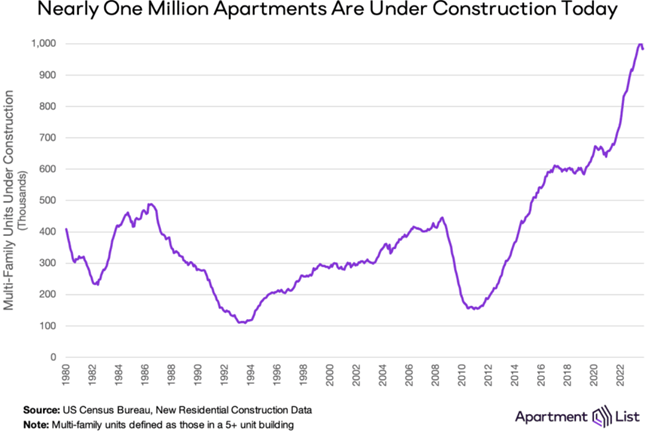
Construction data from the Census Bureau suggests that multifamily supply growth should remain strong through 2024. The number of new multifamily apartment units under construction hit one million for the first time ever in 2023, and completions are expected to peak in 2024. With so many units in the construction pipeline, 2024 should be the strongest year for new multifamily supply since the 1980s.

apartments under construction and implications for 2024 rental market

No. 2 – Low single-digit rent growth in 2024

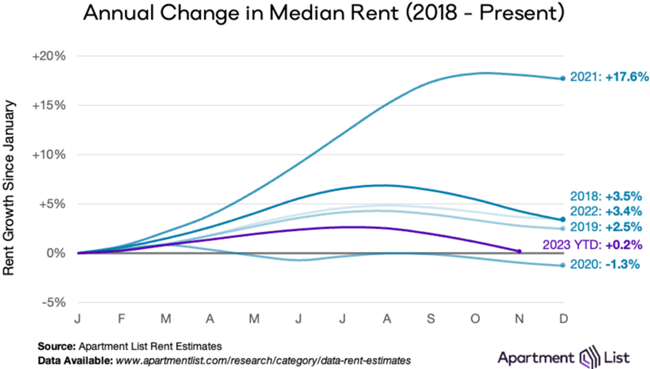
2023 is set to have the second slowest rent growth of any year in the history of our estimates (going back to 2017), coming ahead of only 2020. Looking ahead to 2024, “we expect demand to bounce back slightly, but remain on the soft side. The labor market remains fairly strong and there is likely some pent-up demand for new household formation. However, affordability continues to be a major concern and sentiment data shows that Americans still lack confidence in the economy. Even in the most bullish scenario, it’s unlikely that demand will be strong enough to outstrip all of the new supply that we know is coming, likely resulting in our vacancy index rising modestly from its current level in 2024. We expect that rent growth will rise out of negative territory early next year, but that it won’t get above the low single digits in 2024.”

changes in median rent

No. 3- The changing rent vs. buy math will create more long-term renters

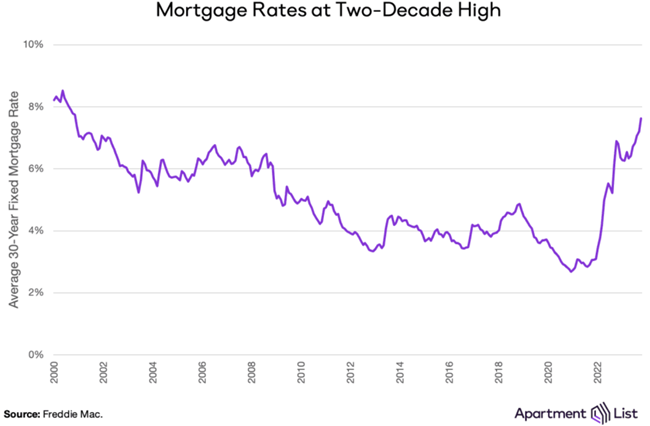
Many families are remaining renters longer than they may have in the past. Even those who can afford to buy in today’s market may find that renting now actually makes more financial sense. Although most Americans still aspire to own homes, more are now finding themselves renting later in life, and that trend is likely to continue. Consensus expectations are that mortgage rates will ease modestly next year, but likely not enough to significantly alter the prevailing dynamics of the for-sale market. As paths to homeownership fade for many, renting will increasingly be seen as the more practical housing option.

mortgage rates remain high into 2024

No. 4- Hybrid work will cement itself as the new norm for office jobs

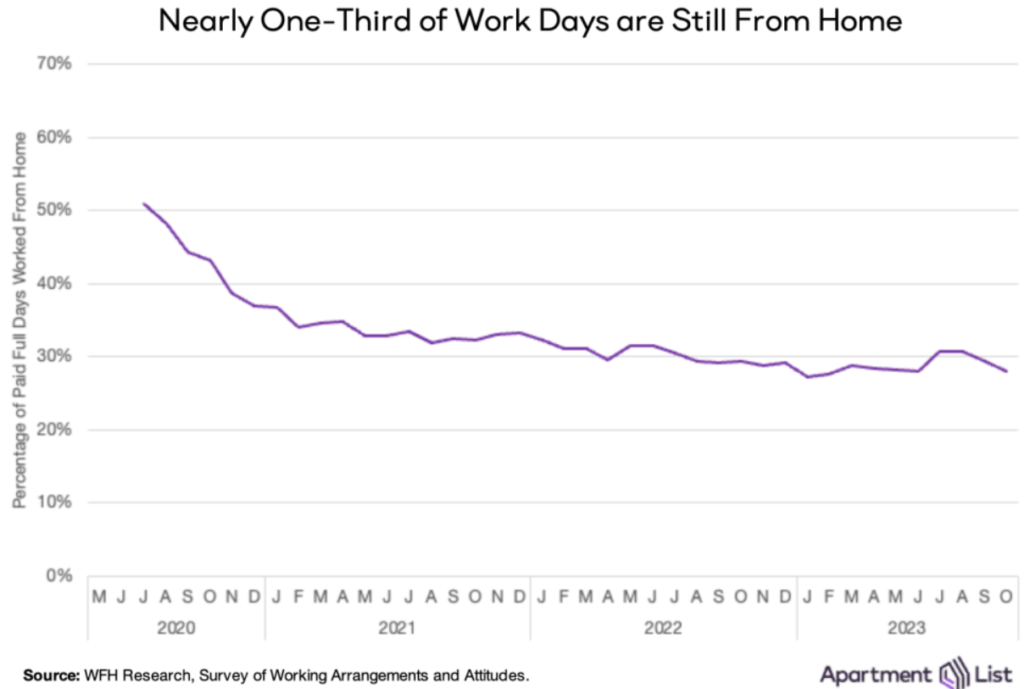
In 2023, the remote work narrative focused on return-to-office plans, but this focus obscures the fact the pendulum will never swing fully back to the pre-pandemic norm. According to the latest estimates, 28 percent of all work days are still from home, and that figure appears to be stabilizing at that level. 42 percent of American workers currently have some form of remote work flexibility, and hybrid arrangements are much more common than fully remote ones. The data shows that hybrid work is here to stay, driving demand for rentals that provide spaces and amenities that blend work and home life for today’s flexible workforce.

work from home and rentals in 2024

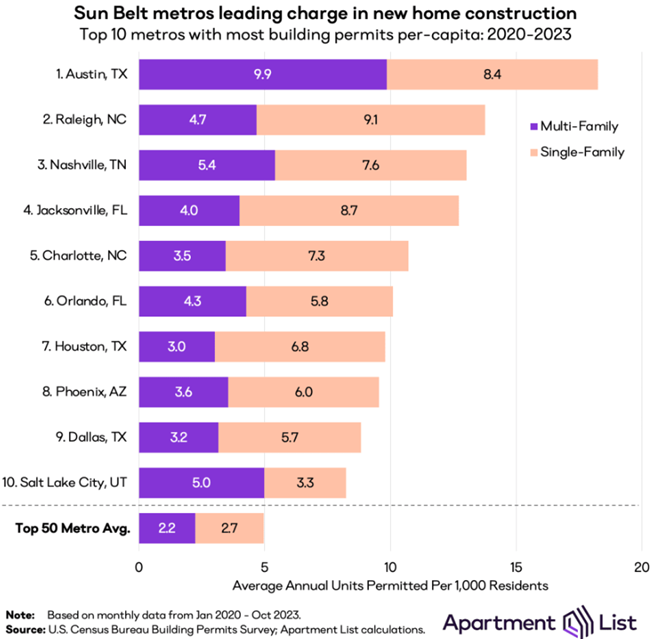
No. 5- Sun Belt markets will see more renters, but not necessarily higher rents

The nation’s fastest population growth in recent years has been taking place throughout the Sun Belt. But in many cases, Sun Belt markets have also been among the most accommodating of growth, allowing for new housing development to meet the growing demand. The key takeaway: fast-growing Sun Belt markets will continue to be renter magnets, but rent growth should be kept in check thanks to lots multifamily development.

work from home and rentals in 2024

No. 6- As the economy takes center stage in the presidential election, candidates will need to speak to housing concerns

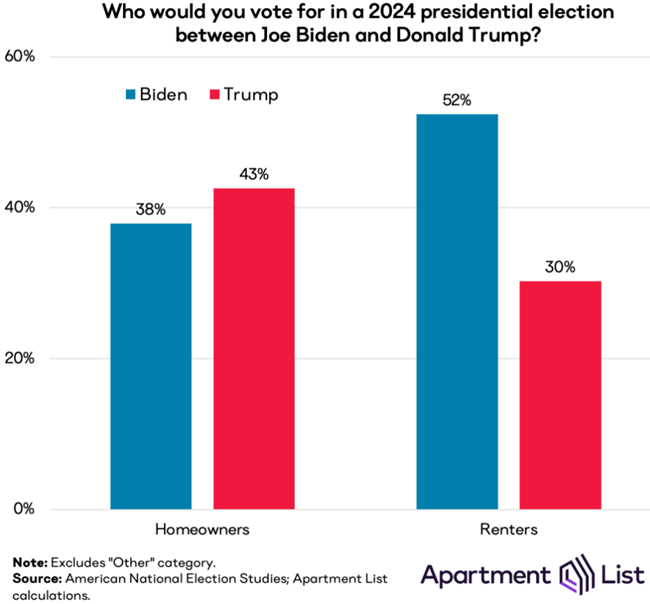
As we head into a presidential election year, the question of whether the economy is good or bad has proven to be surprisingly complicated. Most of the key indicators of economic health are looking quite strong, but economic sentiment surveys show that confidence and satisfaction in the economy remain weak. It’s likely that at least some of this disconnect is being driven by waning housing affordability. As the election cycle continues to ramp up, candidates on both sides of the aisle will need to articulate housing plans and speak to what has become one of the most pressing concerns of the American electorate. 2024 could be the year where housing rises to the forefront of the political discourse.

renters in 2024 and presidential election

No. 7- More renters will use AI in their searches

“We expect 2024 to bring a new wave of AI-powered tools specifically for renters. It will soon become commonplace for renters to use AI in their apartment searches to search, compare, and coordinate actions. It will take time for these advancements to change macro market dynamics, but the next high-demand rental market cycle may look quite different with new power in renter’s pockets. And as adoption of AI-enabled rental search tools accelerates into 2024, both renters and property managers can seize opportunities from this new technological frontier.”

Conclusion

“2024 is certain to bring twists and turns no model can predict, as the new year always does. But we hope that by forewarning of what’s foreseeable—from new supply waves to persistent homeownership headwinds bolstering rental demand—we can help you prepare for what is ahead.”

About the Apartment List research team:

The Apartment List Research Team is a small group of economists and analysts dedicated to understanding the rental market as it evolves rapidly. “On our blog we publish original research reports and offer robust data products for public use.”


Sign Up For Our Weekly Newsletter And Get Rental Property And Apartment News And Helpful, Useful Content Each Week.

* indicates required

Race Against Time: Seizing an Unprecedented Opportunity for Affordable Housing

Affordable housing funds are still available through the federal government's inflation reduction act but time is running out

Ryan Kristoff

Based on what we’ve seen in 2023, it appears that the multifamily affordable housing (MFAH) market will end up accessing a relatively meager portion of the funds from the Inflation Reduction Act (IRA) and Bipartisan Infrastructure Law (BIL). These laws make available an unprecedented volume of free money for weatherization, beneficial electrification, solar, and health and safety solutions. However, many MFAH stakeholders are simply unaware of the legislation or its applicability to them. Beyond that, many state agencies in charge of administering the funds are concerned about spending their allocations in a timely manner and so are sticking to “business as usual” residential markets, i.e., single-family housing.

There is still time to get on the train, but the MFAH community needs to act fast. In 2024, many funds will move from the federal government into states’ coffers, subsequently hitting communities at different times throughout the year. Some states, like Tennessee, are dedicating significant portions of their new funds to increase energy efficiency and clean energy services in MFAH, and they can potentially be a reference for others. But many of the IRA’s funding buckets, which have confronted political opposition since they were in draft form, still regularly come under fire. We’re less than a year out from election season, the results of which could signal a dramatic reduction of the available funds. Running parallel to the political uncertainty is mounting pressure from markets, regulatory bodies, and the environment.

Unfortunately, there is a very real possibility that these resources could disappear almost as quickly as they arrived. Our hope is that one of the big stories in 2024 will be a groundswell of MFAH properties applying for funds and advocating with states for greater investment in this segment.

About the author:

Ryan Kristoff is the Director of Grants at ICAST, a national nonprofit that designs holistic retrofit solutions for MFAH. He works with local government, utility, state, and federal partners to create and launch MFAH-focused clean energy programs.

Planning for Funding Opportunities Through the Inflation Reduction Act and Bipartisan Infrastructure Law

Accessing Solar for Multifamily Affordable Housing

Accessing Utah’s Home Energy Rebate Programs

Where Was The Hottest Rental Market In 2023?

RentCafe took a look at the hottest rental markets in 2023 and while the Midwest has been getting more competitive, there was a clear winner

RentCafe took a look back at the hottest rental markets in 2023 and while the Midwest has been getting more competitive, there was a clear winner, according to a report.

Miami was the hottest rental market in the U.S. in 2023

“Fueled once again by sky-high occupancy and lease renewal rates amid a veritable building frenzy. Despite thousands upon thousands of new apartments being added to the market throughout the last few years, the metro continues to welcome new residents seeking better job opportunities and a tax-free lifestyle.

“Likewise, many wealthy domestic buyers purchased condos for themselves rather than renting them out, which only dwindled the number of apartments available for prospective renters this year.

“Although the number of apartments for rent in Miami has grown by a healthy 3.7% since January, the newly built units were still not enough to meet the demand for rentals this year. On top of that, 71.2% of renters choose to stay put, meaning apartment seekers had a very hard time securing an available unit in 2023. That’s why there were 22 applicants fighting for each vacant rental (more than double the national average), with apartments being taken off the market quickly, often within one month,” the report says

The Midwest was the most competitive region for renting in 2023

“Three Midwest markets making the top five nationwide. While most of the U.S. shows signs of softening in rental competitiveness, Midwestern markets are bucking the trend.

“Specifically, the region’s lower cost of living, ample living spaces that bode well with remote work, and almost instant access to the great outdoors are attracting more and more renters.

“In fact, the Midwest is experiencing an economic revival, fueled in part by the Rise of the Rest fund that aims to boost entrepreneurship and innovation outside of the coastal hubs. To that end, America’s heartland has seen thousands of startups emerging in recent years, showing its both potential and vitality,” the report says.

RentCafe took a look at the hottest rental markets in 2023 and while the Midwest has been getting more competitive, there was a clear winner

Read the full RentCafe report here.

Sign Up For Our Weekly Newsletter And Get Rental Property And Apartment News And Helpful, Useful Content Each Week.

* indicates required

Do I Have to Paint and Replace Flooring for a Long-Term Tenant?

Do I Have to Paint and Replace Flooring for a Long-Term Tenant?

When do rental property managers have an obligation to do upgrades for long-term tenants, such as replace flooring or painting, is the question this week for Ask Landlord Hank. Hank is not an attorney and is not offering legal advice. Please fill out the form below to ask him a question.

Dear Landlord Hank,

I have had a good tenant for more than 10 years. Is my responsibility to replace flooring and painting while he is living there?

-Sharon

Dear Landlady Sharon,

I would check the laws in your area to see if this is addressed?

The Department of Housing and Urban development guidelines are that carpeting should be replaced after 7 years. A paint job usually lasts 3 to 5 years.

I typically paint between tenants, and that is when flooring is dealt with as well.

It’s easier to work in an empty unit than one where furniture would need to be moved.

Replace flooring

I have replaced carpeting for a good tenant, during a lease.

We agreed that tenant would be responsible for moving all furniture so the job could be done and the tenant would pay for any delays or increased costs, if furniture was not moved as required.

So to answer your question, I don’t know if the law in your area requires flooring or painting while a tenant is still living in the unit, but if the carpet is in need of replacement, I would definitely consider this to keep such a good, long-term tenant.

Sincerely,

Hank Rossi

Ask Landlord Hank: Do I Have to Paint and Replace Flooring for a Long-Term Tenant?
Landlord Hank Rossi

Ask Landlord Hank Your Question

Ask veteran landlord and property manager Hank Rossi your questions from tenant screening to leases to pets and more! He provides answers each week to landlords.

  • This field is for validation purposes and should be left unchanged.

Sign Up For Our Newsletter And Get Rental Housing And Apartment News And Helpful, Useful Content Each Week.

* indicates required

A Tenant Poured Grease Down Drain Who Is Responsible?

Can I Enter My Rental If Tenant Moves Out Early But Lease Is Still In Place?

Who’s Responsible For Smoke Detector Batteries In Rentals?