Home Blog Page 35

Justice Department Sues RealPage Over Apartment Pricing

The Justice Department sued RealPage alleging an unlawful rent price fixing scheme to decrease competition by landlords in apartment pricing

The U.S. Department of Justice has sued RealPage alleging an unlawful scheme to decrease competition among landlords in apartment pricing and to monopolize the market for commercial revenue management software that landlords use to price apartments, according to a release.

The Justice Department says RealPage’s pricing algorithm violates anti-trust laws.

“Renters are entitled to the benefits of vigorous competition among landlords. In prosperous times, that competition should limit rent hikes; in harder times, competition should bring down rent, making housing more affordable,” the Justice Department says in the complaint.

“RealPage has built a business out of frustrating the natural forces of competition. In its own words, “a rising tide raises all ships.” This is more than a marketing mantra. RealPage sells software to landlords that collects nonpublic information from competing landlords and uses that combined information to make pricing recommendations.,” the complaint says.

Landlords share nonpublic apartment pricing information

In the press release, the Justice Department alleges “RealPage contracts with competing landlords who agree to share with RealPage nonpublic, competitively sensitive information about their apartment rental rates and other lease terms to train and run RealPage’s algorithmic pricing software.

“This software then generates recommendations, including on apartment rental pricing and other terms, for participating landlords based on their and their rivals’ competitively sensitive information. The complaint further alleges that in a free market, these landlords would otherwise be competing independently to attract renters based on pricing, discounts, concessions, lease terms, and other dimensions of apartment leasing.

“RealPage also uses this scheme and its substantial data trove to maintain a monopoly in the market for commercial revenue management software. The complaint seeks to end RealPage’s illegal conduct and restore competition for the benefit of renters in states across the country,” the department says.

Garland says renters should not pay more over a scheme to break the law

“Americans should not have to pay more in rent because a company has found a new way to scheme with landlords to break the law,” Attorney General Merrick B. Garland said in the release about apartment pricing.

“We allege that RealPage’s pricing algorithm enables landlords to share confidential, competitively sensitive information and align their rents. Using software as the sharing mechanism does not immunize this scheme from Sherman Act liability, and the Justice Department will continue to aggressively enforce the antitrust laws and protect the American people from those who violate them.”

The lawsuit was filed in the U.S. District Court for the Middle District of North Carolina and alleges that RealPage violated Sections 1 and 2 of the Sherman Act.

RealPage has denied the allegations.

Read the full complaint here.

Read the press release here.

 

Read the full report from ProPublica here

Sign Up For Our Weekly Newsletter And Get Rental Property And Apartment News And Helpful, Useful Information Each Week.

* indicates required

Renters Want Flexible Payments And Loyalty Programs

A new survey says renters want flexible monthly payment plans, loyalty programs and help with the stress of moving.

A new survey says renters want flexible monthly payment plans, loyalty programs and help with the stress of moving.

The RealPage survey of more than 2,000 renters showed:

  • 98% of renters want a loyalty program for paying rent.
  • 93% of renters are interested in flexible rent payments.
  • 97% of renters would choose an apartment offering an easy way to manage moving.

The 2024 National Multifamily Renter Study shows the multifamily housing industry must adapt and enhance its offerings to attract and retain residents amid the changing rental landscape and increase in supply, RealPage said in a release.

  • 97% say they would be more likely to renew their lease if working with their property manager was as easy as interacting with Amazon.
  • 97% would be more likely to choose an apartment offering a service to simplify moving, such as help setting up internet and utilities, finding a local mover and setting up payments.
  • 93% were interested in flexible rent payment schedules (biweekly, bimonthly, weekly) rather than a full, once-a-month payment.

“It’s a renter’s market, and they demand more from moving assistance, loyalty programs and payment options to enhance their living experience,” Rob Franklin, Senior Vice President and General Manager of Resident Solutions at RealPage, said in a release. “This national survey confirms the modern experience renters want today, and we are thrilled to bring it to them with LOFT™, RealPage’s fully integrated resident experience platform.”

Overall, the survey responses showed that enhanced offerings from a property manager, such as a seamless digital app and loyalty programs, factor heavily into a resident’s decision to select an apartment and renew. Research shows 97% of respondents would choose a specific unit and renew their lease if they were offered improved benefits from property management companies.

The study, conducted by Dimensional Research, was presented during RealWorld 2024, the company’s conference that brings together nearly 1,500 registered attendees from the multifamily community to highlight innovations in the rental housing industry. All 2,011 qualified study participants were currently paying rent for an apartment in a multi-unit building operated by a property management company. All were between 18 and 55 years of age living in the United States. A mix of genders, household incomes, regions and demographics were captured to enable analysis by various categories.

Great Tenant Experiences Are About Timely, Clear Communication

Sign Up For Our Weekly Newsletter And Get Rental Property And Apartment News And Helpful, Useful Content Each Week.

* indicates required

4 Senses You Should Use To Inspect After Tenant Move Out

Four senses you should use after tenant move out such as smells, to ensure that you don’t miss something on inspection
Quite literally, if it doesn’t pass the smell test, something is likely wrong at the property.

When it comes time to perform a move-out inspection, it’s critical to engage your four senses, especially smells, to ensure that you don’t miss something that could end up costing you thousands down the line.

By David Pickron

“Oh, I had a friend bring her little dog over maybe once or twice while I lived there.” That’s a direct quote from a recently moved-out tenant. Funny thing is, I went to the property the day after she moved out and all of the windows were open … in August … in Phoenix.

As I walked in, I caught the overwhelming odor of what seemed skunky, but I just could not put my finger on it. No wonder she wanted the windows open to air out the place and somehow save her security deposit.

When I asked her if she had been smoking or vaping marijuana, she adamantly denied it. “Did you ever have any pets in the property?” I asked. Refer to the first sentence of this article to see her answer.

I shut the property up and a few days later returned to start the rehab for my next tenants. Sure enough, when I opened the property that had been sealed shut for just a few days, the smell of urine overwhelmed me.

Turns out it was a combination of the urine smell and the smells from a nearby dairy that made me think it was initially marijuana. And just this week I met the carpet guys at the property and to no one’s surprise, when the carpets were pulled up, there were urine stains over every square inch of the carpet and pad. That little dog must have had some kind of bladder for just being there once or twice.

Now before you think I am anti-pet, I’m not. I have three adult Bernedoodles — Wellington, Winston, and Aspen — that bring me pure joy. And I’m not anti-tenant either, as I have multiple short-, mid-, and long-term rental properties that produce a great income and are valued assets. My challenge here lies in the fact that tenants will go to great lengths to avoid any extra expense that comes after they vacate a property.

When it comes time to perform a move-out inspection, it’s critical to engage your senses to ensure that you don’t miss something that could end up costing you thousands down the line. Here’s what I recommend:

No. 1 – SIGHT

If you have copies of photos from the initial move-in inspection, compare those with the current  condition of the property. Things like holes in walls are obvious, but do you remember the paint color that was in the property at time of move-in? Or what appliances were there when the tenants took possession? (Was that room really pink with stars on the ceiling?)

If you own multiple properties or if a tenant has been in a home a long time, you may not remember exactly what was in place. I’ve seen tenants break my nicer appliances or fixtures and replace them with cheap ones, hoping I wouldn’t notice. Always, always take pictures of the property before a tenant takes possession so you don’t have to rely on memory.

No. 2 – SMELL

As my story above illustrates, the nose always knows. What I didn’t tell you is a week prior to the tenants moving out, I visited the property and it smelled great. The tenant asked specifically when I would be arriving and dolled the place up with air fresheners.

Quite literally, if it doesn’t pass the smell test, something is likely wrong at the property. To get the best results, turn off the HVAC system for a couple of days and seal the house up. Smells such as cigarette or marijuana smoke, mildew, or pet urine will become more pronounced once the air stops moving.

No. 3 – SOUND

When I walk into a vacated home, I listen for all types of sounds. Is there an unreported leak somewhere that I can hear, as in the toilet? When the HVAC system turns on, does it sound right? Maybe I should inspect the filter to see why the A/C is struggling. Same goes for dishwashers and washers and dryers. Run all the faucets in the home and listen for any issues that might be related to the plumbing.

No. 4 – TOUCH

During the move-out inspection, I like to feel for things like drywall repairs the homeowner may have completed. Open the cupboards and make sure they glide smoothly. A lot of homes now have stone countertops, and depending on the stone, it may visually hide gouges or cracks caused by homeowner behavior. I also feel with my feet as I walk the property, as unreported water leaks can lead to warped or loose floors that I may not see but can definitely feel.

I teach new landlords all the time about the importance of finding the right tenant to be their “business partner” in maintaining and caring for a property. But even the best tenants can and do create problems for us as housing providers when they move out of our properties. Little things are expected, but when it comes to professionally and effectively managing our portfolios, we have to use everything in our arsenals to protect our assets. Using your senses to sense scents (and other issues) just makes sense.

Speaking of making sense, require a security deposit big enough to cover carpet replacement, as that is usually the biggest replacement item that holds those offending odors.

About the author:

David Pickron is president of Rent Perfect, a private investigator, and fellow landlord who manages several short- and long-term rentals. Subscribe to his weekly Rent Perfect podcast to stay up to date on the latest industry news and for expert tips on how to manage your properties.

6 Vital Tools You Need To Fight Fraud

6 Trigger Words And Questions Every Landlord Should Listen For

The Impact of Student Debt on Qualifying Tenants

Sign Up For Our Weekly Newsletter And Get Rental Property And Apartment News And Helpful, Useful Content Each Week.

* indicates required

Rents Continued Up In July Due To Strong Economy

National multifamily advertised rents rose in July on the back of the strong economy, Yardi Matrix said in the July report.
The strong economy has continued to lead to strong demand for rental housing.

Multifamily advertised rents rose in July on the back of the strong economy, Yardi Matrix said in the July report

“Job growth remained robust while inflation continued to ease, raising hope for interest rate cuts. Meanwhile, July saw a resumption in advertised rent growth in high-supply markets where it had been negative,” the report says.

Highlights of the report

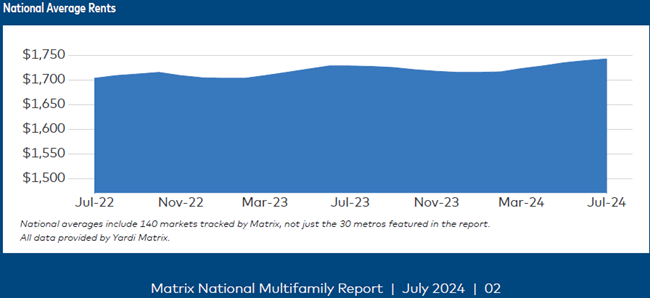
  • Multifamily advertised rents rose for the sixth straight month in July as demand coming from economic growth and demographics remained consistent. The average U.S. advertised rent increased by $4 to $1,743, while year-over-year growth rose by 20 basis points to 0.8%.
  • Although year-over-year rent numbers are weak by historical standards, July produced encouraging signs, including a rebound in growth in some Sun Belt metros that have struggled over the past year due to the heavy delivery pipeline.
  • Single-family rental properties continued their strong performance in July, with advertised rents rising $5 nationally to a record-high $2,171. The year-over-year growth rate moderated again, declining 10 basis points to 1.0%. Occupancy rates fell 10 basis points to 95.3% in June.
  • The national occupancy rate in June was 94.6% for the seventh straight month, down 0.4% year over-year. Only two metros posted year-over-year increases: Las Vegas, which at 93.6% is up 0.7% year-over-year, and the Twin Cities, which at 95.0% is up 0.1% from a year ago. The biggest drops in occupancy rates have been in Indianapolis, Houston, Dallas and Kansas City (all down 0.8%).

The strong economy has continued to lead to strong demand for rental housing, the report says. The U.S. gross domestic product grew by 2.8% in the second quarter, while the economy added 1.3 million jobs in the first half of 2024.

“There are signs the economy will cool, but the worst-case scenario is likely to be a soft landing rather than a hard recession,” Yardi Matrix says in the report. “Although performance so far has been encouraging, we expect continued high levels of new deliveries for the next 15 to 18 months, so there’s a lot more to contend with ahead.”

National multifamily advertised rents rose in July on the back of the strong economy, Yardi Matrix said in the July report.
Chart courtesy of Yardi Matrix

Read the full Yardi Matrix report here.

About Yardi Matrix

Yardi Matrix researches and reports on multifamily, office and self-storage properties across the United States, serving the needs of a variety of industry professionals. Yardi Matrix Multifamily provides accurate data on 18+ million units, covering more than 90 percent of the U.S. population. Contact the company at (480) 663-1149.

Sign Up For Our Weekly Newsletter And Get Rental Property And Apartment News And Helpful, Useful Content Each Week.

* indicates required

A Third of Property Managers are Offering Rent Concessions

More property managers offered rent concessions in July as rent growth has slowed in some parts of the country

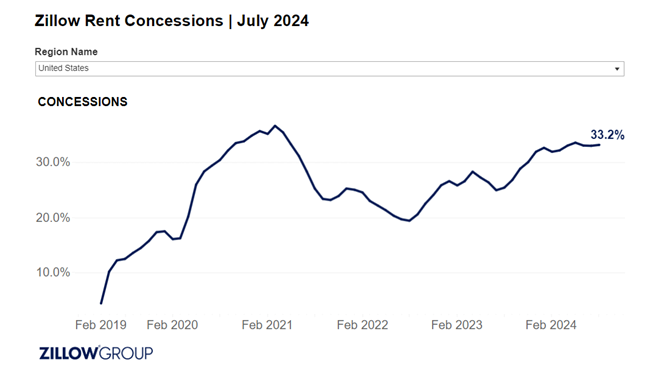
More property managers offered rent concessions in July as rent growth has slowed in some parts of the country, new data from Zillow shows.

“The share of rental listings on Zillow offering a concession — a sweetener such as free weeks of rent or free parking offered as an incentive to rent — climbed to 33.2% in July. That’s up slightly from 33% in June and 25.4% a year earlier,” Zillow said in the release.

“Builders have stepped up and built an incredible number of homes in response to soaring rents during the pandemic, and renters are now seeing the benefits,” said Skylar Olsen, Zillow chief economist, in the release.

“Now is a great time for renters to find a deal, with more new apartments hitting the market than at any time in the past several decades.

“Rents are still growing, but it’s a far cry from the steep rent hikes of two or three years ago, and renters will find sweeteners being offered by more than half of rentals in some places. A slowing job market and lower mortgage rates could mean falling rents if the current trends hold,” Olsen said.

In six major metro areas, more than half of the rental listings on Zillow are offering a concession: Raleigh (53.3%), Charlotte (53%), Atlanta (52.2%), Salt Lake City (50.9%), Nashville (50.8%) and Austin (50.5%). Four major metros have a smaller share of listings with a concession than last year, indicating a more competitive rental market. Those are San Jose (-9.7 percentage points), Baltimore (-5.6), Milwaukee (-1.8) and Pittsburgh (-0.2).

One reason for the rental-market cooldown is a multifamily construction frenzy that is opening up new options for renters and rebalancing the supply and demand seesaw. Almost 60,000 multifamily units were completed nationwide in June — the latest data available — which is more than in any month in half a century.

Sign Up For Our Weekly Newsletter And Get Rental Property And Apartment News And Helpful, Useful Content Each Week.

* indicates required

Ensuring Equal Access: Translation Services for the Deaf and Hard of Hearing in Property Management

Are you and your property management providing reasonable accommodations for the deaf and hard of hearing to communicate effectively?

Are you and your property management providing reasonable accommodations for the deaf and hard of hearing to communicate effectively?

By The Fair Housing Institute

In the field of property management, effective communication is not just a courtesy—it’s a mandate under fair housing laws.

Ensuring that every individual, regardless of hearing ability, has equal access to housing information is not only ethical but also legally required.

This commitment to accessibility includes providing reasonable accommodations for the deaf and hard of hearing, a demographic that often faces significant barriers in accessing housing services. Are you and your team ensuring equal access?

How do I stay fair housing compliant?

Fair housing regulations stipulate that property managers must be equipped to communicate effectively with all prospects and residents. This inclusivity explicitly extends to individuals who are deaf or hard of hearing. When a deaf or hard-of-hearing resident requests an interpreter, this is considered a reasonable accommodation.

Interestingly, unlike other accommodation requests that require a more extensive review process, the need for an interpreter is often so apparent that it bypasses the usual procedural requirements. This streamlined approach underscores the importance of immediate and unimpeded communication.

But what if I can’t get an interpreter right away?

Despite the clear mandates, the practicalities of providing on-the-spot interpreter services can be challenging. It’s generally unrealistic to secure a sign language interpreter without prior notice. However, property managers are still obliged to facilitate communication as per fair housing standards.

Creative solutions become essential in these scenarios. Utilizing readily available tools such as whiteboards for written communication or exchanging SMS text messages can provide interim solutions that uphold the standards of accessibility and ensure that critical information is conveyed effectively and promptly.

How do I prepare for the best-case scenario?

To truly embody the spirit of fair housing, property management teams should proactively prepare to meet the needs of deaf or hard-of-hearing individuals. This preparation involves more than just recognizing the need for accommodation; it requires active and ongoing training of staff. Role-playing scenarios can be an effective method for training, helping staff practice and prepare for real-life interactions.

Additionally, investing in services such as online, on-demand interpreters can significantly enhance a property management company’s ability to provide immediate and effective communication solutions. These investments not only comply with legal requirements but also demonstrate a genuine commitment to inclusivity.

Are you ensuring equal access?

The provision of translation services for the deaf and hard of hearing is a clear example of how property management can and should function under the guiding principles of fair housing.

Property management professionals can ensure that all residents receive the high standard of service they deserve by understanding the legal imperatives, embracing creative problem-solving, and investing in thorough preparation. Ultimately, these efforts reflect a broader commitment to equality and accessibility, pillars upon which the integrity of the property management industry rests.

About the author:

In 2005, The Fair Housing Institute was founded as a company with one goal: to provide educational and entertaining fair-housing compliance training at an affordable price at the click of a button.

The Use Of Marijuana – A Fair Housing Challenge

How Do I Get a Tenant to Remove Backyard Trampoline?

Tenants with a kiddie pool or a backyard trampoline can present liability issues for landlords so that is the question for Landlord Hank.

Tenants with a kiddie pool or a backyard trampoline can present liability issues for landlords. In this week’s Ask Landlord Hank question he discusses the issue of what to do about tenant with a backyard trampoline in his rental. Remember Hank is not an attorney and cannot offer legal advice. If you have a question for him please fill out the form below.

Dear Landlord Hank:

We have a long-term renter who has a trampoline in the backyard.

Ever since we first saw it, we have asked him to get rid of it because of liability issues. He has a truck in which he could haul it away.

Our rental is in a different city about 3 1/2 hours away.  I don’t want to be stuck with it when he moves.

Thanks for your advice.

-Pat

Dear Landlord Pat,

Trampolines are a big liability issue, and sometimes an insurer will cancel your policy due to that risk.

Do you know or have any contact with your neighbor of this property?

I would tell this tenant to immediately remove the trampoline from the premises, that he is in violation of the lease and that he must prove with photographic evidence that it has been removed.

Then I would contact your neighbor to verify. Good luck.

Sincerely,

Hank Rossi

Each week I answer questions from landlords and property managers across the country in my “Dear Landlord Hank” blog in the digital magazine Rental Housing Journal.    https://rentalhousingjournal.com/asklandlordhank/

Can I adjust the rent if a new tenant is added to the lease is the question from a landlord this week for Landlord Hank.
Landlord Hank says, “Trampolines are a big liability issue, and sometimes an insurer will cancel your policy due to that risk.”

Each week I answer questions from landlords and property managers across the country in my “Dear Landlord Hank” blog in the digital magazine Rental Housing Journal.    https://rentalhousingjournal.com/asklandlordhank/


Ask Landlord Hank Your Question

Ask veteran landlord and property manager Hank Rossi your questions from tenant screening to leases to pets and more! He provides answers each week to landlords.

  • This field is for validation purposes and should be left unchanged.

“I started in real estate as a child watching my father take care of our family rentals- maintenance, tenant relations, etc , in small town Ohio. As I grew, I was occasionally Dad’s assistant. In the mid-90s I decided to get into the rental business on my own, as a sideline. In 2001, I retired from my profession and only managed my own investments, for the next 10 years. Six years ago, my sister, working as a rental agent/property manager in Sarasota, Florida convinced me to try the Florida lifestyle. I gave it a try and never looked back. A few years ago we started our own real estate brokerage. We focus on property management and leasing. I continue to manage my real estate portfolio here in Florida and Atlanta. “ Visit Hank’s website here.

In 2024, Most Single-Family Landlords are Cautious

A new survey has found that most single-family rental landlords are cautious in 2024 – neither bullish or bearish

A new survey has found that most single-family rental landlords are cautious in 2024 – neither bullish or bearish about investment, according to the data analytics company Resiclub.

The survey of landlords who own at least one investment rental property between June 25 and July 18, 2024, showed the following:

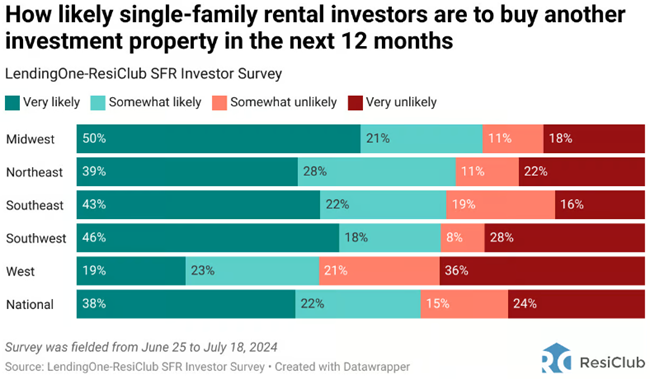
  • 60% of single-family landlords say they’ll likely buy at least one investment property over the next 12 months.
  • 39% of single-family landlords say they’ll likely sell at least one investment property over the next 12 months.
  • 76% of single-family landlords expect to raise their rents over the next 12 months—including 35% who say the increase will be over 4.0%.
  • 2% of single-family landlords expect to decrease their rents over the next 12 months.
  • 72% of single-family landlords expect home prices to increase in their core housing market over the next 12 months. But only 31% expect an increase of over 4.0%.
  • 86% of single-family landlords expect interest rates to fall over the next 12 months. However, just 10% of those landlords expect a decline of more than 1 percentage point.
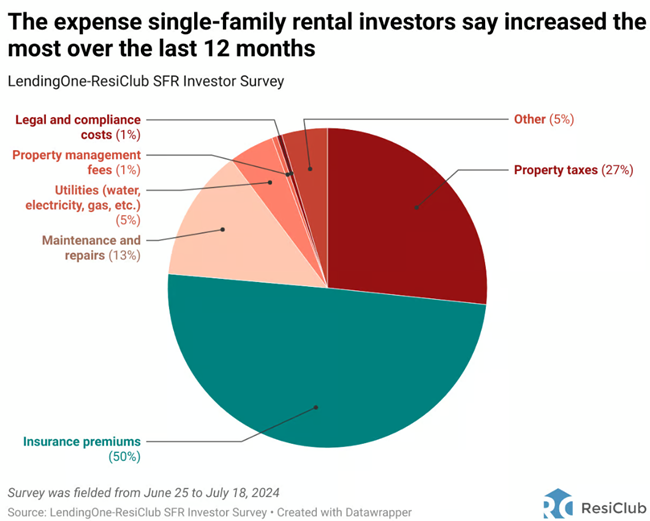
  • 50% of single-family landlords say home insurance was the expense that increased the most over the past 12 months.

A new survey has found that most single-family rental landlords are cautious in 2024 – neither bullish or bearish

The survey says rapidly rising insurance rates for rental properties are a big concern among the group. According to the results, most single-family landlords “aren’t super bullish or bearish; instead, they are cautiously optimistic, expecting a balanced single-family rental market over the next 12 months.”

The survey says many plan to buy properties, raise rents, and anticipate rising home prices and falling interest rates. However, they only expect a mild increase in rents and home prices, as well as just a slight drop in interest rates.

The survey was done by Resiclub and Lending One.

“The survey result generally aligns with what we have heard and thought over the last 12 months and how we see this shaking out,” said LendingOne CEO Matthew Neisser in a release.

“We saw apartment rents starting to stall months ago; apartment rents were already leveling out in most markets and becoming more competitive with concessions. So, on the single-family side, it’s a function of affordability. And people can afford only so much at certain price points. So, it seemed obvious there’s only so much more to run on rents, within reason.”

Read the full survey results here.

Sign Up For Our Weekly Newsletter And Get Rental Property And Apartment News And Helpful, Useful Content Each Week.

* indicates required

Rent Growth Continues in Secondary Markets

Can I Adjust the Rent if A New Tenant Is Added To The Lease?

Can I adjust the rent if a new tenant is added to the lease is the question from a landlord this week for Landlord Hank.

Adding a new tenant to a lease is a question that comes up from time to time. In this week’s Ask Landlord Hank question he discusses the issue or adjusting the rent and the new tenant. Remember Hank is not an attorney and cannot offer legal advice. If you have a question for him please fill out the form below.

Dear Landlord Hank:

I have a tenant who wants to add another tenant to the lease.

Does this constitute an opportunity to adjust the rent?

All utilities are included in the rent.

Also, they are in the first year of tenancy. The cost of utilities has skyrocketed, and adding tenants will add costs to maintain.

-Terri

HI Landlady Terri,

I would talk to your current tenant and tell them what you just wrote to me: That if the tenant passes background screening, they could be added to the lease BUT the costs you pay for utilities would increase and you’d be passing that along to this unit.

Make sure you are generous with yourself about the utility-cost increase, and let tenant know.

Make sure you do screening of the new tenant to make sure you get a good one and not a problem. The rental term remains the same. Good luck!

Sincerely,

Hank Rossi

Can I adjust the rent if a new tenant is added to the lease is the question from a landlord this week for Landlord Hank.
Landlord Hank says, “Make sure you are generous with yourself about the utility-cost increase, and let tenant know.”

Each week I answer questions from landlords and property managers across the country in my “Dear Landlord Hank” blog in the digital magazine Rental Housing Journal.    https://rentalhousingjournal.com/asklandlordhank/

Editors note: Be sure to check your local and state regulations on leases and rents as it varies across the country.


Ask Landlord Hank Your Question

Ask veteran landlord and property manager Hank Rossi your questions from tenant screening to leases to pets and more! He provides answers each week to landlords.

  • This field is for validation purposes and should be left unchanged.

“I started in real estate as a child watching my father take care of our family rentals- maintenance, tenant relations, etc , in small town Ohio. As I grew, I was occasionally Dad’s assistant. In the mid-90s I decided to get into the rental business on my own, as a sideline. In 2001, I retired from my profession and only managed my own investments, for the next 10 years. Six years ago, my sister, working as a rental agent/property manager in Sarasota, Florida convinced me to try the Florida lifestyle. I gave it a try and never looked back. A few years ago we started our own real estate brokerage. We focus on property management and leasing. I continue to manage my real estate portfolio here in Florida and Atlanta. “ Visit Hank’s website here.

Editor’s note: Always check to see if there are any local or state regulations in your area that may vary with Hank’s answer.

Engaging User Generated Content and Influencers to Attract Tenants

Many property owners and property managers are unaware of the power of social media such as user generated content and influencers to attract tenants.

Many property owners and property managers are unaware of the power of social media such as user generated content and influencers to attract tenants so here are some best practices.

By Alexis Krisay

The rental housing market is becoming more competitive every day as the number of available units continues to grow.

With this in mind, property managers and owners need to think of creative ways to attract the right tenants.

Many owners are still unaware of the true power of social media and have failed to allocate the appropriate budgets to these channels, which are at the forefront of marketing practices today. Growing in popularity is User-Generated Content (UGC) and influencer marketing, which involves outsourcing online creators to provide content in different ways.

Specifically, user generated content (UGC) is a form of media created by content creators for a brand or company to post that showcases a relatable perspective tailored for the target audience. Influencer marketing differs from user generated content because instead of the content living on the company or brand’s profile, the influencer shares it to their respective audience. Both strategies are effective tools to boost brand awareness and simultaneously build trust with your targeted audience.

Here are a few best practices for property managers and owners to follow if employing either UGC or influencers to attract new tenants and increase renewal rates.

Develop incentive programs to encourage tenants to create content on your behalf

If there is a lack of budget allocation across social media channels, we encourage property managers and owners to get creative with their strategies.

UGC through rental incentives is a perfect way to generate authentic social media exposure while also being cost-effective. Organizing a campaign of this nature involves various moving parts, all of which should be thoughtfully executed to ensure the program’s maximum potential:

  • Building a brand around a UGC incentive program: Brainstorm and design various elements of digital marketing materials, including a campaign deck, social media posts and potentially a website landing page to announce and detail the specifics of the campaign. The incentive program’s brand should be an extension of the company or property, reflecting the various branding elements that already exist.
  • Make sure the deliverables and objectives are clear: When building the brand around the UGC program, it’s important to effectively communicate guidelines and expected deliverables. Specify the type of content you’re looking for, provide a mood board or examples, include keywords or elements to highlight, and provide clear deadlines.
  • Be creative: Today there are many new and innovative ways to engage with consumers. To get creative, our agency thought out of the box and engaged with Point in Time Studios, a virtual-reality and augmented-reality development company to create virtual-reality tours for prospective tenants to tour properties. We’ve had a lot of success for our clients with this method. Using new technologies and tools may also entice a content creator to promote your property to its followers.
  • Develop a hashtag reflective of the campaign: Though hashtags have become less popular in current social media marketing, creating a unique tagline or phrase for users to include in their posts not only increases brand awareness but also organizes a space for the content to live, making it easier to track and quantify posts – and this all comes at no additional cost to you. When developing the hashtag, make sure it is original, brief and easy to understand.
  • Incentivize content creation: Without exceeding a budget, it can be possible to incentivize tenants to participate in a campaign by offering rent discounts or gift cards. However, it is important to remember that content creators today are getting paid from hundreds to thousands of dollars. That said, the campaign should be worthwhile for both parties.
  • Keep the community exciting and lively with planned events and happenings: Organize fun community events that showcase your amenities and the sense of community at your property. Whether it’s a pool party, a paint-and-sip night, or as simple as catered meals in the lobby, events like these give tenants alternative ways to create content that highlights your property in a positive way.

Overall, UGC can be a great way to attract new tenants and retain existing ones while keeping costs to a minimum, so long as the campaign is executed well.

Finding the Right Local Influencers That Post Content that Aligns with Your Brand

Alternatively, engaging influencers requires a bit more research on your end and likely a more sizable budget.

Much as a UGC campaign requires, influencer marketing also requires creative direction on your part. Creating the campaign begins with branding the program and detailing specifics about the required deliverables and objectives. This involves deciding the type of content that best showcases your property, including day-in-the-life experiences, vlogs, virtual tours or tenant interviews. Additionally, you have to consider the key messages you want the influencer to convey in their content. It is important to remember that the influencer’s only job is executing the guidelines that you put in place. That said, the better the campaign structure, the higher probability of success for both parties.

Similar to user generated content, it is imperative that the campaign offer some sort of incentive for influencers to participate. With the rise in influencer marketing, it is likely that influencers will expect financial compensation for their efforts. However, it is important that you provide an offer that is unique to the influencer to properly track the return on investment (ROI). In doing so, don’t forget to put this offer or unique marketing source in your rental customer relationship management (CRM) tool to generate the appropriate leasing reports!

Once the campaign is complete, you will be able to pull the traffic and leasing reports to identify the true ROI of the campaign. Influencers are great for brand awareness, so make sure your team is able to track the increase in likes, comments, shares and other engagement metrics following the campaign.

To generate true ROI with influencers in the rental industry you’ll need to have a thought-out strategy. If your team decides to use influencer marketing for your community, make sure you think about the following before you choose your influencer:

  • Identify their niche: Look for influencers who are relevant to the rental market or your target demographic. For example, lifestyle bloggers, local celebrities, or real estate influencers might have a more significant impact. Make sure to carefully analyze their content and ensure that their focus aligns with your goals, your brand’s aesthetic and standards.
  • Review their content: Assess the quality of the influencer’s content, including their photography, writing and video-production skills. This can also include their past partnerships, which can accurately gauge the type of content they are capable of producing. Additionally, showing interest in their former collaborations can form a strong, trusting relationship.
  • Analyze their metrics: Look into their analytics on social channels. Track their engagement including likes, comments, shares and other metrics after the campaign. It’s important to not be phased by follower count – sometimes, influencers with smaller but highly engaged audiences (micro-influencers) can be more effective than those with a larger, less engaged following.
  • Make sure their audience aligns with yours: When selecting the right influencer, their audience should largely correlate to your target tenants. The content they are creating should directly relate to the group you are aiming to reach.

Both of these tactics can lead to increased occupancy if done correctly and consistently. Like any tactic, repetition and analysis is key to the success of the campaign.

About the author:

Property owners and property managers can use the power of social media such as user generated content and influencers to attract tenants.


Alexis Krisay is a partner and president of marketing at Serendipit Consulting. She has an extensive background in online and offline strategic marketing operations. With more than 15 years’ experience she has a deep understanding of the rental housing industry and what makes these people, brands and organizations tick.

5 Essential Marketing Strategies to Boost Occupancy Rates

Sign Up For Our Weekly Newsletter And Get Rental Property And Apartment News And Helpful, Useful Content Each Week.

* indicates required

Keeping Your Communications Compliant with Fair Housing

5 Ways to Communicate Better with Challenging Tenants

What to Look for in Property Management Software

5 Things Your Company Can Do To Retain Top Talent in Multifamily

illustration credit Guzaliia Filimonova via istockimages