What to do when a tenant cuts off the electricity and moved early is the question this week for Ask Landlord Hank. Remember Hank is not an attorney and he is not offering legal advice. If you have a question for him please fill out the form below.
Dear Landlord Hank,
What to do if tenant has moved out of house and cut off electric prior to lease ending?
Yes, we do have it in their lease that they’re not supposed to… but what should we do?
-Tiffany
Hi Landlady Tiffany,
Most leases have a section or clause concerning Default.
If may say something like: If the tenant abandons or surrenders possession of the premises during the lease term, the landlord may retake possession and make a good faith effort to re-rent it.
Most leases also have a section concerning Utilities, stating that the tenant is responsible for maintaining essential utilities in their name and if the tenant discontinues service this is a default of the lease agreement and the tenant is responsible for all utility charges that are otherwise tenant responsibility under the lease.
That all being said I would reach out to the tenant via phone, text and email and get confirmation they have left the property. Deal with their security deposit legally and with certified notice to the tenant. Once you confirm the tenant is gone and not coming back, I would change the locks and prepare the property for the next tenant.
Sincerely,
Hank Rossi
Editor’s note: Check your local laws on this issue as many cities and states have different rules.
Landlord Hank says, “Once you confirm the tenant is gone and not coming back, I would change the locks and prepare the property for the next tenant.”
Ask Landlord Hank Your Question
Ask veteran landlord and property manager Hank Rossi your questions from tenant screening to leases to pets and more! He provides answers each week to landlords.
Each week I answer questions from landlords and property managers across the country in my “Dear Landlord Hank” blog in the digital magazine Rental Housing Journal. https://rentalhousingjournal.com/asklandlordhank/
Multifamily rents continued to fall in September, but “interest-rate cuts and robust GDP and job growth have given the multifamily market a shot in the arm,” writes Yardi Matrix in the September Multifamily Report.
Nevertheless, the report points out that the heavy delivery pipeline will constrict rent growth in the near term.
Rents falling but not all the news is bad
The report says good news about interest rates and economic growth has “buoyed the spirits” of the multifamily and commercial real estate industry.
Here are the highlights from the report.
Amid continued healthy demand, multifamily advertised rents fell slightly in September due to seasonality and supply growth in the Sun Belt. The average U.S. advertised rent fell by $3 in September to $1,750, while year-over-year growth was unchanged at 0.9%.
Supply growth remains the bright line determining advertised rent growth. Among the Matrix top 30 metros, advertised rent growth was positive in eight of the 10 metros with the least supply growth and negative in eight of the top 10 with the most supply growth.
Single-family rental rates softened slightly in September. Advertised rents fell $3 nationally to $2,167, while the year-over-year growth rate dropped 30 basis points to 0.6%. The national occupancy rate remains high at 95.3%, but is down 30 basis points year-over-year.
The strong economy has been the major driver for apartment demand, and that demand has absorbed the supply of new apartment units.
“More than 300,000 apartment units were absorbed nationally through the first three quarters of 2024, and more than 1.7 million units since the pandemic lockdowns,” in the first quarter of 2020, the report says.
“Absorption has been particularly strong in the Sun Belt and Mountain West, driven by in-migration and job growth. Rents have flattened or turned negative in some metros in those regions because of the wave of supply growth.
“With the typically slower winter months approaching and the supply wave set to continue through 2025, advertised rent growth in those regions will likely stay weak in coming months,” Yardi Matrix says in the report.
Yardi Matrix researches and reports on multifamily, office and self-storage properties across the United States, serving the needs of a variety of industry professionals. Yardi Matrix Multifamily provides accurate data on 18+ million units, covering more than 90 percent of the U.S. population. Contact the company at (480) 663-1149.
A Seattle landlord has sued the City of Seattle alleging a number of laws passed in the name of tenant protections in the last few years have financially strapped his affordable housing units, according to the Seattle Times.
The city council has been active the past few years in passing tenant protections such as caps on move-in fees, first qualified applicant rules, eviction rules, lease renewals and tenant screening rules.
Goodman Real Estate, through a subsidiary that owns a 254-unit apartment building near Fourth Avenue South and South Jackson Street, filed the lawsuit, calling for unspecified financial damages and a change to city regulations.
“Our goal is to create the highest level of quality affordable and sustainable housing in downtown Seattle for our residents,” CEO George Petrie said in a statement, “but the city has placed so many restrictions on our ability to do that, it is placing our residents at risk.”
The Seattle Times said the city plans to defend the tenant protections but declined to comment further while the case is ongoing, said City Attorney’s Office spokesperson Tim Robinson.
Goodman’s case comes after a rightward shift at Seattle City Hall and as affordable housing developers sound the alarm about rising operating costs and, in some cases, trouble collecting rent from tenants. Some landlords have set their sights on convincing the city council to loosen or repeal landlord-tenant regulations in response to those challenges.
The lawsuit alleges the tenant protection laws have forced the building to accept tenants who caused safety issues, added new maintenance and security costs, increased tenant and staff turnover, limited evictions and discouraged rent increases that might help cover the increased costs.
The suit claims this is a “taking” of the landlord’s property.
The Seattle Times reports that takings arguments can be difficult to prove in court. Constitutional rules generally “do not require compensation for every decline in the value of a piece of private property,” but a regulation that “deprives an owner of all economically beneficial uses” of their property could amount to a taking, the state Attorney General’s Office wrote in a recent memo to local governments unrelated to this case.
Most people change their batteries whenever they hear that beep, but you should replace batteries before that happens.
Smoke detector safety is important for landlords so be sure you know how to maintain smoke detectors and who is responsible for smoke detector maintenance.
By Steve Lockwood
Regarding fire safety, properly operating smoke detectors is one of the most essential tools for alerting property owners and firefighters of dangerous home and apartment fires before they happen.
They are a simple tool that saves lives.
According to the National Fire Protection Association, “Roughly three out of five fire deaths happen in homes with either no smoke alarms or no working smoke alarms.”
This means that the risk of death from a residential or apartment fire is cut in half in homes with operable smoke alarms. In states such as Arizona, where I work, rental property owners must provide smoke detectors to their tenants. However, fire safety requires more than just installing smoke detectors on your property: You must also maintain them. Doing so will keep your property and, more importantly, your tenants better protected against fires.
Here are a few tips from an Arizona fire protection expert on maintaining smoke detectors.
1. Conduct professional inspections annually
The biggest thing a rental property can do to ensure their smoke detectors work is to have them inspected annually by a fire safety professional.
This is especially true of multifamily property owners who must ensure their smoke detectors are connected to the more extensive fire alarm system. A professional is going to do more than just check the batteries.
They will smoke test them, visually inspect them for signs of damage and tampering, and inspect the control panel to ensure your smoke detectors communicate with other devices. A fire safety expert will also document their findings and issue the corrective action you must take.
No one knows the state of your smoke detectors better than fire safety inspectors, and doing an annual inspection protects your property and your tenants while only taking a few hours to conduct. Annual inspections are a baseline for fire safety. Have a fire safety expert inspect your smoke detectors once a year; they will help catch any issues you have.
2. Clean and replace them
A fire safety inspection is great, but you should look at it more as a test you want to pass instead of a checklist of chores the fire inspector gives you.
You can do most of the smoke detector maintenance yourself. You must clean your smoke detector at least once every six months and once every three months if your tenants have pets. Dirt, dust, pet hair, and other home grime accumulate in the smoke detector over time and a dirty smoke detector can either not go off when there is a fire or give you false alarms. The dirtier they get, the less they work correctly.
I recommend removing the head of the smoke detector and using compressed air to blow the dirt and grime off the smoke detector. You can also vacuum the dust out if you don’t have a compressed air canister. Do not clean your smoke detectors with water because it will damage the unit. You should also replace your smoke detectors every ten years, even if they work correctly. After ten years, alarm sensors are on borrowed time, so new smoke detectors are needed.
Replace your smoke detectors ten years from the manufacturing date. You can find the date on the back of your alarm.
3. Replace batteries
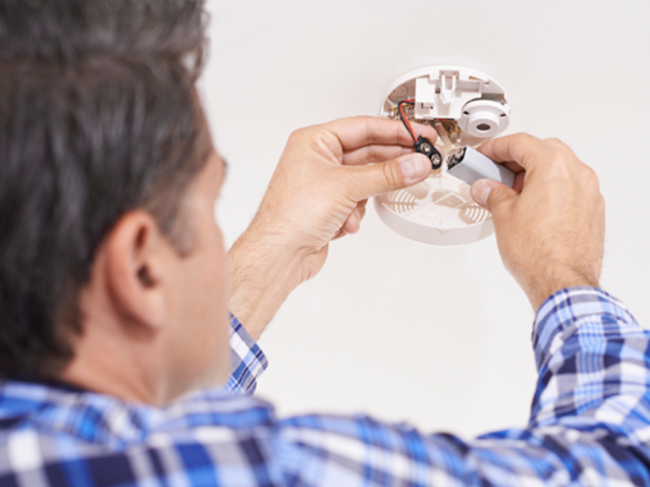
Everyone knows the annoying beeping sound that comes on when your smoke detector battery is low. Most people change their batteries whenever they hear that beep, but you should replace batteries before that happens.
Replace batteries to ensure they do their part to protect against fires.
Replace smoke detector batteries with 9-volt lithium batteries once every six months. This is because you want to replace worn and torn old batteries with fresh ones. It is just an extra safety measure you can put on your calendar twice a year. You can also set a clause in your agreement that the tenant must replace batteries to ensure they do their part to protect against fires.
4. Test smoke alarms yourself
You shouldn’t wait a year for a fire safety inspector to test your smoke detectors.
You can do it yourself. Do a smoke test on your smoke detectors every three months or anytime you do a property inspection. You can see if they work using a can of test smoke alarm tester. You can find them at any home improvement store. Spray a puff of test smoke; if the detector works, it should go off. It is a simple test that only takes a few minutes and gives you peace of mind that your smoke detectors will go off if a fire starts.
Smoke detector maintenance is an easy task and one of the most significant factors in saving lives. Fires happen, and smoke detectors ensure that your tenants are alerted to a fire before it puts them at greater risk. Replace the batteries every six months, replace smoke detectors every ten years, use test smoke, and, most importantly, hire a fire safety professional to inspect them annually. Follow these steps, and you will rest easy knowing your smoke detectors are doing their job.
About the author:
Steve Lockwood is the Owner of Mountain State Fire Protection LLC, an Arizona fire equipment inspections, sales, service, and repair company in Phoenix, Arizona. Mountain State Fire specializes in selling primer fire equipment and fire protection services to residential customers across Phoenix.
As the demand for housing continues to rise, property managers face the dual responsibility of maintaining occupancy standards and adhering to fair-housing regulations.
Occupancy limits are a fundamental tool used to ensure the safety, comfort, and well-being of residents while safeguarding property integrity. However, enforcing these limits while remaining compliant with fair housing laws can present challenges, particularly when requests for reasonable accommodation are involved.
This article explores the critical role of occupancy limits, the legal framework governing their enforcement, and the considerations property managers must account for when handling requests for exceptions.
The Importance of Occupancy Limits
Occupancy limits are established to maintain safety standards and prevent overcrowding in rental units.
These limits are typically based on state and local housing codes, which take into account factors such as the square footage of a unit, the availability of exits, and the capacity of such essential systems as plumbing and ventilation. But what does enforcing these types of limits ensure for properties?
Enforcing occupancy limits is essential for ensuring safety compliance, as overcrowded units can pose significant risks, including increased fire hazards, restricted emergency access, and excessive strain on the property’s infrastructure.
Additionally, occupancy limits help maintain the quality of life for all residents by minimizing noise, preventing property damage, and reducing wear and tear on shared amenities. Lastly, adhering to legal guidelines for occupancy limits not only helps preserve the well-being of the community but also shields property owners and managers from potential legal disputes and costly penalties.
While occupancy limits are essential for these reasons, property managers must enforce them in a manner that also aligns with federal fair housing laws.
Enforcing Occupancy Limits: Key Considerations
When enforcing occupancy limits, property managers must approach the task with professionalism and an understanding of both their legal obligations and the rights of residents under fair housing regulations.
The following considerations will help guide enforcement in a fair and compliant manner:
Can Occupancy Limits Be Enforced? Yes, property managers are within their rights to enforce occupancy limits, as long as these limits are clearly defined in the lease agreement and compliant with state and local regulations. However, it is important to recognize that exceptions may arise in the context of fair housing laws. For example, residents may request reasonable accommodations that necessitate a deviation from the set occupancy limits.
How Should Suspected Violations Be Addressed? When a property manager suspects that a unit is housing more occupants than allowed, the first step is to confirm the facts. This involves engaging with the residents to discuss the terms of the lease and the occupancy policy. Should a violation be confirmed, it is necessary to proceed with addressing the issue as a lease violation. However, property managers must remain open to the possibility that a request for reasonable accommodation may alter the course of action.
What Practices Should Be Avoided? To avoid potential fair housing violations, property managers should refrain from inquiring about the composition of the household in terms of familial status (i.e., whether there are children in the home). The focus should remain on the number of individuals residing in the unit, as family status is a protected category under fair housing law. Unless your occupancy policy explicitly excludes infants from the count, conversations should strictly center on the number of occupants in relation to the lease agreement.
Can Residents Request a Reasonable Accommodation? Yes, federal fair housing law allows residents to request reasonable accommodations to occupancy limits, even if those limits are established by local ordinances. For example, if a resident requires live-in care due to a disability, the property manager may need to allow an additional occupant in the unit beyond the standard limit. When local regulations and federal civil rights laws conflict, federal law takes precedence.
Balancing Enforcement and Fair-Housing Obligations
Enforcing occupancy limits is a necessary aspect of property management, but it must be done with an awareness of legal obligations under federal fair-housing laws. By ensuring that occupancy limits are fairly applied and that reasonable accommodation requests are carefully considered, property managers can navigate this complex issue with confidence.
Reviewing occupancy policies regularly, staying updated on changes to housing laws, and providing ongoing training for staff are essential steps in maintaining compliance and fostering an inclusive and safe residential community.
In conclusion, property managers must find the right balance between enforcing occupancy limits for the benefit of all residents and accommodating individual needs under fair-housing law. By maintaining open communication and staying informed of legal developments, property managers can ensure their policies are both effective and equitable.
About the author:
In 2005, The Fair Housing Institute was founded as a company with one goal: to provide educational and entertaining fair-housing compliance training at an affordable price at the click of a button.
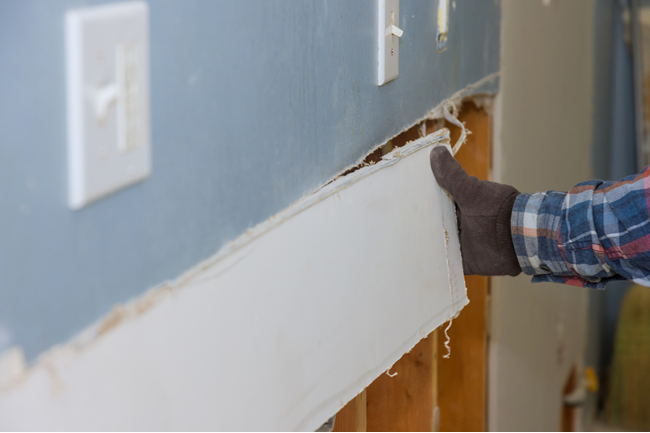
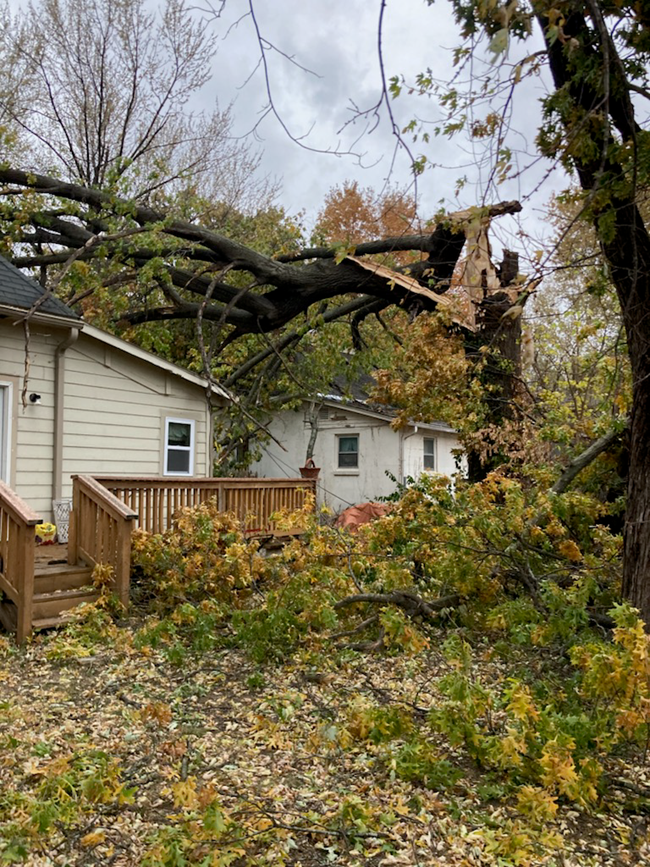
Hurricane damage to rental units has an impact on both landlords and tenants, causing evictions when landlords need to repair damage and creating hardship for tenants unable to find a new rental property.
According to reports, landlord-tenant disputes are unfolding across Florida as people grapple with losing homes and belongings in a relentless hurricane season fueled by climate change and unusually warm ocean waters.
Evictions increase as landlords must deal with local code requirements and laws on not allowing a rental to become “uninhabitable” due to flood and wind damage. Many leases in Florida have provisions that terminate leases in case of hurricane damage.
Under state law in Florida, landlords are required to terminate leases of uninhabitable units and return the security deposit, but that’s all. Tenants may not have much else to help them regain their footing. Insurance companies typically don’t cover flooding in rental units, even flooding caused by a hurricane.
Research from the Georgia Institute of Technology and Brookings Institute shows that renters would benefit from improved policies for coping with natural disasters. The study found that rents rise 4% to 6% immediately in an area affected by a disaster — and then continue to rise for three years.
Bloomberg reports that at the height of the 2021 hurricane season, then-Congresswoman Val Demings, who represented Florida’s District 10 in the U.S. House of Representatives, introduced a bill that would have mandated an automatic 90-day moratorium on evictions in areas affected by disasters. But the bill failed to pass, and the following year, when Hurricane Ian tore through central Florida, the costliest storm in state history at that time triggered the kind of tenant crisisthe bill was designed to help prevent.
Landlord Hank Rossi pointed out that some of his tenants who had rental insurance were not covered when their rental flooded because their renters’ insurance did not cover flooding.
Landlord-Tenant Disputes Over Repairs to Damaged Rentals
In one example, tenants asked a landlord for 30 days before moving out of the damaged rental, and it caused a huge dispute.
The landlord denied the request because according to the lease, in case of a hurricane, “I get to do emergency damage repair. I got to get in here [and] do it, or it’s going to be black mold, and you’re going to die. And not only that, you have to leave. I’m sorry,” one landlord said he told the tenants.
“The bottom line is the house is unsafe to be in,” the landlord told WUSF.org. “It is not even close to being in code. There are electrical problems, I have water over outlets. I got all kinds of stuff I gotta fix and they can’t be in there.”
“Sadly, the state of Florida has very little to no protections for this scenario. No requirement for relocation assistance for folks that are flooded out and just cannot come back to their homes,” said Ivanna Gonzalez, chief campaigns officer at Florida Rising, a nonprofit that advocates for housing rights, among other issues, in an interview with WUSF.org.
“There are requirements in state law that call for landlords to ensure the habitability of the properties that they rent. And so there’s some some leverage there for a renter, but it absolutely requires the resources to sue a landlord for violating the terms of their contract,” said Gonzalez.
Operators need to be careful about how often they incentivize property reviews, including moderating how many are promoted.
By Jen Tindle
I recently caught up with a colleague from the West Coast. Due to the high cost of living in their area, they’ve been renting for years. Unprompted, they went on a rant about their rental experiences: “Ugh, I wish there was a Fakespot for apartment reviews. I’m sick and tired of going to all the effort of moving only to find out how bad the property management is in my new house [aka unit]. You can’t trust anything you see online anymore. It’s just a bunch of promoted posts.”
Renters Seek Authenticity
My friend has a point. How authentic are reviews if you’re always offering freebies, gift cards, raffle prizes, etc. to get those 5 stars? Yes, the FTC banned incentivizing positive reviews. However, you can still legally incentivize reviews as long as you do not request reviews of a certain sentiment. We know from social psychology that when someone gives you a gift, you feel obligated to return the favor. As a result, incentivized reviews will likely lean towards a positive sentiment. The ban may eliminate fake reviews, but it may not eliminate inauthentic ones.
While property owners and managers want properties to show well online, they must also be authentic. Vanessa Van Edwards in her book, Captivate, shared that the No. 1 habit that annoys people the most is inauthenticity.
Why am I bringing all of this up? Because I did a sentiment analysis of comments from ORM solutions (where residents leave online, public reviews) compared to resident satisfaction surveys (where residents share internal, private feedback with management). I focused on maintenance, as that was a commonality measured on both platforms. Year-to-date, there was a significant disparity between the results.
Maintenance comments for ORM solutions showed a Positive to Very Positive average sentiment. On the other hand, resident surveys were Neutral on average. In other words, how residents really feel is a whopping two hops away from what they’re showing online! They feel Neutral about maintenance, and yet in online reviews, they’re saying they feel almost Very Positive.
Providing a More Holistic Picture
This data comparison reveals two important takeaways. First, operators need to be careful about how often they incentivize reviews, including moderating how many are promoted so that prospects can see honest feedback. In fact, 72% of buyers want to see negative reviews. It may be counterintuitive, but some bad reviews are a good thing! Bad reviews give property managers an opportunity to turn a negative situation into a positive one. And when renters don’t see negative reviews, the property will fail their internal lie-detector test. They will quickly resume their online search for more trustworthy properties.
Second, this isn’t a suggestion to avoid managing online reviews; teams still need to ensure that properties are painted in a positive light. This simply means that online reviews can’t be trusted to give a complete picture of a property’s performance. Resident surveys and an ORM solution are both needed. Having the combination of public and private feedback from residents can help gut-check a property’s performance.
By having a more thoughtful approach to achieving accurate online reviews — that aren’t overly incentivized and include the negative too — operators can paint a more accurate picture for both management teams and future residents alike.
About the Author
Jen Tindle brings over a decade of experience in commercial real estate, innovation, and data analytics to her role as VP, Strategic Insights at Grace Hill, which provides technology-enabled performance solutions to help owners and operators of real estate properties. Visit us at gracehill.com or on LinkedIn.
About Grace Hill
Grace Hill provides technology-enabled performance solutions that help owners and operators of real estate properties increase property performance, reduce operating risk and grow top talent. Its industry-leading solutions covering policy, training, assessment, survey and data-driven insights are bolstered by years of real estate experience, in-depth service-level expertise and outstanding customer support. Today, more than 500,000 real estate professionals from more than 2,300 companies rely on talent performance solutions from Grace Hill.
Are rent prices in Zillow and Rentometer accurate is the question this week for Ask Landlord Hank. Remember Hank is not an attorney and is not offering legal advice. If you have a question for him please fill out the form below.
Hi, Hank,
Do Zillow and Rentometer avoid the recent rent-setting issues in the industry?
Or do they also fall under that illegal collusion problem you highlighted in your article, thanks.
-Mary
Hi, Landlady Mary,
I see Zillow and Rentometer as tools and opinions I can use to see what these sites think are market rents.
I’ve found that Zillow’s rent estimate is not very accurate, and I don’t use Rentometer.
When I want to determine market rent I look at all the rentals near my target property that are the same in as many respects as I can find. and see what has rented for how much over the last six months.
What has actually rented is a better gauge, in my mind, of market rent.
Actively marketed properties that haven’t yet rented could have dream rents or hoped-for rents rather than market rent.
I also like to start advertising before the tenant has moved out IF I can determine how long it will take to get that unit market-ready and make sure the tenant will be agreeable to showings.
Most leases require tenants to allow showings, but sometimes it doesn’t work out that way. If you advertise at market rent or slightly below, you should be able to rent your place quickly.
Tenant screening is paramount, so take a good tenant or wait until the right one comes along.
Sincerely,
Landlord Hank says, “Actively marketed properties that haven’t yet rented could have dream rents or hoped-for rents rather than market rent.”
Hank Rossi
Each week I answer questions from landlords and property managers across the country in my “Dear Landlord Hank” blog in the digital magazine Rental Housing Journal. https://rentalhousingjournal.com/asklandlordhank/
Ask Landlord Hank Your Question
Ask veteran landlord and property manager Hank Rossi your questions from tenant screening to leases to pets and more! He provides answers each week to landlords.
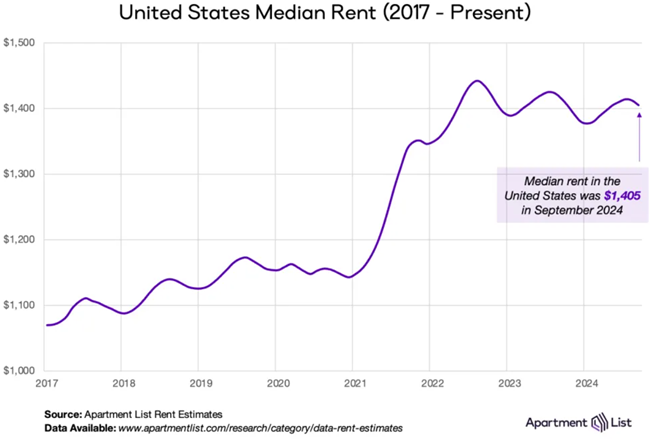
The national median rent dropped 0.5% in September, according to the October report from Apartment List. 80 of the nation’s 100 largest cities saw rents fall in September, in line with the broader national seasonal trend.
The national median rent now stands at $1,405, and “we’re likely to see that number continue to dip modestly through the remainder of the year,” the Apartment List research team writes in the report.
The research team’s analysis shows “the seasonal declines in rent prices that take place during the fall and winter have been steeper than usual, and seasonal increases of the spring and summer have been milder.
“As a result, apartments are on average slightly cheaper today than they were one year ago. Year-over-year rent growth nationally currently stands at -0.7 percent and has now been in negative territory for over a year and a half. Despite this, the national median rent is still more than $200 per month higher than it was just a few years ago,” the research shows.
Apartment vacancies remain elevated
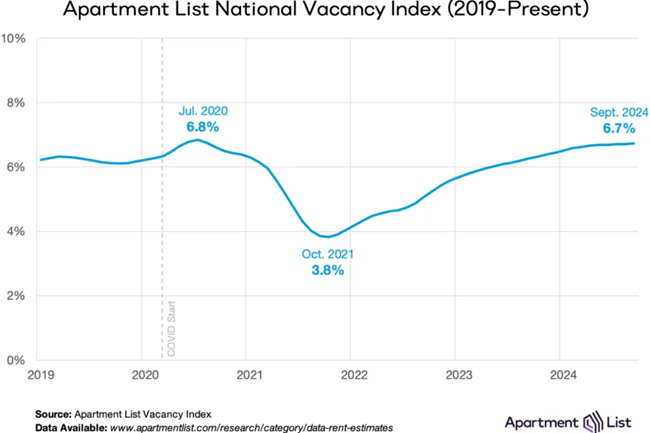
Vacancies have been opening up steadily for over two years, the report says.
As of September, “our vacancy index sits at 6.7 percent, the highest level since August 2020. And there’s good reason to expect that it could rise even further during the remainder of the year.”
New supply driving falling rents in Sun Belt markets
The Midwest and Northeast are maintaining and growing rents in some cases as steady rental demand is not being matched by supply growth.
In the falling rents in the Sun Belt, the Austin metro has seen the nation’s sharpest decline among large metros, with prices there down 7.2 percent in the last 12 months
Conclusion
While rental demand has bounced back a bit this year, recent signs of labor market softness could dampen demand going forward. “With this in mind, we expect that new supply will continue to outstrip demand into 2025,” the report says.
The U.S. Department of Justice has sued the owners and managers of an apartment complex for discriminating against Black tenants over felony and criminal history background checks, according to a release.
The suit alleges that Suburban Heights Apartments near St. Louis “engaged in a pattern or practice of race and/or color discrimination against prospective Black tenants by banning tenants with any past felony conviction and certain other criminal histories, in violation of the Fair Housing Act.” The felony ban was in place regardless of how old the felony was or the nature of the offense, the suit says.
The complaint was filed in the U.S. District Court for the Eastern District of Missouri and alleges that, during their respective periods of ownership or management of the property from at least November 2015 to January 2024, “the defendants publicized and enforced a categorical ban on tenants with felony convictions and certain other criminal histories, regardless of how long ago the conviction occurred.
“This policy excluded prospective tenants based on their criminal histories, which are known to have significant racial disparities, and which are not accurate proxies for actual underlying criminal activity nor reliable predictors of future criminal activity. By choosing to use that policy, the defendants likely deterred prospective Black tenants from applying to rent and excluded them from housing opportunities at Suburban Heights Apartments,” the Justice Department says in the release.
Suburban Heights is a residential multifamily-rental apartment complex located at 5512 Mable Ave. in Kinloch, Missouri. It contains approximately 102 rental units in six two-story buildings.
“Rental-property owners and managers that ban tenants with a criminal history risk running afoul of the Fair Housing Act,” said Assistant Attorney General Kristen Clarke of the Justice Department’s Civil Rights Division in the release. “This lawsuit should send a clear message to housing providers that certain criminal-history bans on people seeking to put a roof over their heads are not just unfair but unlawful.”
The allegations were based, in part, on evidence generated by the department’s Fair Housing Testing Program, in which individuals pose as prospective renters to gather information about possible discriminatory practices.
The lawsuit seeks monetary damages to remedy the harms caused by the defendants’ policy, a civil penalty to vindicate the public interest, and a court order barring future discrimination.