Home Blog Page 33

DOJ Sues Landlords Over Banning Tenants with Felonies

The U.S. Department of Justice has sued the owners and managers of an apartment complex for banning tenants with felonies

The U.S. Department of Justice has sued the owners and managers of an apartment complex for discriminating against Black tenants over felony and criminal history background checks, according to a release.

The suit alleges that Suburban Heights Apartments near St. Louis “engaged in a pattern or practice of race and/or color discrimination against prospective Black tenants by banning tenants with any past felony conviction and certain other criminal histories, in violation of the Fair Housing Act.” The felony ban was in place regardless of how old the felony was or the nature of the offense, the suit says.

The complaint was filed in the U.S. District Court for the Eastern District of Missouri and alleges that, during their respective periods of ownership or management of the property from at least November 2015 to January 2024, “the defendants publicized and enforced a categorical ban on tenants with felony convictions and certain other criminal histories, regardless of how long ago the conviction occurred.

“This policy excluded prospective tenants based on their criminal histories, which are known to have significant racial disparities, and which are not accurate proxies for actual underlying criminal activity nor reliable predictors of future criminal activity. By choosing to use that policy, the defendants likely deterred prospective Black tenants from applying to rent and excluded them from housing opportunities at Suburban Heights Apartments,” the Justice Department says in the release.

Suburban Heights is a residential multifamily-rental apartment complex located at 5512 Mable Ave. in Kinloch, Missouri. It contains approximately 102 rental units in six two-story buildings.

“Rental-property owners and managers that ban tenants with a criminal history risk running afoul of the Fair Housing Act,” said Assistant Attorney General Kristen Clarke of the Justice Department’s Civil Rights Division in the release. “This lawsuit should send a clear message to housing providers that certain criminal-history bans on people seeking to put a roof over their heads are not just unfair but unlawful.”

The allegations were based, in part, on evidence generated by the department’s Fair Housing Testing Program, in which individuals pose as prospective renters to gather information about possible discriminatory practices.

The lawsuit seeks monetary damages to remedy the harms caused by the defendants’ policy, a civil penalty to vindicate the public interest, and a court order barring future discrimination.

Read the full lawsuit here.

Sign Up For Our Weekly Newsletter And Get Rental Property And Apartment News And Helpful, Useful Content Each Week.

* indicates required

Salt Lake City Utah Rents Down In September

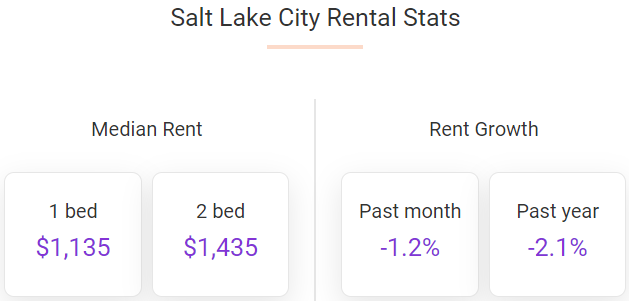
Salt Lake City rents dropped 1.2% in September, according to Apartment List so the overall median rent in the city stands at $1,312

Salt Lake City Utah rents dropped 1.2% in September, according to the October report from Apartment List.

The overall median rent in the city stands at $1,312, after falling 1.2% last month. Prices are now down 2.1% year-over-year.

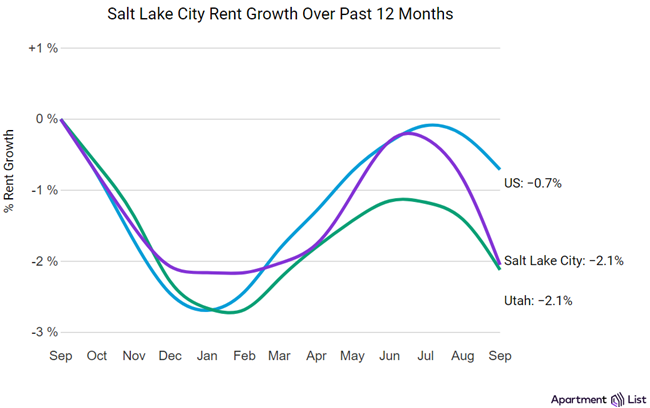
Salt Lake City’s rent growth over the past year has is similar to the state average (-2.1%) but has fallen below the national average (-0.7%).

Salt Lake City rent growth in 2024 pacing similar last year

Nine months into the year, rents in Salt Lake City have risen 0.1%. This is a similar rate of growth compared to what the city was experiencing at this point last year: from January to September 2023 rents had increased 0.0%.

Salt Lake City rents dropped 1.2% in September, according to Apartment List so the overall median rent in the city stands at $1,312

Across the metro

Across the metro area, the median rent is $1,495 meaning that the median price in Salt Lake City proper ($1,312) is 12.2% lower than the price across the metro as a whole. Metro-wide annual rent growth stands at -2.2%, below the rate of rent growth within just the city.

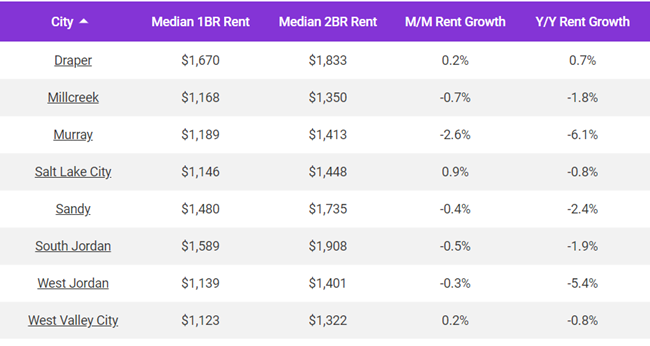
The table below shows the latest rent stats for 9 cities in the Salt Lake City Utah metro area that are included in the Apartment List database.

Among them, Draper is currently the most expensive, with a median rent of $1,939. South Salt Lake is the metro’s most affordable city, with a median rent of $1,268. The metro’s fastest annual rent growth is occurring in Draper (1.5%) while the slowest is in Murray (-4.4%).

Salt Lake City rents dropped 1.2% in September, according to Apartment List so the overall median rent in the city stands at $1,312

The Insurance Secret Every Property Owner Needs to Know

The Utah Landlord’s Playbook: Strategies for Full Bookings

The Utah Landlord’s Playbook: Strategies for Full Bookings

How Pet Poop DNA Testing Fixes Your Apartment Poop Problem

How Pet Poop Testing Fixes Your Apartment Poop Problem

Pets and pet poop are a way of life in rental housing and if you want your rentals fully leased, pet owners are a key tenant demographic you want to keep and apartment pet poop DNA testing can be the key with pooprints.com.

And for companies involved in working with apartments and rental housing providers, “business is booming!” said J Retinger, CEO of BioPet Laboratories Inc. and PooPrints® website.

“We are now servicing over 6,000 communities in six countries. We are currently receiving an average of 300+ pieces of poop a day.  We have also evolved the program to include free perks for the pet owners when a community enrolls in the program,” Retinger said.

“We have PooPrints Pet Parent Perks that they receive when joining our program – credits with Chewy.com, Rover.com, and the BioPet LifePlan,” said McKenzie Towns, Manager, Sales Operations for the company.

“One of the most recent studies to come out of multifamily recently was conducted by PetScreening and J. Turner Research. It found that 84 percent  of respondents ranked pet waste as their No. 1 pet-related concern. We launched an Mobile App to aid in dog registrations and waste collections, and it’s been a huge tech development,” Towns said.

You might have laughed at first at this headline on how apartment pet DNA testing could fix your apartment property’s pet poop problem. Remember studies show 76 percent of millennials are pet owners and a majority are renters.

But here is the reality.

    • Your tenants may be leaving pet poop lying around for you and your maintenance crew to pick up, creating extra work and cost.
    • The pet poop problem can affect your whole apartment community and pit tenant neighbor against tenant neighbor.
    • Your city government may decide your pet waste is polluting the local watershed – which the Environmental Protection Agency will confirm – and decide to fine the landlord, not the tenant.

Unreasonable burden on landlords?

In Chicago, the city turned down an ordinance that would have allowed city inspectors to fine landlords and property owners who didn’t pick up dog poop on their property up to $500. Cherie Travis, former director of Animal Care and Control and the owner of a pair of two-flats in Chicago where she allows pets, told the Chicago Tribune, “I have multiple units — I can’t check every day. That’s an unreasonable burden to place on landlords.

The ordinance that was turned down would have had the unintentional impact “that landlords will not rent to people with dogs. If a tenant cannot find an apartment with a dog, they will either move out of the city or they’ll surrender their dog,” Travis told the newspaper.

So a growing number of apartment complexes are finding a solution in a companies like BioPet’s PooPrints.com that handles the pet DNA testing necessary to fix the poop pick-up problem.

How can you make the tenant responsible for the pet poop?

Here is how it works: Your tenants swab the inside of their dogs’ mouth and provide you that sample DNA for you to send to a company in Knoxville, Tennessee called Poo Prints. When you find poop in the yard that a tenant failed to pick up, you can send a sample to the company and they will identify the offending dog so you can then take it up with the tenant.

“The number one thing for apartment complexes is, ‘How they can clean up the property and make people responsible?’ for their dogs,” said Ernie Jones, former sales manager for BioPet Laboratories, which manages the Poo Prints program. He said some have tried cameras, but that is a huge ongoing expense that requires employees to monitor. And sometimes the video is grainy and hard to see.

“One of the biggest advantages is, it takes away the denial from the tenant about whose dog left the poop on the property,” Jones said. “And it helps avoid the neighbor vs. neighbor accusations about whose dog was responsible for the poop.”

Apartment pet DNA testing

The scoop on how apartment pet DNA testing can fix your apartment poop problem

Photos courtesy of BioPet Labs

Who bears the cost of the pet poop testing program?

So how does the business model work for the company and the apartment properties?

The business model is no longer a startup as PooPrints has  begun to offer alternative registration options in recent years, and the industry as a whole has shifted their focus.

“The whole goal is that the poop goes away. Our partners report a 95 percent waste reduction once our program is implemented, so the poop does stop,” Towns said.

“We’ve found that many operators see more consistent profits from the initial DNA registration component (the cheek swab registrations) – and that is not a declining factor. Communities are becoming more pet friendly all the time, which is just driving more and more registrations. They pass the cost of the registration on to the pet owner and are able to make a small profit with each registration, and offset the cost of the program,” Towns said.

PooPrints offers gradual implementation methods as well. “This allows us to be flexible and work within the budget for a specific community. We want our program to be affordable and something that all pet friendly properties will adopt, so we work hard to evaluate each budget to determine how and where we can fit. Sometimes this means the property registers renewals and lease-ups only – this way they are offsetting the expense as they incur it. Other communities will register 5 dogs/month, or do a rolling implementation of one building at a time. We have really gotten creative to accommodate both the immediate implementations of all dogs at once, and the slower, gradual implementations,” Towns said.

“The main objection for apartments is the start-up costs. If a complex has 100 dogs at $40 per dog to get started, then that is $4,000 that has to come from somewhere that is usually not in the property’s budget,” Jones said.

However, “once a program is in place, it creates increased occupancy,” he said. “It is just in the beginning and the immediate rollout that is sometimes an issue. In terms of rollout when people want it, it takes about a year in an existing complex to get the program in place.”

“Typically the pet owner bears all the cost,” Jones said, and “not the apartment complex itself.  Typical start-up cost is $40 to $60 per resident dog. Some apartments have to ‘grandfather’ in existing pet owners and gradually start the program with new residents and when leases come up for renewal.”

Tenant fines are typically the way apartments handle the violations when poop is found. One Chicago complex fines tenants $250 for the first violation, and $350 after that that, according to the Chicago Tribune.

Depending on different state regulations, apartment managers may not be able to use the word “fine” when they discover the offenders and want to assess a penalty. Apartment owners will need to check their state regulations on wording for how they can assess a monetary penalty. For instance, “Oregon is tight on how they let the apartments charge tenants for violations,” Jones said.

The environmental issue around pet poop


The Scoop On How Pet DNA Testing Fixes Your Apartment Poop Problem

In addition to keeping apartment grounds clean, there are issues with the Environmental Protection Agency from a water pollution and safety concern.  “Dog waste is thousands of times” more polluting than you may think, Jones said.

“The average person today thinks of dog waste as simply a nuisance when they step in it.   They are also under the assumption that it simply turns into fertilizer, as other waste,” the company said in a release. “In fact, dog waste is not fertilizer and does not simply deteriorate; instead, dog waste is the most contaminated waste of any animal.   Their bodies have adapted over the years to digest any type of foods; as such, they produce huge quantities of bacteria, including E-coli. “

Other pet facts from BioPet Laboratories:

    • Dog waste has been ranked as the #6 consumer complaint.
    • The EPA ranks dog waste as an environmental problem equal to toxic chemicals and oil spills.
    • According to one study, which has its critics, an average dog has twice the carbon footprint of an SUV.
    • One dog dropping contains 3 billion bacteria.  Because it does not evaporate, the poop goes into the air and ground water, creating major contamination.
    • Studies have shown that waste from 100 dogs, in one day on a river bank, can contaminate the water for 1 mile downstream.


The scoop on how apartment Pet DNA testing could solve your apartment pet poop problem

The EPA classified pet waste as a dangerous pollutant. And this doesn’t come from folks jumping on the “green” bandwagon; this classification was made nearly 20 years ago, according to Animal Wellness Magazine.

In 1991, the Environmental Protection Agency classified dog waste as a “non-point source of pollution,” which puts it in a category with oil and toxic chemicals. According to the EPA, a single gram of dog waste can contain up to 23 million fecal coliform bacteria, which is capable of causing cramps, diarrhea, intestinal illness and kidney disorders in people, according to a story in the Knoxville News-Sentinel.

As for its effect on the watershed, waste from 100 dogs could add enough bacteria to temporarily close a bay and watershed areas within 20 miles to swimming and shell fishing, the EPA estimates.

Seattle watersheds example of pet poop problem

All solutions begin with excrement pickup. If you are among the 38% of dog owners who scoff at this duty, according to a story in the Los Angeles Times, consider what DNA tests revealed about the bacteria in Seattle watersheds: Although 90% or more of it comes from animals in general, some of them wild, fully 20% of it is traced back to the guts of dogs, according to the newspaper. The EPA’s Clean Water Campaign puts it, “If you think picking up dog poop is unpleasant, try swimming in it.”

Cities are going to start leaning on the big apartment complexes from an environmental standpoint to clean up their grounds to stop the runoff contamination. Dense urban areas are a particular problem.

“Dog waste draws rodents, rodents draw feral cats,” Jones said.

His company said in a release, “One other major issue seldom understood is that rats eat dog waste:  the more left on the ground, the greater the rat population and also the diseases they can pass on.   Many major cities have reported a large increase in rat numbers in parallel with the growth of their dog population.  This is not about whether someone doesn’t like to pick up their dog’s dropping.  This is a social responsibility and about protecting the environment.”

Current compliance systems not working

Dog waste can be disposed of properly, the company says, but not by the present system of compliance.

“Every community has tried signs and public information programs.  Some have even spray-painted the waste to show its prevalence.  None of these methods have worked,” the company said in the release. “Dog owners must be accountable.  And the only proven way to make that happen is with DNA detection.”

Do tenants try to beat the system?

Do tenants try to beat the testing system?

Photo©halfpoint collection via Canva

Jones said apartment complexes have issues with tenants who try various means to avoid the DNA fee, such as hiding dogs to avoid registering their pet during a rollout.

One tenant with a white bulldog came up with another plan to beat the system.

Jones tells the story of one property in the program that kept picking up poop and getting “no matches” and could not figure out what was going on.

The mystery was solved when they found out that a tenant who had registered his white bulldog bought a second, almost identical, white bulldog he did not register. He walked them one at a time so most people could not tell which dog was which. Eventually it was discovered that the second white bulldog turned out to be the source of the “mystery poop.”

Towns said, “Residents do indeed hide their dogs. However, PooPrints is actually a technology that helps operators locate unregistered dogs.

“PooPrints uses a No Match Report tool, which outlines any waste sample that did not match a currently registered dog and creates a special “unregistered profile” for it. This profile is kept on file and compared to any newly registered pets, and other No Match waste samples. Using the data, PooPrints generates a report called a No Match Report. It outlines all No Matches from the same dog, when they were collected, and where. (Collection notes are submitted by the property).

“This proves to be incredibly helpful because we create this easy report that basically says “you have one dog that is responsible for 4 no matches. All of these No Matches are around building 5 and started occurring in November of 2021. You likely have a new move-in that skipped pet registration,” Towns said.

“Onsite teams use this report to nab those repeat unregistered offenders. From there, they can register the pet, collect the pet fee and recurring pet rent, and apply any fines from the previous No Matches that flip to Matches once the pet is registered.

“We’ve also seen our fair share of DNA swabs that get sent home with residents – which we do not recommend. Then when they come back to us, we determine there’s human DNA on the swab, rather than canine.

“We simply issue reswabs and ensure that the property invites the resident to the clubhouse so the onsite team can witness the swabbing of the dog.

“It’s always entertaining to think that a resident doesn’t want to pick up bad enough that they are willing to swab themselves,” Towns said.

 If a property finds pet poop what happens next?

All the poop testing samples come into the company headquarters in Knoxville from across the country.

The U.S. Postal Service delivers all the samples in special-leak proof bottles with a special solution that protects and preserves the pet poop DNA.

Apartment property managers say the apartment pet poop DNA testing works to solve the problem

How testing can solve the dog waste problem at your apartments

“We use it as a sales tool. It’s something we knew we’d implement right at the beginning,”  Kris Tomlinson,  property manager at the Residences at Fountainhead in west Tempe, a 320-unit apartment complex, told the Arizona Republic.

Violators are assessed a $250 fine. Tomlinson said the pet poop testing program has proven an effective deterrent, as only one person has been assessed the fine in the past year.

“We told them it was their dog, charged the $250 fine. They weren’t happy, but then they tell their friends because they’re (upset)” he told the newspaper.

Everything Landlords Should Know About Emotional Support Animals

Also: 7 Questions Landlords Have About Pets and Pet-Friendly Apartments

Sign Up For Our Weekly Newsletter And Get Rental Property And Apartment News And Helpful, Useful Content Each Week.

* indicates required

Welcoming Pets Is a Smart Financial Move In Rental Housing

Emotional Support Animals and the Fair Housing Act

Everything Landlords Should Know About Emotional Support Animals

The Median Rent In Vancouver Fell In September

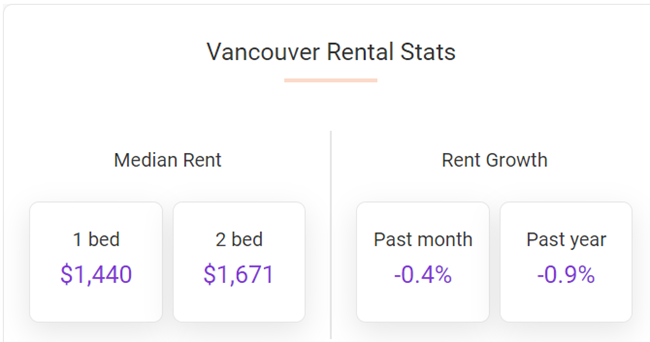
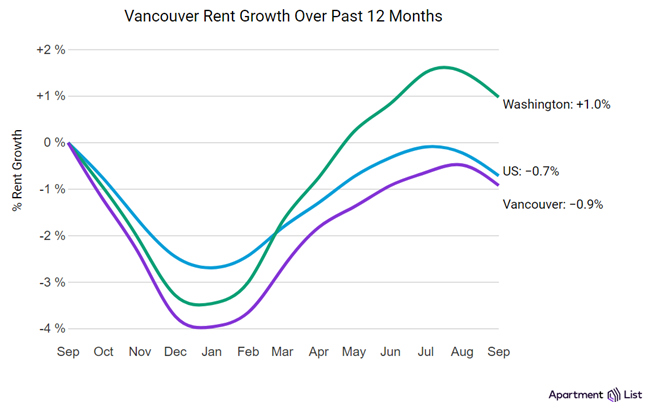
The median rent in Vancouver fell 0.4% in September and Vancouver rents have now decreased by a total of 0.9% over the past 12 months

The median rent in Vancouver fell 0.4% in September, according to the October report from Apartment List.

Rents in the areas have now decreased by a total of 0.9% over the past 12 months. The rent growth over the past year has fallen behind the state average (1.0%) and is similar to the national average (-0.7%).

Vancouver rent growth in 2024 pacing above last year

Nine months into the year, rents in Vancouver have risen 3.2%. This is a faster rate of growth compared to what the city was experiencing at this point last year: from January to September 2023 rents had decreased 1.1%.

The median rent in Vancouver fell 0.4% in September and Vancouver rents have now decreased by a total of 0.9% over the past 12 months

Vancouver rents are 0.5% lower than the metro-wide median

Across the Portland metro area, the median rent is $1,694 meaning that the median price in Vancouver ($1,685) is 0.5% lower than the price across the metro as a whole. Metro-wide annual rent growth stands at 1.3%, above the rate of rent growth within just the city.

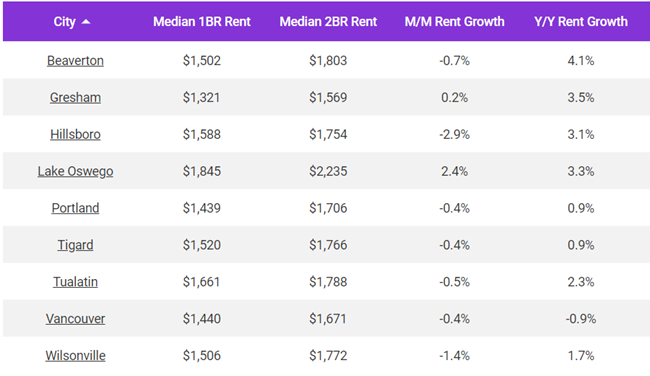
The table below shows the latest rent stats for 9 cities in the Portland metro area that are included in the Apartment List database.

Among them, Lake Oswego is currently the most expensive, with a median rent of $2,107. Gresham is the metro’s most affordable city, with a median rent of $1,548. The metro’s fastest annual rent growth is occurring in Beaverton (4.1%) while the slowest is in Vancouver (-0.9%).

The median rent in Vancouver fell 0.4% in September and Vancouver rents have now decreased by a total of 0.9% over the past 12 months

September Saw 0.5% Drop in National Median Rent

Stay Ahead of the Game: Avoiding Multifamily Hurdles Before They Occur

Strong Delivery Of New Apartments Levels Off Rents

Oregon Rent Control Will Allow A 10% Rent Increase in 2025

The annual maximum rent increase allowed by statute for calendar year 2025 and the Oregon rent control law maximum percentage is 10%

The Oregon Department of Administrative Services (DAS) has published the annual maximum rent increase allowed by statute for calendar year 2025 and the Oregon rent control law maximum percentage is 10%, according to a release.

The rent increase is 7% plus the annual 12-month average change in the Consumer Price Index for All Urban Consumers, West Region (All Items), as most recently published by the Bureau of Labor Statistics of the United States Department of Labor, or 10%, whichever is lower.

The allowable rent increase percentage for the previous year, 2024, was 10%.

Since implementation in 2019, the rate has held around nine or 10%, with the exception of 2023 prior to July 6. The mid-year change was due to a change in the law that capped the rent increase at 10%.

In 2023, Oregon Gov. Tina Kotek signed a revised rent control law, SB 611, which caps rents and prohibits landlords from charging a rent increase annually of more than 10 percent regardless of inflation.

That rent control law also makes key changes to how the maximum-allowable annual rent increase percentage is calculated for residential tenancies.

The bill was passed to fix the previous rent control law that limited rent hikes to seven percent plus inflation. But when the Consumer Price Index showed high inflation, some recent cases resulted in 14 percent rent increases.

SB 611 states that the maximum allowable annual rent increase percentage is calculated as the lesser of:

SB 611 also clarifies that during any tenancy, other than week-to-week, the landlord may not increase the rent more than once during any 12-month period.

Oregon was the first state in the nation to pass a statewide Oregon rent control law.

Sign Up For Our Weekly Newsletter And Get Rental Property And Apartment News And Helpful, Useful Content Each Week.

* indicates required


Some Landlords Changing How They Set Rents

Some landlords are changing how they set multifamily rents as a result of the U.S. Department of Justice lawsuit against RealPage

Some landlords are changing how they set multifamily rents as a result of the U.S. Department of Justice lawsuit against RealPage alleging price-fixing on rents by landlords.

At the Bisnow Southeast Summit in Atlanta, Kenneth Racowski, an antitrust lawyer and partner at Holland & Knight, said, “Many multifamily companies are moving away from RealPage products, moving away from revenue-management software that uses private information and moving away altogether from revenue management [software].”

Racowski said the issue comes down to whether the information used to establish apartment rents is coming from exclusively public sources. Racowski has helped two multifamily companies get dismissals from charges of price-fixing using algorithmic price-setting software, the Bisnow article says.

“The most conservative risk-mitigation advice is not to use revenue-management software that uses confidential nonpublic information,” Racowski said.

RealPage has said in response to the lawsuit that its products that use algorithms are legal. RealPage announced earlier this month a feature that allowed users to remove “nonpublic competitor data” from the results.

Several states, including Arizona, have sued RealPage and landlords for price-fixing and conspiring to illegally raise rents for hundreds of thousands of renters.

“The conspiracy allegedly engaged in by RealPage and these landlords has harmed Arizonans and directly contributed to Arizona’s affordable-housing crisis,” Arizona Attorney General Kris Mayes said in the release earlier this year.

“In the last two years, residential rents in Phoenix and Tucson have risen by at least 30% in large part because of this conspiracy that stifled fair competition and essentially established a rental monopoly in our state’s two largest metro areas,” Mayes said. “RealPage and its co-defendants must be held accountable for their role in the astronomical rent increases forced on Arizonans.”

Melissa White, the chair of the board of directors for the Atlanta Apartment Association, an organization representing more than 300 companies managing more than 415,000 apartment units, said during the Bisnow multifamily event that even the methods by which apartment owners conduct basic competitive-market studies are seen as risky by association.

“Something as simple as a market survey that we have been doing forever is now looked at in a negative manner, and it could impact any involvement companies are having related to this issue,” said White, a partner with the Atlanta-based urban mixed-use development firm Perennial Properties.

“It’s definitely a conversation that you should all be having if you don’t have priorities established for 2025,” she told the audience at the event, Bisnow reported.

Sign Up For Our Weekly Newsletter And Get Rental Property And Apartment News And Helpful, Useful Information Each Week.

* indicates required

FTC Alleges Largest Single-Family Landlord Deceived Renters

The FTC alleges that Invitation Homes, the country’s largest single-family rental landlord, deceived renters about rental costs

The Federal Trade Commission (FTC) is taking action against Invitation Homes, the country’s largest single-family rental landlord, for deceiving renters about rental costs, according to a release.

The FTC complaint is seeking $48 million for an array of unlawful actions against consumers, including deceiving renters about lease costs, charging undisclosed junk fees, failing to inspect homes before residents moved in, and unfairly withholding tenants’ security deposits when they moved out.

The complaint notes that many news organizations have reported on the problems with Invitation homes. Multiple news articles and investigative reports have documented Invitation Homes’ deceptive and unfair practices, including The New York Times (“A $60 Billion Housing Grab by Wall Street,” March 5, 2020), Reuters (“Spiders, sewage and a flurry of fees – the other side of renting a house from Wall Street,” July 27, 2018), The Atlantic (“When Wall Street is Your Landlord,” February 2019), and The Washington Post (“At Invitation Homes, unpermitted work leaves leaky plumbing, faulty repairs, renters say,” July 12, 2022).

“Invitation Homes, the nation’s largest single-family-home landlord, preyed on tenants through a variety of unfair and deceptive tactics, from saddling people with hidden fees and unjustly withholding security deposits to misleading people about eviction policies during the pandemic and even pursuing eviction proceedings after people had moved out,” said FTC Chair Lina M. Khan in the release.

“No American should pay more for rent or be kicked out of their home because of illegal tactics by corporate landlords. The FTC will continue to use all our tools to protect renters from unlawful business practices.”

The proposed settlement would require Invitation Homes to pay $48 million, advertise true rental prices, and stop other unlawful behavior against renters.

The FTC complaint alleges:

  • Invitation Homes advertised monthly rental rates that failed to include mandatory junk fees that could total more than $1,700 yearly.
  • Consumers looking for rental houses paid nonrefundable fees—including application fees up to $55 and reservation fees up to $500—based on the deceptively advertised rates.
  • Consumers learned that the price would be higher than advertised only when they received a copy of their lease, and sometimes not even until after they signed the lease.
  • These undisclosed fees ranged from “services” such as “smart-home” technology and “utility management,” to air-filter delivery and Internet packages.
  • Renters could not opt out of paying these fees. Since 2019, Invitation Homes has collected more than $18 million in application fees alone for deceptively priced houses.

“The complaint also points to multiple times the company actively chose not to disclose the fees prior to consumers paying nonrefundable application and reservation fees, despite the company receiving numerous complaints about the fees after renters learned their actual monthly lease prices were higher than advertised,” according to the release.

Maintenance, security deposits and other issues

The FTC complaint also alleges that:

  • Residents in 33,328 properties submitted at least one work order within the first week after they moved in for issues including plumbing, electrical, and heating and air-conditioning service requests. In some instances, residents reported houses that were unclean and had mold, broken appliances, rodent feces, or exposed wiring.
  • Invitation Homes has systematically withheld renters’ security deposits when they moved out of the company’s houses, including by deceptively and unfairly charging them for normal wear-and-tear, damages that existed before renters moved in, and even renovations.
  • Invitation Homes’ security-deposit refund practices were far outside of national norms, with the complaint noting that, between 2020 and 2022, Invitation Homes returned only 39.2% of consumers’ total security deposit dollars collected, compared to the national average of 63.9%.

The settlement details

Under the terms of the proposed settlement, Invitation Homes would be required to turn over $48 million to the FTC to be used to provide refunds to consumers harmed by the company’s unlawful actions.

The settlement also places a number of requirements on Invitation Homes moving forward. The company would be:

  • prohibited from deceiving consumers about the true rental price of a house, including a requirement to include all mandatory monthly fees in a house’s advertised rental price and disclose whether listed fees are mandatory;
  • prohibited from withholding security-deposit money for damages that are part of normal wear and tear and requiring that any money withheld be used to repair or correct the damage for which it was withheld;
  • prohibited from using withheld security-deposit money to fix issues that were present before the renter moved in or to cover the cost of maintenance, repairs, or capital improvements not related to damage caused by a renter;
  • required to notify consumers about federal, state, or local programs designed to assist people facing eviction;
  • prohibited from filing evictions against certain renters who have already moved out of their house and notified Invitation Homes of their departure.

The settlement, which must be approved by a federal judge before it can go into effect, would also require Invitation Homes to destroy consumer financial data it collected prior to the settlement except under certain conditions, including if that information is needed for current renters.

Read the full complaint here.

Sign Up For Our Weekly Newsletter And Get Rental Property And Apartment News And Helpful, Useful Information Each Week.

* indicates required

Photo credit fiskus via istockimages.com

HUD Charges Housing Providers Over Emotional Support Animal

HUD has charged a housing provider with discrimination over failing to provide accommodation for a tenant with an emotional support animal

The U.S. Department of Housing and Urban Development (HUD) has charged a Florida housing provider with discrimination over failing to provide reasonable accommodation for a tenant with a disability to live with an emotional-support animal, according to a release.

HUD charged Tallahassee, Fla., housing providers Greenbriar Partners, LLC, Jackson Properties and Financial Services, LLC, and Erwin D. Jackson with violating the Fair Housing Act.

According to the complaint, the tenant, who suffers from a mental disability and requires the assistance of an emotional-support animal, moved into the rental without an animal. The tenant then requested a reasonable accommodation in order to get the animal added to her rental unit.

The tenant provided a letter from a licensed mental health counselor who noted in his letter that the tenant had a mental disability and needed to live with an emotional-support animal, “because its presence will mitigate the symptoms of disability.”

The tenant emailed the housing providers stating she was a tenant at the subject property and attached a letter indicating she is qualified for an emotional-support animal. The tenant stated in her email that she had not adopted a dog because she was not approved yet by the housing providers.

Her request for reasonable accommodation was denied by Jackson.

According to the complaint, Jackson stated that allowing the tenant to have an ESA would constitute an undue financial burden and alter the company’s business practices.

Jackson stated that allowing the ESA would force “our company” to lay off employees and would increase the housing provider’s landlord liability insurance rate.

In his email, Jackson added, “Events in the past and medical conditions inhibit my team’s ability to perform their tasks while in the presence of other animals and possesses a direct threat to their safety and their health.”

Jackson ended his email by stating, “Furthermore, your lease can and will be terminated at our discretion as you falsified information in your rental application indicating you had no pets or ESAs. The animal must be removed from the premises by no later than 7 days or a formal eviction notice will be issued.”

The tenant sent the email from Jackson to her legal counsel stating she did not currently have an ESA, but rather, got approved for an ESA and was planning to get one because she had “been on a decline mentally.”

The tenant relocated to an apartment complex that permitted her to have an ESA, though she continued paying rent at the original residence until her lease expired.

HUD’s charge alleges that the housing providers failed to grant the requested reasonable accommodation for an assistance animal. That denial led to economic loss, lost housing opportunity and emotional distress. The charge also alleges that the housing providers violated the Fair Housing Act when they threatened the tenant with an eviction because of her reasonable accommodation request.

“The Fair Housing Act requires housing providers to make reasonable accommodations necessary to afford persons with disabilities an equal opportunity to use and enjoy a dwelling,” said Damon Smith, HUD General Counsel, in the release. “The Department will take action to ensure housing providers comply with their obligations to provide necessary reasonable accommodations.”

Everything Landlords Should Know About Emotional Support Animals

Emotional Support Animals and the Fair Housing Act

Sign Up For Our Weekly Newsletter And Get Rental Property And Apartment News And Helpful, Useful Content Each Week.

* indicates required


Rental Market Tightens Up Even More

The rental market is tightening up even more as rising lease-renewal rates and 94% occupancy has made the rental market tighter than ever,

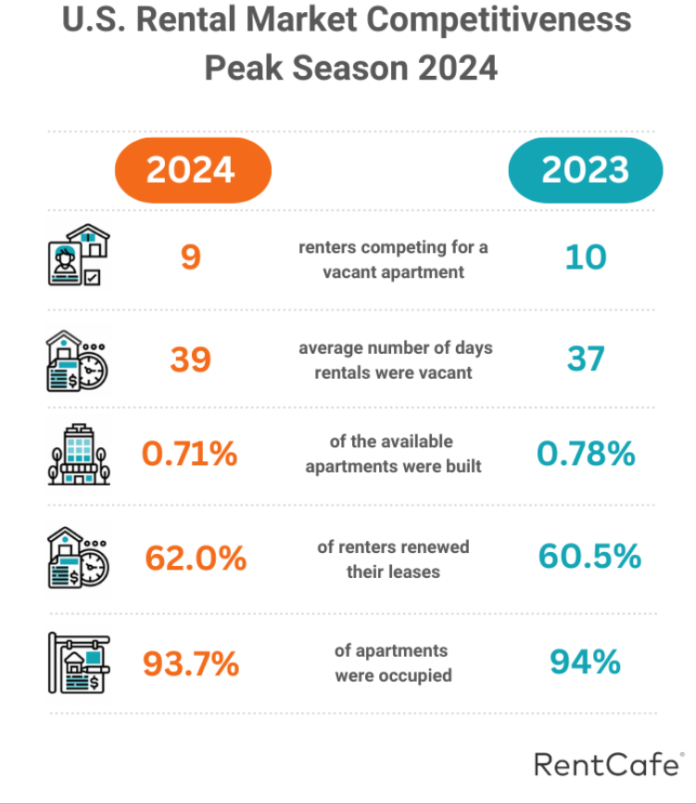
Rising lease-renewal rates and 94% occupancy has made the rental market tighter than ever, according to RentCafe.

“Those hoping for a smoother renting journey in 2024 may need to adjust their expectations,” the latest rental competitive report says. The number of potential renters per apartment remains high.

How the rental market has heated up compared to last year:

  • More renters are choosing to stay put, with the lease-renewal rate rising to 62.0% (up from 60.5% in peak season 2023).
  • Additionally, fewer available units and strong demand are keeping the occupancy rate at a high 93.7% (a marginal 0.3% decrease from 2023).
  • Limited options mean a high number of applicants for each vacant apartment: The number of prospective renters per apartment has barely shifted, dropping from 10 to 9 since last year.
  • The quick turnaround on vacant units is leaving less time for decision-making, as the average number of vacant days for an apartment is 39 (just 2 days up from 37 last year).
  • The share of new apartments has dropped from 0.86% last year to 0.65% this peak season, slowing the addition of modern rentals and leaving renters with fewer options to choose from.
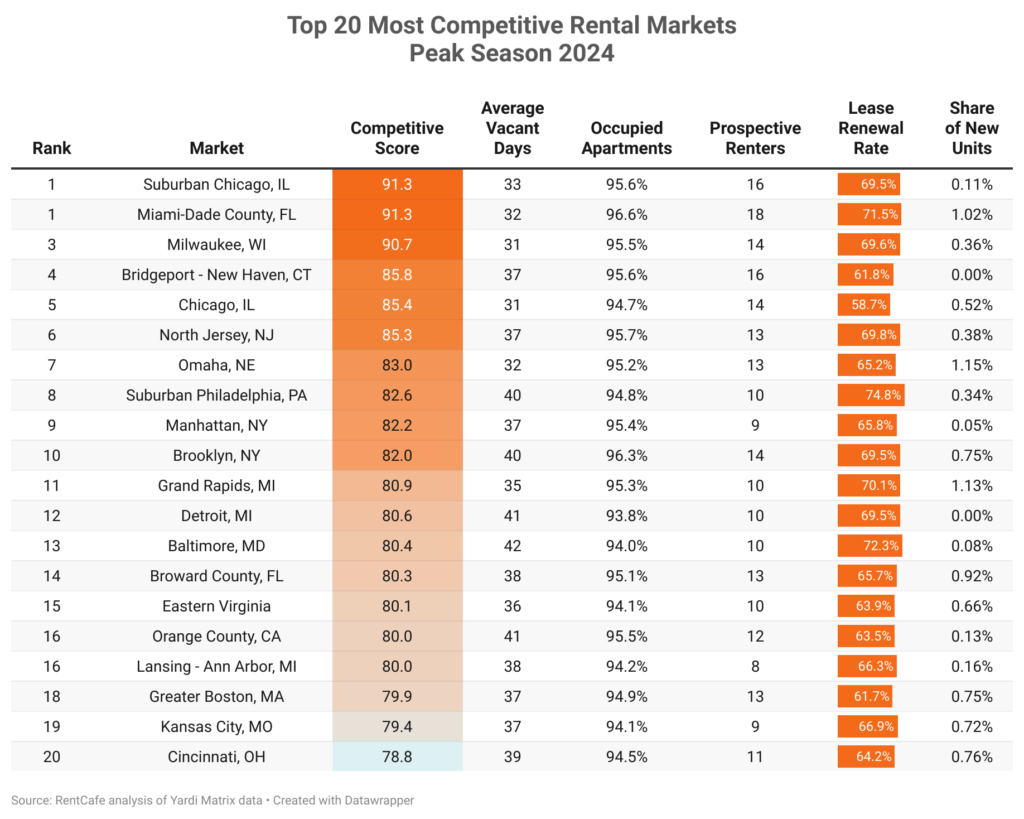
  • Based on these metrics, “We calculated a Rental Competitiveness Index (RCI) of 75.8 for the peak moving season, up from 69.4 in 2023, indicating a more competitive U.S. rental market,” RentCafe says in the report.

The rental market is tightening up even more as rising lease-renewal rates and 94% occupancy has made the rental market tighter than ever,

Why renters prefer to renew leases

In many cases, renters prefer to renew (as opposed to searching for a new place) during the moving rush because it helps them avoid rent increases that typically come with signing a new lease while potentially getting renewal incentives, the report says.

“This choice often helps renters save money on moving costs, application fees and security deposits. Choosing to renew their leases also allows renters — especially families with children in school — to remain settled for longer. Of course, home prices and mortgage rates are also keeping potential homebuyers in the rental market longer,” RentCafe says.

Read the full report here.

Sign Up For Our Weekly Newsletter And Get Rental Property And Apartment News And Helpful, Useful Content Each Week.

* indicates required

Is Smoking Considered A Disability Under Fair Housing?

Is smoking considered a disability or is nicotine addiction considered a disability under under fair housing act rules

Smoking and housing policies often intersect in ways that raise questions about resident rights and property management responsibilities. One common point of confusion is whether smoking or nicotine addiction qualifies as a disability under the Fair Housing Act (FHA). While marijuana use for medical purposes introduces its own complexities, this article will focus specifically on cigarette smoking and how the FHA applies in these cases.

By The Fair Housing Institute

What is Smoking? Does Nicotine Addiction Qualify as a Disability?

At its core, smoking is the act of inhaling and exhaling the fumes of burning plant material, commonly tobacco.

The question of whether nicotine addiction qualifies as a disability is critical, especially in the context of reasonable accommodation requests under the Fair Housing Act (FHA).

According to the FHA, a disability is defined as a physical or mental impairment that substantially limits one or more major life activities. While addiction is recognized as a serious health condition, nicotine addiction, specifically smoking, does not qualify as a disability under the FHA.

Smoking is considered a personal choice, even if it is difficult to quit, and therefore does not meet the legal criteria for reasonable accommodation in housing settings. The law does not require housing providers to treat smokers differently or make special accommodations for their habit.

Can Properties Dictate Anti-Smoking Policies?

Yes, property owners have the right to establish and enforce anti-smoking policies.

The Fair Housing Act permits housing providers to regulate or ban smoking on their properties, as long as these rules apply to all residents equally and are clearly outlined in rental agreements or property guidelines.

Enforcing these policies, however, can be tricky. Clear communication with residents about smoking restrictions and the consequences of violating them is essential.

Properties are within their rights to penalize or evict residents who breach non-smoking rules, provided they do so in a consistent and fair manner. This is particularly relevant in multifamily housing, where secondhand smoke can impact the health and well-being of others.

Does HUD Require Properties to Have Designated Smoking Spaces?

The U.S. Department of Housing and Urban Development (HUD) does not require housing providers to offer designated smoking areas, but many property managers choose to do so to reduce conflicts between smokers and non-smokers.

The decision to provide such areas often depends on the type of property. In private market properties, it’s at the owner’s discretion, while HUD considers it a best practice, though not a requirement, for federally funded properties.

Even though it’s not mandated, offering designated smoking areas can show sensitivity to all residents’ needs. For example, placing these areas away from doors, windows, and communal spaces helps minimize the impact on non-smokers while still providing smokers a designated place.

Balancing Property Policies and Fair Housing Regulations on Smoking

Smoking itself is not considered a disability under the Fair Housing Act, and property managers are not required to make accommodations for individuals who smoke.

However, anti-smoking policies are legally enforceable, provided they are applied equally to all residents.

While HUD does not mandate designated smoking areas, providing them can help create a more harmonious living environment by respecting the preferences of both smokers and non-smokers.

Balancing these considerations through clear communication, thoughtful policies, and training is key to maintaining a fair and healthy community.

About the author:

In 2005, The Fair Housing Institute was founded as a company with one goal: to provide educational and entertaining fair-housing compliance training at an affordable price at the click of a button.

The Use Of Marijuana – A Fair Housing Challenge