
Home Blog Page 199

7 great reasons to invest in smaller multifamily real estate

Are smaller multifamily buildings a better fit for many real estate investors than larger multifamily commerical buildings? This week veteran real estate investor Richard Montgomery, who knows real estate investing, from up-close, get-your-hands-dirty rehab to armchair investing using your self-directed IRA as your funding vehicle, takes on this question from a reader:

Reader Question: Monty, my wife and I are 32 years old and have just finished restoring a big Victorian two-family home in New Jersey. We took on a bit of debt, but I just paid all of the credit cards down and completely paid off a pretty big loan. We currently owe around $280,000 on the mortgage and it is worth around $350,000. Our other two-family is hitting on all cylinders. Debt is looking good and we once again have a good amount of disposable income. I have been looking at multifamily properties on the MLS (Multiple Listing Service) and cannot believe how low they are priced. That combined with interest rates makes me think that this is a fantastic time to buy property. After tax season, we will have $35,000 to invest. Should we continue with small multifamily homes or try to go into larger properties?  Ryan C. 

Monty's Answer: Hello Ryan, and thanks for your question. I would caution you that credit card debt might not be the best way to finance the improvements you are making. There are lenders (commercial banks or private lenders) that will fold the cost for building improvements into the mortgage. There is also a FHA 203k loan that folds the upgrades into the loan. You may want to talk with other remodelers, flippers or real estate investors in your area to see how they finance the improvements and lenders they prefer.

Sorting out the multifamily options

sorting out the multifamily options blog by Richard Montgomery

©Photo by Elena Photo via Canva

There are many unknown facts that do not allow a recommendation suggesting you buy larger multifamilyproperties. Earning capacity, industry sector, net worth, total debt and other factors play a role in decisions of that magnitude.

Based on the information you provided it appears you are ready for another two or three-unit building. There are many benefits in creating your portfolio with smaller buildings. Here are some of them:

  1.  A small loan is easier to obtain. It is less risky for both you and the lender, and most lenders make many more small loans than large loans. The underwriting standards for four-unit and smaller buildings are less stringent. 
  2. Small buildings are the largest market. There are considerably more two and three-family multifamily units in most communities than buildings with eight families and larger.  
  3. Many tenants prefer living in smaller buildings. Fewer people and fewer rules can make for a more “homey” environment with some people. There is a greater variety of floor plans and architecture. 
  4. There are more sources of capital. Commercial banks, credit unions, national banks, savings banks and online lenders make these loans.  
  5. As an investment strategy you are spreading your risk among many buildings instead of a few. 
  6. The return-on-investment gains are higher in smaller buildings.  
  7. There are more opportunities to add-value to communities. Seeking fix-ups in older neighborhoods has been a viable business opportunity for generations.   

The most important principles

why smaller multifamily buildings are great for investors

The key to success in building wealth in real estate transcends whether you invest in small or large buildings, it is gaining a good understanding of these principles:

  1. Make yourself an expert in understanding the vital statistics in the submarkets you chose. Sales rate, time on market, list to sell percentage, average price per square foot by style of property, percentage of listings that expire unsold, rental values, home value trends and more. In-and-out sale prices will be the best comparables if the data on renovation improvements is included.

  1. Operate under the principle that one makes money when buying a property, not when selling it. This real estate reality is not widely understood. Determine the cost to renovate against the projected as-complete value is one of the methods used to calculate the price one can afford to pay. 

  1. Make sure the areas you invest in are transitioning toward being a more desirable neighborhood. When you drive the neighborhood, do you see renovation projects under way, younger people on the sidewalks and a recovering business district? Look for completed renovations as a positive sign.

  1. Possibly the most difficult part of building a portfolio of real estate investments is learning how to manage them. Successful property management techniques and practices are the key to the business. Identifying, qualifying, placing and managing tenants are one of the most challenging aspects of rental property ownership. There are a number of ways to learn “how to” beside the school of hard knocks. Numerous books, university level classes, seminars and more, offer a path to enlightenment. This is an area of real estate where working smart trumps working hard.  

Your letter suggests that you are doing well in real estate. It is nice to hear real estate success stories and I wish you continued success.

About the Author:

Richard Montgomery gives no-nonsense real estate advice to readers’ most pressing questions through his website Dear Monty. He is a real estate industry veteran who has championed industry reform for over a quarter century. He knows real estate investing, from up-close, get-your-hands-dirty rehab to armchair investing using your self-directed IRA as your funding vehicle. In his nearly half-century in the industry, Monty has bought and sold investment properties, founded a real estate brokerage company using a non-traditional consumer driven model, run his own successful brokerage and is former CEO of Corporate Relocation Services. He is a consultant to businesses and entrepreneurs and also shares his knowledge with inquisitive readers through syndicated newspaper columns. You can ask him your real estate questions at www.DearMonty.com.

Richard Montgomery answers small multifamily investing question

Resources:

Buy and live in a duplex, triplex or fourplex

Buying a two- to four-unit home

Why smaller properties are great for the beginning investor


smaller multifamily investing


The Top 3 Criteria Renters Use To Evaluate A Property

A survey of active renters shows the top three criteria potential tenants use to evaluate a property are the price, the location and the community environment, according to a recent study.

The survey by Village Green, called the National Renters Index, involved 1,000 respondents in seven markets across the country.

In looking for properties, 59 percent of renters said in the survey they research online before visiting a potential rental property and 65 percent used nationally-known renting websites, such as apartments.com.

Community environment is important to renters who say they want a “homey” look and feel in their apartment community with a high-end feel. The cities included in the survey were Phoenix, Atlanta, Chicago, Dallas, Detroit, Philadelphia and Minneapolis.

The top 3 criteria potential tenants use to evaluate a property

  • Rent price – 85%
  • Location – 81%
  • Community environment – 49%

“The National Renters Index serves as a call to us all that we need to be listening to our current and prospective renters around the amenities and experiences sought from their next rental experience,” Diane Batayeh, CEO of Village Green said in the release.

“Renters should carry the believ that they are getting a special experience filled with amenities and the feel of home,” she said.

The top 4 amenities renters are seeking

  • Homey look and feel – 62%
  • Fits my lifestyle –  60%
  • Ability to issue a maintenance request online – 52%
  • High-end property amenities – 52%

How generations differ in what they want

Online, millennials care most about high quality photos, 69%. GenX and Baby Boomers are looking for clear and thorough information about amenities.

In terms of amenities, millennials are willing to pay more for high-end property amenities, 48% of them, compared to only 25% of Baby Boomers who are willing to pay for the high-end property amenities.

The high-end amenities they are willing to pay more for were smart-time technologies, 45%, and door service and/or a coffee bar, 49%.

The Phoenix renter profile

Community environment is especially important to renters in Phoenix, according to the survey. It has the highest percent of renters who are interested in a community with a “homey” or high-end feel. Facilities are also especially important to Phoenix residents.

About the Index

The first Village Green National Renters Index was conducted online, surveying 1,000 paneled respondents in the seven markets across the country. The survey was conducted using SurveyMonkey and ResearchNow online polls in February and March 2017. Respondents were required to be active renters in a residential community.

About Village Green

Village Green is an award-winning, Detroit-based property management company serving more than 30 cities throughout the U.S. Village Green’s hospitality-based business model is focused on delivering exceptional living through passionate service. The company operated 40,000 units valued in excess of $6.5 billion.

Seattle Bars Landlords From Using Criminal Records To Screen Tenants

The Seattle City Council has passed an ordinance 8-0 to bar landlords from using criminal records to screen tenants based on past arrests or criminal convictions, with the exception of sex offenders, according to a release.

“The Fair Chance Housing ordinance would prevent landlords from screening applicants based on criminal convictions; arrests that did not lead to a conviction; convictions that have been expunged, vacated or sealed; juvenile records,”  Councilmember Lisa Herbold said in a release.  

“The bill also prohibits the use of advertising language that categorically excludes people with arrests or conviction records. The legislation does not apply to people registered as sex offenders who committed their crime as an adult.

“Landlords will still be able to screen applicants based on employment, credit scores, income ratios, or other criteria to ensure people will be good tenants,” Herbold said.  They’ll merely be unable to use criminal history when considering applicants, something no study has shown affects a person’s ability to successfully be a good neighbor or tenant.”

Electronic records make it easy for landlords to check criminal history

“Today, largely because of the new access to data that historically has been less accessible, landlords can reject tenants because they’ve been arrested in the past seven years – not convicted – arrested,” she said.

“For a criminal justice system that disproportionately arrests people of color, punishing someone who hasn’t been found guilty is a true injustice.  For those who have been convicted, the way I see it, you’ve paid your debt to society if you’ve served your time.  Blocking formerly incarcerated people from accessing stable housing is an extrajudicial punishment not consistent with the rule of law.”

Rental housing association opposes the ordinance

The Rental Housing Association of Washington (RHAWA) opposes the law, but its External Affairs Director Sean Martin said told Komonews.com that the Association saw no point in attending Monday's meeting after it passed in Council Committee 6 to 0.

"We knew it was going to be approved today," said Martin, who added the RHAWA will review the decision and consider its options, including a legal review. "A lot of our people are concerned about the liability component. There's a lot of concern."

The RHAWA, whose majority of members have smaller units – about 10 or less, said the measure is poor policy and will put landlords and other tenants at risk by turning a blind eye to most criminal records.

"The big concern is landlords feel pain on this, we are closing doors in access to tenants," Martin told komonews.com.

He insisted all landlords want the same thing: good tenants, and said the law will make it harder to assess risks. He thinks some landlords will opt out of the rental business, possibly shrinking the city's rental market inventory.

Landlords renting part of their own homes and sharing a kitchen or bathroom with a tenant will be exempt, as will primary leaseholders given the authority by landlords to choose roommates, according to the Seattle Times.  People renting mother-in-law apartments or backyard cottages on properties where they live also will be exempt, but micro-housing units will be covered by the ordinance.

Not going into effect for months

Herbold said there will be a delay in the ordinance.

“In addition, the legislation will not go into effect for nearly 6 months in order to support a new Fair Housing Home Program in which the City will help landlords learn how they can implement practices that will affirmatively further fair housing by reducing racial and other biases in tenant selection,” she said in the release.

The Seattle Office of Civil Rights will develop rules for and enforce the ordinance. The office regularly conducts testing to check whether landlords are engaging in discrimination.

Rental applicants will be able to file complaints with the office, which will investigate. For a first-time violation, the maximum penalty will be $11,000; for a second violation in five years, $27,500; and for a third violation in seven years, $55,000, according to the newspaper.

Resources:

Council Approves Fair Chance Housing Legislation: Councilmember Herbold’s Remarks as Delivered

Seattle approves ordinance to stop landlords from using criminal records to screen tenants

Seattle rental applicants’ criminal histories virtually off-limits under new law

Seattle bars landlords from using criminal record to screen tenants

Photo credit wildpixel via istockphoto.com

Landlords Appeal Ruling In Tenant Relocation Lawsuit

Portland landlords, who lost the first round in a lawsuit against the Portland tenant relocation ordinance back in July, have filed an appeal to the judge’s ruling.

The two Portland landlords last February claimed the ordinance, backed by Portland City Councilwoman Chloe Eudaly, the “Tenant Relocation Ordinance,” violated Oregon statutes and the Oregon Constitution.

They filed the appeal with the Appellate Court Administrator in Salem seeking to overturn the judgment entered in the case back in July, signed by Judge Henry Breithaupt, in the Multnomah County Circuit Court.

 Breithaupt stated the ordinance was legal, ruling against landlords Phillip E. Owen and Michael L. Feves’ suit, concluding “the ordinance was a legislative response to a socio-economic problem in the city… such change is not prohibited."

Tenant relocation ordinance disguised rent control

“Though we appreciate the time and effort the court expended on this case, we still strongly believe the ordinance will only aggravate Portland’s housing crisis,” Owen and Feves’ attorney John DiLorenzo said in a release.

 “The court failed to see it for what it is – disguised rent control, which violates state statutes and the Oregon Constitution,” DiLorenzo said.

Eudaly’s ordinance requires residential property lessors to provide relocation assistance amounting to what may often total three months’ rent to tenants (a) who have left a tenancy after a rent increase of 10% or higher (b) who have received a 90-day no-cause termination notice; or (c) reach the end of their lease for a set term and are not offered a renewal. 

That relocation assistance means landlords must pay $2,900 to $4,500 toward relocation costs.

How tenant relocation ordinance violates state law

Owen and Feves’ complaint claimed the ordinance as amended violates state law in at least three ways.

  • First, it effectively “controls the rent that may be charged for the rental of any dwelling unit,” in violation of ORS 91.225.
  • Second, it conflicts with ORS 90.427, which authorizes no-cause terminations of tenancies, by imposing significant financial burdens on lessors who utilize the no-cause termination procedure.
  • Third, the ordinance expressly applies to existing leases and therefore impairs contracts in violation of the state Contract Clause, Article I, section 21, of the Oregon Constitution.

Eudaly says the appeal is a waste of time

"The ruling from Judge Breithaupt was clear and comprehensive. It is disappointing that DiLorenzo and the landlord lobby continue to waste time and money fighting the city in its efforts to stabilize families in their homes,” Eudaly said in a statement in the Portland Tribune.  “Their time might be better spent helping us find additional solutions to the housing crisis instead of trying to take away the only tool we have to help vulnerable people."

Eudaly originally introduced the policy and the city council unanimously approved it within Eudaly's and Mayor Ted Wheeler's first month on the job.

The rule is set to expire in October 2017. The city council is in talks to extend the rule, according to Oregonlive.com

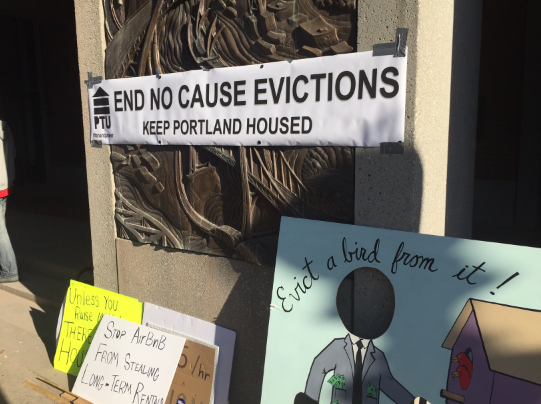
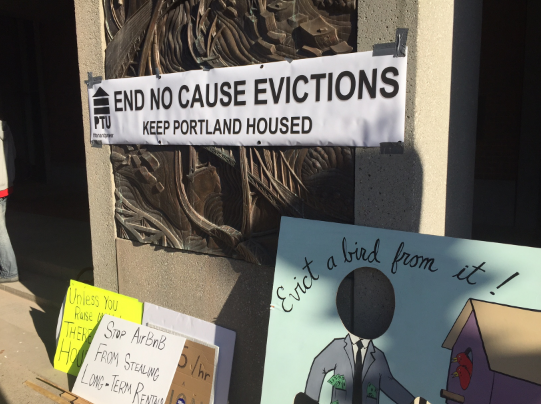
No cause evictions which are tied to tenant relocation were the subject of protests last fall

Resources:

Relocation ordinance information

Landlords appeal ruling upholding PDX tenant protections

Landlords Appeal Judge's Approval of Portland's Renter Relocation Law

Landlords appeal ruling upholding Portland tenant protections

Photos courtesy of Multifamily NW.from protests last year.

Landlords Settle Fair Housing Pet Discrimination Case For $72,000

Northern California landlords have settled pet discrimination allegations that they and their agents discriminated against a female tenant with disabilities who requires an assistance animal, according to a release from the U.S. Department of Housing and Urban Development.

Fair Housing Advocates of Northern California (FHANC) filed a complaint alleging that the owner of the properties (Shultz Investment Co.), representatives of its management company (Greenbrae Management, Inc.) and its leasing agents discriminated against a resident who has a medical condition and required a service dog at the Bon Air Apartments in Greenbrae, California.

The fair housing group also claimed the woman, who had lived at the property for more than 15 years, was subjected to discriminatory statements and retaliation due to the presence of her assistance animal, including false accusations that the animal was disruptive, that it bit maintenance workers, and that it was not a service animal under California law, according to the release.

 The woman’s Housing Assistance Program voucher was ultimately cancelled, forcing her to find housing elsewhere.

HUD investigation confirmed discriminatory statements by property managers

A subsequent HUD investigation corroborated the woman’s need for the dog and discovered written discriminatory statements made by the property managers, according to a HUD release.

HUD found no evidence indicating that the animal was disruptive or had bitten anyone.

“Landlords are required to provide a reasonable accommodation for individuals who require assistance animals,” Bryan Greene, HUD General Deputy Assistant Secretary for Fair Housing and Equal Opportunity, said in the release.

 “HUD is committed to make certain that landlords meet this obligation under the nation’s fair housing laws.

Landlords will pay $72,000 in pet discrimination agreement

Under the Conciliation Agreement, the respondents will pay the woman $31,000; pay Fair Housing Advocates of Northern California $41,000; and develop and implement a reasonable accommodation and reasonable modification policy consistent with the Fair Housing Act.

 The owners will also revise their standard lease to be consistent with the new accommodations policy; send a letter to current tenants notifying them of the new policy; and obtain fair housing training.

“On an ongoing basis, our agency receives many calls from people with disabilities who need reasonable accommodations,” Caroline Peattie, FHANC’s Executive Director, said in the release. “Many of those calls concern service and companion animals; both must receive the same consideration under fair housing law. When a person with a disability requests an accommodation, the housing providers may require documentation that there is a disability and that the request will address that need, but they are required to consider each request individually and engage in an interactive dialogue with the tenant.”

Pet discrimination case settled

The Fair Housing Act prohibits housing providers from denying or limiting housing opportunities to persons with disabilities or imposing different rental terms and conditions. This includes refusing to make reasonable accommodations in policies or practices for people with disabilities.

In addition to the Fair Housing Act’s prohibition against discrimination based on disability, HUD provided guidance in April 2013 reaffirming that housing providers must provide reasonable accommodations to people with disabilities who require assistance animals. Read HUD’s notice.

Fair Housing Advocates of Northern California is a non-profit organization serving several Bay Area counties that provides free counseling, enforcement, mediation, and legal or administrative referrals to persons experiencing housing discrimination. Fair Housing Advocates of Northern California also offers foreclosure prevention services, pre-purchase education, seminars to help housing providers fully understand fair housing law, and education programs for tenants and the community at large. Fair Housing Advocates of Northern California is a HUD-Certified Housing Counseling Agency.

Resources on Pet Discrimination and Housing:

HUD approves discrimination agreement between California Fair Housing Group and Marin County landlords

Fair Housing Advocates of Northern California and a Plaintiff Settle Disability Complaint

California landlords settle over alleged fair housing violation

The Fair Housing Act

Service Animals and Assistance Animals for People with Disabilities in Housing

The conciliation agreement

Multifamily Recycling Issues At Buildings In Portland Metro

A new study says there is inadequate access to multifamily recycling, including mixed recycling and glass recycling service, at many multifamily buildings in the Portland metro area, according to the Multifamily Recycling Project.

The study was a collaborative project between Metro, the cities of Beaverton, Gresham and Portland, and Clackamas and Washington counties. The project focused on gathering and analyzing a range of data about garbage and recycling in apartment and condominium buildings with five or more units, across greater Portland.

The purpose of the project was to define what opportunities for improvement exist in multifamily garbage and recycling collection related to policy, infrastructure, and education, according to the study.

Key multifamily recycling project findings

  • There is inadequate access to mixed recycling and glass recycling service at many multifamily sites. Capacity, or volume, of available garbage, mixed recycling, and glass recycling service is inconsistent from site to site. Less than weekly service of glass recycling or mixed recycling is problematic.
  • The current collection equipment is inconsistent and confusing to those who use it.
  • Contamination in the mixed recycling stream is high.
  •  Bulky waste is inadequately managed

More than 4,000 apartment and condominium building garbage and recycling accounts were analyzed to identify median per household, per week service levels for each collected stream. This information was then used to calculate the median household volume of garbage, mixed recycling, and glass recycling service, and the ratio of mixed recycling volume compared to garbage service volume.

“Less than weekly glass recycling service presents health and safety issues for people living in multifamily households. Bins can overflow and garbage and mixed recyclable materials litter collection areas. When a large quantity of glass collects outside of the bin water can be trapped for prolonged periods of time and broken glass presents a safety issue to children and adults accessing the area,” the study says.

Help needed for multifamily recycling efforts

Multifamily recycling issues in Portland metro apartment buildings

Apartment residents typically have a high mobility rate, meaning they move more often and are more likely to encounter multiple garbage and recycling collection areas, according to the study.

 A 2016 survey done by the National Apartment Association reports a turnover rate of 53 percent for market rate apartments. Put another way, 53 percent of people in rental apartment homes are “new” residents at that site every year. This includes people moving from site to site within the greater Portland area.

The high rate of turnover makes a simple, intuitive, easy-to-learn, and consistent system for collecting garbage and recyclables extremely important.

Bulky waste collection an additional issue

The term “bulky waste” includes furniture such as sofas, chairs, dressers, console televisions, mattresses, appliances, and larger size pieces of carpet and carpet pad.

Bulky waste has long been, and currently is, inadequately addressed within the multifamily garbage and recycling collection system. Under current service provisions, bulky waste is an “on call” service at the property manager’s request, with a separate, additional charge for service.

Bulky waste can create unsafe and unhealthy situations in garbage and recycling areas. It negatively contributes to people’s experience and perception of their garbage and recycling service.

92 property managers interviewed for the study

The study said 92 property managers were interviewed for the waste characterization study, and 57 percent used their collection company to handle bulky waste at their site.

People in multifamily households do not feel empowered to address bulky waste with their property managers, according to the study. It said discussion group participants cited fear of retaliation as a reason not to approach the property manager.

“Property managers do not always have, or provide, correct information to tenants about how to deal with bulky waste,” the study said.

Due to high household turnover, multifamily households may generate bulky waste at a greater rate than single-family households. Bulky waste is a material stream at multifamily sites in need of an apartment and condominium household-specific solution, the study said.

The report said there are some options local governments can do without a policy change to improve conditions. In addition, the study outlined changes that could be made to regional waste plans.

Options to change multifamily recycling in the regional waste plan

  • Require per unit, service volume minimum standards (gallons/unit/week) for garbage, mixed recycling, and glass recycling material streams.
  • Require weekly mixed recycling and glass recycling service.
  • Set a standard for bin colors.
  • Require use of standardized signage at all multifamily sites in the region.
  • Require regular bulky waste service.
  • Develop garbage and recycling collection area model ordinance or design guidelines for new construction and significant remodel of multifamily sites.

Resources:

Multifamily Recycling Report 2017

Local apartment residents face unique recycling challenges, research finds

Apartment Pet DNA Testing Expands To “Travel Dog” Concept

Pet friendly apartments have turned to pet DNA testing to help keep common areas clear of dog poop. It has worked for many apartment complexes.

By John Triplett

The company that started pet DNA testing for apartment buildings, PooPrints, has recently launched the Travel Dog membership program that

Brody, pictured above, is a Travel Dog member.

allows pet owners to register their pets in the DNA World Pet Registry using a simple DNA sample, according to a release.

“Due to the success of our PooPrints DNA testing program in multifamily properties, we are now looking to expand pet access to other types of properties. We are also receiving inquiries from cities and towns because they are looking for ways to promote responsible dog ownership,” David Woody, director of business development for BioPet Labs, told Rental Housing Journal.

“Travel Dog is a voluntary program for the actual dog owner, because across the country dog owners are losing access to places they can take their dogs,” Woody said which is one reason the new program was started.

However if a city was trying to require PooPrints, he said he was not sure how well that would work because “a  typical city that requires pet registration is only going to get about 10 percent of the people to register their dogs, so from a compliance stand point it doesn’t really work.”

From the apartment and condo standpoint, it can be difficult to find rental condos that are pet friendly. Woody said if a pet owner can show they have their pet DNA on file, that can help show the condo owner that they are a responsible pet owner. That is not the sole reason. But at least that gives the dog owner a little more ammunition to show the apartment or condo landlord or owner – who might consider being pet friendly – that they are a responsible pet owner.

““For the multifamily industry in the United States we have the PooPrints program,” he said,  but there are situations where private condos and apartments don’t have the ability to implement the program’s entire infrastructure, and dog owners want to make the rental housing owners more comfortable with being pet friendly.” So Travel Dog could be a step in that direction.

Looking to promote responsible dog ownership through pet DNA testing

apartment pet dna testing expands to travel dog concept

This is Knox, whose owner purchased a Travel Dog membership.

“We are looking to promote responsible dog and pet ownership as a whole,” Woody said. “We want to give dog owners a way to be proactive” which they can do with Travel Dog.

“We are focusing on the environmental side because we see article after article,” of pet owners being denied access to areas due to pet waste. “We saw there was a large dog park in Colorado that shut down due to pet waste,” he said. “Dog owners had been visiting this park for years, and the dog owners basically said we will DNA our dogs – we can show we are responsible and we are not causing this problem.”

Woody said another problem is that sometimes dog owners will bag the poop, and then drop the poop bag beside a trail or even leave it next to a garbage can, instead of putting it inside he said. This contributes to dog owners losing their access to public areas.  “Every time we turn around we are seeing, for environmental reasons, dog owners are starting to lose their access to areas,” he said.

“Frankly that extends to apartment buildings as well,” he said. “On the PooPrints side, we are in about 2,500 apartment buildings. We have tenants that go from one PooPrints property to another,” and they can transfer their world pet registry to the new apartment building, if it is pet friendly.

Dog waste problems in Colorado parks

The Denver Post reported earlier this year that for the second time in five months, the Railyard Dog Park in downtown Denver was closed because of piles of dog poop not picked up by pet owners. “Once it gets to the point where it’s unsanitary, we have to close it,” Yolanda Quesada, director of communications for Denver Parks and Recreation, told the newspaper.

Another dog park in Evergreen, Colorado, Elk Meadow, was closed permanently, partly because Jefferson County Open Space officials had declared high levels of E. coli from dog waste. That, plus parking problems, forced them to permanently close Elk Meadow Dog Park.

Dog waste environmental problem not new

“The dog waste problem is not new, especially as a source of water pollution. The U.S. Environmental Protection Agency classifies dog waste as a major pollutant and most recently the University of Minnesota found dog waste is the third largest pollutant of the Mississippi River,” J Retinger, President BioPet Laboratories, said in a release.

“What is new, is that the strong human animal bond is creating dramatic growth in dog ownership, especially in urban areas. The result is a true dog waste crisis meaning many dog owners are banned from bringing their dogs to parks, beaches and even cemeteries. In extreme cases, such as Colorado’s Evergreen Dog Park, permanent closures are occurring.”

Travel Dog is a membership club for responsible dog owners that will serve as a global brand representing responsible pet ownership and concern for the environment through pet DNA testing, according to the release.

Each Travel Dog member registered through pet DNA testing, receives an exclusive Travel Dog tag and is registered in BioPet’s 250,000 member DNA World Pet Registry. Travel Dog membership also enables each owner’s dog to be recognized by pet friendly hotels, restaurants, attractions, and other businesses. Through the Travel Dog logo these businesses will display to pet owners that they are pet friendly. A percentage of Travel Dog sales are donated to animal welfare causes, according to the release.

“Cities and counties also benefit from BioPet’s Travel Dog and DNA World Pet Registry™ as they provide the basis and infrastructure for developing dog waste control programs,” added Retinger.

Portland can fine dog owners up to $150

According to Portland’s Parks and Recreation Department, “Dog poop is essentially raw sewage; it contains harmful organisms like E. coli, Leptospira, and roundworms. These organisms can be contracted by other dogs, wildlife, and even children. Bacteria from dog poop can wash into rivers and streams when it rains.

City Code also requires that all poop must be picked up and disposed of into the proper receptacle. Violation of either leash or scoop laws will result in a fine of up to $150.”

Resources:

What pollutes the urban Mississippi? Lawns, dogs and lots of pavement runoff

Piles of poop shut down Railyard Dog Park in Denver — again

Popular Evergreen off-leash dog park closing for good despite efforts to save it

Seattle people, dogs and parks plan

Frequently Asked Questions about dogs in Portland’s parks

The Scoop On How Pet DNA Testing Fixes Your Apartment Poop Problem

Why Are Some Property Managers Not Solving Pet Poop Problems?

About Biopet Laboratories

BioPet Laboratories is an international biotechnology company specializing in animal genetics. The company’s full-service laboratory provides comprehensive DNA analysis, reporting, research and product development. BioPet Laboratories’ mission is to promote responsible pet ownership, provide pet waste management solutions and to improve public facility access enabling owners to take their pets anywhere. For more information about BioPet Laboratories or its DNA-based pet products, contact us at www.biopetlabs.com or call (865) 546-2862.


Majority Of Rental Property Investors Are Small Entrepreneurs

Most rental property investors and owners are small landlords who own five or fewer single-family rental housing units, according to a new study.

The study showed that landlords and real estate investors lease 44 million rental households that house about 60 million people across the U.S., according to a release from Real Property Management. The study found this means there are about 10 million real estate investors representing 98 percent of all rental property owners and about 80 percent of all rental properties.

“The single-family residential investment market has long been misunderstood and dismissed as only an option for those wealthy enough to use real estate investing as a business,” Bob Pifke, CMO of Property Management Business Solutions, LLC, the franchisor of Real Property Management, said in the release.

“The results of this study have painted a clear picture that single-family residential investors are becoming more and more serious, and that rental properties are being recognized as a mainstream asset for investors building a portfolio for retirement,” he said.

Pike was referring to findings from The Iceberg Report, an annual report and analysis of the American single-family residential investment industry. Real Property Management was a primary sponsor of the study, which was created in partnership with 2020 REI.

 “With the Iceberg Report, we now have a better understanding of this unique market including who they are, what they are interested in, how and when they buy properties, and the impact of their investment activity,” Pike said.

Rental property investors find property managers through referrals 

In addition, the findings show that personal referrals from family, friends, and real estate agents were the primary means by which more than half of rental property investors found a property manager – contrary to what most believe is internet-driven research and validation.

There is an increasing level of sophistication amongst rental property investors and a higher level of financial acumen than previously thought, according to the study.

Single-family residences second only to apartments as rental housing

The Real Property Management organization, along with other sponsors, uncovered the following key information through the administration of this research study:

  1. Types of Structures of Renter Households. Out of the 43.7 million rental households, 15.2 million or 35 percent are single-family residences that represent 43 percent of rental residences. This segment of the rental industry is second only to apartment buildings.
  2. First vs. Subsequent Investment Opportunities. The first rental property investors purchase is typically found with the help of others. Real estate agents are the leading source, followed by friends and real estate investment clubs. Real estate investment courses also play a major role. In contrast, subsequent investment property purchases involve a much greater variety of inputs including personal contacts and internet sources. Investors quickly learn how to leverage multiple information sources to build their portfolios.
  3. Investor Location Preference. Two thirds of rental property investments are made in the investor’s local area and 52 percent occur in the investor’s city or town. The role of national investors who have no location preference remains a small segment of the market.
  4. Price for Residential Property. Most investors buy rental properties priced below both the average new or existing home price. Only one-third are willing to pay for housing above $275,000.
  5. Intent of Property Acquisition. Property investors play an important role in upgrading and improving housing. Two thirds of properties are renovated after purchase, and nearly half of all property investments are turned into rentals. Only a third of investors are “flippers”, who plan to sell the property as-is or with renovations.
  6. Property Management Preference. Doing it yourself and having a professional property manager is not a black and white decision for investors. Although half of investors handle all aspects of property management, 22 percent enlist the aid of a third party for some aspects of property management (primarily leasing vacancies), while 28 percent have a professional do all the property management work.
  7. Most Frequent Rental Problems. The number one problem for rental property investors is unexpected maintenance. Since most investors have full time careers outside of property investing, unexpected maintenance issues interfere with work and family activities. Secondly, one in four investors frequently deal with late or delinquent rent collection, and tenant damage to property is the third most frequently reported rental problem for investors.

The Iceberg Report is a new annual study designed to understand the behavior of the American single-family residential investment industry from Steve Murray of REAL Trends and Andrew Waite of NEXZUS Publishing Group, former publisher of Personal Real Estate Investor Magazine. The authors pioneered studying this market in 2007 when Murray, a real estate brokerage consultant, questioned Waite about the market impact of intentional investors on housing resales. At the time, investors were considered an irritant to traditional real estate agents, yet little had been done to quantify the amount of recurring business opportunity real estate investment offered the real estate sales industry. After years of industry expansion, and no subsequent industry wide surveys, polls, or reports being published, the 2020 REI Group commissioned the authors of the previous reports to embark on this new format. Adding a qualitative aspect to the proven quantitate approach was a key factor to the mission of the project.

To obtain the executive summary of the Iceberg Report, please visit https://www.propertymanagementfranchise.com/iceberg-report/.

About Real Property Management

Real Property Management is a franchise organization owned by Property Management Business Solutions, LLC, a privately held corporation based in Utah. With over 30 years of industry expertise, Real Property Management offices provide full-service residential property management for thousands of investors and rental home owners from more than 300 independently owned and operated locations throughout the United States and Canada. For more information about Real Property Management or property management services, please visit the following link: www.realpropertymgt.com. For information on franchising opportunities, please visit www.propertymanagementfranchise.com.


Portland Landlords Lose First Round In Suit Against Relocation Ordinance

A federal judge has ruled a landlord did not have to automatically waive its animal fee for a tenant with an emotional support animal

A judge has ruled in Circuit Court in Portland against landlords who had challenged the city’s relocation ordinance passed earlier this year.

Judge Henry Breithaupt, a tax court judge sitting in Circuit Court, upheld the relocation assistance ordinance and ruled against the landlords’ argument that the relocation ordinance amounted to rent control and illegally sought to stop no cause evictions.

The city’s law allows tenants to collect between $2,900 and $4,500 when landlords use no-cause evictions or raise rents more than 10 percent in a year. Portland’s ordinance is set to expire in October along with the City Council’s housing emergency declaration.

“There were three things happening at the same time to put it in perspective,” John DiLorenzo Jr, the attorney representing landlords, told Rental Housing Journal.

“First of all we have a state law in Oregon that “pre-empts local governments from enacting ordinances which control rent – so it is a prohibition on rent control.

“We also have a state law that makes it clear that landlords have a right to issue no fault, or no cause, tenancy termination notices for month-to-month tenants,” he said. “The city believes that the state law prohibits it from banning no cause notices.” He explained that the city acknowledges that the state law imposes parameters on their ordinances that control rent or attempt to regulate no cause notices.  They do believe that their home rule authority allows them to enact tenant relocation payment requirements, even if they tie them to rent increases or no cause notices.

At the same time HB 2004 is now dead in the legislature. “That bill was a total failure,” he said.

Relocation ordinance was disguised rent control

“We argued in court that requiring landlords to pay relocation expenses that could amount to up to three times the amount of rent, when rent was raised 10 per cent or more, was tantamount to a penalty for doing what landlords have a perfect right to do under the state statute. And was in essence was disguised rent control,” DiLorenzo said.

“The court just did not buy that argument. I think it is a good argument. And I think the Court of Appeals may be receptive to it,” he said.

City officials cheered the ruling

Jamey Duhamel, the policy director for Commissioner Chloe Eudaly who was instrumental in bringing the law forward, issued a statement, according to the Portland Mercury saying: “At a time when the legislature has so blatantly turned its backs on tenants in Oregon, it is deeply gratifying to know that the only tool available to us has been upheld in the courts. Relocation assistance helps stabilize families and we intend to make sure as many tenants as possible know about it.”

In a letter to officials, Deputy City Attorney Dennis Vannier boasted that Breithaupt “just comprehensively rejected John DiLorenzo’s challenge to the City’s relocation-assistance ordinance enacted earlier this year, and conclusively ruled for the City on every claim…,” according to the newspaper.

Landlords considering appeal

“There are some complications. Under normal circumstance I would just tell you yes we are appealing. And we may in fact appeal,” he said.

“But the ordinance is set to expire on its own accord in October. So it is going to be up to our city council to decide whether they are going to renew it, or change it. They might renew it, or they might change it. And it might be a different ordinance and so the likelihood is that we will appeal.

“The appeal may be disrupted depending on what the city council in turn does. If they allow it to expire the appeal would be moot.

In terms of whether we appeal or not, “We cannot wait until October. We have to decide within 30 days of the judgment. And the judgment should be finalized next week. So I would say by mid-August we should know what we are going to do.”

Photo credit Feverpitched via istockphoto.com


Divided Oregon Supreme Court Upholds Portland Relocation Payment Ordinance

Rent Control And No Cause Evictions Bill Dies In Senate

Controversial legislation to remove the state-wide ban on rent control in Oregon and to set new rules for no-cause evictions has died in the Oregon Senate, according to reports.

The bill, HB 2004 , passed the Oregon House 31-27 in April, but lacked support in the more conservative Senate and failed after several attempts to amend it.

The Senate Human Services Committee modified the bill to make it less punitive against landlords. The committee’s amendments reduced the circumstances under which landlords would have to pay relocation fees to tenants who were forced to leave at no fault of their own. The Senate also removed a provision to lift a ban on local rent control, according to koin.com.

However, the proposal lacked support from the Senate’s 13 Republicans.

The bill, called a tenant protections bill by advocates, was a chief priority for House Speaker Tina Kotek and several other Portland-area lawmakers.

Sen. Tim Knopp, has said restrictions on landlords are counterproductive to solving Oregon’s shortage of affordable rental units and has advocated for measures that make it easier for investors to develop new housing units.

Originally as passed by the House, the measure would have allowed cities and counties to enact local ordinances that would control how much landlords could raise rents each year, removing the state-wide ban.

Rep. Bill Kennemer, R-Oregon City, who is a landlord, also told Oregonlive.com  when the bill passed the house that HB 2004 is “a well-intentioned effort,” but isn’t the right approach. “This bill does not build a single apartment unit,” he said.

The bill originally stated:

“Prohibits landlord from terminating month-to-month tenancy without cause except under certain circumstances with 90 days’ written notice and payment of relocation expenses. Provides exception for certain tenancies for occupancy of dwelling unit in building or on property occupied by landlord as primary residence. Makes violation defense against action for possession by landlord. Requires fixed term tenancy to become month-to-month tenancy upon reaching specific ending date, unless tenant elects to renew or terminate tenancy. Requires landlord to make tenant offer to renew fixed term tenancy. Repeals statewide prohibition on city and county ordinances controlling rents.”