Home Blog Page 178

Apartment Maintenance Technician Jobs In High Demand In Portland And Seattle

Apartment Maintenance Technician Jobs In High Demand In Portland And Seattle

This month’s jobs report from the National Apartment Association (NAA) shows that apartment maintenance technician jobs in Portland and Seattle had the highest demand across the country.

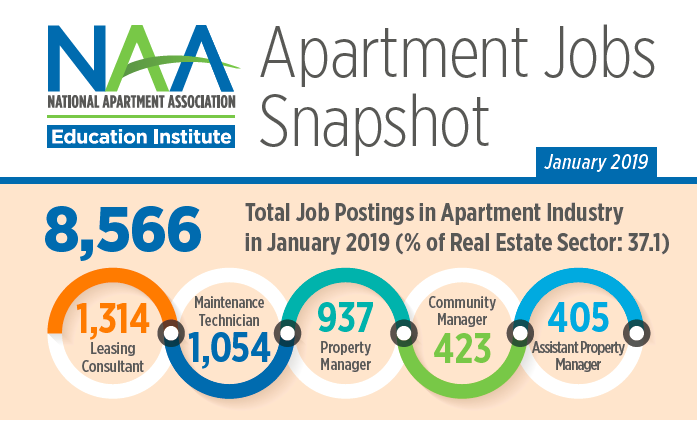
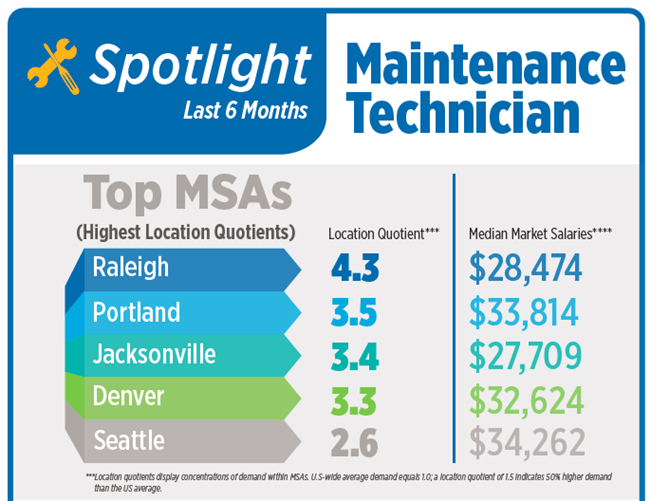
The need for people to fill apartment-maintenance technician positions were more than three times the U.S. average in Raleigh, Portland, Jacksonville, Denver and Seattle, according to the National Apartment Association Education Institute (NAAEI) Apartment Jobs Snapshot January 2019.

Median market salaries for apartment-maintenance technician jobs was $33,814 in Portland and $34,262 in Seattle. Most jobs required only up to two years or less experience.

Apartment Maintenance Technician Jobs In High Demand In Portland And Seattle

Apartment Maintenance Technician Jobs In High Demand In Portland And Seattle

High number of jobs in rental housing

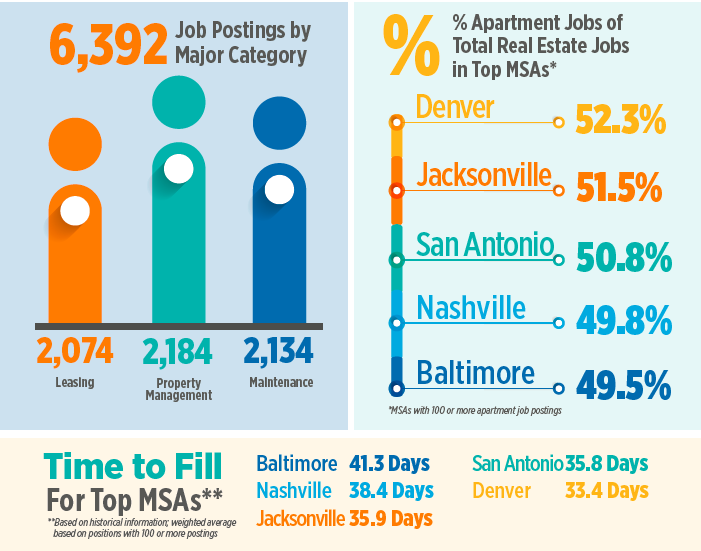
The apartment-industry labor market held its momentum from late last year into 2019, with apartment jobs representing more than 37 percent of job openings in the real estate sector.

Jobs available in the rental-housing industry rose from an average of 35 percent last year to more than 37 percent of the real estate sector in January.

Days-to-fill were particularly challenging in Baltimore, where the unemployment rate fell to post-recession lows at the end of last year, and Nashville, which currently boasts the tightest labor market of major metro areas across the United States.

Apartment Maintenance Technician Jobs In High Demand In Portland And Seattle

Maintenance-tech skill set still highly sought as titles change

 The change in the proportion of job titles over the past five years is not only reflective of demand, i.e. the highly sought-after maintenance tech, but of recruiters providing more focused and appealing titles, the NAA report says.

The generic “apartment manager” has given way to “community manager,” while the surge of assistant property managers and maintenance supervisors reveals a clear career path within those sectors.

The greatest increases in skills desired for all types of positions included both specialized skills such as Yardi Matrix software, and soft skills, particularly writing and collaboration.

National apartment association jobs report background

 The jobs report focuses on jobs that are being advertised in the apartment industry as being available, according to Paula Munger, Director, Industry Research and Analysis, for the National Apartment Association’s Education Institute.

“Our education institute is a credentialing body for the apartment industry. They hear often that one of the biggest problems keeping our industry leaders up at night is the difficulty in finding talent, attracting talent and retaining talent,” Munger said.  “Labor-market issues are happening in a lot of industries, certainly with the tight labor market we have.”

NAA partnered with Burning Glass Technologies. “They have a labor-job posting database that is proprietary,” she said, and they can “layer on data from the Bureau of Labor Statistics (BLS). We looked at that and thought we could do something that is really going to help the industry and help benchmark job titles and trends as we go forward,” Munger said.

Customer Relationship Management In Multifamily Has Skyrocketed

Oregon Rent Control Bill Passes The Senate

Rent Control Still Not the Solution to Housing Affordability

The Oregon Senate has passed SB 608, a rent-control and evictions bill, which limits landlords’ rights in Oregon.

The Senate majority leader’s office released a statement after the bill passed, saying, “Rent stabilization will help prevent price gouging,” and that “healthy and thriving families need safe and stable housing.”

The bill is designed to help rein in soaring rental increases for working families across the state, according to the release.

The bill would eliminate “no-cause” evictions after tenants have completed their first year of occupancy. It also would cap annual rental increases for buildings more than 15 years old.

The bill was co-carried by Sen. Shemia Fagan, D-Portland, and Sen. Laurie Monnes Anderson, D-Gresham, on the Senate floor.

“Last December, I met an 83-year-old renter who was afraid to ask maintenance to fix her lights for fear of eviction or a rent spike,” Fagan said in the release. “She had lived in the dark for 3 months by the time I met her. SB 608 protects her and hundreds of thousands of Oregonians who deserve safe and stable rental housing.”

Oregon Republicans Say Democrats are Ignoring Affordable Housing Issue

The Oregon Senate Republicans issued a statement following passage of the bill, saying, “the majority party followed through on their promise to pass rent control early in session, without bipartisan support. SB 608, which will cap rent increases statewide, will lead to fewer available affordable housing units statewide.

“The overwhelming message during the public hearing on rent control was that there is not enough affordable housing in Oregon, yet this bill does nothing to address the real problem,” said Senate Minority Leader Herman Baertschiger, Jr., R-Grants Pass, in the release.

“If we actually want to address the issue of housing in Oregon, then it’s time to take a good hard look at the barriers in place that limit developing more affordable housing.”

“This bill will not accomplish the goal that the proponents have set,” said Senator Tim Knopp, R-Bend, in the release.  “The likely outcome from this legislation will be fewer affordable housing units, and increased rent throughout the state.”

The problem was created in Portland

The rent-control bill was written with urban Oregon in mind and does not offer any alternatives for rural or frontier communities, the Republican statement said.

“This is a problem that was created by Portland, and this legislation is designed for Portland,” said Senator Fred Girod, R-Stayton, in the release. “Instead of addressing the real issues here, this bill will only create more problems throughout the state.”

The bill would protect Oregon’s renters by ensuring they won’t face enormous, unforeseen rent increases or be kicked out of their homes after they’ve lived there for at least a year, according to the release from the Senate majority leader’s office.

“Safe and stable housing is a central requirement for healthy families to thrive and for children to excel in school,” the release states.

The bill prohibits landlords from terminating month-to-month tenancies without cause after one year of occupancy. Tenants would be entitled to 90 days’ notice of eviction and a relocation assistance payment in the amount of one month’s rent. Landlords with four or fewer units would not be required to make relocation assistance payments.

What Oregon Senate Bill 608 Does

  • Prohibits a landlord from terminating month-to-month tenancy without cause after 12 months of occupancy. Provides exception for certain tenancies on a building or lot used by a landlord as residence.
  • Allows a landlord to terminate tenancy with 90 days’ written notice and payment of one month’s rent under certain conditions. Exempts landlords who manage four or fewer units from payment of one month’s rent.
  • Provides that fixed-term tenancy becomes month-to-month tenancy upon ending date if not renewed or terminated.
  • Allows landlord to not renew fixed-term tenancy if tenant receives three lease-violation warnings within 12 months during term and landlord gives 90 days’ notice.
  • Limits rent increases for residential tenancies to one per year.
  • Limits maximum annual rent increase to 7 percent above annual change in consumer price index.
  • Requires Oregon Department of Administrative Services to publish maximum annual rent increase percentage.
  • Declares emergency, effective on passage.

Resources:

Oregon Senate passes rent-control bill

Oregon Senate Passes Statewide Rent Control Bill


How to Educate Tenants On Septic Systems

septic systems and rental property

How to help tenants understand septic systems and what it takes to maintain them to avoid problems is the maintenance checkup this week provided by Keepe.

If your rental property has a septic system, you must learn the warning signs that can save you and your tenants a lot of trouble – and expense.

Let’s explore the most common issues in septic systems and rental property that are likely to arise:

  • As a property manager or landlord, you are responsible for maintaining your building’s septic tank. Regular plumbing every three to four years, depending on your tank, is the key to maintenance to avoid premature failing of septic systems.
  • You can give your tenants a list of do’s and don’ts for what to put and not to put down the toilet or kitchen sink drain.
  • In addition, give tenants information on the common symptoms they might see when a septic tank is failing to ensure you can identify the problem quickly before more damage happens.
septic systems and rental property
Tenants should also avoid very long showers, use the washing machine no more than once a day, and refrain from excessive use of garbage disposals.

Drain Maintenance Habits

Do not put these items down a drain (including toilets, sinks, tubs and showers) since they can trigger a septic-system failure:

  • Baby wipes and diapers
  • Large amounts of food waste
  • Any kind of grease. When needed, use alternative cleaning solutions that are septic-safe (like vinegar).

Tenants should also avoid very long showers, use the washing machine no more than once a day, and refrain from excessive use of garbage disposals. Tenants should know to report any drain issues as soon as possible. Being aware of these bad habits can keep tenants informed and aware if any issues were to arise.

Most Common Signs of Septic Systems And Rental Property Failures

septic systems and rental property
Sewer smells can be an indication of an issue with the septic system.

Septic systems are fragile, and issues are bound to arise at some point. Be proactive by keeping an eye out for the most common problems that occur with septic systems:

  1. Backed-up toilet: An overflowing toilet might be a sign that your septic tank is failing, but in most cases, it’s easy to plunge or snake the toilet to drain any buildup.
  2. Sewer smells: Sewer odors are likely to arise if your tank is overflowing. Other reasons might be due to a pump malfunction, such as a transfer pump that has stopped working. In this case, you’d have to have the system inspected to verify the issue. Another reason for a smelly sewer could be due to frozen rank or outflow pipes. If the weather is cold in your region, your septic tank may have frozen. In this case, you would need your tank pumped.
  3. Drain cleaners: Drain cleaners such as toilet disinfecting products that sit in the tank and dissolve slowly might actually have a negative effect on your drain. Also, hazardous chemicals, paints, solvents, antifreeze, and other drain cleaners can have a similar negative effect. Encourage tenants to avoid using these products.
septic systems and rental property
Let tenants know where your septic field is so tenants can enjoy outdoor activities and plant gardens away from the area to avoid contamination.

Other Warnings

 As a property manager, make sure to communicate the status of your septic tank to tenants to avoid related septic issues such as the following:

  • Limited-capacity tank: If your septic tank’s capacity is limited, let your tenants know so they can limit how many guests they have during gatherings in the building.
  • Septic field location: Let tenants know where your septic field is so tenants can enjoy outdoor activities and plant gardens away from the area to avoid contamination.

Other recent rental property maintenance Keepe posts you may have missed:

4 Outdoor Flooring Options For Your Rentals

20 Easy, Affordable Maintenance Projects To Update Your Rentals

7 Tech Gadgets For A Safer And More Efficient Rental Property

5 Maintenance Tips For Long-Lasting Rental Carpet Flooring

Is The Water Heater At Your Rental Property Ready For The Big One?

7 Types Of Kitchen Countertops For Your Apartments

Which Cooktop Is Best For Your Rental Property?

A Guide To 4 Types Of Flat Roof Systems

6 Ways To Trash Your Apartment Waste Management Issues

About Keepe:

Keepe is an on-demand maintenance solution for property managers and independent landlords. The company makes a network of hundreds of independent contractors and handymen available for maintenance projects at rental properties. Keepe is available in the Greater Seattle area, Greater Phoenix area, San Francisco Bay area, Portland, San Diego and is coming soon to an area near you. Learn more about Keepe at https://www.keepe.com


Washington State Bill Would Make Washington Evictions Harder For Landlords

Evictions: They Are Not The Terrible Landlords Fault

Companion bills in the Washington State Senate, SB 5600, and the Washington House of Representatives, HB 1453, would support new tenant protections and make Washington evictions harder for landlords.

The Senate bill would make a number of changes to the Landlord-Tenant Act. It proposes to:

  • Extend the 3-day notice for default in rent payment to 14 days’ notice for tenancies under the Residential Landlord-Tenant Act.
  • Require the 14-day notice be written in plain language and include information on civil legal aid resources available, if any, to the tenant.
  • Extend the mandatory-notice period from 30 to 60 days when landlords propose a change in the amount of rent. Requires a landlord to first apply any tenant payment to rent before applying the payment toward other charges.
  • Prohibit continued tenancy and relief from forfeiture to be conditioned upon tenant payment or satisfaction of any monetary amount other than rent.
  • Provide the court with discretion to provide relief from forfeiture or to stay a writ of restitution.
  • Require a landlord to provide a tenant with documentation regarding any damages for which the landlord intends to retain any of the deposit amount.

Seattle tech companies support the Washington evictions bill

The general counsels of Amazon, Microsoft, Expedia, RealNetworks, and other Seattle-area tech companies have sent a letter to the Washington legislature and Gov. Jay Inslee supporting Senate Bill 5600 and its companion House Bill 1453.

“Simply stated, Washington’s eviction laws are a root cause of our homelessness problems, and we can take a significant step toward addressing them now – at minimal cost to taxpayers – by simply updating them in some common-sense ways this legislative session,” says the letter, a copy of which was obtained by GeekWire.

The Seattle region is experiencing a homelessness crisis, driven by rapidly increasing housing costs associated with job growth in tech. The tech industry has started to be more vocal about mitigating the crisis. Last month, Microsoft announced a $500 million fund to accelerate the development of affordable housing in the area.

Washington State Bill Would Make Washington Evictions Harder For Landlords
The legislature provided pro and con statements on the bill based on testimony.

The legislative staff also provides a pro-and-con summary of testimony taken on the bill.

The staff summary of testimony for the bill:

“There is a need to overhaul our statewide approach to housing and homelessness by focusing on prevention as opposed to being primarily reactive.

“Inflexible eviction policies are a major source of housing instability around our state. If we are serious about long-term prevention, we must address this primary driver of homelessness. Currently, 26 states and the District of Columbia have pay-or-vacate notice periods longer than three days, including some with a 14-day notice. Washington State is outside the norm and for individuals living paycheck to paycheck, which is now nearly half of all Americans, these extensions of notice matter.

“We should also offer resources, flexibility, and compassion to help, since one unexpected medical bill or car accident or government shutdown can lead to an eviction. The bill gives tenants more time to pay rent, although 21 days would probably be best to a deal with most medical emergencies since it can take several weeks or even months to heal and be able to deal with outside responsibilities like paying rent. Housing stability is crucial for healing https://propfinast.com.

“Emergencies happen to everyone at all income levels and we all need flexibility to deal with emergencies. Over three quarters of the tenants in King County end up vacating their apartments, with about 10 percent being unaccounted for.

“The leading cause for eviction in a recent survey revealed tenants were behind a month or less or rent, and most of those tenants were either in western Washington, but not Seattle, or in eastern Washington. The reforms in the bill are not going to increase housing costs. Some landlords will apply rent payments to overdue utilities instead of rent.

“The rental system is literally designed to kick people when they are down; in contrast, when a homeowner becomes delinquent on their mortgage payment, they have at least 90 days before issuance of a notice of default.”

Washington evictions systems a mismatch for homelessness interventions

“Our eviction system is a complete mismatch with homelessness interventions,” the bill summary says.

“There is not nearly enough time for a tenant to get rental assistance to their landlord before the costs and the risks escalate. Attempting to get legal aid might eat up two days, so the current time period is not long enough. Once the paperwork is filed, the tenant is almost always forced to pay extremely expensive attorneys’ fees in court costs as well as late fees. Some tenants might be lucky enough to get homelessness assistance to help pay off these costs.

“Ohio and New York City allow judges to consider circumstances as to why a tenant fell behind on rent. Seventy-one percent of the lowest-income households in Washington State are paying over 50 percent of their income towards rent, which means that one small household crisis can lead to the inability to pay rent on the first of the month. Judges have little discretion over the process and tenants often leave court owing much more in court costs and attorneys’ fees than they ever owed.

“The Legislature must seriously consider the significant race and gender issues at stake – female-headed households and people of color are much more likely to face eviction in Washington State. Black women are four to five times more likely to face eviction.

“If we are going to get Washington State ahead of our homelessness crisis we must keep people in their homes and protect tenants. Over the past five years, 132,000 adults have had been formally evicted in Washington, which is 1.8 percent of the state’s population. Informal evictions are even higher. Nine percent of the black adult population in King County has an eviction; in Pierce County, 17 percent of the black adult population has had an eviction. Across the state, women are evicted 50 percent more than men. Forty-six percent of renters are rent-burdened.

“The number of individuals becoming homeless continues to outpace our efforts. Extending the current three-day notice to allow up to 14 days for rent to be paid would make a significant difference in preventing homelessness for these households. It is going to be adequate for the tenant to go to a program do the intake, verify the debt, contact the landlord, and make the payment.

“We also need to ensure all eviction notices have information about legal resources and we need to allow courts to come up with alternatives,” the staff report summary states.

The staff summary of testimony against the bill:

“The attrition rate of landlords show that they are getting out of the business because they can no longer afford it or handle the risk.

“Landlords are selling by the thousands in a market that is fairly high right now.

“This is going to devastate the amount of rental-housing inventory.

“Landlords are also one medical trip to the hospital or one crisis away from having the same sort of issues as tenants. Many are struggling day-to-day as well. Many landlords’ profit-loss statements for one year do not show that they are making money.

“With property taxes and operating costs, landlords are just one late mortgage payment away from losing their building.

“By the time that tenant replies to a three-day notice, there is an additional 10 days for them to come up with funds or work with the landlord, of which many do work with their tenants.

“Communication between the tenant and the landlord is critical. Many landlords do not want the vacant unit or to have turnover costs, so landlords want to keep these tenants in the units and keep them maintained in a good working order.

“Some landlords offer payment plans or provide education information about the consequences of not paying rent,” the bill summary says.

Washington evictions bill could reduce landlords flexibility to work with tenants

“There is concern that the remedies proposed in the bill may reduce a landlord’s flexibility to work with tenants,” the bill summary says.

“Many of the remedies proposed may not actually address the true causes of homelessness or housing availability and affordability, which is more of a supply-and-demand issue.

“Landlords are not interested in arbitrarily terminating a tenancy since it costs money to do so.

“The Legislature should work with both landlords and tenants to create a regulatory environment that is fair and protective. The Legislature needs to put together a work group to look at all of the landlord-tenant bills and solve the issues before the end of this session.

“The plain-language requirement for the 14-day notice should be written into the statute. Lawyers should not have to argue in court as to whether or not a particular notice is in plain language. Both the landlord and tenant lose if eviction notices have to be issued.

“Many landlords try to work with the tenant in multiple ways over an extended period of time and use eviction as a last-case scenario. If the bill passes as is, all tenants will eventually absorb the resulting costs and unintended consequences. The bill would force landlords to stop working with tenants and immediately start the eviction process as a result of the increase in time frames and costs.

“The three-day notice is only a nuclear option for some landlords. Most tenants respond when they get a three-day notice on their door. Extending the notice to 14 days is going to cause landlords to be more aggressive with tenants.

“One alternative is to only allow a longer notice period for first-time late rent or fees. Language regarding a term lease not coming to an end is concerning. A lot of landlords own one single rental property but because of a work reassignment they have to rent out their home but plan to move back into it.

“Also, having a month-to-month renewal on fixed-term leases is difficult for landlords of student housing since the transition of students year after year without automatic renewal allows students to know that housing will always be available.

“Language regarding the provision of written estimates for move-out costs is also concerning. Some repairs are custom jobs and not done through a vendor. There needs to be a distinction made between single-family homes versus a 1,000-unit apartment community. It is problematic to have the same rules apply to very different types of rental housing,” the staff summary states.

Resources:

Senate Bill Report SB 5600 analysis

Civil Rights & Judiciary Committee HB1453 Analysis

Eviction reform from a landlord’s perspective

Amazon, Microsoft, Expedia and other tech giants urge Washington State to pass eviction reform


Sexual Harassment In Housing And Unwelcome Comments And Requests

Sexual Harassment In Housing And Unwelcome Comments And Requests

Sexual harassment in housing happens thousands of times each year so the Grace Hill training tip this week focuses on the issue of sexual harassment and its many forms in housing.

By Ellen Clark

While harassment of any kind is illegal, the topic of sexual harassment warrants special consideration. Every year, thousands of people face unwelcome comments and requests for sexual favors from landlords, property managers, maintenance workers, and security guards.

The Department of Housing and Urban Development (HUD) and the Department of Justice (DOJ) recognize two types of sexual harassment: quid pro quo sexual harassment and hostile environment sexual harassment.

  • Quid pro quo sexual harassment is an unwelcome request or demand to engage in conduct where the submission is either explicitly or implicitly made a condition related to the terms, conditions, or privileges of the sale or rental. An unwelcome request or demand may constitute quid pro quo harassment even if the person agrees to the unwelcome request or demand. A property manager telling a prospective resident that she’ll waive the pet fee if he goes on a date with her is an example of quid pro quo sexual harassment.
  • Hostile environment sexual harassment is unwelcome conduct that is sufficiently severe or pervasive enough to interfere with the use or enjoyment of the apartment home or other facilities. Determining a hostile environment depends on many factors, including nature, severity, frequency, duration, context, and location of the conduct. An example of hostile environment sexual harassment would be a leasing consultant making frequent comments about a resident’s body while she is at the swimming pool to the point where his behavior makes her stop visiting the swimming pool.

Considering the attention sexual harassment has gotten lately, you may be feeling nervous or confused about what is and isn’t appropriate.

Here are some tips on the issue of sexual harassment in housing

  • Take a moment to think about how others may perceive actions you consider friendly.
  • In general, do not initiate hugs or kisses with customers and coworkers.Even if you are just an affectionate person and don’t mean anything by it, it could make people uncomfortable, and they may be too polite to tell you so. You can still be friendly—try a big smile and a positive greeting instead.
  • In general, avoid commenting on how customers and coworkers look, like telling a customer she looks great in her jeans or telling a co-worker he’s “looking hot.” What may seem like a harmless compliment to you could be unwanted attention for that person.
  • If you see harassing behavior happening, don’t play along and don’t ignore it. The person doing the harassing may think your silence or nervous laughter means that you are OK with the behavior. If you don’t feel safe speaking up, at least report the behavior to your supervisor or the HR department.
  • If you are a supervisor, immediately investigate and respond to any complaints of harassment.

The increased spotlight on sexual harassment is not going away. HUD is serious about investigating complaints of sexual harassment, and owners and operators of rental housing communities are paying the price.

Make sure your employees are aware of the laws, but more importantly make sure they are trained in what is appropriate, respectful behavior that should be shown at all times.

Sexual harassment in housing a HUD and Justice Department initiative

“This important initiative is giving a voice to victims of sexual harassment in housing. It also sends the strong message that the Department is listening to victims and taking action against landlords and managers who attempt to prey on vulnerable individuals all over the country,”  Acting Assistant Attorney General John Gore for the Civil Rights Division said in a release last year. “The Justice Department remains committed to our goal to make more people aware that no one should have to choose between a home and the right to be free from sexual harassment.”

“A home can never be a place of peace and comfort for individuals who are subjected to sexual harassment,” Anna María Farías, HUD’s Assistant Secretary for Fair Housing and Equal Opportunity, said in a release last year. “We still have work to do, but the initiative has taken tremendous steps this past year toward addressing this unlawful behavior and the Justice Department and HUD remain committed to doing even more to inform the public about their housing rights.”

Read Ellen’s blog here.

Recent Grace Hill training tips you may have missed:

What Do You Do When Assistance Animals Break The Rules?

7 Ways To Stay Out Of Trouble When Checking Criminal History

5 Ways To Protect Applicants, Residents And Employees From Sexual Harassment

Do You Have A Smoke-Free Policy That Adequately Protects Residents?

How To Handle Suspicious Documentation For Assistance Animals

How A No Pet Policy Can Be Discriminatory

Property Management Cyber attack Risks Overlooked, Underestimated

Do You Know How To Respond To a Sexual Harassment Complaint?

Have You Reviewed Your Criminal Background Checks Policy Lately?

Multifamily Managers And Marijuana: Caught In A Pot Crossfire

Fair Housing Discrimination Against Someone You’ve Never Talked To?

4 Ways To Avoid Screening Pitfalls With Applicants

Red Flags In Evaluating Documentation For Assistance Animals

About the author:

Ellen Clark is the Director of Assessment at Grace Hill. Her work has spanned the entire learner lifecycle, from elementary school through professional education. She spent more than 10 years working with K12 Inc.’s network of online charter schools – measuring learning, developing learning improvement plans using evidence-based strategies, and conducting learning studies. Later, at Kaplan Inc., she worked in the vocational education and job-training divisions, improving online, blended and face-to-face training programs, and working directly with business leadership and trainers to improve learner outcomes and job performance. Ellen lives and works in Maryland, where she was born and raised.

About Grace Hill

For nearly two decades, Grace Hill has been developing best-in-class online training courseware and administration solely for the Property Management Industry, designed to help people, teams and companies improve performance and reduce risk. Contact Grace Hill at 866.472.2344 to hear more.


HUD Charges Landlords With Discrimination Against Combat Veteran With Assistance Animal

Landlords who refused to waive the pet deposit for the dog of a combat veteran with an assistance animal have been charged with discrimination and violating the Fair Housing Act, by the U.S. Department of Housing and Urban Development (HUD), according to a release.

The veteran was renting a single-family home in Moore, Oklahoma, and asked that the $250 pet deposit be waived because his dog was an emotional support animal needed to assist him with his disability. The veteran provided landlords a letter from his doctor, according to the complaint.

Under the law, assistance animals are not considered pets.

According to the charge, the combat veteran is diagnosed with service-connected Post Traumatic Stress Disorder (PTSD) and Major Depressive Disorder (MDD). These mental impairments substantially limit his personal, work, and social life. His disability symptoms include anxiety, isolation, avoidance, and a difficulty in public, as well as difficulty with interpersonal relationships and insomnia. He is an individual with a disability as defined by the Fair Housing Act https://holisticdental.org/ambien-treat-insomnia/.

In the letter to the landlords, the doctor stated that the veteran was diagnosed with PTSD following a combat tour of deployment and he was being treated at Oklahoma City Veterans Administration Medical Center. The letter further stated that dogs can often provide combat veterans support when PTSD symptoms escalate, and that veteran’s dog often keeps his PTSD symptoms in check.

The complaint says the dog, an emotional support animal, improves the veteran’s insomnia, gets him out of the house because he has to walk the dog, improves his mood, and provides comfort and support because he has a limited social system.

The veteran asked that pet deposit be waived citing the law

Pet deposit issue over emotional support animal leads to HUD discrimination charge against landlord

The tenant complained that AMH 2015-1 Borrower, LLC, and its management company, AH4R Management – OK, LLC, refused to waive their pet deposit fee.

The leasing agent told the veteran, according to the complaint, ” … Unfortunately my broker said only service dogs are waived. I’m sorry I tried.”

The veteran then provided a link to websites with information on emotional support animals in rental housing units that included an example demonstrating landlords should not charge pet deposits for assistance animals and included the statement “Landlords cannot… [a]sk a tenant to pay a deposit, fee, or surcharge in exchange for having a service or emotional support animal, even if they require such a practice from owners who wish to obtain pets in their dwelling,” the complaint states.

After the company refused, the veteran paid the pet deposit and moved into the property.

The rental management told the veteran they had been advised by their attorney that the deposit had to be paid and that he “accepted their decision to not waive the pet deposit fee when he signed the lease and moved into the property,” according to the complaint.

The veteran replied that he was not OK with that decision, and he filed a complaint. The management company has since refunded his $250 deposit.

However in the complaint HUD is asking for $16,000 in civil penalties from the management company for discrimination and violation of the Fair Housing Act “when they refused to waive the pet deposit for complainant’s emotional support animal,” according to the complaint.

Fair Housing Act and pet deposits for tenants with disabilities

The Fair Housing Act prohibits housing providers from denying or limiting housing to persons with disabilities, or from refusing to make reasonable accommodations in policies or practices for people with disabilities. This includes waiving pet fees for persons with disabilities who use assistance animals.

Disability is the most common basis of fair housing complaints filed with HUD and its partner agencies, according to the release. Last year alone, HUD and its partners considered over 4,900 disability-related complaints, or more than 58 percent of all fair housing complaints.

HUD’s charge will be heard by a United States Administrative Law Judge unless any party to the charge elects to have the case heard in federal district court. If an administrative law judge finds after a hearing that discrimination has occurred, he or she may award damages to the complainant for their loss as a result of the discrimination. The judge may also order injunctive relief and other equitable relief, as well as payment of attorney fees. In addition, the judge may impose civil penalties in order to vindicate the public interest. If the case is heard in federal court, the judge may also award punitive damages to the complainant.

Matthew Wildman from The Humane Society of the United States provided this question and answer on pets:

A question and answer on pets and pet-friendly apartments with the Humane Society of the U.S.

No. 1- Question: I am confused over the terminology of service animal, assistance animal and companion animal. Tenants use different terms such as these to refer to their pets. How do I as a landlord know which is which?

Answer: “Companion animals” or “companion pets” are interchangeable terms with the most common term, “pets.” For some reason, the term “companion animal” is perceived by many in the multifamily housing industry to mean something different than a “pet,” but there is no difference. The terms that are of relevance to housing providers encountering requests for reasonable accommodation are “assistance animals” (also commonly referred to as “emotional support animals”) and “service animals.” An assistance animal can be any animal who is commonly referred to as a pet, but the difference is that their owner has a disability for which the animal is needed to either provide assistance in managing activities of daily living, and/or provides support that alleviates the symptoms or effects of the person’s disability. An “emotional support animal” is a type of assistance animal that provides emotional support that improves the symptoms of an individual’s disability.

According to the Department of Justice, a “service animal” may be a dog or miniature horse who has been trained to perform a specific task(s). Under the Americans with Disabilities Act, individuals living with a disability are legally entitled to bring these animals into places of public accommodation as well as their residence regardless of any pet restrictions. The most common example of a service animal is a Seeing-Eye dog, but not all disabilities requiring service animals are obvious. For example, individuals suffering from PTSD may need their dog with them at all times. This dog may be trained to sit calmly beside their owner.

It’s helpful to keep in mind that service and assistance animals are not considered pets, meaning that pet rules – such as no-pet policies, breed and size restrictions, pet deposits and fees – don’t apply to them, but owners are responsible for any damage they cause. Read more of the question and answer session here.

Photo Credits:

By English: Erin A. Kirk-Cuomo [Public domain], via Wikimedia Commons

Dog in training photo by Crjs452 via creative commons license

Resources:

Increasing housing options for renters with pets

Information for renters with pets The Humane Society of the United States

7 questions landlords have about pets and pet-friendly apartments

HUD Charges Oklahoma Landlords With Discriminating Against Veteran With Disabilities

HUD Charges Oklahoma Landlords With Discrimination

HUD charge of discrimination document

The Fair Housing Act


Get our pet guide and find out more about pet deposits and emotional support animals.


Upgrades That Can Lead To Rent Increases

Upgrades That Can Lead To Rent Increases

Property managers and landlords are always looks for the types of upgrades that can lead to rent increases so here are some ideas.

By Lucas Bergman

It’s in your best interest, as a landlord, to keep your rental property in top shape.

While in most cases this requires periodic overhauls, there are some relatively affordable upgrades that allow you to increase the rent at each lease renewal period. So, whether you’re managing an apartment building or a multifamily home, here are some of the sure-fire upgrades that tenants are going to fall for.

Add another bedroom

While adding a bedroom without increasing the home’s square footage isn’t always possible, if you can squeeze it in, it would be a great way to increase the unit’s potential income. Keep in mind, though, that there are building codes that specifically determine what can be considered a bedroom, so you may want to check that out before you start, unless you want to end up with an extra storage room.

This kind of upgrade requires obtaining a permit from your local building department. For most codes, a bedroom needs to have a door, a closet and a widow to the outside. If your rental unit has a room of another purpose, you may even modify it to fit into the bedroom role.

Upgrades That Can Lead To Rent Increases

Update your flooring

Although carpet and vinyl are the typical choices for many landlords, they don’t scream either luxury or style. They are inexpensive, durable, and most importantly, cheap, but if you’re looking to increase the rent in the next lease period, you need something more attractive. Wood flooring is a premier high-end option that will surely appeal to renters, however, laminate flooring is not only more affordable, but also more durable for rental situations, which often include a bit of furniture-moving and reorganization. So, while laminate floors don’t have the same value-retaining curve as wood flooring, in general it’s a better investment for landlords.

Focus on kitchen and bathroom

If you’ve ever wondered which space adds most value to rentals buck for a buck, it’s the kitchen and bathroom.

You can make them much more attractive to prospective renters if you declutter them, clean them thoroughly, refinish the surfaces, and modernize the appliances. Such an updated kitchen will typically give you better ROI than other renovations, as well as lower your maintenance requests, so you won’t only save time, but also money in the long run. And here’s an unexpected bonus: if you make the effort to integrate green upgrades such as low-flow toilets, Energy Star water heaters, and dual-flush plumbing, you can even apply for government grants for energy-efficient upgrades or have them depreciate against your taxable income.

Give it a new roof

This often overlooked upgrade comes with many benefits for both the renters and the owner. However, in most cases, it’s the difficult access and the amount of work that turns landlords from roof updates. In order to upgrade your property you might want to speak with a contractor, or, if you’re handy, you might decide to do it yourself. You’ll have to find a reliable crane hire company before everything else. With the right crane, you’ll be able to move the materials and access even those tricky places.

However, in most cases it’s the difficult access and the amount of work that discourages landlords from roof updates. New roofing and underroof insulation give your tenants an opportunity to lower the heating and cooling costs, at the same time improving the building’s resale value.

Don’t forget the landscape

For many renters, the home’s exterior is almost as important as the interior, especially in the suburban neighborhoods, where people are likely to spend a healthy share of time in the back yard. So, if you want to spruce up your curb appeal and landscape in general, you’ll want to fill those dry lawn patches with new grass, trim overgrown bushes and trees, and clean up any garden debris. If you want to go an extra mile, consider including low-water landscaping elements, such as native grasses and plants, stones, and gravel mulch in flowerbeds, which prevents weeds from taking root.

Rental properties are long-term investments that don’t always increase the landlord’s margin as much as planned, especially if the monthly mortgage rent draws near the maximum rent that can be charged each month.

The key in renovating for higher rent is to choose upgrades that potential renters will recognize as life-improving, so they are willing to pay the extra buck for them. (And no, that saltwater aquarium isn’t the best idea.)

How To Deal With The Most Common Pests In Rental Housing

How To Deal With The Most Common Pests In Rental Housing

Pests in rental housing can be a real headache for property managers so here is a guide to the common pests and how to deal with them.

When you start thinking about pest control as a management philosophy instead of just triage in an emergency, it is good to give a little thought about what your policy is going to be as a property manager in dealing with the common pests in rental housing.

Giving some thought to integrated pest management and how you are going to communicate that to your owners, your tenants and your employees. Pests in rental housing was the topic during a recent webinar by Darcy Jacobsen, director of content for Buildium.com. Buildium.com has put together a guide called Infestation 101: A property manager’s guide and shared several things from the guide on the webinar covering pests in rental housing.

Pest control prevention in rental housing for property managers

“Using Integrated pest management as a preventive is a key. There really is never one magic bullet. There is no one site that has the same treatment solution, so using integrated pest management allows you to work up a plan,” said Kari Warberg-Block, CEO and pest prevention expert at EarthKind.com.

Property managers may want to consider a philosophy gaining ground these days called integrated pest management to deal with pests in rental housing. It is an environmentally friendly common-sense approach to:

    • Identify pests and monitor infestations
    • Set thresholds for interventions
    • Prevent new infestation
    • Control current outbreaks

What is the biggest pest problem in rental housing?

“Rodents is where we started and about 28% of the population has that issue, and more so in urban areas around dumpsters and on farms. They are a public health risk. So they need to be taken seriously,” Block said.

9 most common pests in rental properties

During the webinar, Jacobson and Block took a poll of property managers and asked them to identify the top pest issues they see in their properties.

Pests om rental housing

Then they broke out the nine most common pests in rental properties.

No. 1 – Pests In Rental Housing – Rodents

Pests in rental housing


“You will see little brown droppings that look like rice. Sounds in the walls and ceilings will freak your tenants out. You will find shredded paper,” Jacobsen said. Traditional options such as traps and poisons can end up with a dead animal in your walls, she said. No one wants dead animals in their walls.

“Repellents are the best option because poisons alone are rarely effective,” said Block. “The rodents die and they keep coming back. Repellents can be effective – it is how I got my start – if they are put in a place where rodents go to nest or where they are going to go and chew on wiring. It is good preventative maintenance because they won’t move in in the first place,” Block said. Also rodents can get in through very small openings, so even the smallest holes are worth sealing up.

No. 2 – Ants

Pests in rental housing

Ants are more of a nuisance than a hazard, but they can ruin food stores. “The gross-out factor is high with these pests for residents. They take a psychological toll. This might be one you get called on frequently,” Jacobsen said. There are certain conditions that make ants come out of the ground after heavy rains, and anywhere there is going to be food. If you can find the path in, then that is a huge step in controlling them,” Block said. In terms of maintenance for pests in rental housing keep ants away look first at windowsills, seal cracks and crevices, in walls and foundations, trimming the trees and shrubs back from the exterior walls and minimizing water around your foundation.“Ants are drawn to water, and so are many of these bugs. If you take away water sources they are less likely to come around – leaks, air conditioners dripping, etc.” Jacobsen said.

No. 3 – Fleas

Fleas How To Deal With The Most Common Pests In Rental Housing

Obviously fleas pose a health risk to animals, dogs and cats especially. A lot of people also have allergies. What do we look for? “So look for pets scratching themselves that’s a sure sign, or fast moving black/brown insects in fur especially near the eyes. In some cases you may see black dirt or dried blood where pets sleep. “Prevention options include treating the pets with spot applications. Avoid feeding or taking in stray animals,” Block said. Anywhere also where animals are coming into contact with each other you want to be vigilant, especially if you have a multifamily pet area. Fleas, Jacobsen said, are really one of those things that it’s up to your residents more to keep up with as the tenant behavior in taking care of the pet is important so you want to educate them if you have a known problem and if fleas are common in the area. Traditional treatments are a residual insecticide around baseboards, lawns, flea collars, baths and bombs. Biologically safe treatments include frequent vacuuming and emptying the bag immediately – one of those common sense things that makes a huge difference. You want to get the eggs out of the carpet and sleeping areas and bedding. There are growth regulator pesticides with an active ingredient and using flea combs on pet fur.

No. 4 – Wasps

wasps How To Deal With The Most Common Pests In Rental Housing

“Wasps, fleas and mosquitoes are three of the top things searched on the internet because people are so freaked out about them. There is a heightened sensitivity to them. So when you hear about it from a tenant take it seriously because there is also an emotional component – whether real or perceived. So some of the signs to look for are nests in eaves, light fixtures and even underground. Wasps will congregate around picnic tables and trash bins. If you get complaints from your tenants, you need to look in the lights, in the eaves, and around the trash and if you are seeing a lot there you may have an infestation,” Jacobsen said. Block suggested taking a flashlight with red cellophane over the cover to look for nests so the wasps are not attracted to bright light of a regular flashlight.  Also trash areas with old sweet, soft drinks can be a magnet for wasps as well as other pests in rental housing.

No. 4 – Bedbugs

bed bugs How To Deal With The Most Common Pests In Rental Housing

“This can be a terrifying infestation – not because they do a lot of damage – but because of the stigma. Plus the loss of property in having to replace your mattress, plus they do bite,” Jacobsen said. “Bed bugs feed on human blood,” Block said, “so look for dark spots the size of a pinhead or red stains on sheets or mattresses. If your tenants suspect they might have bedbugs, how do you treat that when they arise? “The best prevention is not to take on used mattresses or used furniture,” Jacobsen said. Exterminators are recommended. “You have to rely on your tenants. Your tenants are bringing this in, so you need to be sure they are not staying somewhere they will bring these in. It is good to educate your tenants and used mattresses seem to be the number one culprit,” Jacobsen said. “Do you have to disclose to the next tenant that you had bedbugs? Yes some jurisdictions require that. So show the steps you have taken and document your pest protocol.”

No. 5 – Cockroaches

cockroaches and How To Deal With The Most Common Pests In Rental Housing


“Another bug that is really gross, and terrifies residents,” Jacobson said. Roaches are more active at night. A lot of people confuse roaches with other bugs. Roaches have a moist, musty smell like a basement. “Cockroaches seem particularly drawn to appliances, especially microwaves because of food droppings. A really great habitat for them,” Block said. Inspect any used appliances. “If you have one cockroach in a multifamily unit, you should really consider a plan for your whole building. Because with cockroaches, if you have them in one unit chances are they are in others as well.”

No. 6 – Beetles and other invaders

beetles and How To Deal With The Most Common Pests In Rental Housing

“We have lumped several types in here, including stinkbugs, which are horrible. Then there are carpet beetles that like wool, hair and feathers and they will destroy clothing and carpet. They can get up inside furniture and upholstery was well. How do we know they are there? Knowing where to look is most of it. They tend to lurk in dark areas. A good prevention option is frequent vacuuming and empty the bag immediately and fixing holes in screens. “You may have to talk to residents about replacing their furniture. It is good to have communication around where the responsibility lies for these types of issues, as bugs are rarely covered even in renters insurance. It is good to have policies set out in your leases. So if you get bedbugs whose responsibility is it to replace the mattress? “Jacobsen said.

No. 7 – Moths

moths and How To Deal With The Most Common Pests In Rental Housing

“Of all these bugs, this is the one that dogs me the most. I used to live in Seattle, and I bought some beautiful wool rugs. I don’t know if they (moths) came in the rugs or were in the very old apartment in Seattle I was living in. But when I came back to Boston I brought the rugs with me and put them underneath my bed. And about three months later my apartment was filled with moths! I could not figure out what was going on and then finally I dragged those rugs out from underneath the bed and they were infested with moth larva. All of my clothes had holes in them and it was just awful,” Jacobsen said. Moths can hide in the food pantry, dense closet spaces that are tight and dark. They will chew holes in carpets, natural fiber clothing. How do you find them? “They prefer dark,” Block said. “And unused areas like basements and attics. One red flag is seeing tiny moths. Also look around near food sources such as birdseed and dog food. Cardboard boxes can be a common area where they are found. Sometimes people will move in and leave things in boxes, and moths can get in between the layers of cardboard. They really like natural fibers.”

No. 8 – Mosquitoes

Pest control and mosquitoes

“This is very much in the news. It is becoming more and more something residents have been concerned about, especially in the southeast. They are the most deadly critter on earth because they spread diseases that kill more than one million people annually,” Jacobsen said.  The Zika virus many are terrified about. They are also just generally a nuisance. There are things you can do on your property to try and minimize the damage. Look for any standing water on property – including water in flower pots –  and check vegetation and keep it trimmed back also cleaning gutters and removing any potential wet breeding grounds and keep screens in good repair. Certain types of plants can also deter mosquitoes such a mint and the citronella plant, she said.

No. 9 –Termites

Pest control and termites

This is one of highest risk critters for damage to structures. Look for the presence of insect wings and mud tubes on foundations and near wood piles. Annual inspection of property is the best way to prevent an infestation of termites. Also remove any wood or wood piles and elevated above the soil and far away from any structures, Jacobsen said.

“Find a pest management pro (PMP) which we used to call an exterminator. State regulatory offices have a lot of information because they regulate the area. Online reviews can be very helpful. And, the national pesticide information center,” she said. Block suggested asking the following questions:

Questions to ask a professional pest management company

    • How many years have you been in business?
    • What is the EPA registration number of the product to be used?
    • Do you charge for an initial inspection?
    • What methods and pesticides do you use?
    • What do you charge and what services do you provide?
    • What is your guarantee?
    • Do you have an entomologist on staff?
    • Do you practice integrated pest management?
    • Do you carry insurance?
    • What are your safety measures and protocols?

“Create a seasonal pest maintenance checklist as part of your regular maintenance program,” Jacobsen said. “It is something you can make a part of your records if you ever find yourself in a lawsuit. It is something you can show incoming residents and show evidence of past pest outbreaks and how they were handled. You want to document what services were performed. Document what pesticides were used, and include all of that in your property management software such as buildium.com. The reports from your vendors should be clear on the extent of the infestation, and the level and extent of tenant cooperation. Include photos wherever you can,” Jacobsen said.

Also follow up with residents afterward to check resident satisfaction with the action taken to make sure there is no recurring problem. Keep staff up to date on how to spot and treat problems.

In the guide is a long section on health risks, ethics, how to contact insurance companies, what types of liability policies you should have in place. Also the dangers of toxins particularly for children and pets. As many residents could be more concerned about those issues than the pests.

Then also how to communicate with owners and tenants.

How to talk to tenants about pests

“Arming your tenants with information to spot pests is highly effective. Tenants are your early-warning sign. And pest information from them can make a huge difference in whether you are able to deter a full-scale pest invasion. Educate them about the signs and common pests when they move in. Managing concerns and expectations during an infestation is key. People can get grossed out and panicky,” Jacobsen said. She suggested the following:

    • Educate yourself and your staff on how to answer questions calmly.
    • Share you plans to get buy-in from your tenants on your methods. If a reluctant tenant undermines your treatment plan, it can backfire.
    • Have a liability plan in place as some infestations destroy personal property and could render the property temporarily inhabitable.
    • Be sure to have a policy where you can direct tenants for reimbursement or alternative lodging
    • In terms of infestations, check local laws, but many jurisdictions require disclosure to new tenants regarding some pests.
    • It is ethical to inform tenants if pest control activity has taken place, especially if toxins were employed.

5 questions for property managers about pests in rental properties

No. 1 – Will you take a toxic and/or non-toxic/ environmentally friendly approach to pest infestation?

No. 2 – How will you educate residents about spotting and preventing pests?

No. 3 – What proactive maintenance, prevention and inspections will you conduct?

No. 4- How will you train staff, and when will you call in vendors and experts?

No. 5- How might you use your comprehensive pest strategy as a marketing and promotional tool?

Resources:

National Pesticide Information Center at Oregon State University

Infestation 101: a property manager’s guide

How to Rent a Pest-Free Home to Your Tenants

Sign Up For Our Newsletter And Get Apartment News And Helpful, Useful Content Each Week.

* indicates required


U.S. Multifamily Outlook Holds Strong and Shines Bright On Multifamily Landscape

U.S. Multifamily Outlook Holds Strong and Shines Bright On Multifamily Landscape

Multifamily-industry observers are optimistic that the sector will continue performing strongly and remain popular as an investment vehicle, according to a new multifamily outlook report from Yardi Matrix.

“The National Multifamily Housing Council (NMHC) gathered in temperate San Diego last week as much of the country was blasted by extreme cold,” the report says.

“The juxtaposition could be seen as a metaphor for the multifamily sector, which remains a bright spot on the investment landscape relative to other sectors both inside and outside commercial real estate,” it said.

Highlights of the multifamily outlook

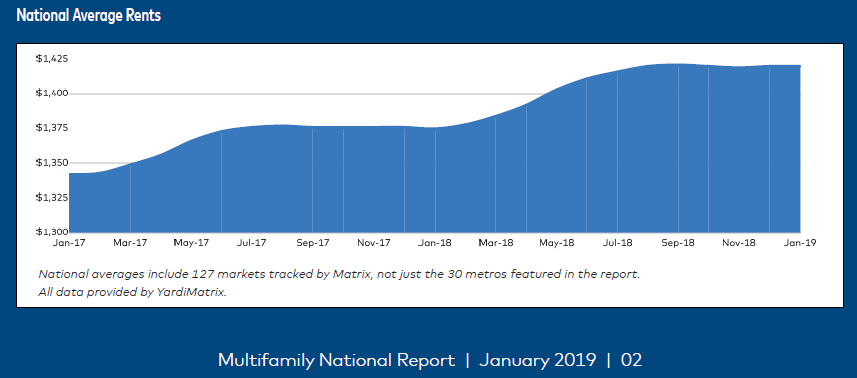
U.S. multifamily rents did not change in January, remaining at $1,420, while year-over-year growth rose 10 basis points to 3.3%. Rents are at the same level they were in August.

■ Market players are largely optimistic about the prospects for the sector’s performance in 2019, based on the discussion at the conference in San Diego. Demand trends are expected to remain strong.

■ Las Vegas (7.9%), Phoenix (6.5%) and Atlanta (5.9%) comprise the top 3 metros, with each producing growth in the normally slow winter season.

A January survey of 127 major U.S. real estate markets showed that despite flat rent performance, which is normal for winter, year-over-year rent growth increased by 10 basis points to 3.3%, the sixth consecutive month above 3%.

“Such performance gives no indication that multifamily rent growth is on its last legs in the cycle,” the report says.

Older renters staying put, rental households growing in ages 20-34

Panelists at the NMHC conference were bullish on multifamily.

Speakers by and large expect demand to remain strong along the age spectrum. The 20-34 age category, which has the highest percentage of renter households, will continue to grow for several more years, the report says.

“Some speakers noted that household renters above that age group are increasingly remaining in rental housing (both single-family homes and multifamily) rather than purchasing homes. One noted that the demographic of some luxury apartment buildings encompasses an average age above 40 and average income above $200,000. Retirees are also downsizing from suburban homes and divorcing at a faster rate, which creates apartment demand,” the Yardi Matrix report says.

U.S. Multifamily Outlook Holds Strong and Shines Bright On Multifamily Landscape

Forecast rent growth, occupancy and yield expectations

Here are some highlights of this portion of the report:

  • One topic of conversation at the NMHC conference was the lower yield expectations among investors. Appreciation gains are likely to be modest in coming years.
  • Fannie Mae and Freddie Mac are expected to operate as normal in 2019, but new regulatory leadership could change the way they operate starting in 2020.
  • The ability to develop affordable housing con­tinues to be a sore spot. NMHC panelists talked about frustration with inconsistent enforcement of regulations and the high costs of building.

View the full Yardi Matrix multifamily national report for January 2019 for additional detail and insight into 127 major markets.

Yardi Matrix offers the industry’s most comprehensive market intelligence tool for investment professionals, equity investors, lenders and property managers who underwrite and manage investments in commercial real estate. Yardi Matrix covers multifamily, industrial, office and self- storage property types. Email [email protected], call 480-663-1149 or visit yardimatrix.com to learn more.


Rent Payment Issues Primarily Send Property Managers To Court

Rent Payment Issues Primarily Send Property Managers To Court

It’s simple economics when rents go up, rent payment issues go up, because it becomes harder for people to afford leasing an apartment.

By Ellen Calmas

For for most typical renters, working class families, recent college graduates, and young professionals climbing the career ladder, qualifying for a new apartment lease just gets tougher as monthly rents increase.

And asking applicants for more money in upfront in security deposits only shows they can come up with that cash, while likely setting them up to be cash-strapped at some point in the lease.

That is why residents often pay rent late or fall behind completely, resulting in unwanted action by community staff who are just doing their jobs in enforcing a lease.

Rent payment issues send property managers to court

While owners and managers look diligently at opportunities to renew residents and keep them at their properties longer, payment issues are typically the straw that sends hard working assistant community managers to court to earn their stripes in fighting for what is due from delinquent residents.

In the high flying rent market of San Francisco, for example, the March 2016 Rent Board Annual Eviction Report showed some 30 percent of evictions in the past year were due to habitual late payment, non-payment or breech of rental agreement.

According to published articles, the next most common way to end up in eviction court is when there is evidence of a violent or antisocial criminal act or a drug-related offense that merits a felony conviction, or less serious though equally problematic issues related to specific lease violations.

Huge amounts of time in court to correct residents’ wrongs cannot possibly be a favorite part of the job, especially when a typical community of 300 units can have as many as five to eight residents who need to be brought to court in a month, or 60 to 86 residents in court in a year. At thousands of dollars per incident, costs add up quickly, and take their toll on community staff who also have a full load of non-court related responsibilities to attend to.

Industry statistics on payment performance and evictions are easier to come by than those on employee retention. Also hard to find are exit interviews with community management burned out by the negative aspects of the job. But it doesn’t take a statistician to know that people generally dislike conflict and are not emotionally equipped to manage it on a continual basis.

Payment issues send property managers to court most often says Ellen Calmas in her blog

How to solve rent payment issue problems

What is a community to do to maintain good payment performance and, in turn, resident retention as well as that of community staff?

That is where innovative new programs in rent delivery have been proven effective, especially at B and C communities in markets where credit and rising rents may be in conflict.

One such program focuses on rent from payroll from NPS Rent Assurance. According to an analysis the company completed of 6,597 conditionally approved applicants, skip and eviction rates went down a whopping 77 percent — 9.37 percent to a 2.12 percent — when rent from payroll is utilized by residents who present with higher payment risk based on credit. For instance, that is 30 to 35 percent of all rental prospects conditionally approved.

Based on industry estimates of $4,000 in court costs, staff time, lost revenue, make-ready and marketing costs for a vacant unit to achieve new occupancy, the cost of unexpected move-outs drops by more than $250,000 for every 1,000 conditionally approved move-ins on a rent from payroll program.

As a result of significantly improved payment performance, residents on rent from payroll programs have decreased bad turns and bolstered renewal rates by the fact that they tend to stay in their units 66 percent longer than conditionally approved residents who moved in with extra deposits. That is  a win-win for residents and community staff and solves rent payment issues.

For more information on eliminating friction in the rent process, download the latest report on rent from payroll here.

About the author:

Ellen Calmas is co-founder and executive vice president of Neighborhood Pay Services, LLC / NPS Rent Assurance and brings 25+ years marketing communications experience with Fortune 500 and entrepreneurial companies to her role in strategic planning and marketing and sales support. She is also responsible for brand positioning, outbound marketing and digital networking as well as coordination of partner programs. Ellen has held senior management positions for marketing communications firms serving such clients as GlaxoWellcome, Bausch & Lomb, Avon Products, Heinz USA, AT&T, The House of Seagram, among others. She actively supports numerous health, civic and arts organizations throughout the Boston area and currently holds board positions for Silent Spring Institute, a leading research and advocacy group dedicated to identifying links between women’s health and the environment. She received her B.S. from the Roy H. Park School of Communications at Ithaca College. She can be reached at 617.209.3048 ext 104.