
Home Blog Page 177

Governor Kate Brown Signs Landmark Oregon Rent Control Bill

Governor Extends Oregon Foreclosure Moratorium to End Of The Year

Governor Kate Brown has signed a landmark first-in-the-nation rent-control bill, SB 608, which she said which provides protections for renters related to no-cause evictions and rent increases.

“This legislation will provide some immediate relief to Oregonians struggling to keep up with rising rents and a tight rental market,” the Governor said in a release.

“But it does not work alone. It will take much more to ensure that every Oregonian, in communities large and small, has access to housing choices that allow them and their families to thrive,” Brown said in the release.

The Governor’s 2019-21 budget includes $400 million in new investments aimed at ending homelessness for Oregon’s children, providing permanent supportive housing for the chronically homeless, housing Oregon’s veterans, and accelerating the growth of housing supply by tripling the existing pipeline of affordable housing by 2023, according to the release.

Brown has made affordable housing a priority, but cautioned the bill could lead to “a lot of headaches” if not paired with a $20 million funding package, according to reports. The funding package included in Brown’s proposed budget, for instance, would pay for technical assistance in the form of a help line and legal aid for landlords and renters, according to the Statesman-Journal.

Democrats released a statement saying the legislation will “protect renters from rent-gouging and no-cause evictions.

Senate Bill 608 “creates a fairer system that will provide predictability and stability to renters throughout the state, while not discouraging new construction,” the statement reads.

Rep. Mark Meek (D-Oregon City), a realtor and property manager, carried the legislation on the floor.

He told the story of his own experiences as a child dealing with housing instability.

“I have lived both sides of this issue,” Meek said in the release. “I’ve experienced homelessness and extreme hunger. I remember couch-surfing throughout the Los Angeles area with my mother after being evicted from our apartment. We’d sleep in a motel when we could afford them, and when we couldn’t, we’d sleep in our car.

“My story is one example of what displacement looks like. Displacement is devastating. It stifles a child’s ability to be successful. It is no small miracle that I am standing here before this esteemed body today,” Meek said in the release.

Senate Bill 608 will establish a statewide limit on rent increases, keeping them to no more than 7 percent plus the consumer price index during a 12-month period.

It would also ban no-cause evictions following the first 12 months of occupancy.

Passage of SB 608 erodes private property rights and fixes nothing

Oregon House Republicans released a statement saying, “It is evident supply is necessary to alleviate the affordable housing shortage.

“Passage of this bill also raises a more serious question: If a property owner can’t decide who lives in their apartments and houses, who really owns the property? Certainly, it is no longer the one who pays the property taxes.

“Moreover, the bill doesn’t address the real problem, the supply of affordable housing. The super-majority party contends the legislation will rein in rising rents caused by a housing crisis.

“But over and over, rent control in cities across the country has demonstrated otherwise. The answer to the housing crisis is not rent control, the answer is increasing the available number of houses and apartments. SB 608 neither encourages the building of new housing supply, nor does it provide real incentives to maintain existing rental property.

“Investment dollars that would have provided more housing will now go elsewhere. The Democrats’ unwillingness to seriously consider common-sense amendments will damage the mom-and-pop property owners, many of whom have invested their retirement dollars into the rental market.

“The consequences of this legislation will ripple far beyond the urban areas to Oregon’s small communities, where the housing shortage is just as real as in urban areas. It is also an assault on private property rights, effectively removing property owners’ ability to do what they wish with their own assets.

“This bill is just one of many aimed to further regulate Oregonians, while doing little to solve the problems it purports to fix. The virtual elimination of single-family zoning ensconced in HB 2001 and the explicit promise in HB 2020 of a new “economic system” for households, businesses and workers demonstrate the true intentions of Oregon’s ruling party,” the Republicans’ statement said.

National Multifamily Housing Council and National Apartment Association Warn of Negative Consequences of SB 608

“There is no doubt that housing affordability is a crisis in Oregon. However, SB 608 will worsen the imbalance between housing supply and demand by allowing for rent control across the state,” said Doug Bibby, President of the National Multifamily Housing Council, in a release.

“While the intent of rent-control laws is to assist lower-income populations, history has shown that rent control exacerbates shortages, makes it harder for apartment owners to make upgrades and disproportionately benefits higher-income households.

“That is why Oregon and a majority of other states have laws in place that explicitly prohibit local municipalities from implementing rent-control laws. Reversing course is counterproductive and will not solve the crisis.

“Oregon lawmakers should focus on holistic solutions that encourage more housing supply, facilitate public-private partnerships to tackle many of the existing barriers, and increase direct assistance to renters,” Bibby said in the release.

“Today’s regrettable action by the Oregon State House of Representatives on SB 608 will lead to unintended, but pre-eminently predictable negative consequences for housing affordability in the state,” said Robert Pinnegar, CAE, President and CEO of the National Apartment Association, in a release.

“Rather than focusing on the onerous regulatory environment that constricts the diversity of housing needed to meet the surging demand for rental housing, Oregon’s public officials chose to slide backward by enacting a failed policy that has historically proven to hurt residents and housing supply alike.

“The National Apartment Association and the National Multifamily Housing Council will continue to promote sustainable, responsible solutions that lead to more apartment construction, and oppose reckless and ill-advised policy approaches like rent control,” Pinnegar said in the release.

Oregon Democrats Praise Bill

The Oregon Democrats’ release said, “Senate Bill 608 builds on years of work to address Oregon’s housing crisis, including a law passed in 2017 that prohibits rent increases in the first year of month-to-month tenancy and requires that landlords provide 90-day notice of rent increases. “

Meek added in the release, “I am a landlord and will remain one after this bill becomes law. Becoming a property manager in Oregon is a great investment, and providing fair protection to renters with Senate Bill 608 does not change that.”

The non-partisan Office of Economic Analysis said in a memo that the regulations instituted by Senate Bill 608 will not negatively impact new housing supply.

Rep. Tiffiny Mitchell (D-Astoria) spoke about the need for protections in rural communities throughout Oregon. In recent years, rents statewide have increased by 14 percent, and in towns like Talent, Oregon, one in three residents spends more than half of their income on housing.

“As someone who has spent the last year talking to countless rural Oregonian tenants about the stress they face every day from a rental market in crises, I know how critical this legislation is towards helping them find the stability they deserve,” Mitchell said in the release.

Rep. Tawna Sanchez (D-Portland) stressed how important the legislation is for protecting the most vulnerable and underserved Oregonians.

“In every corner of Oregon, individuals are facing an emergency,” Sanchez said in the release. “From women fleeing domestic violence, to working families in communities big and small trying to get by, to indigenous people who struggle to find a safe and secure home, this crisis touches all of us.”

“Oregon House Democrats continue to work to ensure more Oregonians have access to an affordable, stable place to call home. This legislation is an important and significant step forward, and it is one part of a broad range of solutions needed to address this statewide crisis,” the release states.

Senate Bill 608 passed the Oregon House of Representatives by a 35-25 with three Democrats joining Republicans to vote against it.


Rent Control is Coming to Oregon, So Lawmakers Must Offer Direction and Resources

Rent Control is Coming to Oregon, So Lawmakers Must Offer Direction and Resources

Rent control is coming to Oregon, so Deborah Imse, executive director of MultiFamily NW, offers her thoughts and opinions and urges lawmakers to offer direction and resources.

By Deborah Imse
Multifamily NW

 The Oregonian/OregonLive Editorial Board offered several thoughtful suggestions regarding Oregon’s move toward statewide rent control (“Restrained rent control bill offers a temporary salve,” Feb. 17). We hope lawmakers in Salem are listening.

Whether renting or buying, we at Multifamily NW — the largest rental provider organization in Oregon — agree that the biggest reason homes are largely unaffordable is lack of supply. We need more from the legislature to address this issue. House Speaker Tina Kotek’s multifamily zoning bill is a good start, but it’s not nearly enough. To lower housing costs, policy makers statewide need to put more attention into increasing supply.

We also appreciate that The Oregonian called out the novel, untested nature of the rent-control method proposed in Senate Bill 608. No other state has implemented statewide rent control. And no other state has enacted a 7 percent increase plus inflation — as measured by the consumer price index. If state lawmakers choose to enact an approach that has never been implemented or tested anywhere else in the nation, it is crucial that the state also measure the impact and report back regularly to determine if investment in rental construction decreases. At Multifamily, we will track the effects of this policy on our membership.

The state should also monitor the impact of limiting notices to terminate tenancies — sometimes called “no-cause notices.” SB 608 allows termination of a lease for no cause in the first 12 months, but not after. “End-of-tenancy” notices help rental providers create safe rental properties by ensuring people who are harassing other residents can be removed, even if their actions don’t rise to the level of a for-cause eviction. It’s actually a form of tenant protection that serves our most vulnerable populations. So let’s also monitor the impact of limiting this tool.

In addition, if this truly is going to be a different kind of rent control in Oregon, it’s crucial that lawmakers commit to the 7 percent cap and ensure there is no ratcheting down. As Speaker Kotek has noted, this is a fragile compromise. Both sides are unhappy. And both sides will be working in the future to get more of what they want. How can we ensure that 7 percent doesn’t become 5 percent in the future, or lower? We would like to see lawmakers offer assurances to investors that Oregon is still a smart, predictable place to invest in the rental market. This will support efforts to increase supply.

Finally, Speaker Kotek has noted that this is one of four bills she plans to introduce to address housing problems in Oregon. One of those four may be a housing subsidy program, but the details have not yet emerged. We encourage lawmakers to look at programs like LIVE Denver, a low-income voucher equity program that is a public-private partnership with employers, foundations and the city.

Rent control is coming to Oregon. So, Oregon lawmakers need to offer the direction and resources necessary to measure the short-term and long-term impacts of this approach and show Oregonians that rent control offers all of the touted benefits, without the drawbacks.

About the author:

Deborah Imse is the executive director of MultiFamily NW, which represents individuals, families and businesses that provide more than 250,000 rental homes throughout Oregon.

Living With A Roommate Can Save Renters $515 A Month

Living With A Roommate Can Save Renters $515 A Month

Renters in the most expensive markets typically save the most by living with a roommate and renting a room in a shared home or apartment, according to a release from HotPads’ first Rooms for Rent Index.

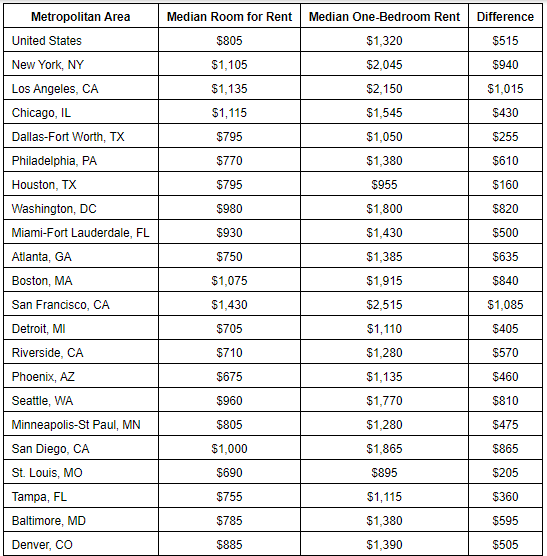
  • The median rent for a single bedroom in a shared home or apartment is $805 in the United States, compared to $1,320 for the median one-bedroom unit.
  • As rent prices increase, having a roommate saves renters more money. San Francisco and Los Angeles renters can save more than $1,000 on their rent each month by renting a room and sharing common areas.
  • Of renters in the 25 largest markets, renters in Houston and St. Louis save the least by getting a roommate.

“Privacy comes at a price in the rental market, and increasingly it’s a price that renters are unwilling or unable to pay,” said Joshua Clark, economist at HotPads, in the release.

“For the past 30 years, wages have stagnated while rent prices and student-loan debt have been on the rise. Finding a roommate or renting out that extra bedroom can help renters keep up with these rising expenses – particularly in expensive rental markets where housing affordability is a major concern,” Clark said.

Living with a roommate best in expensive markets

Renters in the country’s most expensive rental markets can save the most by renting a single room instead of an entire unit. San Francisco and Los Angeles renters can typically spend more than $2,100 per month on a typical one-bedroom apartment and more than $1,100 per month on a room for rent – about a $1,000 difference. Meanwhile, renters in New York City can expect to save about $940 each month by having a roommate, according to the release.

As rent prices rise and housing affordability continue to be a top concern, many renters pair up with roommates to cut down on housing costs. About 30 percent of U.S. renters lived with a roommate in 2017, up from about 28 percent of renters in 2012 and 24 percent of renters in 2007.

One-bedroom rent prices vary widely across the country – in the top 25 metro areas, the median one-bedroom rent ranges from $895 to $2,515 per month. In comparison, the typical cost of a room for rent is fairly steady – the median asking price for a room for rent in the top 25 metro areas ranges from $670 to $1,430 per month. Because one-bedroom rent prices are more variable, getting a roommate in the most expensive rental markets becomes more economical as rent prices rise.

However, renters in some Southern and Midwestern markets where one-bedroom apartments are relatively affordable save less when they split the rent. Renters in Houston save $160 per month by sharing their home or apartment with a roommate instead of renting an entire one-bedroom unit, while renters in St. Louis save $205 per month.

Cost of rooms for rent and one-bedroom rents

Living With A Roommate Can Save Renters $515 A Month

HotPads is a Zillow® Group-owned apartment- and home-search platform for renters in urban areas across the United States. Renters can use a map-based search to find homes and apartments available for rent, as well as individual rooms listed for rent. For more information, visit HotPads.com.


Senate Bill 608: Landlords Proceed With Caution

Lawmakers Extend Oregon Eviction Moratorium Through End of September

A Portland attorney shares some thoughts and opinions on Senate Bill 608, the rent control bill, moving through the Oregon legislature.
By Brad Kraus
Special to Rental Housing Journal

Currently advancing through the Oregon legislature—with no sign of stopping, and with the votes to pass—is a radical set of amendments to the Oregon Residential Landlord Tenant Act known as Senate Bill 608.

If passed without amendments, Senate Bill 608 will drastically amend ORS 90.427 (the termination statute), ORS 90.323 (the rent-increase statute), and other statutes, thereby fundamentally changing your rights as a landlord.

While it would be impossible to touch on every legal issue presented by the Senate Bill 608’s statutory amendments, there are a couple that deserve your immediate attention:

  • First, Senate Bill 608 will effectively eliminate the ability to serve no-cause notices after the first year of occupancy, unless the landlord has a “qualifying” reason (as detailed in the bill), or the landlord occupies the premises with his/her/their tenant. Even worse, service of a no-cause notice without qualifying for any of the exceptions will (a) trigger statutory penalties, including the payment of three months’ rent to the tenant, and (b) provide the tenant a defense to any eviction action filed pursuant to that no-cause notice.
  • Looking deeper into Senate Bill 608, you’ll see that it applies to “[t]erminations of month-to-month tenancies occurring on or after the 30th day after the effective date of this 2019 act.” As of this writing, it’s unclear when that 30th day will be. Therefore, it may be presently difficult (if not impossible) to determine whether your no-cause notice will trigger the new damages provision imposed by Senate Bill 608.

Senate Bill 608 also will cap rent increases during any 12-month period at seven percent plus the consumer price index above the existing rent

The consumer price index changes periodically, but the amount a landlord may raise rent in excess of the seven percent is chained to the figure published by the Bureau of Labor Statistics of the United States Department of Labor in September of the prior calendar year.

Therefore, landlords are capped with the September, 2018 figure throughout 2019. Finally, as of this writing, Senate Bill 608 indicates that the amendments only affect rent-increase notices served on or after the bill’s effective date.

All of the foregoing comments predate the passage of Senate Bill 608 and these are but a few of the drastic changes coming to the Landlord/Tenant Act.

Given the hostility landlords now face in the legislature, you should conduct ample due diligence and seek competent legal advice prior to serving any notices of termination or notices of rent increase.

About the author:

Senate Bill 608: Landlords Proceed With Caution
Bradley Kraus, Portland attorney

Bradley Kraus is an associate at Warren Allen and is a member of the firm’s landlord/tenant practice. A graduate of the University of Minnesota, he attended law school and graduated cum laude from Lewis and Clark Law School. Along with landlord/tenant law, Mr. Kraus assists clients in various litigation, probate, and family law matters.

Senate Bill 608: Landlords Proceed With Caution
Photo credit zrfphoto via istockphoto.com

High-Income Renters Are Fastest-Growing Housing Segment With Multifamily Leading

High-Income Renters Are Fastest-Growing Housing Segment

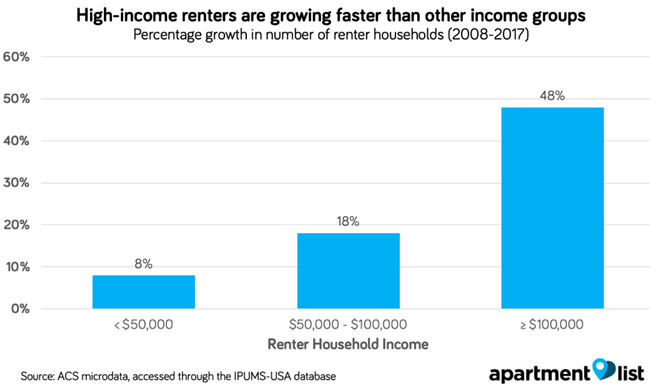
High-income renters are the fastest-growing housing segment in the United States, representing renters with six-figure incomes who choose to continue to rent rather than buy, according to new research from Apartment List.

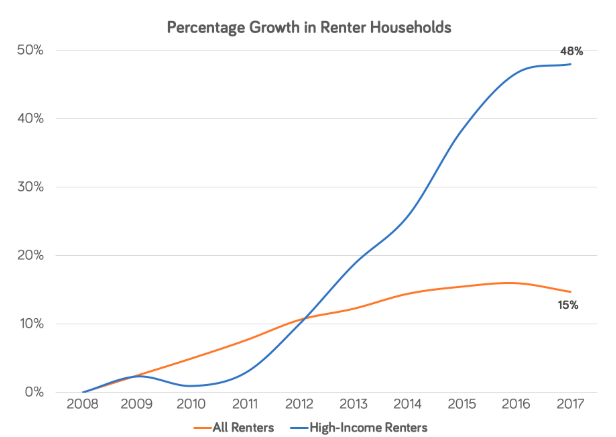
Across the United States there has been an increase of 48% in the number of renters who earn at least $100,000 per year. Growth in this segment in the future is expected to be much faster in multifamily homes than in single-family homes.

High-Income Renters Are Fastest-Growing Housing Segment

What is driving the high-income renters market

There are interacting supply-and-demand forces that are encouraging high-income households to rent instead of buy:

  • Growing supply: In the wake of the Great Recession, rental housing is booming across multifamily and single-family markets.
  • Growing demand: Now more than ever, even wealthy Americans are demanding rental options as they struggle to afford homes and increasingly value the flexibility of renting.

High-Income Renters Are Fastest-Growing Housing Segment

Why the surge in high-income renters in multifamily?

During the first three years of the recession, as single-family rentals were surging across American suburbs, funding for new housing construction had mostly evaporated.

But in 2011, the multifamily sector came back to life and brought new renter-friendly housing to dense urban cores. As Apartment List previously analyzed, multifamily construction quadrupled between 2010-2017 and has returned to pre-recession spending levels.

Most of this supply was geared towards the higher end of the market, providing new amenities for high-income renters at a time when single-family home construction lagged.

High-Income Renters Are Fastest-Growing Housing Segment

High-income multifamily renters growing faster

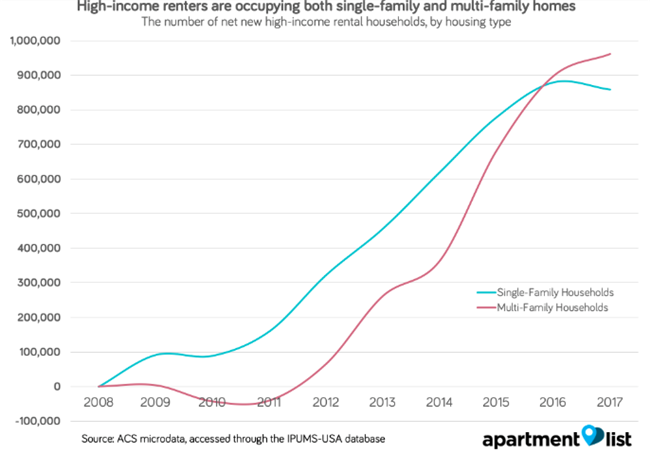
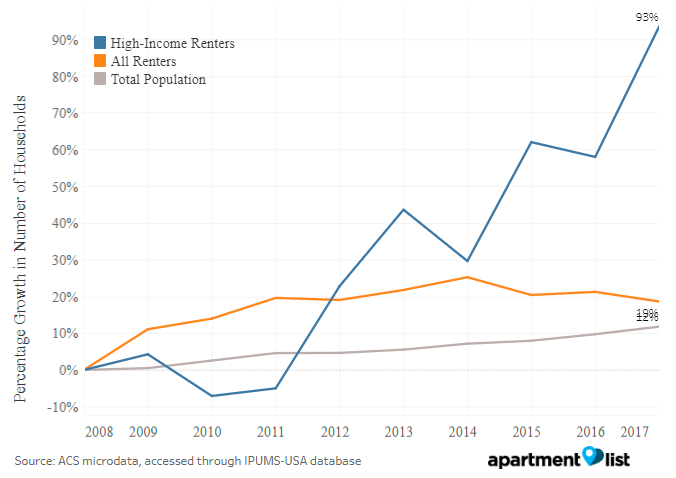
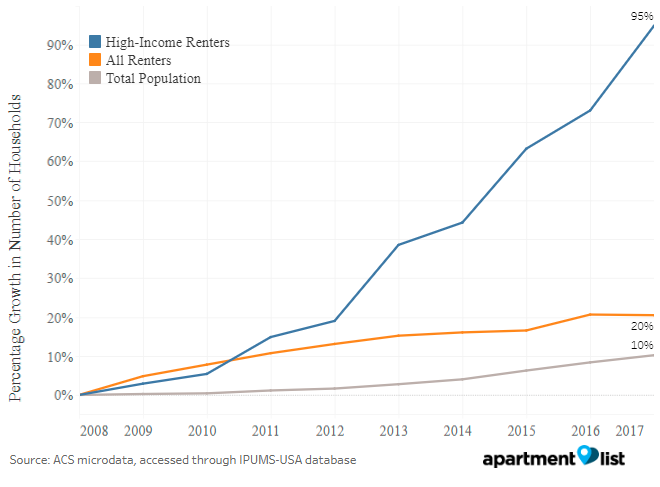
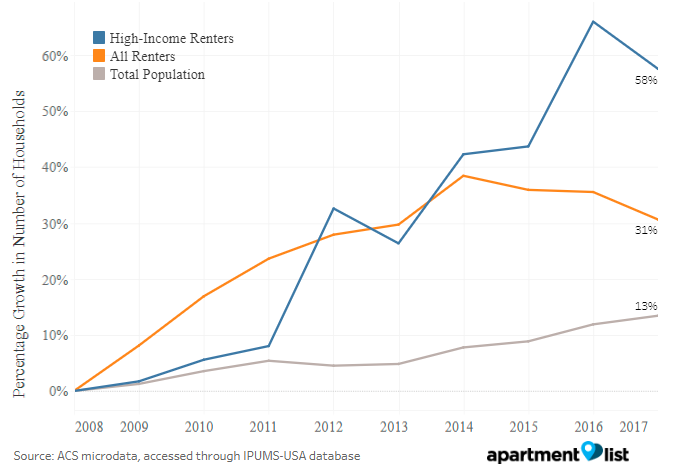
From 2008-2011, high-income renters left multifamily homes in favor of the vacant single-family homes left behind from the Great Recession, according to the Apartment List research. Then, following the resurrection of multifamily construction in 2011, high-income households moved into these homes at such a fast rate that they overtook single-family in just five years.

By 2017, there were 1.8 million new high-income renter households – 960,000 occupying multifamily and 860,000 occupying single-family.

Portland Oregon High-Income Renters

High-Income Renters

Conclusion

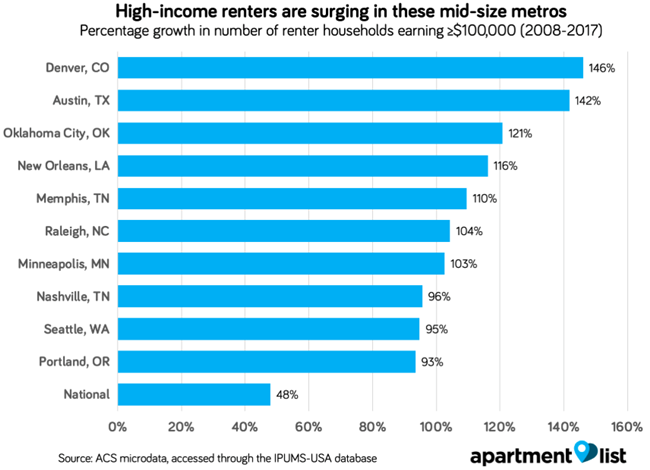
High-earning renters have multiplied especially quickly in mid-size, supply-abundant cities with strong economies.

What does this mean for the future of the housing market?

  • In the short-term, Apartment List economists expect the influx of high-earning households into multifamily rentals to continue, as multifamily construction remains strong and workers value the job opportunities and amenities of living in urban areas. With higher incomes, these households will demand new amenities from their homes and neighborhoods. High-income-renter growth in the single-family segment began to level off last year, but it will take a major shift in housing affordability to completely reverse the trend.
  • In the medium-term, economists expect the growth of high-income renters to create both policy challenges and opportunities. On one hand, the trend will likely lead to greater inequality within the rental market. As cities debate solutions to disappearing affordability and gentrification, high earners are increasingly competing with everyone else for finite city space. On the other hand, these high-earning households may bring new momentum for policies that affect all renters. This may even solicit policy response at the federal level, which is currently a quiet topic but one that expected to ramp up in the near future.
  • In the long-term, this decade’s trend may be indicative of changing norms around how we pay for our housing. If today’s high-earning families increasingly value the centrality of living in cities or the flexibility of renting instead of owning, the traditional paradigm of homeownership as a paramount metric for financial success may begin to evolve, the Apartment List report says.

Seattle High-Income Renters

High-Income Renters Are Fastest-Growing Housing Segment

High-Income Renters Phoenix

High-Income Renters Are Fastest-Growing Housing Segment

About Apartment List

Apartment List is a fast-growing online apartment rental marketplace “on a mission to make finding a home an easy and delightful process,” according to the company. The company currently has over four million units on the platform and has reached more than 150 million users in over 40 cities since launch.

4 Things To Check In A Chimney Inspection In Your Rentals

4 Things To Check In A Chimney Inspection In Your Rentals

The importance of a chimney inspection in your rental property is the maintenance checkup this week provided by Keepe.

A chimney inspection, including cleaning and inspecting your chimney flue, should be done regularly to prevent chimney fires.

Even if tenants don’t regularly use the fireplace, it’s best to have a chimney sweep check at least once a year to avoid preventable damage.

4 Things To Check In A Chimney Inspection In Your Rentals
Chimney caps protect your fireplace from rain, birds, animals and debris so check the caps regularly.

Annual chimney maintenance removes flammable creosote, the major cause of chimney fires, and identifies other performance problems.

Creosote is a natural byproduct of burning wood. As fireplaces get used, the more likely it is that your fireplace venting can become impaired. In addition to being a fire hazard, creosote build-up can also lead to harmful smoke coming inside the building.

 Chimney inspection
Creosote is a natural byproduct of burning wood. As fireplaces get used, the more likely it is that your fireplace venting can become impaired.

Even if you don’t burn much, these inspections will ensure that your chimney is safe to use.

 4 things you should do during a chimney inspection

  1. Have the chimney caps checked: Chimney caps protect your fireplace from rain, animals and debris. These caps can also protect your roof and reduce fire risk by trapping embers and sparks. If you don’t have a cap, or notice that it is loose or needs to be replaced, be sure it gets done during a chimney sweep with a maintenance professional.
  2. Schedule follow-up inspections: Every tenant and building has different burning habits. If the chimney is used often at your property, be sure to schedule more than one yearly inspection. Chimneys can be checked and cleaned at any time of the year.
  3. Encourage responsible use: Tenants should only burn dry, cured wood. Other treated wood releases chemicals into your building, compromising your air quality. For a safe fire, build it slowly, only adding more wood as the heat decreases. Educate tenants on proper fireplace use to avoid safety issues.
  4. Boost efficiency: When the fireplace is not being used, make sure tenants close their dampers to prevent heat loss. Replace any poorly sealing dampers during your chimney inspection and cleaning appointment.
4 Things To Check In A Chimney Inspection In Your Rentals
When the fireplace is not being used, make sure tenants close their dampers.

Other recent rental property maintenance Keepe posts you may have missed:

4 Outdoor Flooring Options For Your Rentals

20 Easy, Affordable Maintenance Projects To Update Your Rentals

7 Tech Gadgets For A Safer And More Efficient Rental Property

5 Maintenance Tips For Long-Lasting Rental Carpet Flooring

Is The Water Heater At Your Rental Property Ready For The Big One?

7 Types Of Kitchen Countertops For Your Apartments

Which Cooktop Is Best For Your Rental Property?

A Guide To 4 Types Of Flat Roof Systems

6 Ways To Trash Your Apartment Waste Management Issues

About Keepe:

Keepe is an on-demand maintenance solution for property managers and independent landlords. The company makes a network of hundreds of independent contractors and handymen available for maintenance projects at rental properties. Keepe is available in the Greater Seattle area, Greater Phoenix area, San Francisco Bay area, Portland, San Diego and is coming soon to an area near you. Learn more about Keepe at https://www.keepe.com


Millennials’ Expectations Driving Maintenance Changes

A study by a new company found millennials’ service expectations in apartments and rental homes are driving changes in both property maintenance and maintenance staff and the tools used to perform their jobs.

By John Triplett

High turnover in the maintenance ranks is a problem in multifamily housing, especially among millennial maintenance personnel. They like easy-to-use technology applications on their smart phones and not old paper-based maintenance processes. That is why the company, Facilgo, did the study to research these questions.

    • How do millennials’ expectations for faster maintenance affect property management maintenance organizations?
    • Are millennial maintenance personnel leaving multifamily due to the lack of technology solutions available in their day-to-day jobs?  What can be done to retain them?
    • What strategies are companies using to make their maintenance processes more efficient?
    • How will these new strategies help retain millennial maintenance personnel and satisfy millennial residents?
    • What will happen if companies don’t do anything to cater to millennials’ needs?

In an interview with Rental Housing Journal, Ken Murai, founder and CEO of FacilGo said, “There is a greater degree of expectation that we respond faster, we communicate better, and we get things fixed quickly.

“And if we don’t, then they’re going to shout from the mountaintops through social media to let us know about that, and that’s really putting the pressure on making sure that we do a good job the first time,” Murai said.

Fighting turnover among millennial maintenance employees

“There’s so much turnover in the maintenance ranks right now that executing company processes needs to be really easy for staff to do.  In fact, they almost need to be trained as a part of doing the process.

“Paper and pencil and running back to the maintenance shop to log something on the computer, it’s just not going to cut it,” Murai said which is why he founded the company.

“The thing I’m hearing from a lot of the larger owners whenever we talk about maintenance and turnover, is that staff turnover is so high and that makes them frustrated. The thing that’s really astounding is that they’ll hire someone  and train them but after  six months,  they’ll quit and move to a different industry because the work environment is paper-based. They’re using their phone for social stuff, communicating, entertaining, getting things done, and then they get to their job and they’re handed a clipboard. It’s really demoralizing and frustrating for them,” he said.

Millennials’ expectations driving maintenance change

To be a successful and continual improve, there needs to be “support for the entire process from start to finish. You need to use mobile devices or computers within the process to capture pictures and comments in order to get the job done,” Murai said.

“Use that documentation to communicate with your residents because it’s not just fixing the problem that’s important. You have to fix it and communicate well about it, or else nobody’s going to be happy,” he said.

“The problem that we’re seeing with other solutions out there today is that they may solve one piece of the puzzle. If you don’t build a process that leverages one step to the next, it becomes disjointed and is tough. You’re having to redo things and not do things efficiently. Even if you stitch together a bunch of solutions, it will be far from optimal. Even if you usie one of the large property management solutions and they have some of the functionality needed to manage maintenance, they still may lack the ability to “help” your employees follow your process from one step to the next; it’s  still a problem.

Lack of innovation was most surprising find in the study

Murai said the most surprising lesson from the study was “the lack of innovation.”

“After I left Realpage and was doing other consulting work, I hadn’t paid attention to all the different efforts that were happening with maintenance and procurement systems. When I was asked to look at the maintenance and procurement market once again, I saw that there really hadn’t been much evolution in the systems since I left the space.

“I think we’ve seen a lot more evolution on the leasing side of the business, but on maintenance and operations, it’s been a part of the business that has been left behind. There is so much more that can be done. In FacilGo®, we have a great system, and we’re finding that by supporting the entire operational process, we can really help people get things done more efficiently and get the right things done.”

Most maintenance transactions are service related

Millennials Expectations Driving Maintenance Changes

“What I found from analyzing multifamily data is more of the transactions are service-related than product-related, especially for turns,” Murai said.

“We’ve built our platform to work with services in a way that other platforms do not.

“For example, with floor covering, we handle not only scheduling the service, but also include pricing, your negotiated price per square yard, your floor plan measurements, the amount of carpet  needed for a given floor plan by room,  seaming diagrams, and you can order by the room with accurate measurements rather than having to do a full replacement. Everybody else does estimates. We have your company’s flooring information accurate, down to the room,” he said. And the applicable flooring can be purchased directly through his company’s app. “We have a mobile-enabled website and  a web application. So, we have everything you need, wherever you need it, to get the job done.

Describing his pricing, Murai said, “Our pricing model is  unit-based pricing, and very dependent on what solution modules our clients utilize.  Some solution modules can be used very cost-effectively, or you can use our entire suite.

“We have several mid-sized multifamily and single-family home customers, and we’re actually on track to start part pilots with several larger multifamily customers this quarter. We also have some of the largest suppliers in the industry on the platform,” Murai said.

Question and answer with Ken Murai

Q: How do millennials’ expectations for faster maintenance affect property management maintenance organizations?

A: Our challenge is to get maintenance issues solved more quickly and efficiently than ever before.  If not, we are going to hear about it on social media.  How do you speed up you processes and improve communication with your residents?  You need to have the people and tools to help you track, document, assign, and get the right products/services/work done, and you need to help them collaborate.

“People need to know what to do, when and how, as well as get access to the right help when the time is appropriate.  Instead, maintenance staff often spend a lot of time figuring out what they need to do or buy.

“This is heightened when you have new employees, since they don’t know what to do.  By providing them with tools that guide them to work with the right people, buy the right things, document problems and solutions with pictures, etc. it will help them get the work get done faster.

“They’ll be able to get help from vendors or other staff, leverage past solutions, plan for the future, and ensure that customer issues are not lost or fixed too slowly.  In addition, you’ll be able to provide better communication with your residents.  Remember, it’s not just the solving of the problem that matters, but also the communication of the resolution.

Millennials Expectations Driving Maintenance Changes

 Q: Are millennial maintenance personnel leaving the multifamily industry due to the lack of technology solutions available in their day-to-day jobs? What can be done to retain them?

A: Millennials use their phones to socialize, communicate, entertain themselves, and get things done.  Millennials are the top smart phone users with Facebook, Facebook Messenger and YouTube (according to Nielson) being the top 3 apps.  The Bank of America Trends in Consumer Mobility report interviewed 1,000 adults and found that smartphones were more important to millennials than deodorant.  These devices are an integral part of millennials’ daily lives.

In speaking to various management companies, we have anecdotally heard that many recently hired millennials quit their jobs to move into jobs in other industries.  Why?  Because, they were frustrated by the lack of tools on their smartphones that the property management companies provided to get things done.  They hate using paper and property management is full of paper processes. Who is going to hire them in the future based upon their expertise in running a paper based process?  As a result, the millennial workforce will continue to migrate to other industries that have tools that allow them to do their jobs more efficiently unless we as an industry evolve.

As a starting step, many companies are starting to adopt “bring your own phone policies.” While this means that pictures and texting are being used for communication and tracking, the lack of integration of this information into their property management systems means that information is isolated, collaboration is difficult, and tasks are left undone.  In other words, it’s a good baby step, but this like any other siloed system doesn’t provide nearly as much help as a collaboration platform.

 Q: What strategies are companies using to make their maintenance processes more efficient?

A: The best companies are focusing on supporting an entire business process instead of providing point solutions that help solve a sliver of that process. That means they need to be able to support multiple processes (not just ordering or invoice processing or inspections or work orders).

For example, one company we spoke to talked about using an application to do due diligence inspections. At the end of the process they had a lot of great pictures and data, but then didn’t know what to do next, since the data resided in their app, and didn’t support any of their other processes or work with their property management system.

The most efficient companies are using software platforms that support the entire maintenance process where they collaborate with their staff and suppliers, and leverage past data to make the process more efficient.

Inspections lead to work orders, quote requests or orders and everything is tied together.  Being easy-to-use, they require less training and support, and guide the staff through the process.  So, you’re getting the benefit of requiring little training on the application and the process!  That’s something that not just millennials want, but all people in the organization.

Another comment on mobile.  Given that real estate is a distributed operation, mobile applications are required so people can get the work done at the location where the issue exists.  With mobile, staff and suppliers are able to record notes, take pictures and record them in a system where the information can be shared, trigger additional actions and used for reporting.

Some of the baby steps we are seeing companies take are policies that allow staff to text each other and their vendors with messages and pictures.  It’s a start, but the information is isolated on a person’s phone and isn’t leveraged for future actions by the entire organization.

We’re also seeing some companies adopt virtual turn boards using Google Spreadsheets or Microsoft Sharepoint.  Again, it’s a great solution that solves one piece of the pie, but often falls short around updates and scheduling.  We believe that it’s most efficient to have virtual turn boards that tie into your turn schedule, inspections, work orders, quotes, contracts, orders, and invoices, which allows you to support your entire process.

We’ve also seen a trend for companies having maintenance personnel handle more units than before and they aren’t necessarily outsourcing more work to vendors.  Unless they provide tools and software that makes them more efficient, they will both slip on their quality of service and lose residents.

We’ve also seen some outsourcing tasks to key vendor partners, but those who are doing so tend to be smaller property management companies with smaller properties.

 Q: How will these new strategies help to retain millennial maintenance personnel and satisfy millennial residents?

Millennials Expectations Driving Maintenance Changes

A: Nielsen reports that 97-98% of millennials have smart phones. They are using them for social media, messaging, YouTube, maps, search and more.  They are constantly on their phones and can’t stand using paper or the dusty old PC in the maintenance shop.

“If you are thinking of allowing them to use their phones to text and take pictures, just remember that if their phones are not connected to the rest of the property maintenance platform, they’re going to have to use some paper and transpose that data into a computer.  It’s wasteful, they know it, and it’s frustrating.  Plus, it doesn’t help them gain the skills to help them be competitive with future jobs.

By using mobile and web software that helps support the entire maintenance process, you’re able to help your staff get things done faster and more efficiently and communicate much more effectively.  Who doesn’t want have the satisfaction of getting things done.  And, if they’re happy, they’ll stay.

 Q: What will happen if companies don’t do anything to cater to millennials’ needs?

A: Millennial staff become frustrated when using antiquated methods.  Tools that support their entire process and help them collaborate not only allow the maintenance personnel to have more job satisfaction, they are more efficient, collaborative and social, and learn faster.

Just using their phones is the first step, but being able to use their phones to work with existing processes is what they are looking for, and what will keep them from running away to other industries that use more technology.  Continuous improvement leveraging tools is key to retention

 Q: How does FacilGo® help property management companies and their suppliers not only operate more efficiently, but also help improve maintenance personnel’s job satisfaction?

A: “FacilGo® is built to support the entire turn and maintenance process from when you identify a problem, figure out how to solve it, get the work done (with internal or external staff) and order parts, process the invoice and payment, and then charge back residents.

“We believe that a platform must do more than one step of a process. In fact, your software should leverage one step of the process to help you with the next step, so your staff does the right thing quickly and efficiently.

“ We find that companies initially adopt some of our easier-to-implement solutions like inspections and move out closing statements, then start adding on work orders, contract management, procurement, invoice processing, fixed asset, and inventory management.  We also have functionality such as budgets, supplier ratings, job cost and CAM charges, so we offer a very robust set of features and functions to support your operations and maintenance processes.”

About Ken Murai

Ken was the Vice President of Product Development and Client Management at OpsTechnology, where he was responsible for designing and developing the OpsTechnology product and oversaw its client management team from initial deployment to acquisition by RealPage and beyond. Ken has experience creating procurement organizations and managing strategic technology initiatives for executive teams in the multifamily industry. Ken graduated from the University of California, Davis with a B.S. in Electrical Engineering, and an M.B.A. from the University of California, Berkeley, Haas School of Business. He has been working in the technology industry for 25 years, in areas including product development, sales, marketing and management.

About Facilgo

FacilGo® provides a solution to property management organizations who are frustrated by their turn and maintenance processes. Our property maintenance platform and private marketplace streamlines operations and saves money by offering an integrated inspection to invoice process through which you manage your turns and maintenance processes. Unlike other software that provide piece-meal solutions, FacilGo® offers an integrated process where your staff is presented with what to do and buy based upon their inspection and work order results. Instead of spending time figuring out what to do, staff can spend time collaborating with suppliers to get things done.


Lying About An Emotional Support Animal In Utah May Become A Misdemeanor

Lying About An Emotional Support Animal In Utah May Become A Misdemeanor

Utah lawmakers are close to passing legislation penalizing renters for lying about owning an emotional support animal, according to reports.

The lawmakers say the legislation is for the benefit of both landlords and people with legitimate disabilities, but disability groups say the legislation could be intimidating to people who legitimately need an emotional-support animal in their residence.

The Utah House has passed the bill to make it a misdemeanor to falsely claim to a landlord that a tenant has an emotional-support animal; it has received favorable recommendation in the Utah Senate.

The bill, HB43, was proposed by Rep. Jim Dunnigan, R-Taylorsville, and makes a clear distinction between service animals and emotional-support animals.

According to Dunnigan, there is no penalty under the current law for a tenant falsely claiming to a landlord that he or she has an emotional-support animal, and this bill changes that.

“It’s becoming a problem, I’ve heard a lot from service-animal owners that the people with emotional-support animals are kind of damaging their brand, because more and more people are saying, ‘I qualify for an emotional-support animal, you need to rent housing to me,’ when they do not,” Dunnigan told KSL.com.

The bill’s primary function would be to impose criminal penalties on people who seek housing and lie about having a medical need for an emotional-support animal.

Under current state law, people who lie about having a “service animal” can be charged with a class B misdemeanor, but no such penalty exists for “emotional-support animals.”

Disability group sees problems with the legislation

Ogden-based disability advocacy group Roads to Independence sees problems with the bill.

“They say that it will be used as a deterrent, but our concern is that deterrent, if you want to call it that, is intimidation,” said Roads to Independence Director Andy Curry during a public hearing before the Senate Health and Human Services Committee, according to the St. George News.

“When you do intimidation, you’re catching the whole gamut of people,” Curry said. “You’re catching the people that have the disability and you’re catching people that don’t.”

Curry suggested that there are alternatives to taking a law enforcement approach, such as awareness training for landlords.

Andrew Riggle, a public policy advocate with the Disability Law Center, also spoke in opposition to the bill.

“As part of our fair-housing work, the DLC takes hundreds of calls and represents hundreds of clients every year facing barriers to their ability to live independently,” Riggle said, according to the newspaper.

“Clients with support animals are people with debilitating anxiety, PTSD, postpartum depression, bipolar disorder or severe depression,” he explained. “These people need their support animals so badly that many of them would be unable to live independently without (them).

“These people, real people with disabilities with real needs, face denials of their requests for accommodation every single day.”

Riggle said people making fraudulent claims about service or support animals are “exceedingly rare” in the experience of the Disability Law Center, arguing that legislation of this nature would just serve as yet another barrier to these people seeking living accommodations.


Resources:

Lawmakers advance bill penalizing people for lying about emotional support animals

Bill to make lying about emotional support animals a misdemeanor passes in Utah House

Bill to make lying about emotional support animals a misdemeanor passes in Utah House

NMHC Multifamily Housing Quarterly Survey Shows Little Overall Change

NMHC Multifamily Housing Quarterly Survey Shows Little Overall Change

A majority of industry leaders cite tariffs as a cause of higher costs as a survey shows apartment market conditions were mixed in the National Multifamily Housing Council’s (NMHC) Quarterly Survey of Apartment Market Conditions for January.

The Market Tightness (46) and Equity Financing (50) indexes showed little change in those conditions from October, while the Debt Financing Index (59) showed improving conditions. By contrast, the Sales Volume Index (33) showed further slowing in property sales, according to a release.

Notably, a significant majority of respondents found that recent tariffs have driven up costs across the board and in a variety of markets throughout the country.

“While the four indexes each changed somewhat over the last quarter, overall market conditions remained fairly static. Debt-market financing conditions improved somewhat over the last three months,” said NMHC Chief Economist Mark Obrinsky in the release.

“By contrast, equity-market financing conditions are little changed, as considerable capital continues to seek investment in the apartment sector.”

Highlights of the quarterly multifamily housing survey

NMHC Multifamily Housing Quarterly Survey Shows Little Overall Change

The Market Tightness Index increased from 41 to 46. Less than one-quarter (22 percent) of respondents reported looser market conditions than three months prior, compared to 13 percent who  reported tighter conditions. Nearly two-thirds (64 percent) of respondents felt that conditions were no different from last quarter.

The Sales Volume Index fell from 44 to 33. This continues the nearly unbroken declining sales volumes that began in October 2016. Slightly less than half of respondents (49 percent) reported lower sales volume from three months earlier, while almost one-third (31 percent) noted unchanged volume. Fifteen percent of respondents, on the other hand, reported higher sales volume.

The Equity Financing Index slid slightly from 51 to 50. Twelve percent thought equity financing was more available than in the three months prior, compared with 13 percent who believed equity financing was less available. For the eighth consecutive quarter, most respondents (62 percent) reported unchanged conditions in the equity market.

The Debt Financing Index rose from 22 to 59. About one-third of respondents (34 percent) reported better conditions for debt financing compared to the three months prior. Over one-third (39 percent) of respondents reported unchanged conditions, while 15 percent thought that conditions for debt financing had become less favorable.

Similar to last quarter, there was a general consensus that tariffs have driven up costs by some amount, but that tariff-induced delays (and especially cancellations) were less common. The majority (84 percent) of respondents reported higher costs due to tariffs (excluding the 26 percent of respondents who reported “Don’t know/not applicable”).

More specifically, 59 percent of respondents saw tariff-related costs rise by a little (less than 5%), while another 25 percent saw costs rise by more than 5%; only 16 percent did not observe higher costs from tariffs. Yet, well over half (61 percent) of respondents (excluding 37 percent who reported “Don’t know/not applicable”) indicated that tariffs had not caused them any project cancellations or delays. Almost a third (31 percent) reported that tariffs had caused delays but not cancellations, while 8 percent experienced both cancellations and delays.

About the Survey:

The January 2019 Quarterly Survey of Apartment Market Conditions was conducted January 15-22, 2019; 112 CEOs and other senior executives of apartment-related firms nationwide responded.

View the full data online.

Based in Washington, D.C., the National Multifamily Housing Council (NMHC) is the leadership of the trillion-dollar apartment industry. We bring together the prominent apartment owners, managers and developers who help create thriving communities by providing apartment homes for 39 million Americans. NMHC provides a forum for insight, advocacy and action that enables both members and the communities they help build to thrive. For more information, contact NMHC at 202/974-2300, e-mail the Council at [email protected], or visit NMHC’s web site at www.nmhc.org.


Republicans Ask to Amend Oregon Rent Control Bill In The House

Republicans Ask to Amend Oregon Rent Control Bill In The House
Senator Tim Knopp (R) Bend, Oregon

Republicans in the Oregon House of Representatives have asked to amend the Oregon rent control bill, Senate Bill 608, which has passed the Senate and is now up for consideration in the House, according to a release.

The Senate approved the bill over bipartisan opposition, 17-11, with Democrat Betsy Johnson joining with Republicans in voting against the legislation.

“The bill that will do renters more harm than good was whisked through the Senate Housing Committee with utter disregard for five amendments offered by Vice Chair Fred Girod (R-Stayton). A request to remove the emergency clause, allowing property owners time to prepare for the impact of the legislation, was denied,” according to the release from House Republicans.

“Oregon is piling on regulation upon regulation, which is essentially causing the problem, so the response to failed regulation from this chamber is to add more regulation,” said Sen. Tim Knopp (R-Bend) in the release.

“And when that doesn’t work, the response is going to be ‘we didn’t go far enough, we need even more regulation on the housing industry’. I think the most likely outcome of this bill is negative consequences for the very people the proponents of this bill want to help,” Knopp said.

“When the House Human Services Committee takes up SB 608 on Feb. 18, House Republicans hope the majority party will afford the bipartisan spirit promised in January. Only then will the intended beneficiaries truly be helped,” the Republicans said in the release.

What Oregon Senate Bill 608 Does

  • Prohibits a landlord from terminating month-to-month tenancy without cause after 12 months of occupancy. Provides exception for certain tenancies on a building or lot used by a landlord as residence.
  • Allows a landlord to terminate tenancy with 90 days’ written notice and payment of one month’s rent under certain conditions. Exempts landlords who manage four or fewer units from payment of one month’s rent.
  • Provides that fixed-term tenancy becomes month-to-month tenancy upon ending date if not renewed or terminated.
  • Allows landlord to not renew fixed-term tenancy if tenant receives three lease-violation warnings within 12 months during term and landlord gives 90 days’ notice.
  • Limits rent increases for residential tenancies to one per year.
  • Limits maximum annual rent increase to 7 percent above annual change in consumer price index.
  • Requires Oregon Department of Administrative Services to publish maximum annual rent increase percentage.
  • Declares emergency, effective on passage.