Home Blog Page 171

How To Avoid A Fair Housing Claim Over Source Of Income Discrimination

How To Avoid A Fair Housing Claim Over Source Of Income Discrimination

Potential source of income discrimination as more and more cities and states pass these types of fair housing laws is the topic this week of the Grace Hill training tip.

By Ellen Clark

 Many states and cities, including Seattle and the State of Washington, have laws against source of income discrimination meaning a property owner cannot choose to reject an applicant based on where his income comes from as long as it is a lawful source.

Source-of-income discrimination has been documented by researchers, and advocates say it creates barriers for people struggling to find housing.

In Baltimore, the City Council has passed legislation that would make it illegal for property managers to discriminate against prospective residents because of how they would pay their rent. The law bans discrimination on the basis of a tenant’s source of income, so long as the income is lawful. Under the law, landlords will be unable to turn away voucher holders simply for paying their rent with a voucher rather than with earned income, a rule that is already on the books in dozens of cities and several states.

This type of discrimination is known as “source of income” discrimination, and though not prohibited under federal fair housing law, it is prohibited by some state, city, and county laws. According to reports at least 12 states and numerous cities have similar legislation in place so it pays to check your local city and state laws on this issue. The states of Washington, Oregon, Utah and Colorado all have these types of laws see the list here of states and cities with these types of laws.

Source of income discrimination is often directed at people whose lawful livelihoods come from sources other than a paycheck.

Examples of lawful sources of income include:

Source of income discrimination may not be prohibited under federal fair housing law, however, it is prohibited by some state, city, and county laws.

  • Housing Choice Vouchers (Section 8)
  • Supplemental Security Income (SSI)
  • Social Security
  • Veterans benefits
  • Alimony or child support payments
  • Temporary Assistance for Needy Families (TANF)

What types of actions may be considered source of income discrimination?

Here are some examples:

  • Advertising that a person “must have a job” to rent an apartment.
  • Requiring documentation, such as pay stubs, that are typically only available to people who are working.
  • Advertisements that express limitations as to the source of income of potential residents, such as, “No Section 8” or “We do not take public assistance”
  • Refusing to rent to a person who is receiving public benefits.
  • Setting income requirements artificially high in order to exclude applicants who receive public benefits.
  • Requiring co-signers or a larger security deposit because of an applicant’s source of income.

How to avoid a fair housing claim over source of income discrimination

If discrimination based on the source of income is prohibited in your state or locality, one of the most important things you can do to make sure you do not end up on the wrong side of a fair housing claim is to keep all employees well informed.

  • Staff members should refresh their fair housing knowledge at least annually and be aware that discrimination based on “source of income” is illegal.

All staff members who come into contact with residents and prospective residents must be trained in fair housing laws.

  • All staff members should refresh their fair housing knowledge at least annually and should be very clear that discrimination based on the source of income is illegal.
  • Don’t forget about vendors and contractors! Anyone who could possibly interact with your residents should be informed of your company’s fair housing policy and asked to abide by fair housing laws.

It is important to remember that many states, cities, and municipalities have expanded fair housing protection to include additional protected classes. In addition to the source of income, these may include characteristics such as ancestry, marital status, age, military status, and student status.

Even if your area does not include some or all of these additional protections, all people should be treated fairly and equally – as a housing provider, that’s your responsibility!

Read Ellen’s full blog post here.

Resources:

Washington lawmakers OK bill to ban housing bias based on tenant’s source of income

Fair Housing: Source of Income Discrimination

List of states and cities with source of income laws

Recent Grace Hill training tips you may have missed:

Are You Confused By Requests For Service, Emotional Support And Assistance Animals?

What Do You Do When Assistance Animals Break The Rules?

7 Ways To Stay Out Of Trouble When Checking Criminal History

5 Ways To Protect Applicants, Residents And Employees From Sexual Harassment

Do You Have A Smoke-Free Policy That Adequately Protects Residents?

How To Handle Suspicious Documentation For Assistance Animals

How A No Pet Policy Can Be Discriminatory

Property Management Cyber attack Risks Overlooked, Underestimated

Do You Know How To Respond To a Sexual Harassment Complaint?

Have You Reviewed Your Criminal Background Checks Policy Lately?

Multifamily Managers And Marijuana: Caught In A Pot Crossfire

Fair Housing Discrimination Against Someone You’ve Never Talked To?

4 Ways To Avoid Screening Pitfalls With Applicants

Red Flags In Evaluating Documentation For Assistance Animals

Did You Know Fair Housing Laws Apply To Vendors Working At Your Property?

About the author:

Ellen Clark is the Director of Assessment at Grace Hill.  Her work has spanned the entire learner lifecycle, from elementary school through professional education. She spent over 10 years working with K12 Inc.’s network of online charter schools – measuring learning, developing learning improvement plans using evidence-based strategies, and conducting learning studies. Later, at Kaplan Inc., she worked in the vocational education and job training divisions, improving online, blended and face-to-face training programs, and working directly with business leadership and trainers to improve learner outcomes and job performance. Ellen lives and works in Maryland, where she was born and raised.

About Grace Hill

For nearly two decades, Grace Hill has been developing best-in-class online training courseware and administration solely for the Property Management Industry, designed to help people, teams and companies improve performance and reduce risk. Contact Grace Hill at 866.472.2344 to hear more.
 

Washington Governor Signs Sweeping New Eviction Bill

3 Areas Where Congressional Legislation Falls Short, Could Be Detrimental to Rental Housing Market

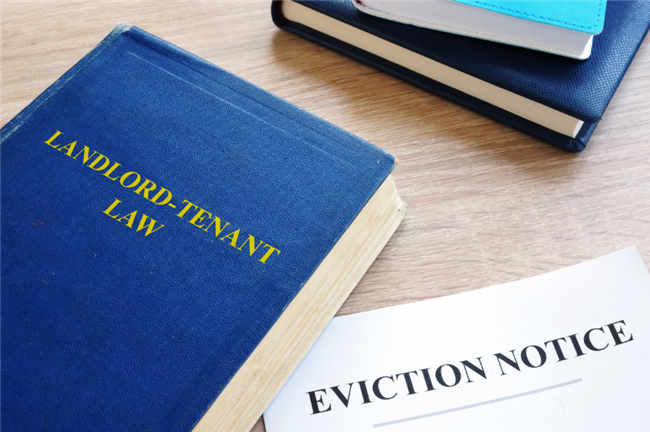
A sweeping new eviction bill has been signed by Washington Gov. Jay Inslee requiring landlords to give tenants 14 days to respond to an eviction notice instead of the current three days.

The bill also allows judges to impose payment plans, so that tenants can remain in their homes while they repay what they owe.

The eviction bill, SB 5600 , a comprehensive change to the current Washington landlord-tenant law, requires uniform eviction notices written in plain language available to landlords for use that includes information on civil legal aid resources available to tenants and where to find translated copies of the notices.

“We have heard definitively from experts, and from those directly impacted, that evictions are the leading cause of homelessness in Washington State,” said Sen. Patty Kuderer (D-Bellevue), the bill’s sponsor, in a release.

“When the Senate formed the new Housing Stability & Affordability Committee, we redirected our statewide approach on homelessness to include prevention. This legislation is a significant step in that direction,” Kuderer said.

“The eviction process can be complicated and overwhelming for anyone facing the possibility of homelessness. Simplifying language is about more than conveying information to tenants, it is about increasing accessibility to a legal system in which they have every right to participate.”

Opponents of the bill say it will drive small landlords out of the business and make the housing crisis worse.

“Not all landlords are just rolling in cash,” said Puyallup Republican Rep. Chris Gildon in an interview with the Seattle Times. “It will result in the exact opposite of what we’re trying to do.”

Landlords’ associations objected to the bill in the weeks leading up to the vote on similar grounds, saying that adding more than a week to eviction periods would cause property owners to risk missing their own mortgage and utility payments.

Along with extended wait times, the bill also proposes giving new power to judges, who would be allowed to temporarily block evictions based on factors including the tenant’s payment history and whether they had made a good-faith effort to pay.

A summary of the new Washington eviction bill

  • Extends the 3-day notice for default in rent payment to 14 days’ notice for tenancies under the Residential Landlord-Tenant Act.
  • Requires the 14-day notice to be written in plain language and include information on civil legal aid resources available, if any, to the tenant.
  • Extends the mandatory notice period from 30 to 60 days when landlords propose a rent change amount. Requires a landlord to first apply any tenant payment to rent before applying the payment toward other charges.
  • Prohibits continued tenancy and relief from forfeiture to be conditioned upon tenant payment or satisfaction of any monetary amount other than rent.
  • Provides the court with discretion to provide relief from forfeiture or to stay a writ of restitution.
  • Requires a landlord to provide a tenant with documentation regarding any damages for which the landlord intends to retain any of the deposit amount.

Staff summary of public testimony in favor of the new eviction bill – the pro arguments

There is a need to overhaul our statewide approach to housing and homelessness by focusing on prevention as opposed to being primarily reactive. Inflexible eviction policies are a major source of housing instability around our state.

If we are serious about long-term prevention, we must address this primary driver of homelessness. Currently, 26 states and the District of Columbia have pay-or-vacate notice periods longer than three days, including some with a 14-day notice. Washington State is outside the norm and for individuals living paycheck to paycheck, which is now nearly half of all Americans, these extensions of notice matter. We should also offer resources, flexibility, and compassion to help, since one unexpected medical bill or car accident or government shutdown can lead to an eviction https://viasilden.com.

The bill gives tenants more time to pay rent, although 21 days would probably be best to deal with most medical emergencies since it can take several weeks or even months to heal and be able to deal with outside responsibilities. Housing stability is crucial for healing. Emergencies happen to everyone at all income levels and we all need flexibility to deal with them. Over three-quarters of tenants in the city of Seattle who received notices to pay and vacate for failure to pay rent ended up vacating their apartments.

The leading cause for eviction in a recent survey revealed tenants were behind a month or less or rent and most of those tenants were either in western Washington (but not Seattle), or in eastern Washington. The reforms in the bill are not going to increase housing costs. Some landlords will apply rent payments to overdue utilities instead of rent. The rental system is literally designed to kick people when they are down; in contrast, when a homeowner becomes delinquent on their mortgage payment, they have at least 90 days before issuance of a notice of default.

Our eviction system is a complete mismatch with homelessness interventions. There is not nearly enough time for a tenant to get rental assistance to their landlord before the costs and the risks escalate. Attempting to get legal aid might eat up two days, so the current time period is not long enough. Once the paperwork is filed, the tenant is almost always forced to pay extremely expensive attorneys’ fees in court costs as well as late fees. Some tenants might be lucky enough to get homelessness assistance to help pay off these costs.

Ohio and New York City allow judges to consider circumstances as to why a tenant fell behind on rent. Seventy-one percent of the lowest-income households in Washington state are paying over 50 percent of their income towards rent, which means that one small household crisis can lead to the inability to pay rent on the first of the month. Judges have little discretion over the process and tenants often leave court owing much more in court costs and attorneys’ fees than they ever owed. The Legislature must seriously consider the significant race and gender issues at stake – female-headed households and people of color are much more likely to face eviction in Washington state. Black women are four to five times more likely to face eviction.

If we are going to get Washington state ahead of its homelessness crisis, we must keep people in their homes and protect tenants. Over the past five years, 132,000 adults have been formally evicted in Washington, which is 1.8 percent of the state’s population. Informal evictions are even higher. Nine percent of the black adult population in King County has an eviction; in Pierce County, 17 percent of the black adult population has had an eviction. Across the state, women are evicted 50 percent more than men. Forty-six percent of renters are rent-burdened. The number of individuals becoming homeless continues to outpace our efforts.

Extending the current three-day notice to allow up to 14 days for rent to be paid would make a significant difference in preventing homelessness for these households. It is going to be adequate for the tenant to go to a program, do the intake, verify the debt, contact the landlord, and make the payment. We also need to ensure all eviction notices have information about legal resources, and we need to allow courts to come up with alternatives.

Staff summary of public testimony against the new eviction bill – the con arguments

The attrition rate of landlords shows that they are getting out of the business because they can no longer afford it or handle the risk.

Landlords are selling by the thousands in a market that is fairly high right now. This is going to devastate the amount of rental housing inventory. Just like tenants, landlords also are one medical trip to the hospital or one crisis away from having the same sort of issues. Many are struggling day to day as well. Many landlords’ profit-loss statements for one year do not show that they are making money.

With property taxes and operating costs, landlords are just one late mortgage payment away from losing their buildings. By the time a tenant replies to a three-day notice, there is an additional 10 days for them to come up with funds or work with the landlord, of which many do work with their tenants. Communication between the tenant and the landlord is critical.

Many landlords do not want the vacant unit or to have turnover costs, so landlords want to keep tenants in the units and keep them maintained in a good working order. Some landlords offer payment plans or provide education information about the consequences of not paying rent.

There is concern that the remedies proposed in the bill may reduce a landlord’s flexibility to work with tenants. Many of the remedies proposed may not actually address the true causes of homelessness or housing availability and affordability, which is more of a supply-and-demand issue.

Landlords are not interested in arbitrarily terminating a tenancy since it costs money to do so. The Legislature should work with both landlords and tenants to create a regulatory environment that is fair and protective. The Legislature needs to put together a work group to look at all of the landlord-tenant bills and solve the issues before the end of this session. The plain language requirement for the 14-day notice should be written into statute.

Lawyers should not have to argue in court as to whether or not a particular notice is in plain language. Both the landlord and tenant lose if eviction notices have to be issued.

Many landlords try to work with the tenant in multiple ways over an extended period of time and use eviction as a last-case scenario. If the bill passes as is, all tenants will eventually absorb the resulting costs and unintended consequences. The bill would force landlords to stop working with tenants and immediately start the eviction process as a result of the increase in timeframes and costs.

The three-day notice is only a nuclear option for some landlords. Most tenants respond when they get a three-day notice on their doors. Extending the notice to 14 days is going to cause landlords to be more aggressive with tenants. One alternative is to only allow a longer notice period for first-time late rent or fees. Language regarding a term lease not coming to an end is concerning. A lot of landlords own a single rental property, but because of a work reassignment they have to rent out their home for a period of time. Also, having a month-to-month renewal on fixed-term leases is difficult for landlords of student housing since the transition of students year after year without automatic renewal allows students to know that housing will always be available. Language regarding the provision of written estimates for move-out costs is also concerning. Some repairs are custom jobs and not done through a vendor. There needs to be a distinction made between single family homes versus a one thousand unit apartment community. It is problematic to have the same rules apply to very different types of rental housing.

Resources:

Gov. Inslee signs bill overhauling eviction rules in Washington state

Landmark Eviction Reform Bill Passes Washington Legislature

Sweeping eviction reform passes the Washington State Legislature

Press release: Washington Tenants Organized and Won Eviction Reform

SB 5600 bill report

Rent Control Does More Harm Than Good

Rent Control Still Not the Solution to Housing Affordability

While Oregon has passed the first in the nation rent control measure, it is good to remember that most economists and many other professionals have warned it is bad housing policy.

Both the National Multifamily Housing Council and the National Apartment Association retain the viewpoint that rent control exacerbates housing shortages, causes existing buildings to deteriorate and disproportionately benefits higher-income households.

A  study by Stanford University professors of rent control in San Francisco concludes that it does more harm than good and can cause housing shortages that reduce the number of low-income people who can live in a city.

Economists Rebecca Diamond, Timothy McQuade and Franklin Qian did the study, “The Effects of Rent Control Expansion on Tenants, Landlords, and Inequality: Evidence from San Francisco.”

“Steadily rising housing rents in many of the U.S.’s large, productive cities has brought the issue of affordable housing to the forefront of the policy debate and reignited the discussion over expanding or enacting rent control provisions,” the report states.

Several states consider removing rent control limits

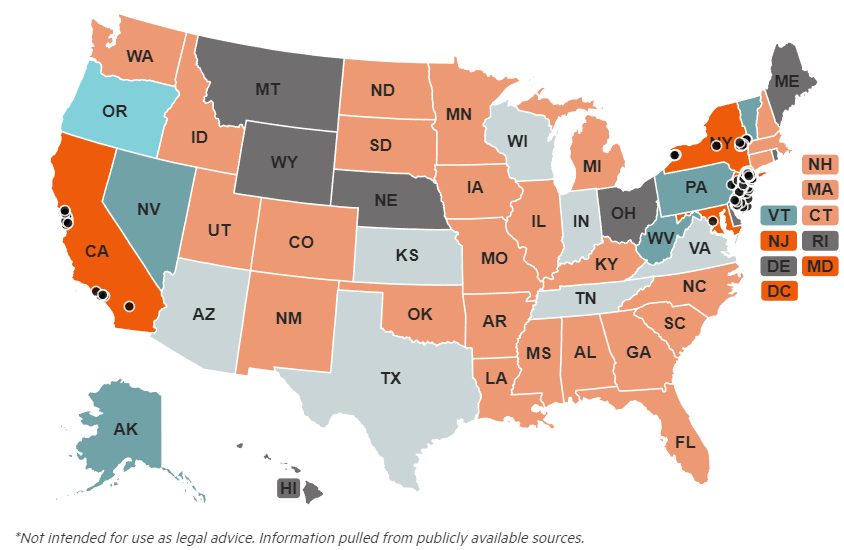
The map created by the National Multifamily Housing Council (NMHC)  earlier this year below shows states with rent control, with preemptions that prevent rent control policies, without rent control or preemptions and states that have previously been listed as having preemptions, but no statute or case law could be found. The NMHC has urged lawmakers to reject price controls and pursue alternatives such as voucher-based rental assistance to better address critical affordable housing shortages.

Rent Control Does More Harm Than Good

Rent Control Does More Harm Than Good“Dillon’s Rule” requires states to explicitly grant powers to local governments. Although these states have not preempted rent control, they have not affirmatively granted power to cities to adopt rent regulations, and no cities in these states have rent-control policies. Ten states that do not have preemption laws and that don’t employ Dillon’s Rule do not have any cities with rent control. And even among the states with active
rent-control policies, some (such as California) impose strict limits on local laws, according to the Urban Land Institute.

Rent control does more harm than good

Diamond, McQuade and Qian examine the effects of rent control in traditionally rent expensive San Francisco in the paper. They find that the effects of rent control are pretty much what economics textbooks would predict.

“Rent control, the Econ 101 student learns, helps a few people, but overall does more harm than good,” writes Noah Smith in Bloomberg View. “According to the basic theory of supply and demand, rent control causes housing shortages that reduce the number of low-income people who can live in a city. Even worse, rent control will tend to raise demand for housing — and therefore, rents — in other areas,” Smith writes.

“It just dramatically limited the supply of rental housing. On top of that, it pushed landlords to supply owner-occupied housing and new housing—both of which are really the types of housing consumed by rich people,” Diamond said. “So we’re creating a policy that tells landlords, ‘It’s much more profitable to cater to high-income housing taste than low-income housing tastes.’”

The report states, “We find that rent control offered large benefits to impacted tenants during the 1995-2012 period, averaging between $2,300 and $6,600 per person each year, with aggregate benefits totaling over $214 million annually. Over the entire period, tenants received a discounted value of around $2.9 billion. We find that most of these benefits came from protection against rent increases and transfer payments from landlords. However, we find losses to all renters of $2.9 billion due to rent control’s effect on decreasing the rental housing and raising market rents. Further, 42% of these losses are born by future residents of San Francisco, making them worse off, while incumbent residents benefit on net.

“These results highlight that forcing landlords to provide insurance against rent increases leads to large losses to tenants,” the report states.

Summary

In the end, the strongest argument against controlling rents is that there are better ways to protect vulnerable renters.

“Diamond and her coauthors suggest an idea that I’ve also endorsed in the past — a citywide system of government social insurance for renters. “ Households that see their rents go up could be eligible for tax credits or welfare payments to offset rent hikes, and vouchers to help pay the cost of moving. The money for the system would come from taxes on landlords, which would effectively spread the cost among all renters and landowners instead of laying the burden on the vulnerable few,” writes Noah Smith in Bloomberg.

Resources:

The High Cost of Rent Control
Rent Control: What Does the Research Tell Us about the Effectiveness of Local Action?

Rent Control’s Winners and Losers

The Effects of Rent Control Expansion on Tenants, Landlords, and Inequality: Evidence from San Francisco

Yup, Rent Control Does More Harm Than Good

Rent Control: a Reckoning

Rent Control Could Be Making Income Inequality Worse In Gentrified Cities

3 Big Problems with Rent Control And A Property Management Alternative

Noah Smith is a Bloomberg View columnist. He was an assistant professor of finance at Stony Brook University, and he blogs at Noahpinion.


Mayor Says New “Renting in Seattle” Program to Provide Resources for Landlords and Renters

Mayor Says New “Renting in Seattle” Program to Provide Resources for Landlords and Renters

Seattle Mayor Jenny A. Durkan has announced the official launch of Seattle’s new “Renting in Seattle” program, a centralized resource for renters and landlords to find information, services, and help with navigating the rules and regulations of renting in the City of Seattle, according to a release.

This follows the passage of two pieces of historic eviction-prevention legislation by the Washington State Legislature that allow tenants 14 days (instead of 3) to catch up on late rent before losing their homes, allow eviction-court judges to use discretion and consider extenuating circumstances such as job loss or hospitalization, expand a mitigation fund to ensure landlords receive judgment payments promptly while giving tenants more time to pay, and limit the attorney fees tenants can be required to pay. An additional bill provides more notice of rent increases by requiring 60 days’ notice of rent increases instead of 30.

“As we work to address our housing and affordability crisis, Renting in Seattle is one more tool that will help ensure Seattle can be a home for all,” Durkan said in the release.

“Renters make up the majority of households in our city, and it’s crucial that we have a range of resources so that renters have the tools they need to protect their rights, that property owners understand their obligations under the law, and that when questions arise, they can easily find the help they need,” she said.

Mayor Says New “Renting in Seattle” Program to Provide Resources for Landlords and Renters
Seattle mayor says it’s crucial that the city “have a range of resources so that renters have the tools they need to protect their rights.”

Renting in Seattle program says small landlords can help preserve affordable housing

The program recognizes that landlords, particularly small landlords, have a vital role in preserving affordable rental housing in Seattle.

A portion of the website is written specifically to a landlord audience, providing information, best practices, and tips. Renting in Seattle is providing quarterly trainings to help landlords understand Seattle’s laws.

Landlords and property managers also are encouraged to call the helpline with questions and guidance on how to navigate complex situations. Enhancing the rental relationship through education of both landlords and tenants about their mutual rights and responsibilities is an important goal of the program.

“We are pleased to see the launch of the Renting in Seattle website and the city’s recognition of the importance of providing information, training, and assistance to landlords,” said Brett Waller of Washington Multi-Family Housing Association in the release.  “Landlords play a critical role in providing housing to the residents of Seattle and keeping Seattle housed. The Renting in Seattle website will better assist landlords in accessing essential information to help increase awareness and conformity to new landlord-tenant laws specific to Seattle on an easy-to-use portal.”

Renting in Seattle making city services more accessible

“This is an important effort to make city services more accessible and efficient,” said Nathan Torgelson, Director of the Seattle Department of Construction and Inspections (SDCI), which will oversee the new program. “We started by thinking about the needs of the rental community and organized our information and resources to serve those needs.”

Historically, rental housing resources were spread across several city departments and various community partners, making it challenging for people to figure out where to find help. After deep consultation across departments and with the community, SDCI identified the need for a dedicated, centralized resource. Renting in Seattle consolidates information incorporating direct outreach and education to advance awareness of the city’s rental regulations, according to the release.

The Seattle Department of Construction and Inspections is now partnering with the Seattle Office for Civil Rights (SOCR) offering quarterly trainings, referrals, and technical assistance to tenants and landlords about their fair housing rights and obligations under city laws.

SOCR remains the enforcement agency of the city’s expansive housing discrimination laws. Renters may experience housing discrimination while seeking assistance with rental regulations, and landlords might have questions about how to comply with the rental regulations while trying to develop a reasonable accommodation policy. This approach creates better alignment for both tenants and landlords following  Seattle’s rental laws.

“The Seattle Renters’ Commission had the opportunity to provide feedback during the development of the Renters’ Portal and expect it to be a helpful resource for renters and landlords in Seattle,” said Jessica Westgren, Co-Chair of Seattle Renters’ Commission, in the release. “We are excited to see the aggregation of information in a user-friendly format that is available to help renters find relevant information throughout all the stages of renting, including help finding a rental, navigating issues with landlords, and tenant’s responsibilities when leaving a property.”

Renting in Seattle includes a new plain-language website, www.seattle.gov/rentinginseattle, that organizes information on laws, tips, and resources, across various stages of the renting experience. The city has added a dedicated helpline at (206)-684-5700 to connect renters and landlords to information and resources and to take complaints about problems in rental housing.

The Renting in Seattle program is:

  • Administering more than $600,000 in grants to community partners who provide assistance to renters such as education, counseling, and legal services for eviction defense.
  • Expanding capacity with outreach efforts to help renters and landlords understand their rights and responsibilities. More than 50 outreach and educational events are planned for 2019.
  • Partnering with Seattle Housing Authority (SHA) to attend their weekly Housing Choice Voucher program (Section 8) orientations to bring vulnerable and low-income renters information about the program as they begin to look for housing.
  • Using social media and advertising to distribute information, including a 30-second video for both landlords and tenants narrated in 13 languages.

5 Tips for Preparing Your Apartments for the Summer Season

5 Tips for Preparing Your Apartments for the Summer Season

5 tips for preparing your apartments for summer is this week’s maintenance tip from Keepe.

Now is the best time to prepare and restore your apartment property for the summer season by cleaning up any outdoor areas and investing in small projects and inspections that will boost your property’s appeal.

Do it now if you can because the busy months and the peak rental season begins right away.

5 tips for preparing your apartments for summer

  • Inspections: Spring is the time to inspect and repair any systems that are not functioning perfectly. Have your air conditioner inspected before your tenants really need it. If there is any problem with your HVAC systems such as inefficiency or weird sounds being made, be sure to get a professional inspect your site.
  • Insulation: Boost energy efficiency at your property by updating or beefing up your insulation around windows and doors. As the seasons change, cracks and gaps will form in your property, offering opportunity for energy inefficiency. Prioritize this simple project if you are looking to save money during the peak air conditioning system use.
  • Clean vents/dryer: Spring is the perfect time to properly clean vents and dryers. Prevent an expensive repair by checking in on your vents and dryers 1-2 times per year. Save money, energy and prolong the life of your dryer and venting systems by checking off this maintenance task this spring.
  • Power Wash: As the sun starts to shine on your property this season, you might notice the build up of dirt and grime on the sliding. Give life to your property with a power wash. Removing surface materials such as dirt, mud and other stains on your exterior features will prevent permanent damage to your property’s exterior surfaces and bring more eyes to your property.
  • Yard Maintenance: Clean up dead plants and vegetation that might have accumulated over the winter months. Apply fertilizer, dispose of weeds, and trim trees. Outdoor space should look clean and inviting for tenants and potential renters. A healthy lawn and garden can be easy to maintain with regular upkeep.

Other recent rental property maintenance Keepe posts you may have missed:

 How To Pick The Perfect Exterior Paint Color For Your Rental Property

4 Outdoor Flooring Options For Your Rentals

20 Easy, Affordable Maintenance Projects To Update Your Rentals

7 Tech Gadgets For A Safer And More Efficient Rental Property

5 Maintenance Tips For Long-Lasting Rental Carpet Flooring

Is The Water Heater At Your Rental Property Ready For The Big One?

7 Types Of Kitchen Countertops For Your Apartments

Which Cooktop Is Best For Your Rental Property?

A Guide To 4 Types Of Flat Roof Systems

6 Ways To Trash Your Apartment Waste Management Issues

Top 5 Apartment Maintenance Emergencies vs. Maintenance Requests

About Keepe:

Keepe is an on-demand maintenance solution for property managers and independent landlords. The company makes a network of hundreds of independent contractors and handymen available for maintenance projects at rental properties. Keepe is available in the Greater Seattle area, Greater Phoenix area, San Francisco Bay area, Portland, San Diego and is coming soon to an area near you. Learn more about Keepe at https://www.keepe.com


More Than One in Five Millennials Still Live With Parents

More Than One in Five Millennials Still Live With Parents

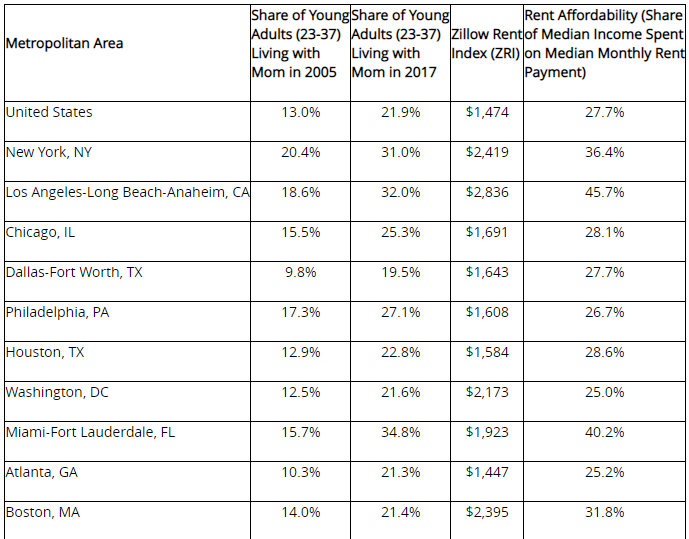
The number of millennials age 23 to 37 living with mom or both parents has more than doubled since 2001 from 6.8 million to 14.3 million, according to a Zillow® analysisi.

Nearly 22% of American millennials – more than 14 million in total – live with their mom or both parents, the highest share for this age group since at least 2000.

  • 9% of millennials live with their moms, nine percentage points higher than those of the same age in 2005.
  • A much larger share of those living with mom have jobs than in 2010, highlighting affordability challenges even as the economy has recovered.

Even with a job, millennials struggle to find independent living

While the economy has recovered since the housing bust and recession of the mid-2000s, young people living with their parents has continued to rise.

The share of those living at home who are unemployed has fallen to 10.3% from 19.5% in 2010, indicating that more young people are struggling to afford independent housing even while holding a job.

“While it might be tempting to stereotype these young adults as lazy millennials bumming off of mom, the data paints a different picture,” said Zillow Senior Economist Sarah Mikhitarian in a release.

“When the housing market went bust and the economy unraveled into a recession, young adults increasingly returned to their childhood home. And, despite a strong labor market and fairly robust economic recovery, this trend has continued in the face of rising housing costs and deteriorating affordability.

“Living with mom as an adult can certainly bring its share of headaches, but the benefits go beyond the occasional home-cooked meal – living under mom’s roof can allow young adults to save enough money for a down payment, security deposit or some other big expense. Not to mention you won’t have to travel far to take your mom out to dinner this Mother’s Day,” Mikhitarian said.

More Than One in Five Millennials Still Live With Parents

Rents are on the rise, bringing present-day affordability challenges for those looking to rent and long-term difficulties in saving for a down payment on a first home. Recent Zillow research found today’s renters need an extra year and a half to save for a down payment than their parents’ generation did 30 years earlier.

Those that choose to live with their parents and build up their savings may have a leg up. An analysis from HotPads showed that living rent-free with parents can allow you to afford a down payment on a home nearly three years sooner. And a small share of this young adult population is actually hosting mom in their own home – perhaps to take care of her as she ages or to have help raising children of their own.

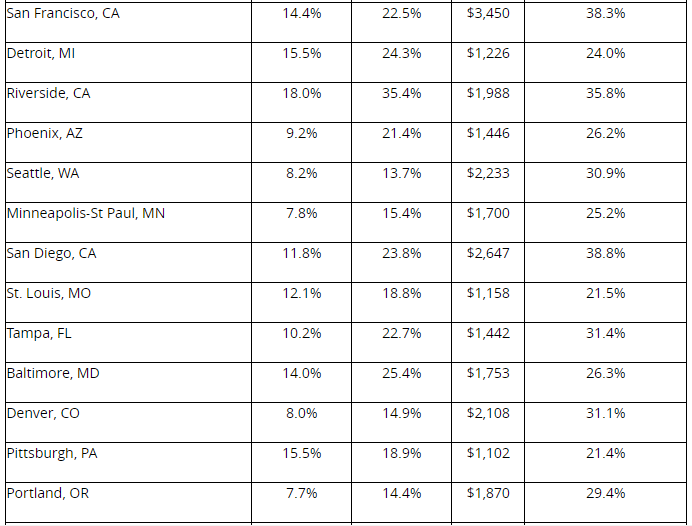
Among large housing markets, Riverside, Miami, Los Angeles and New York have the highest share of millennials living with one or both parents – at least 31%. These four metros are all among the seven least affordable rental markets in the country.

The median monthly rent price in the U.S. is $1,474, up 2.5% from a year earlier, according to the Zillow Rent Indexii. Zillow predicts rents will rise an additional 1.8% in the coming year and reach the $1,500 threshold.

Portland Rents Declined Moderately Over the Past Month

Portland Rents Declined Moderately Over the Past Month

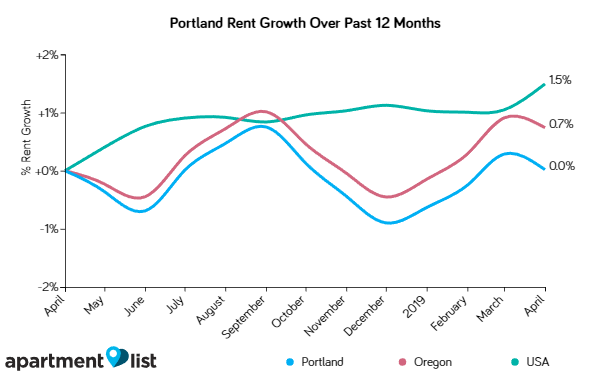
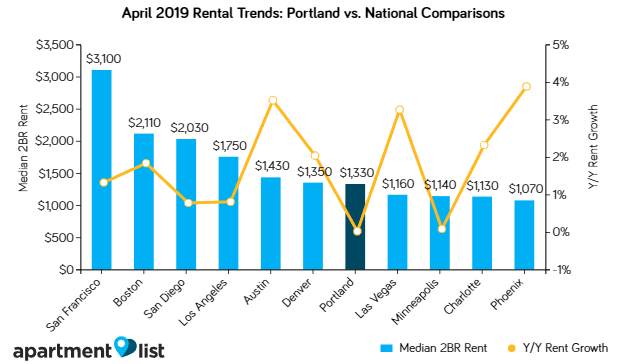
Portland rents declined 0.3% in April, but have been relatively flat in comparison to the same time last year, according to the latest report from Apartment List.

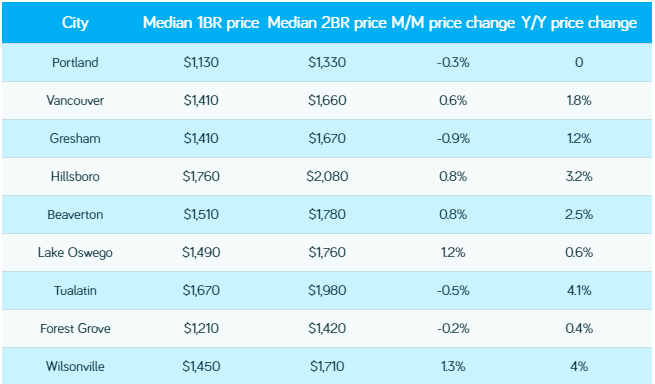
Currently, median rents in Portland stand at $1,130 for a one-bedroom apartment and $1,330 for a two-bedroom. Portland’s year-over-year rent growth lags the state average of 0.7%, as well as the national average of 1.5%.

Beaverton rents increase sharply in April

Beaverton rents

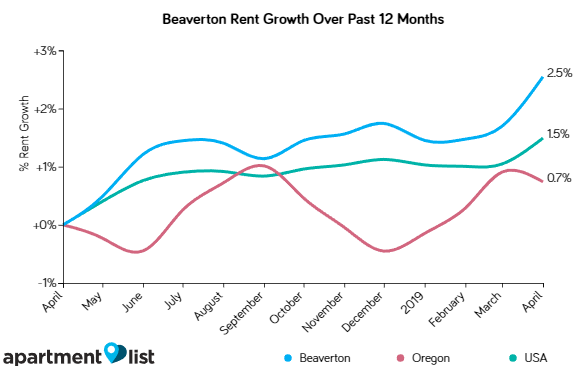
Beaverton rents have increased 0.8% over the past month, and are up moderately by 2.5% in comparison to the same time last year.

Currently, median rents in Beaverton stand at $1,510 for a one-bedroom apartment and $1,780 for a two-bedroom. This is the third straight month that the city has seen rent increases after a decline in January.

Beaverton’s year-over-year rent growth leads the state average of 0.7%, as well as the national average of 1.5%.

Rents rising across cities in the Portland metro

Portland Rents Declined Moderately Over the Past Month

Throughout the past year, rents have remained steady in the city of Portland, but other cities across the metro have seen rents increase.

Of the largest 10 cities that Apartment List has data for in the Portland metro, all of them have seen prices rise.

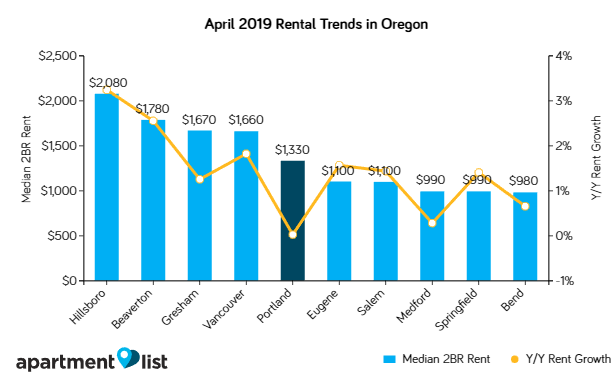
Oregon as a whole logged rent growth of 0.7% over the past year.

Portland Rents Declined Moderately Over the Past Month

Here’s a look at how rents compare across some of the largest cities:

  • Hillsboro is the most expensive of all Portland metro’s major cities, with a median two-bedroom rent of $2,080; of the 10 largest Oregon metro cities that the company has data for, all have seen rents rise year-over-year, with Hillsboro experiencing the fastest growth (+3.2%).
  • Beaverton, Vancouver, and Eugene have all experienced year-over-year growth above the state average (2.5%, 1.8%, and 1.6%, respectively).

Portland rents more affordable than comparable cities nationwide

Portland Rents Declined Moderately Over the Past Month

Rent growth in Portland has been relatively stable over the past year – some other large cities have seen more substantial increases. Portland is still more affordable than some other large cities across the country.

Portland’s median two-bedroom rent of $1,330 is above the national average of $1,180. Nationwide, rents have grown by 1.5% over the past year compared to the stagnant growth in Portland.

While rents in Portland remained moderately stable this year, similar cities saw increases, including Phoenix (+3.9%), Austin (+3.5%), and Las Vegas (+3.3%); note that median 2BR rents in these cities go for $1,070, $1,430, and $1,160 respectively.

Renters will find more reasonable prices in Portland than some similar cities. For example, San Francisco has a median 2BR rent of $3,100, which is more than twice the price in Portland.

Vote Now And Pick The Winning Photo In Our Ugly Parking Lot Contest

Enter Our Ugly Parking Lot Contest And Win A Free $5,000 Parking Lot Makeover

The photo entries are in and now it is time for you to pick the winner of the ugly parking lot and ugly pothole contest.

Review the photos and vote on your favorite “ugly.”

 Vote here now.


Enter Our Ugly Parking Lot Contest And Win A Free $5,000 Parking Lot Makeover Enter Our Ugly Parking Lot Contest And Win A Free $5,000 Parking Lot Makeover

Job Openings In The Apartment Industry Are Growing

Job Openings In The Apartment Industry Are Growing

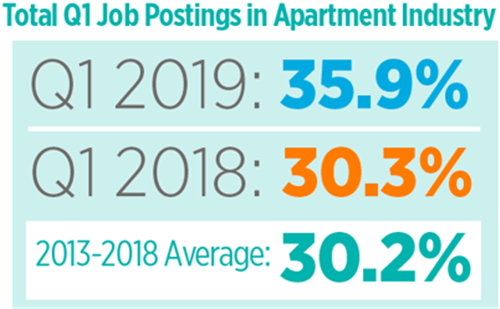
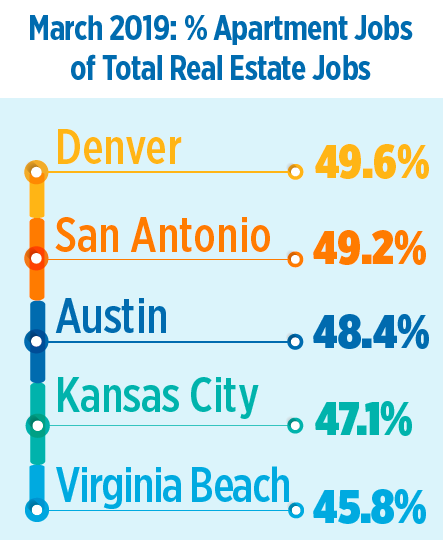
Job openings in the apartment industry comprised nearly 36 percent of available real estate positions during the first quarter of 2019, well above the average for the past six years and a significant increase from 2018, according to the National Apartment Association Education Institute (NAAEI).

The NAAEI monthly jobs report ranking showed metro Denver on top in terms of the concentration of jobs in apartments versus other property sectors.

Competition for talent in both Denver and Seattle was particularly fierce given the high demand for jobs in the industry as well as in hospitality and retail.

 Positions in property management in demand

Job Openings In The Apartment Industry Are Growing

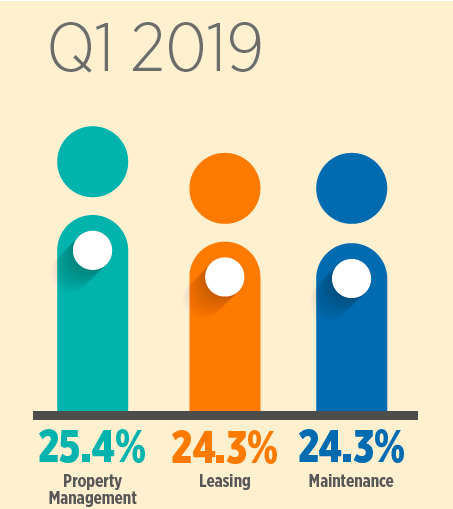
Positions in property management were in greatest demand during the first quarter, with three of the top five job titles involving property management functions.

There were 5,600 job postings for property managers, community managers and assistant property managers combined.

Maintenance jobs in high demand

Job Openings In The Apartment Industry Are Growing

Maintenance jobs are often cited by industry professionals as some of the most difficult to attract and retain.

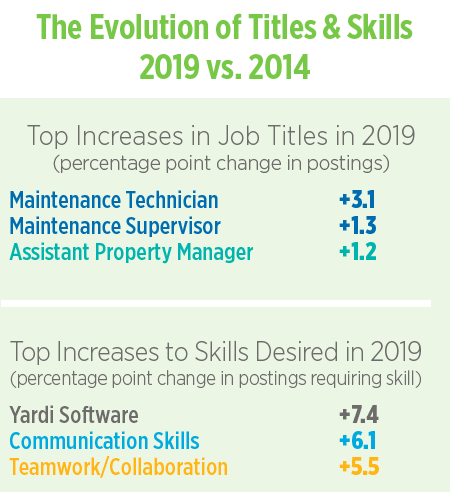
According to CEL & Associates, on-site maintenance jobs had the highest turnover rates, 37.3 percent, in 2017. Over the past five years, the two job titles most in demand, maintenance technician and maintenance supervisor, increased their share of apartment jobs by 3.1 and 1.3 percentage points, respectively.

With the exception of the specialized skill of Yardi software (up 7.4 percentage points), changes in skills sets were typically more common among baseline, or soft skills.

Positions requiring strong communication skills and the ability to collaborate have increased significantly since 2014.

Competition in Denver and Seattle more fierce than other cities

The apartment industry often competes with the hospitality and retail sectors, all of which require strong customer service, communication, and organizational skills.

Competition for talent in Denver and Seattle was likely fiercer than other cities given the location quotients for all three sectors are rated very high.

That means demand for all of these jobs is well above the U.S. average.

Job Openings In The Apartment Industry Are Growing

National apartment association jobs report background

 The jobs report focuses on jobs that are being advertised in the apartment industry as being available, according to Paula Munger, Director, Industry Research and Analysis, for the National Apartment Association’s Education Institute.

“Our education institute is a credentialing body for the apartment industry. They hear often that one of the biggest problems keeping our industry leaders up at night is the difficulty in finding talent, attracting talent and retaining talent,” Munger said.  “Labor-market issues are happening in a lot of industries, certainly with the tight labor market we have.”

NAA partnered with Burning Glass Technologies. “They have a labor-job posting database that is proprietary,” she said, and they can “layer on data from the Bureau of Labor Statistics (BLS). We looked at that and thought we could do something that is really going to help the industry and help benchmark job titles and trends as we go forward,” Munger said.


6 Ways to Upgrade the Look and Feel of Apartment Common Spaces

6 Ways to Upgrade the Look and Feel of Apartment Common Spaces

What are 6 ways to upgrade the look and feel of apartment common spaces you can take to keep tenants happy is this week’s maintenance tip from Keepe.

Community living has become a growing trend in multifamily housing, especially among younger people, including millennials and Generation Z renters.

Co-living spaces allow residents to have room to spend time, meet with others and work professionally outside of their units. Dedicated shared spaces are easy to incorporate into existing properties.

If you currently have a common space or have room in your building to dedicate to a community space, you may want to consider the following:

6 ways to upgrade the look and feel of apartment common spaces

6 Ways to Upgrade the Look and Feel of Apartment Common Spaces
Co-living spaces allow residents to have room to spend time, meet with others and work professionally outside of their units.
  1. Lighting can be very inviting: Add indoor lighting throughout your property to brighten up the rooms. If you have outdoor spaces, light fixtures can elevate the space of a walkway, or a larger communal area such as a shared outdoor patio.
  2. Add new furniture: Installing new pieces of furniture in an existing communal space in your building can attract new groups of people. Be aware of how you arrange your furniture. Don’t space the pieces too far apart, since you want to make the space intimate and approachable for groups of people.
  3. Bring in some plants: Greenery can add a lot to a shared space. Add artificial or real plants and flowers in traditional areas, such as on a coffee table, in the kitchen or on the sides of a hallway.
  4. Use textiles with some color: Layer accessories like pillows, cushions, and rugs to add extra warmth to a space. Use spots of color to pull more eyes into a specific space.
  5. Add wall decoration: Shelves, paintings, and mirrors are great additions that can bring your empty walls to life. Keep it personal, not commercial-looking. Think about how you would decorate your own home or apartment.
  6. Accessories rule: Think about adding kitchenware in shared kitchens, books in a shared library or workroom, and similar small details and accessories to make communal spaces more resourceful and more like home. Residents will appreciate these little details and potentially spend more time due to these small amenities.
6 Ways to Upgrade the Look and Feel of Apartment Common Spaces
Shelves, paintings, and plants are great additions that can bring your empty walls to life.

Small investments can pay dividends

These quick fixes are easy to incorporate into any size space.

When brainstorming what features to include in your property, ask yourself what sorts of finishing touches would make you feel welcome. And whenever you add new features to your property, be sure to communicate these features to your tenants so that they are aware and more likely to explore the living spaces.

The small investments you make to your property can go a long way towards tenant morale and can become incentives to renew their leases.

Other recent rental property maintenance Keepe posts you may have missed:

 How To Pick The Perfect Exterior Paint Color For Your Rental Property

4 Outdoor Flooring Options For Your Rentals

20 Easy, Affordable Maintenance Projects To Update Your Rentals

7 Tech Gadgets For A Safer And More Efficient Rental Property

5 Maintenance Tips For Long-Lasting Rental Carpet Flooring

Is The Water Heater At Your Rental Property Ready For The Big One?

7 Types Of Kitchen Countertops For Your Apartments

Which Cooktop Is Best For Your Rental Property?

A Guide To 4 Types Of Flat Roof Systems

6 Ways To Trash Your Apartment Waste Management Issues

Top 5 Apartment Maintenance Emergencies vs. Maintenance Requests

About Keepe:

Keepe is an on-demand maintenance solution for property managers and independent landlords. The company makes a network of hundreds of independent contractors and handymen available for maintenance projects at rental properties. Keepe is available in the Greater Seattle area, Greater Phoenix area, San Francisco Bay area, Portland, San Diego and is coming soon to an area near you. Learn more about Keepe at https://www.keepe.com