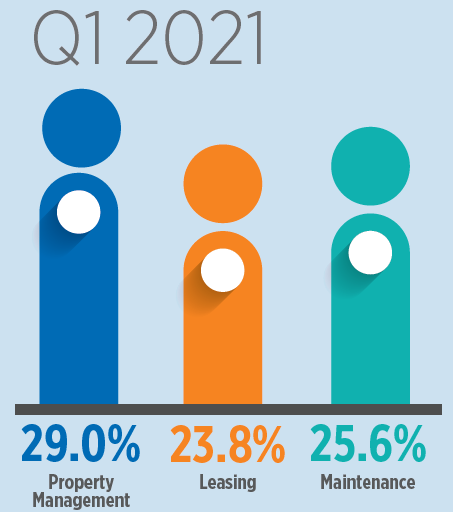
Property management jobs for professionals were the most sought-after jobs during the first quarter of 2021, according to the latest jobs report from the National Apartment Association.
The National Apartment Association Education Institute (NAAEI) report also said that maintenance openings had the largest growth in demand since 2020, with a year-over-year increase of 2.1 percent.
“Nearly 37 percent of available real estate jobs in the U.S were in the apartment sector during first quarter of 2021, well above the five-year average of 28.6 percent,” the NAAEI said in the report.
“Multifamily talent was in high demand, likely due to increased leasing activity. According to RealPage, annual apartment absorption reached an outstanding 353,453 units during the first quarter of 2021.
“In gateway markets such as New York City, existing renters are signing new leases at historically high levels, although occupancy rates continue to weaken. This indicates that concessions and reduced rental rates are attracting existing renters instead of prospective renters,” the report says.
Dallas, Los Angeles, Washington, D.C., Seattle, and New York City ranked highest in concentration of apartment-job availabilities.
Demand for student-housing property management job professionals was greatest in Austin, Tex., Columbus, Ohio., College Station, Tex., Tucson, Ariz., and Tallahassee, Fla.
According to Entrata, student-housing occupancy rates held steady through February at 89.1 percent, down just one percent since the same time last year.
Leasing consultants were the most sought-after position by employers. In February, the average number of new leads per unit reached 1.78, 48 percent higher than in January 2021 and 91 percent higher than February 2020.
A federal judge in Minnesota has sided with landlords and stopped the City of St. Paul from enforcing a new renter protection law he says is likely unconstitutional while a lawsuit filed by a group of landlords is pending, according to reports.
U.S. District Judge Paul Magnuson granted the injunction, writing that it’s likely the landlords ultimately will win the case. The ordinance likely is unconstitutional, the judge wrote.
The landlords argued that the ordinance violates the 5th Amendment, which prohibits government from taking private property for public use without fair compensation.
“Plaintiffs (landlords) claim that the ordinance operates as a per se taking because it singles out private landlords to ‘address a perceived, though vaguely identified, societal problem’ related to housing needs. The court agrees,” Magnuson wrote.
The landlords’ suit alleges that the new housing protections amount to violations of due process rights, illegal takings and mandated forms of speech, all while making it harder to screen out unreliable tenants or force them to move.
Renter protection law
The ordinance, branded as the S.A.F.E. Housing Tenant Protections, limits the ability of landlords to consider evictions, credit histories and criminal histories when screening applicants for housing.
It also limits how much money they can require of new tenants and forces landlords to give a written explanation when they decide not to renew a lease.
“The ordinance forces plaintiffs (landlords) to bear society’s burden related to housing needs,” the judge said in the ruling.
A spokesman said the city “will abide by the court’s preliminary injunction while the legal claims are addressed by the courts.”
The Minnesota Multi Housing Association, which is not a party to the lawsuit, said in a statement the ruling affirms many of the objections it has raised both in St. Paul and in Minneapolis, which has similar renter protections.
“The shared view of the Minnesota Multi Housing Association and other advocates is that we need more housing. These types of regulations do not solve that problem, but discourage investment in additional housing in our communities. We call on leaders in St. Paul to work with our members, particularly the plaintiffs, to find effective solutions,” it said in a statement.
Keeping good tenants is key to long-term profitable rentals, so here are 7 proactive maintenance tips that keep tenants happy and staying in your rental property.
By Justin Becker
As a landlord or building manager, there are several responsibilities that will take you on the path to success. It’s not just about collecting rent from tenants, being firm, and making sure the rules are always followed. If you want your business of being a landlord and property manager to be lucrative and thriving, it’s only logical to hold on to great tenants when you find them.
Good tenants are great to work with; they’ll call you up for any issue, pay the rent on time, and respect the rental property. These might come around only once in a blue moon. So, you should be doing proactive maintenance in order to retain these good residents.
Whether you’re thinking about considering mobile homes for lease or renting out apartments, keeping your property tenants happy should be on the list of priorities. Not sure how to achieve this in the long run? Take care to follow these tips:
How to Keep Tenants Happy
A major chunk of property management includes finding ways to enhance the appeal of your property for good tenants. Hopefully, the following tips will help in keeping your tenants happy. Proactive maintenance means you’ll be more likely to keep good tenants for the long run in this manner.
What’s even better is that not every property maintenance idea for your tenants will cost an arm and leg. As long as you find something that will appeal to tenants about the property, go ahead and invest in it. Do proactive maintenance. There are also non-monetary and inexpensive options.
1. Address All Concerns as Soon as Possible
Every decent landlord wants to keep their tenants happy, especially if the aim is to extend the lease agreement on the property. Staying on top of property maintenance and responsibly performing inspection are just two great tips to retain and keep your tenants for the long run.
While you take care of the tenants, you should place yourself in their shoes; there’s probably nothing more frustrating in everyday life than having to deal with maintenance delays. No tenants want to live on a property with a leaking roof, dripping pipe, or broken toilet. While a landlord is a busy person, proactive maintenance is one of the main forms of property management that makes tenants happy.
In addition to property management, landlords can also go for incentives such as offering tenants carpet cleaning, deep cleaning every year, and other services that won’t cost too much. They’d still be appreciated by the tenants and be an influential factor when they’re thinking about extending the lease.
What’s more, routinely checking up on the property’s maintenance issues and fixing problems when they’re still small has an additional advantage. This way, you’ll avoid having the tenants’ issues develop into something difficult and expensive to fix. Property management costs will then go down in the long run if you take care in keeping your tenants happy.
The best way to keep tenants happy is to routinely check for little problems in your proactive maintenance before they become big problems.
2. Never Forget the Human Factor
A landlord might sometimes forget that their tenants are human and liable to make errors. If you really want to keep tenants happy, try to empathize with them more often. Tenants are more likely to stay on when the landlord of the property is cooperative with them.
One way to be cooperative is to make it easy for tenants to have access to you to talk about the property. This doesn’t mean giving them permission to call you at all hours, but to have some form of open communication. This will solve misunderstandings and make for a better relationship with the tenants on the property.
Additionally, keep the needs and comfort of the tenants in mind as well as the property issues. If you’re hiring a team to come for proactive maintenance and repairs on the property, have them over when most of the tenants have gone to school or work. This way, you won’t be ruining their downtime or naps on the property.
3. Stay Updated on What Your Tenants Want
The younger, modern generations require certain things from the places they’re living in. High-speed Wi-Fi is one of them, while beautiful outdoor spaces and open floor plans are also very welcome. If required, you might want to fit these in your property-management budget to keep your tenants happy.
As a landlord in the current times, you need to prepare for the long run. Take care of these requirements so that the lifestyle quality of your tenants is a good one. This will go a long way in keeping your tenants happy.
For instance, you might offer features like study rooms or bike racks if most of your tenants are students. For families, upgrading to stainless steel appliances or providing a laundry room might be great ideas.
Thinking like this might also help with your mobile homes for sale as well as other types of property. In fact, most of these tips are useful for anyone looking to rent to tenants or sell property.
4. Stay Proactive about All the Lease Renewals
Among the top tips for keeping your tenants happy is to let them know well before you offer to renew their lease on the property. Don’t wait until they’ve paid the last month’s rent; consider informing them around three months before the lease expiry date.
Even if your good tenants decide to move out of the property, you’ll have the chance to advertise that space for rent well in time. This way, you won’t have to worry about the lost months of rent.
If the good tenants seem a bit hesitant, ask them if they want a decrease in rent. Communication and honesty are key. So, don’t underestimate these concepts when you’re dealing with property management.
5. Aim for Longer Leases
See if your good tenants will agree to sign a lease for a longer term in exchange for a reduced rent. Renewing every six months can be extended to a year if the tenants are agreeable. Tenants who extend after a year might be convinced to go for two years if they’re satisfied with the property.
These tips might mean that the landlord of the property loses out on some profit. However, such tips will also make sure that reliable, decent tenants stay on.
6. Treat All Tenants the Same
There might be some tenants on the property that you get along with more than others. But don’t show that to everyone so clearly. Every landlord needs to know the federal and local housing laws. So, there’s no room for discrimination between tenants on the basis of race, physical abilities, religion, body size, etc. Sometimes, keeping your tenants happy simply means seeing them as people instead of income sources on a property.
7. Stay Firm about Rules but Know When to be Flexible
There are several rules to follow when it comes to rental property, but there’s still room to be flexible when it’s appropriate. The regulations might not allow pets or waterbeds, for instance, while things like closed toilets might elicit fines.
While most of these rules are for the tenants’ own safety, there are times when you might want to make an exception. For instance, you can waive the fine for tenants who are really having financial difficulty.
Communication is the best way to deal with rental property. If the people next door are complaining about the noise coming from a rental unit at night, talk to the tenants first. Don’t be so quick to blame; you might find that the problem isn’t so big after all, and you could even end up helping someone out.
The Takeaway
The National Center for Housing Management has reported that around 54 percent of apartments will go to new tenants every year. This is not good news for landlords, as it means they have to bear the cleaning and repair expenses after the tenants leave. The rent is also lost which means that paying the advertising fees, mortgage installments, and utilities will become even harder.
By following the tips above, though, you can learn how to keep your tenants happy and satisfied on your property. This will reduce the turnover expenses by a mile. So, take care to do proactive maintenance in order to be maintain your property better.
About the author:
Justin Becker is a property owner in the state of Michigan and has a passion for managing communities. He owns apartment complexes and mobile home communities, and has been writing his own blogs for his properties for several years.
While some weakness remains, the multifamily market is coming out of one of the strongest first quarters in years with rent growth nationally up 0.8 percent for the quarter, according to the March Yardi Matrix National Multifamily Report.
The report says affordable metros in the West continued to thrive in March, with these areas leading the way in the year-over-year rent growth:
California Inland Empire 8.3 percent
Sacramento 7.3 percent
Phoenix 9 percent
“The strong demand for housing in these metros has enabled this trend. Even expensive coastal markets and gateway cities are beginning to bounce back, albeit slowly,” Yardi Matrix says in the report.
Multifamily market rents turning the corner
On a year-over-year basis, multifamily market growth and rents increased by 0.6 percent year-over-year in March, “a sign that the multifamily market has turned a corner.”
Overall rents increased by $6 in March to $1,407. Nationally, multifamily rents had one of the strongest first quarters in a few years, with rents up 0.8 percent from the previous quarter. In the first quarter of 2020, the effects of the pandemic were just beginning to set in, and rents were up only 0.1 percent.
Outside of the gateways and a select few other top 30 markets, most other metros had positive year-over-year rent growth. Out of our 134 markets surveyed this month, 114 had flat or positive year-over-year rent growth.
“As the pace of vaccinations continues to ramp up and cities continue to reopen, the multifamily market is poised for a strong 2021,” Yardi Matrix says. “As the spring leasing season picks up, most metros will likely continue to enjoy strong short-term rent growth.”
The forecast for rent growth
“Jobless claims fell to 684,000 in the week ending March 20, the fewest since the beginning of the pandemic, the report says. “As the recovery gains momentum, the number of jobless claims will likely continue to recede.
“As the labor market recovers, one metric we will be following is the labor-force participation rate. The rate dropped when the pandemic hit, especially among older workers who were forced into retirement. Some economists are projecting that labor force participation won’t recover until the end of 2022.”
Yardi Matrix also points out in the report that the supply of new apartments in some metros coming online will make rent recovery challenging.
About Yardi Matrix:
Yardi Matrix researches and reports on multifamily, office and self-storage properties across the United States, serving the needs of a variety of industry professionals. Yardi Matrix Multifamily provides accurate data on 18+ million units, covering more than 90 percent of the U.S. population. Contact the company at (480) 663-1149.
Ask attorney Brad is a new feature with attorney Bradley S. Kraus and this week the question is about removing a long-term tenant and moving into your own rental with all the Covid-19 rules. If you have a question for Brad, please feel out the form below.
Ask Attorney Brad:
My brother owns a house in Washington County, Oregon. He’s come down with Stage 4 cancer and would like to move into his home and have a caretaker take care of him since it’s a two-bedroom and he presently lives in a studio. Can he give the present long-term tenant a 90-day notice to move?
–Judy
Hello Judy,
First off, I’m sorry to hear about your brother. Watching loved ones deal with such an illness can be difficult, but as I’m sure you know, being there for him at this time can make a world of difference. Stay strong, as hard as that can be.
With regard to your brother’s rental property, he may be able to utilize the Qualifying Landlord Exemption related to the landlord moving in to the property as his primary residence. Nothing in HB 4401 prohibits such a notice from being served at this time.
Service of such a notice can be very technical, and a misstep can create issues. Accordingly, please ensure that your brother works with the attorney of his choice on such a notice.
Thanks,
Brad Kraus
Bradley Kraus, Portland attorney
Brad Kraus is a partner at Warren Allen LLP. His primary practice area is landlord/tenant law, but he also assists clients with various litigation matters, probate matters, real estate disputes, and family-law matters. A native of New Ulm, Minnesota, he continues to root for Minnesota sports teams in his free time.
Ask Attorney Brad
Please enter your rental housing management question below for Ask Attorney Brad Kraus. Unfortunately he cannot answer questions from tenants.
Do you have written rental criteria for which tenants you accept, which you do not, and why? That is this month’s article by veteran real estate investor and property manager David Pickron.
By David Pickron
Hypothetically, let’s say that last week an individual named Javier applied at one of your properties. His credit score was low and payment history showed a lengthy history of difficulty in keeping current with his obligations. The results of the criminal background check showed various drug and theft charges. Your call to his previous landlord alerted you to the fact that he was currently being evicted even as he was applying for your property. Like most landlords, you would analyze the situation and reasonably conclude that “there is no way he is living in my rental.” You decide to provide an adverse action letter to Javier and move on to the next applicant.
In the week that follows, you receive a phone call from an attorney with Fair Housing asking why you denied the applicant. Was it because of his ethnicity? No, but you explain all the negative history you found relating to the applicant and the risk he would be to your property and investment. The attorney then asks a series of questions: Did you tell the applicant that you did not accept people with evictions? No. Did you tell him he needed a certain credit score to qualify? No. Did you lay out your requirements in relation to criminal history? No. Can you provide a copy of your rental criteria that details how you treat every applicant the same? I don’t have one. The attorney then drops the hammer with the final question: Is possible that you treat every applicant differently as a result of not having a written, base-qualifying criteria? Javier believes he was disqualified based on his ethnicity and subsequently reported a potential violation.
Imagine how different this scenario looks for you as a landlord if prior to showing the property to Javier, you handed him a criteria sheet with crystal-clear information about credit, criminal, collection, and eviction history qualifying parameters. It also had income and residential history requirements as well as your policies regarding no smoking or pets on the property. If after seeing the property and performing your due diligence there was disqualifying information, it is easy to indicate to your tenant applicant exactly which part of the criteria was not met. If the phone call then comes from Fair Housing or the attorney general’s office, you have the ability to clearly show the reason for denial based on behavioral history alone.
Simply said, if you do not have a written rental criteria, then everyone qualifies. That’s right, everyone qualifies. As a landlord, you know that is a recipe for disaster.
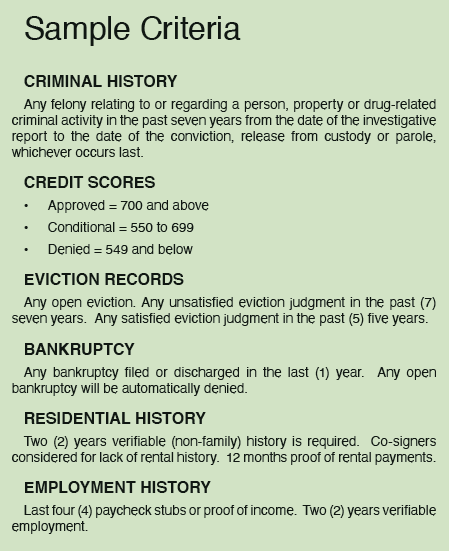
The box below has some examples of rental criteria that have been strategically written to protect you, broken down by category. These should be reviewed and modified by your local attorney to represent what is legal in your specific jurisdiction. (Email [email protected] and if you would like an all-inclusive criteria sample.)
About the author
David Pickron is president of Rent Perfect, a private investigator, and a fellow landlord who manages several short- and long-term rentals. Subscribe to his weekly Rent Perfect Podcast (available on YouTube, Spotify, and Apple Podcasts) to stay up to date on the latest industry news and for expert tips on how to manage your properties.
Here are 10 fire prevention tips for landlords and property managers including remembering to have a fire-action plan for tenants.
By Oliver Andrews
Thirty seconds is all it takes for a small flame to start a blaze if there are no fire-prevention measures in place. Within minutes, a property can fill with choking black smoke, and temperatures can reach as high as 600° F.
The same is true for most fires in rental properties. If landlords and tenants practice due diligence, the tragedy and inconvenience of a fire can be prevented.
In this article, we’ll discuss practical fire-prevention tips that enable landlords to safeguard their investment. By the end of the article, you’ll be able to draft a comprehensive fire-prevention and protection plan.
What Are the Main Causes of Fires within the Home?
According to loss assessors, the following are the most common culprits for fires in the home:
Cookers/Stovetops
Many household fires happen while cooking. As a landlord, you can encourage tenants to implement the following habits to reduce the chance of a fire.
For example, you can instruct tenants to switch the stove or oven off at the plug when they’ve finished cooking. This will ensure that if something is left on the stove, it won’t burst into flame. Frying food is another activity with which everyone needs to use caution, as it’s easy for grease to spill over the side of the pan and catch fire.
Heating Equipment
Furnaces, clogged chimneys, heaters, and fireplaces are all common sources of home fires. Regular maintenance is the best way to prevent these fires. Clean out the chimney and ensure that you follow the manufacturer’s instructions for heaters and other appliances, or call a qualified contractor.
Candles
Many people love to set the mood with a candle, but candles can also pose a severe fire hazard. Remind your tenants not to leave candles unattended, or consider having a no-candle policy.
Children
Young children don’t understand the potential for danger. They can cause or contribute to fires related to kitchen or electrical mishaps. Caution tenants not to leave children unattended or let them cook unsupervised.
Barbecue grills
Grilling is a fun pastime, but it also has a great potential for danger. Many tenants have gotten themselves into trouble by grilling too close to the home or using accelerants. If your property has grills or patios, be sure to inform tenants of safety tips for grilling.
What Are the Top 10 Fire Prevention Tips?
1. Install Smoke Alarms in Every Room and Test Them Regularly
An early warning system is one of the most critical fire-prevention measures. Make sure to replace the batteries every six months, or instruct tenants to do so. You should replace all the fire alarms at least once every 10 years.
2. Explain the House Rules
Create a comprehensive set of home fire-safety rules for your tenants. Make it a condition of the lease that they abide by these regulations. Finally, explain the rules both verbally and in writing, and have the tenant sign that he or she understands.
Your fire-safety rules should also include a clearly defined smoking policy.
3. Establish Grilling Rules
Grills should be at least 10 feet from the home or overhanging structures at all times. General fire-safety rules also suggest that the grill should never be left unattended.
4. Conduct Regular Fire-Safety Checks
This is a good chance to check that smoke alarms are working correctly and that potential emergency exits (such as windows) are accessible. You can also review the house rules with tenants.
5. Create a Fire Action Plan
If you run a multifamily property, it’s essential to teach your tenants how to escape from a fire. Create a plan that allows them to leave through the nearest exit as quickly as possible.
Discuss the plan with the tenants and practice the evacuation regularly. Finally, post a copy of the plan in every unit. Place your contact information and that of emergency services on this paper as well.
6. Encourage Tenants to Speak Up
Some people don’t like to rock the boat. If they see something wrong, but it doesn’t affect them, they won’t report it. This is counterproductive when it comes to fire prevention. Make it clear to your tenants that you appreciate their assistance in identifying potential issues.
7. Place a Fire Extinguisher in Each Kitchen
A well-placed fire extinguisher could be the difference between smoke damage and a five-alarm fire.
8. Install Sprinklers
Sprinklers linked to the fire alarm provide a valuable preventative tool against fire damage.
9. Document Everything
The consequences of a fire top the list when it comes to extensive damage. Protect yourself by documenting each of the fire precautions you put in place.
10. Keep Up-to-Date with Repairs
As a landlord, it’s your responsibility to keep your tenants as safe as possible. A good fire-prevention strategy incorporates regular building maintenance and timely repairs.
What Tenants Can Do to Prevent Fires
Tenants also have a responsibility in fire prevention. They must adhere to the building’s fire-protection policy at all times.
Landlords should communicate the rules regarding the kitchen, laundry, and general electrical use. Don’t assume your tenants already know! For example, be sure to mention not overloading outlets or leaving appliances running when you’re not at home.
Fire-Safety Regulations for Landlords
Fire-safety regulations vary among different jurisdictions. In general, it’s the landlord’s responsibility to ensure that the building meets the applicable building codes and ensure that fire-escape routes are available.
Also, the landlord has an obligation to:
Repair structural elements
Respond to repair requests promptly
Conduct regular fire and safety checks
Ensure that all entries and exits are clear of debris
Devise a fire-prevention and evacuation strategy
What are the four types of fire?
Effective fire awareness starts with knowing what to do in a fire. A grease fire on a stovetop, for example, requires a different approach than an electrical fire.
There are four types of fire extinguishers, and each deals with a specific blaze:
Paper and wood
Oil, grease, and gasoline
Electric
Flammable metals
Conclusion
Effective fire prevention requires a commitment from both the landlord and the tenant. Both parties should work together to prevent a devastating fire. When everyone pitches in, it becomes simpler to detect potential risks before they burst into flame.
About the author:
Oliver Andrews is the editor for Property Claim Assist
Urban living still appeals to high income earners, and renters living in big cities are less likely to relocate to suburbs, according to a new study from StorageCafe.
Amid a year defined by significant disruptions, the rental market saw an increase in the share of Americans relocating – 18 percent more renters changed residences in 2020 compared to 2019. Out of all the renters moving, 68 percent of people picked urban living over the suburbs
Despite the pandemic and many renters moving for reasons related to COVID-19, the “exodus towards suburban or smaller towns that many anticipated on a grand scale actually materialized for a smaller fraction of the renter cohort,” the study says.
While about 32 percent of renters who wanted to move did choose the suburbs in the last year, that number is close to pre-pandemic renter patterns.
Highlights of the report:
More renters moved in 2020 vs. 2019, with most upgrading to bigger homes.
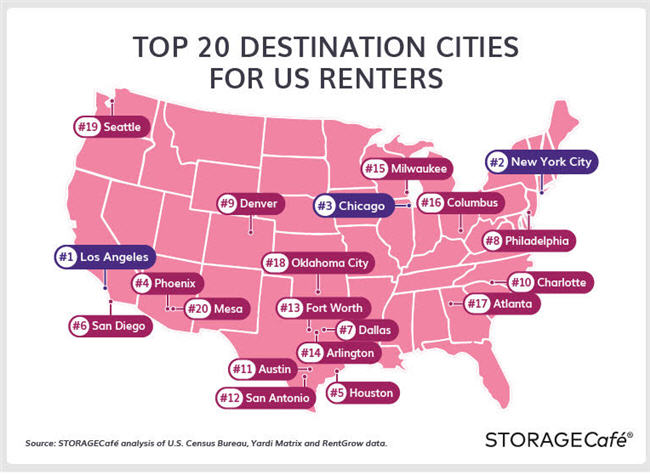
Los Angeles saw the most renter applications in 2020, with 60 percent of the people who moved staying in the state.
77 percent of the renters moving to New York City and 72 percent of those relocating to Philadelphia came from a different state.
Millennials make up 48 percent of renters who relocated last year, followed by members of Gen Z.
Only 21 percent of renters moving out of big cities relocated to suburbs.
Columbus, Ohio, attracted the most renters relocating from suburbs – 77 percent, and Phoenix the fewest – 23 percent.
The higher the income, the less likely the renter is to move to a suburban area
Renters thinking of leaving cities with a population of over a million are more inclined to relocate to other urban areas instead of the suburbs.
Only 21 percent of big-city dwellers applied to homes in a suburb in 2020, similar to 2019 trends. However, a bigger proportion of renters moving out of cities with a population between 500,000 and one million – roughly 35 percent – decided to go suburban.
Income plays a role, as only 25 percent of the renters with incomes between $100,000 and $2 million who planned to relocate in 2020 picked a new rental home in a suburb.
However, 40 percent of the renters with an annual income of under $30,000 who moved last year preferred a suburban area.
Urban living expected to hold strong
The study says younger Americans’ preference for urban living will most likely hold strong in the coming years, as they are generally driven by the promise of professional and social fulfillment traditionally associated with big-city life.
“The big-city lifestyle will represent a momentarily larger share of the metro economy post-pandemic, due to the pent-up unexpressed demand for those services and experiences which have accumulated during the COVID-19 era,” said Larry Rosenthal, Senior Lecturer of Public Policy, Richard & Rhoda Goldman School of Public Policy, University of California, Berkeley, in the study.
“The magnetism of cities – and their irresistible allure socially – will reemerge and thrive. Young post-higher-ed movers will flock in the same or greater numbers. To the extent that job location will transform given the waning appeal of proximity and specificity, one might expect that many transformed addresses will flood the market, making city living more affordable compared to elsewhere,” Rosenthal said.
Impact of working from home versus office
Janice Madden, a professor at the University of Pennsylvania who teaches regional science, sociology, urban studies, and real estate, said in the report that “to the extent that workplaces are in cities and workers commute to them, work leads to greater centralization of residences, both owned and rented.
“I believe that fewer workers will be traveling to their workplaces each day after the pandemic ends because the pandemic has shown us what can be done from home. People living in cities rather than suburbs to decrease their commutes will be motivated to suburbanize.
“People also live in cities rather than suburbs, however, for lifestyle or consumption reasons. The pandemic has substantially reduced the lifestyle reason for city living. Fewer restaurants and arts venues being open make the city less attractive. I believe, however, that these closures are short-term and that arts and restaurants will be revived after the pandemic.
“So, the effects of living in cities versus suburbs ultimately depend on how strong the workplace pull versus the lifestyle pull is. Obviously, the workplace effect must decrease the desirability of city living, just not clear whether that effect will be very big,” she said.
Understanding the rules of a 1033 Exchange aka Involuntary Conversion
DSTs provide replacement options for a property sold under eminent domain.
Property owners initiating a 1031 Exchange often end up in that situation by choice after deciding to sell an investment property or business. But what happens when that decision to sell is out of your hands? That is the case when the government steps in to acquire a property by exercising its power of eminent domain.
What is eminent domain?
Eminent domain applies to situations where the federal, state or local government uses its authority to acquire private property for a public use or the greater good. Eminent domain has been around for decades with cases dating as far back as the late 1800s. It is commonly used by government entities to assemble land to build infrastructure, such as roads, interchanges or airport expansion. The government also has been known to step in and utilize its powers of eminent domain to acquire property to pave the way for private-sector development that will in some way potentially serve the community or help raise the tax base, such as a new convention center, hotel, or hospital. Eminent domain or condemnation also can come into play when a property has been destroyed by a natural disaster, such as flooding, hurricanes, or wildfires.
Although eminent domain sounds a bit onerous, property owners are entitled to fair compensation for that property. Once that eminent-domain transaction is complete, the question is: What to do with that pile of cash? Just as with any property sale where the transaction generates a profit, any income recognized from that eminent-domain acquisition is subject to capital-gains tax. One way to potentially defer that tax bill is to roll the proceeds from the sale into a tax-deferred like-kind exchange. Whereas the 1031 Exchange is used for tax-deferred reinvestment in most property sales, eminent domain has its own separate category that falls under a 1033 Exchange.
Key differences and similarities in 1031 and 1033 exchanges
A 1031 Exchange and a 1033 Exchange were designed for exactly the same purpose. Each is sanctioned by the IRS as a means to defer capital-gains taxes. However, there are some key differences that an owner should be aware of when conducting a 1033 Exchange. One notable item is that similar to a 1031 Exchange, a 1033 Exchange allows the taxpayer to fully defer both capital gains and any potential depreciation to recapture taxes that may be incurred from the government acquisition. In other words, 1033 Exchanges have the potential for the taxpayer to avoid an even bigger tax bill. In addition, the rules on a 1033 are considered by many to be a bit more relaxed, giving property owners more time and flexibility to successfully execute the exchange. Some of those key differences are:
More time to execute. The IRS gives taxpayers two years from the date the sale closes to complete a 1033 Exchange (three years if granted a further one-year extension) compared to 180 days for a 1031 Exchange.
No limit on replacement IDs. The taxpayer has no restrictions on the number or dollar value of potential replacement properties they can identify for their exchange. In contrast, 1031 Exchanges have reporting rules that require that a limited number of replacement properties be identified within a 45-day window.
No need for a qualified intermediary. In a 1033 Exchange, funds do not need to be handled by a qualified intermediary (also known as an exchange accommodator or facilitator), as is the case with a 1031 Exchange. In fact, funds can even be placed into shorter-term investments, such as a bond or CD, until they are needed to close on the purchase of 1033 Exchange replacement assets.
Do investors utilize DSTs for 1033 Exchange replacement property?
Yes, DSTS are commonly used in 1033 Exchanges. DSTs work just like other investment real estate, the difference being that it is fractional ownership. All of the same reasons why a DST work well for a 1031 Exchange also apply to cases of eminent domain where an owner is conducting a 1033 Exchange. For example, DSTs provide a solution that allows for portfolio diversification and passive ownership in real estate as well as income potential.
Despite the longer timeline to complete a 1033 Exchange, the clock winds down quicker than many people realize. Some simply put off identifying replacement properties because they don’t know what to buy, or perhaps they are waiting out the market for better opportunities or pricing. So, it is not unusual for clients to focus on DSTs as replacement properties for their 1033 Exchange at the eleventh hour, knowing they can reinvest proceeds in one or more DSTs in as little as a week’s time. For a free list of available DST investments for your 1033 Exchange please visit www.kpi1031.com.
Kay Properties is a national Delaware Statutory Trust (DST) investment firm. The www.kpi1031.com platform provides access to the marketplace of DSTs from over 25 different sponsor companies, custom DSTs only available to Kay clients, independent advice on DST sponsor companies, full due diligence and vetting on each DST (typically 20-40 DSTs) and a DST secondary market. Kay Properties team members collectively have over 115 years of real estate experience, are licensed in all 50 states, and have participated in over $15 billion of DST 1031 investments.
This material does not constitute an offer to sell nor a solicitation of an offer to buy any security. Such offers can be made only by the confidential private placement memorandum (the “Memorandum”). Please read the entire memorandum, paying special attention to the risk section prior to investing. IRC Section 1031, IRC Section 1033 and IRC Section 721 are complex tax codes; therefore you should consult your tax or legal professional for details regarding your situation. There are material risks associated with investing in real estate securities including illiquidity, vacancies, general market conditions and competition, lack of operating history, interest-rate risks, general risks of owning/operating commercial and multifamily properties, financing risks, potential adverse tax consequences, general economic risks, development risks and long hold periods. There is a risk of loss of the entire investment principal. Past performance is not a guarantee of future results. Potential cash flow, potential returns and potential appreciation are not guaranteed. Securities offered through Growth Capital Services, member FINRA, SIPC, Office of Supervisory Jurisdiction located at 582 Market Street, Suite 300, San Francisco, CA 94104.
The Federal Trade Commission has issued a warning to landlords to not evict, or threaten to evict, tenants in violation of the Centers for Disease Control and Prevention (CDC) moratorium or any other applicable state or local measures, according to a release.
“Evicting tenants in violation of the CDC, state, or local moratoria, or threatening to evict them without apprising them of their legal rights under such moratoria, may violate prohibitions against deceptive and unfair practices, including under the Fair Debt Collection Practices Act and the Federal Trade Commission Act,” said Federal Trade Commission Acting Chairwoman Rebecca Kelly Slaughter and Consumer Financial Protection Bureau (CFPB) Acting Director Dave Uejio in the release.
The FTC warns landlords, “We will not tolerate illegal practices that displace families and expose them—and by extension all of us—to grave health risks.
“In the ongoing economic and public health crisis, millions of American families are at risk of losing their homes. A recent CFPB report found that renters are particularly endangered, with over 8.8 million tenants behind on rent. These tenants at risk of homelessness are disproportionately people of color, primarily Black and Hispanic families.
“Federal, state, and local governments have put in place protections against evictions to keep people in their homes and to stop the spread of COVID-19. Research has shown that eviction moratoriums save lives.”
The CDC on March 29 extended the federal moratorium on evictions by three months.
FTC warns landlords
“Unfortunately, there are reports that major multistate landlords are forcing people out of their homes despite the government prohibitions or before tenants are aware of their rights. Depriving tenants of their rights is unacceptable. Many of the tenants at risk of eviction are older,” the release says.
“Staff at both agencies will be monitoring and investigating eviction practices, particularly by major multistate landlords, eviction-management services, and private equity firms, to ensure that they are complying with the law. “