
Home Blog Page 109

House Panel Asks Landlords to Explain Evictions During Moratorium

House Panel Asks Landlords to Explain Evictions During Moratorium

A House panel studying evictions during the COVID-19 moratorium has asked four large corporate landlords to explain and provide documentation on 5,000 evictions they filed, according to The Washington Post.

Invitation Homes, Pretium Partners, Ventron Managemen,t and the Siegel Group were all asked to provide documentation on evictions filed while the federal eviction moratorium was place, in letters sent from Rep. James E. Clyburn (D-S.C.), the Select Subcommittee on Coronavirus Crisis panel’s chairman to the landlords.

Some of these companies “refused to accept rental-assistance funds” as an alternative to eviction, the letters stated, while others have accepted funds and moved to evict families anyway. As a result, such practices have had a “substantial negative impact” on struggling American families, the letters said, according to The Washington Post.

The Federal Trade Commission (FTC) and Consumer Financial Protection Bureau (CFPB) on March 29 announced they would investigate evictions by “private equity firms” and “major multistate landlords,” amid “reports that major multistate landlords are forcing people out of their homes despite the government prohibitions or before tenants are aware of their rights.”

The Las Vegas Review–Journal in June reported on The Siegel Group. The Review-Journal investigation found The Siegel Group had evicted hundreds of tenants at its Siegel Suites and Siegel Select during the pandemic last year. The Siegel Group declined comment. The House panel cited the newspaper’s reporting in letters from Clyburn to company CEO Stephen Siegel, informing him of the inquiry.

The Private Equity Stakeholder Project (PESP) published a report in April detailing how Progress Residential and Front Yard Residential, owned by the private equity firm Pretium Partners, have filed to evict more than 1,300 residents during the COVID-19 pandemic, with the companies filing most evictions after the Centers for Disease Control and Prevention (CDC) Eviction Moratorium went into effect in September 2020.

In Pandemic Evictor: Don Mullen’s Pretium Partners Files to Evict Black Renters, Collects Billions From Investors,” PESP writes that despite the CDC Eviction Moratorium that took effect on September 4, 2020 and was later extended, Progress Residential and Front Yard Residential have filed to evict growing numbers of residents.  Pretium Partners is the top evictor since the beginning of the year within the seven states that the Private Equity Stakeholder Project has been tracking.

The companies filed more than 500 eviction actions in the first 10 weeks of 2021. Almost half (246) of these filings were in two Georgia counties – DeKalb and Clayton – which have majority Black populations.

Also, Sen. Sherrod Brown (D-OH) has asked for answers from a corporate landlord according to an NPR report after the report by PESP found the firm has been filing for eviction much more often in predominantly Black neighborhoods during the pandemic.

“While evictions can have long-lasting, damaging effects on renters in normal times, they are especially troubling during a pandemic where safe, stable housing can literally mean the difference between life and death,” Brown wrote in his letter to Don Mullen, a former Goldman Sachs partner and founder and CEO of Pretium Partners, NPR reported.

In response to Brown’s letter, a spokesperson for Pretium Partners said in a statement that the company can “unequivocally confirm that no individual covered by a valid CDC declaration has been evicted from our properties.”
 

Sign Up For Our Newsletter And Get Rental Housing and Apartment News And Helpful, Useful Content Each Week.

* indicates required


Will You Be Ready When the Eviction Moratorium Ends?

Everything Landlords Should Know About Emotional Support Animals

No Guns In My Apartments: Can A Landlord Say That And Put It In A Lease?

Can I Say “No Pot In My Apartments” When It’s Legal In My State?

Out-of-Town Movers Outbidding Local Phoenix Renters

Out-of-Town Movers Outbidding Local Phoenix Renters

So many out-of-town people are moving to and searching for apartments in Phoenix that they are putting pressure on rent prices for local Phoenix renters, according to a report from Apartment List.

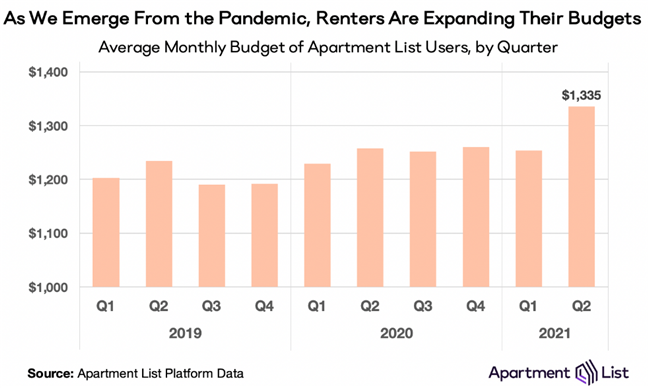
“This migration flow is putting pressure on local rent prices because these movers have budgets that are 10 percent higher than the existing residents who are also searching for a new apartment,” Apartment List housing economists and experts  Chris SalviatiRob Warnock, and Igor Popov write in the report.

On average, Phoenix residents looking for a new home have a monthly budget of $1,213, while renters searching from a different metro have a budget of $1,332.

“Our newest Quarterly Migration Report finds that not only are more people moving, but movers today have higher incomes and higher budgets than ever before. This is putting added pressure on already-competitive markets and contributing to rising rent prices across the country,” the report says.

People moving from higher-rent locations driving up prices

Rents in Phoenix have increased by $200 overall in the last year.

In Yardi Matrix’s latest multifamily report, the company says “many people moving into Phoenix are coming from higher-cost locations, where they are accustomed to higher rents. But for longtime residents of Phoenix, the swift price increases are driving them to downsize or find a lower-cost location to live.”

This migration to Phoenix is coming largely from higher-cost California, the report says.

Out-of-Town Movers Outbidding Local Renters in Phoenix

The single-family housing market is performing equally as strong as the rental housing market, with prices up almost 22 percent on a year-over-year basis, according to the S&P Case Shiller Index.

Limited new supply in Phoenix is one factor contributing to the spike in rental and home prices. As of June, 3.2 percent of stock had been delivered in the last 12 months. “Even though this falls in the top 10 of our 30 largest metros, it is not enough to keep up with the demand,” Yardi Matrix said in its report.

Sign Up For Our Newsletter And Get Rental Property And Apartment News And Helpful, Useful Content Each Week.

* indicates required


Average National Monthly Rent Tops $1,500 For 1st Time

Will You Be Ready When the Eviction Moratorium Ends?

Average National Monthly Rent Tops $1,500 For 1st Time

Average National Monthly Rent Tops $1,500 For 1st Time

The average monthly national rent hit $1,513, topping the $1,500 mark for the first time in 150 metros that were reviewed, according to the National Apartment Association (NAA).

In addition to the average national monthly rent increases, occupancy and demand are also at all-time highs.

“According to separate reports from RealPage, all three have surged forward to levels last recorded in at least the early 2000s,” the NAA says in the report.

“I think we’re going to see increases for the next 12 to 18 months,” said Robert Pinnegar, president of the National Apartment Association, in an interview with The Washington Post.

“We’ve never had three generations in the rental housing space, at least not in the numbers we’re seeing now,” Pinnegar said.

Here is what is going on with those three indicators:

  • NAA reported that nationally, asking rents increased 2 percent in June and are up 6.3 percent year over year—the largest 12-month growth since 2001.
  • Occupancy is at 96.5 percent, the highest it has been since the later part of 2000.
  • Demand also skyrocketed in the second quarter from the same time last year, with the biggest quarterly jump in RealPage’s database dating back to the early 1990s.

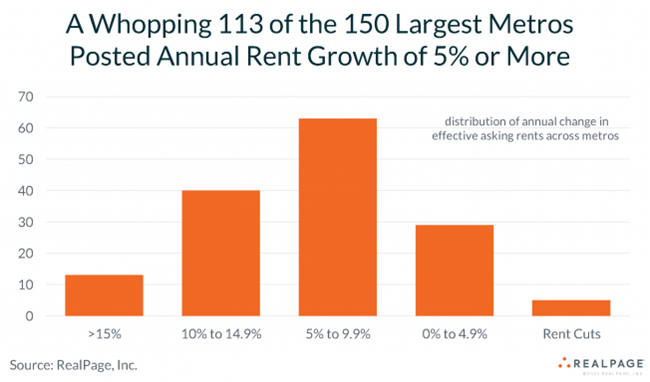
The RealPage report says of the 150 largest metros reviewed, 113 saw an annual rent growth increase of  least 5 percent. Larger locations with at least 100,000 apartment homes—Phoenix, Las Vegas and Atlanta, among others—witnessed double-digit annual rent growth.

Average National Monthly Rent Tops $1,500 For 1st Time
Chart courtesy of RealPage.

New apartment construction continues in many parts of the country. It is unclear what the impact of new apartments coming online will be on demand in the future.

Greg Willett, RealPage economist, said in the report that annual growth in effective asking rents comes in at more than 10 percent in 53 of the country’s 150 largest metros, including 13 spots where year-over-year price increases are at 15 percent or more.

Willett said Boise, Idaho posts the most aggressive annual rent growth in that 150-metro group of markets, with pricing there up 21.2 percent. In larger cities with at least 100,000 apartment units, Phoenix registers 19.2 percent annual rent growth, and Las Vegas rents are up 16.7 percent. Other big markets recording yearly price increases that top 15 percent are West Palm Beach, Riverside/San Bernardino and Tampa.

Sign Up For Our Newsletter And Get Rental Property And Apartment News And Helpful, Useful Content Each Week.

* indicates required


Will You Be Ready When the Eviction Moratorium Ends?

Everything Landlords Should Know About Emotional Support Animals

No Guns In My Apartments: Can A Landlord Say That And Put It In A Lease?

Can I Say “No Pot In My Apartments” When It’s Legal In My State?

Bill Kay New Managing Director of Ashcroft Capital Markets

Bill Kay New Managing Director of Ashcroft Capital Markets

Real estate industry veteran Bill Kay has been hired as the new managing director of capital markets for Ashcroft Capital, according to a release.

The hiring of Kay will support Ashcroft’s continued emergence in the rental-housing sector as the company continues to acquire assets in its existing markets in the Sunbelt and seeks to enter new markets.

Kay will lead all capital markets activities at Ashcroft, with a focus on equity relationships with institutional investors such as real estate funds, endowments, foundations, major insurers, sovereign wealth funds, pensions and family offices. He will also actively participate in the investment and asset management processes across the company, according to the release.

“With more than two decades of experience in private real estate and private equity, it was quickly apparent that Bill is the perfect fit to lead our institutional investor relations and fundraising efforts,” Frank Roessler, founder and chief executive officer of Ashcroft Capital, said in the release.

“He has a proven track record of helping to build world-class institutional investment management companies, and we could not be more excited about having his leadership, knowledge and experience as part of the Ashcroft team.”

Prior to joining Ashcroft, Kay held senior leadership roles at Lubert-Adler Real Estate, Apollo Global Management, Morgan Stanley AIP and others. A Dartmouth College graduate with an MBA from The Fox School of Business and Management at Temple University, he has extensive global experience advising investors in tactical and strategic portfolio construction. His strategic acumen encompasses an extensive array of private strategies in fund, direct and co-investment formats.

“I’m thrilled to join the Ashcroft Capital team, which has established itself as a major player in the multifamily industry and is committed to aggressive but highly strategic growth,” Kay said in the release.

Bill Kay New Managing Director of Ashcroft Capital Markets
Bill Kay said on joining Ashcroft Capital, “I’m eager to lend my expertise to help an on-the-rise company continue to thrive,”

“I am thoroughly impressed with the company’s proven track record of creating value through the rebranding, renovating and repositioning of its acquired properties, as well as its history of delivering strong returns to investors and improving the resident experience. The company already has done an outstanding job of developing funding, and I’m eager to lend my expertise to help an on-the-rise company continue to thrive,” Bill Kay said.

Since its inception, Ashcroft Capital has acquired more than 11,500 units totaling more than $1.3 billion in value. Until this year, the company’s portfolio consisted of apartment communities in Jacksonville, Fla., Dallas-Fort Worth, Orlando, Fla., and Tampa, Fla. Ashcroft, which acquired just under $300 million of assets in 2020, recently entered the metro Atlanta market and is also seeking acquisition opportunities in the Charlotte, N.C., Raleigh-Durham, N.C., and Phoenix metros. Many of Ashcroft’s 2021 investments have been purchased through the company’s new $150 million Value Add Fund.

Birchstone Residential, Ashcroft Capital’s in-house property management company, manages all of Ashcroft’s owned multifamily communities. Birchstone was created to provide best-in-class service that attracts new residents, enriches the lifestyles of current residents and drives the operational performance of the Ashcroft portfolio, leading to targeted rates of return. Birchstone promotes a culture of authenticity, transparency and empowered associates.

About Ashcroft Capital

Founded in 2015, Ashcroft Capital has acquired over $1.3 billion of assets and more than 11,500 units. The firm focuses on capital preservation while striving to return strong, risk-adjusted cash-on-cash to investors. Ashcroft is capitalized with high net worth, family office and institutional capital. Within the real estate industry, Ashcroft specializes in value-add real estate and exhibits an expertise in extracting maximum value from every asset it acquires. Rather than attempting to play market timing, the firm strives to acquire excellent apartment communities within well-located submarkets of large and growing U.S. metroplexes.


Top 4 Best Cities with Least Environmental Risk For Investors

Portland among Top 4 Best Cities with Least Environmental Risk For Investors

Four metro areas, including Portland, stand out as having the least overall environmental risk for investors in commercial real estate and multifamily, according to a new rating from Yardi Matrix.

The company said they did the study because events over the past year “have brought environmental, social and governance (ESG) front of mind for investors and experts in commercial real estate. “

Yardi Matrix said more and more weather-related disasters “that produce billions of dollars of property damage, changes in work practices spurred by the COVID-19 pandemic, and recognition of the need for equity and diversity have created an urgency for businesses to act” on environmental, social and governmental criteria.

The report also cites the 2020 Urban Land Institute report on Climate Risk and Real Estate: Emerging Practices for Market Assessment.  That study by real-estate investment-management firm Heitman and the Urban Land Institute said,  “Leading real-estate investment managers and institutional investors are increasingly recognizing climate risk as a core real-estate issue that is beginning to affect their decisions at the market level as well as at the asset level. As this market-scale analysis of climate risks and cities’ resilience strategies advances, investors will better assess both the economic impact of climate-related events and the cost and ability of cities to mitigate the impact of climate change through their resilience strategies.”

Ranking of factors for environmental risk for investors

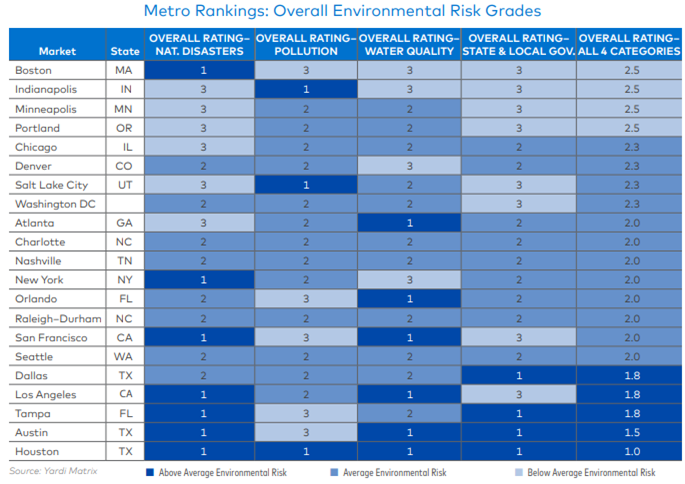
Yardi Matrix graded and ranked 21 top metros for risk for commercial real estate investing using natural disasters, pollution, water quality and state and local government investment.

Combing these four risk factors, Yardi Matrix said the top four metros with the least risk were Boston, Indianapolis, Minneapolis and Portland.

“The commonality for all was being in states that are taking environmental risk seriously. Boston and Indianapolis received the highest grades in three categories and the lowest grade in one, while Minneapolis and Portland received high marks for government action and propensity for natural disasters and middle grades for pollution and water quality,” Yardi Matrix said in the report.

Top 4 Best Cities, including Portland, with Least Environmental Risk For Investors
Chart courtesy of Yardi Matrix

The 5 bottom ranked metros for environmental risk for investors

The Yardi Matrix report said the bottom five metros “include three in Texas: Houston, Austin, and Dallas, along with Tampa and Los Angeles. The Texas metros’ grades were dragged down by low scores in the “natural disasters” and “government-response” categories.

The severe winter storm that hit Texas causing massive power outages was a key factor in the ranking, including lack of government response.

“The Texas storms are a demonstration of the stakes. Texas has reaped the benefits of deregulation and low taxes/utility costs, but utility providers’ lack of investment to winterize the power grid left the state unprepared to handle extreme weather. Without collective action to mitigate environmental risk, such disasters with high damages will recur,” Yardi Matrix said in the report.

Conclusion

“Some will no doubt question the categories we chose, the methods we used to grade metros, or what constitutes a proper response to environmental risk. This is our intention,” the report noted.

“Our rankings are not meant as a final word on the topic, but rather, a first attempt to understand the issues and develop a model for how to approach the topic—which is of increasing importance for commercial real estate.

“We encourage all to develop their own views about which metrics will have the most impact on the property sector and the appropriate response” in regards to environmental, social and governance factors, wrote Paul Fiorilla, director of research, and Claire Anhalt and Maddie Harper, senior analysts, for Yardi Matrix.

About Yardi Matrix:

Yardi Matrix researches and reports on multifamily, office and self-storage properties across the United States, serving the needs of a variety of industry professionals. Yardi Matrix Multifamily provides accurate data on 18+ million units, covering more than 90 percent of the U.S. population. Contact the company at (480) 663-1149.

Sign Up For Our Newsletter And Get Rental Housing and Apartment News And Helpful, Useful Content Each Week.

* indicates required


Will You Be Ready When the Eviction Moratorium Ends?

Everything Landlords Should Know About Emotional Support Animals

No Guns In My Apartments: Can A Landlord Say That And Put It In A Lease?

Can I Say “No Pot In My Apartments” When It’s Legal In My State?

Seattle Area Market Rebounds, Marches On

Seattle Area Market Rebounds, Marches On

Veteran property manager Cory Brewer weighs in on how the Seattle area market rebound is going and how the pendulum is swinging.

By Cory Brewer

Perhaps the most prevalent 2020 trend in housing was the “migration” of demand. COVID-19 issues, coupled with civil unrest, led prospective renters away from dense in-city multi-family properties to more spacious suburban single-family homes.  When I wrote about this before, I covered these issues in detail (health concerns, telecommuting, etc.).  As we look back on market activity for the first half of 2021, I’ll focus on how the pendulum is swinging back toward downtown Seattle and also take a look at surrounding areas.

By far, the hardest hit local sub-market in our region was downtown Seattle.  Average rents dropped more than 20% in some circumstances, and concessions such as 2-3 free months on a new lease became common.  Market time, or in other words absorption rate, slowed by 35% and the number of condos unsuccessfully offered for lease (listing cancelled or expired without ever finding a tenant) nearly doubled the five-year historical average (statistics gathered from Northwest Multiple Listing Service data).

Now that the numbers are in for the first half of 2021, as the economy has started to re-open and vaccination rates are climbing, we are again seeing demand return to downtown Seattle.  Concession offers have faded away, and rents have begun to tick up (though remain below pre-pandemic levels).  For units listed on the NWMLS, I took a look at the average number of new leases signed per month dating back to 2017.  What a difference!  The monthly frequency of new Seattle condo/multi-family leases signed is up 42.7% over last year, and is by far the highest it’s been over the past five years.

So what is going on in downtown Seattle?  Haven’t people found that they like working from home?  Haven’t they decided to live further outside the city where they don’t have to worry about a daily commute and can enjoy more space for a home office, home classroom, and recreation?  Well, yes, they have.  It’s being reported that the magnet effect of downtown Seattle is attracting younger renters in particular at this time.  It’s not only that amenities, bars, restaurants, shops, stadiums, and artistic venues are re-opening … but these renters also realize that pricing is still relatively depressed, and now is the time to get in before rent levels fully recover.  It probably doesn’t hurt that as a city, Seattle is among the national leaders in vaccination rates, offering a buffer against many of the health concerns that cooled interest in city living last year.  Some of the buzz is returning, and I can attest personally that it was an amazing feeling to recently attend a Mariners game after a year off (even though we lost!).

How is the rest of the Seattle Metro area faring at the 2021 mid-way point? 

We are seeing some continuance of 2020 trends, especially with single-family homes on the Eastside.

When people stopped looking for a condo or apartment in Seattle last year, clearly they shifted gears in hopes of finding a rental house, often times on the Eastside.  We saw sharp gains in absorption rate (24%) and not-insignificant gains in pricing (6.5%) across the Eastside single-family submarket.  So far this year, absorption rate has sped up by an additional 12% and pricing is up an additional 9.7%.  Part of the reason for this goes back to the statistic that I referenced earlier, which is number of new leases signed per month.  While we see that the frequency of new leases in downtown Seattle is shattering historical averages in a major way, it is quite the opposite with Eastside single-family homes where opportunities are scarce and competition is fierce.  Availability is down 8% from last year, and down a substantial 34.4% from five years ago.  We are also seeing price appreciation and reduced availability among single-family homes throughout Seattle, Snohomish County, and South King/Pierce County, though not as pronounced as what is happening on the Eastside.  So, if you maintain rental housing in the region, there is strong demand for what you’re offering.

Our resident tech giants (Amazon, Microsoft, Google, etc.) continue to bring in new hires from around the world, and they need places to live.  With very tight sales inventory available, renting is not only the preferred option for many relocating to the region but it’s often the only available option, and even then it can be competitive.

While it has been a hot seller’s market, some of this supply loss can be attributed to legal policies that have come down over the last several years.  It can be difficult to pinpoint exactly why someone sells their rental home as it’s often a combination of factors, but plenty of them are doing so in response to legal changes that they fear are too risky to absorb.  I hear this on a regular basis not only from clients at my own firm, but from other property managers that I network with from around the state.  It’s a real issue – single-family rental housing supply loss, that is – and our elected officials had better wake up to the inevitable long-term effects of their very near-sighted decisions.  My hope is that the real estate exemption for the newly introduced state capital gains tax will encourage investors to remain in the housing sector.  I am also hopeful that as we head into an election season, particularly in Seattle, voters have an appetite for a pendulum swing as it relates to housing policy.

About the author:

Cory Brewer Seattle Area Market Rebound Marches On
Cory Brewer

Cory Brewer is the general manager at Windermere Property Management / Lori Gill & Associates. He oversees a team of property managers in the greater Seattle area who manage approximately 1,500 rental properties. Brewer can be reached via www.wpmnorthwest.com or [email protected]

Sign Up For Our Newsletter And Get Rental Property And Apartment News And Helpful, Useful Content Each Week.

* indicates required


Average National Monthly Rent Tops $1,500 For 1st Time

Will You Be Ready When the Eviction Moratorium Ends?

Real Estate Investors – Is Your Tax Sheltering Plan Bulletproof?

Real Estate Investors - Is Your Tax Sheltering Plan Bulletproof?

Whether you are in the business of fix & flips or rental properties, we are all sitting in a world of unknowns right now. However, all politics aside, there are two things that are certain. First, is that the trillions of dollars in government aid will need to be paid back. Second, is that this expectation foreshadows what recourse will most likely be taken, taxes. So, in anticipation of this impending tax event, does your real estate investment strategy also include an optimal tax shelter plan?

If your answer was “no”, then let Preferred Trust Company introduce you to one of the most dynamic tax-sheltering tools you can fold into your portfolio, the Self-Directed IRA. You are receiving an exclusive invitation to attend the Virtual Seminar “Self-Directed IRAs: Fact and Fiction” on Wednesday, July 28th at 9:00AM PST.

At this virtual seminar you will learn the benefits of Self-Directed IRA accounts, how to open an account, and how to direct your investments in alternative assets, like real estate, with an IRA.

CTA – REGISTER HERE

If you are interested in adding a Self-Directed IRA to your retirement strategy, Click Here to schedule a no obligation consultation at your convenience. Now until December 31st, 2021, Preferred Trust Company will waive the establishment fee and first year administration fee for all new accounts. Give us a call at 888.990.7982 or visit our website and apply online to take advantage of this offer today!

Real Estate Investors - Is Your Tax Sheltering Plan Bulletproof? Preferred Trust

Purchase Your Next Property at Auction with a Retirement Account

New Resident Expectations Accelerate Rise in Smart Communities

New Resident Expectations Accelerate Rise in Smart Communities

Property managers may want to consider investing in the right technologies to create smart communities as nearly half of prospective renters say smart building products increase their interest in a potential apartment, according to a 2021 study by Assurant. Renters are even willing to lose out on floor space if it means enhanced digital features.

By Dean Compoginis
VP of Business Development, Nomadix Inc.

Imagine controlling the lights, thermostat, security system and community gates all with a tap on your smartphone or through voice commands. After spending countless hours at home over the past 16+ months, we’ve learned new habits and shifted our preferences for comfort, efficiency and seamless connection while working, learning and relaxing in our homes.

With the promise of continued hybrid work options – as seen with the U.K. looking to make work-from-home the “default” choice, the new smart-home requirements will only continue to increase. In fact, 40 percent of all U.S. apartments are expected to have connected devices by 2025, with smart apartment revenue to exceed $9B.

Aligning with this new demand, multifamily property managers and owners should invest in internet-of-things (IoT) technologies and smart functionality to ensure higher tenant satisfaction and lease renewals. Let’s take a look at a few key areas that not only benefit the resident but also improve operational efficiencies and create higher values for the property.

Connected Entry

Did you know that 61 percent of millennials are more likely to rent an apartment specifically because of its electronic access features? For individual apartments, property gates, fitness rooms, pools and more, connected entry and access controls make it easy for residents to let friends or service people in from a distance via mobile apps or digital-key technology.

For property managers, they can increase the security of the property by instant authorization and restriction of access as residents move in and out. It’s more efficient than changing locks, simple to manage, and eases the tension of onboarding during peak transitions times.

Energy Management

Smart thermostats, outlets, lighting and other energy-smart IoT solutions offer smart-home conveniences residents want. It provides joy to many to start cooling down their apartment 20  minutes before they arrive home on a sweltering day! It’s also easy to turn on lights with sensors or voice commands when walking into a room or sitting on the couch when the sun starts to go down.

 Meanwhile, IoT energy-management systems can deliver significant savings. Many operators report that heating and cooling alone accounts for half or more of their monthly energy costs. Using IoT sensors to track and analyze energy consumption and air quality optimizes energy use and improves response times if any problems arise. Leak detection, for example, can instantly alert maintenance before catastrophic damage occurs.

Mobile Apps

Today’s residents want a home that offers comfort and  community, and which eases their everyday lifestyle. Mobile apps provide the glue that pulls it all together. From staying in touch with other residents with messaging apps, to paying rent and utility bills, package notification, maintenance orders, and controlling the lighting and temperature, investing in an integrated, customized mobile app really helps build the community.

Owners and managers see substantial benefits from the adoption of a customized mobile app. From touring a property at lease-up, to staying in touch with residents over the course of their tenancy, and continuing the relationship after they move out, mobile apps deliver what all property owners and managers need: continuous engagement with their most important resource – their customers.

Connection via mobile apps can also allow residents to immediately notify property managers of a leaky faucet, faulty light switch or other maintenance issues. Open communication through the app can help property managers keep residents aware of important updates or community events. Property managers can also collect rent and notify residents about overdue payments digitally.

Wi-Fi as a Service

 Managed Wi-Fi offers the support necessary for all these IoT devices and gives residents instant access to fast, high-quality connectivity. Residents can manage their own connections with individual network passwords and controls, and benefit from seamless access across the property. This powers all of the smart technologies across the community, not to mention the smart TVs, computers and other devices they use to work and relax in their homes.

Offering managed Wi-Fi also opens up many opportunities for property owners. It can be quite common to generate an additional $20-$30 per month per apartment for just internet services alone. Beyond generating additional monthly revenue, the managed Wi-Fi network will also provide outstanding opportunities to improve operational efficiencies and add ancillary revenue streams.

There is a wide range of IoT and smart technologies available today to support smart-apartment initiatives. Where you focus your resources depends entirely on your specific situation, competitive set, local market variables and portfolio management imperatives. For example, in some markets, a $20 monthly savings on electricity due to smart thermostats may be highly valued, while in another market, smart apps and access control for dog walkers and delivery people may be of higher interest.

Residents have shown they are willing to pay for the latest digital features in smart communities, with millennials paying about 20 percent more and staying longer in buildings that offer modern lifestyle conveniences. Now’s a great opportunity to build a solid foundation to align to the new expectation of residents. Happy residents create happy communities, and offering modern, smart conveniences will continue to create positive returns with resident satisfaction and increased revenue opportunities.

About Dean Compoginis

New Resident Expectations Accelerate Rise in Smart Communities

Dean is a global sales and marketing executive who most recently served as director of MDU business development & sales at Ruckus Networks. Before that, he was the director of the hospitality business unit at Meru Networks. Dean has a proven track record in multiple industries, including networking, hospitality, MDU, software, telecommunications, broadcast, major retail, marine products, computer hardware. He currently serves as VP of Business Development of Nomadix

Sign Up For Our Newsletter And Get Rental Property And Apartment News And Helpful, Useful Content Each Week.

* indicates required


Will You Be Ready When the Eviction Moratorium Ends?

Everything Landlords Should Know About Emotional Support Animals

No Guns In My Apartments: Can A Landlord Say That And Put It In A Lease?

Can I Say “No Pot In My Apartments” When It’s Legal In My State?

Portland Rents Continue 5-Month Climb

Portland Rents Continue 5-Month Climb

Portland rents have increased 1.7 percent over the past month, and are now up 2.5 percent year-over-year, according to the June report from Apartment List.

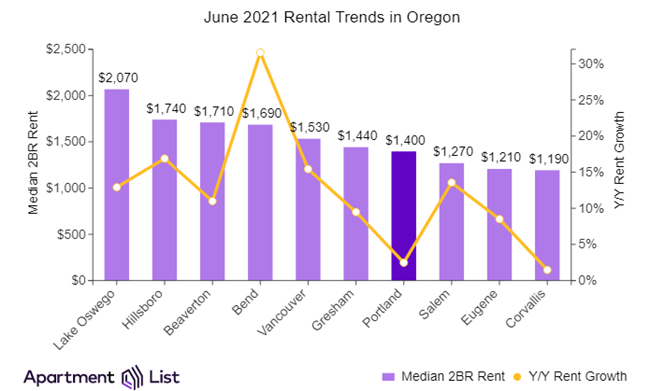
Now, median rents in Portland are $1,197 for a one-bedroom apartment and $1,396 for a two-bedroom.

These increases are part of the fifth straight month that the city has seen rent increases. The last decline in rents came in January.

However, Portland’s year-over-year rent growth lags the state average of 7.3 percent, as well as the national average of 8.4 percent.

Portland Rents Continue 5-Month Climb

Rents Rising in All Major Cities Across Portland Metro

Of the 10 largest cities in the Portland metro for which Apartment List has data, all have seen prices rise. Oregon as a whole logged rent growth of 7.3 percent over the past year.

Here’s a look at how rents compare across some of the largest cities in the metro.

  • Lake Oswego is the most expensive of all Portland metro’s major cities, with a median two-bedroom rent of $2,068.
  • Hillsboro rents have increased 4.4 percent over the past month, and have increased sharply by 16.9 percent in comparison to the same time last year. Currently, median rents in Hillsboro are at $1,585 for a one-bedroom apartment and $1,740 for a two-bedroom.
  • Beaverton rents have increased 2.4 percent over the past month, and have increased sharply by 11.0 percent in comparison to the same time last year. Currently, median rents in Beaverton stand at $1,409 for a one-bedroom apartment and $1,710 for a two-bedroom.
  • Vancouver rents have increased 2.0 percent over the past month, and have increased sharply by 15.4 percent in comparison to the same time last year. Currently, median rents in Vancouver stand at $1,298 for a one-bedroom apartment and $1,533 for a two-bedroom.

Across the state rent increases:

  • Bend had the fastest growth in Oregon up 31.5 percent.
  • Eugene rents have increased 1.6 percent over the past month, and have increased sharply by 8.5 percent in comparison to the same time last year.

Sign Up For Our Newsletter And Get Rental Property And Apartment News And Helpful, Useful Content Each Week.

* indicates required


Will You Be Ready When the Eviction Moratorium Ends?

National Rent Prices Jump Again in June, As Upward Trend Continues

What Are First Steps In Plumbing Emergencies In Rental Property?

What to Do During Plumbing Emergencies In Rental Property

How to handle plumbing emergencies in rental property is this week’s maintenance tip from Keepe, the on-demand maintenance company.

If you manage rental property, you and your tenants are bound to experience plumbing emergencies at some point. The problems can include broken pipes, gas leaks, blocked drains, faulty taps and tenant-caused issues that can lead to plumbing disasters.

Being prepared and knowing what to do when this happens is your first step to reducing damages and repair costs.

While having a professional plumber on call is the most important factor for having your plumbing issues promptly fixed, here are the steps you should take to minimize damage in a plumbing emergency.

Examples of plumbing emergencies

Plumbing emergencies in rental property are those that require immediate action now, especially when your tenants call, such as:

  • Clogged sinks, toilets, bathtubs or shower drains
  • Leaky faucets, toilets, water heater, hoses
  • Broker water lines
  • Burst or frozen water pipes
  • Sewer system backups

First steps to take in plumbing emergencies in rental property

Turning off the water supply is the first step, as the most common plumbing emergency in residential rental housing is water leaks or water flooding an area.

Do you know where all the water shut-off valves are?  Many times a property manager may not even know the main source of a water leakage. It could be sewage water or domestic water leaking into your rental from another source.

Find your shutoff valves ahead of time so you know where they are when you need to quickly shut off the water. The valve could be in the building somewhere or out by the street.

Sewage Backups: Call a Professional Plumber

Sewage backups usually happen when there is something wrong with the sewage pipes under your foundation. Tree roots can sometimes lead to a blockage, or an incorrect installation may lead to serious problems.

If you see a pool of brown smelly water in your yard, the first thing you should do is to shut off the water. Don’t try to fix a sewage-related problem yourself; you could expose yourself to harmful bacteria. Call the water utility company or septic company, who will send a trained professional to investigate and fix the problem.

Overflowing Toilets: Turn off the Water Supply

A clogged toilet can quickly overflow when flushed, leading to unsanitary issues and immense water damage. Caution your tenants about paper towels, tissues, wrappers and even baby wipes, all of which can all easily clog your plumbing and cause toilets to overflow.

Your first step is to find and turn off the water-supply valve beneath the toilet tank to prevent more water from entering the bowl. Then, deal with the clog or call the plumber.

Broken Water Heater: Flush the Water Tank/Call a Professional

As a water heater begins to malfunction, your tenants may experience water that’s too cold or too hot or has a strange color or odor. Having a professional flush the hot-water tank may solve color and odor problems as well as improve the heater’s efficiency. If you notice a leak, it may be time for replacement.

In conclusion

Acting fast can save your rental property from major damage and prevent any significant costs.

Keep your emergency plumber’s contact number close, and be prepared with these essential steps to avoid damage during a plumbing emergency.

Best of all, be sure your tenants notify you immediately when there is a plumbing emergency, as the longer they wait, the more damage to your property.

Sign Up For Our Newsletter And Get Rental Property And Apartment News And Helpful, Useful Content Each Week.

* indicates required

6 Ways To To Rid Smoke Smells From Rental Units