
Home Blog Page 108

Three Reasons Investors Prefer Real Estate

Three Reasons Real Estate Investors Prefer Real Estate Ashcroft Capital

By Evan Polaski
Ashcroft Capital

Two common forms of investment strategies that smart investors use to grow their wealth with passive income include creating a diversified portfolio of stocks and investing in real estate. While investing in the stock market is beneficial for numerous reasons, investing in private market properties like multifamily provides several advantages.

Here are three important reasons why some investors prefer multifamily private placement investments over stock market investments.

#1. Lower Volatility

Stocks can have a volatility that’s not found with most private placement offerings. Real estate provides a long-term cash flow provides passive income and the promise of appreciation (1).

The stock market is particularly vulnerable to several different forms of risk, which include economic, inflationary, and market risks. This volatility can occur because of company-specific or geopolitical events. The real estate market across the U.S. has been strong for more than a decade. Since 2010, the national housing market added $11.3 trillion in value – a more than 50% increase (4).

#2. Your Gains Can Be Deferred

If you sell a property that you’ve invested in and put the proceeds towards purchasing a similar property, your capital gains taxes can be deferred to a later date, which is called a 1031 tax-deferred exchange (3). During this process, a qualified intermediary will hold the proceeds from the sale until the money can be transferred to the other property’s seller. Engaging in a 1031 allows you to avoid the 15-20% long term capital gains tax rate (5).

#3. Can Be Used As Hedge Against Inflation

Over time, the value of a dollar increases as a result of inflation. While the value of currency will invariably increase over time, the rate of inflation isn’t always consistent. As inflation rises, the cost of everything goes up, including real estate (2). When property values increase, the property owner can charge more for rent, which ensures a higher revenue stream. By keeping pace with inflation, you gain an advantage that is difficult to obtain with stock market investments.

It’s never too early to start generating passive income. Placing some of your money into multifamily private placements could help you balance your portfolio and reduce the potential for losses. To assist you on this journey, download this free 20-page guide to Understanding Real Estate Private Placements.

  1. Reasons to Invest in Real Estate vs. Stocks
  2.  “How Buying a House Can Hedge Against Inflation.”
  3. Internal Revenue Service. “IRS 1031 Exchange.”
  4. Recovery Added $11.3 Trillion to U.S. Housing Value in the 2010s.
  5. 1031 Exchange Rules: What You Need to Know.”

DISCLAIMER: Ashcroft Capital LLC is not an investment adviser or a broker-dealer and is not registered with the U.S. Securities and Exchange Commission. The information presented in this email should not be used as the sole basis of any investment decisions, nor is it intended to be used as advice with respect to the advisability of investing in, purchasing or selling securities, nor should it be construed as advice designed to meet the investment needs of any particular person or entity or any specific investment situation. Nothing in this advertisement constitutes legal, accounting or tax advice or individually tailored investment advice. The reader assumes responsibility for conducting its own due diligence and assumes full responsibility of any investment decisions.

About the author:

Evan Polaski
Investor Relations Manager
[email protected]
Bill Kay New Managing Director of Ashcroft Capital Markets

Multifamily Jobs In Apartment Sector Strong in Second Quarter 2021

Multifamily Jobs In Apartment Sector Strong in Second Quarter 2021

The number of real estate multifamily jobs in the apartment sector continues to grow, as more than 37 percent of  vacant real estate openings in the United States were in the multifamily sector during the second quarter of 2021, exceeding the five-year average of 33.2 percent, according to the latest report from the National Apartment Association (NAA).

“As the apartment market continued its recovery during the second quarter with surging rental rates and occupancy high, the demand for multifamily professionals stood strong,” the NAA’s Educational Institute said in the quarterly jobs report.

Renter demand for apartments climbed considerably because of the recovering economy,” the report said. “According to RealPage, annual units absorbed reached 496,542 during the quarter. Solid apartment demand fueled rent growth, in turn allowing multifamily companies to hire additional professionals. As of June, effective asking rent increased 6.3 percent year-over-year, recording the largest annual rent growth since early 2001.”

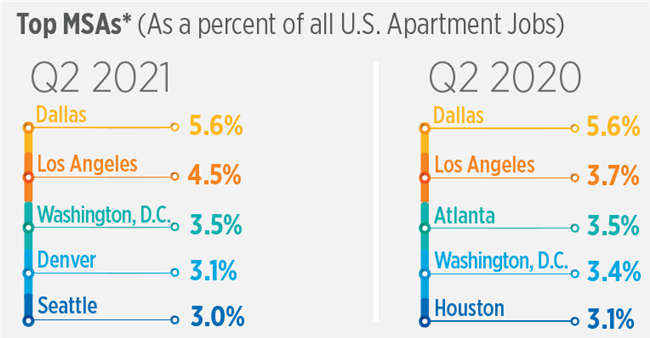
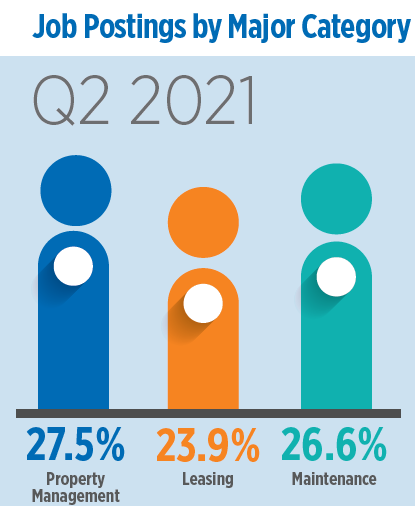
Property management, leasing, and maintenance job openings declined year-over-year, yet administrative positions increased by 1.1 percent. Dallas, Los Angeles, Washington, D.C., Denver, and Seattle ranked highest for apartment job demand.

Multifamily Jobs In Apartment Sector Strong in Second Quarter 2021

Student housing slow in preleasing

For the student-housing sector, job openings were most prevalent in Austin, Columbus, Gainesville and Tallahassee.

Leasing consultants were the most sought-after position by employers, despite a decline in preleasing activity. According to Yardi Matrix, as of April, “preleasing for the fall 2021 semester is trailing prior years. Preleasing stood at 58.6 percent, 4.2 percent below the same time last year and 5.8 percent lower than 2019. As more students become fully vaccinated, preleasing rates are expected to improve,” the report said.


Sign Up For Our Newsletter And Get Rental Property And Apartment News And Helpful, Useful Content Each Week.

* indicates required


Average National Monthly Rent Tops $1,500 For 1st Time

Will You Be Ready When the Eviction Moratorium Ends?

Everything Landlords Should Know About Emotional Support Animals

Crazy Landlord Times; Are We Near the End?

As landlords we know these are crazy times and we may not be near the end, so here are 5 critical resources landlords should use in these crazy landlord times from veteran real estate investor and property manager David Pickron.

As landlords we know these are crazy times and we may not be near the end, so here are 5 critical resources landlords should use in these crazy landlord times from veteran real estate investor and property manager David Pickron.

By David Pickron

Like many of you, I was blessed to experience the ‘80s as a teenager.  The hair, the movies, and most of all the music, were iconic.  One of my favorite bands was Journey, and I knew all their lyrics (and air-guitar solos) by heart.  Just hearing Steve Perry hit the notes that only he could reach brings the memories flooding back.   Unfortunately, he left the band in 1987 and through changes and challenges, things were never really the same for the band.

Similarly, our own industry was riding high in 2019, when we all looked like rock-star investors with a solid, proven rental base.  Then COVID-19 hit (a real low note) and things just haven’t been the same.

Hoping to return to form, here is what we have seen over the last month:

  • The CDC extended the eviction moratorium to July 31, 2021 and alluded to the fact that there was no intention to renew it.
  • A few days later the Supreme Court refused to take a case involving the moratorium, stating it would be expiring within 30 days and therefore there was no need to rule.
  • The Consumer Financial Protection Bureau let credit-reporting agencies know that they better report evictions and delinquencies correctly or they will get sued. This was seen as a “shot across the bow” letting us know they will be watching closely; a scare tactic often used by Fair Housing and other government agencies.
  • Several states passed legislation saying companies like ours cannot report evictions through 2022.
  • Recently a congressional House panel went after four large corporate-housing providers, asking them to produce documentation on how they were able to evict 5,000 residents while there was an active eviction moratorium.

While we may be seeing the light at the end of the tunnel for the eviction moratorium, we are far from “business as usual.”   Our industry, and landlords specifically, will continue to be a target as this so called ”housing crisis” is figured out.  Notice I intentionally did not say until COVID is figured out.  It’s no longer about COVID-19, it’s about a bigger problem that is not going away anytime soon.

Within this ever-changing landscape, every landlord can and must protect themselves by utilizing these five critical resources:

  1. Turn to and trust professional attorneys for any issues between you and your tenants. As investors we like to save money and handle situations by ourselves.  While that is fine most of the time, in today’s environment an attorney could save you money, time and aggravation.  Their knowledge of federal, state, and local laws is something we can’t possibly keep up with.  City councils and state legislatures are passing laws to protect the tenant at breakneck speeds.  For example, in Chicago, you cannot ask about criminal history until you have made a conditional offer of approval.  Asking about criminal history on the initial application is a violation of a Cook County law and could cost you thousands of dollars.  Your local landlord attorney will help you navigate these types of changes and save you money.
  2. Take a fair-housing class. The industry has seen more protected classes added this year around the country than any other year in the past. Know what you can and can’t say in your online ads, over the phone, and in person.  Make sure you understand the importance of a detailed written criteria and how to properly use an adverse-action letter.  (We can provide you a sample if you email [email protected]).  Some states now protect “source of income,” so landlords now are required to take Section 8 housing and inherit the government as a business partner whether they like it or not.
  1. Join a local REIA to learn about changes in law. Most Real Estate Investment Associations (REIA) have attorneys and professionals that educate the association to ensure its members are up to date in their practices.  If you do not have a local REIA in your area, search for investing or property-management podcasts.  There are many professionals around the country who publish something weekly to help keep landlords up to date.  Our Rent Perfect podcast drops every Tuesday and covers topics from top attorneys, tricks of the trade, solutions to current problems, and general management topics.  You can find us wherever you get your podcasts.
  1. Review your onboarding processes. Are you getting the information you need to identify the tenant who will stay there for the next five years or longer?
  • With so few evictions last year, consider requiring your potential tenants to provide 12 months’ worth of bank statements to prove rent was paid to the current landlord ,and look for deposits that match the check stubs and income amounts on the application.
  • Always talk to the previous landlord (or two if possible). Sadly, some current landlords will lie to get a bad tenant out, so talking to another prior landlord is beneficial.
  • Review your move-in procedure and ensure that it allows you to document the condition of the property at time of possession so you can prove whether damage was already existing or was caused by your tenant.
  • Determine if it is time to accept rent online and have it deposited directly into your bank account. No more waiting for a check in the mail or partial payments.
  • Explore new industry technology to see if you can eliminate any of those time-consuming tasks.
  1. Take care of your current tenants who have paid you over the last year; they are worth keeping. The tenant pool after the eviction moratorium ends will be teeming with risks you would rather avoid.  A big game of musical chairs, or better yet, musical homes, is about to start.  Retaining good tenants might mean upgrading your rental with new countertops or discounting the rent for a year.  In the end, this strategy will pay for itself. Congratulations on having that great tenant, not everyone had that luxury.

Every investor is asking this question right now:  Will we ever get back to normal?  In those immortal lyrics from Journey, “Don’t Stop Believin’.” Believe that it might be a while.  Believe that we might need to create and accept a “new” normal.  Believe that even with new COVID variants you will survive.  Believe that you are still working in the greatest business in the world and controlling your destiny.  Believe and focus on what you have and what you know.  Believe that there will be more surprises through 2021 and moving forward.  Most of all, believe that together we can weather any storm.

About the author

David Pickron is president of Rent Perfect, a private investigator, and a fellow landlord who manages several short- and long-term rentals.  Subscribe to his weekly Rent Perfect Podcast (available on YouTube, Spotify, and Apple Podcasts) to stay up to date on the latest industry news and for expert tips on how to manage your properties.

As landlords we want to know who is on our rental properties and what they are doing there, but we are not always on our property but often neighbors are nearby. So what is the solution?
David Pickron

3 Tips to Keep You Out of Landlord Rehab

Sign Up For Our Newsletter And Get Rental Property And Apartment News And Helpful, Useful Content Each Week.

* indicates required

Why I Like My Rental Properties’ Nosy Neighbors

New Online Tool to Help Renters, Landlords Access Federal Assistance

New Online Tool to Help Renters, Landlords Access Federal Assistance

The Consumer Financial Protection Bureau has released a new online tool to help renters and landlords find state and local programs distributing federal rental assistance funds, according to a release.

The Rental Assistance Finder, available at www.consumerfinance.gov/renthelp, connects renters and landlords with the state and local programs that are distributing billions of dollars in federal assistance nationwide to help renters stay housed during the pandemic.

According to a CFPB analysis of Census Household Pulse Survey data from June 23–July 5, 16 percent of adults living in households who rent said they are currently behind on their payments. Of adults living in households behind on rent, 49 percent, or approximately 3.6 million, say that eviction in the next two months is somewhat or very likely.

“Millions of people are behind on their rent and at risk of eviction as a result of the pandemic,” said CFPB Acting Director Dave Uejio in the release. “The Rental Assistance Finder will make it easier for renters and landlords to locate the financial assistance available in their area. People across the country are already receiving billions of dollars in assistance, and with this new tool we hope even more renters and landlords will take advantage of this emergency relief. This money is a win-win for both landlords and renters and a better outcome for all than costly, needless evictions.”

As part of an unprecedented economic recovery effort, the federal government has allocated more than $46 billion to assist households unable to pay rent, utilities, and other housing costs. All 50 states and hundreds of local, tribal, and other programs are distributing funds. The CFPB’s Rental Assistance Finder tool will make it easier for renters and landlords to connect with rental-assistance programs in their area, and take the first steps toward accessing available funds, according to the release.

The CFPB has taken other actions to support renters during COVID-19, including promising with the FTC to monitor illegal evictions, monitoring illegal debt-collection practices related to evictions during the pandemic, and monitoring Fair Credit Reporting Act obligations about reporting consumer rental and eviction information during the pandemic, including how rental assistance payments are reported.

Access the Rental Assistance Finder.

Sign Up For Our Newsletter And Get Rental Property And Apartment News And Helpful, Useful Content Each Week.

* indicates required


Average National Monthly Rent Tops $1,500 For 1st Time

Will You Be Ready When the Eviction Moratorium Ends?

Everything Landlords Should Know About Emotional Support Animals

How Should I Best Assess Late Fees For My Rentals?

How Should I Best Assess Late Fees For My Rentals?

How best to assess late fees for rentals is the question this week for Ask Landlord Hank. Remember Hank is not an attorney and he is not offering legal advice. If you have a question for him please fill out the form below.

Dear Landlord Hank:

When I am assessing a late fee, can I charge a one-time late fee of $250, or can I only charge 5 percent of the rent as a one-time late fee?

I understand if I charge a daily late fee, it cannot exceed 5 percent a day. Thank you

– Yvonne

Hello Landlady Yvonne,

I don’t know what state you are in, as many states address this subject and you must comply, but the late fee amount, when it is applied, and daily late-fee policies should all be very clear in your lease.

You must abide by those guidelines. If those issues weren’t addressed in your lease, you have no right to collect a late fee or daily late fee. Here in Florida, I charge a standard late fee of $100, no matter the rent of the property. I always reach out to a tenant, if they normally pay in a timely way, to tell them that the late fee will be applied if rent is not received by deadline, in the lease.

We try to have all our tenants pay by electronic funds transfer so the mail is not an excuse for tardiness.

Sincerely,

Hank Rossi

How Should I Best Assess Late Fees For My Rentals?
Landlord Hank says, “I charge a standard late fee of $100, no matter the rent of the property.”

Ask Landlord Hank Your Question

Ask veteran landlord and property manager Hank Rossi your questions from tenant screening to leases to pets and more! He provides answers each week to landlords.

  • This field is for validation purposes and should be left unchanged.

Do I Have to Paint and Replace Flooring for a Long-Term Tenant?

Sign Up For Our Newsletter And Get Rental Housing And Apartment News And Helpful, Useful Content Each Week.

* indicates required

Everything Landlords Should Know About Emotional Support Animals


Who’s Responsible For Smoke Detector Batteries In Rentals?

Multifamily Rent Growth Reaching Unprecedented Levels

Multifamily Rent Growth Reaching Unprecedented Levels

People moving around due to the pandemic and job changes or losses, government stimulus, and a hot housing market have all contributed to unprecedented levels of multifamily rent growth, Yardi Matrix says in its latest report.

“A slew of factors has pushed asking-rent growth across the country to levels not seen in decades,” Yardi Matrix says in the multifamily report.

“Rent growth will not be able to continue at these levels indefinitely, but conditions for above-average growth are likely to persist for months,” the report says.

Highlights of the multifamily rent-growth report

  • Multifamily asking rents increased by 6.3 percent on a year-over-year basis in June. “This is the largest year-over-year national increase in the history of our data set,” the report says.
  • Rents grew an amazing $23 in June to $1,482—another record-breaking increase. Lifestyle rents are growing at a faster pace than Renter-by-Necessity rents, “something we have not seen since 2011 and another sign of a hot market.”
  • Single-family (Built-to-Rent) rents grew even faster, at an 11 percent year-over-year pace.
  • “To be clear, the increases represent growth in what landlords are asking for (in) unleased apartments. Increases are smaller for tenants that are rolling over existing leases.”

The 3 big factors pushing rent growth to unprecedented levels

No. 1: Migration

Job loss during the pandemic plus the ability to work from home meant lots of people moving around. Rents are growing rapidly in both the Southwest and Southeast. Phoenix is up 17 percent, Tampa and the Inland Empire in California are up 15.1 percent. Not far behind are Las Vegas at 14.6 percent and Atlanta at 13.3 percent. “These metros were lower cost compared to larger gateway metros, but with double-digit rent increases the affordability of these metros has begun to decline,” Yardi Matrix said in the report.

No. 2: Government stimulus

Government stimulus checks, enhanced unemployment benefits and more than $45 billion of direct renter payments have all helped to prop up the multifamily industry. “All of this stimulus led to consistent levels of collections across the country,” the report says.

No. 3: Hot housing market

The S&P Case-Shiller Index shows home prices are up 14 percent year-over-year through June. “Many potential home buyers have been forced out of the market, and in turn, decided to rent an apartment for another year. Another pressure on the cost of housing is the lack of new supply. The U.S. is on track to build 1.5 million units in 2021, according to the Census Bureau, but that will not be enough to satisfy the demand for housing,” Yardi Matrix said in the report.

About Yardi Matrix:

Yardi Matrix researches and reports on multifamily, office and self-storage properties across the United States, serving the needs of a variety of industry professionals. Yardi Matrix Multifamily provides accurate data on 18+ million units, covering more than 90 percent of the U.S. population. Contact the company at (480) 663-1149

Multifamily Rent Growth Reaching Unprecedented Levels

Sign Up For Our Newsletter And Get Rental Property And Apartment News And Helpful, Useful Content Each Week.

* indicates required


Average National Monthly Rent Tops $1,500 For 1st Time

Will You Be Ready When the Eviction Moratorium Ends?

Everything Landlords Should Know About Emotional Support Animals

No Guns In My Apartments: Can A Landlord Say That And Put It In A Lease?

Can I Say “No Pot In My Apartments” When It’s Legal In My State?

July Apartment Market Showed Improvement in All Metrics

July Apartment Market Showed Improvement in All Metrics

Renter migration due to the pandemic and job changes or losses, government stimulus, and a hot housing market have all contributed to great apartment market conditions, according to a release from the National Multifamily Housing Council (NMHC).

“Robust demand across the country is reflected in growing optimism in the fundamentals of the apartment industry,” The NMHC said in the report.

For the first time since October 2015, the NMHC Quarterly Survey of Apartment Market Conditions for July 2021 had all indexes come in above the breakeven level of 50: market tightness (96), sales volume (79), equity financing (69), and debt financing (71).

“We are witnessing strong, broad-based demand for apartments as the U.S. economy continues to recover,” said NMHC Chief Economist Mark Obrinsky in the release. “Many U.S. gateway metros, which were among those hardest hit during the coronavirus pandemic, have now seen their occupancy rates return to near-pre-pandemic levels. Meanwhile, rent growth remains particularly strong in a number of Sun Belt and mountain markets.”

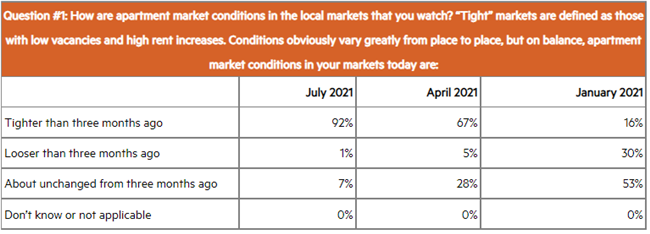
“Nearly all (92 percent) respondents this quarter observed tighter conditions in their apartment markets, signaling that the worst of the pandemic could be behind us. Apartment sales volume is strong as well, bolstered by continued low interest rates and strong availability of equity financing,” Obrinsky  said.

July Apartment Market Showed Improvement in All Metrics

  • The Market Tightness Index increased from 81 to 96 – the highest index number on record – indicating widespread agreement among respondents that market conditions have become tighter. Nearly all (92 percent) respondents reported tighter market conditions than three months prior, compared to only one percent who reported looser conditions. Seven percent of respondents felt that conditions were no different from last quarter.
  • The Sales Volume Index increased from 77 to 79, signaling continued increases in apartment sales volume. More than half (60 percent) of respondents reported higher sales volume than three months prior, while 31 percent deemed volume unchanged. Just three percent of respondents indicated lower sales volume from the previous quarter.
  • The Equity Financing Index increased from 68 to 69. While 41 percent of respondents reported that equity financing was more available than in the three months prior, the same share of respondents (41 percent) believed equity financing conditions were unchanged during the same period. A smaller portion (three percent) of respondents indicated equity financing was less available.
  • The Debt Financing Index increased from 44 to 71, surpassing the breakeven level of 50 for the first time in three quarters. Forty-five percent of respondents reported better conditions for debt financing compared to three months prior, while 39 percent felt that financing conditions were unchanged. Only three percent of respondents signaled that conditions worsened in the debt market, the report said.

View the full survey data online

About the Survey:

The July 2021 Quarterly Survey of Apartment Market Conditions was conducted July 12-19, 2021; 118 CEOs and other senior executives of apartment-related firms nationwide responded.

Sign Up For Our Newsletter And Get Rental Property And Apartment News And Helpful, Useful Content Each Week.

* indicates required


Average National Monthly Rent Tops $1,500 For 1st Time

Will You Be Ready When the Eviction Moratorium Ends?

Everything Landlords Should Know About Emotional Support Animals

No Guns In My Apartments: Can A Landlord Say That And Put It In A Lease?

Can I Say “No Pot In My Apartments” When It’s Legal In My State?

4 Ways to Reduce Rental Property Maintenance and Repair Costs

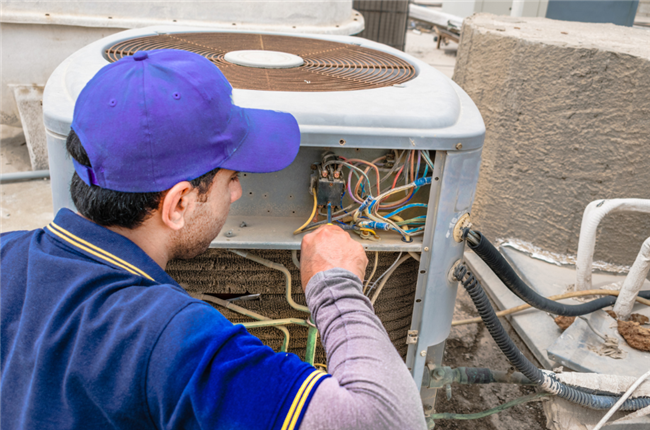
6 signs your rental property air conditioner may not be ready for this heat so check up now because air conditioning repair is not a surprise you want when tenants call.

Rental property repair and management costs are one of the many expenses that you cannot escape when managing a rental property, so this week’s maintenance tip from Keepe shows some ways to save.

From a sudden breakdown of the HVAC unit to termite infestation, rental properties require continuous maintenance.

While it is essential to embark on regular property maintenance, this doesn’t come cheap. Sometimes, maintenance may cost you thousands of dollars, which eats deep into your potential rental income.

In this article, we will discuss four ways you can reduce your rental property maintenance and repair costs.

No. 1 – Regulate Tenant Selection 

While this may seem like a reasonable thing to do, you’d be surprised at the number of property managers that rarely carry out full background checks on their potential tenants. Some tenants are fond of trashing their rented apartment and losing the deposit. A simple call to a tenant’s previous landlord may save you thousands of dollars in repair costs. You can also request credible references before renting out your property to tenants.

No. 2 – Do Preventive Maintenance

As a property manager, engaging in preventive maintenance is a must. Not only does it help you reduce maintenance costs, but it also helps in preventing future repair issues. Take time out of your busy schedule to test the smoke and fire detectors, maintain heating/cooling systems, clear the gutters, and check for water or gas leaks. By being proactive in your property maintenance duties, you save your property and tenants from unexpected home-related disasters.

4 Ways to Reduce Rental Property Maintenance and Repair Costs

No. 3 – Work with a Reliable Vendor

It is important that you collaborate with reputable vendors if you are looking to cut down on maintenance cost. By working with a reputable vendor, you have access to experienced, vetted, and reliable contractors.

No. 4 – Respond to Maintenance Requests Quickly

This is the most essential factor to consider in reducing your rental property maintenance costs. Tenants expect to live in a property that contributes positively to their overall welfare and quality of life. When a tenant signs a lease, the expectation is that the unit he or she has agreed upon is both functional and habitable for them to live in. Therefore, if a tenant returns home from a busy day at the office and the shower or cooling system doesn’t seem to be functional, it would certainly affect tenant satisfaction and retention rate moving forward.

As a property manager, responding on time to your tenant maintenance or repair request not only saves you money but prevents the escalation of repair issues. You can start by creating a maintenance hotline/email, or you can adopt a digitized maintenance platform that updates in real-time. In addition, it is advisable that you have a reliable handyperson that your tenants can reach in the case of an emergency repair issue, such as a gas leak.

Rental property maintenance conclusion

Reducing your rental property maintenance and repair cost is a deliberate effort that offers you long-term rewards.

Applying the above-listed tips will help you reduce your average monthly expenses.

About Keepe:

Keepe is an on-demand maintenance solution for property managers and independent landlords. The company makes a network of hundreds of independent contractors and handymen available for maintenance projects at rental properties. Keepe is available in the Greater Seattle area, Greater Phoenix area, San Francisco Bay area, Portland, San Diego and is coming soon to an area near you. Learn more about Keepe at https://www.keepe.com.

Sign Up For Our Newsletter And Get Rental Property And Apartment News And Helpful, Useful Content Each Week.

* indicates required


Average National Monthly Rent Tops $1,500 For 1st Time

Will You Be Ready When the Eviction Moratorium Ends?

Everything Landlords Should Know About Emotional Support Animals

Landlords Agree to Pay $100,000 To Settle Sexual Harassment Lawsuit

Landlords Agree to Pay $100,000 To Settle Sexual Harassment Lawsuit involving harassment of female tenants

A group of Ohio landlords have agreed to settle a Fair Housing Act lawsuit over sexual harassment of female tenants, according to a release from the U.S. Department of Justice.

The Justice Department said in the release that Toledo, Ohio, landlords Anthony Hubbard, Ann Hubbard, Jeffery Hubbard, PayUp LLC and No Joke Properties Inc. have agreed to pay $100,000 to resolve a Fair Housing Act lawsuit “alleging that Anthony Hubbard sexually harassed female tenants at rental properties he owned or managed with the other defendants.”

The release says Anthony Hubbard made “unwelcome sexual advances and comments to female tenants; sending them unwanted sexual text messages, videos and photos; offering to reduce or excuse their monthly rental payments, security deposits and utility fees in exchange for sex acts; and entering the homes of female tenants without their consent and without prior notice.”

“The Justice Department will not tolerate landlords who abuse their power by sexually harassing their tenants, and we will continue to vigorously enforce the Fair Housing Act against landlords who engage in this conduct,” said Assistant Attorney General Kristen Clarke of the Justice Department’s Civil Rights Division in the release.

Acting U.S. Attorney Bridget M. Brennan for the Northern District of Ohio said in the release, “Exploiting any person’s basic housing needs as a way to sexually harass, demean and control them violates the law. We remain committed to rooting out homeowners and landlords who target vulnerable residents seeking safe and affordable housing opportunities for them and their families.”

The settlement, which must still be approved by the U.S. District Court for the Northern District of Ohio, requires that defendants pay a total of $90,000 to three female tenants who were harmed by Hubbard’s harassment and a $10,000 civil penalty to the United States

Others Liable for Anthony Hubbard’s Actions

The suit also said that Anthony Hubbard carried out some of this sexual harassment while managing properties on behalf of the other defendants — Ann Hubbard, Jeffery Hubbard, PayUp LLC and No Joke Properties Inc. — making them liable for the harassment he carried out while acting as their agent.

The settlement also:

  • Prohibits Anthony Hubbard from continuing to manage rental housing;
  • Requires Anthony Hubbard to retain an independent property manager to manage any rental properties he owns now or in the future; and
  • Requires defendants to receive fair-housing training and implement comprehensive non-discrimination policies and complaint procedures to prevent sexual harassment at their properties in the future.

The Justice Department’s Sexual Harassment in Housing Initiative is led by the Civil Rights Division, in coordination with U.S. Attorney’s Offices across the country. The goal of the department’s initiative is to address and raise awareness about sexual harassment by landlords, property managers, maintenance workers, loan officers or other people who have control over housing. Since launching the initiative in October 2017, the Department of Justice has filed 21 lawsuits alleging sexual harassment in housing and recovered more than $2.5 million for victims of such harassment.

Sign Up For Our Newsletter And Get Rental Property And Apartment News And Helpful, Useful Content Each Week.

* indicates required


Will You Be Ready When the Eviction Moratorium Ends?

Everything Landlords Should Know About Emotional Support Animals

Investments Growing In Build-To-Rent Single-Family Homes

Investments Growing In Build-To-Rent Single-Family Homes

Many investment groups are getting into the growing single-family rental market with build-to-rent communities, a segment rejuvenated due to COVID-19, Yardi Matrix reports in a special bulletin.

“Increasingly, the way institutions are growing their presence is to build their own communities. Some 12 percent of new single-family construction in 2021 is being done for rentals,” according to John Burns Real Estate Consulting.

“With so much capital looking to invest in the sector and the demand for rentals rising, we would expect build-to-rents to increase rapidly for at least the next several years,” the report says.

Why is Build-to-Rent Investment Growing?

The trend of build-to-rent investment by large institutional investors started after the housing bubble and crash in the early 2000s. The pandemic has revived this niche segment, as homebuilders are now working to develop the single-family homes-to-rent market.

The pandemic created this growing investment niche, the report says, because, “Families wanted more space and the privacy of a detached home, but without the inherent limitations of a mortgage and homeownership.”

Yardi Matrix says this desire by families for more space and privacy without a mortgage “has prompted many institutional players to jump into the niche, with more than $10 billion allocated to the sector by institutions over the last few years, according to corporate announcements and news reports.”

While there are challenges to build-to-rent, such as finding enough available land to put together a large group of homes, there are also advantages, such as:

  • Ease of managing properties close together
  • Renters preferring a new home and willing to pay more for it
  • Control of the construction and quality of homes

Yardi Matrix says this niche of build-to-rent “does offer a more stable environment in which to grow. Although much can still go wrong and space to build remains limited, there are advantages.

“It enables investors to control the product from start to finish, to create a ‘brand’ as opposed to a random pool of assets, to concentrate a larger number of holdings in fewer locations, and possibly to improve liquidity by adding to the potential number of market participants.

“As such, build-to-rent is likely to flourish in the next economic cycle,” write Paul Fiorilla, director of research, and Casey Cobb, senior analyst, with Yardi Matrix.

New Build-To-Rent Community Coming to Phoenix South Mountain

A build-to-rent developer is now pre-leasing 72 single-family homes designed as rentals near South Mountain in Phoenix with attached two-car garages and fenced back yards.

The new community built by Curve Development, called Cyrene at South Mountain, is located just west of 16th Street and north of Baseline Road. The development is part of 3,500 rental homes the company has in the developmental pipeline, spread across 26 communities in multiple states, according to a release.

Investments Growing In Build-To-Rent Single-Family Homes
Inside a gated community, each home has an attached two-car garage and a fully fenced private back yards.

The community is estimated to be complete by the first quarter of 2022.

Cyrene at South Mountain will offer three- or four-bedroom design plans featuring multiple modern farmhouse-style elevations.  Inside a gated community, each home has an attached two-car garage and a fully fenced private back yards. The three-bedroom homes start at $2,400 a month rent, the four-bedrooms start at $2,665 a month rent. Two plans have one unit still available; the other three plans are waitlisted.

Community amenities include a private dog park, a ramada with barbecue, a multi-purpose event lawn, outdoor seating with fireplace and more.

The homes feature SMART home technology and covered patios with views of South Mountain. Each single-family detached home is pet-friendly with a dog door.

For more information about Cyrene at South Mountain, visit https://cyreneatsouthmountain.com/.

About Curve Development 

Curve Development is a national developer/builder based in Arizona developing single-family rental projects coast to coast. Funded by JEN Partners, LLC, a New York-based private equity fund.