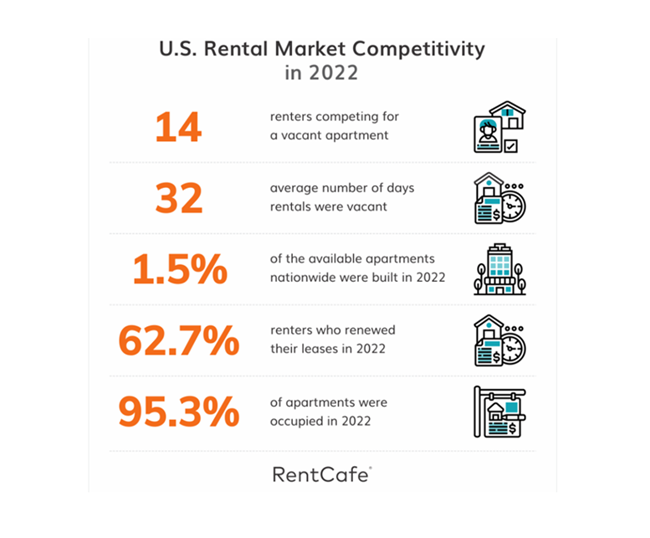
Almost two-thirds of renters renewed leases in 2022 in a market that’s still hindered by record home prices and surging interest rates, RentCafé says in their year-end report for 2022.
At the national level, vacant apartments were occupied within 32 days, on average and as many as 14 prospective renters competed to secure a lease for a rental apartment in 2022.
The reason so many leases were renewed is because 95.3 percent of apartments were already occupied, so finding a new rental was not easy in 2022 — especially because newly built units only represented 1.5 percent of the nation’s total housing supply, the RentCafe report says.
Where were hottest rental markets in 2022
To find out the hottest rental markets in 2022 RentCafe.com analyzed the 135 largest markets in the U.S. where data was available. Specifically looking at five important metrics that affect a location’s competitivity:
the number of days apartments were vacant
what percentage of rentals were occupied
the number of prospective renters competing for an apartment
what percentage of renters renewed their leases
the share of apartments completed this year
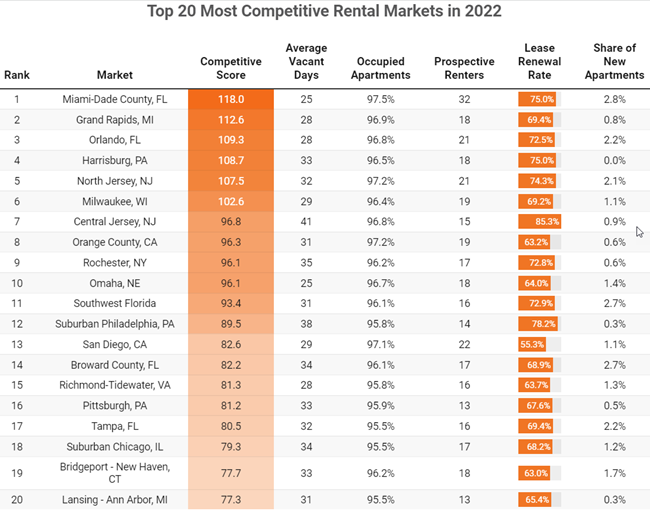
Based on these metrics, “we calculated a Rental Competitivity Index (RCI), which shows how competitive the rental market was this year,” the report says.
The national RCI score was 59.9 in 2022.
The most competitive rental markets in 2022 scored over 100 out of 130.
“Boasting an RCI of 118, Miami was by far the hottest rental market in the U.S., due to record-high occupancy and high lease renewal rates. Here, a combination of factors — including the lack of state income tax, business-friendly climate and booming tech scene — attracted droves of millennials and even Gen Zers looking to work and live in the Sunshine State,” the report says.
Chart courtesy of RentCafé
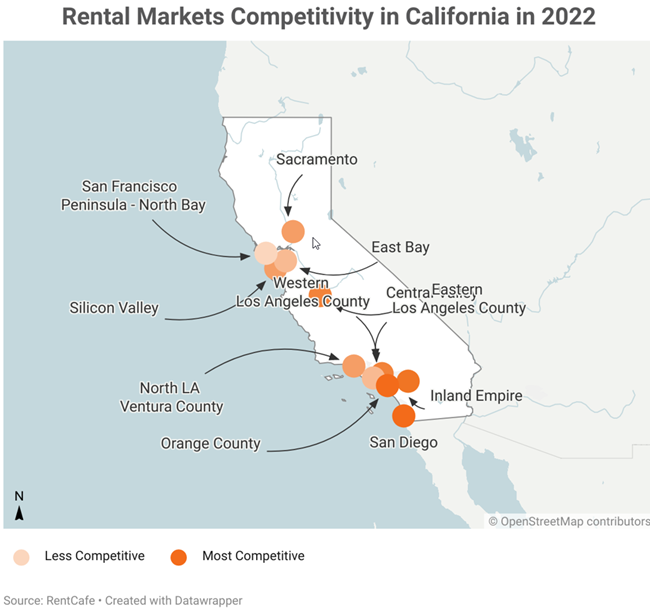
Low-supply Orange County is the hottest renting spot in SoCal
It’s no secret that the ever-increasing cost of living in Los Angeles and rising housing prices are pushing many renters to seek new homes in less expensive locations in Southern California — with a preference for apartments in Orange County. And, with a strong economy and diverse job pool fueled by the booming e-commerce sector, the OC is overheated due to low supply.
Another competitive location in SoCal was San Diego. Yet, despite consistently being ranked as one of the most expensive places in the country, it’s still not as expensive as Los Angeles or San Francisco. Notably, the median age is around 35 and high-level job opportunities abound in high tech, education, research, military, defense and health care.
As we close out the year, the Apartment List research team has rounded up a summary of the key rental market trends that defined 2022 and those expected to define 2023.
Here is a look at national trends, regional trends and key themes for 2023 to help make you more informed about 2023.
No. 1 – Rent growth comes back to earth
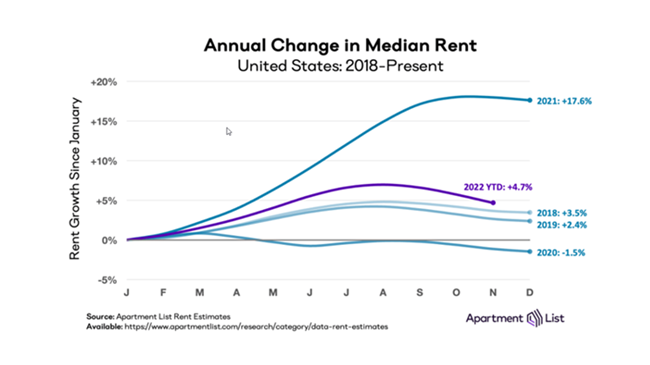
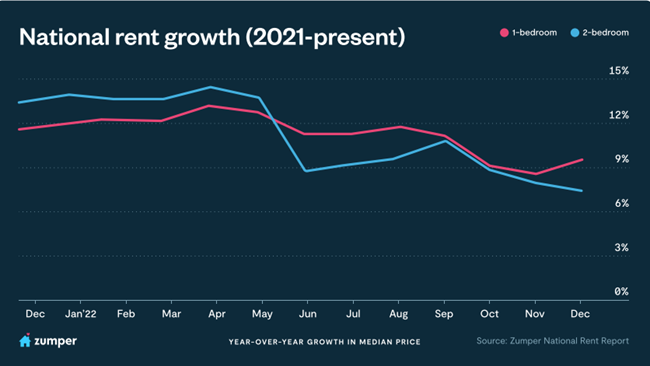
In the first six months of 2022, rents increased by 5.5 percent nationally, a growth rate that represented a notable slowdown from the 2022.
But in the back half of the year half of this year, rent growth has cooled even further, and apartment prices have now actually been falling since August. It’s typical to see a dip in rents in the fall and winter, when fewer renters are looking to move, but it appears the recent decline is reflecting more than just seasonality.
No. 2 – More options for renters
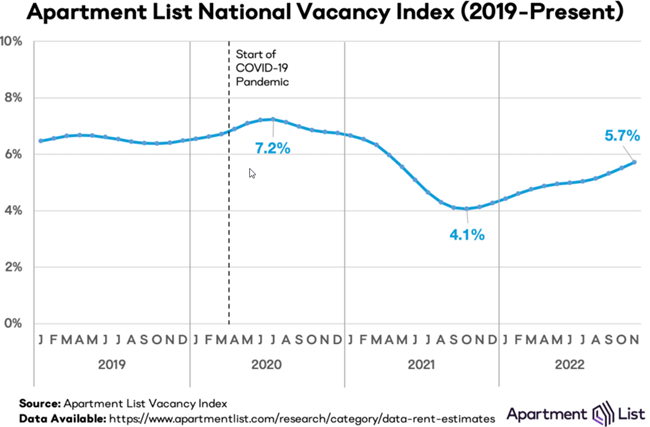
The vacancy index has been steadily ticking back up, meaning that more supply has been coming available.
In recent months, the rate of supply easing has picked up steam.
For renters looking to move, this means they should now see more options and less competition than at the outset of this year.
Chart courtesy of Apartment List
No. 3 – Lack of household formation drives cooling demand
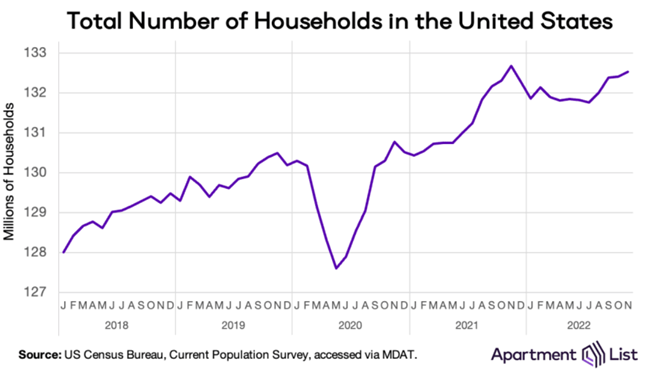
During the pandemic, especially in the early months, there was a sharp contraction in the number of households as people moved in with family and friends.
By late 2020, most of these households had re-formed, and that was followed by a surge in new households in 2021, as Gen Z struck out on their own and roommate households broke apart to find their own places. In just a year and a half, the number of households in the U.S. increased by more than 5 million, from a pandemic low of 127.7 million, to a peak of 132.7 million in November 2021.
However, in 2022, new household formation has been relatively flat. As of last month, the total number of households stood at 132.5 million, down by 143,000 compared to last year’s peak. It appears that renters are exhibiting much more caution in striking out on their own, as higher housing costs and general inflation have eroded their budgets, and as fears of a potential 2023 recession loom large in the public’s economic sentiment.
No. 4 – The Sun Belt boom stalls out as the Midwest picks up steam
After the spike in Sun Belt rents, the Midwest may now be the nation’s last bastion of rental affordability, and seems to be drawing interest from price-conscious and geographically flexible renters.
The St. Louis, Indianapolis, Kansas City, and Cincinnati metros all rank among the top 10 for fastest rent growth in 2022. Rent growth in each of the markets has been slower this year than it was last year, but this is largely reflective of the broad cooldown in the national rental market as a whole.
No. 5 – Early pandemic price convergence is still holding
Pandemic-era rent growth has been correlated with pre-pandemic rent prices, with affordable cities tending to see faster rent growth and more expensive ones tending to experience slower growth.
Because of this divergence in rent growth, the price gap between the nation’s most expensive cities and its most affordable ones has narrowed.
Take, for example, San Francisco and Phoenix – in March 2020, the median rent in San Francisco ($2,556) was 2.5 times greater than that of Phoenix ($1,013); as of November 2022, that gap has narrowed to 1.6 times ($2,308 vs $1,421). This price convergence can be seen most clearly in Sun Belt cities, but as described above, this trend may now be extending to the Midwest as well.
From March 2020 through November 2022, the core cities of the nation’s large metro areas have seen prices rise by a total of 14.5 percent, on average. Over that same period, prices are up by 20.7 percent in the closest suburbs, 24.1 percent in the mid-distance suburbs, and 27.7 percent in the furthest suburbs.
The further you move from the urban core, the faster the rent growth. With many workers retaining at least hybrid remote flexibility, proximity to job centers has grown relatively less important, and this has driven a shift in preferences that continues to persist.
No. 7 – Renters back in the driver’s seat for 2023
“Looking ahead to next year, we expect that the most notable trend in the rental market will be a shift in bargaining power away from property owners and back to renters,” the Apartment List economists write in the report.
it’s important to note that “the trajectory of the market next year is largely dependent on broader macroeconomic conditions. If the economy were to experience a recession next year, it’s possible that rents could decline meaningfully (though even then, it’s highly unlikely that we’d see anything close to a return to 2020 rent levels).
“On the other hand, there have been recent signs that inflation is abating while the labor market remains fairly strong. If renter confidence bounces back and demand improves, rent growth could be faster than anticipated.”
No. 8 – Remote work faces its biggest test in 2023
In 2023, we’ll also have our eye on the next chapter of the remote work revolution.
Remote work remains prevalent, especially hybrid arrangements. Recent research suggests that 29 percent of workers currently have hybrid working arrangements in which they work from home on some days and go into the office on others, while 13 percent of employees work entirely from home.
If these levels of remote work persist in the long term, it could have significant implications for the housing market.
In a recent survey, 44 percent of workers with full or hybrid remote flexibility told us that they’re planning to move in the upcoming year, compared to just 28 percent of on-site workers.
As office leases expire, many companies may significantly downsize their footprints and redesign their spaces to better suit a hybrid workforce. This would have significant implications for the commercial real estate market, as well as the broader economic outlook for the central business districts of major cities.
However, it’s also possible that in the case of a recession or even just a weakening of the labor market, executives who are skeptical of remote work could leverage increased bargaining power to force workers back to the office full time.
“In any case, by the end of 2023, we should have a clearer picture of the long-term future of remote work and its implications for housing,” the Apartment List report says.
No. 9 – Official estimates of housing inflation will reflect the cooling “that our index has long been showing”
The 2023 prediction “that we have perhaps the highest confidence in is related to the highest profile economic storyline of 2022 – inflation. As we’ve noted throughout this report, our rent estimates have shown that the market has been consistently cooling off throughout the past year.
“We expect that the official measure of housing inflation will turn a corner in the first half of 2023 and begin to gradually fall.
“Thankfully, the topline inflation numbers have already started to cool off, even with the housing component still keeping CPI (Consumer Price Index) propped up. Next year, when the CPI’s housing measure begins to reflect the rapid cooldown in the rental market that we see in our index, it should contribute to further moderation of inflation overall.” The economists write.
Conclusion
“As we close out the year and look ahead to 2023, the rental market is showing some positive signs for renters.
“Rent prices are now dipping after a year and a half of record-setting growth. And with a record number of new apartment units in the construction pipeline, 2023 will bring more options for renters than they’ve had in years.
“As new supply meets cooling demand, renters may finally have the upper hand in the market, while property owners will be the ones competing to fill their vacancies.
“That said, the broader macroeconomic environment remains somewhat uncertain, and that backdrop will be a key factor in determining the trajectory of the rental market in 2023,” the Apartment List economists write.
The Apartment List Research Team is a small but mighty group of economists and analysts dedicated to understanding the rental market as it evolves rapidly. On our blog we publish original research reports and offer robust data products for public use.
California became the world’s largest legal marijuana market. When pot is legal in a state, what issues does this present to property managers and landlords of rental properties? Can a property manager say “no pot in my apartments.”
By John Triplett
Rental Housing Journal
Property managers are often confused and seeking to better understand how to handle the issues of legal marijuana and medical marijuana when it comes to tenants and rental housing in their states.
Laws are changing all the time in many states, just as California did on January 1, 2018, as voters approve different levels of permission when it comes to marijuana. This leaves property managers trying to figure out what should be in their leases around the issue.
You may be able to ban smoking, but do you really know what your tenants are eating or growing in their apartments? Do you really want to know if they are good paying tenants?
Rental Housing Journal did an interview with Seattle, Washington attorney Bret Sachter, an expert in tracking the progression and transformation of marijuana laws, to discuss some common questions property managers have about marijuana and tenants.
“I’ve been asked this a lot,” Sachter said, “but it does not come up as often as you might think. The overarching issue here is that, with few exceptions, people can do what they want to protect their property, even if the prohibited behavior is not illegal. You can prohibit smoking, prohibit pets, but with marijuana it’s much easier because it is federally illegal. So you can pretty much prohibit it if you want to no matter what, even medical marijuana,” Sachter said.
4 questions about pot, tenants and apartment leases
Sachter says in terms of Fair Housing issues, and the U.S. Department of Housing and Urban Development (HUD) it is a situation where HUD wants it in the lease that marijuana is illegal but enforcement is another issue, he said. It is not so much that HUD wants landlords to evict over marijuana, but that you have something in the lease language that allows for eviction in the instance of marijuana use on the property. “So it is pretty clear as far as HUD is concerned,” he said. Here are his answers to four questions on pot and apartments.
No. 1 – Tenants with a disability and medical marijuana
Question: If a tenant comes in and says I have a disability, here is a note from my doctor, I use medical marijuana, which is legal in this state, and I want to rent your apartment. Can a landlord prohibit that?
Answer: “A landlord can absolutely prohibit that because marijuana is illegal under federal law.” The landlord can say, “I understand our state allows medical marijuana but as it is still a Schedule 1 drug and I prohibit it on my premises.”
No. 2 – Marijuana is legal in my state – but what does the lease say?
Question: What if a tenant says marijuana is legal and they should be allowed to use it?
Answer: “If your lease prohibits smoking and prohibits use of illegal drugs, then the legality of marijuana at the state level is irrelevant because under federal law marijuana is illegal. If your lease does not have those types of clauses, you should talk to an attorney in your state or city to find the best solution for your lease.”
There is no law about reasonable accommodation for marijuana users, federal laws do not require it. As far as the federal government is concerned it is not ok.
“One thing I would say, and it is important, I would encourage landlords just to make everything clear,” in the leases, he said. “Clarify in a lease that you must abide by all laws state and federal.”
That is the case in residential. He said it can be different in commercial. (There was a commercial case in Oakland, California and you can read more about it here.)
“But In residential it is not as tricky, and I am speaking very generally here,” Sachter said. “The states may have their own thing going on with legal marijuana laws, but it is still federally illegal. Make it crystal clear in your leases is my best advice,” he said. “How can you attract tenants in a state where it is legal yet protect the owners of the property? You cannot have it both ways.”
“I know in Seattle there are Airbnb bed and breakfasts that specifically market themselves accordingly, as part of marijuana tourism to come and stay in our place where it is legal.” But if a property manager doesn’t want that going on, then they have to be up front in the lease.
“If your tenant is Airbnbing to a tenant who is then using marijuana – well if you can’t catch them you cannot do anything about it. You have to prove they are doing this. They are going to be using marijuana regardless of what the lease says.”
No. 3 – What if the tenant using marijuana is a well-paying, good tenant?
“Landlords can certainly put a no-waiver clause in the lease. If I say, ‘Here is a list of prohibited things’ and if you do these prohibited things in the lease, you are subject to eviction,” he said.
“However, any time I waive any of these things does not constitute an overall waiver. It basically means you should not ever do it again,” he said. “Just because you get away with it once, does not mean you get away with it every time,” Sachter said.
“Landlords can certainly put a no-waiver clause in the lease. If I say, ‘Here is a list of prohibited things’ and if you do these prohibited things in the lease, you are subject to eviction,” he saidPhoto by Raihan Rana via creative commons
No. 4 – Can I say ‘no pot in my apartments?”
“Usually if you say, ‘No pot in my apartment’ and you find a tenant using marijuana and you haul them into court, more than likely the judge is going to say, ‘Have you stopped?’ to the tenant and ‘Are you going to do it again?’ and the tenant is going to say ‘No.” And then judge will say, ‘Ok, dismissed.”
To put a more legalistic term on it, usually a court will be in favor of “allowing the tenant to cure the defect,” rather than evict for most things like that, Sachter said.
Technically, in Washington, a landlord would serve a 10-Day notice to comply or vacate with the terms of the lease. This process, therefore, gives the tenant a chance to “cure” the violation before the landlord can evict. Check your local state laws on this.
What one experienced property manager says about pot
Sam Driver, Product Director for Buildium.com, and an experienced property manager at the property management software company, said as far as marijuana use in apartments, due to the newness of the legislation, the federal laws that supersede state and county laws, and liability concerns, it is not a topic that comes up a lot – yet.
“Generally, the safest solution is to choose the most conservative path-impose a no-smoking policy, which can in some cased cover outside areas, and a crime provision that includes local, state and federal laws. In many states, there are setbacks from doors, and it is particularly important if the building is a place of work which a multi-unit apartment building certainly is. So your lease should contain a provision explicitly banning smoking and illegal activity. Because the feds still outlaw it, this should be sufficient,” Driver said.
“This of course only covers the smoking angle. If a resident consumes it in another way, you’d likely never know,” he said.
Growing marijuana could put a power load on your apartments
“As for growing, that’s less clear. But in general, unless the electrical system is designed for it, the loads grow lights put on the apartment unit could be excessive. I’d consider a reasonable use clause that specifies all high load equipment, including lights, air conditioners and any kind of pump be approved by you tramadult.com.
“This would put you in a position to take action if they are putting too much load, without specifically calling out the use of the equipment. Pumps are a good area for monitoring, because of the intermittent load, they trip breakers, and anyone who is using a hydroponic system would need several,” Driver said.
What if I want to market my apartment to marijuana users?
“If, however, you wanted to roll the dice and market to this crowd, assuming your state laws allow it, remember that the federal laws would cover any bank deposits from proceeds,” Driver said.
“In this case, you’d be able to do it, assuming no federal intervention, in compliance with local laws. No insurer would provide EO&E (errors and omissions excepted) insurance to you, and you wouldn’t be able to deposit any funds into a federally-accredited bank. So you’d have to self-insure, and run an entirely cash business, but you could do it, risking only federal enforcement.
“The big question is, ‘Would the premium rents be worth the risk of forfeiture?’ If you run afoul of the federal drug laws, the asset seizure possibility is a huge risk. You could lose the building.
“If you’re managing other owners’ properties, then you’d be risking their assets even if you used different leases, unless you kept fully separate books, bank accounts, and co-mingled nothing. So I’d say it would be all-or-nothing,” he said.
“The timing is tricky, too. Leases contain a provision that stipulates that the contract is in force in a specific jurisdiction. If they change the laws rendering your lease out of compliance, what happens during the remaining time of the lease? Is it invalidated? Or does the contract remain in force until it expires?
“Good questions for your lawyer,” Driver said.
How to keep up with status of pot laws in the different states
ProCon.org, a 501(c)(3) nonprofit nonpartisan public charity, provides professionally-researched pro, con, and related information on more than 50 controversial issues from gun control and death penalty to illegal immigration and marijuana laws across the country. “Using the fair, FREE, and unbiased resources at ProCon.org, millions of people each year learn new facts, think critically about both sides of important issues, and strengthen their minds and opinions,” according to the company’s website.
Here are where the pot laws stand for medical and recreational marijuana in several states, how it was passed, and what is permissible in the possession limit, according to procon.org. You can see their excellent full chart here state by state. Keep this link as they update the ever-changing pot laws in the different states.
Can I Say ‘No Pot In My Apartments’ When It’s Legal
Here are what some some states are doing with links to more information on each state’s pot laws.
Oregon: Ballot measure 67, 24 oz usable; 24 plants, 6 matures and 12 immature
Photo credit up top Natan Bolckmans via istock.com
About Bret Sachter:
As a Presidential Scholarship recipient, Bret received his law degree from the Seattle University School of Law. In addition to his law degree, Bret holds a bachelor’s degree in evolutionary psychology and master’s degree in psychology. Bret has taken an interest in tracking the progression and transformation of marijuana laws, as they are among the most recent and highest-profile legal issues affecting entrepreneurs in Washington and, increasingly, all around the country. You can call him at 206-295-2547 or visit his website here.
The basement is an important part of your property to protect so let’s take a look at the issues around how to best waterproof your rental property basement.
By Phil Schaller
Aside from providing additional living space (or storage), many critical systems and structures live in the basement (think plumbing, the foundation, electrical panel, etc.).
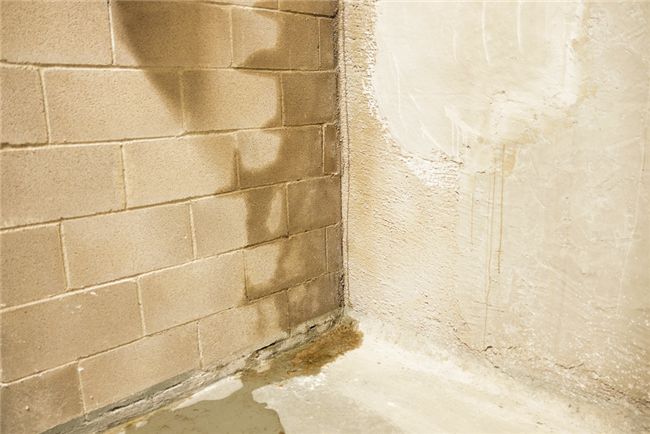
One of the most damaging things to any property is water. If a pipe bursts in the basement, the foundation leaks, or the washer malfunctions, you want to make sure the basement can handle the water damage. Enter: waterproofing.
There are several ways you can waterproof the basement. We’ll take a quick look at each so you can determine what solution is best for your property. But first, let’s take a look at why basements are especially susceptible to water damage:
Drainage: If water naturally runs towards your property, this puts you at an increased risk of water damage. Water should run away from the foundation when possible (we’ll explore a solution below if that’s not the case).
Foundation: Cracks or deterioration in the foundation can be a source of moisture build-up in the basement (especially if the drainage isn’t dialed in). Water can seep through the foundation after heavy rain and cause foundation and wall damage.
Plumbing failure: If a pipe bursts or even if there’s a small plumbing leak, water can pool in the basement. Because many basements have a lot of plumbing infrastructure, they have a bit higher probability of water damage.
Waterproofing is important in the event of flooding or moisture damage to negate any mold, flooring damage, or drywall damage, and the list goes on. Here are three methods for waterproofing the basement:
French drain: This can be a more costly way to combat water buildup, but a French drain is a great solution. You can run a French drain along the side of the property where the natural slope of the land pushes water towards the foundation. A French drain will capture much of the water that would otherwise seep into the foundation and carry it away from the property.
Interior sealant: Sealing up the floors and walls is a pretty cost-effective way to prevent structural damage (mainly to floors and walls). The process involves applying waterproofing sealant to the walls and floors. You’ll want to wash the walls/floors first, seal any cracks with epoxy, and then apply the sealant. Paint or any flooring would need to be removed before the sealant is added.
Exterior waterproofing: Waterproofing the exterior of your property can take many forms (installing a French drain being one). It’s helpful to check and clean the gutters, make sure downspouts are aimed away from the foundation and working properly, and ensure foliage is at a proper distance from the foundation (one foot for plants and at least 3 feet for trees). Finally, where possible, make sure the soil and earth are sloped away from the foundation.
Some properties may require just one waterproofing solution while others may warrant all three. If you have any questions about how to waterproof your rental property basement or how to prevent water damage, please feel free to reach out anytime.
About the author:
Phil Schaller is an experienced landlord and the founder/CEO of RentalRiff – an alternative service to traditional property management. With RentalRiff, landlords can hire a dedicated “property specialist” (licensed/insured general contractor or handyman) who will provide ongoing support and upkeep of rental properties, while serving as the main point of contact for tenants. Maintenance and repair costs are included in the monthly fee. Phil is a Pacific Northwest native, father of two, and fly-fishing addict. You can reach RentalRiff at 541-600-3200.
You and your tenants should be on the outlook for these four signs of faulty electrical wiring in a rental property.
By Phil Schaller
There are a few telltale signs that you may have some bad wiring at your property. If you or your tenants hear, see, or smell any of these indicators your electrical infrastructure needs to be inspected.
Electrical malfunction can be very dangerous (fires), not to mention that you need consistent electricity to power many components of the home (which you are legally obligated to provide based on landlord/tenant laws and the lease with your tenants). Not only should tenants be encouraged to report any issues with the property, electrical systems should also be inspected regularly (we suggest a couple of times a year).
Be alert for any of the following four signs of faulty electrical wiring from your tenants
1. Warm electrical wall outlets
If a wall outlet is warm to the touch, this is a sign of faulty wiring and should be addressed immediately.
Another indicator is if the outlet is vibrating; call an electrician!
2. Frequent circuit-breaker trips
The reason circuit breakers exist is to provide a safety net for the electrical systems of a property.
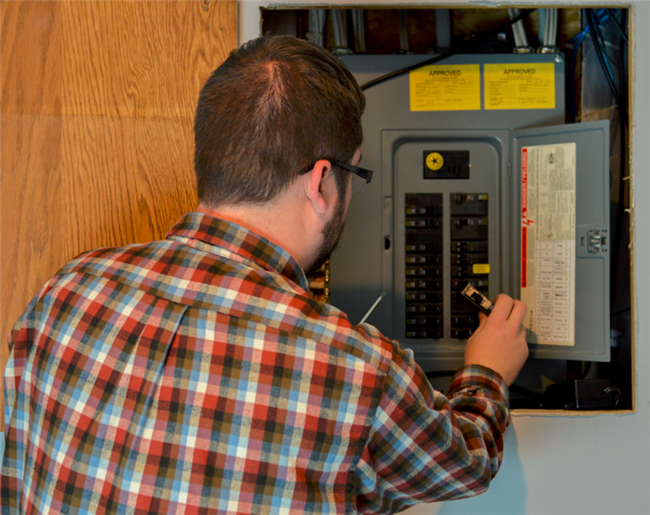
When an electrical system is overloaded, the circuit breaker will shut off the power. This happens occasionally and is normal here and there. But when the breaker trips too often (once a month or more) it’s a sign something is off.
Either the electrical load is too high or you may have faulty wiring. This is another reason to call an electrician (you may see a theme here!).
3. Abnormal noises or lighting issues
If your tenant hear any clicking or flickering noises coming from lights or outlets, this is another sign something may be wrong.
Buzzing is another noise to look out for. If you notice lightbulbs dying quickly or dimming, this should be addressed by an electrician.
4. Signs of scorching and/or smoke
Probably the most obvious of wiring woes. If you or a tenant sees or smells smoke or odd odors coming from an electrical outlet, be ready to call 911 in case of a fire. If there are signs that heat has caused a stain or discoloration around an outlet, this could mean the wiring is faulty and is producing heat (and hence a big fire hazard). If left unchecked, major damage could ensue.
It’s important to be diligent about the state of a property’s electrical infrastructure. We advise not to take the inexpensive route when doing electrical work, especially the more complex work requiring a permit. Hire an electrician and invest in your property.
About the author:
Phil Schaller is an experienced landlord and the founder/CEO of RentalRiff – an alternative service to traditional property management that provides ongoing oversight and upkeep of rental properties, while serving as the main point of contact for tenants. You can reach him at 541-600-3200. Maintenance and repair costs are included and property specialists are licensed/insured. Phil is a Pacific Northwest native, father of two, and fly-fishing addict.
It’s that time of the year again. Winter will bring cold and wet weather and it’s critical to prepare your rental for the elements. Just one cold spell can wreak havoc on your pipes, gutters, roof, and unfortunately more. But have no fear, we are here to help! The checklist below is a must-do heading into winter.
While the items listed below will set your property up well for the months ahead, it is not exhaustive. The koi pond in the front yard will require some attention, although we don’t have it listed below (maybe a future blog post).
How to winterize your rental property
Blow the irrigation system. This will require a landscaping company to come out to clear your systems, but it’s quick and not very expensive.
Detach your hose(s) and cover the spigots. Water left in the hose/spout can cause pipes to crack and the spouts to malfunction (not to mention the hose as well).
Caulk any cracks or holes around your windows. Exterior silicone caulk is the way to go here. It’s water-resistant and very durable.
Clear the gutters. With more precipitation in the winter months, your gutters need to function as well as possible. All those needles, leaves, pinecones, etc. clog things up.
Clean up the roof and siding. If you notice any moss build-up (common in the PNW) it’s best to scrape it to prevent further build-up. We don’t recommend hopping on the roof yourself, hire someone who has the proper equipment.
Bring in outdoor furniture and grills. If your furniture sits outside all winter in the elements, you’ll be buying new furniture before you know it.
Insulate water supply pipes. Focus on pipes that aren’t kept warm by insulation or heating – pipes in the attic, crawl spaces, garage. Foam pipe covers work well and are easy to install.
Install draft guards and weather stripping to necessary doors. Draft guards are inexpensive and slide onto the bottom of a door.
Replace the furnace filters. This is important to do regularly but especially important heading into winter. You and your tenants will want the furnace working as well as possible.
Adjust the thermostat. If you’re turning over a unit or a single family home, make sure you don’t let the temperature dip below 50 degrees. Damage to uninsulated pipes can ensue if it gets too cold.
While there’s a decent to-do list above, if you winterize your rental property (or any property for that matter) it will pay dividends in the long run. On top of that, these tasks aren’t very time-consuming or expensive.
Any questions for us, please feel free to reach out anytime. Happy winterizing!
About the author:
Phil Schaller is an experienced landlord and the founder/CEO of RentalRiff – an alternative service to traditional property management that provides ongoing oversight and upkeep of rental properties, while serving as the main point of contact for tenants. You can reach him at 541-600-3200. Maintenance and repair costs are included and property specialists are licensed/insured. Phil is a Pacific Northwest native, father of two, and fly-fishing addict.
Here are several common plumbing emergencies in rental properties and what to do in each case.
By Phil Schaller
Plumbing issues can range from a rapidly flooding basement to a small leak. All of these issues should be addressed as a landlord, some more quickly than others. Be cognizant of your local landlord/tenant laws as water issues are typically a high priority and require a landlord to initiate a fix immediately.
Before we dive into the list of common plumbing emergencies in rental properties and what to do, there are a few items you should be familiar with at your property. The most important is the location of the main water supply. This is critical to know if there’s ever a plumbing emergency (and helpful for other plumbing issues as well). We always advise landlords to inform their tenants of the location of the main water supply (one of the first steps we take with customers is to make sure tenants, owners, and property specialists know where this is).
It’s also important to know the basics of your water heater: how to turn it on and off, how to increase the water temperature, where the pilot light is – basic troubleshooting.
Burst Pipes
A pipe can burst when too much water pressure builds up at a weakened joint. Pipes also burst in the winter when leftover water expands when frozen, hence the importance of insulating exterior pipes and interior pipes that are exposed to the cold. More likely than not you will know when a pipe has burst – it can make a loud popping noise – otherwise, there will be significant leaking.
Burst pipes need to be addressed immediately. Turn the main water line off to stop the leak and call a plumber as soon as possible. After the water has been shut off it’s best to drain all the faucets and do your best to clean up the water. Let in as much warm air as possible to dry out the area around the leak.
No Hot Water
A lack of hot water is a little trickier to diagnose – many things can cause this. Here are a few items to look at:
What is your water temperature set to? If it’s below 120 degrees F you may want to turn up the heat – temps below that 120-degrees F mark can also cause bacterial growth in your tank. Don’t go above 140 degrees F for the risk of burning.
Check the pilot light. If you have a gas water heater, it will have a pilot light – if it’s out, it will need to be re-lit. New heaters will have an ignition switch, older models may require you to light manually. Reference the user manual when relighting the pilot.
Flush the water heater. Over time, sediment and other buildups can cause your water heater to not be effective. Again, take a look at the user manual on directions for flushing your tank – this may or not be a job a landlord is up to.
Water pooling around the heater. If you can see a leak or determine that the pooled water is coming from your heater, this should be fixed. We recommend calling a plumber – the leak will get worse and worse with time.
Broken Water Line
A busted water line is a major headache for a landlord. These are not easy fixes and are typically quite expensive. Here are some indicators that your water line needs repair:
Poor water pressure. If your tenants notice the water pressure is lower than normal, it could be because there’s a leak. If there are no other signs of water damage or a leak on the property, it may be the water line. Bringing out a pro to scope your line is the next step to take.
Increasing water bills. If you or your tenants notice the water bill going up, it’s because water may be leaking into the ground. Hopefully, the city can alert you/your tenants of any significant changes but, again, bring out a plumber to look at your water line.
Soggy ground. If the tenants notice soft spots or water build-up in the front lawn, for example, the water line may be broken. Water can be one of the most damaging elements on any property. Make sure to keep a close eye on your plumbing systems and check for signs of malfunction often.
About the author:
Phil Schaller is an experienced landlord and the founder/CEO of RentalRiff – an alternative service to traditional property management. With RentalRiff, landlords can hire a dedicated “property specialist” (licensed/insured general contractor or handyman) who will provide ongoing support and upkeep of rental properties, while serving as the main point of contact for tenants. Maintenance and repair costs are included in the monthly fee. Phil is a Pacific Northwest native, father of two, and fly-fishing addict. You can reach RentalRiff at 541-600-3200.
It is easy for rental property maintenance expenses to get out of control, which can quickly impact the profitability of your investment.
Tracking and staying on top of routine upkeep, as well as practicing preventative care, is essential to maximizing the returns of your rental business. Furthermore, it helps keep things running efficiently and smoothly, which has the added benefit of reducing the stresses of surprise repairs.
This article is the first in a 3-part series on maintenance, which focuses primarily on plumbing issues.
Key Plumbing Issues & How to Tackle Them
Plumbing issues are both common and potentially costly in rental properties. While drain cleaning is an inevitable reality, there are plenty of other plumbing issues that can arise. Here are some of the top plumbing issues every landlord faces, and suggestions on how to address them.
Water Heaters
Modern water heaters truly have a limited life-span, and can cause very costly damage if they fail and dump water into your building. Always record the installation date of all water heaters and schedule replacement based on the manufacturer’s estimate of lifespan.
Main Drain
Blockage in the main drain line can flood your building with sewage and filthy water. To head off this risk it is good practice to have those lines thoroughly cleaned every few years. One approach that is highly effective and gentle on pipes is to have them jetted with high-pressure water, as it clears grease and build-up from the whole drain line. You may either jet-clean from the roof or remove a toilet to access the line.
Also, consider using cameras to scope the sewer line, which will help you to monitor the condition. This is especially beneficial if you have an old building. Knowing the drain line’s condition will help you avoid sudden damage and disruption.
Bathroom Sinks
Another trouble area is the bathroom sinks that often clog with hair and soap build-up. It is good practice to remove the trap and sink stopper to clear any blockage at each tenant turnover. This way if that drain clogs during the next tenants’ residency you know it is their doing and can bill them for the cleaning costs. You may also try using a product like a “FlexiSnake” to unclog drains without disassembling the plumbing.
Leakage
Leaks are the most common plumbing issue causing water damage in rental property. Many times they are under the kitchen or bathroom sinks, and often go undetected. There are now plenty of affordable leak detectors on the market that sound an alarm or send an alert to your phone.
It is also important to check all fixtures, such as faucets and showerheads, regularly to ensure there are no leaks that waste water. For toilets, we suggest putting a few drops of food coloring in the tank. If that color starts showing up in the bowl you know the toilet is leaking. If a leak is detected, the best solution is usually to replace the flapper assembly and fill valve. With the high cost of water, however, it often makes sense to replace old toilets that use a high volume of water at each flush.
Takeaway
The list of potential plumbing issues in rental property is long, however we see these as the most important to address.
The next two articles in this series cover issues related to security, pest control, exterior maintenance, electrical, fire safety, and HVAC.
About the author:
Eli Secor started LandlordGurus.com with long-time friend and fellow landlord Chris Lee. After many a discussion about how to manage various tricky rental property issues, they decided to share their experiences and expertise with other independent landlords. Along the way they are finding new answers and new tools, which they also share.
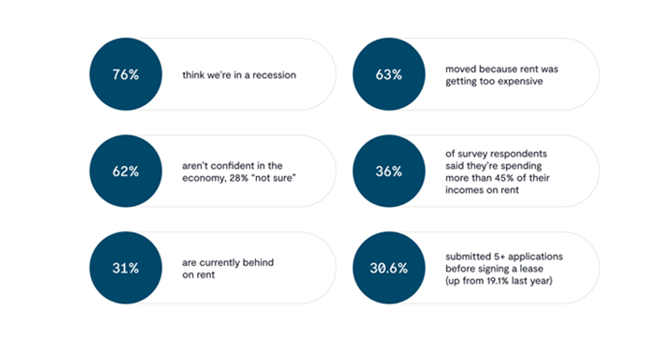
Renters are putting off moves due to fear of the unknown, hunkering in place until they have a clearer picture of the market, and having trouble finding a home that suits their budget, according to a survey in the Zumper State Of The American Renter Report.
“Rent prices are nearly always a harbinger of other economic indicators. We’re seeing pandemic-era trends begin to unwind, and we expect that to accelerate—in nearly every sector of the economy—over the next six months or more, ” Zumper CEO Anthemos Georgiades said in the report.
Renters Think The Country Is In A Recession
The survey says 76 percent of respondents think the country is in a recession and as a result their lifestyle choices are shifting and renters are putting off moves.
New household formation is shrinking
Occupancy is down
Prices are beginning to level off or decline in many markets
Chart courtesy of Zumper
Rental market impacted by home ownership getting out of reach
The survey says people “priced (or scared) out of the home-buying process have created pressure on the rental market—and, perhaps, helped prevent rent prices from dropping more drastically.
“Markets that became accustomed to all-cash bidding wars and listings staying online for under a day are now seeing homes sit on the market for weeks or months. Today’s interest rates are driving even more people out of the home-buying process and chipping away at confidence in the idea that owning a home is part of the “American dream.”
Other highlights from the report
51.5 percent believe the new American dream is being untethered to homeownership and yet 36 percent of survey respondents said they’re spending more than 45 percent of their incomes on rent
Money saving hacks; ditching coveted amenities saves hundreds per month etc.
Post-pandemic winners: Florida, NYC, Jersey City
Post-pandemic losers: Boise, Austin and Phoenix
New York City will end 2023 the reigning most expensive metro
Conclusion: What does 2023 look like?
“Given the amount of demand for rental homes (including from people priced out of buying a home), we don’t expect to test a new bottom of the market. Occupancy will continue falling, but it isn’t likely to fall below 94 percent (which is considered the bottom end of our industry’s normal range).
“As new household formation continues to shrink and consumers put off big moves until the economic picture is more clear, we do expect rents to decrease across much of the country for at least the first quarter of 2023. But, by around mid-year, consumer confidence will likely improve significantly, and renters will help drive the economy with more optimistic spending habits. By the end of 2023, we’ll potentially see the first “normal” season since 2019,” the report says.
“Our industry will certainly need to weather the upcoming storm but, overall, will do very well over the next decade,” Georgiades said in the report.
How property managers are adapting to changing resident expectations and industry trends to align with renters lifestyles.
By Kerstin Young
The COVID-19 pandemic changed how property managers and renters alike defined home.
At some point, properties became more than just places to live. They became safe havens in great times of uncertainty. They became connectivity hubs: home offices for hybrid or remote work and the backdrop for countless Zoom or Facetime calls with family and friends.
As renters spend extraordinary amounts of time in their dwellings, property managers are working overtime to provide them with premium resident experiences, property upgrades, and amenities that align with their lifestyles. Let’s take a closer look at some of the industry trends property managers are following.
Affordably Meeting Residents’ Demands
With more of Americans’ paychecks going to rent—36 percent of their gross income to be exact–renters are looking to get more for what they’re paying, especially if they’re staying home more. Keyless entry, free Wi-Fi, and smart lockers that store their packages are hot on their list of digital amenities. Interior features like walk-in closets and soundproofed living environments that quiet everyday noise distractions are another must.
Amenities may be nice, but residents also want property managers to listen to them.
They expect prompt responses when they reach out with questions, concerns, or maintenance requests. According to a property management report, 55% of residents expect to hear back from a property manager within 2 hours of contacting them. Additionally, 22.8% of almost 65,971 online mentions about poor communication were related specifically to a lack of email response from property managers. One suggestion for property managers in order to mitigate this situation is to include an automated email response with an expected response time in order to manage communication efficiently.
Property managers should also not underestimate the power of using surveys and reviews to elicit/collect existing resident feedback.
They’ll also notice a different level of candidness in what residents are willing to say in surveys versus reviews versus social media. The same report reveals 88 percent of prospective residents read reviews before touring a property and 55 percent won’t even consider doing that if a property has less than four stars. Virtual tour mentions online have increased by 49 percent from last year with the sentiment increasing by 14.1 points.
Be Aware of the Competition
Aside from taking care of their residents, property managers also need to stay on top of their competition.
Well-funded start-ups are the new kids on the block, using fancy amenities at premium costs to attract new residents. Therefore, it’s in property managers’ best interest to closely monitor the competition by reading reviews and gathering competitive intelligence -investing in tools that mine external feedback on social media is critical to gaining an advantage in the current market. An increased use of automation including automated resident screening and onboarding, rent collection and maintenance requests allows property managers to stay above the rest in terms of competition.
Be Prepared for Rent Negotiations
Over the past two years, amenities have become a deal breaker for residents. So much so, that they use it as a bargaining chip when it comes to rent negotiations.
For example, choosing to not offer free Wi-Fi gives residents even more reason to live at a competing property instead. Property managers know residents have high expectations when it comes to amenities but are also struggling with controlling costs at a time when inflation is prevalent at every juncture of everyday life. This is especially true for Gen Z, who prefers working from home since the pandemic, and expects apartment rentals to offer amenities such as outdoor living and working spaces.
Renewed Emphasis on Renter’s Customer Journey
In today’s renter’s landscape, property managers are also stewards of the resident journey. According to Gartner, 11 percent of resolution is completely resolved by self-service. This means that residents need help resolving their problems, and rarely can customers navigate the entire journey on their own. The best communities are going to have both options, thus the need for property managers to provide residents with an omnichannel experience that prioritizes self-service over a multistep process to be connected to a live agent. Offering digital solutions allows an easier process for tenants to find, rent and manage properties.
Let’s not forget that listening to employees is also a critical part of providing renters with the best living experience possible. They’re responsible for maintaining the top two drivers of positive sentiment, customer service, and speed, and are property managers’ eyes and ears in identifying service issues that are negatively affecting resident sentiment.
After all, employee experience and customer experience are symbiotic. Data from each cohort directly impacts the other.
Providing Renters with the Best Experience Possible
By and large, renters’ demands will remain unchanged between 2022 and 2023. Property managers are still contending with setting affordable rent rates, lingering labor issues, and industry regulations from COVID-19, on top of finding new ways to drive more efficiencies without sacrificing performance.
What will ultimately be a measure of property managers’ success is how they strategically prioritize their efforts to improve the resident experience. At the end of the day, property managers and renters both want the same thing: to love where they live. Let’s make that happen in 2023.
About the author:
Kerstin Young is a Senior CX Strategist at Reputation, where she supports organizations with strategic initiatives to help improve the customer experience, from acquisition to loyalty. With 10+ years of CX management programs, she is responsible for providing guidance across various phases of the consumer journey such as implementation, design and actioning on feedback, to ensure alignment in developing a programmatic approach. Connect with her on LinkedIn.