Home Blog Page 58

Why Renters Want Smoke-Free Housing

People increasingly want their living environment to be smoke-free housing to protect their short- and long-term health and safety.

By The Department of Health and Human Services
Tobacco Prevention and Control

People increasingly want their living environment to be smoke-free to protect their short- and long-term health and safety.

If you’re looking to attract new residents and retain your current ones, creating a smoke-free housing policy is essential.

When it comes to ensuring healthy housing, protecting health and preventing fires, renters know that the only sustainable option is to search for properties with a strict no-smoking policy.

Secondhand Smoke Makes for Unhealthy Housing

Renters are aware of the damaging effects of secondhand smoke.

According to a 2019 survey conducted by the American Housing Survey and the U.S. Census Bureau, approximately 43.9 million residences, or 31.4% of housing today, is multifamily.

Of those renters, 1 in 3 nonsmoking renters are exposed to secondhand smoke, and 2 out of 5 children are exposed to secondhand smokers.

The surgeon general has concluded that there is no safe level of secondhand smoke exposure.  Being around secondhand smoke causes heart disease, lung cancer and stroke in adults. It impacts children’s overall developmental health, and imposes health risks such as asthma attacks, lung problems, and even sudden infant death syndrome (SIDS).

The only way to keep nonsmoking residents safe from the effects of secondhand smoke is the full elimination of smoking indoors.

According to the CDC: 

  • About 8 in 10 multiunit housing residents have chosen to make their own homes smoke-free.
  • Approximately 1 in 3 multiunit housing residents are covered by smoke-free building policies.
  • A majority of multiunit housing residents want smoke-free building policies.

The numbers show that renters and property owners are prioritizing health and safety first, making smoke-free policies less of an anomaly and more of a necessity for ensuring community protection.

Smoking Increases Fire Risks and Jeopardizes Resident Safety

Aside from detrimental damages to your residents’ health, smoking on property brings a slew of safety issues, smoking-related fires being among the most concerning.

According to the U.S. Fire Administration: 

  • Properties that allow smoking have an increased risk of fire with an estimated 7,600 smoking-related fires occurring in U.S. residential buildings each year.
  • Fires caused by smoking are the leading cause of residential fire deaths in the U.S.
  • Smoking-related fires affect more than just the smoker: One in 4 casualties are the children, friends and neighbors of the smoker who caused the fire.

Smoking-related fires are preventable. Protecting all residents begins with a smoke-free policy.

Put Health and Safety First 

If you are ready to implement a smoke-free policy and would like resources and support,

visit tobaccofreeutah.org. For free resources to help you quit, visit waytoquit.org.

Sources:

1Multifamily housing. National Association of Home Builders (NAHB) (2019), Accessed September 2022.

2Secondhand Smoke, CDC, Accessed September 2022.

3The Health Consequences of Involuntary Exposure to Tobacco Smoke: A Report of the Surgeon General. U.S. Department of Health and Human Services (2006), Accessed September 2022.

4Going Smokefree Matters, CDC 2014, Accessed September 2022.

5Health Effects of Secondhand Smoke, CDC, Accessed September 2022.

6Smoking-related fires in residential buildings (2008-10), U.S. Fire Administration, Accessed September 2022.

How Smoke-Free Policy In Housing Saves You Money

5 Steps To Going Smoke-Free In Your Multiunit Housing

How Thirdhand Smoke Affects Your Properties


Apartment Conversions Stall, but Interest Remains High

Apartment conversions seem to have stalled, as the office market is stuck between the expectation that workers will return and hybrid work

Apartment conversions seem to have stalled, as the office market is stuck between the expectation that workers will return and the increasing popularity of hybrid work, according to a RentCafe report.

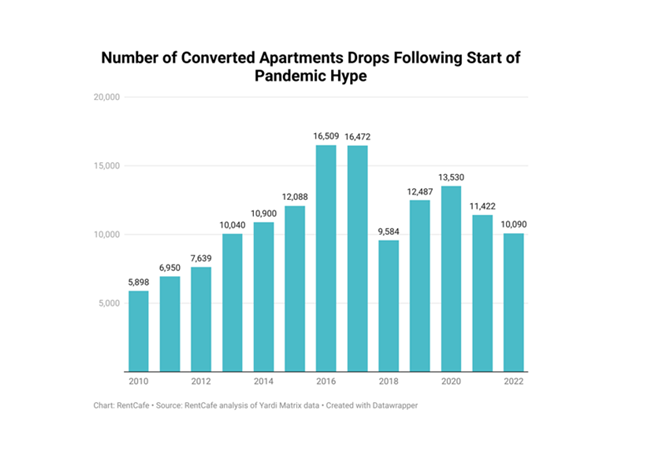
Apartment conversions of office buildings or adaptive reuse, emerged after the pandemic as the solution to the increased demand for housing and the rejuvenation of deserted downtown areas. However, after a brief surge in conversions, there was a big drop-off in 2021 and 2022, the report says.

“Even so, interest in converting older buildings into residences remains high. In fact, our analysis of Yardi Matrix data shows that adaptive-reuse apartments are poised for impressive growth in the upcoming years. A whopping 122,000 rental apartments are currently undergoing conversion, 45,000 of which are the result of office repurposing,” the report says.

Apartment conversions seem to have stalled, as the office market is stuck between the expectation that workers will return and hybrid work

Highlights of the apartment-conversions report

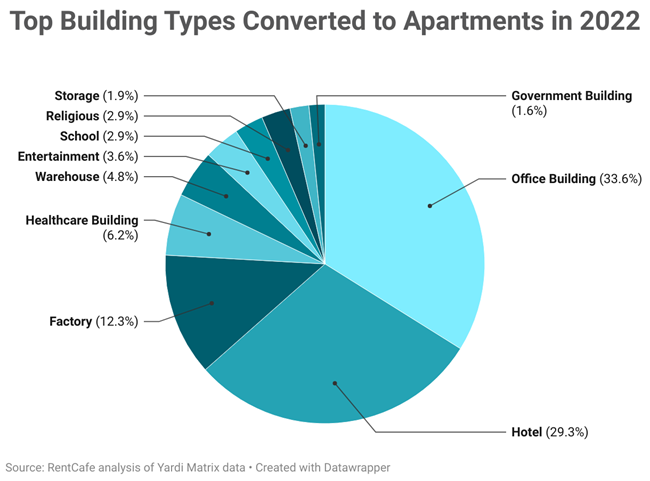
  • Office conversions are anticipated to lead the way, representing 37 percent of the total, followed by hotel conversions (23 percent of future projects). Factory conversions come in third place with 14 percent.
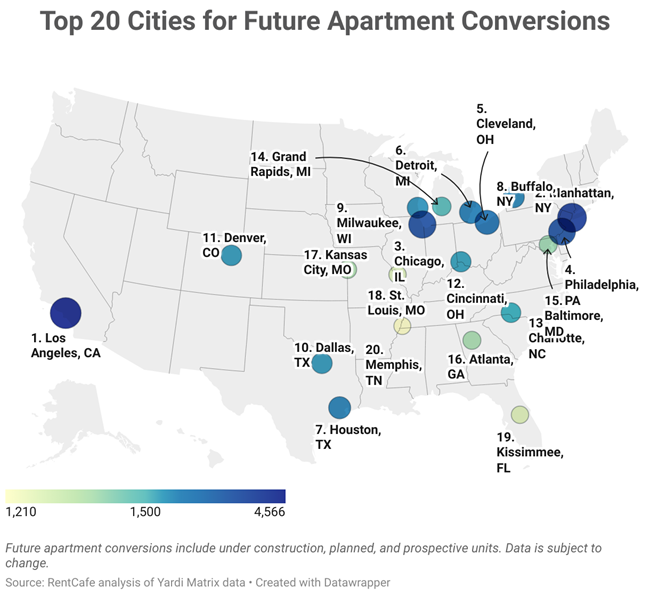
  • At the city level, Los Angeles is predicted to continue to ride the adaptive-reuse wave in the future, with 4,566 apartments expected to be created through conversion. New York is set to see the creation of 3,987 apartments, while Chicago follows closely behind with 3,519 apartments.
  • 10,090 new rentals were delivered nationwide in 2022, a decrease of 12 percent compared to one year prior and 25 percent fewer than in 2020. Los Angeles, Kissimmee, Fla., and Alexandria, Va. led the way in the number of repurposed buildings during this period. In these cities alone, the conversions make up 20 percent of the total nationwide. This indicates continued interest in adaptive reuse despite market uncertainties.
  • Despite office conversions slowing down 15 percent, with 3,390 apartments delivered in 2022, they still represent a substantial part of the adaptive-reuse sector. Los Angeles converted the most offices into residential in an effort to revitalize its downtown area. As a result, 692 apartments entered the market. Office-to-apartment conversions made up 100 percent of the adaptive-reuse projects in Alexandria, Va. (435 apartments) and Baltimore (395 apartments).
  • In a significant shift, former hotels experienced a record-breaking 2,954 new apartments resulting from conversion, a 5-year high. This building type’s easier, more straightforward transformation guaranteed a 43 percent increase in 2022 compared to 2021, almost mirroring office conversion.

“Office-to-multifamily conversions target smaller, older properties, yielding limited sector effects. Based on the latest research by real-estate company CBRE, the conversion of office spaces into multifamily units will primarily be restricted to smaller, older office properties due to factors such as construction costs and regulations related to residential construction,” said Doug Ressler, senior analyst and manager of business intelligence for Yardi Matrix.

“Market conditions that favor such projects include significant multifamily demand or government incentives, specifically aimed at promoting historic restoration efforts,” Ressler said.

Apartment conversions seem to have stalled, as the office market is stuck between the expectation that workers will return and hybrid work


Read the full report here.

Sign Up For Our Weekly Newsletter And Get Rental Property And Apartment News And Helpful, Useful Content Each Week.

* indicates required

Should I Renew Tenant’s One-Year Lease Or Go Month-To-Month?

Whether to renew tenant's one-year lease or go month-to-month is the question this week for Ask Landlord Hank who answers landlords questions

Whether to renew tenant’s one-year lease or go month-to-month is the question this week for Ask Landlord Hank. Remember Hank is not an attorney and is not offering legal advice. If you have a question for him please fill out his form below.

Dear Landlord Hank:

My tenants’ first year lease on my rental townhouse expires Oct 1, 2023.

Should I offer them a one-year lease renewal or switch them to month-to-month lease?

What are the pros and cons of yearly lease renewal vs month-to-month?

-Rome

Dear Landlord Rome,

Let me tell you how I look at my rental properties and why I like one-year leases.

I see my rentals as a money tree. I take care of them with regular maintenance, respond to tenant issues promptly and act fairly with tenants and treat them with respect.

I like to have my money trees producing fruit (MONEY) every month, and I know if I have an annual tenant I can count on that money for every month of the coming year because I’ve taken time to do proper background screening of my tenants and I know they are “normal” people who pay their bills and will take care of my property.

If I have a tenant that has fulfilled a 12-month lease and can’t sign for another year due to possible job transfer or maybe they are building a new home and it’s not ready yet, etc., I will extend a lease on a month to month basis BUT I require 60 days notice of the tenants last day so that I have enough time to find a good quality replacement.

If you are thinking about selling the property you might want to go month-month.  Just FYI, my longest lasting tenant moved in in 1998.

Sincerely,

Hank Rossi

Rent Sarasota

Owner/Broker

1000 East Avenue N.

Sarasota, Fl 34237

www.rentsrq.com

Each week I answer questions from landlords and property managers across the country in my “Dear Landlord Hank” blog in the digital magazine Rental Housing Journal.    https://rentalhousingjournal.com/asklandlordhank/


Whether to renew tenant's one-year lease or month-to-month lease is the question this week for Ask Landlord Hank who answers landlords questions
Landlord Hank says, “I will extend a lease on a month to month basis BUT I require 60 days notice of the tenants last day so that I have enough time to find a good quality replacement..”

Ask Landlord Hank Your Question

Ask veteran landlord and property manager Hank Rossi your questions from tenant screening to leases to pets and more! He provides answers each week to landlords.

Can I Monitor Tenant Smoking In My No-Smoking Rental?

Can I Limit the Number of People in My Rental?

Do I Have to Paint and Replace Flooring for a Long-Term Tenant?

A Tenant Poured Grease Down Drain Who Is Responsible?


Sign Up For Our Newsletter And Get Rental Housing And Apartment News And Helpful, Useful Content Each Week.

Governor Signs Revised Oregon Rent Control Law

Oregon Gov. Tina Kotek signed a revised rent control law, SB 611, which caps rents and prohibits landlords from charging more than 10 percent
Governor Tina Kotek

Oregon Gov. Tina Kotek has signed a revised rent control law, SB 611, which caps rents and prohibits landlords from charging a rent increase annually of more than 10 percent regardless of inflation.

The new Oregon rent control aw makes key changes to how the maximum-allowable annual rent increase percentage is calculated for residential tenancies.

The bill was passed in the recent legislative session. It was designed to fix the current rent control law that limited rent hikes to seven percent plus inflation. But when the Consumer Price Index showed high inflation, some recent cases resulted in 14 percent rent increases.

SB 611 states that the maximum allowable annual rent increase percentage is calculated as the lesser of:

  1. Ten percent; or
  2. Seven percent plus the September annual 12-month average change in the Consumer Price Index for all urban customers, according to the Portland Housing Bureau Rental Services Office.

SB 611 also clarifies that during any tenancy, other than week-to-week, the landlord may not increase the rent more than once during any 12-month period.

SB 611 takes effect immediately, applying to all notices of rent increase delivered on or after July 7, 2023.

Oregon was the first state in the nation to pass a statewide Oregon rent control law.

While rent control appears to help housing providers in the short run, in the long run it affects their investment and development plans, according to new research by the National Apartment Association (NAA).

“While the notion of rent-control policies may appear as an appealing solution to housing affordability, it is critical to acknowledge their potentially counterproductive and damaging consequences. Rent control has been proven to negatively impact renters, housing providers and even entire communities.

“This research shows that rent control policies can inadvertently lead to reduced housing supply, lower property values and decreased quality of available properties. Additionally, rent control disincentives new construction, which could exacerbate the housing affordability crisis,” the NAA research said.

Portland Update: Changes to FAIR Ordinance Bring (Some) Necessary Changes

Dealing with Habitability issues and Substitute Housing


Multifamily Demand Remains Stable As Rent Growth Slows

Multifamily rents are rising as demand remains stable and healthy, but rent growth is slowing in some markets, Yardi Matrix June report says.

Multifamily rents are rising as demand remains stable and healthy, but rent growth is slowing in some markets, Yardi Matrix says in the June National Multifamily Report.

“While some markets are experiencing slowing growth, multifamily largely continues to perform well, with a solid 95 percent occupancy rate and moderate rent growth in most metros. However, economic uncertainty and high interest rates present ongoing challenges, and the sector is dealing with a refinancing crisis,” Yardi Matrix says in their national report for June.

Highlights of the June report

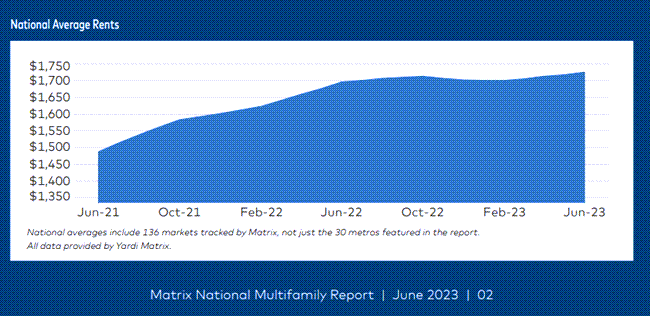
  • The average U.S. asking rent rose $7 in June to $1,726, while year-over-year growth fell to 1.8 percent, down 70 basis points from May and—outside of the pandemic year—the lowest growth rate since 2011. However multifamily demand remains stable.
  • Readers of the Matrix monthly report might notice that the Top 30 metros have been refreshed to provide a regionally diverse mix that reflects the highest amount of population and multifamily stock, along with the most growth.
  • Single-family rental rates increased $5 in June to $2,103, while year-over-year growth fell 80 basis points to 1.3 percent. Occupancy rates are holding up, reflecting robust demand as home sales sputter.

Multifamily rents are rising as demand remains stable and healthy, but rent growth is slowing in some markets, Yardi Matrix June report says.

“Worries coming into the year about a hard landing for multifamily seem to be unfounded, but the market’s ongoing growth is somewhat fragile, given the Federal Reserve’s attempt to cool the job market,” Yardi Matrix says.

“That effort does not appear to be over, as officials have signaled more rate hikes to come. Thus, the ongoing crisis for properties in need of refinancing is far from over.”

Lease renewal slowing continues

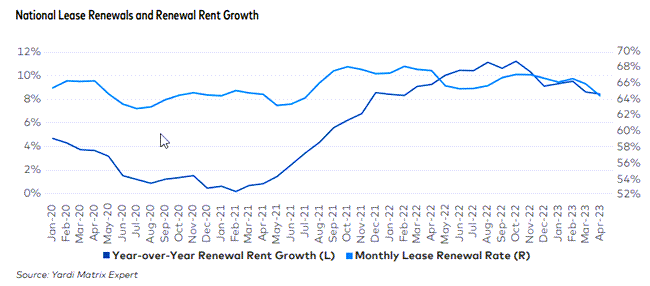
Renewal rent growth is decelerating “but very slowly, reflecting the strength of demand and the large gap between existing residents and asking rents.

Renewal rents, the change for residents that are rolling over existing leases, rose 8.5 percent  year-over-year nationally in April, down from 8.6 percent in March.

National lease renewal rates were 64.4 percent in April, down from 65.9 percent in March.

Multifamily rents are rising as demand remains stable and healthy, but rent growth is slowing in some markets, Yardi Matrix June report says as lease renewals decline

Borrowers Not Interested In high-cost mortgages

Yardi Matrix says the increase in interest rates over the last 15 months “has changed the mortgage market for multifamily. Borrowers have less appetite for debt, and short-term fixed-rate loans are becoming increasingly popular.

  • Lenders, including Fannie Mae and Freddie Mac, have seen mortgage volume plunge as a result of a wide market bid-ask spread.
  • More borrowers prefer five-year fixed-rate loans that can be prepaid after three years to provide flexibility when rates are expected to decline.

Read the full Yardi Matrix report here.

About Yardi Matrix

Yardi Matrix researches and reports on multifamily, office and self-storage properties across the United States, serving the needs of a variety of industry professionals. Yardi Matrix Multifamily provides accurate data on 18+ million units, covering more than 90 percent of the U.S. population. Contact the company at (480) 663-1149.

Sign Up For Our Weekly Newsletter And Get Rental Property And Apartment News And Helpful, Useful Content Each Week.

* indicates required

The Time Has Come to Rethink and Revamp Lease Renewals

When operators revamp lease renewals and make them a priority and put the right systems and processes in place, they experience benefits.

When operators revamp lease renewals, make them a priority and put the right systems and processes in place, they will experience a host of operational and financial benefits.

By Rob Hayden

After years of double-digit rent growth and microscopic vacancy rates, the multifamily market has cooled noticeably in the first half of 2023.

With the softening, apartment owners and operators are placing a greater emphasis on resident retention, as they prioritize occupancy and can no longer expect to see an endless stream of prospects willing to pay elevated rents.

The truth is that property managers should always make renewals a priority, regardless of market conditions, because doing so offers a wide array of significant business benefits. To execute renewals efficiently and experience those benefits, operators need to revamp lease renewals and optimize their renewal processes and also think about retention more holistically.

The Traditional Way Isn’t Working

For too long and across too many apartment communities, the renewal process has unfolded largely like this: overextended site teams send out a PDF with a renewal notice 90 days before a lease’s end (and let’s be honest, 90 days is an optimistic estimate).

Due to bandwidth constraints, they often have no choice but to engage in sporadic follow-up. This results in a negative experience for residents and in communities that leave money on the table because they lose roughly 50 percent of their residents each year.

Through this process, operators typically don’t think of offering to move residents into other apartment homes within the same community, and they don’t capture data about the resident experience to inform future strategy.

Use Technology To Automate

Today, multifamily owners and operators can use technology to automate and bring nuance to their renewal process.

Automated systems can collect feedback from residents and gauge their intent to renew; this data provides better occupancy forecasting to help asset managers make rational decisions around pricing. These insights also can create more personalized and effective communications about renewals to residents.

Automated systems also can ensure the timely delivery of renewal offers featuring dynamic pricing that spur quicker decisions from residents. Lastly, automation frees up onsite professionals to contribute to the renewal and retention process in ways that only humans can — by building greater rapport with the residents they serve.

Operators should also think about renewals more holistically, and technology can support this as well.

Stated another way, renewals can be about more than keeping a resident in their current unit. Over the course of a lease, a renter’s needs can change.

Perhaps they want to stay in their current community, but for whatever reason – their roommate is moving out or they’re now working from home – they need a smaller or larger unit. Maybe they need to move to another part of the same metro area, or maybe they have to relocate to another city altogether.

These scenarios could represent a chance to move the resident into another community in the same operator’s portfolio. Technology can help apartment owners and managers identify and facilitate these moves more seamlessly, and it can help incentivize the resident to make these in-portfolio moves, further improving the relationship with the resident.

The Benefits of a Modern Approach

When operators revamp lease renewals, make renewals a priority, put the right systems and processes in place, then they will experience a host of operational and financial benefits. For starters, onsite associates will be freed up to concentrate on their many other responsibilities, and residents will have a much better customer experience.

In addition, an automated and nuanced process can lead to increased resident retention and faster renewal decisions. In turn, this results in reduced vacancy loss, reduced marketing and prospect acquisition costs, improved occupancy forecasting and better real-time pricing decisions.

For too long, renewals have taken a back seat to new leases in multifamily, and operators’ net operating income and bottom lines have suffered as a result. The time to change that is now and, moving forward, operators should always devote the needed time and resources to renewals, regardless of the market for new leases.

Stated simply, a robust and well-executed approach to renewals leads to a better resident experience, greater resident retention, more revenue and increased asset value.

About the author:

Rob Hayden is the co-founder and CEO of Renew. Previously, he was vice president of sales and strategic partnerships for Jetty. He also was a director at New York Life Ventures.

Fostering a Self-Starter Culture to Unleash Employee Potential

Fostering a self-starter culture can unleash employee potential and is one of the best ways to build collaborative and successful teams. 

Fostering a self-starter culture can unleash employee potential and is one of the best ways to build collaborative and successful teams.

By Kendall Pretzer

Today’s employment landscape requires leaders to remain engaged and nimble. Taking a one-size-fits-all approach to leadership and employee recognition will only result in team members feeling unseen, unheard and quickly uninterested. Companies that opt for this approach will often find their teams doing the bare minimum to stay employed and their top talent exiting for greener pastures and more inspiring organizations.

Recognizing potential self-starters, nurturing their ambitions and mentoring them through the early stages of their careers are the best ways to build collaborative and successful teams. Every person needs something different depending on where they are in their journey, what’s ahead of them, what they are asked to do and what they truly want to do. I learned these important lessons as I moved through my own career.

Finding Empowerment Through Exploration

After I graduated college with a degree in finance, I knew I didn’t want to work for a bank, which was the most common career path at the time for people with finance degrees. My first job was with a commercial real estate company based in Dallas as the regional financial analyst. In addition to being an analyst, my responsibilities included training onsite teams on the new property management system. It was then that I learned that I had a knack for training and technology.

After a few years working as an internal consultant for a bank (yes, I ended up at one anyway) my first boss, now with Trammell Crow Residential, recruited me to become the director of training for their central region multifamily portfolio. There, I led training, marketing and corporate housing for several regions of Trammell Crow Residential up to and including when those divisions became Gables Residential.

Another former boss brought me to Security Capital/Archstone where I ultimately led property operations for a region. I shifted my focus from services to property operations after a vice president at Trammell Crow Residential said to me, “You need to lead revenue in order to truly have a seat at the table.” That move was also an opportunity to determine whether all the training theory I had been talking about for years actually worked. Eventually, I returned to Gables Residential until starting The Strategic Solution, which focused on innovative policy management solutions. Along with my team, I grew that business for 18 years before selling it to Grace Hill in 2018 and became CEO in 2021.

 The Power of Learning and Perspective

Everyone I met, all the people I learned from and every position I’ve held have factored into the success I’ve achieved today. Rather than let ego guide my path, I accepted several lateral positions, continuously seeking new education and skills from each role. Each opportunity was a new experience that expanded the breadth of my learning and helped me hone my passions.

 Too many times I thought I knew everything. Now, I realize I didn’t know as much as I let myself believe. One pivotal moment in my career was when I was chewed out by my boss in a room of 25 people during a presentation. In his opinion, I spent too much time focused on problems and too little on solutions. It was very painful and even more embarrassing, but it has always stuck with me. I learned so much from that experience.

First, I survived the moment. Yes, I was embarrassed, but it gave me the perspective that words didn’t kill me. Second, I understood that my boss’s assessment was accurate. Third, my close colleagues in the group offered support afterward and helped me comprehend that one moment did not define me or my work. I developed thicker skin, an understanding that work isn’t necessarily personal and that if someone says something that hurts me, I can grow from it rather than let it defeat me.

Prioritizing Collaboration

I had several bosses who were successful by being collaborative and who empowered me to use my intelligence to problem-solve. One of them had a highly effective technique of questioning me until I found the right answer myself. On a side note, he also taught me a rule about never leaving a voicemail longer than one minute.

My father is another of my role models for good leadership. When I was growing up, he was the manager of a large department store. I remember walking through the store and listening to his employees speak about how much they liked working for my father. At a young age, I learned the power of good leadership and how it can influence performance and attitude. My father exemplified the importance of using leadership to create a strong team that would work to move the business forward.

Turning Initiative Into Leadership

There is much to be done in today’s work environment. My interest in problem-solving hasn’t subsided, and at Grace Hill, we want to support and develop the skills of up-and-coming leaders. My advice is to show initiative by volunteering to tackle difficult issues. Communicate with your company’s customers and collaborate with others. Never stop seeking ways to be involved, particularly with challenging projects. Embrace the old adage, “Don’t bring me problems, bring me solutions.”

Most leaders welcome help in getting things done, but if those in charge must think of all the solutions, it feels lopsided. Good leaders want everyone rowing. Demonstrate how you can contribute and don’t be silent. If you see something amiss, speak up. Better yet, bring a solution to the table or at least some options to consider. Try to make suggestions using the current resources, as well as a solution if more investment can be spent on the problem. Help the leaders of your company see the completeness of the research and the path to a result. Your ingenuity and creativity will be appreciated.

And always remember that the bad moments don’t define you. Learn from them. You will survive.

Are you or a colleague making a positive impact in your community? At Grace Hill, we want to build up our colleagues who show passion, leadership and demonstrate effective change for good. Nominate yourself, a colleague or a friend for the 2023 Grace Hill Hero Impact Awards today.

Be a Mentor

Mentors have value in many ways. They help by offering options and suggestions, coaching mentees toward an answer and sharing applicable experiences. Sometimes just having a sounding board — someone willing to listen without judgment — is the most helpful thing.

Companies and leaders today need to embrace the thought processes and decision-making skills of their most ambitious employees. Engage with them and nurture their confidence by awarding them more responsibilities. Encourage people to pursue more.

Grace Hill not only works to mentor and encourage self-starters to discover their full potential, but it is our mission to help other multifamily organizations to do the same. We’ll discuss these important issues and offer insights and advice at the Leadership Languages: Understanding What Motivates Your Team webinar on July 20, 2023. This free and informative session will show you the best ways to motivate your teams and inspire your self-starters. Register today!

Find Passion

As I have grown in my career, I have realized that work is what I do, not who I am. I have several interests, passions and causes that are a valuable part of my life. Work can satisfy some goals and certainly provides a living, but we must give ample attention to the other parts of our lives that define happiness and fulfillment.

Whenever we think we know it all, when we are so busy ringing our own bell or patting ourselves on the back, we forget to learn, listen and ask questions. It is then that we lose the opportunity to grow. We lose ground on our path to success, and we’re probably not too fun to be around. We all can learn something from all the other people and situations we encounter, and we’ll all be better for it in the long run.

 About the Author

Kendall Pretzer brings more than 30 years of experience in property management and supplier solutions to her role as the Chief Executive Officer at Grace Hill. Kendall joined the team in 2018 after Grace Hill purchased her company, The Strategic Solution, bringing together policies and procedures with training. Today, she and Grace Hill champion making a positive impact in our communities in multifamily, as demonstrated in company initiatives like the annual Impact Hero Awards, Breast Cancer Awareness Month and Human Trafficking Awareness Month. In recognition of her dedication to the industry, Kendall was recently named a GlobeSt. Woman of Influence and one of the Top 25 Women Leaders in US PE-Backed Software by Calibre One.

About Grace Hill

Grace Hill provides industry-leading SaaS technology solutions designed to make a positive impact in real estate and improve the lives of people where they work and live. Harnessing years of real estate experience and the understanding that people are better together, Grace Hill helps owners and operators increase property performance, reduce operating risk and grow top talent. More than 500,000 professionals from over 1,700 companies rely on Grace Hill’s talent performance solutions covering policy, training, assessment, survey, and data-driven insights. Visit us at gracehill.com or on LinkedIn.

Sign Up For Our Weekly Newsletter And Get Rental Property And Apartment News And Helpful, Useful Content Each Week.

* indicates required

HUD Charges Landlord With Discrimination Over Assistance Animal

HUD has charged a landlord with disability discrimination over failing to lease a rental to a woman with a dog as an assistance animal

HUD (The U.S. Department of Housing and Urban Development) has charged a landlord and Realtor with disability discrimination over failing to lease a rental to a woman with a dog as an assistance animal, according to a release.

HUD has charged Serrot Management LLC, the owner of a dwelling in Maplewood, New Jersey, and its realtor with violating the Fair Housing Act by refusing to allow a prospective tenant with a disability to live with her assistance animal. Read the Charge. The rental had a no-pet policy. Assistance animals are not pets.

HUD’s charge alleges that the landlord approved the potential tenant’s application to rent an apartment in Maplewood, New Jersey. However, they imposed discriminatory terms and conditions on the complainant’s tenancy and eventually rescinded their approval after they learned she required an assistance animal.

“Although the complainant (tenant) offered medical support documentation for her assistance animal, the landlord continued to impose onerous conditions, denied her reasonable accommodation request, and ultimately denied her housing. The complainant was forced to find another place to live with her family under a tight time deadline,” the complaint says.

Some of the discriminatory language placed in the lease for the tenant with the assistance animal, a dog, stated that:

“If the landlord has any signs of issues with the dog barking, or making too much noise the rent will increase by $100 w/ a 30-day notice. The landlord has the right to terminate the lease with a 60-day notice if the dog becomes an issue for any reason,” the complaint says.

The Fair Housing Act (“Act”) prohibits discrimination based on disability. Such discrimination includes refusing to rent based on a person’s disability, failing to grant reasonable accommodations, or subjecting tenants to discriminatory terms and conditions.

“Persons with disabilities must not be subjected to burdensome constraints while trying to secure housing. The rights of persons with disabilities have been protected under the Fair Housing Act for more than 30 years, yet they continue to face discrimination,” Demetria L. McCain, HUD Principal Assistant Deputy Secretary for Fair Housing and Equal Opportunity, said in the release. “HUD is committed to vigorously enforcing the Act to protect the rights of individuals with disabilities.”

“The Fair Housing Act requires housing providers to make reasonable accommodations that are necessary for an individual with disabilities to have equal enjoyment of housing,” HUD’s General Counsel, Damon Smith, said in the release, “In some cases, that means a housing provider must permit the use of an assistance animal without imposing onerous conditions.”

Sign Up For Our Weekly Newsletter And Get Rental Property And Apartment News And Helpful, Useful Content Each Week.

* indicates required

Fair Housing And Phone Calls – Ensuring Compliance

Property management professionals must remain vigilant about the potential fair housing implications associated with phone calls and testing

Property management professionals must remain vigilant about the potential fair housing implications associated with phone calls as fair housing testing primarily takes place over the phone.

By The Fair Housing Institute

In today’s rapidly-evolving digital landscape, it’s easy to overlook the significance of traditional forms of communication, such as phone calls, in the day-to-day operations of leasing offices.

While email and messaging services have become prevalent, phone calls remain an indispensable aspect of effective leasing-office management.

However, property management professionals must remain vigilant about the potential fair housing implications associated with phone calls and the importance of handling them meticulously to prevent any violations.

Busy Leasing Office vs. Fair Housing Testers

Leasing offices often experience a whirlwind of activity, with multiple individuals vying for attention simultaneously. Amidst this flurry of tasks and interactions, it is all too easy to make inadvertent mistakes that can potentially lead to fair housing violations, and fair housing testers are banking on this.

Fair housing testing, which seeks to uncover discriminatory practices, predominantly takes place over the phone due to its cost-effectiveness and ability to reach a wide range of properties. Consequently, every phone call becomes an opportunity to showcase compliance with fair housing guidelines and avoid inadvertently engaging in discriminatory behaviors.

Let’s consider a few common scenarios that leasing agents are presented with on a daily basis that, if not handled properly, could lead to a fair housing claim.

Who Should You Help First

As referenced above, we all know how incredibly busy a leasing office can be. So what should you do if you are on a call with a prospect who is inquiring about availability when another person walks in and is staring right at you? It might be tempting to ask the person on the phone if you can call them back, but this can lead to potential problems.

What if the person on the phone falls under a protected category while the person in front of you does not? What if the person that just walked in is also interested in availability? Either case could appear discriminatory if not handled correctly.  A best practice would be to place your caller on a brief hold so you can explain to the in-person prospect that you will be right with them and assist them according to the order that you made initial contact.

Unseen Discrimination

A question we often get is: How can someone claim discrimination if I can’t even see them?

It is essential to recognize that fair housing violations and discrimination claims can emerge from phone calls, even when the caller remains unseen. Subtle cues, such as foreign-sounding last names or accents, can be utilized by fair housing testers in an attempt to provoke or fabricate a basis for racial discrimination claims.

Similarly, individuals can assert fair housing violation claims based on disabilities through phone calls without any face-to-face interaction. For example, a person may have a speech impediment or use a relay service to communicate. Both of which indicate that you are speaking with a potentially disabled individual. It is crucial to approach these calls with sensitivity, ensuring that the caller’s unique needs are fully understood and effectively addressed.

Discussing Policies – Consistency Is Key

Another common phone call that we handle in our leasing offices is inquiries into the property’s policies.

When individuals inquire about property management policies over the phone, effective and consistent communication is of utmost importance. Ensuring that every staff member responding to inquiries has easy access to the office’s policy is a best practice. In cases where uncertainties arise, seeking guidance from a supervisor is highly recommended. Consistency in conveying information not only demonstrates professionalism but also minimizes the risk of potential fair housing pitfalls.

In conclusion, ensuring that property management professionals are well-versed in handling phone calls appropriately and adept at addressing a diverse range of inquiries is paramount.

Achieving this proficiency requires comprehensive fair housing training programs and engaging in practical role-playing exercises. By prioritizing fair housing compliance and fostering a culture of sensitivity and inclusivity, leasing offices can minimize the risk of fair housing violations and provide equal opportunities to all prospective tenants.

About the author:

In 2005, The Fair Housing Institute was founded as a company with one goal: to provide educational and entertaining fair-housing compliance training at an affordable price at the click of a button.

Fair Housing and Hoarding – What You Need To Know

Mid-Year Report: Multifamily Faces Challenges but Demand Remains Steady

Multifamily rent growth is positive, but slowing, Yardi Matrix says in the Multifamily Mid-year report and outlook but challenges lie ahead.

Multifamily rent growth is positive, but slowing, Yardi Matrix says in the Multifamily Mid-year Outlook report. However, challenges do lie ahead.

While rent growth is positive, “the market faces challenges related to the potential economic downturn and rising interest rates that have eroded property values and is likely to lead to an increase in distress,” the report says.

What Lies Ahead for Rents?

Multifamily rents continued to increase through the first half of 2023, despite challenges that included slowing demand, growing issues with affordability, slower population growth and competition from a large amount of new supply.

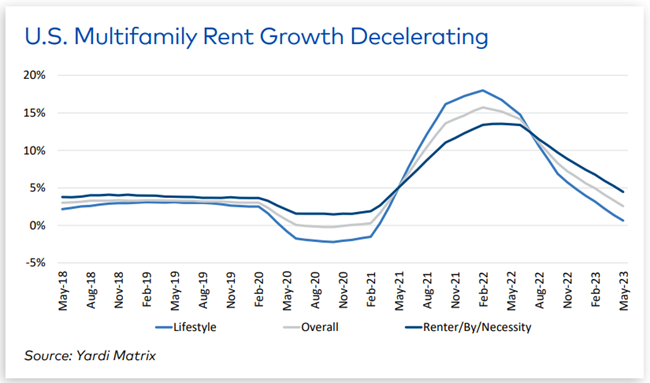
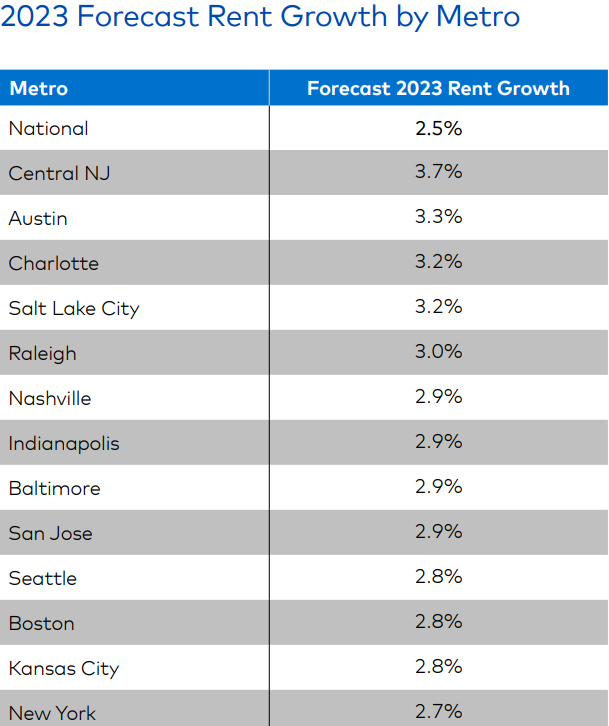
“We anticipate that rents will continue to increase modestly over the course of the year as demand has firmed, albeit at a more moderate rate in line with historical growth levels,” the report says.

Multifamily demand also is boosted by the sharp drop in home sales, which keeps renters in apartments. Low in-place mortgage rates are discouraging homeowners from selling homes, keeping inventory low and single-family prices high.

Rents also will continue to be constrained by affordability, as a growing number of households are paying more than 30 percent of their income on rent.

This can be addressed with more supply, but at the same time states and municipalities are debating rent-control and limits to development that will backfire if allowed to be implemented.

Multifamily rent growth is positive, but slowing, Yardi Matrix says in the Multifamily Mid-year report but challenges do lie ahead.
Multifamily rent growth is positive, but slowing, Yardi Matrix says in the Multifamily Mid-year Outlook but challenges do lie ahead.

New Apartment Supply

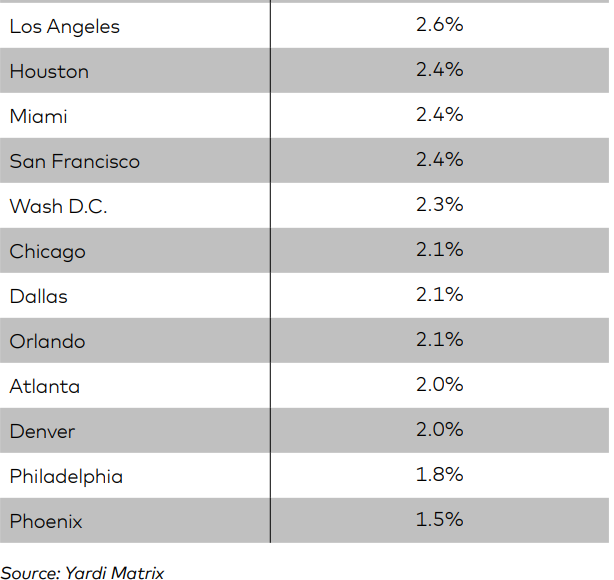
Matrix expects 430,000 multifamily units to be delivered in the United States in 2023, an increase of 2.8 percent of stock, according to the multifamily mid-year report.

This new product represents a 15 percent increase over the 366,000 units (2.4 percent of stock) that came online in 2022. The increase in supply will put pressure on operators, but the impact will not be spread evenly across markets.

Deliveries will be focused in 10 to 15 of the fastest-growing markets.

Markets expected to deliver the highest numbers of new apartments in 2023 include Austin (22,310 units), Dallas (21,769), Miami (18,571), Atlanta (15,611), New York City (15,510) and Phoenix (13,592).

Capital Markets an Achilles Heel?

Property fundamentals are strong, but the increase in capital costs has injected pricing uncertainty into the market and made it difficult to complete a transaction of any kind, the report says.

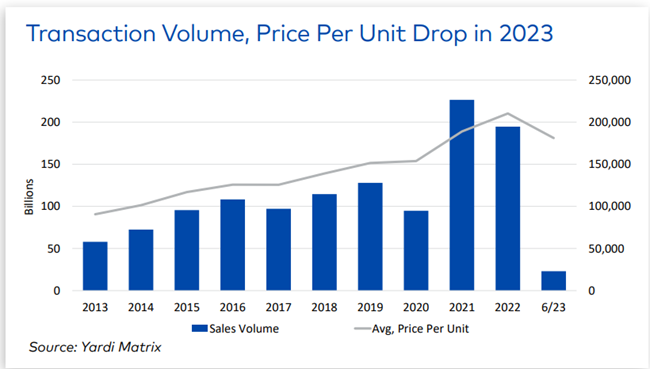
Property sales and mortgage-origination volume are both down sharply and distress is on the rise.

The biggest hindrance to deal flow is the rapid and steep decline in property values stemming from the increase in interest rates and slowing rent growth.

Multifamily rent growth is positive, but slowing, Yardi Matrix says in the Multifamily Mid-year Outlook but challenges do lie ahead.

“While there will be some rough patches ahead, and operators must cope with rising costs such as labor, taxes and insurance, multifamily has strong long-term fundamental demand drivers and solid liquidity from investors and lenders.

“Those attributes should enable it to withstand market conditions better than other commercial property types,” Yardi Matrix writes in the report.

Read the full report here.

Multifamily rent growth is positive, but slowing, Yardi Matrix says in the Multifamily Mid-year reportok but challenges do lie ahead.

About Yardi Matrix

Yardi Matrix researches and reports on multifamily, office and self-storage properties across the United States, serving the needs of a variety of industry professionals. Yardi Matrix Multifamily provides accurate data on 18+ million units, covering more than 90 percent of the U.S. population. Contact the company at (480) 663-1149.

Sign Up For Our Weekly Newsletter And Get Rental Property And Apartment News And Helpful, Useful Content Each Week.