Home Blog Page 56

Expense Growth Clouds Future Multifamily Performance

Expense growth clouds future multifamily performance as operators are now facing the rapidly growing expense side of the ledger

While economic growth and a strong job market have helped multifamily asking rents grow nationally in August, operators are now facing the rapid expense growth on that side of the ledger, led by mushrooming property-insurance costs, Yardi Matrix says it in its national report for August.

“With rent growth slowing, property owners increasingly must implement strategies to pare expense growth to maintain and grow net income,” the report says.

“After several years of stellar income growth, multifamily is facing headwinds that include not only decelerating rent gains but a rapid uptick in expenses. During the trailing 12-month period ending June 2023, expenses for multifamily properties nationally grew by an average of 9.3%, up 63% from the 5.7% increase during the previous 12 months,” according to Yardi Matrix data.

“During that period, the average property operating expense rose $740 per unit to $8,694, according to Matrix. Costs rose significantly in most categories, led by insurance, which increased by an average of 18.8% in the 12 months ending June 2023, per Matrix. Insurance is rising because of the growing number of significant weather-related events, such as hurricanes, extreme temperatures and wildfires, that have created large insurer payouts, particularly in the Southeast, California and Texas,” the report says.

Highlights of the August report

Asking rent growth in August was concentrated in the renter-by-necessity segment, which increased by 0.1%, while lifestyle rents declined 0.1%. The composition of rent growth reflects a substantial supply increase in some areas, as most deliveries are lifestyle units, which increases competition within the segment.

  • Multifamily performance continues to hold up well, as rents and occupancy were relatively flat in August. The average U.S. asking rent rose $1 to $1,728 during the month, while year-over-year growth fell to 1.5%, down 20 basis points from July.
  • In the short term, supply growth remains a driving factor in metro-level rent growth. Most metros with the highest year-over-year asking rent growth, such as New York, Chicago, Indianapolis and San Diego, benefit from a weak new supply pipeline.
  • Single-family rents (SFR) fell slightly, down $6 nationally to $2,104. Year-over-year, national SFR rent growth fell 70 basis points to 0.5%. SFR demand remains strong overall, but there is some evidence of deceleration in the high-end segment.

Lease renewal rates continue to slow

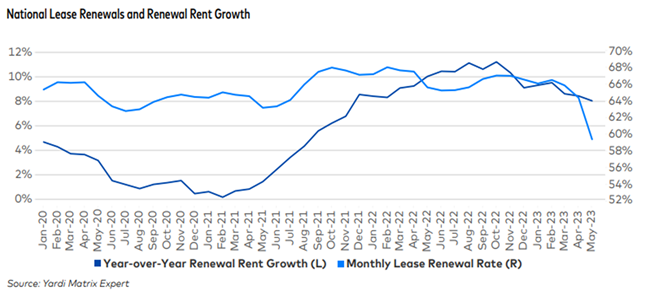
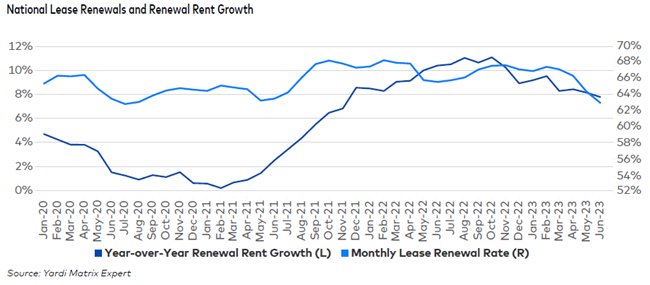
Renewal rent growth fell to 7.8% year-over-year as of June, down 40 basis points from May.

Renewal rents, the change for residents that are rolling over existing leases, has slowed since peaking at 11.1% in 4Q 2022 as more tenants get caught up to asking-rent rates. Only a handful of metros continue to see double-digit growth in renewal rents. Miami has had the largest renewal rent growth at 12.4% while San Francisco had the smallest at 1.8%. Growth was between 5.6% and 9.7% year-over-year in 26 of the top 30 markets in the report.

National lease renewal rates were 62.9% in June.

“Renewal rates have been steadily declining since mid-2022, which is attributable to the large amount of new supply that has come online. As new deliveries are made available, occupancy rates decline, which compels properties to offer greater concessions and consequently creates the incentive for more renters to move,” Yardi Matrix says in the report.
Expense growth clouds future multifamily performance as operators are now facing the rapidly growing expense side of the ledger
Chart courtesy of Yardi Matrix

Read the full Yardi Matrix report here.

About Yardi Matrix

Yardi Matrix researches and reports on multifamily, office and self-storage properties across the United States, serving the needs of a variety of industry professionals. Yardi Matrix Multifamily provides accurate data on 18+ million units, covering more than 90 percent of the U.S. population. Contact the company at (480) 663-1149.
Lawsuit Charges 18 Property Management Companies with Rent Price Fixing

A lawsuit is charging 18 property management companies and Yardi Systems of rent-price fixing to increase rent prices across the country

An antitrust class-action lawsuit is charging 18 property management companies and Yardi Systems of rent price fixing by colluding to increase the cost of rent in cities across the country, according to a release from the law firm that filed the suit.

The lawsuit says the property management companies used Yardi’s centralized, automated pricing software, “RENTmaximizer,” to raise costs in lockstep while maintaining occupancy. This is similar to another lawsuit filed against RealPage.

“Through Yardi’s complex software, otherwise-competing rental companies teamed up to outsource pricing decisions to Yardi, artificially eliminating any competition between them,” attorneys say in the release.

The lawsuit cites two confidential witnesses and former employees of defendant companies who divulge details of the organized scheme.

The lawsuit was filed in the U.S. District Court for the Western District of Washington and accuses the conspirators of “colluding to coordinate pricing through the usage of a centralized, automated pricing software, ‘RENTmaximizer,’ created by Yardi Systems in 2011.” By 2013, the software was used to price 8 million residential units. The new lawsuit falls on the heels of the law firm’s class action against RealPage alleging similar rent price-fixing tactics.

The new class action names as defendants or co-conspirators the following property management companies using Yardi’s RENTmaximizer and “Revenue IQ” revenue management software:

  • Alco Management Inc.
  • Bridge Property Management LLC
  • Calibrate Property Management LLC
  • Clear Property Management LLC
  • Creekwood Property Corporation (Tonti Properties)
  • Dalton Management Inc.
  • HNN Associates LLC
  • Jones Lang Lasalle Incorporated (JLL)
  • KRE Group Inc.
  • LeFever Matson, Manco Abbott Inc.
  • Legacy Partners Inc.
  • McWhinney Property Management LLC
  • Manco Abbott Inc.
  • Morguard Corporation
  • Pillar Properties LLC
  • Summit Management Services Inc.
  • Towne Properties
  • Tribridge Residential LLC.

“Our antitrust legal team has uncovered what we believe to be a clear gaming of the system through controlled, lockstep algorithmic increases to fix the cost of rent — one that has affected millions of renters,” said Steve Berman, managing partner and co-founder of Hagens Berman, in the release. “Housing is a basic human need. What these companies have done is both legally and morally bankrupt.”

In a related case, late last year 17 Democratic members of the U.S. House of Representatives sent a letter to the Department of Justice and the Federal Trade Commission asking the agencies to investigate another property management company, RealPage, and it’s rent-setting software, according to ProPublica.

RealPage has said the data fed into its pricing tool is anonymized and aggregated. It said the company “uses aggregated market data from a variety of sources in a legally compliant manner.”

ProPublica is reporting that RealPage, a Texas-based real estate tech company, is facing a new barrage of questions about whether its software is helping landlords coordinate rental pricing in violation of antitrust laws.

In an Oct. 15 story, ProPublica detailed how RealPage’s pricing algorithm uses competitor data to suggest new prices daily for available apartments. ProPublica raised concerns that the software, sold by RealPage, is potentially pushing rent prices above competitive levels, facilitating price fixing or both.

Read the full lawsuit complaint here.

Sign Up For Our Weekly Newsletter And Get Rental Property And Apartment News And Helpful, Useful Content Each Week.

* indicates required

Rental Market: August Rent Slows, Annual Fall Decline is Early

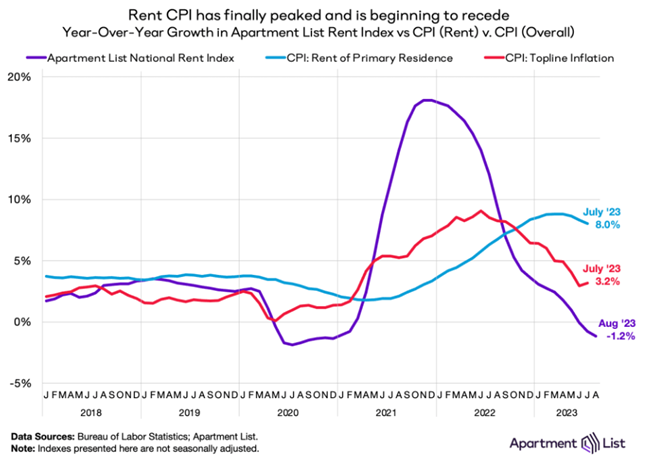
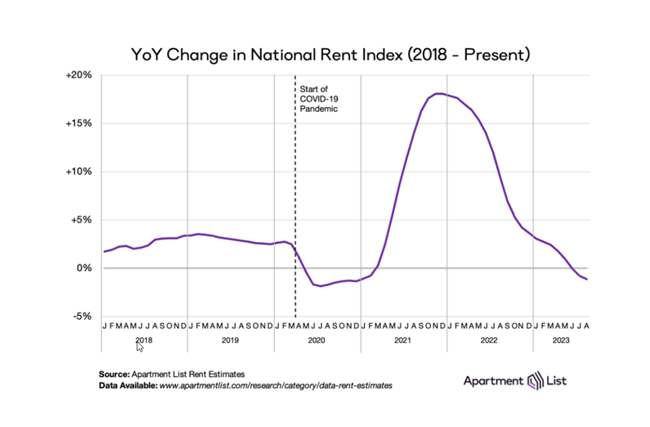
The rental market continued slowing down in August as both monthly and annual rent growth turned negative, according to Apartment List.

The rental market continued slowing down in August as both monthly and annual rent growth turned negative, according to the September report from Apartment List.

Rent growth typically follows a seasonal pattern with rents up in spring and summer and down in fall and winter, but 2023 seems to be showing an early decline in rents already down heading into the fall and winter period.

“Annual rent growth turned negative last month, for the first time since the beginning of the pandemic. Today it stands at -1.2 percent, meaning that on average, apartments across the country are 1.2 percent cheaper today than they were one year ago,” Apartment List research team writes in the report.

“This is a major deceleration from recent years, when annual rent growth neared 18 percent nationally and soared to over 40 percent in a handful of popular cities.

“Additionally, monthly rent growth turned negative this month, marking the beginning of the rental market’s slow season. Our national rent index decreased 0.1 percent in August, flipping negative one month earlier than it did last year.”

Overall Apartment List says rents fell month-over-month in August in 53 of the nation’s 100 largest cities. With sluggish rent growth throughout the past 12 months, prices are down year-over-year in 72 of these 100 cities.

Rental slowdown finally reflected in inflation numbers

The primary measure of inflation in the United States is the Bureau of Labor Statistic’s Consumer Price Index (CPI), which is heavily influenced by changes in housing prices.

“Our index shows that the rental market has been cooling rapidly for a year, but the CPI housing component has just recently hit its peak. Despite the CPI’s measure of housing inflation remaining elevated, topline inflation has already meaningfully cooled. As the CPI housing component now gradually begins to reflect the cooldown that we’ve long been reporting, it will help to further curb topline inflation in the months ahead.”

The rental market continued slowing down in August as both monthly and annual rent growth turned negative, according to Apartment List.

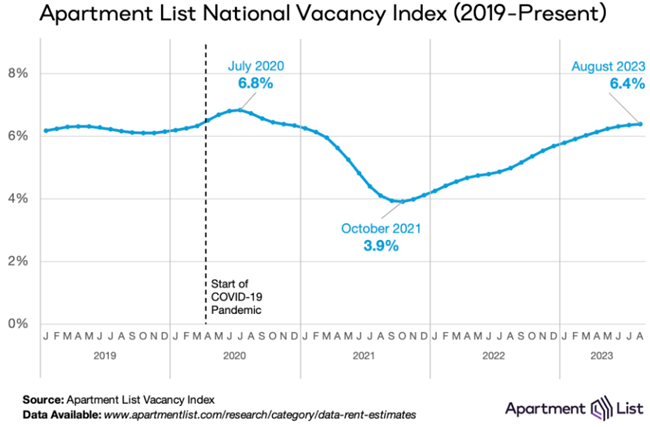
Vacancies continue growing

“Our vacancy index has increased for 22 consecutive months and now sits at 6.4 percent, slightly above the pre-pandemic average. Additionally, with a record number of apartments under construction, we expect vacancies to remain strong in the coming months.

“New apartment construction is recovering from pandemic-related disruptions, and there are now more multifamily units under construction than at any point since 1970. As this new inventory continues to hit the market over the remainder of this year and into next, we are now entering a phase in which property owners are beginning to compete for renters to fill their units, a marked change from the prevailing conditions of the past two years, in which renters had been competing for a limited supply of available inventory.”

The rental market continued slowing down in August as both monthly and annual rent growth turned negative, according to Apartment List.

Summary

August’s 0.1 percent rent decline marks an early start to the rental market’s slow season, and brings year-over-year rent growth to a low that has not been seen since early in the pandemic.

“As apartment demand wanes throughout the remainder of the year, and apartment supply improves through a strong construction pipeline, expect rent growth to cool further for the remainder of the year,” the report says.

Read the full rental market report here.

Operational Efficiencies Top Challenge For Property Managers

Operational efficiencies that can reduce costs are now the top challenge for rental property managers a new report from the NAA says

Inflation has spoken “loud and clear” says a new report and operational efficiencies that can reduce costs are now the top challenge for rental property owners and property managers.

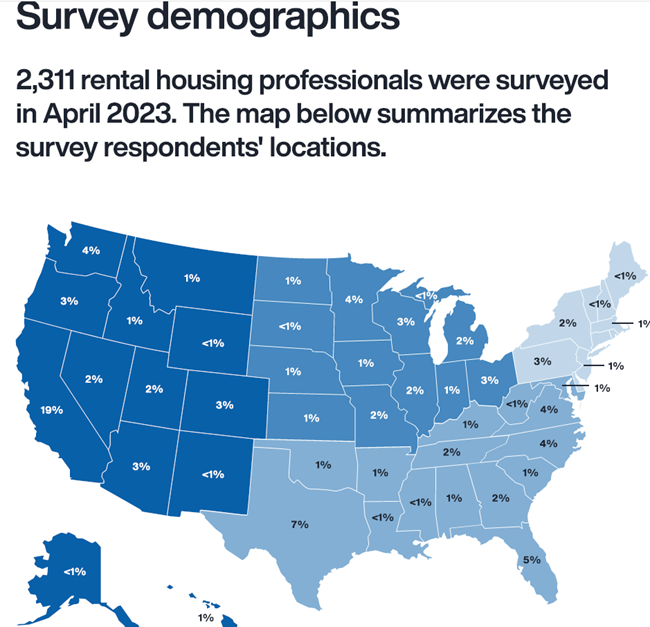
The National Apartment Association (NAA) along with AppFolio conducted a survey for their Property Management Industry Report of more than 2,000 property management industry professionals in April 2023.

Key Points From The Survey

  • The top challenge facing housing providers was operational efficiencies, which comprised 76% of responses.
    • The most challenging activity within this group was reducing costs, as cited by 57% of respondents.
    • Although inflation has eased in recent months, insurance and property taxes have been skyrocketing in recent years, while costs of capital and wage increases are adding to the upward pressure on costs.
  • Operational efficiencies were followed closely by maximizing revenue and profits (61%) and HR, staffing and recruitment (42%).
  • The results mark a significant contrast from 2021, when HR, staffing and recruitment was reported as the top challenge for apartment professionals at 74%.
Operational efficiencies that can reduce costs are now the top challenge for rental property managers a new report from the NAA says
Charts courtesy of the National Apartment Association and AppFolio

Operational efficiencies that can reduce costs are now the top challenge for rental property managers a new report from the NAA says

“Across the country, monumental cost increases – from insurance premiums and utilities to property taxes – are impacting operations for housing providers who by and large operate on narrow profit margins,” NAA President and CEO Bob Pinnegar said in a release.

“This year’s survey importantly elevates the voice of property management companies and provides important takeaways for the kinds of solutions the industry can implement to ease these challenges and remain viable for generations to come.”

This year’s results notably reveal a significant change from how owners and operators ranked their most pressing concerns in 2021. Two years ago – amid record-breaking rent growth and historic demand for apartment living – property management professionals ranked HR/staffing/recruitment as their top challenge (74%).

“Inflation has spoken loud and clear in this year’s survey, touching many of the industry’s most pressing challenges,” NAA Vice President of Research Paula Munger said in the release.

“This doesn’t mean that the industry’s labor woes have disappeared, but it is a testament to the impacts of a high interest rate and high inflationary environment.”

The Challenge Of Maximizing Revenue

“New supply pressures in some markets coupled with a dip in demand caused mainly by an uncertain economic climate are behind the lackluster rent growth, which is negative in some markets, so it’s not surprising that strengthening alternative sources of revenue came in fourth place

“In addition to a focus on top-line revenue, industry leaders are also maintaining margins by negotiating with suppliers, adjusting bonus programs, or changing suppliers altogether.

“Others are using incentives for on-site teams, including maintenance staff, and tying bonuses to resident retention. Some said they were willing to prioritize stable occupancy over rent growth for the remainder of the year, and to that end are not being overly aggressive on renewal increases.

“A big concern in minimizing expenses is to not dilute the resident experience in the process — an outcome that may prompt renters to look to move elsewhere and take advantage of concessions increasingly being offered in some markets,” the report says.

Operational efficiencies that can reduce costs are now the top challenge for rental property managers a new report from the NAA says

Some closing thoughts from the report

“With inflation moving in the right direction and recession fears receding, owners and operators may see relief on the horizon for some of these challenges. The many non-economic challenges, however, may very well continue, highlighting the need for all rental housing stakeholders to work together in finding solutions to keeping the industry responsible for housing millions of Americans vital and profitable,” the report says.

Read and download the full report here.

Operational efficiencies that can reduce costs are now the top challenge for rental property managers a new report from the NAA says

Rents Are Falling But Falling Slower In The Suburbs

Rents are falling in most parts of the country but falling slower in many suburban communities than the rent drops seen in urban areas

Rents are falling and down year-over-year in most parts of the country but many suburban communities, which experienced dramatic rent inflation in 2021 and 2022, are seeing slower rent drops than urban areas, according to a new report from Apartment List.

“The rental market is taking a deep breath in 2023. Double-digit annual rent growth persisted in 2021 and 2022, but has swiftly fallen to -0.7% as of our most recent estimates for July, meaning apartments are renting for less today than they did one year ago. This is the first year-over-year price drop the rental market has experienced since the early days of the COVID-19 pandemic,” writes Apartment List senior research associate Rob Warnock.

Rents are falling in most parts of the country but falling slower in many suburban communities than the rent drops seen in urban areas

Urban-suburban rent gap

The urban-suburban gap has widened steadily for the past eight months because rent drops have been slower in the suburbs than in core cities, the report says.

In some metro areas, the urban-suburban gap is more than twice the national average. This includes a handful of dense, coastal metros like Seattle, Portland, Los Angeles and Washington, DC; where core cities experienced deep rent cuts early in the pandemic are just now returning to pre-pandemic prices.

Rents are falling in most parts of the country but falling slower in many suburban communities than the rent drops seen in urban areas

What’s Next for Suburban Rental Markets?

Rent growth should continue to cool in the coming months, as fewer moves take place during the winter and a strong construction pipeline creates new apartment vacancies.

But it remains to be seen if forthcoming rent drops will remain concentrated in urban centers or if they will proliferate outwards to the suburbs.

As more workers return to downtown offices, some apartment demand should shift inward towards core cities. And a recent study found that the majority of last year’s new building permits were issued in suburban areas. These trends suggest that we are moving in the direction of better supply-demand balance in the suburbs. Nevertheless, rents in many suburbs are over 20 percent higher today than they were in 2020, so strong supply growth must be maintained for years to reclaim some of the affordability that was lost during the pandemic.

Read the full report here.

Accessing Utah’s Home Energy Rebate Programs

The U.S. Dept. of Energy announced states can apply for funding allocations through the Inflation Reduction Act Home Energy Rebate programs.

Ryan Kristoff

The U.S. Dept. of Energy (DOE) recently announced that States can apply for their funding allocations through the Inflation Reduction Act (IRA)-created Home Energy Rebate programs.

Utah’s Office of Energy Development (OED) will administer the funds in Utah. Once the program is underway, multifamily affordable housing (MFAH) will be able to receive rebates of up to $14 thousand per apartment to install heat pump-based HVAC and water heaters, and to upgrade their property’s electrical infrastructure. They can tap up to $8 thousand per apartment for other efficiency solutions.

Heat pumps for space conditioning and water heating are several times more efficient than the business-as-usual alternatives, such as gas-fired furnaces and water heaters and central air conditioners. Switching to heat pumps can reduce operational costs and improve property value while creating healthier, safer, more comfortable, and affordable homes for the low-income tenants. Growing demand for these systems has been slowly but surely driving down costs.

DOE has given states significant flexibility in designing their Rebate programs. MFAH needs to push Utah’s OED to design a program that can effectively serve MFAH, otherwise the State may create a program that ultimately favors the single-family market.

History shows that programs designed around single-family without taking MFAH into account will ignore that market segment.  For guidance, OED should collaborate with the Rocky Mountain Power (RMP) Multifamily Energy Efficiency Program in Utah. RMP’s program offers a one-stop-shop approach that includes outreach and education, income-qualification, project design and management, and reporting. It was crafted in collaboration with multifamily stakeholders, and it is one of the country’s leading electrification programs.

About the author:

Ryan Kristoff is the Grants Director at ICAST, a national nonprofit that designs holistic retrofits solutions for MFAH. He works with local government, utility, state, and federal partners to design and launch clean energy programs to benefit MFAH.

5 Essential Marketing Strategies to Boost Occupancy Rates

Here are 5 essential marketing strategies rental property owners can implement to boost their occupancy rates.

Here are 5 essential marketing strategies for rental property owners on how to boost occupancy rates.

By Alexis Krisay

Owning and managing rental properties can be a lucrative venture, but to maximize your profits, you need to keep those occupancy rates high.

An empty rental property means lost income and increased expenses. To ensure a steady stream of tenants, effective marketing strategies are essential. In this blog post, we’ll explore five essential marketing strategies that rental property owners can implement to boost their occupancy rates.

1. Create an Appealing Online Presence

In today’s digital age, the first place potential tenants look for rental properties is online. Therefore, it’s crucial to establish a strong online presence. Start by creating a professional and user-friendly website for your rental properties. Include high-quality photos, detailed descriptions, and virtual tours if possible. Make sure your website is mobile-responsive, as many people use their smartphones to search for properties.

Additionally, list your properties on popular real estate and rental websites. Utilize social media platforms to showcase your properties and engage with potential tenants. Regularly post updates, share tenant testimonials, and respond promptly to inquiries. An appealing online presence not only helps you attract tenants but also builds trust and credibility.

2. Highlight Unique Selling Points

What sets your rental properties apart from the competition? Whether it’s a prime location, modern amenities, or exceptional views, identifying and highlighting your unique selling points can make a significant difference. Use compelling language and visuals to showcase what makes your properties special.

For example, if your rental property is in a vibrant neighborhood with access to public transportation and trendy restaurants, emphasize these benefits in your marketing materials. If you offer amenities like a fitness center, swimming pool, or pet-friendly features, make sure to mention them prominently.

3. Implement Targeted Advertising

Blanket advertising might attract some interest, but targeted advertising is more effective at reaching your ideal tenants. Identify your target audience based on factors such as demographics, interests, and lifestyle. Once you have a clear picture of your ideal tenant, tailor your marketing efforts to reach them specifically.

Utilize online advertising platforms like Google Ads and Facebook Ads to create highly targeted campaigns. For instance, if you’re targeting young professionals, you might focus on platforms like LinkedIn or Instagram. By narrowing your audience, you increase the likelihood of attracting individuals who are genuinely interested in your rental properties.

4. Offer Incentives and Flexible Leasing Options

To entice potential tenants, consider offering incentives or flexible leasing options. This could include discounted rent for the first month, waived security deposits, or even including utilities in the rent. These incentives can make your properties more appealing compared to others in the market.

Additionally, offering flexible leasing options such as month-to-month leases or shorter lease terms can attract tenants who may not want to commit to a longer rental agreement. Providing choices and accommodating different needs can give you an edge in a competitive market.

5. Engage with Current and Past Tenants

Your current and past tenants can be valuable advocates for your rental properties. Engage with them and encourage them to leave positive reviews on platforms like Google, Yelp, and social media. Positive testimonials from satisfied tenants can significantly influence the decisions of potential renters.

Consider implementing a referral program where tenants can receive rewards for referring friends and family who ultimately become tenants. This not only helps with tenant retention but also brings in new leads through word-of-mouth marketing.

In conclusion, you can boost occupancy rates for your rental properties with a well-rounded marketing strategy that leverages both online and offline tactics. By creating a strong online presence, highlighting unique selling points, targeting your advertising efforts, offering incentives, and engaging with tenants, you can effectively attract and retain tenants, ensuring a steady income flow from your rental properties.

About the Author:

With an extensive background in online and offline strategic marketing operations, Alexis Krisay is the Co-founder and President of Marketing at Serendipit Consulting. Alexis graduated from the University of Arizona with a degree in communications and marketing and is currently an active member of Entrepreneur’s Organization (EO). In 2013, Alexis was named on the list of 30 Under 30 and Student Housing Rising Star the following year, both by Student Housing Business.

Sign Up For Our Weekly Newsletter And Get Rental Property And Apartment News And Helpful, Useful Content Each Week.

* indicates required

Keeping Your Communications Compliant with Fair Housing

5 Ways to Communicate Better with Challenging Tenants

What to Look for in Property Management Software

5 Things Your Company Can Do To Retain Top Talent in Multifamily

Oregon Landlord To Pay $17,000 Over Assistance Animals

HUD says an Oregon landlord will pay $17,000 for refusing reasonable accommodation request to waive a no-pet policy for an assistance animal

An Oregon landlord will pay $17,000 after refusing a reasonable-accommodation request to waive a no-pet policy and allow a tenant’s assistance animals – a dog and cat-  into their rental property, according to a release.

The U.S. Department of Housing and Urban Development (HUD) said in a release that Kye Patton and Bob Cave, the owner and manager of a duplex apartment in Salem, Oregon, will pay $17,000 to resolve allegations that they violated the Fair Housing Act by denying a reasonable accommodation request for a woman to live with her assistance animals.

The woman had requested the accommodation because her assistance animals help alleviate symptoms of her disabilities that substantially limit her major life activities, including sleeping, concentration, social interaction with others, working, reasoning, and caring for herself.

The owner of the rental property wrote to the tenant, “We will NOT be changing our rental policy. If you feel that you need this accommodation, then please look for another place to live. We will NOT accept any animals of any kind no questions asked. I will give you a good rental reference if needed.”

Cave also verbally denied the tenant’s request, telling her that he would not change the rental policy, would not accept any animals of any kind, and that she should seek new housing if she insisted on an accommodation, according to the release.
The tenant later vacated the property and moved to a different residence that would allow her to live with her assistance animals.

In addition to the $17,000, Patton and Cave must develop a reasonable accommodation policy that is in compliance with the Fair Housing Act and applies to every property they own or manage. They must also maintain records of any reasonable-accommodation requests they receive.

“The Fair Housing Act requires housing providers to make reasonable exceptions to their ordinary policies when necessary for individuals with disabilities to live with their assistance animals,” said Damon Smith, HUD’s General Counsel, in the release. “A housing provider’s refusal to do so is a serious violation of the law.”

Sign Up For Our Weekly Newsletter And Get Rental Property And Apartment News And Helpful, Useful Content Each Week.

* indicates required

New Apartment Construction To Remain High Until 2025

The new apartment construction building boom- the biggest since the 1970s – while slowing somewhat is expected to continue until 2025

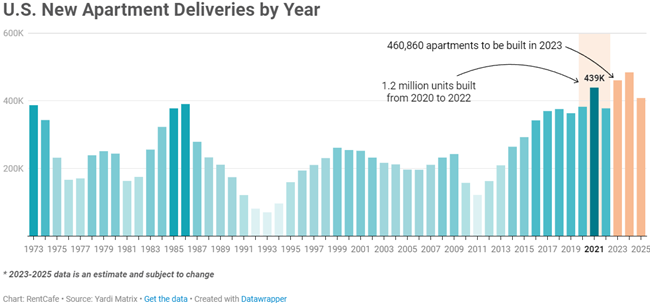
The new apartment construction building boom- the biggest since the 1970s – while slowing somewhat is expected to continue until 2025, according to a new report from Rent Café.

“Our annual apartment construction report based on Yardi Matrix data shows that the number of deliveries is expected to remain high until 2025 when the echoes of the current economic headwinds will begin affecting construction as well,” the report says.

New apartment construction summary

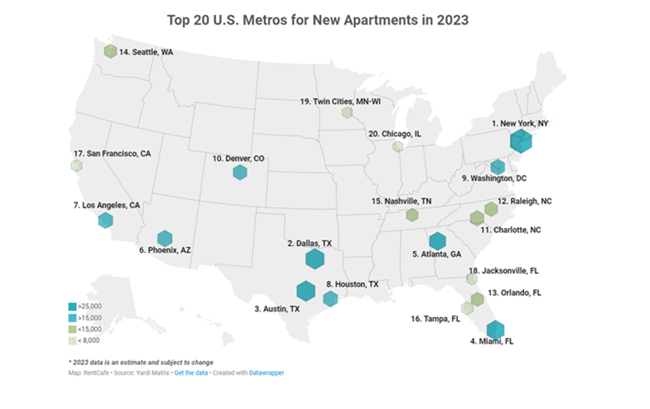
  • 460,860 new apartments are expected to open this year as New York metro emerges as the top builder with 33,000 rentals.
  • 1.2 million new apartments were opened throughout the U.S. during the pandemic boom, with Dallas metro opening the most apartments during those three years (76,660 units).
  • At the city level, Texas’ Austin and Houston topped the chart for most apartments built in 2020 through 2022.
  • 60% of the new units built from 2020 to 2022 are accessible to only 41% of America’s renter population.
  • Another 1 million new rentals are set to be completed through 2025, despite economic headwinds.

Why did this happen?

Households grew at a rapid rate after the pandemic as job growth boomed and young adults moved out of their parents’ homes.

At the same time, “work-from-home prompted renters to form their own households to gain more living space for offices, children and pets,” said Doug Ressler, senior manager of business intelligence at Yardi Matrix.

The new apartment construction building boom- the biggest since the 1970s – while slowing somewhat is expected to continue until 2025

New apartment supply will drop in coming years

The supply growth is likely to go slower after the current round of projects is completed. 

“Tightening of bank lending standards — combined with rising costs of construction materials, labor and land — has made new projects harder to pencil,” Ressler said.

“Construction debt starts at 8% interest, and most banks only lend 60% or less of the total cost of a project.

The new apartment construction building boom- the biggest since the 1970s – while slowing somewhat is expected to continue until 2025
Doug Ressler, senior manager of business intelligence at Yardi Matrix.

“Junior construction debt is even more expensive, with interest rates in the mid-teens. This financing structure can make it challenging for companies to initiate new construction projects unless they already have a substantial amount of capital on hand,” Ressler said.

The number of new apartments is expected to drop by 15% year-over-year — from 484,000 in 2024 to 408,000 in 2025  with new completions bottoming out in 2026 at approximately 400,000 units. Then, according to Yardi Matrix estimates, the pace of construction is projected to gradually recover in 2027 and 2028. Read the full report here.

As Demand Slows, Supply is Key to Multifamily Rent

As Demand Slows, Supply is Key to Multifamily Rent

Rent growth is being driven by new units, and those multifamily rents are tied to supply as demand slows, says Yardi Matrix in  July report.

Rent growth is being driven by new units, and those multifamily rents are tied to supply as demand slows, says Yardi Matrix in its  July report.

Also, demand is being driven by a strong job market as the economy continued to add jobs in the first half of 2023.

“While we still expect the economy to cool in coming quarters, the fact that second-quarter job and GDP numbers were strong while inflation recedes has confounded the economic consensus. As long as that continues, consumer balance sheets will stay strong and apartment demand is likely to be firm,” the report says.

A few highlights:

  • The multifamily market exhibited strength in July, as the economy continues to outperform expectations. The average U.S. asking rent rose $2 to $1,729, while year-over-year growth fell to 1.6 percent, down 30 basis points from June.
  • After dominating the rent-growth rankings for several years, Sun Belt metros have come back to the pack. The Sun Belt market with the highest year-over-year growth rate is Richmond, which ranks ninth among Yardi Matrix’s top 30 metros (a list that was recently updated).
  • Single-family rents were unchanged in July at $2,108, although they remained at an all-time high thanks to robust occupancy rates. Year-over-year, national SFR rent growth fell 20 basis points to 1.2percent.

Lifestyle rents vs renter-by-necessity

The makeup of rent growth attests to the significant growth in supply, as new deliveries are almost all lifestyle-segment units and add to the competition in that class.

Asking rent growth in July was concentrated in the renter-by-necessity segment, which increased by 0.2 percent while lifestyle rents were flat. Rents increased in 19 of the top 30 Matrix metros for renter-by-necessity, but only in 13 for lifestyle.

Renewal rent growth remains high

“Renewal rent growth remains stubbornly high, a sign of the large gap that grew between existing residents and asking rents over the past two years,” Yardi Matrix writes in the report.

National lease-renewal rates were 59.4 percent in May, down from 64.4 percent in April.

Rent growth is being driven by new units, and those multifamily rents are tied to supply as demand slows, says Yardi Matrix in  July report.

Regulatory focus on multifamily

“The unprecedented rapid growth in rents over the last few years has put a bullseye on the multifamily industry with policymakers across the country, with mixed results,” the report says.

Some examples:

  • The rapid growth in multifamily rents has increased policymakers’ scrutiny of the industry.
  • Some legislative efforts—including rent controls and fee regulations—add to the costs of owning apartments.
  • A more productive response is embodied in the Biden administration’s plan to incentivize and fund affordable supply.

Read the full Yardi Matrix report here.