
Home Blog Page 49

The Leasing Centralization Conundrum: When is the Right Time?

Your company may need leasing centralization especially if you have limited staffing and reduced resident service levels.

What are the indications your company may need leasing centralization especially if you have limited staffing and reduced resident service levels.

By Katie Nelson

 Seldom part of the apartment sector’s vernacular prior to 2020, the term centralization has been a prominent component of many industry conversations the past few years. So much so, in fact, that many organizations actively wonder whether they are missing out if they are not deploying it to some degree.

Like many new-school concepts in multifamily, leasing centralization had been on the industry’s “next wave” radar and became more prominent because of the pandemic. Operators learned about its potential efficiencies in 2020 and 2021, and it has since become a staple of the modern-day operations of many organizations.

Forbes defines centralization in multifamily as “any effort to move away from individual property-based leasing and operational teams and centralize them in one or multiple regional locations to improve efficiencies and cut down costs.”

That’s a broad description, and many potential organizational efforts can fall under its umbrella. That’s why the question “is centralization the right fit for an organization?” is something of a challenging question. While some traditional concepts such as call centers technically qualify as centralization, most modern-day efforts focus upon efficiencies spurred by the shutdown, such as the need to provide virtual leasing during a contactless environment.

Signs operators might need it

So, what are the indicators that your organization might need centralization? If your company is experiencing pain points within existing operating procedures—often in the form of limited staffing—it might be time to shift toward it. Limited staffing, of course, creates the double-whammy of reduced resident service levels and potential burnout of onsite teams due to the overload of responsibilities.

Operators experiencing these challenges can consider centralizing certain services—and this is where one organization might vary from the next. In an effort to bolster service levels and create a balanced working environment, operators have centralized the roles of assistant property manager, accounting personnel, maintenance supervisor and several additional positions that are typically onsite.

Leasing centralization often serves as a prominent option for operators with several communities within a certain locale. For instance, operators with five communities within a 30-mile radius can centralize service-centric roles that still require some onsite presence. That said, proximity doesn’t matter for leasing- or accounting-focused roles that are mostly handled digitally and remotely.

Centralized leasing can reduce pain points

While centralization can equate to different things to different operators, the form that most directly impacts everyday onsite operations is centralized leasing. Offsite associates can assist teams by answering calls, setting tour appointments, conducting follow-ups and marketing the community. This can result in a richer customer experience with greater service levels and more information for prospects, which subsequently can increase lead-to-lease closing ratios.

With a large portion of prospect calls taken care of by the centralized leasing team, onsite associates can devote more focus to resident needs and the community at large. It can create a more efficient work environment and leave associates less overburdened.

Centralizing certain leasing services also can help solve hiring challenges. While it’s not only difficult to find high-performing onsite team members in the current industry landscape, offering a competitive salary also can put a strain on the community budget. Centralized leasing programs can reduce these costs without sacrificing service levels.

Challenges to consider

Operators considering a centralized platform should first define their specific needs and challenges—then create the platform. They should take inventory of the immediate changes it will present for current associates and write a business plan for the new platform. Learning from the experiences of other operators is key, as well, and operators should consider reaching out to other organizations that have successfully implemented centralization concepts.

Additionally, it is crucial to hire the right associates in the transition to centralization. The skills possessed by an onsite leasing associate might differ from what’s needed in a centralized leasing employee. Implementing the proper technology is also paramount, as teams should allow time to vet solutions, implement them and learn their various nuances before launching any type of centralization.

Lastly—and perhaps most importantly—when considering a potential move to centralization, think about the prospect’s experience. While newfound efficiencies can be welcoming for an onsite team, the industry’s primary mission is to provide an amazing customer journey. That should be enhanced rather than disrupted with any move to centralization.

About the author:

Katie Nelson is the Vice President of Marketing for CAPREIT.
Top 10 Cities To Watch For Rentals In 2024

Sign Up For Our Weekly Newsletter And Get Rental Property And Apartment News And Helpful, Useful Content Each Week.

* indicates required

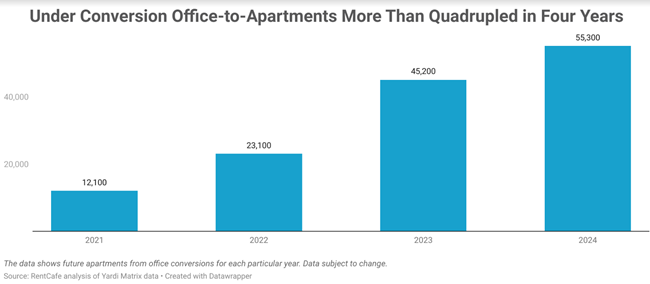
55,000 Office-to-Apartment Conversions Underway in Major Cities

Office-to-apartment conversions show office buildings, “once the epicenters of the 9-to-5 grind, are being transformed into the new homes

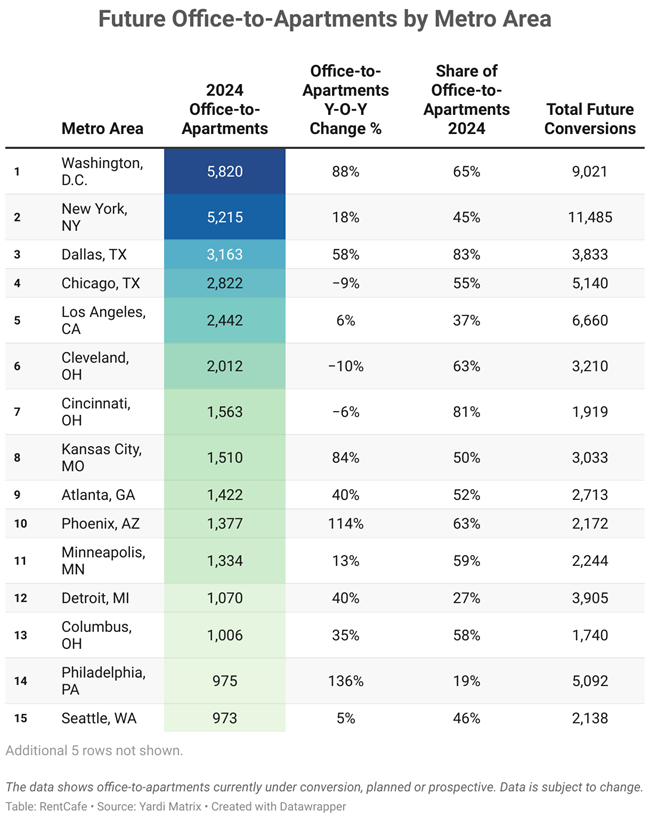
Office-to-apartment conversions show office buildings, “once the epicenters of the 9-to-5 grind, are being transformed into the new homes of urbanites, in a pandemic-driven remote-work new reality,” RentCafe says in their adaptive reuse report.

The report says the offices that are having the makeovers “are relatively newer, averaging 72 years old, which is 20 years younger than those previously converted.”

Using relatively newer buildings for office-to-apartment conversions “suggests a strategic preference for buildings that might require less investment in refurbishment and are more likely to meet modern standards, potentially simplifying the conversion process.”

Where are top 5 office-to-apartment conversions taking place?

Here is a breakdown by RentCafe of the cities where most of the conversions are taking place:

  1. The Washington, D.C., metro area leads in office-to-apartment conversions, with 5,820 units in the pipeline – nearly doubling last year’s figures with an 88% increase. The largest transformation: The Myers Drive project in Arlington, which is repurposing Rosslyn’s Xerox Building into a 691-unit apartment complex.
  2. New York metro is second, preparing to convert office spaces into an impressive 5,215 apartments (up 18% since last year). Leading the adaptive reuse movement is the 25 Water Street project in Manhattan, which will convert the former home of The Daily News and J.P. Morgan into 1,263 new apartments, marking the largest single project of its kind in the country.
  3. Dallas has 3,163 units transitioning from office spaces to apartments, which translates into a 58% year-over-year increase. A standout project is the redevelopment of the Renaissance Tower on Elm Street, poised for a real-life renaissance as it swaps out old offices for 500 modern apartments.
  4. Chicago is next with 1,422 new apartments created by repurposing old office buildings. Not even the 9% dip from last year could stop the metro from being a frontrunner in future office-to-apartment conversions. The project at 135 South LaSalle St. stands out as Chicago’s largest, with 430 expected units.
  5. Rounding up the top five is Los Angeles, with 2,442 units in the pipeline and a 6% uptick since the previous year. Taking center stage is the adaptive reuse project at 695 S. Vermont Avenue, which is ready to roll out 255 new apartments.

Office-to-apartment conversions show office buildings, “once the epicenters of the 9-to-5 grind, are being transformed into the new homes

While offices offer the best opportunity for apartment conversions with 38% of the conversions, other properties work as well, the RentCafe report says. Other buildings are:

  • Hotels 24%
  • Factories 13%
  • Healthcare buildings 6%

Learn more about other cities and adaptive reuse here at the full RentCafe report.

Top 10 Cities To Watch For Rentals In 2024

Sign Up For Our Weekly Newsletter And Get Rental Property And Apartment News And Helpful, Useful Content Each Week.

* indicates required

As Human Trafficking Surges, Multifamily Has a Role in the Solution

Human trafficking is a global tragedy and a $99-million-a-year criminal enterprise in the nation with only about 1% of victims currently being rescued

If you know or suspect someone is a victim of human trafficking, contact the National Human Trafficking Hotline at 1-888-373-7888 (TTY: 711) or SMS text 233733.

By Stephanie Anderson

Human trafficking is a global tragedy and a $99-million-a-year criminal enterprise in the nation with only about 1% of victims currently being rescued, according to the U.S. Department of Defense. With January being National Human Trafficking Prevention Month, educating every employee in a company is critical to identifying potential victims and increasing the rescue rate. As an industry, we need to familiarize ourselves and take advantage of all of the available multifamily-focused resources, including Human Trafficking Truths: A Guide to Saving Lives in Your Community, in order to raise awareness and bring an end to a grave issue that harms tens of millions.

The COVID-19 pandemic travel restrictions slowed down human trafficking cases. Unfortunately, during this time, traffickers took advantage of the situation by sharpening their skills at utilizing the Internet to lure their victims, including the creation of fake job ads. As a result, the number of victims has increased to around 27 million from an estimate of 21 million in 2022, according to the 2023 Trafficking in Persons Report by the U.S. Department of State. Furthermore, the report also notes a five-fold increase in the identification of male victims.

Human trafficking can sometimes be difficult to spot since victims might appear to be shy or standoffish, while others interact normally with those around them. However, there are often cues that indicate trafficking could be taking place in a community that might seem innocuous at first. A child who seems shy. A woman in the house who is not allowed to drive. A person who speaks for everyone. They might seem harmless individually but put together, they may point to trouble. It’s important for onsite teams to know the signs of trafficking and create a plan of action for the situation. Here are some starting points to help multifamily associates start to identify a potential human trafficking case, along with next steps.

Signs of Human Trafficking

Human trafficking has no boundaries and schemes target people of any socioeconomic, religious, cultural, or ethnic background. Traffickers are present in urban, suburban and rural areas, but favor places that have vulnerable populations, such as multifamily properties, public housing and homeless shelters. Recognizing the key indicators of human trafficking is the first step in identifying victims. Onsite teams need to be aware of the signs of human trafficking and pay particular attention to situations where multiple signs are present.

Living Situation

People involved in human trafficking don’t have typical living habits. If onsite team members are able to view the apartment home, they may witness items present or an interior setup that should cause concern.

 Too many people living in one apartment

  • Interior locks on doors and windows designed to keep people in, not out
  • Abnormal living conditions such as multiple mattresses on the floor of a single room

Actions and Activity

In addition to an atypical living situation, human trafficking comes with activities that will be out of the norm. Child sex trafficking and adult sex trafficking may have numerous visitors to a single apartment. Labor trafficking might have a group of people on a set schedule.

  • Frequent visitors to an apartment with short visits of 15 to 45 minutes at a time
  • People who are picked up and then brought back later at around the same time daily
  • A prospect wants details regarding security cameras on the property
  • The potential resident requests an apartment that looks over the parking lot
  • A person who is often in the company of someone they defer to or who controls their behavior, such as where they go or who they talk to
  • Someone who does not have access to their own personal documents
  • An adult who is not allowed to drive or travel alone

Behavioral Cues

The behavior of a person can reveal them as a victim of human trafficking, but it can be difficult to tell. Victims may be withdrawn or very social but will always remain silent about their situation. Their behavior could also be mistaken for shyness or other causes.

  • A prospect or resident who is anxious if law enforcement is present or mentioned
  • Someone who seems to be coached on what to say and sound like they’re following a script
  • Someone who appears fearful, timid, submissive or avoids eye contact
  • Someone who is disoriented or confused
  • A person who shows signs of mental or physical abuse or signs of being denied food, water, sleep or medical care
  • Someone who lacks knowledge of the neighborhood or city they are in
  • Someone who has someone else to speak for them and doesn’t appear to know the person they are with

What to Do Next

If human trafficking is suspected in a community, there are steps to take to address it. Property management professionals should not put themselves in harm’s way or confront anyone if human trafficking is suspected. While calling the police might seem like an ideal option, victims are usually conditioned to fear law enforcement and told they will be arrested also. Instead, suspicious activity should be reported to the National Human Trafficking Hotline at 1-888-373-7888 (TTY: 711) or SMS text 233733. This organization has the resources to assist and an understanding of victims, especially how to gain their trust and rescue them. They also understand better when it’s time to get law enforcement involved. If your company has a policy in place, you should follow your company protocol or speak to your direct supervisor.

Grace Hill is proud to offer a course on human trafficking, which has been taken by more than 100,000 multifamily professionals. It provides an in-depth look into the topic, including how it affects our industry and how apartment owners and operators can respond to suspected human trafficking situations.

About the author

Stephanie Anderson is Senior Director of Communication and Social Media for Grace Hill. She is an advocate for the implementation of human trafficking policy and access to resources for the real estate community. Stephanie is a certified Mental Health First Aid (MHFA) instructor, as well as a member of the National Apartment Association Operations Committee and NAA’s Mental Health Committee.

About Grace Hill

Grace Hill provides industry-leading SaaS technology solutions designed to make a positive impact in real estate and improve the lives of people where they work and live. Harnessing years of real estate experience and the understanding that people are better together, Grace Hill helps owners and operators increase property performance, reduce operating risk and grow top talent. More than 500,000 professionals from over 1,700 companies rely on Grace Hill’s talent performance solutions covering policy, training, assessment, survey, and data-driven insights. Visit us at gracehill.com or on LinkedIn.

Human trafficking is a global tragedy and a $99-million-a-year criminal enterprise in the nation with only about 1% of victims currently being rescued

The Importance of Human-Trafficking Knowledge for On-Site Teams

Sign Up For Our Newsletter And Get Rental Property And Apartment News And Helpful, Useful Content Each Week.

* indicates required

Top 10 Features and Amenities Today’s Renters Want

Here are the top 10 features in apartments – as well as the top 10 community amenities – today’s renters say they want

Here are the top 10 features in apartments – as well as the top 10 community amenities – today’s renters say they want, based on the 2024 NMHC and Grace Hill Renter Preferences Survey Report.

By Sarah Yaussi

Understanding prospective renters’ preferences is a fundamental responsibility for property owners, developers, and managers.

However, it’s more than just about knowing what renters are looking for or would like to have; it’s about identifying the truly non-negotiable elements that are crucial for modern lifestyles and everyday enjoyment. Recognizing these dealmakers (and dealbreakers) ensures consistent and reliable occupancy — and happier communities.

Whether it’s high-speed internet, modern appliances, a pet-friendly policy or other in-demand features, emphasizing desirable differentiators can create a compelling marketing narrative that resonates with current and potential renters. In the 2024 NMHC and Grace Hill Renter Preferences Survey Report, renter respondents shared both the aspirational and practical elements that make the difference when they’re considering which home to rent. Based on 172,703 survey responses across 77 markets and 4,220 communities, the report provides a valuable snapshot into the needs and desires of a wide range of renters.

Renter respondents surveyed were focused on privacy, convenience, and lifestyle when communicating which features and amenities they simply were unwilling to do without. They’re looking for homes and communities that function as retreats for themselves, their friends, and their families.

Top 10 Features Renters Want or Would Not Rent Without

These are those deal-makers (or deal-breakers!):

  1. Air conditioning (93 percent)
  2. Washer/dryer In unit (93 percent)
  3. High-speed Internet access (90 percent)
  4. Soundproof walls (88 percent)
  5. Walk-in closet (87 percent)
  6. Garbage disposal (87 percent)
  7. Dishwasher (87 percent)
  8. Noise-reducing window panes (83 percent)
  9. Pre-installed window shades/blinds (83 percent)
  10. Refrigerator with water/ice dispenser (81 percent)

Amenities such as air conditioning and in-unit washers/dryers, which at one time were considered luxuries, are now essential components for comfort and convenience.

Survey respondents named these their top must-haves, each with 93 percent of renter respondents indicating they were interested in these features or wouldn’t rent without them.

Whether for remote work, streaming music or video, or gaming, high-speed internet access ranked high on the list of renter essentials as well (90 percent). Along with this, the privacy offered by soundproof walls (88 percent) and noise-reducing windowpanes (83 percent) allows renters a sense of refuge to get work done or enjoy an evening without interruptions.

Walk-in closets (87 percent) and pre-installed window shades and blinds (83 percent) were both important to renters, providing room for storage and the ability to settle into a new rental home quickly and easily. Similarly, upgraded kitchen appliances that were once considered desirable extras, such as garbage disposals and dishwashers (both 87 percent) along with refrigerators with water and ice dispensers (81 percent), are now considered essential for a well-equipped kitchen.

Top 10 Amenities Ranked

A look at the community amenities renter respondents said they were interested in or wouldn’t rent without.

  1. Reliable cell reception (86 percent)
  2. Secure self-service 24/7 package access (76 percent)
  3. Covered parking (76 percent)
  4. Swimming pool (76 percent)
  5. Controlled property/amenity access (75 percent)
  6. Dedicated visitor/guest parking (73 percent)
  7. Fitness center (73 percent)
  8. Controlled-access parking (72 percent)
  9. Non-smoking buildings (71 percent)
  10. On-site back-up power supply (68 percent)

Renters expect seamless use of their mobile devices at all times for everything from answering emails to resourcing GPS navigation to video conferencing. This level of connectivity isn’t just considered convenient; it’s considered essential for personal safety, work-from-home professionalism, and family communication. Because of this, reliable cell reception topped the survey’s list of amenities that renters won’t live without. Another popular amenity—on-site back-up power supply (68 percent)—ensures that power outages don’t interrupt that all-important online access.

Whether ordering essentials from Amazon or dinner from the local take-out restaurant, secure, consistent, and convenient access to packages and deliveries was a significant consideration for 76 percent of the renters surveyed.

In addition, on-the-go lifestyles require convenient and reliable transportation and parking options, reflected in the preference for covered (76 percent) and controlled access (75 percent) parking. In addition, when guests arrive, ensuring that they have a dedicated place to park is also a high priority for 73 percent of renters surveyed.

Many renters look to their community amenities to provide resources that support their active lifestyles. A swimming pool (76 percent), fitness center (73 percent), and non-smoking buildings (71 percent) were high on the wish lists of renters surveyed, allowing them to stay healthy and fit close to home.

For property investors, developers and management companies alike, insight into the lifestyles and needs of the modern renter offers the opportunity to plan ahead, differentiate services, and develop marketing strategies that are tailor-made for potential residents in their properties. By knowing the difference between nice-to-have bells and whistles and must-have features and amenities that renters simply won’t do without, it’s easier to keep homes filled and residents happy.

Building more thoughtful, purpose-driven, and responsive communities is good for everyone.

About the author:

Sarah Yaussi

Sarah Yaussi is vice president of business strategy at the National Multifamily Housing Council. Since its inception in 2013, the NMHC and Grace Hill Renter Preferences Survey Report has been the authoritative data source for apartment owners, managers, developers, industry suppliers, as well as architects, financial institutions and others seeking insights into the minds of renters. For more information, visit NMHC.org/residents.

Digital Leasing Requires a Precise Human Touch

Inclusive Rental Communities: Fair and Safe Policy Making

Fair and safe policy making in rental communities involves adaptable supervision policies, appropriate technology access for youth

Fair and safe policy making involves adaptable supervision policies, appropriate technology access for youth, and uniform application of safety measures to avoid discrimination and fair housing violations in rental communities.

By The Fair Housing Institute

To be a property-management professional, it’s vital to strike a balance between maintaining a safe, orderly community and ensuring compliance with fair-housing laws, especially concerning rules that might impact children. This article provides valuable insights into navigating these complex issues.

Supervision Rules and Technology Access

When formulating supervision rules for facilities such as pools or gyms, consider factors beyond just age, such as maturity and skill level.

For instance, pool rules might be based on swimming proficiency rather than a strict age cutoff. Similarly, access to areas like the business center should reflect today’s tech-savvy youth. Rather than imposing an age limit, focus on responsible behavior and proper usage. These considerations ensure that rules are not only fair and inclusive but also adapt to the evolving digital landscape and diverse capabilities of younger residents.

Safety Versus Discrimination in Common Spaces

Distinguishing between safety measures and potential discrimination is crucial in rule-making.

While banning activities like skateboarding for safety is generally acceptable, such policies should apply to all residents to avoid age-based discrimination. Additionally, rules restricting children from playing outside within complex gates warrant reconsideration. A more balanced approach might involve designated play areas that allow children to enjoy common spaces without causing disturbances. This strategy not only addresses safety concerns but also respects the rights of children to use shared facilities.

Equal Access and Neutral Enforcement

When it comes to public areas of your property, it is important to ensure that equal access is granted with fair enforcement to avoid a fair-housing violation.

For example, the disparity in pool hours for adults and children could be seen as discriminatory. Instead, consider implementing family swim times or assessing the hours based on safety and usage patterns rather than age. Moreover, the enforcement of quiet hours should be uniformly applied to all residents. A fair and consistent approach in applying these rules is essential to avoid any perception of age-based bias and to maintain a harmonious living environment.

Regular consultation with fair-housing attorneys ensures compliance with evolving laws. Additionally, actively seeking feedback from residents, especially families with children, can guide the development of rules that are both practical and respectful of everyone’s needs. This engagement not only helps in tailoring policies that are community-centric but also fosters a sense of belonging among all residents.

Documentation, Transparency, and Regular Reviews

Clearly documenting the reasons behind specific rules, especially those regarding supervision, is vital for transparency and can be crucial in case of legal scrutiny.

Furthermore, the societal and legal landscape is constantly changing. Regularly reviewing and updating community rules to reflect these changes is essential in maintaining a legally compliant and inclusive environment.

Additionally, actively seeking feedback from residents, especially families with children, can guide the development of rules that are both practical and respectful of everyone’s needs. This engagement not only helps in tailoring policies that are community-centric but also fosters a sense of belonging among all residents.

In conclusion, this article underscores the necessity of formulating community rules with fairness, safety, and legal compliance in mind.

It highlights the importance of adaptable supervision policies, appropriate technology access for youth, and uniform application of safety measures to avoid discrimination. Balancing children’s play rights with communal order, ensuring equitable policy enforcement, and actively engaging with residents are key.

Regular training, transparent rule documentation, and staying current with legal developments are essential for maintaining an inclusive, compliant, and harmonious community environment. This approach not only aligns with fair-housing laws but also promotes resident satisfaction and overall community well-being.

About the author:

In 2005, The Fair Housing Institute was founded as a company with one goal: to provide educational and entertaining fair-housing compliance training at an affordable price at the click of a button.

New Warnings on Inaccurate Tenant Background Checks

Consumer Financial Protection Bureau issued a new warning to consumer reporting companies about inaccurate tenant background check reports

The Consumer Financial Protection Bureau (CFPB) has issued a new warning to consumer reporting companies to address inaccurate tenant background check reports as well as sloppy credit-filing sharing practices, according to a release.

Background checks often are critical factors when landlords and employers make rental and employment determinations. The information in the reports can cover a person’s credit history, rental history, employment, salary, professional licenses, criminal arrests and convictions, and driving records. However, as documented in earlier CFPB research on tenant screening, background check reports often contain false or misleading information about individuals.

The new warning has two primary ways it seeks to ensure that the consumer reporting system produces accurate and reliable information and does not keep people from accessing their personal data:

  • First, an advisory opinion on background check reports highlights that those reports must be complete, accurate, and free of information that is duplicative, outdated, expunged, sealed, or otherwise legally restricted from public access.
  • Second, an advisory opinion on file disclosure highlights that people are entitled to receive all information contained in their consumer file at the time they request it, along with the source or sources of the information contained within, including both the original and any intermediary or vendor source.

“Background-check and other consumer-reporting companies do not get to create flawed reputational dossiers that are then hidden from consumer view,” said CFPB Director Rohit Chopra in the release. “Background-check reports, and all other consumer reports, must be accurate, up to date, and available to the people that the reports are about.”

Criminal and credit system issues in housing decisions

The CFPB and Federal Trade Commission (FTC) launched a public inquiry in early 2023, and asked for people’s experiences with background checks used to screen potential tenants for rental housing. The CFPB and FTC received more than 600 comments. Most of the comments came from renters. They told the agencies about many problems they encounter, including not receiving adverse-action notices and finding inaccuracies and errors that are difficult to correct and that have a decades-long impact on housing opportunities.

Many described biases in criminal and credit systems transferring into housing decisions.

The CFPB issued the advisory opinion on background screening to highlight that consumer reporting companies, covered by the Fair Credit Reporting Act, must maintain reasonable procedures to avoid producing reports with false or misleading information. Specifically, the procedures should:

  • Prevent the reporting of public-record information that has been expunged, sealed, or otherwise legally restricted from public access.
  • Ensure disposition information is reported for any arrests, criminal charges, eviction proceedings, or other court filings that are included in background check reports.
  • Prevent the reporting of duplicative information.

In addition, the advisory opinion on background screening reminds consumer reporting companies that they may not report outdated negative information—and that each negative item of information is subject to its own reporting period, the timing of which depends on the date of the negative item itself. For example, a criminal charge that does not result in a conviction generally cannot be reported by a consumer reporting company beyond the seven-year period that starts at the time of the charge.

Credit File Disclosure

People have the right to know what information consumer reporting companies keep about them as well as where the information originates. Disclosure of a person’s complete file, upon their request, is a critical component of a person’s right to dispute false or misleading information. Consumers must be provided with all sources for the information contained in their file, including both the originating sources and any intermediary or vendor sources, so they can correct any misinformation.

As explained in the advisory opinion on file disclosure, individuals requesting their files:

  • Only need to make a request for their report and provide proper identification – they do not need to use specific language or industry jargon to be provided their complete file.
  • Must be provided their complete file with clear and accurate information that is presented in a way an average person could understand.
  • Must be provided the information in a format that will assist them in identifying inaccuracies, exercising their rights to dispute any incomplete or inaccurate information, and understanding when they are being affected by adverse information.
  • Must be provided with the sources of the information in their file, including both the original and any intermediary or vendor source or sources.

In a January 2023 report, the CFPB noted improvements and continued challenges for the nationwide consumer-reporting companies. The CFPB has highlighted other consumer reporting problems and has reminded consumer-reporting companies of their obligations to consumers under the Fair Credit Reporting Act. For example, the CFPB issued guidance on permissible purposes for accessing consumer reports, identifying and eliminating obviously false and junk data, and resolving consumer disputes. Additionally, the CFPB has taken action against consumer-reporting companies when they have broken the law, as well as affirmed the ability of states to police credit reporting markets.

Read the advisory opinion, Fair Credit Reporting; Background Screening.

Read the advisory opinion, Fair Credit Reporting; File Disclosure.

Portland, Metro Area Rents Continue Decline

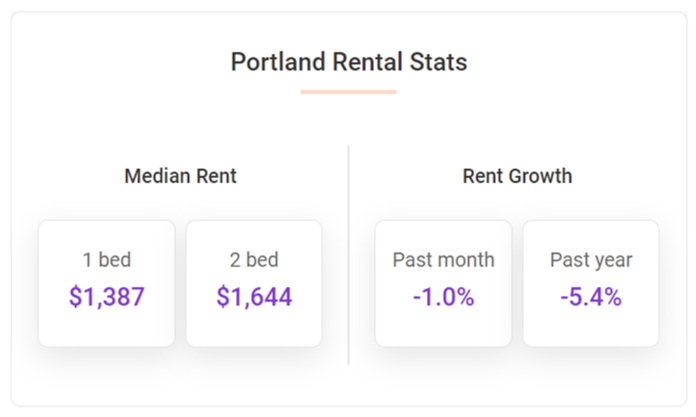
Portland rents declined 1.0% in December and are now down 5.4% year-over-year, according to the January report from Apartment List.

Portland rents declined 1.0% in December and are now down 5.4% year-over-year, according to the January report from Apartment List.

Currently, the overall median rent in the city stands at $1,527, after falling 1.0% last month.

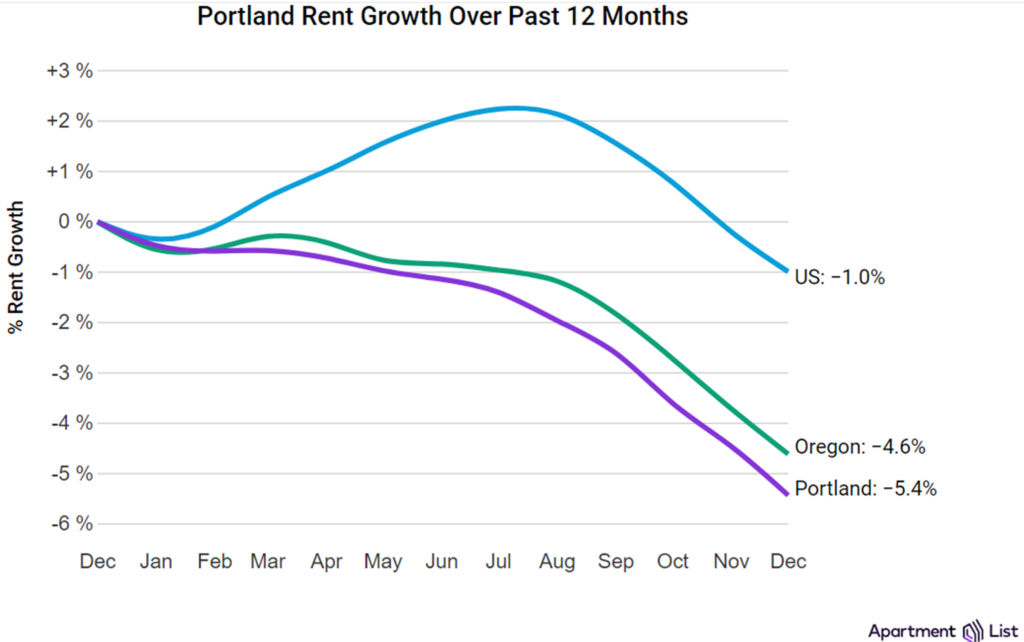
Rents have now decreased by a total of 5.4% over the past 12 months. Portland’s negative rent growth over the past year is similar to the state average (-4.6%) but has fallen below the national average (-1.0%). This is a slower rate of growth compared to what the city was experiencing at this point last year; from January to December 2022, rents had increased 3.1%.

Portland rents declined 1.0% in December and are now down 5.4% year-over-year, according to the January report from Apartment List.

Citywide, the median rent stands at $1,387 for a 1-bedroom apartment and $1,644 for a 2-bedroom. Across all bedroom sizes (i.e., the entire rental market), the median rent is $1,527. That ranks No. 39 in the nation, among the country’s 100 largest cities.

For comparison, the median rent across the nation as a whole is $1,211 for a 1-bedroom, $1,365 for a 2-bedroom, and $1,379 overall. The median rent in Portland is 10.7% higher than the national, and is similar to the prices you would find in Atlanta, Ga. ($1,528) and Austin, Texas ($1,501).

Portland rents in December across the metro

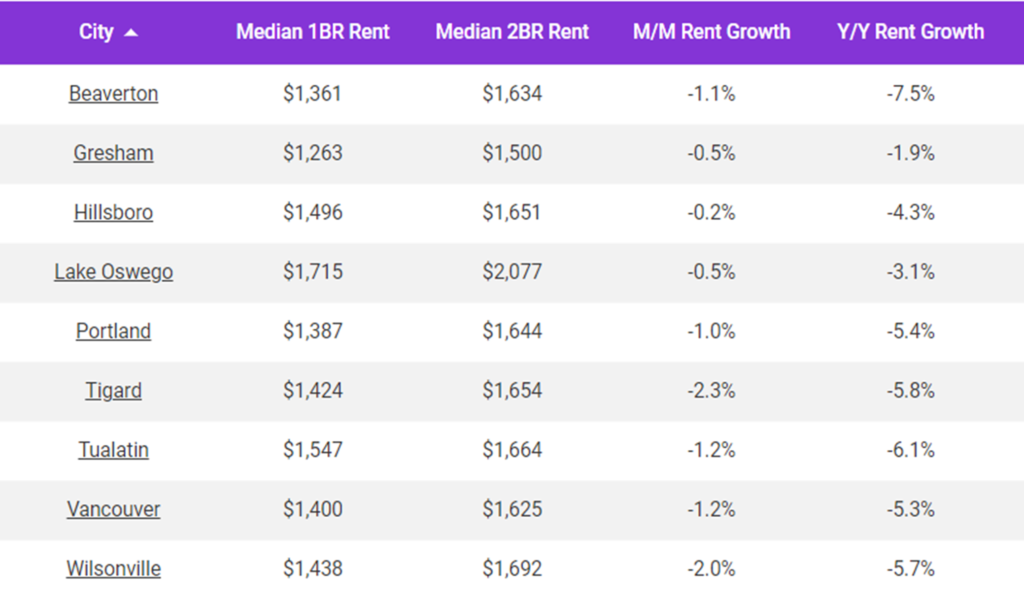
Across the Portland metro area, the median rent is $1,625, meaning that the median price in Portland proper ($1,527) is 6.0% lower than the price across the metro as a whole. Metro-wide annual rent growth stands at -5.0%, above the rate of rent growth within just the city.

The table below shows the latest rent stats for nine cities in the Portland metro area that are included in the Apartment List database.

Among them, Lake Oswego is currently the most expensive, with a median rent of $1,958. Gresham is the metro’s most affordable city, with a median rent of $1,480. The metro’s fastest annual rent growth is occurring in Gresham (-1.9%) while the slowest is in Beaverton (-7.5%).

Portland rents declined 1.0% in December and are now down 5.4% year-over-year, according to the January report from Apartment List.


Portland Update: Changes to FAIR Ordinance Bring (Some) Necessary Changes

Dealing with Habitability issues and Substitute Housing


New Year, New Laws, 2024 Oregon Edition

New laws in the landlord tenant space in Oregon for 2024 involve child care in rentals and notices and return of money and security deposits.

New laws in the landlord tenant space in Oregon for 2024 involve child care in rentals and notices and return of money and security deposits.

By Bradley S. Kraus
Attorney at Law
Warren Allen, LLP

As we approach the end of 2023, it is once again time to look forward to the new year. During this past year, the Oregon legislature has passed a slew of new laws affecting landlord/tenant relations. Several of those laws have been covered in prior articles (e.g., House Bill 2001). If you have non-paying tenants, you have likely felt the negative effects of that ridiculous law, and this article will not beat you down any further.

The new year will also see the implementation of two other new laws that directly affect landlords, both going into effect on January 1, 2024. Those laws are SB 599 (dealing with childcare in rentals) and SB 1069 (dealing with E-Notices, electronic return of monies and security deposits/accountings).

Child care in rentals 

Senate Bill 599 requires landlords to allow residential dwellings to be used as family childcare homes in a variety of scenarios.

Per the new law – and subject to a handful of exceptions – “a landlord may not prohibit the tenant’s use of a dwelling as a family childcare home if: (a) the family childcare home is certified under ORS 329A.280 or registered under ORS 329A.330; and (b) the tenant has notified the landlord of the use.” A landlord is allowed to require advance payment for the costs of modification to the premises necessary or desirable for the tenant’s use, certification, or registration of the dwelling as a family childcare home, even if it is not required of the landlord under ORS 90.320 or the rental agreement. Further, a landlord may prohibit use as a family childcare home if it is not allowed under (a) the zoning laws for the dwelling unit; (b) an association’s governing documents; or (c) the rules of the Early Learning Council (the regulating body for in-home childcare facilities). As for liability protection, childcare homes are not required to carry liability insurance unless the landlord specifically requires it.

However, landlords can require that the tenant running the childcare home either:

  • sign a document relieving the landlord of liability for losses from injuries to their children or their guests connected with the operation of the childcare facility and acknowledge that the home-care provider does not maintain liability coverage; or
  • carry and maintain a reasonable surety bond or liability policy covering injuries that protects the landlord as an additional insured.

Finally, the new law amends the retaliation statute, prohibiting landlords from decreasing services or threatening to terminate tenancies for a tenant’s use or attempted use of the dwelling as a family childcare home.

SB 1069

Another new law that has been briefly discussed in other articles—but will have a massive benefit to landlords going forward—is SB 1069. This new law has a prerequisite that requires addendum to be executed with tenants after the tenancy begins and the tenant has occupied the premises. That addendum must specify a number of things, including:

(a) the landlord’s email address from which the landlord agrees to send and receive email;

(b) the email address from which the tenant agrees to send and receive email;

(c) allowance of either party to terminate service via email, or to change their email address with no less than 3 days written notice, and

(d) a specific disclosure discussed in SB 1069.

Once this occurs, landlords will be able to “e-mail and mail” written notices using timelines and processes similar to “post and mail” methods. Senate Bill 1069 will also allow the return of monies electronically to a bank account or other financial institution designated by the tenant via a written addendum. Like the changes in ORS 90.155, the tenant must agree to receive money electronically after the tenancy begins and the tenant has occupied the premises by way of separate addendum.

While the childcare laws are odd additions to the ORLTA, E-Notice rights are a welcome addition. Many provisions of the ORLTA are unnecessarily archaic. Hopefully, the legislature will create (or modify) additional new laws with an eye on their practical effects and benefits going forward.

New laws in the landlord tenant space in Oregon for 2024 involve child care in rentals and notices and return of money and security deposits.
Brad Kraus

About the author:

Bradley S. Kraus is an attorney and partner at Warren Allen LLP. His primary practice area is landlord/tenant law, but he also assists clients with various litigation matters, probate matters, real estate disputes, and family law matters. You can reach him at [email protected] or at 503-255-8795.


Portland Update: Changes to FAIR Ordinance Bring (Some) Necessary Changes

Dealing with Habitability issues and Substitute Housing


Top 10 Cities To Watch For Rentals In 2024

Here are the top 10 cities to watch for rentals in 2024 in a report showing which cities attracted the highest number of online engagements

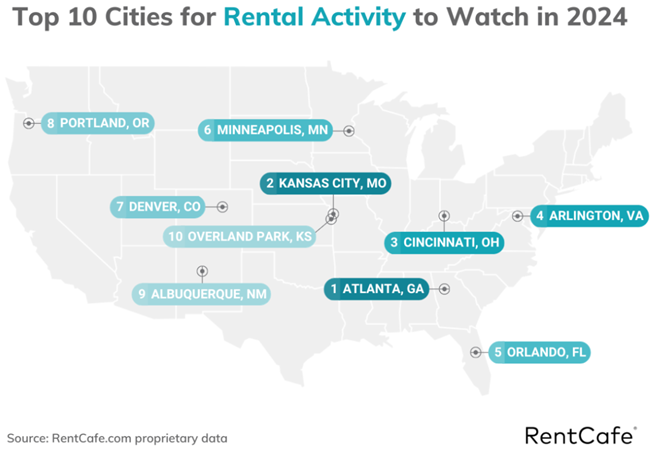
Here are the top 10 cities to watch for rentals in 2024 in a RentCafe.com report showing which cities attracted the highest number of online engagements on RentCafe.com in 2023, according to a new report.

“As we enter 2024, here’s a special wrap-up edition where we totaled the same metrics for the entire 12-month period to determine which cities were the year’s stars for renters,” the report says.

Here are the top 10 cities to watch

  1. Atlanta is #1 as renters showed high interest for apartments in the city throughout 2023. Renters added 60% more listings to their favorites list than the year prior, while the rate of saved searches for Atlanta rentals was highest compared to all 150 U.S. cities analyzed. Throughout the year, Atlanta ranked among the top 10 most sought-after cities by renters on eight occasions and reached the podium twice.
  2. Kansas City, MO was #2 with 63% more listings traffic and renters adding three times as many favorites to their list, cementing interest in one of the Midwest’s most vibrant yet affordable cities. Kansas City started the year above Atlanta in our monthly ranking and scored a place among the top 3 cities six times.
  3. Cincinnati rounded out the top 3 after a 19% rise in traffic and with renters favoriting twice as many properties, the most important step toward leasing. The city was one of renters’ top 3 hotspots just once this year, but it managed a strong end of the year.
  4. Arlington, VA, landed at #4 after dominating renters’ preferences during peak rental season in 2023 when it came in at #1 in our rankings for three months straight. Renters viewed 52% more listings in the city in 2023 versus the year before.
  5. Orlando, FL, was #5 with its sunny appeal drawing in 18% more traffic and apartment hunters favoriting twice as many rentals, cementing its status as a popular city for renters.
  6. Minneapolis was #6 in 2023. Plus, in our November rental activity report, Minnesota’s most populous city came in at #1 for the first time after Minneapolis listings attracted the highest number of engagements that month.
  7. Denver was #7. Its success came after renters intensively searched for Denver listings on RentCafe.com throughout the year. Clearly, the city’s tech/energy/finance economy, sunny climate and array of outdoor activities were a magnet for apartment hunters.
  8. Portland was #8. Portland may have its quirkiness, but it also has renter appeal, which helped the city rank eighth in the top 30 for 2023. One of the most appreciated aspects about living in Portland is its relaxed pace combined with its food and beverage culture. In the same way, its balanced combination of entertainment and diverse job opportunities helped the city claim a spot in the top 30 throughout last year.
  9. Albuquerque was #9. Albuquerque was another Western location on our list of the most in-demand cities for renters in 2023, ending at #9. In fact, it ranked just as high or even higher in our reports during the high season for renting.
  10. Overland Park was #10. This Kansas City suburb on the Kansas side landed at #10 in the ranking for 2023. This came as no surprise, given Overland Park’s favorable path among the most sought-after cities for renters throughout the year: In June and October, this suburban destination occupied the second position in our top 30, it’s best scores so far.

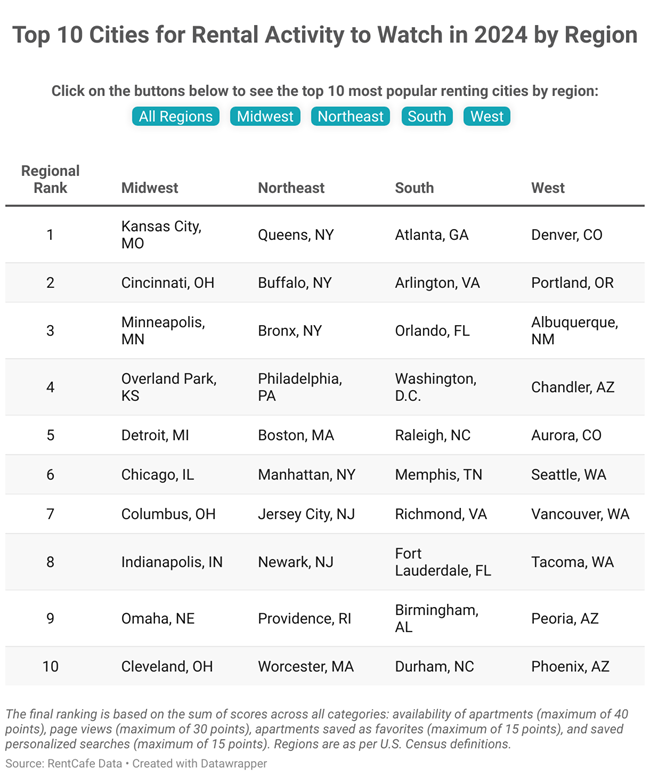
Top 10 cities to watch by region

Here are the top 10 cities to watch for rentals in 2024 in a report showing which cities attracted the highest number of online engagements

Read the full report here.

Sign Up For Our Weekly Newsletter And Get Rental Property And Apartment News And Helpful, Useful Content Each Week.

* indicates required