


For a full review of your apartment or rental property insurance, contact a knowledgeable Anderson Insurance Group agent today.
Avoid Costly Coinsurance Penalties with Proper Insurance Coverage for Your Investment Properties

1-23-24 anderson info graphic
Portland, Metro Area Rents Continue Decline
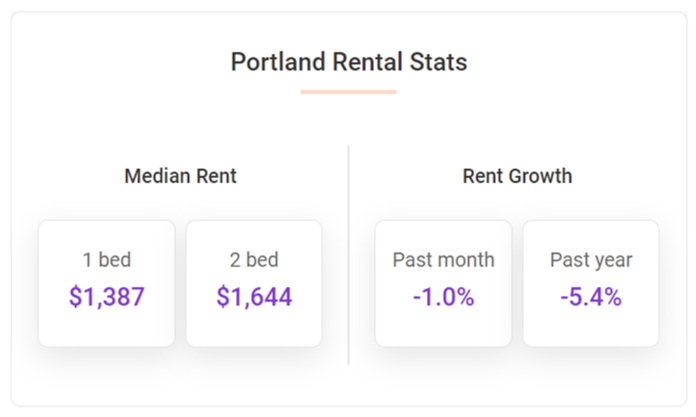
Portland rents declined 1.0% in December and are now down 5.4% year-over-year, according to the January report from Apartment List.
Currently, the overall median rent in the city stands at $1,527, after falling 1.0% last month.
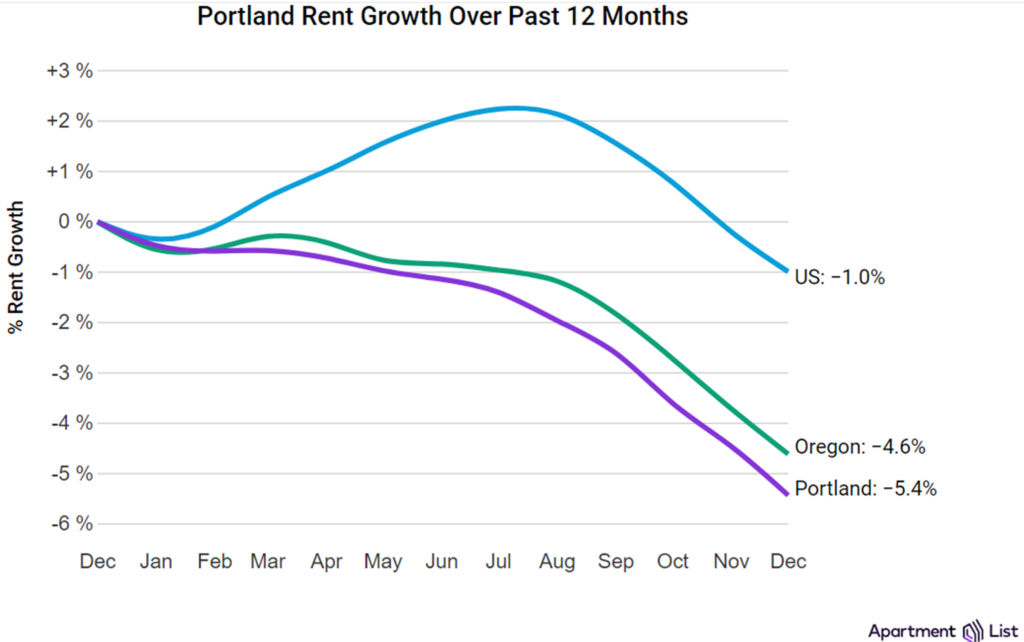
Rents have now decreased by a total of 5.4% over the past 12 months. Portland’s negative rent growth over the past year is similar to the state average (-4.6%) but has fallen below the national average (-1.0%). This is a slower rate of growth compared to what the city was experiencing at this point last year; from January to December 2022, rents had increased 3.1%.
Citywide, the median rent stands at $1,387 for a 1-bedroom apartment and $1,644 for a 2-bedroom. Across all bedroom sizes (i.e., the entire rental market), the median rent is $1,527. That ranks No. 39 in the nation, among the country’s 100 largest cities.
For comparison, the median rent across the nation as a whole is $1,211 for a 1-bedroom, $1,365 for a 2-bedroom, and $1,379 overall. The median rent in Portland is 10.7% higher than the national, and is similar to the prices you would find in Atlanta, Ga. ($1,528) and Austin, Texas ($1,501).
Portland rents in December across the metro
Across the Portland metro area, the median rent is $1,625, meaning that the median price in Portland proper ($1,527) is 6.0% lower than the price across the metro as a whole. Metro-wide annual rent growth stands at -5.0%, above the rate of rent growth within just the city.
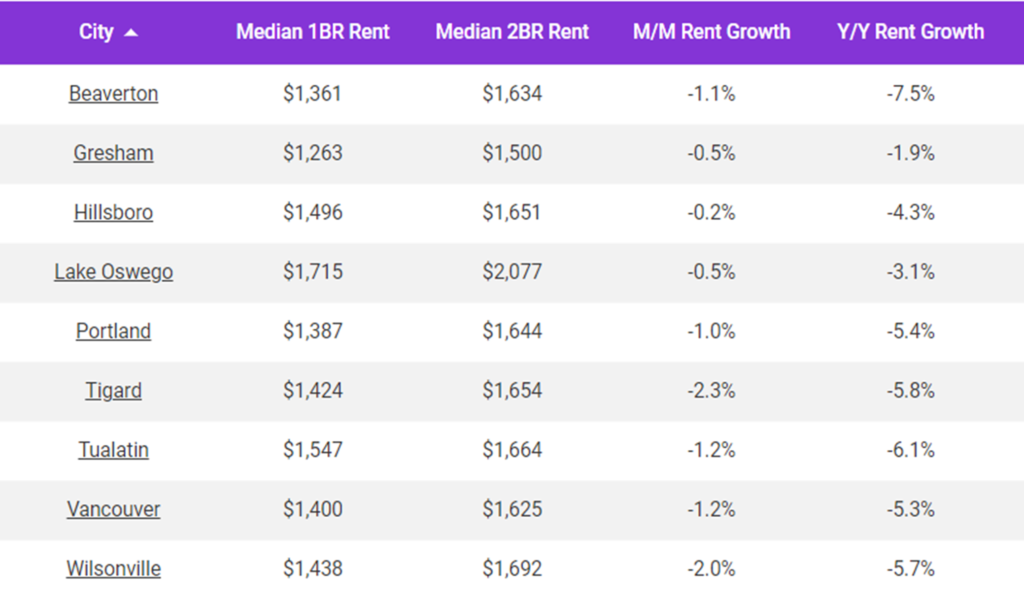
The table below shows the latest rent stats for nine cities in the Portland metro area that are included in the Apartment List database.
Among them, Lake Oswego is currently the most expensive, with a median rent of $1,958. Gresham is the metro’s most affordable city, with a median rent of $1,480. The metro’s fastest annual rent growth is occurring in Gresham (-1.9%) while the slowest is in Beaverton (-7.5%).
Portland Update: Changes to FAIR Ordinance Bring (Some) Necessary Changes
Dealing with Habitability issues and Substitute Housing
New Year, New Laws, 2024 Oregon Edition

New laws in the landlord tenant space in Oregon for 2024 involve child care in rentals and notices and return of money and security deposits.
By Bradley S. Kraus
Attorney at Law
Warren Allen, LLP
As we approach the end of 2023, it is once again time to look forward to the new year. During this past year, the Oregon legislature has passed a slew of new laws affecting landlord/tenant relations. Several of those laws have been covered in prior articles (e.g., House Bill 2001). If you have non-paying tenants, you have likely felt the negative effects of that ridiculous law, and this article will not beat you down any further.
The new year will also see the implementation of two other new laws that directly affect landlords, both going into effect on January 1, 2024. Those laws are SB 599 (dealing with childcare in rentals) and SB 1069 (dealing with E-Notices, electronic return of monies and security deposits/accountings).
Child care in rentals
Senate Bill 599 requires landlords to allow residential dwellings to be used as family childcare homes in a variety of scenarios.
Per the new law – and subject to a handful of exceptions – “a landlord may not prohibit the tenant’s use of a dwelling as a family childcare home if: (a) the family childcare home is certified under ORS 329A.280 or registered under ORS 329A.330; and (b) the tenant has notified the landlord of the use.” A landlord is allowed to require advance payment for the costs of modification to the premises necessary or desirable for the tenant’s use, certification, or registration of the dwelling as a family childcare home, even if it is not required of the landlord under ORS 90.320 or the rental agreement. Further, a landlord may prohibit use as a family childcare home if it is not allowed under (a) the zoning laws for the dwelling unit; (b) an association’s governing documents; or (c) the rules of the Early Learning Council (the regulating body for in-home childcare facilities). As for liability protection, childcare homes are not required to carry liability insurance unless the landlord specifically requires it.
However, landlords can require that the tenant running the childcare home either:
- sign a document relieving the landlord of liability for losses from injuries to their children or their guests connected with the operation of the childcare facility and acknowledge that the home-care provider does not maintain liability coverage; or
- carry and maintain a reasonable surety bond or liability policy covering injuries that protects the landlord as an additional insured.
Finally, the new law amends the retaliation statute, prohibiting landlords from decreasing services or threatening to terminate tenancies for a tenant’s use or attempted use of the dwelling as a family childcare home.
SB 1069
Another new law that has been briefly discussed in other articles—but will have a massive benefit to landlords going forward—is SB 1069. This new law has a prerequisite that requires addendum to be executed with tenants after the tenancy begins and the tenant has occupied the premises. That addendum must specify a number of things, including:
(a) the landlord’s email address from which the landlord agrees to send and receive email;
(b) the email address from which the tenant agrees to send and receive email;
(c) allowance of either party to terminate service via email, or to change their email address with no less than 3 days written notice, and
(d) a specific disclosure discussed in SB 1069.
Once this occurs, landlords will be able to “e-mail and mail” written notices using timelines and processes similar to “post and mail” methods. Senate Bill 1069 will also allow the return of monies electronically to a bank account or other financial institution designated by the tenant via a written addendum. Like the changes in ORS 90.155, the tenant must agree to receive money electronically after the tenancy begins and the tenant has occupied the premises by way of separate addendum.
While the childcare laws are odd additions to the ORLTA, E-Notice rights are a welcome addition. Many provisions of the ORLTA are unnecessarily archaic. Hopefully, the legislature will create (or modify) additional new laws with an eye on their practical effects and benefits going forward.

About the author:
Bradley S. Kraus is an attorney and partner at Warren Allen LLP. His primary practice area is landlord/tenant law, but he also assists clients with various litigation matters, probate matters, real estate disputes, and family law matters. You can reach him at kraus@warrenallen.com or at 503-255-8795.
Portland Update: Changes to FAIR Ordinance Bring (Some) Necessary Changes
Dealing with Habitability issues and Substitute Housing
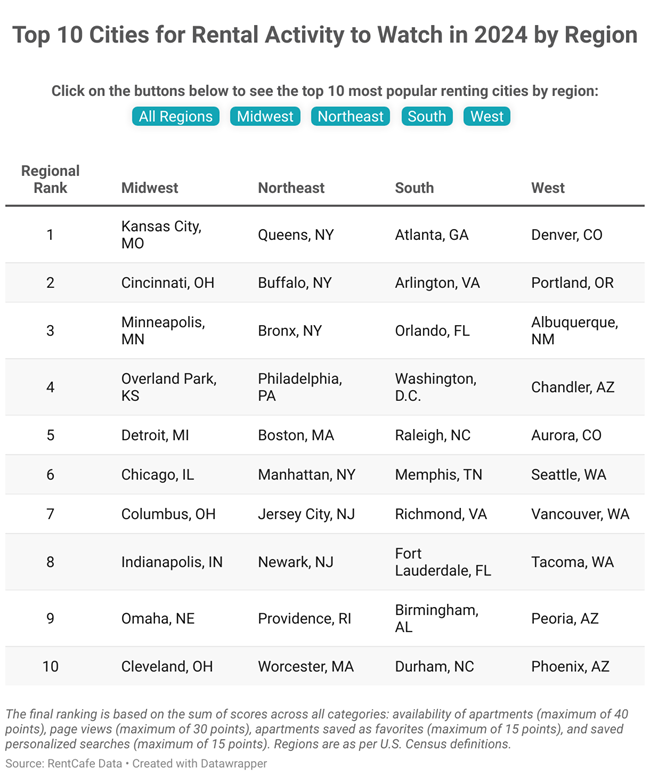
Top 10 Cities To Watch For Rentals In 2024
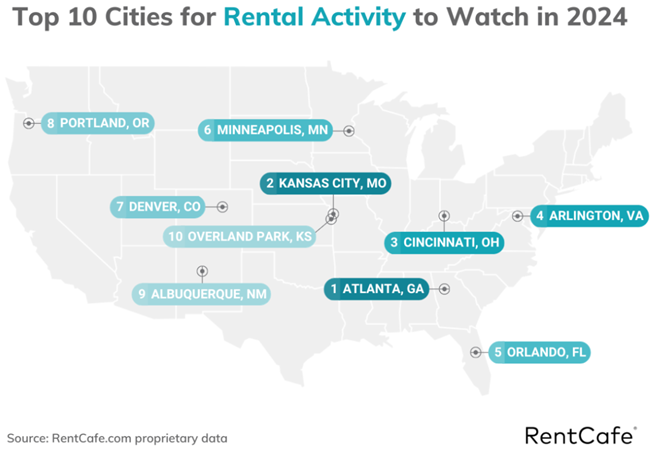
Here are the top 10 cities to watch for rentals in 2024 in a RentCafe.com report showing which cities attracted the highest number of online engagements on RentCafe.com in 2023, according to a new report.
“As we enter 2024, here’s a special wrap-up edition where we totaled the same metrics for the entire 12-month period to determine which cities were the year’s stars for renters,” the report says.
Here are the top 10 cities to watch
- Atlanta is #1 as renters showed high interest for apartments in the city throughout 2023. Renters added 60% more listings to their favorites list than the year prior, while the rate of saved searches for Atlanta rentals was highest compared to all 150 U.S. cities analyzed. Throughout the year, Atlanta ranked among the top 10 most sought-after cities by renters on eight occasions and reached the podium twice.
- Kansas City, MO was #2 with 63% more listings traffic and renters adding three times as many favorites to their list, cementing interest in one of the Midwest’s most vibrant yet affordable cities. Kansas City started the year above Atlanta in our monthly ranking and scored a place among the top 3 cities six times.
- Cincinnati rounded out the top 3 after a 19% rise in traffic and with renters favoriting twice as many properties, the most important step toward leasing. The city was one of renters’ top 3 hotspots just once this year, but it managed a strong end of the year.
- Arlington, VA, landed at #4 after dominating renters’ preferences during peak rental season in 2023 when it came in at #1 in our rankings for three months straight. Renters viewed 52% more listings in the city in 2023 versus the year before.
- Orlando, FL, was #5 with its sunny appeal drawing in 18% more traffic and apartment hunters favoriting twice as many rentals, cementing its status as a popular city for renters.
- Minneapolis was #6 in 2023. Plus, in our November rental activity report, Minnesota’s most populous city came in at #1 for the first time after Minneapolis listings attracted the highest number of engagements that month.
- Denver was #7. Its success came after renters intensively searched for Denver listings on RentCafe.com throughout the year. Clearly, the city’s tech/energy/finance economy, sunny climate and array of outdoor activities were a magnet for apartment hunters.
- Portland was #8. Portland may have its quirkiness, but it also has renter appeal, which helped the city rank eighth in the top 30 for 2023. One of the most appreciated aspects about living in Portland is its relaxed pace combined with its food and beverage culture. In the same way, its balanced combination of entertainment and diverse job opportunities helped the city claim a spot in the top 30 throughout last year.
- Albuquerque was #9. Albuquerque was another Western location on our list of the most in-demand cities for renters in 2023, ending at #9. In fact, it ranked just as high or even higher in our reports during the high season for renting.
- Overland Park was #10. This Kansas City suburb on the Kansas side landed at #10 in the ranking for 2023. This came as no surprise, given Overland Park’s favorable path among the most sought-after cities for renters throughout the year: In June and October, this suburban destination occupied the second position in our top 30, it’s best scores so far.
Top 10 cities to watch by region
Multifamily Rents Sliding, But Close 2023 With Slight Annual Gain
Multifamily rents extended their downward drop in December, falling for the fifth straight month, though they finished 2023 with a slight annual gain, Yardi Matrix writes in their December 2023 Multifamily National Report.
Rents are likely stuck in neutral for the first part of 2024, the report says, as 2023 ended on a downswing with the average U.S. multifamily asking rents dropping for five straight months.
The average asking rent fell $17 over those five months to $1,709.
Highlights of the report
- The book closed on 2023 with multifamily rents producing extremely slight gains. The average U.S. asking rent fell $4 in December to $1,709, while year-over-year growth was unchanged, finishing 2023 at 0.3%.
- Since peaking in the summer, multifamily asking rents have declined by 1.0%, but the drop is mostly a function of supply increasing in high-growth markets. Overall demand remains firm, which limits the potential downside.
- Single-family rents outperformed multifamily in 2023, as demand has remained robust. U.S. average single-family rents declined by $1 in December to $2,123, while year-over-year growth rose 20 basis points to 1.2%.
Worried about the market in 2024?
“While it is prudent to prepare for downside scenarios, conditions may not be as weak as they appear on the surface,” Yardi Matrix says in the report.
“Maybe most importantly, household formation and the strong job market should continue to maintain demand.”
New apartment absorption has remained healthy across the country as rents have turned negative in some markets.
“And it is increasingly appearing as though the job market will hold up better than consensus expectations in the wake of the Federal Reserve’s rate hikes.
“Demand is also coming from an increase in net immigration, which fell by almost half between 2018 and 2021. Net immigration has increased by more than 1 million annually in the last two years, and is projected to remain at that level in coming years,” the report says.
Renewal lease rates have moderated
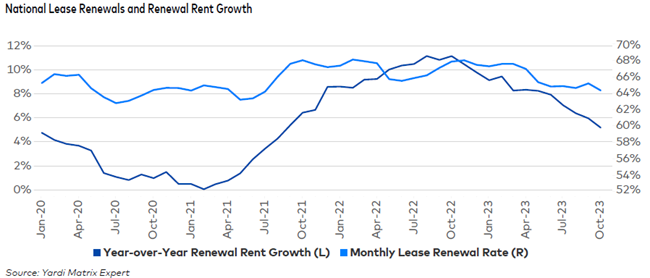
The national lease renewal rate averaged 64.4% in October.
Lease renewal rates have settled into a range, having been between 64.4% and 66.0% for the last six months. Lease renewal rates were highest in New Jersey (80.8%) and lowest in Los Angeles (45.3%).
2024 promises to be consequential for multifamily
- The multifamily industry faces some important challenges in 2024 related to expenses, income, deliveries and interest rates.
- The market is on track for more than 500,000 units to be delivered in 2024, but starts are slowing.
- Recent interest rate declines are a positive development for potential distress, but owners are not out of the woods yet.
Read the full Yardi Matrix report here.
About Yardi Matrix
Yardi Matrix researches and reports on multifamily, office and self-storage properties across the United States, serving the needs of a variety of industry professionals. Yardi Matrix Multifamily provides accurate data on 18+ million units, covering more than 90 percent of the U.S. population. Contact the company at (480) 663-1149.
Seasonal Rent Dip Sharper Than Usual
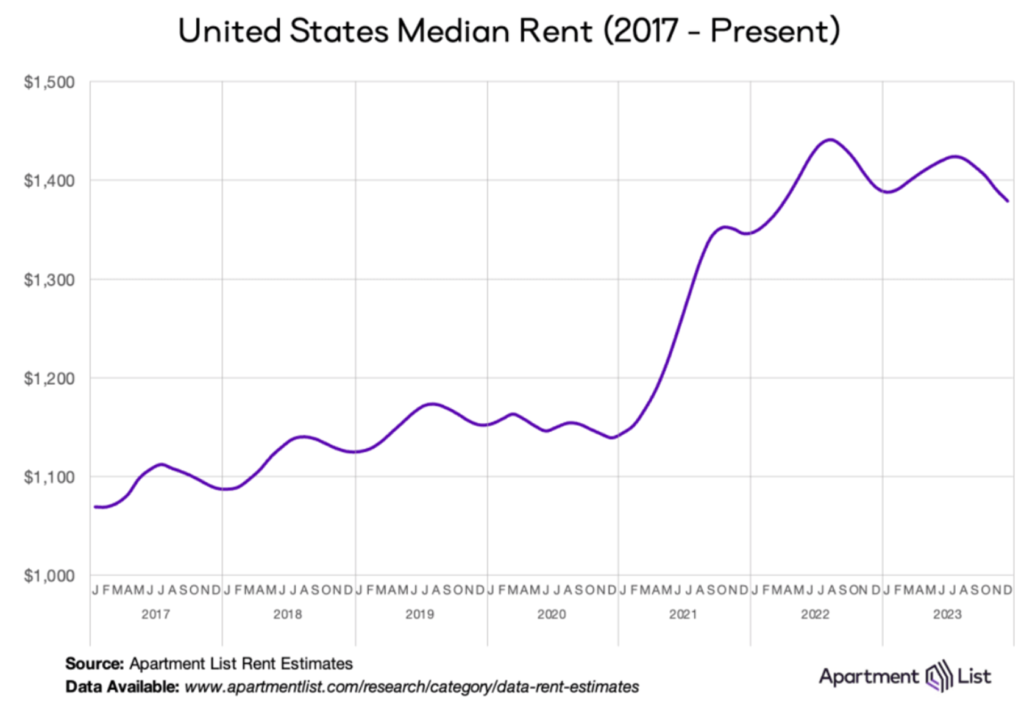
The rental market closed out 2023 with a seasonal rent dip for the fifth straight month of negative rent growth as the nationwide median rent fell by 0.8 percent to $1,379, Apartment List says in its January report.
The recent declines are in line with the rental market’s typical seasonal rent dip pattern, as fewer renters are looking to move at this time of year, “although this year’s dip has been a bit sharper than what we normally see,” the report says.
Despite the recent cooldown, the national median rent is still nearly $250 per month higher than it was three years ago, although that time frame was part of the pandemic.
Rents are down 0.8% month-over-month, down 1% year-over-year
Rent growth follows a seasonal pattern – rent increases generally take place during the spring and summer, whereas the fall and winter usually see a modest price dip.
“We are now squarely in the midst of the rental market’s off-season, as reflected in recent price trends. Rents began to dip last August, and have now fallen for five straight months as of December’s 0.8 percent decline.
As nationwide rent growth was negative in December, so too was local rent growth in the majority of large cities across the county,” the report said. And, “83 of the nation’s largest 100 cities saw prices fall month-over-month, and in 60 of these cities, prices are down year-over-year.”
Apartment vacancies are back above pre-pandemic levels
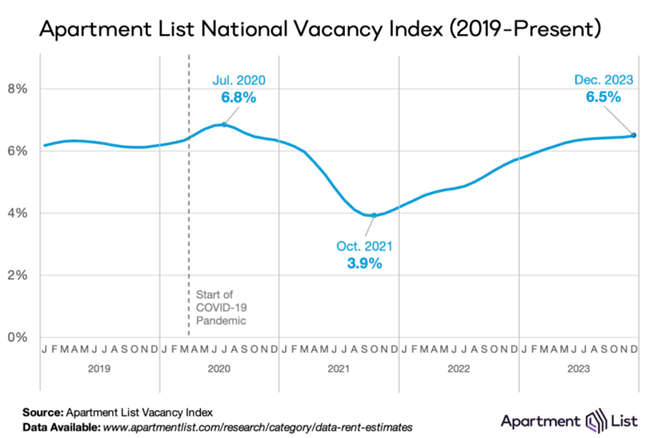
The Apartment List national vacancy index stands at 6.5 percent, slightly higher than the pre-pandemic average.
“This represents the culmination of vacancies gradually easing for two full years after a historic tightening in 2021. And with the construction pipeline of new apartments still near record levels, we expect that there will continue to be an abundance of vacant units on the market in the year ahead,” the report says.
Portland, Seattle and San Francisco among slowest in rent growth
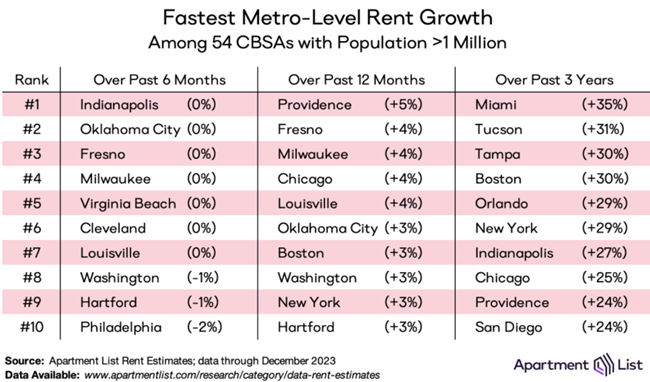
The Portland and San Francisco metro areas are also experiencing some of the nation’s slowest year-over-year growth, showing that high-cost coastal metros are also seeing a slowdown in rental demand. The Midwestern and Northeast rental markets have maintained positive rent growth.
Over the longer three-year period, the fastest rent growth is still found in the Sun Belt – even as many metros there have cooled in 2023. The Miami metro tops the list with a three-year rent growth of 35 percent, while the Tucson and Tampa metros round out the top three.
Will rental market rebound in typical seasonality?
“Our national rent index is likely to fall for at least one more month before rebounding in line with the market’s typical seasonality. Looking further ahead, a robust construction pipeline should drive strong supply growth throughout 2024. On the other hand, the extent to which demand rebounds or remains sluggish will likely depend on broader macroeconomic conditions,” the report says.
Read the full Apartment List January report here.
Avoid These Two Applicant Background Checks At All Cost

There are two types of applicant background checks that you truly must avoid like the plague if you want to be a successful housing provider for very long.
By Scot Aubrey
Variations of the phrase “avoid like the plague” have been in use for more than 400 years. It has become synonymous with staying away from something as much as possible.
In recent years, we could adopt a new phrase, “avoid it like COVID.” No matter how we use it, when it comes to performing background checks on your new potential tenants, a necessity of our current times, there are two types of background checks that you truly must avoid like the plague if you want to be a successful housing provider for very long.
No. 1: The Applicant Background Check You Do Yourself
With an ever-increasing crime rate and the ability for people to steal another’s identity or change their own, these chameleon types should put you on notice.
You excel at investing and managing properties, and that should be good enough for you, so why then do so many of our fellow housing providers take it upon themselves to also perform background checks?
My advice is to stay in your lane and let the experts handle things. I’ve heard countless times that people just “trust their gut” when it comes to doing background checks. They rely on their investigative questioning and have full faith and confidence that the applicant is providing them with correct information.
Guess what? Your “gut” can be wrong, and lie to you just as much as your applicants do.
Applicants, especially those who have been recently evicted or have something to hide, are masters of disguise and put their best face forward when it comes to meeting you and viewing your property.
You might be tempted to pepper your applicant with personal question, but beware: Becoming too familiar with the personal life of an applicant brings compassion into the equation… which is no good (especially when they tell a good story).
Lastly, you lack the real tools of an investigator who can receive and confirm proper ID, date of birth and Social Security numbers. Remember, desperation drives creativity, and if someone is desperate enough, they will pull out all the stops to get into your property – and then they may be hard to get out.
No. 2: The Instant Applicant Background Check
Contrary to what a marketing department tells you, there is no “instant” database that holds all current records.
At best, you may be accessing 50% of available data, and that doesn’t guarantee accuracy or completeness. Instant databases gather information from public sources and aggregate it into a single searchable source.
They do not update every second; rather, they update every other month or quarter.
Wouldn’t you want to know if your applicant had a criminal conviction last week, or even yesterday? Or if they are currently in the middle of an eviction?
Of course you would, and you just can’t have that kind of certainty with an instant report. With the recent rise in stories of serial squatters in the news, having a complete, in-depth look at your applicant can help you avoid this alarming trend.
Also, if an instant report says “no records found,” it does not mean that the applicant doesn’t have a criminal history. It just means that they did not find any records in their particular database.
As a professional housing provider, trying to save money by doing one of these types of background checks is not worth the low – and often not so low – price.
In almost every market I know of, the applicant pays, so why expose yourself to the risk? This is one plague that you can and should avoid at any cost.
About the author:
Scot Aubrey is vice-president of Rent Perfect, a private investigator, fellow landlord and cohost of the Rent Perfect Podcast. Subscribe to the weekly Rent Perfect to stay up to date on the latest industry news and for expert tips on how to manage your properties.
Oregon Unsure Where Pandemic Rental Assistance Money Went

Oregon auditors say they are unsure where millions of dollars of pandemic rental assistance relief money for landlords and tenants went, according to an audit from the secretary of state.
The Oregon Housing and Community Services (OHCS) agency was supposed to manage an emergency rental assistance program that spent $426 million during the COVID-19 pandemic, but auditors say they still can’t determine how many Oregonians were helped by the money.
“There is no doubt OHCS, like all of Oregon government, was working under unprecedented emergency conditions during the pandemic,” said Audits Director Kip Memmott in a statement. “As auditors, it’s our job to ensure public monies are being spent in accordance with program guidelines and properly accounted for. It’s extremely concerning that OHCS is unable to verify whether millions of dollars went to the Oregonians who needed and deserved this money the most,” according to the audit.
“As a result, the agency has no way of knowing how much of the $426 million went to eligible Oregon recipients and how much was sent to landlords, renters, and non-eligible recipients in error,” the audit report said.
The audit also found that the program itself had a rocky rollout, with glitchy new software, poor customer service and delays in application processing for both tenants and landlords.
What auditors found, according to the state report:
- OHCS distributed $426 million in emergency rental assistance as of June 2023. However, because of limited oversight and controls, OHCS cannot be certain that spending met federal guidelines, or how much emergency funding went to eligible applicants. Also, the agency has not reliably determined how many total applications were paid, or households helped.
- Material weaknesses regarding contract oversight and monitoring resulted in an adverse opinion for the program in the Statewide Single Audit — the first adverse opinion issued in more than 25 years by the Oregon Audits Division.
- Renters and landlords experienced application-processing delays because of rushed implementation of new software. A fragmented customer service system resulted in communication challenges.
- OHCS was not prepared to respond to disaster-housing emergencies, despite its responsibility to do so under Oregon’s emergency management framework.
- OHCS took an equity-based approach to distributing funds. In the wake of Oregon ERA, OHCS is moving toward outcome-based contracting, tracking outcomes, and has hired an ombudsperson to handle client complaints.
“The urgency with which OHCS acted to distribute rental assistance during a global crisis is laudable,” said Oregon Secretary of State LaVonne Griffin-Valade in a statement. “As auditors, it’s our job to ensure state agencies properly account for how they spend public money. I encourage OHCS to work speedily to implement the recommendations in this report in preparation for future emergencies.”
New Year, New Laws, 2024 Oregon Edition
Portland Update: Changes to FAIR Ordinance Bring (Some) Necessary Changes
Dealing with Habitability issues and Substitute Housing
Welcoming More Pets Can Lead To Better Retention, More Revenue

Lifting pet and breed restrictions and welcoming more pets can lead to higher tenant retention rates, an increase in pet-related revenue and building stronger communities.
By Judy Bellack
Michelson Found Animals
Lifting breed and weight restrictions for our four-legged friends and generally becoming more pet-inclusive can create significant financial gain for multifamily communities, such as increased NOI and higher resident-retention rates.
However, opening your doors to more pets requires planning in order to manage a larger pet population, and rental-housing operators may need to make an investment in pet-focused amenities, services and events to best accommodate their pet residents. But don’t fret – even with these steps, the financial benefits of happier, longer-tenured residents have been shown to far outweigh the costs, since pet-friendliness not only means an increase in pet-related revenue but also helps mitigate the costs associated with bringing in new residents.
Below are a few steps apartment communities should consider in conjunction with lifting or easing breed and weight restrictions.
Establish clear pet policies and communicate to owners
While most communities already have some form of pet policies in place, broadening your pet community may necessitate adjustments. Establishing comprehensive guidelines as well as onboarding third-party resources to manage more pets responsibly are a few things to consider.
All of a community’s policies, along with any rent or fees associated with pets, should be clearly spelled out in the resident’s lease. Even better is a separate pet lease or contract that provides all the pertinent information and is easy for the resident to understand and access. Documentation, guidelines, rules and expectations should be easy to locate electronically and posted throughout the community.
Provide tools and amenities for responsible pet ownership
Some pet tools and amenities – such as pet-waste stations – may be deployed immediately when additional pets are on site, while others can be rolled out over time depending on resident preferences. While it’s not required to provide all of the items below, implementing as many as possible will increase the chances of success by mitigating a community’s risk and increasing resident responsibility. Certain amenities, such as dog parks, also give residents and their pets the chance to meet and bond, boosting the connection residents feel with their property and increasing the chances they will renew their lease.
Here are some amenities and services that result in well-managed pet populations and responsible pet owners:
- Pet-waste stations: This is a feature that would be considered a must-have for any community with pets. Not only does it encourage responsible behavior, but it also helps to reduce risk. Pet waste is detrimental to the health of your community, and its presence can have consequences on resident retention and curb appeal.

- Dog parks or runs: According to a 2021 study from Michelson Found Animals Foundation and the Human Animal Bond Research Institute (HABRI), fewer than 10 percent of animals cause any damage to units, but a bored pet is more likely to exhibit destructive behavior. Dogs need to be active, so providing them with a convenient place for exercise can further reduce the risk of property damage. Parks are one of the primary areas where the pet community will bond. Creating this space should not be cost-prohibitive, and is sometimes as simple as repurposing a seldom-used area.
- Dog-washing stations or services: Washing a pet in a home can be a hassle, especially for medium- to large-size dogs, and not everyone can afford or wants to use a grooming service. This amenity can be a factor for anyone considering a renewal. If an installation is not an option, consider partnering with a mobile service that provides self-washing or grooming for your residents’ pets.
- Dog-training services: During the pandemic, many residents became first-time pet owners. Pet parents don’t become experts overnight, and improperly trained pets can increase risk. Providing dog-training resources and services gives an opportunity to pet owners to become the best stewards they can be.
- Pet background checks: Third-party services are available to screen prospective pets, making sure that no incidents have occurred that might indicate potential future risk to residents or other pets. These services allow for onsite teams to feel confident that the pets in their community will be an asset and not a liability.
- DNA analysis of pet waste: Even in a community with ample waste stations, there’s a chance that some pet owners won’t pick up after their dogs. Communities can request residents submit a sample of their pet’s DNA, which can be submitted to a service that uses the sample to identify any culprits of unattended waste. Communities can implement penalties to discourage future incidents and help offset costs.

- Pet events: This is another opportunity for pet owners and pets to gather and meet each other, as well as a chance for non-pet owners to meet the furry residents of a community. Not all people are in a position to own a pet, so this is an avenue for them to experience the joy that pets bring. These can be handled by onsite teams if staffing permits, or communities can turn to third-party services that will handle set-up and promotion.
- Pet adoption: There are millions of dogs and cats nationwide that are looking for good homes. Communities can do their part to reduce this problem by offering to connect residents with pet-adoption services.
- A pet concierge: Third-party services that manage pet events may also offer concierge services that can provide information on local veterinary services, pet services and pet policies in a community.

Prepare your residents for the upcoming changes
After completing the preparation work, current residents will need to be informed of any upcoming changes in breed and weight restrictions. To help this go smoother, it’s important to point out to residents the positives to the community that will result. Highlight how the removal of restrictions will strengthen the community and share all the steps being taken to help this be a wonderful experience for all residents.
Notices should include office contact information for any residents to ask questions and express concerns. Community managers should educate their leasing teams on all preparations, as well as information that will help answer any questions and dispel misinformation surrounding pets and breeds. Recent studies, including a recent study Science.org, have shown that pet breed has very little influence on behavior, which is primarily guided by owners and training.
This information can alleviate fears or concerns that other residents may have. Plus, it’s a chance to share with non-pet owners how to be courteous and safe around pets on the property, such as the best way to approach a dog.
Build resident and community connections
Having more pets in residential communities can be a great way to create ties between residents and onsite teams. Pet amenities provide the opportunity to interact and get better acquainted with staff. The opportunity to reward outstanding and responsible pet ownership is an excellent way to send a message of appreciation to residents, and also to set an example for all pet owners and foster retention. There are a variety of options for rental housing operators to reward responsible pet owners when renewing, including reduced pet rent, the forgiveness of two to three months of pet rent, discounts or gift cards to local pet businesses and pet-centric gift baskets.
As an added bonus, offering referrals and discounted pet services can build neighborhood connections that increase retention and build a strong sense of community. Local businesses are usually happy to offer discounts to residents in exchange for the exposure and potential future business.
In the end, an increased acceptance of pets can be a boon to net operating income, open a community to a wider pool of applicants and help increase the possibility that residents will stay. However, the path to success in this endeavor includes planning, preparing and executing in a way that maximizes the benefits and the investment.
About the author:

Judy Bellack is the industry principal for the non-profit Michelson Found Animals Foundation, helping to advance the Pet-Inclusive Housing Initiative. She is a 30-year veteran of the multifamily industry, holding various executive leadership positions with some of the foremost supplier companies. Judy has served both as Chair of NAA’s National Suppliers’ Council and NMHC’s Supplier-Partner Alliance and was the recipient of NAA’s Outstanding Supplier in 2010. She currently operates a consulting practice advising start-up technologies in the multifamily space.
Welcoming Pets Is a Smart Financial Move In Rental Housing
Emotional Support Animals and the Fair Housing Act
Everything Landlords Should Know About Emotional Support Animals
Multifamily Demand To Stay Positive, But Market Faces Hurdles
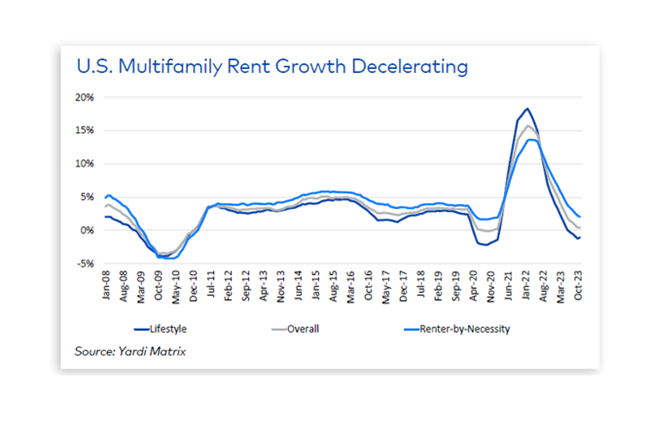
Multifamily demand is likely to remain healthy in 2024, though rent growth will be tested by decelerating economic growth and a rapid supply uptick in some markets, Yardi Matrix says in the 2024 U.S. Multifamily Outlook.
The report says the higher interest-rate environment will stress property values and threatens to increase loan defaults. However, interest rates have probably peaked.
“Our expectations are that economic growth will be weak in 2024, with a soft landing the baseline likelihood, and that property owners should prepare for rates to remain higher than normal through most of the coming year,” the report says.
Multifamily rent growth also continues to decelerate and Matrix forecasts a tepid 1.5% rent growth nationally in 2024 for several reasons. Perhaps the biggest reason is the growth in supply. Another reason is affordability.
Highlights of the 2024 multifamily outlook
- Multifamily faces a mixed outlook in 2024. Property performance remains healthy for most apartments, but challenges will come from a wave of deliveries, rapid growth in expenses, a potential economic slowdown, and mortgage rates.
- The U.S. economy has remained surprisingly resilient, helping to maintain strong demand for housing, led by robust employment growth and moderate gains in consumer spending. However, economic growth is likely to slow in 2024 due to the effects of a higher-for-longer interest rate scenario. For commercial real estate, that means a market reset with higher acquisition yields, higher financing costs, and lower leverage and values.
- “We expect rent growth will be positive in 2024 but diminished by slowing absorption, supply growth and declining affordability after extraordinary gains in 2021-22. Growth will be led by metros in the Midwest, Northeast and smaller Southern and Mountain areas where demand remains consistent and deliveries are subdued.”
- Supply growth is at decades-long highs, with more than 1.2 million units under construction. Deliveries should top 500,000 units in 2024, with concentrations in rapidly growing markets in the South and West. However, the rise in construction financing is putting a lid on new starts, so 2024 is expected to be a peak year for deliveries.
- Multifamily expenses—particularly insurance but also labor, materials and maintenance—are rising rapidly. With income growth slowing, operating efficiency and cost-cutting will be focuses of the industry.
- Transaction volume fell by 70% in 2023 as falling values and rate volatility created pricing uncertainty. Activity is likely to remain weak in 2024, but could rebound later in the year if rate hikes have ended. Lenders are being cautious and borrowers are reluctant to lock in loans at high rates. Maturity defaults will be a growing issue as loans come due and properties qualify for proceeds that are less than the existing mortgages.