Home Blog Page 45

Offering Extras In Your Rental? Be Sure To Clarify Lease Terms

Offering extras in your rental like a washer and dryer? Then be sure to clarify lease terms on who is responsible for repairs and damages.

Offering extras in your rental like a washer and dryer? Then be sure to clarify lease terms on who is responsible for repairs and damages.

By David Pickron

If you’ve ever purchased a gift for someone, you’re familiar with those three dreaded words you must be on the lookout for: “batteries not included.”

Most of us have experienced that moment on a holiday morning or birthday when the excitement of receiving something new is dashed as the recipient realizes that without power, they just have an empty box and a lifeless gift.

Knowing what is and is not included in any transaction is critical to achieving the end goal of both parties; this is especially true for housing providers.

I recently had a potential tenant who was going through some life challenges ask me if there was any way that I could include a washer and dryer as part of the rental.

Questions like these set off all sorts of alarms in my head.  I’ve been at this for more than 20 years and situations like this have rarely ended well for me… but I reluctantly gave in and provided the washer and dryer at move-in.

Here’s why I entered into this agreement reluctantly: If they own the equipment and it breaks, they never call, but if I own the equipment and it breaks, I am the first call and end up playing repairman. Ideally, I avoid these situations, but under certain circumstances I do go that way and when I do, I always do these two key things that will also help to protect your investment.

No. 1 – Establish Your Ground Rules

When it comes to rental property, the number of items a tenant may ask for is unlimited.

In your business, determine in advance what and what will not even be a possibility to include with the property.  When it comes to appliances, those that are attached to the property are usually included.  I’m talking about items like a dishwasher or oven.

You might include a refrigerator if it is the built-in variety.  Usually not included is anything related to laundry, microwaves, BBQ grills, etc.  And speaking of grills, if you decide to provide one, make sure you establish that you are not responsible for providing fuel.

I’ve taken the brunt of an angry phone call from a tenant whose dinner party plans were destroyed when the propane ran out halfway through cooking their meal.  Same goes for things like yard equipment if you decide to leave a lawn mower for the tenant who wants to maintain the yard.  Each of these items present different challenges that require different rules, and it is best to lay out those rules in your lease.

No. 2 – Put it in the lease

The lease is your first (and best) line of defense when it comes to items you have included in your property.  I would recommend always using language that references the following categories:

  • Ownership: Clearly state who owns the equipment that is included in the lease. This ensures that if something “walks” off at the end of the lease period, all parties know whom it legally belongs to.
  • Responsibility: If something breaks, it is critical to know who bears the financial and physical responsibility for its repair. For example, if I were to include laundry units in the property, I include language like, “If the laundry units become non-functional, you are responsible for all repair costs.  If you do not want to cover those costs, the units will be removed from the property and you will be responsible for procuring your own units.  If, when the lease is terminated, the units are in place and non-functioning, all repair costs will be covered by your security deposit.”  Clear and concise, the tenant knows exactly what to expect and you can look back on this if these situations arise.
  • Terms of Use: The final piece of protection is having them understand the terms by which you are providing any item in the property.  This might include a term similar to this, “As the housing provider I am not responsible for any damages to your personal items created by using the laundry units provided.”  Or this fun one, “Use of the provided BBQ grill is at your own risk and expense.  Housing provider is not responsible for providing fuel for grill and/or for any damage or loss of food associated with use of the grill.”  It sounds like overkill, but I’ve seen and heard it all.

Being in this industry is a gift.

I can’t think of another place that would allow me to the opportunity for challenge and growth as much as being a housing provider.

Knowing if and what to include in a lease is paramount to finding success; but without fail, the satisfaction that comes from helping others is definitely “included” in every transaction.  Offering extras in your rental like a washer and dryer? Then be sure to clarify lease terms on who is responsible for repairs and damages.

David Pickron, Rent Perfect

About the author:

David Pickron is president of Rent Perfect, a private investigator, and fellow landlord who manages all types of rentals.  Subscribe to his weekly Rent Perfect to stay up-to-date on the latest industry news and for expert tips on how to manage your properties. 

4 Reasons Small Move Sizes Are Predicted to Grow in 2024

4 reasons Small move sizes by renters are predicted to grow in 2024 mostly because the ratio of rental moves and homeowner moves changed.

Small move sizes by renters are predicted to grow in 2024 mostly because the ratio of rental moves and homeowner moves changed.

By Jessica Share

A full 50% of moves in 2024 will be renters with small move sizes, predicts one report based on moving-company request trends.

Looking ahead to the warm-weather moving season’s busiest months, the report notes that “people who own homes aren’t moving. Only renters are moving. And renters have a lot less stuff.

So, in 2023, we saw the average move size drop by about 30%. Mostly because the ratio of rental moves and homeowner moves changed. So, we’ll continue to see rental moves make up a big portion of 2024 moves.”

The report‘s predictions are based on user behavior — when movers submit requests, interest in those destinations and sizes of moves are logged. If the trend continues, rentals will reign, and small-size movers will take a larger and larger percentage of overall moves this year.

Why? And what does that mean? We’ll dig into some factors we think are behind the trend.

What are the Reasons Behind the Small-Move Rental Boom?

1. It’s Easier to Move a Rental Household

Typically, renters have fewer items to move than owners. That makes them more likely to relocate than owners, who might have decades’ worth of possessions tucked into garages, basements, and attics. It makes renters more mobile than owners.

Owners have social and psychological reasons to stay put, too. They may be ensconced in their communities, from schools to places of worship and city councils.

In fact, one study showed renters were three times more likely than owners to have moved recently.

But that doesn’t explain why this year’s renters are taking an even larger share of the pie. Or does it?

2.  The Current Job Market Favors Relocators

When it’s easier to move without having to find a new job, more and more renters who are thinking about relocation are likely to jump in.

Long-distance moves continued to accelerate through 2023 as job-seekers looked outside their own cities in search of affordable housing and better quality of life. The remote-work renaissance during pandemic shut-downs made that possible, and it shows no signs of slowing years after lockdowns.

Some even say that return-to-office “died” in 2023, so workers may be feeling bolder that their jobs will accommodate new moves.

Because renters can pick up and move more easily with smaller move sizes, more small-move relocators get in on the trend.

3.  Interest Rates Are High

At the same time, large move sizes (belonging to more homeowner moves) are stagnating.

While current interest rates can’t compete with their high 1990s counterparts, they’re still high compared to anything prospective homeowners have seen in the last two decades. That’s put a damper on home buying and it has encouraged owners who are moving to consider renting in their new location until rates come down.

With some speculation that this could happen by the end of the year, homeowners are more likely to put off moving for one more year, while renters face no such obstacles. They can move now, and many are.

4. Pricing Pressures

Recent inflation on everything from food to consumer goods, coupled with an ongoing housing shortage that’s been driving prices upward, has put pressure on renters to move. According to one survey, 56% of renters said they felt pressure to move in order to seek relief from increasing rents.

And, as prices rise, renters who have a mobility advantage can look outside their home cities for a discount. With remote jobs, they’re even more likely to do so.

The result? Renters are less likely than ever before to ask themselves if lower-rent regions are “worth it.” Of course they are! They can increasingly keep their jobs anywhere in the country while saving more — and maybe even increasing the likelihood that they become homeowners in the future.

In a world where renters can work just as much, but save more and live larger in a potentially safer, cleaner location closer to nature, why wouldn’t they?

What Does the Rental Move Boom Mean for Renters?

More moves, more renters, and smaller move sizes?

Is that positive or negative? As housing transactions fall, demand for rental units necessarily rises, benefitting landlords. That small-size rental moves are grabbing a bigger share of the moving pie also predicts strong demand for rental properties, rising rates and competition for units.

However, there are benefits for renters that come with the trend toward smaller move sizes:

  • Focus on tenant satisfaction: As landlords try to keep down the high turnover that comes from more moves, they’re more likely to seek out stable tenants who they feel will stay long-term. That means more focus on tenant satisfaction and retention, with more responsive property management, on-point maintenance, and timely communication.
  • Greater flexibility: More small moves and higher mobility may pressure unit owners to offer more flexible lease terms, as renters increasingly value the freedom to move. Landlords can attract a broader pool of tenants when they offer more flexibility in housing terms.
  • Amenities rule: Tenants will be increasingly able to seek out properties near transportation or with lifestyle amenities from fishing ponds to crystal lagoons, car-free thoroughfares, and more. After all, they’re often moving to increase their quality of life. Appealing to these renters may mean the market increasingly bends toward differentiating their properties and making them lifestyle destinations.
  • Moving becomes more about location, location, location: Renters may find it more difficult to move to neighborhoods in high demand for their high quality-of-life amenities, access to culture, and accessible transportation. These hot spots should see increasing applications for new moves.

Small Moves Will Reign in 2024

While some landlords fear a rental market crash in 2024, the reality is far more nuanced. In fact, demand for rental housing stands to rise, with prices predicted to increase 1.5% in 2024. New supply is actually putting the brakes on the rental market, not a lack of movers.

Landlords can take heart from moveBuddha’s data that shows an increase in the market share of small-size moves, as they predict high move intent from renters throughout the 2024 moving season. But renters have plenty to celebrate, too.

The biggest takeaway?

The era of moving to “Zoom towns” is not over, as more and more renters recognize that it’s not the time to buy, and that they won’t lose their existing jobs if they opt for new rental digs. Renters who can harness the demand for these moves stand to gain in 2024.

About the author:

Dr. Jessica Share is a former academic with a Ph.D. in philosophy who loves researching issues in economics, education, and relocation. Her writing specializes in data-driven storytelling that explores new insights.

photo credit Franck-Boston via istockphoto

Sign Up For Our Weekly Newsletter And Get Rental Property And Apartment News And Helpful, Useful Content Each Week.

* indicates required

7 Spring Rental Property Maintenance Outside Checks

As warmer weather begins to show up, here are 7 spring rental property maintenance outside checks to do to get ready
With strong winter winds, gutters will have likely accumulated sediments and debris.

As warmer weather begins to show up, here are 7 spring rental property maintenance outside checks foundations, siding and more to put on your to do list provided by Keepe the on-demand maintenance company.

Spring is the best time to plan and get to work on a rental property maintenance on the exterior.

As weather gets warmer, it becomes easier to begin projects that would have been difficult or even impossible to complete during the wet and cold of winter.

7 spring rental property maintenance outside todo’s.

No. 1:  Water Drainage

After winter showers it is necessary to check whether any water remains undrained around the property.

Noticing whether puddles fail to disappear after 24 hours is one way of gauging this. If water fails to properly drain, moisture can easily increase around the property’s foundations and walls, often causing heightened moisture levels within the property and water damage to walls and floors, which all facilitate mold growth.

Our experts encourage turning to a professional who can evaluate the efficiency of a property’s drainage system and suggest any maintenance work to ensure that water is directed away from the property.

No. 2: Roof

While it’s best to hire a professional to climb on the roof and check for cracks that might cause interior leaks, the Do-It-Yourself and Climbing-Free option (not recommended) entails spraying water with a garden hose (if possible) onto the roof and checking whether it drains without leaks.

Promptly turn to a roof cleaning and repair specialist if interior leaks are noticed. Additionally, natural debris – such as leaves and branches – can easily collect on the roof during the winter, which makes the spring a good time to schedule a roof cleaning service.

7 Checklist Items Outside For Spring Rental Property Maintenance
Inspect the roof, gutters and downspouts.

No. 3: Gutters and Downspouts

With strong winter winds, gutters will have likely accumulated sediments and debris.

Check in with your trusted gutter cleaning specialist and schedule a cleaning service.

No. 4: Foundations

As warmer weather begins to show up, here are 7 spring rental property maintenance outside checks to do to get ready
Foundation work may be required after too much water and moisture during the winter.

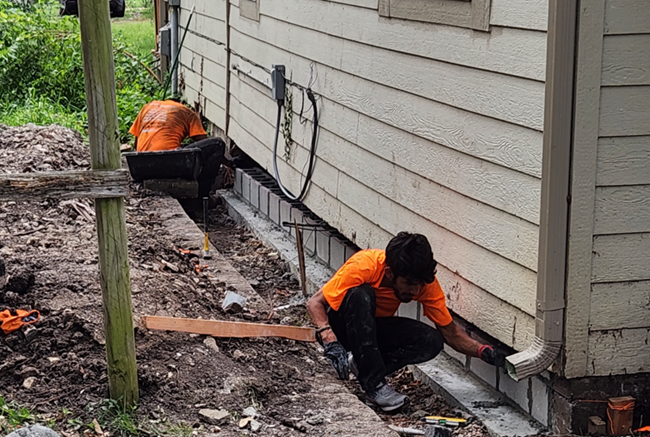
If your property has an exposed brick or concrete foundation, check for cracks and signs of deterioration.

Turn to a foundation professional for necessary repairs to guarantee that the property is properly and safely sealed.

No. 5: Windows, Entryways and Thresholds

Window sills and entryways can easily develop cracks.

Those cracks make it possible for critters to enter the property while also contributing to straining the heating, ventilation and air-conditioning (HVAC) system as a poorly-insulated property fails to retain a desired temperature. A professional handyman can easily reseal cracked thresholds.

No. 6: Caulking

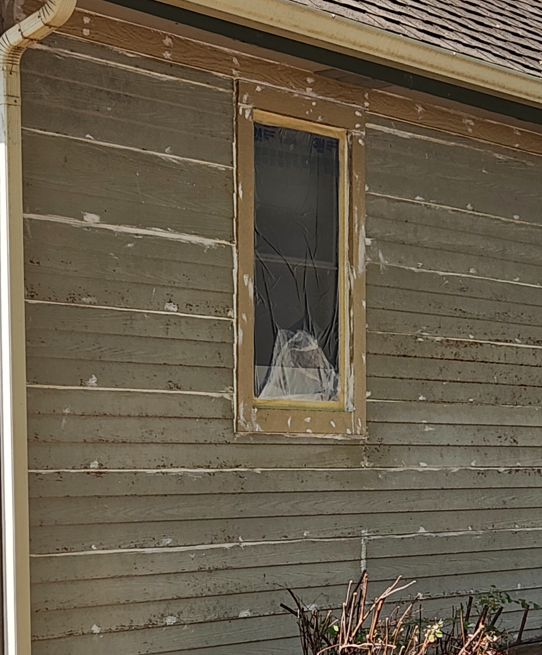
Similarly to entryways and windows, exterior caulking can wear off as a result of harsh weather exposure.

To guarantee that a property is properly insulated, a professional should check the conditions of exterior caulking and re-caulk deteriorated areas.

No. 7:  Siding

A cleaning and pressure washing specialist can assess the conditions of a property’s exterior siding and recommend whether it should be thoroughly cleaned.

Cleaning dirt and debris from siding keeps mold and fungi from growing and should be a part of spring rental property maintenance.

As warmer weather begins to show up, here are 7 spring rental property maintenance outside checks foundations, siding and more to get ready
Exterior caulking can wear out from harsh weather. Caulking siding and painting will give your rental a new look.

About Keepe:

Keepe is an on-demand maintenance solution for property managers and independent landlords. The company makes a network of hundreds of independent contractors and handymen available for maintenance projects at rental properties. https://www.keepe.com

Sign Up For Our Newsletter And Get Apartment News And Helpful, Useful Content Each Week.

* indicates required


4 Kinds Of Front Doors For Your Rental And Pros And Cons Of Each

3 Critical Electrical, Fire Safety, & HVAC Maintenance Checks

Rent Stabilization Is Just Another Word For Rent Control

Rent Stabilization Is Just Another Word For Rent Control

Advocates are trying to rebrand rent control with the words “rent stabilization,” but it is the same policy with a different name, Jason Sorens writes in an article in the American Institute For Economic Research article.

By Jason Sorens

he Washington State House has passed a bill to cap rent increases at 7 percent a year. The Senate has yet to vote on it, and the governor has not taken a position. If enacted, this law would hurt renters, including low-income renters.

Advocates of the legislation call it “rent stabilization” rather than “rent control,” because “rent control” has gotten a bad name over the years (and for good reason). But in practice, it works the same way.

Capping rents means lots of people will want to rent at the capped rate, but fewer units will be available to rent, creating a shortage. After all, owners of apartment buildings can put their units to alternative uses,  selling them off as condos, converting them to office spaces, occupying the units themselves, or simply leaving them vacant.

In the long run, rent caps encourage apartment owners to skimp on maintenance as well. So fewer units are available, and they are of lower quality

The Washington legislation exempts apartments built in the past 10 years. But the law could still discourage new apartment construction. After all, builders have to keep in mind the possibility that 10 or 15 years from now, those new units themselves will be added to rent stabilization. This is precisely what has happened in New York over and over again.

Once a place adopts rent caps, it’s very hard to un-ring the bell and make investors feel safe again about building new apartments.

Advocates of rent stabilization say that “vacancy decontrol” — letting rents adjust when a tenant moves out — makes the legislation less harmful. But rent stabilization makes tenants less likely to want to move out. That makes it harder for young people and workers moving to an area to find a place to rent, and keeps people locked into locations where it might not make sense for them to live anymore.

In markets that have had rent caps for many years, there’s even a well-known scam, described in Tom Wolfe’s Bonfire of the Vanities, whereby a renter pretends to still occupy a unit, while subletting it to someone else, to avoid vacancy decontrol.

Advocates of rent stabilization also say that a high rent cap, like one that limits a one-year increase to 7 percent, is less harmful than traditional rent control. But it’s no defense of a policy that it might cause only a little harm. And in any case, a 7-percent cap could cause a lot of harm.

Why might a housing provider need to raise rent more than 7 percent in a year?

First, inflation might run above that rate. We just went through a year in which inflation topped 9 percent. It could happen again.

Second, even if inflation doesn’t run that high, rent inflation could run that high if land-use regulations have choked off housing supply and demand is growing. Again, the recent pandemic is a case in point: Americans’ demand for housing went up because people were spending more time at home, but a lot of places did not let property owners build lots of new units. Last year, annual rent growth topped 10 percent in several markets that have limited the supply of new homes.

Third, repairs and renovations can be costly for housing providers, and the value of these improvements, especially after a tenant has stayed several years and if building codes change, could justify a rent increase of much more than 7 percent.

Fourth, the city of Seattle requires a court order to evict a tenant. For instance, if the tenant is involved in drug activity, the housing provider has to prove it in court. But a housing provider might prefer not to get the police involved. Sometimes a rent increase is the only realistic way to get rid of a problem tenant. In this way, just-cause eviction laws and rent stabilization laws interact to make it extremely difficult to remove tenants who are damaging the property, annoying their neighbors, or engaging in illegal activity.

The economic research on rent caps shows unequivocally very large economic losses, even for tenants of those units themselves. A recent study of San Francisco rent caps shows that after adoption, corporate housing providers reduced supply by 64 percent, while individuals reduced supply by 14 percent. Perhaps the definitive study of the welfare effects of rent control in New York, published in Journal of Urban Economicsfound that even tenants in rent-capped units suffered from the policy.

Thus, it’s no surprise that only 2 percent of top economists agree that “ordinances that limit rent increases for some rental housing units, such as in New York and San Francisco, have had a positive impact over the past three decades on the amount and quality of broadly affordable rental housing,” while 81 percent disagree.

Rent caps also have unintended consequences in other markets. Rent caps reduce the value of multifamily properties, because owners and investors expect to earn less. In New York, a recent tightening of “rent stabilization” drove down multifamily properties’ values by more than 30 percent, leaving some housing providers with negative equity and encouraging foreclosure. As a result, a major housing lender has incurred large losses, and investors are worried it could go bankrupt.

Instead of rent caps, cities and states can make housing affordable by letting people build more of it. That’s just what has happened in the last year in several Sunbelt markets. Investors are even complaining that multifamily has a “supply problem,” meaning too much supply, resulting in rent declines.

Just about the worst way to “help” renters is by punishing property owners for providing rental housing, which is just what rent caps do, regardless of whether they call them “rent control” or “rent stabilization.”

About the author:

Jason Sorens, Ph.D., is Senior Research Fellow at AIER. He is also Principal Investigator on the New Hampshire Zoning Atlas. Jason was formerly the director of the Center for Ethics in Society at Saint Anselm College. His research is focused on housing policy and land-use regulation, U.S. state politics, fiscal federalism, and movements for regional autonomy and independence around the world.

Sign Up For Our Weekly Newsletter And Get Rental Property And Apartment News And Helpful, Useful Content Each Week.

* indicates required

National Rental Rates Up For First Time In 6 Months

The national rental rates for both one and two-bedrooms are up on a monthly basis for the first time in 6 months

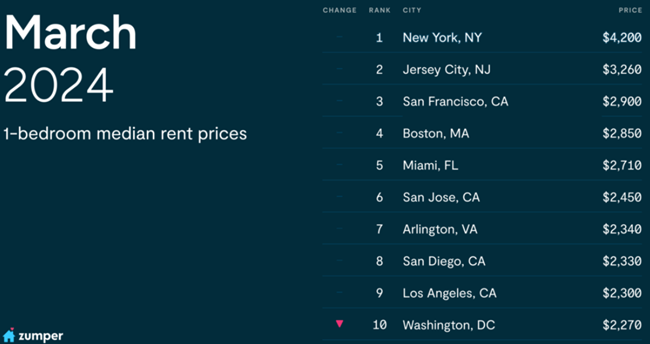
The national rental rates for both one and two-bedrooms are up on a monthly basis for the first time in 6 months, according to a new Zumper report, which mirrors other predictions of rents now increasing.

The report covers 100 cities nationwide, with data aggregated from over one million active listings, and includes a National Rent Index for one- and two-bedroom units.

Highlights

  • March marks the end of the slow-moving season as the national rates for both one and two-bedrooms grew on a monthly basis for the first time in 6 months.
  • The rate increase in the latest Consumer Price Index (CPI) data indicates that inflation is sticking around for longer than previously expected and the recent uptick shown in Zumper’s National Rent Index suggests that even more pressure will be put on the CPI in the coming months.
  • Meanwhile, New York City had the largest annual rent price growth rate in the nation with one-bedroom rent up 24.6%.

“Annually speaking, Zumper’s national rates have remained relatively flat with one-bedrooms down a slight 0.5% and two-bedrooms up 0.8%. While the historic amount of new apartment supply hitting the U.S. market coupled with the lessened demand from the winter months have contributed to the market’s current overall flatness, the skyrocketing rates that were seen in 2021 and 2022, when 2 years of pent-up demand from the pandemic hit the market, have not been offset.

“The current national rent rates are still up 22% for one-bedrooms and 26% for two-bedrooms, when compared to March 2020,” the report says.

“Inflation’s stickiness” at the same time as growing national rent rates will put more pressure on the Consumer Price Index, the report says.

“There is a lagging nature to the CPI’s shelter cost component since it measures existing paid rents as part of its calculation, not just current asking rents,” Zumper CEO Anthemos Georgiades said in a release. “Zumper’s National Rent Index serves as a leading indicator of shelter CPI since our data measures asking rents today. Zumper’s national rates showed an increase for the first time in 6 months. Coupled with the current stickiness of inflation, this suggests that there will be even more pressure put on the CPI in the coming months.”

Read the full report here


Rent Concessions Cool with Spring Rental Season

As rent concessions cool during the upcoming leasing season, property managers are signaling a tighter market for renters this spring

As rent concessions cool during the upcoming leasing season, property managers are signaling a tighter market for renters this spring, according to a Zillow report.

Tempting rental concessions such as free months of rent or free parking, Zillow’s latest data reveals, may have hit their peak.

The good news for renters is that the market is friendlier than it was a year ago, with the share of rentals offering a concession rising 5.6 percentage points.

February data show 32.2% of rental listings on Zillow offered a concession, down slightly from December and up 5.6 percentage points from a year earlier. That marks the slowest annual growth pace since last June. After seven months of consecutive monthly increases to end 2023, the share of rentals offering concessions fell to 31.9% in January before a slight uptick last month.

If past seasonal trends continue to hold, renters looking to secure a new lease in the upcoming spring or summer may encounter fewer incentives and increased competition.

“The rental market always ebbs and flows with the seasons, so it’s no shock that we’re seeing concessions start to level off as we move into the warmer months,” said Anushna Prakash, an economic research data scientist at Zillow, in a release.

“It looks like we’re beginning to see the market balance the ongoing high demand from renters with a competitive environment for property managers and landlords. While concessions are beginning to dip, they are more common than they were a year ago, helped by new buildings that have opened their doors.”

While the expected seasonal shift accounts for the stabilization of concessions, the pace of rent growth and vacancy levels offer deeper insights. Recently, rents haven’t been going up as quickly as they did before the pandemic, and it looks like supply and demand are starting to balance out. The share of rental housing units that were vacant was at 6.6% in the fourth quarter of 2023, which is just a bit higher than the nearly 40-year low seen at the end of 2021. This indicates there are enough eager renters, nudging the market toward stability.

The Metros Leading the Concession Charge

Despite the national trend toward stabilization, certain markets continue to lead with high shares of concessions. These metros exemplify the diversity within the rental market, with strategies varying widely across regions to attract tenants.

10 Metro Areas with the Largest Share of Rental Concessions 


Metro Share of Rentals w/ Concessions Year over Year (YoY) Change in Share of Concessions Typical Rent in Zillow Observed Rent Index (ZORI) YoY Change in ZORI 
Salt Lake City, UT 60.3% + 22.9 percentage points $1,656 1.6%
Austin, TX 55.0% + 17.9 pp $1,735 -3.0%
Charlotte, NC 53.5% + 19.0 pp $1,775 1.7%
Dallas, TX 50.7% +  13.5 pp $1,747 0.5%
Raleigh, NC 50.6% + 13.4 pp $1,747 1.2%
Nashville, TN 49.9% + 9.9 pp $1,874 0.7%
Washington, DC 49.4% – 2.9 pp $2,273 5.1%
Minneapolis, MN 49.4% + 4.3 pp $1,615 2.9%
Phoenix, AZ 48.8% + 8.6 pp $1,846 1.4%
Denver, CO 48.1% + 8.5 pp $2,007 3.1%
United States 32.2% + 5.6 pp $1,959 3.5%

Source: Zillow data 


In nine of the 10 metros where the share of rental concessions is highest, rents are growing more slowly than the nationwide 3.5% annual rate, and they are outright falling in Austin. This could mean there are more apartments available than there are people looking to rent them.

On the other hand, areas where there are fewer of these kinds of deals available, such as Providence, R.I. (12.3% of rentals offered concessions in February), Hartford, Conn. (16.3%), and Cincinnati, Ohio (18.9%), are seeing some of the fastest rent increases. In Providence, typical rents have jumped by 8.1% since last year. Hartford and Cincinnati both saw rents increase by 6.4%.


Tenant Background Checks and Your Rights

a resource for rental housing applicants and tenants about their rights under federal laws related to tenant background checks

The Justice Department, Federal Trade Commission (FTC), Consumer Financial Protection Bureau (CFPB) and Department of Housing and Urban Development (HUD) jointly published a resource for rental housing applicants and tenants about their rights under federal laws related to tenant background checks, also referred to as tenant screening reports.

The Justice Department and HUD enforce the Fair Housing Act (FHA) and other civil rights statutes, and the FTC and CFPB enforce the Fair Credit Reporting Act (FCRA).

“Rental housing applicants and tenants across our country should not be denied housing opportunities because of unjust background checks and discriminatory screening policies,” Assistant Attorney General Kristen Clarke of the Justice Department’s Civil Rights Division said in a release. “Landlords and background check companies cannot use or ask for unnecessary information to deny someone housing. Today we are shining a light on the bad practices that can emerge when landlords maintain unjust screening policies, ensuring that applicants and tenants know their rights, and that housing providers and background check companies are on notice regarding their obligations under federal law.”

“Mistakes in your background check shouldn’t cost you a home or create one more hurdle to overcome as you search for affordable housing,” said Director Samuel Levine of the FTC’s Bureau of Consumer Protection. “This collaboration among FTC, CFPB, HUD and the Justice Department helps consumers know their rights, and what to do if landlords or background check companies break the law.”

“Tenants have rights when landlords deny housing based on tenant screening reports,” said CFPB Director Rohit Chopra. “These reports often rely on hidden data and complex algorithms and can cause serious harm to families seeking housing. Anyone who thinks they were wrongly denied housing because of a tenant screening report can file a complaint with the CFPB.”

“People seeking housing have a right to be free from discrimination, including during the tenant screening process,” said HUD Principal Deputy Assistant Secretary for Fair Housing and Equal Opportunity Demetria McCain. “HUD is excited to be a part of the release of this joint agency resource that contains important information about the Fair Housing Act’s protections against discriminatory background checks. We encourage anyone who suspects they are being discriminated against to file a complaint with HUD.”

The new resource provides information about how tenant background checks work, what kinds of background information a landlord might receive from tenant background check companies, how applicants and tenants can respond if they think that information is wrong and their rights under federal laws.

It also explains that, in some instances, tenant background checks can lead to illegal discrimination, even if there is no factual error in the report. The FHA makes it illegal for tenant background check companies and housing providers to discriminate against individuals on the basis of race, national origin, color, sex, religion, disability or familial status. A landlord cannot reject an application or treat an applicant or tenant differently than other applicants or tenants because of any of these characteristics. Actions of a tenant background check company or a landlord can also be illegal if they use or encourage the use of irrelevant or unnecessary information to deny individuals housing, and this negatively affects some groups more than others – this may be discrimination even if the tenant background check company or landlord does not intend to discriminate.

The resource also explains an individual’s rights under the FCRA, including the right to request a free copy of a report from the tenant background check company if a landlord makes a negative housing decision because of something included in the report and the right to dispute errors on a report. Tenant background check companies are required to take reasonable steps to ensure the information in tenant background check reports is accurate and to investigate within 30 days when someone disputes errors in their report.

Read the joint resource here.

New Warnings on Inaccurate Tenant Background Checks

TransUnion To Pay $15 Million Over Tenant Screening Inaccuracies

Avoid These Two Applicant Background Checks At All Cost

Multifamily Loans Coming Due May Be a Challenge

In a research bulletin, Yardi Matrix says maturing debt of multifamily loans coming due may test the strength of the multifamily industry
Yardi Matrix says In the short term, through the end of 2025, loans on 6,800 properties totaling nearly $150 billion are set to mature.

In a multifamily research bulletin, Yardi Matrix says maturing debt of multifamily loans coming due may test the strength of the multifamily industry.

Higher mortgage rates, lower property values and tightening bank credit will challenge the market in coming years, Yardi Matrix says in a special report.

“For this special report, Yardi Matrix analyzed mortgage debt on more than 58,000 properties in its multifamily database to determine when the loans are coming due, which metros have the most maturing debt, lender type and more,” writes Paul Fiorilla, director of research, Yardi Matrix, in the special report.

Multifamily loans coming due

“A review of Yardi Matrix’s database found that loans on more than 58,000 properties totaling $525 billion will mature over the next five years, nearly half of the total $1.1 trillion of loans currently backed by apartments. In the short term, through the end of 2025, loans on 6,800 properties totaling nearly $150 billion are set to mature,” Fiorilla writes.

When the Federal Reserve starting rapidly raising interest rates to fight inflation, worries about defaults in the multifamily area begin to rise.

Fiorilla writes, “Years of zero short-term interest rates had pushed loan coupons to historically low levels, and many multifamily properties booked loans with coupons within the 3%-4% range.

“Meanwhile, reflecting the higher capital costs, multifamily property values fell by 20%-30% from the 2022 peak, and lenders tightened standards due to regulatory pressure, growing fears of a recession and weaker income growth. The result is that many properties up for refinancing are qualifying for lower proceeds than they did when their existing loans were originated,” he says in the report.

Summary

Fiorilla writes that despite these concerns, multifamily fundamentals are solid and most properties are in good shape – especially with signals from the Fed that rates may be coming down in the future.

“Long-term investors, as usual, are on more solid ground. Investors who try to time the market and expect to make a quick profit are more likely to see an uptick in defaults.

“Overall, multifamily delinquencies will increase from current low levels and provide a venue for opportunistic capital. But it may not be enough to deploy the amount of capital being raised or lead to a banking crisis akin to the last downturn in 2008-10.”

Read the full special report here.

Multifamily Rents Inch Up Ahead of Spring

Photo credit Yumi mini via istockphoto

Should I Pay Realtor for Lease Renewal?

Realtor lease renewal payments is a topic that comes up often with landlords, and is the question this week for Hank Rossi, Landlord Hank

Realtor lease renewal payments is a topic that comes up often with landlords, and is the question this week for Ask Landlord Hank. Remember Hank is not an attorney and he is not offering legal advice. If you have a question for him please fill out the form below.

Dear Landlord Hank,

At lease-renewal time, I call on my realtor to ask what rent would be appropriate for the new lease since she knows my apartments well. Then I write letters to my tenants and have them complete a form as to whether they will renew or vacate. She then prepares the renewal rental agreements for my tenants and has them signed digitally.

I like to pay her for her time. I was wondering what would be appropriate – $50? $75? $100? I live in Massachusetts. Thank you.

– Ellie

Dear Landlady Ellie,

Lease renewals for good tenants is a satisfying time for me.

You know your tenants are happy in a good well-maintained home or they’d be moving. You’ve done your job well.

If your Realtor, whom you trust, is working for you, you should pay her.

I don’t know what is customary in Massachusetts, but here in Florida we charge $60 for renewal work and about $35 of that goes to the attorney to write the renewal lease.

Sincerely,

Hank Rossi

Each week I answer questions from landlords and property managers across the country in my “Dear Landlord Hank” blog in the digital magazine Rental Housing Journal.   

Realtor lease renewal payments is a topic that comes up often with landlords, and is the question this week for Hank Rossi, Landlord Hank
Landlord Hank says about lease renewal payments, “If your Realtor, whom you trust, is working for you, you should pay her.

Ask Landlord Hank Your Question

Ask veteran landlord and property manager Hank Rossi your questions from tenant screening to leases to pets and more! He provides answers each week to landlords.

  • This field is for validation purposes and should be left unchanged.

Do I Have to Paint and Replace Flooring for a Long-Term Tenant?

Sign Up For Our Newsletter And Get Rental Housing And Apartment News And Helpful, Useful Content Each Week.

* indicates required

Who’s Responsible For Smoke Detector Batteries In Rentals?

Tenant Refuses To Return Keys After Leaving My Rental

A Tenant Poured Grease Down Drain Who Is Responsible?


A tenant poured grease down the kitchen sink so who is responsible for the plumbing repair is the question this week for Ask Landlord Hank.
Top Photo credit SeventyFour via istockphoto

Navigating the Waters of Resident Relations: A 2024 Guide to Help Prevent Retaliation Claims

A guide to provide strategies and insights to help property managers and staff avoid fair-housing retaliation claims.

A guide to provide strategies and insights to help property managers and staff avoid fair-housing retaliation claims.

By The Fair Housing Institute

Navigating the complexities of property management includes dealing with fair-housing claims, a task that becomes even more challenging when a claim of retaliation is added to the mix. This article aims to provide strategies and insights to help property managers and staff prevent fair-housing retaliation claims, ensuring a harmonious living environment for all residents.

Understanding Retaliation in the Housing Sector

Retaliation occurs when a resident, having filed a fair-housing claim, alleges that they are being mistreated in response to their claim. Retaliatory actions can vary widely but are united by their potential to exacerbate already-sensitive situations. For instance, consider a resident who has filed a fair-housing claim and subsequently submits a maintenance request. Prioritizing this request lower than others out of spite could escalate the situation, demonstrating apparent retaliatory behavior.

It’s crucial to remember that retaliation is unacceptable, regardless of the outcome of the original fair-housing claim. Effective training on fair-housing laws can play a significant role in preventing both the initial claim and any retaliatory actions that might follow.

Best Practices to Promote Prevention of Retaliation Claims

The cornerstone of avoiding retaliation claims lies in maintaining standard operating procedures for all residents without discrimination. Here’s how to approach a situation where a resident, perhaps feeling emboldened by their claim, starts to breach property rules or policies:

  1. Enforce Rules Fairly: Do not disregard rule violations. Every resident must adhere to the property’s policies. The delicate nature of these circumstances may necessitate consulting with a fair-housing attorney to ensure that any actions taken do not seem retaliatory.
  2. Fair-Housing Training: Continuous education for all staff members on fair-housing regulations is essential. This not only helps in avoiding initial claims but also in handling any situations that arise, without crossing into retaliation.
  3. Documentation and Communication: If a complaint does arise, minimize direct interactions between the complainant and involved staff members. Document all interactions meticulously to provide a clear record of your response to the issue.

Proactive Measures to Help Prevent Fair-Housing Complaints

The most effective strategy to avoid fair-housing complaints is to create an environment where residents feel respected and valued. This involves:

Ongoing Staff Training: Ensuring that all staff members, including property managers, understand fair-housing laws and how to apply them in daily operations.

Transparent Communication: Maintaining open lines of communication with residents about their rights and how to address grievances.

Responsive Management: Showing a willingness to address and resolve issues promptly and fairly can prevent many complaints from escalating.

Summary

Property management is indeed a complex field, rife with challenges that demand both tact and diligence. However, by adopting these best practices and dedicating themselves to continuous training, property managers can adeptly navigate the intricacies of resident relations with poise and assurance. This approach not only aims to circumvent potential legal pitfalls but also to cultivate an inclusive and welcoming community atmosphere.

In such an environment, every resident is not only afforded their rights but is also encouraged to engage and contribute, thereby fostering a sense of belonging and mutual respect. The ultimate objective extends beyond merely avoiding disputes; it’s about creating a living space where every individual feels valued, understood, and integral to the community fabric.

About the author:

In 2005, The Fair Housing Institute was founded as a company with one goal: to provide educational and entertaining fair-housing compliance training at an affordable price at the click of a button.

Managing Conflicting Accommodation Needs In Fair Housing