
Home Blog Page 42

10 Items To Check in a DIY Rental Property Inspection

Here are 10 items to check in a do-it-yourself rental property inspection to both plan preventative maintenance and build tenant trust.
10 items to check in a do-it-yourself rental property inspection

Here are 10 items to check in a do-it-yourself rental property inspection to both plan preventative maintenance and build tenant trust.

By Phil Schaller

Conducting a periodic informational inspection/walkthrough of your rental property is important; we recommend at least once a year. It allows you to understand the state of your property, troubleshoot for larger issues, plan some preventative maintenance and also build trust with your tenants (more on that in a bit).

While there are hundreds of items you could inspect in a walkthrough, we’re going to focus on the low-hanging fruit and the most important boxes to check. Before we get into the list, here are a few pointers:

  • Schedule this walkthrough far in advance with your tenants – they’ll keep it on the radar and (hopefully) focus on keeping the property in good shape. Most states require at least 48 hours of written notice before anyone enters the dwelling.
  • Communicate to your tenants why you’re conducting this walkthrough. You want to know what’s going on with the property but you also want to make sure you’re providing a hospitable environment for your tenants.
  • We recommend conducting these walkthroughs with a general contractor or maintenance pro (RentalRiff can help) as an unbiased third party and someone who can easily diagnose/fix certain issues.

Without further ado, here we 10 items to check in a rental property inspection:

1. Replace furnace filters

This is an easy one. You’ll need a filter on hand but it’s easy and not expensive. Replacing a broken furnace, on the other hand, is very expensive.

2. Replace smoke and carbon monoxide alarm batteries

Here is another easy one that is a critical safety tool. Aside from the liability you’ll have on your hands if these alarms don’t work during an emergency, let’s keep everyone safe!

3. Clean out dryer vents

While cleaning out a dryer vent may require slightly more elbow grease than changing batteries, it’s another important safety precaution. If your dryer can’t ventilate, two things can happen: Your dryer breaks ($$$) or, much worse, a fire can start.

4. Switch the GFIs

We can’t tell you how many calls we get for electrical work that can be solved with the push of a button. Get ahead of these issues by switching the GFI for your tenants.

5. Run water and check for leaks under the sinks

An easy way to do this is to turn on the water and throw a baking pan under the plumbing to see if any liquid is captured. Sometimes leaks can be small, but they can cause serious damage.

6. Turn on all appliances

Checking to see that appliances are in good working order is definitely helpful. Appliances are expensive and that weird sound your dishwasher is making may indicate a new one is in your future.

7‍. Run the garbage disposal

The No. 1 maintenance request landlords receive is for garbage disposals. We recommend giving them a tighten with an Allen wrench and/or a reset. Olive pits love giving landlords a headache.

8. Test the heating and air conditioning

You’re required as a landlord to provide a humane environment for your tenants; this means a livable temperature. We like to turn the AC on full blast to check, then switch to heat – it’s easy to inspect other items while checking these systems.

9. Inspect crawl spaces and attics

Pests and water damage love the areas of your property where people don’t hang out. It’s pretty easy to spot both (poop and watermarks) and if left untreated, they can cause big problems.

10. Check ceilings, walls, floors, doors, and windows

All right, so we crammed a few into No. 10 here, but they’re all important. Any sign of water damage is a big red flag and requires an immediate solution. Walls/ceilings/floors are expensive fixes.

About the author:

Phil Schaller is an experienced landlord and the founder/CEO of RentalRiff – an alternative service to traditional property management that provides ongoing oversight and upkeep of rental properties, while serving as the main point of contact for tenants. These walkthroughs are included with our service and many of our customers will schedule several throughout the year (based on the tenants and condition of the property). If you have any questions on how to conduct these informal walkthroughs we’re happy to chat or provide some more insight – https://www.rentalriff.com/contact-us You can reach him at 541-600-3200. Phil is a Pacific Northwest native, father of two, and fly-fishing addict.


Sign Up For Our Weekly Newsletter And Get Rental Property And Apartment News And Helpful, Useful Content Each Week.

* indicates required

3 Must-Have Coverages for Landlords

The 3 most important coverages you should look for in a proper Landlord Insurance Policy are dwelling, liability and loss of rents

By Andres Dominguez III

I spent years mastering landlord insurance, but I’ll break it down for you in minutes. Landlording is rewarding, tedious, and at times a pain in the neck. The last thing you need is an insurance policy that leaves you underinsured, exposed, and lacking essential coverages. Our agency works local, regional, and national carriers to find the best combination of coverage and pricing for your unique situation. In this article I’ll break down the 3 most important coverages you should look for in a proper Landlord Insurance Policy.

1- Dwelling Coverage

The dwelling limit is the meat and potatoes of an insurance policy.

This limit is the maximum amount your carrier will pay to rebuild your property in the event of a total loss. Imagine your property burns down and you have to rebuild it from the ground up. The dwelling limit will pay for the materials, labor, and cost of construction to rebuild your property.

We have not seen this level of inflation in many years. This means that the cost to rebuild your property has also increased due to increased cost of materials and labor. And your current policy may not have enough Dwelling Limit to rebuild your property. We advise our clients to not take this coverage lightly because there is a Coinsurance Penalty that insurance carriers will charge you if your property is underinsured. More on Coinsurance Penalty in this article: How Does Coinsurance Work in a Commercial Property Insurance Policy?

2- Loss of Rents

This often overlooked coverage is crucial at the time of a severe claim.

Another name for this coverage is “Fair Rental Value.” This coverage will reimburse you for lost rents due to a covered peril. Example: Imagine your rental unit has a tragic fire that burns the property to the ground. During the period of restoration while you get the property rebuilt, this coverage will step in and reimburse you the rents you would have received during this time. This coverage will continue to pay your lost rents until the home is repaired or rebuilt or the policy limit is exhausted (whichever comes first). That is why we emphasize the importance of reviewing your policy to ensure this limit is adequate.

3- Liability

 The United States is the most litigious society in the world.

We spend roughly $310 Billion a year on tort litigation. It is more important than ever to have sufficient liability limits on your Landlord Policy. Some carriers maximum is $500K, and some will go up to $1M. Every situation is unique, however, we usually suggest going for the highest limits your carrier offers.

***Bonus–Renter’s Insurance

A Renter’s insurance policy provides a layer of liability insurance between you, the tenants, and their visitors.

If the tenant’s mother-in-law drops by to visit, trips and falls, the renters insurance may respond before dinging your Landlord Policy. This is especially important if your tenant has a dog. The average dog bite claim across the nation is $50,000, make sure your tenants policy does not limit dog bite claims or exclude certain breeds. We recommend you require your tenants to carry at least a $300,000 limit of liability coverage. More on Renter’s Insurance in this article: Are You Requiring Renter’s Insurance?

Call or click for more information on how to best protect your rental properties or any questions you have about Landlording: 801-262-1551 or Click Here for a for a consultation with our experienced team. Find out more about renter’s insurance. We love helping our customers be successful Utah landlords.

Avoid Costly Coinsurance Penalties with Proper Insurance Coverage for Your Investment Properties

For a full review of your apartment or rental property insurance, contact a knowledgeable Anderson Insurance Group agent today.

Secure Your Monthly Cash Flow With One Easy-to-Miss Coverage: Business Income Insurance for Utah Landlords

Avoid Costly Coinsurance Penalties with Proper Insurance Coverage for Your Investment Properties


A Different Kind of AI For Landlords

A caution for landlords on how to react to tenant information provided by background screening companies per the new HUD tenant screening requirements.

There is a different kind of AI for landlords – Actual Information – and a caution for landlords on how to react to tenant information provided by background screening companies per the new HUD tenant screening requirements.

By Scot Aubrey

 When it comes to artificial intelligence, it seems to be everywhere.

In fact, it probably knows you’re reading this article right now.  But did you know it’s even trying to work its way into your life as a housing provider?  Although it has some restrictions, we do believe in AI, just a different kind than you are thinking of right now.  Rather than relying on artificial intelligence, we believe that the AI we provide will change the way you manage.  That AI is “Actual Information,” and it is more important than ever that you use it in managing your properties.

Recent changes in the HUD regulations for housing providers will create new challenges for each of us in this industry.  How we use the information provided by background-screening providers will be affected, and your need to understand how you interact with information provided from your background-screening provider has been elevated to a whole new level.  Please consider the following items as you use “Actual Information” in your business.

Creating a Criteria 

 One of the areas that HUD is highlighting is the use of and creation of criteria for all of your potential tenants.

HUD warns against the use or application of certain criteria in determining who can move into one of your properties.  They indicate that you as a housing provider are solely responsible for creating and enforcing your own criteria.  It is recommended that you contact your attorney for any custom criteria creation.

Beware as you create your criteria to steer away from the many areas HUD indicates as being potentially discriminatory and only rely on “Actual Information” results as you measure against your final criteria.

Evictions 

 Per the new HUD guidelines, “tenant screening companies and housing providers should not rely on eviction records that are old, incomplete, irrelevant, or where a better measure of an applicant’s behavior is available.”

Does that sound vague or subjective to you?

The new HUD guidelines are both clear and unclear about eviction data and how you can use it as a housing provider.  One of the things you should look for with your “Actual Information” regarding evictions are the circumstances surrounding any eviction.  Factors like how long ago the eviction occurred and the reason for the eviction, if you can find one, are the two main items.

Also to consider per the HUD guidelines is the likelihood of an eviction occurring again. You must consider things like whether there was criminal activity surrounding the eviction, if the evicted person was a victim of a crime, or if the individual who was evicted was forced to commit a crime, causing the eviction.

In our opinion, this just made using eviction data harder.

Final Occupancy Determination

When you are ready to decide on who you will rent to, please keep in mind the following regarding the “Actual Information” provided by your screening company:

  • Your screening company cannot provide a pass-or-fail decision.
  • Your screening company cannot provide an accept-or-deny decision.
  • A landlord has to take all the information provided by the screening company and decide about housing. The screening company can have no role in the housing decision.
  • Your screening company cannot give a landlord a score, recommendation, or any influence (explicit or implicit) as to the relevance of any information about an applicant.

In essence, you are on your own.

In conclusion, by relying on the “Actual Information” provided by your background-screening company, you will be equipped to make the best decisions on how to manage your properties and onboard new tenants.

It would be beneficial to familiarize yourself with the new guidance from HUD by reviewing the “Guidance on Application of the Fair Housing Act to the Screening of Applicants for Rental Housing” as provided by the Office of Fair Housing and Equal Opportunity.

About the author:

Scot Aubrey is vice-president of Rent Perfect, a private investigator, and fellow landlord who manages short-term rentals.  Subscribe to the weekly Rent Perfect Podcast to stay up to date on the latest industry news and for expert tips on how to manage your properties.

Sign Up For Our Weekly Newsletter And Get Rental Property And Apartment News And Helpful, Useful Content Each Week.

* indicates required

Phoenix, Tucson Rents Flat Month-Over-Month

Phoenix rents are flat month-over-month and down 3.8% year-over-year, according to the May report from Apartment List.

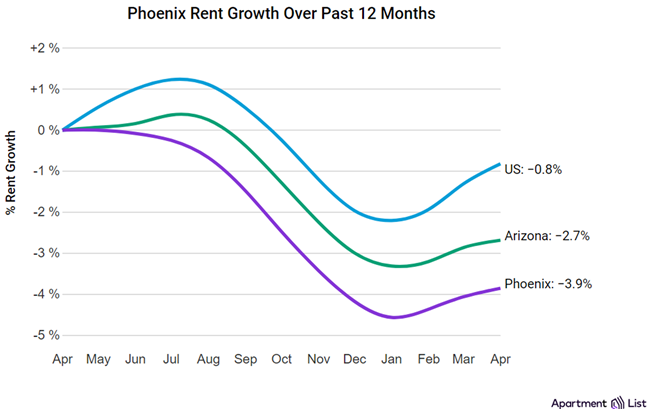
Phoenix’s rent growth over the past year has fallen behind both the state (-2.7%) and national (-0.8%) averages.

Four months into the year, rents in Phoenix have risen 0.8%. This is a faster rate of growth compared to what the city was experiencing at this point last year; from January to April 2023, rents had decreased 0.0%.

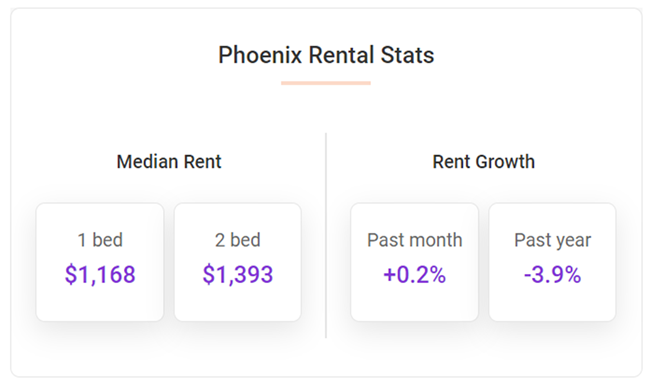
Citywide, the median rent stands at $1,168 for a 1-bedroom apartment and $1,393 for a 2-bedroom. Across all bedroom sizes (i.e., the entire rental market), the median rent is $1,363. That ranks No. 60 in the nation, among the country’s 100 largest cities.

Phoenix rents are flat month-over-month and down 3.8% year-over-year, according to the May report from Apartment List.

Phoenix rents are 5.7% lower than the metro-wide median

Across the Phoenix metro, the median rent is $1,446, meaning that the median price in Phoenix proper ($1,363) is 5.7% lower than the price across the metro as a whole. Metro-wide annual rent growth stands at -3.0%, above the rate of rent growth within just the city.

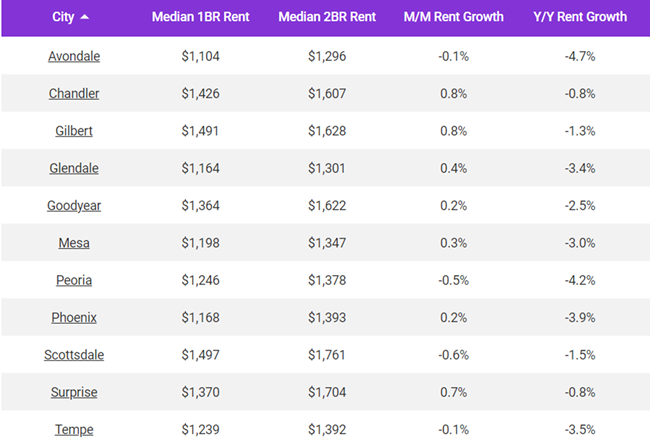
The table below shows the latest rent stats for 11 cities in the Phoenix metro area that are included in the Apartment List database.

Among them, Surprise is currently the most expensive, with a median rent of $1,836. Glendale is the metro’s most affordable city, with a median rent of $1,354. The metro’s fastest annual rent growth is occurring in Surprise (-0.8%), while the slowest is in Avondale (-4.7%).

Phoenix rents are flat month-over-month and down 3.8% year-over-year, according to the May report from Apartment List.

Tucson rents are flat month-over-month and flat year-over-year

Tucson Arizona rental stats for April 2024

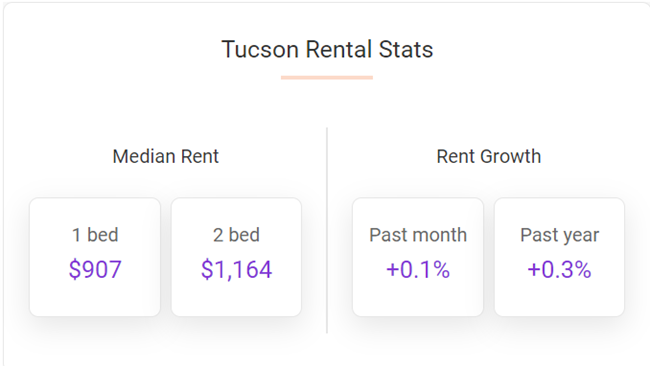
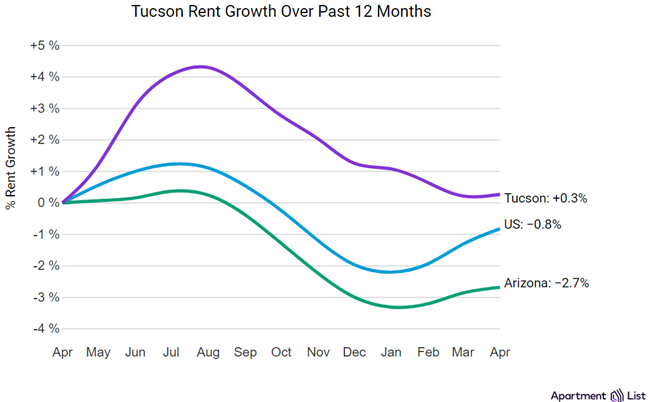
The median rent in Tucson rose by 0.1% over the course of April, and has now increased by a total of 0.3% over the past 12 months, according to the May report from Apartment List.

Tucson’s rent growth over the past year has has outpaced both state (-2.7%) and national (-0.8%) averages.

Four months into the year, rents in Tucson have fallen 0.8%. This is a slower rate of growth compared to what the city was experiencing at this point last year: from January to April 2023 rents had increased 0.5%.

Tucson rent growth flat in April

Sign Up For Our Weekly Newsletter And Get Rental Property And Apartment News And Helpful, Useful Content Each Week.

* indicates required

Portland Rents Rise in April, Decreases Over Year

Portland rents rose 0.8% in April, making the overall median rent in the city $1,549, according to the May report from Apartment List.

Portland rents rose 0.8% in April, making the overall median rent in the city $1,549, according to the May report from Apartment List.

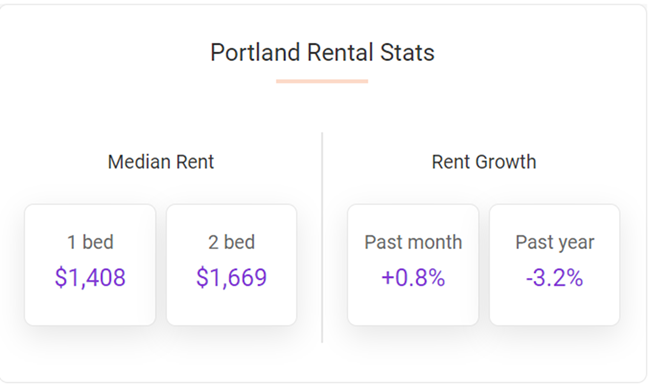
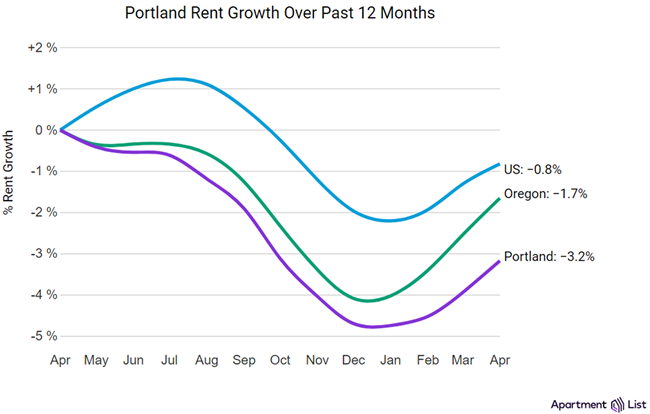
While the median rent in Portland rose over the course of April, it has decreased by a total of 3.2% over the past 12 months.

Portland’s rent growth over the past year has fallen behind both the state (-1.6%) and national averages (-0.8%).

However, so far in 2024 Portland rent increases are pacing above 2023. At this point four months into the year, rents in Portland have risen 1.6%.

April rent growth in Portland ranked No. 32 among large U.S. cities. Citywide, the median rent stands at $1,408 for a 1-bedroom apartment and $1,669 for a 2-bedroom.

Portland rents rose 0.8% in April, making the overall median rent in the city $1,549, according to the May report from Apartment List.

Portland rents are 6.7% lower than the metro-wide median

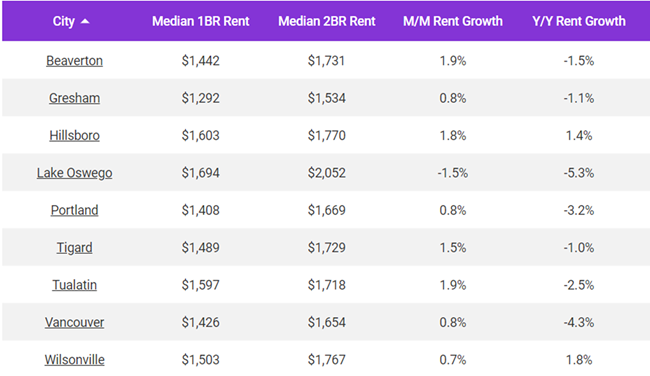
Outside the city proper, the median rent is $1,661, meaning that the median price in Portland is 6.7% lower than the price across the metro as a whole. Metro-wide annual rent growth stands at -2.3%, above the rate of rent growth within just the city.

The table below shows the latest rent stats for 9 cities in the Portland metro area that are included in our database. Among them, Lake Oswego is currently the most expensive, with a median rent of $1,935. Gresham is the metro’s most affordable city, with a median rent of $1,514. The metro’s fastest annual rent growth is occurring in Wilsonville (1.8%), while the slowest is in Lake Oswego (-5.3%).

Portland rents rose 0.8% in April, making the overall median rent in the city $1,549, according to the May report from Apartment List.

Sign Up For Our Weekly Newsletter And Get Rental Property And Apartment News And Helpful, Useful Content Each Week.

* indicates required

Salt Lake City Rents Flat In April

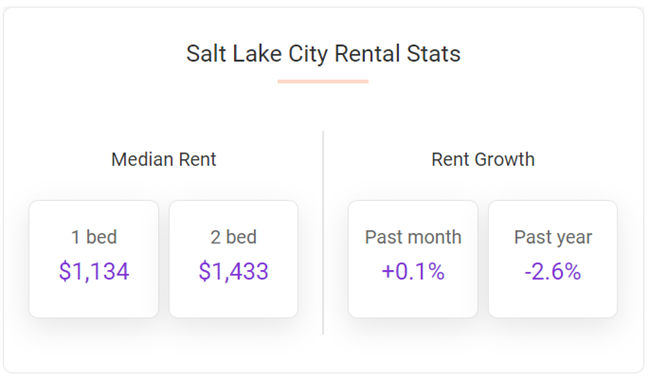
Salt Lake City rents are flat month-over-month and down 2.6% year-over-year, according to the May report from Apartment List.

Salt Lake City April rents are flat month-over-month and down 2.6% year-over-year, according to the May report from Apartment List.

The overall median rent in the city stands at $1,310, roughly the same as April.

So far this year, Salt Lake City rent growth is pacing similar last year. Four months into 2024, rents in Salt Lake City have risen 0.3%. This is a similar rate of growth compared to what the city was experiencing at this point last year as from January to April 2023 rents increased 0.5%.

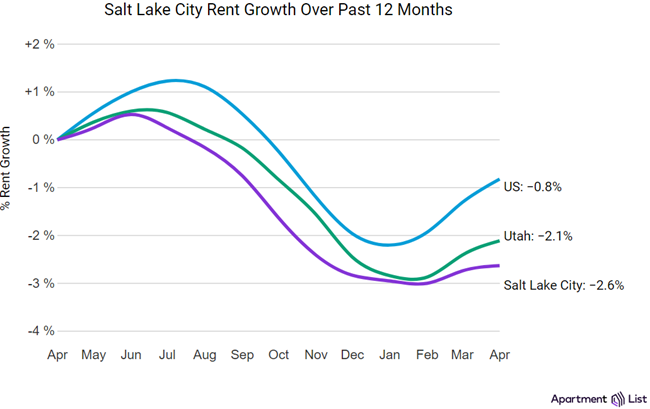
Salt Lake City’s rent growth over the past year is similar to the state average (-2.1%) but has fallen below the national average (-0.8%).

Salt Lake City rents are flat month-over-month and down 2.6% year-over-year, according to the May report from Apartment List.

Salt Lake City rents are 12.5% lower than the metro-wide median

Across the Salt Lake City metro area, the median rent is $1,497 meaning that the median price in Salt Lake City proper ($1,310) is 12.5% lower than the price across the metro as a whole. Metro-wide annual rent growth stands at -2.1%, above the rate of rent growth within just the city.

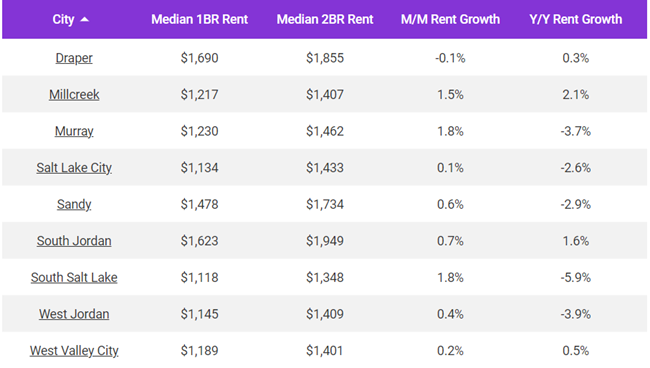
The table below shows the latest rent stats for 9 cities in the Salt Lake City metro area that are included in the Apartment List database.

Among them, Draper is currently the most expensive, with a median rent of $1,911. South Salt Lake is the metro’s most affordable city, with a median rent of $1,280. The metro’s fastest annual rent growth is occurring in Millcreek (2.1%) while the slowest is in South Salt Lake (-6.0%).

Salt Lake City rents are flat month-over-month and down 2.6% year-over-year, according to the May report from Apartment List.

Salt Lake City Rents Up Slightly In March

New Apartment Construction Steadily Being Absorbed

Multifamily rents continue to rise slightly as the market absorbs the steady supply of new apartments, Yardi Matrix says in the April Report.

Multifamily rents continue to rise slightly as the market absorbs the steady supply of new apartments, Yardi Matrix says in the April National Multifamily Report.

“Although rent growth remains moderate, there are plenty of encouraging signs in the data. Most importantly, demand for apartments continues unabated due to high levels of household formation stemming from the strong job market, large numbers of immigrants and ongoing migration to the South and West,” the report says.

Also, the absorption of new apartment units was strong around the county and “particularly in high supply metros where there is concern about supply’s impact on occupancy rates and rent growth.

“Absorption is not near 2021’s peak levels, but 2024 started at a pace that would be on par with an average year and slightly ahead of 2022 and 2023 levels,” Yardi Matrix says in the report.

Highlights of the report

  • April heralded good news for the multifamily market, as rents rose solidly for the second straight month. The average U.S. asking rent increased by $6 to $1,725, while year-over-year growth was unchanged at 0.7%.
  • Multifamily faces challenges that include increased expenses and insurance costs plus higher- for-longer interest rates, but post-pandemic demand for units has remained consistent, leading to healthy absorption numbers in most locales.
  • The single-family rental market also had its second straight strong month, with rents increasing $9 in April to an all-time high of $2,154. The year-over-year growth rate rose 10 basis points to 1.3%, and occupancy rates were unchanged at 95.4%.

Increase in renewal rents

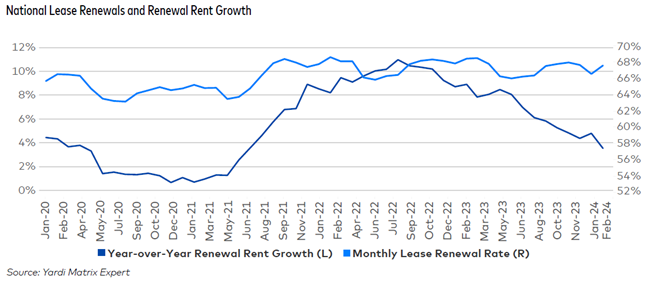
The national lease renewal rate averaged 65.8% in March, a low that has not been recorded in nearly two years. Lease renewal rates were highest in New Jersey (83.8%) and lowest in Los Angeles (56.1%).

Multifamily rents continue to rise slightly as the market absorbs the steady supply of new apartments, Yardi Matrix says in the April Report.

Looking ahead

While apartment demand has cooled after 2021’s record 620,000 units, it remains consistent.

“That’s good news with supply growth at multi-decade highs. Over the next year or two, it may take longer to lease up new properties in high-supply Sun Belt markets, and owners may have to offer concessions to attract and retain tenants, but if demand remains healthy, fundamentals will return to normal after new stock is digested,” the report says.

Read the full report here.

About Yardi Matrix

Yardi Matrix researches and reports on multifamily, office and self-storage properties across the United States, serving the needs of a variety of industry professionals. Yardi Matrix Multifamily provides accurate data on 18+ million units, covering more than 90 percent of the U.S. population. Contact the company at (480) 663-1149.

Sign Up For Our Weekly Newsletter And Get Rental Property And Apartment News And Helpful, Useful Content Each Week.

* indicates required

photo credit Ivanko_Brnjakovic via istockimages

HUD Warns About Using AI for Tenant Screening and Advertising

HUD has issued two warnings about using AI for tenant screening and advertising due to potential Fair Housing violations using AI

The U.S. Department of Housing and Urban Development (HUD) has issued two guidance documents addressing the application of the Fair Housing Act to two areas in which the use of artificial intelligence (AI) poses particular concerns: the tenant-screening process and its application to the advertising of housing opportunities through online platforms that use targeted ads, according to a release.

“We have released new guidance to ensure that our partners in the private sector who utilize artificial intelligence and algorithms are aware of how the Fair Housing Act applies to these practices,” acting HUD Secretary Adrianne Todman said in the release.

Demetria McCain, principal deputy assistant secretary for Fair Housing and Equal Opportunity said, “Housing providers, tenant-screening companies, advertisers and online platforms should be aware that the Fair Housing Act applies to tenant screening and the advertising of housing, including when artificial intelligence and algorithms are used to perform these functions.”

“Housing providers have a legitimate interest in selecting tenants who will pay their rent and otherwise comply with lawful requirements of their lease. However, some tenant-screening practices do not in fact serve these goals.

“Tenant screening based on imprecise or overbroad criteria may unjustifiably exclude people from housing opportunities in discriminatory ways. These issues have been magnified in recent years by the increasing reliance by housing providers on tenant-screening companies to drive tenant-selection decisions.

“An increasing number of tenant-screening companies claim that they use advanced technologies, such as machine learning and other forms of artificial intelligence (“AI”). These technologies can increase these companies’ capacity to access and analyze information about applicants that has not been widely used for rental decisions until recently but may have little bearing on whether someone will comply with their lease.

“These technologies can also lead to a less transparent process by obscuring the precise reasons for a denial from the housing provider and applicant,” HUD says. “The Fair Housing Act applies to housing decisions regardless of what technology is used. Both housing providers and tenant-screening companies have a responsibility to avoid using these technologies in a discriminatory manner.”

On the advertising side, HUD cautioned that online advertising-targeting tools are covered by the Fair Housing Act. The release said violations  “may also occur when ad targeting and delivery functions are used, on the basis of protected characteristics, to target vulnerable consumers for predatory products or services, display content that could discourage or deter potential consumers, or charge different amounts for delivered advertisements.”

Read the full statement here.

Sign Up For Our Newsletter And Get Apartment News And Helpful, Useful Content Each Week.

* indicates required


The Do’s and Don’ts of Fair Housing Advertising

ADA, HUD, the Fair Housing Act: Which One Applies to Housing and Support Animals?

Allergies and Reasonable Accommodation Requests In Rental Housing

Photo credit amgun via istockimages

Back to Basics: What Today’s Residents Want

Operators should concentrate on the basics of what residents want so here are 4 upgrade measures to contemplate for capital improvements.
The addition of pet spaces, such as dog parks and pet-wash stations, can make an impact at pet-friendly communities,

In the current multifamily marketplace, operators should concentrate on basics and functionality that today’s residents want. So with that in mind, here is a look at the four upgrade measures most likely to pencil out from a value-proposition perspective for capital improvements.

By Tim Bruss

As apartment owners and operators clamor to offer more attractive communities than their competitors, it can seem like a creativity contest at times.

The temptation to incorporate previously unseen amenities and in-home features certainly exists. While that approach might evoke an initial reaction, however, it doesn’t necessarily have the desired long-term impact.

Amenities such as theater rooms might appear sophisticated, but in actuality, residents might use them once, then check off the experience from their to-do list. When a property is performing upgrades, the same space almost certainly would be better allocated toward attractions that would be used more frequently, such as coworking spaces or other features that cater to the work-from-home resident.

While maybe not as eye-popping as a novelty-type amenity such as an onsite arcade, items such as coworking spaces are more functional and ultimately are more likely to drive resident retention. That is part of the big-picture premise that in the current multifamily marketplace, operators should concentrate on basics and functionality when contemplating any renovations or capital improvements.

This is particularly paramount at a time when, because of the expense involved, owners and operators must be highly strategic with any upgrade measures, making certain that they’ll move the needle in a positive direction.

With that in mind, here is a look at the four upgrade measures most likely to pencil out from a value-proposition perspective:

No. 1 – Clean outdoor spaces

While it might sound ultra-basic, a clean outdoor environment is among the most compelling attractions for residents.

When considering upgrades, properties can boost their appeal by implementing functional outdoor community spaces, such as barbecue areas, grills and fire pits, well-manicured courtyards and added features to the pool area.

The addition of pet spaces, such as dog parks and pet-wash stations, can make an impact at pet-friendly communities, although operators should make certain to also incorporate multiple pet-waste stations to ensure resident cooperation with maintaining a clean community.

No. 2 – Upgraded security features

Above all, residents want to feel safe at a property.

If they do not believe that they are, they will be vocal about it and the community could get skewered in online reviews.

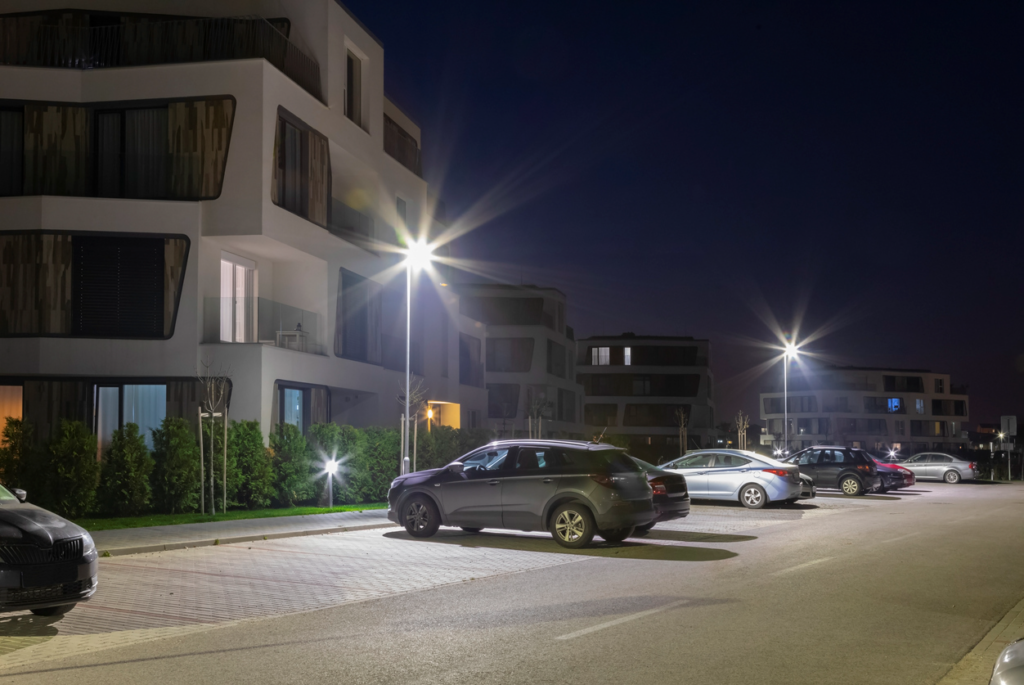
Enhancing security isn’t always a budget-breaker. From an amenity perspective, it could include the installation of cameras in common areas, LED lighting for a bright nighttime environment and damage-resistant gates and fences to further protect the community.

Operators should concentrate on the basics of what residents want so here are 4 upgrade measures to contemplate for capital improvements.
LED lighting for a bright nighttime environment is not a budget breaker.

No. 3 – Resources to make things easy

Today’s residents don’t want to jump through hoops to schedule a tour, sign a lease, pay rent or submit a service request.

They desire an easy process, and in an increasingly digital environment, operators should make every effort to provide it.

While capital improvements are generally thought of as common-area additions and upgraded features within the apartment homes, properties can also augment their digital footprint by offering tech-savvy ways to navigate the leasing process. This includes offering options for virtual tours, contactless leasing and innovative resident portals that enable one-click rent payments and quick-hit maintenance requests.

No. 4 – Every community is different

It might seem easy to use a cookie-cutter approach when considering community improvements. What works for one property, though, might not necessarily work for another.

As such, operators should treat each property as its own entity and factor in location, demographic, type of community and any other potential factors that might affect the type of upgrades craved by the resident base.

For instance, prospective residents in a property located in Phoenix may prioritize a high-end resort-style pool, whereas residents in Seattle may prioritize a well-lit and spacious clubhouse with an indoor fitness center. The climates of each region dictate different needs and demands.

Summary

With the multifamily market experiencing price challenges with regards to materials, labor and insurance, the sector is in a cycle in which operators could greatly benefit from returning to fundamentals. Part of that approach includes refraining from high-priced upgrades that might have cosmetic value but are least likely to drive ROI.

By concentrating on the basics and functionality, owners and operators can ensure that their improvement measures are truly providing a return on investment.

About the author:

Tim Bruss is the managing director of Asset Management for Hamilton Zanze, a San Francisco-based real estate investment firm that owns more than 120 multifamily communities nationwide.

Building Code Changes Affecting Rental Housing Affordability

Building code changes over the past 10 years have been the single biggest driver in increasing rental housing affordability

Building code changes over the past 10 years have been the single biggest driver in increasing rental housing affordability, according to a release from the National Multifamily Housing Council (NMHC).

The NMHC conducted a survey of its membership to gain more clarity on specific building-code cost drivers and feasibility deterrents.

The NMHC Pulse Survey on Building Codes and Standards was conducted from March 5 -19, 2024, and received 41 responses from multifamily builders, developers and operators across the United States. All data are available in a downloadable PDF.

The release says that on average, respondents reported that more than half (55%) of the projects they are involved with are townhouse/garden style, while a third (34%) are mid-rise and 10% are high-rise.

As government officials put in more layers of building codes and regulations, “housing providers grapple with increased costs and technologically or structurally infeasible requirements.”

Building code changes over the past 10 years have been the single biggest driver in increasing rental housing affordability

Topics that cause the most challenges for rental housing providers

The codes and standards that caused the most significant challenges were:

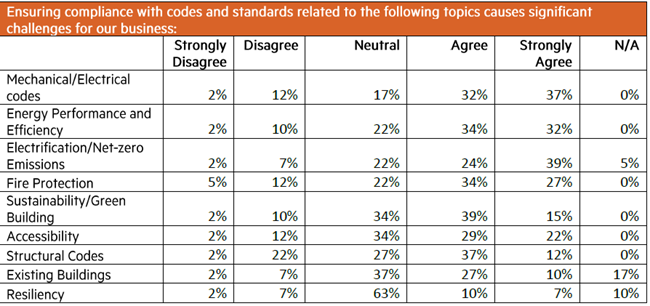
  • Over two-thirds (68%) of respondents agreed or strongly agreed that mechanical/electrical codes posed significant compliance challenges, followed by compliance challenges related to energy performance and efficiency (66%), electrification/net-zero emissions (63%) and fire protection (61%).
  • Over half of respondents agreed or strongly agreed that codes and standards related to sustainability/green building (54%) and accessibility (51%) caused them significant challenges.
  • Although 49% of respondents agreed or strongly agreed that structural codes and standards caused significant compliance challenges, another 49% of respondents reported being neutral or disagreed about the challenges related to structural codes and standards.
  • Codes and standards related to existing buildings as well as those related to resiliency were reported as less problematic. The largest share of respondents for both groups reported being neutral—37% for codes and standards related to existing buildings and 63% for those related to resiliency.

Inconsistency between jurisdictions – Key factors

The report said for those respondents who agreed or strongly agreed that at least one area of codes and standards posed significant challenges for their business, they heavily attributed those challenges to a few key factors:

  • Of those respondents who reported challenges, 92% agreed or strongly agreed that those challenges could be attributed to variation in code requirements/interpretation between jurisdictions. Respondents noted that interpretations of fire codes, for example, could even differ depending on an individual fire marshal.
  • Similarly, 82% of respondents agreed or strongly agreed that interpretability (i.e., that codes are difficult to interpret) was a source of significant challenges.
  • Eighty-nine percent of respondents agreed or strongly agreed that compliance challenges could be attributed to the effect of construction costs.
  • Separately, 89% of respondents agreed or strongly agreed that building code requirements in general affect the cost and viability of construction projects.
  • Respondents also largely agreed that challenges could be attributed to design issues (82% agree or strongly agree), material selection and availability (79%), as well as enforcement and inspection (79%).
  • Compliance challenges were less attributed to workforce availability and training (50% agree or strongly agree; 47% neutral or disagree) or resident preferences and marketability (37% neutral and 26% disagree).

“Multiple respondents highlighted Austin as a place where these issues were particularly acute, as well as locales in North Carolina such as Chapel Hill or Charlotte,” the report says.

Read the full report here.

Sign Up For Our Weekly Newsletter And Get Rental Property And Apartment News And Helpful, Useful Content Each Week.

* indicates required