Home Blog Page 37

Entrata Announces New Collaboration with Freddie Mac Multifamily

Entrata has announced recently acquired Rent Dynamics is now working with Freddie Mac Multifamily as part of its credit-building initiative.

Entrata has announced that recently acquired Rent Dynamics is now working with Freddie Mac Multifamily as part of its credit-building initiative.

The collaboration will help renters build credit by reporting on-time rent payments to the top three credit bureaus.

Multifamily residents living in eligible properties backed by Freddie Mac financing can receive 24 months of credit-building services from one of Freddie Mac’s participating rent-reporting vendors.

“Entrata is honored to collaborate with Freddie Mac Multifamily in this potentially life-changing initiative as we continue to build and expand our industry-leading products and ecosystem to help multifamily community residents across the U.S.,” said Adam Edmunds, Chief Executive Officer of Entrata. “In collaboration with Freddie Mac, Entrata’s resident services program will continue to empower residents and property managers alike as they make the most of our platform.”

Entrata’s rent-reporting program, a part of their larger resident services program, has already seen significant results with an average increase in credit scores across residents who have participated in the program. Data from Entrata also shows that rent reporting allows a significant number of residents to go from having no credit to being scored.

“Freddie Mac Multifamily is working to expand best practices in resident-centered housing across the multifamily industry, and that includes helping families establish or improve their credit scores,” said Corey Aber, Vice President of Mission, Policy and Strategy at Freddie Mac Multifamily. “We are confident that this collaboration with Entrata and Rent Dynamics will further our mission to make the multifamily industry more equitable and to strengthen the economic mobility of renters.”

Entrata has announced recently acquired Rent Dynamics is now working with Freddie Mac Multifamily as part of its credit-building initiative.

In addition to its work with Freddie Mac, Entrata recently announced a similar continuation with Fannie Mae’s Multifamily Positive Rent Payment program. As Entrata continues to expand its resident services, it will continue to address the issues that residents face and add significant value to the millions of apartment units that Entrata services nationwide.

About Entrata

Entrata is a leading operating system for multifamily communities worldwide.

Entrata Acquires Colleen AI to Usher in New Era of Autonomous Property Management

Photo credit designer491 via istockimages

San Francisco Adopts Ordinance To Ban AI Rent Pricing Tools

San Francisco has become the first city to adopt an ordinance banning the use of artificial intelligence software to set rental rates

San Francisco has become the first city in the nation to adopt an ordinance to ban the use of artificial intelligence software to set rental rates, according to reports.

The Board of Supervisors has unanimously adopted an ordinance blocking the use and sale of artificial intelligence tools that allegedly enable price fixing by large corporate landlords.

“Banning algorithmic price gouging is pro-housing policy,” Supervisor Aaron Peskin said at a recent board meeting. “Let’s build housing for renters, not for real estate investors,” according to NBCbayarea.com.

The rent pricing tools legislation will go before the board for final approval on Sept. 3.

Peskin said he hopes the legislation will be a model for other local governments around the country, comparing the urgency around the ordinance to the city’s early regulation of Airbnb.

The city’s ordinance comes as the U.S. Department of Justice is investigating RealPage, a revenue management company whose software is used by landlords to maximize rents. Attorney generals across the country have filed lawsuits alleging RealPage’s tools empower collusion and price-gouging among large corporate property owners, KQED reported.

Peskin, who introduced the legislation, said. “Wall Street has gotten into the housing business, and it’s a phenomenon we have seen here locally.” He said banning the software is “entirely consistent with our shared goal of a functioning housing market that meets our real housing needs.”

Tens of thousands of units in San Francisco are estimated to be owned by companies that use artificial intelligence software technology, according to Lee Hepner, senior legal counsel at the American Economic Liberties Project.

“Landlords, who should be ordinarily competing against each other, are instead adopting the price recommendations of this third-party revenue management software. And the effect of that is an old-fashioned price-fixing scheme,” Hepner told KQED. “It is not unlike the kind of price fixing that antitrust laws have addressed for well over a century.”

RealPage says the claims about the artificial intelligence software are false and housing affordability should be the focus.

“The time is now to address a number of false claims about RealPage’s revenue management software, and how rental housing providers operate when setting rent prices,” Dana Jones, RealPage CEO and President said in a statement. “Housing affordability should be the real focus. RealPage is proud of the role our customers play in providing safe and affordable housing to millions of people. Despite the noise, we will continue to innovate with confidence and make sure our solutions continue to benefit residents and housing providers, alike.”

The Budgeting Benefits of Reputation Management

Multifamily online reputation management is crucial to protecting reviews and distinguishing a rental property in the competitive space.

Multifamily online reputation management is crucial to protecting multifamily reviews and distinguishing a rental property in the competitive space.

By Kendall Pretzer

Reputation management has emerged as a crucial aspect of multifamily operations, encompassing strategies and techniques to monitor, enhance and protect a brand’s online presence.

Reputation management should not be reactionary, but instead an integral part of marketing for a property’s long-term financial health. By proactively managing their reputation, owners and operators can mitigate potential crises, build trust with customers and ultimately drive revenue growth.

Understanding the Importance of Online Reputation Management

According to the 2024 NMHC and Grace Hill Renter Preferences Survey, 71% of residents who referenced property ratings and reviews (e.g. Google, Yelp, ApartmentRatings.com) report that the content of the ratings and reviews has stopped them from visiting properties. Actively monitoring these platforms and promptly addressing customer feedback, both positive and negative, can feel daunting, but it is crucial for maintaining a community’s brand.

Negative reviews can deter prospects— 84% of renters report that reviews influenced their leasing decision— leading to a direct impact on overall property performance. Conversely, positive reviews, and how companies respond to them, can serve as powerful endorsements.

Reputation in multifamily goes beyond Google business profiles and Internet Listing Services. Engaging with customers and groups on social media platforms builds trust and fosters positive relationships as part of Online Reputation Management (ORM). Crisis management is also a part of ORM and having a well-defined plan in place can help mitigate the impact of negative publicity or poor reviews on a brand’s reputation.

Managing reputation to improve the resident experience

The most obvious benefit of effectively addressing concerns across all digital platforms is the opportunity to improve the resident experience. By actively managing online reputation and addressing concerns quickly, consistently and authentically, onsite teams can improve resident satisfaction. What’s better than a five-star experience? Sometimes it is converting a one-star into a five-star.

Consistency in communication and responsiveness has a trickle-down effect. As multifamily is also starting to see the long-term value of building a strong brand reputation, fostering customer loyalty and mitigating the potential impact of negative publicity has become crucial.

The bottom line is that no single property stands alone for today’s savvy residents, and it doesn’t matter how new or beautiful the apartments are. When prospects read reviews, they’re taking in all facets of those critiques — the community, customer service and resident experience — along with the quality.

 Reducing turnover reduces expenses

In the crowded market multifamily, a strong reputation can distinguish a community from its competitors, enabling it to attract more prospects and stabilize financial growth.

Monitoring online reviews and feedback allows owners to identify areas for improvement and streamline operations. Moving is usually no fun, and residents want to avoid it when they can. Increased responsiveness has a direct impact on resident retention, leading to cost savings and reduced turnover.

While the exact calculations for ROI will vary based on the specific location of a property and the type, there are key factors to consider across an entire portfolio. Owners and operators must examine the potential revenue increases resulting from higher occupancy rates and optimizing rental rates.

This goes hand in hand with thousands of dollars per unit in turnover costs when a resident leaves, which includes the time spent on attracting new residents. The financial impact of improved efficiency and reduced marketing expenses can be realized quickly.

 Reduced operational costs also benefit teams

While not always considered a line item in the marketing budget, ORM may need to be reframed as a necessary component in marketing goals and considerations.

 Prioritizing ORM is one of the most cost-effective ways to help the bottom line. The financial benefits are often realized by operational and marketing savings that are greater than the investment. Utilizing automated tools and software solutions to streamline monitoring, reporting and response processes will reduce manual labor and improve efficiency. This is also helped by investing in employee training and education programs to maximize the use of ORM solutions.

Companies will need to ensure that the solutions they implement will offer ORM management across all review channels and platforms, as well as  analytics and reporting tools that show the results of their teams’ efforts. This information should be both easily accessible and customizable, providing insights about overall property performance.

In today’s landscape, effective multifamily online reputation management is a critical component of a successful budget. By allocating the necessary resources and implementing effective reputation management strategies, businesses can build trust, enhance their online presence and ultimately drive revenue growth.

About the Author

Kendall Pretzer brings more than 30 years of experience in property management and supplier solutions to her role as the Chief Executive Officer at Grace Hill.

About Grace Hill

Grace Hill provides technology-enabled performance solutions that help owners and operators of real estate properties increase property performance, reduce operating risk and grow top talent. Its industry-leading solutions covering policy, training, assessment, survey and data-driven insights are bolstered by years of real estate experience, in-depth service-level expertise and outstanding customer support. Today, more than 500,000 real estate professionals from more than 2,300 companies rely on talent performance solutions from Grace Hill. Visit us at gracehill.com or on LinkedIn.

Sign Up For Our Weekly Newsletter And Get Rental Property And Apartment News And Helpful, Useful Content Each Week.

* indicates required

More Young Adults Living With Parents

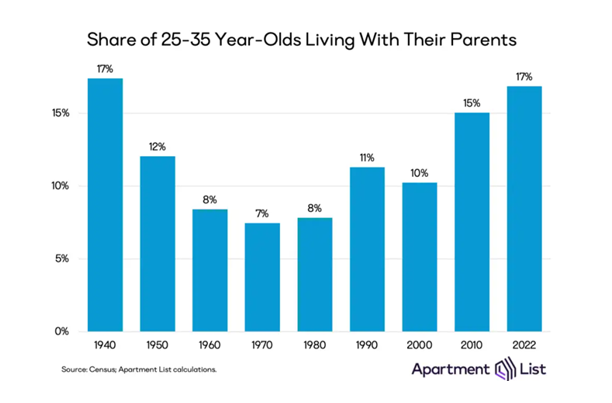
There are more young adults living with parents than at any point since the 1940s, says a new report from Apartment List economists.

There are more young adults living with parents than at any point since the 1940s, says a new report from Apartment List economists.

Housing affordability is forcing young adults between 25 and 35 to live with parents out of necessity and not out of choice.

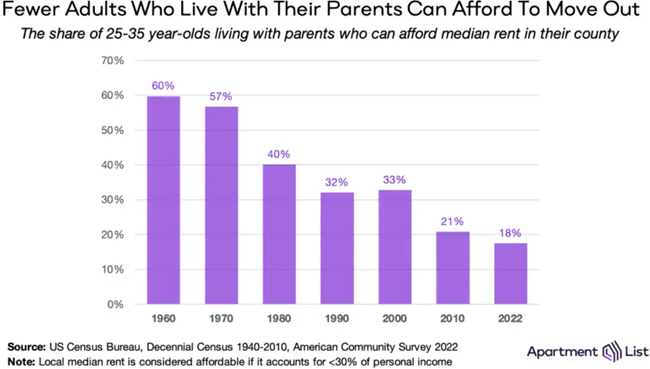
“Fewer than one-in-five are earning incomes that would allow them to comfortably afford local rent prices, a far lower share than in the past. The prevalence of young adults living with parents is increasing in all parts of the country, and for both those with and without college degrees,” Apartment List Senior Housing Economist Chris Salviati writes.

Less than one in five earn enough to move out on their own

For the 25-to-35 age group incomes have gradually declined over the past few years.

For example, the median annual income of employed 25- to 35-year-olds who lived with their parents was $32,000. After adjusting for inflation, this was down by 10 percent compared to 2000.

“Among young adults who live at home, the share who could comfortably afford to live independently has fallen dramatically.

“For the purpose of this analysis, we assume that an individual was in a financial position to move out of their parents’ home if they could have paid the median rent for studio and 1-bedroom apartments in the county where they lived without spending more than 30 percent of their individual income on rent,” Salviati writes.

As of 2022, just 18 percent of young adults living at home were earning incomes that would have allowed them to comfortably strike out on their own.

There are more young adults living with parents than at any point since the 1940s, says a new report from Apartment List economists.

College degrees make a difference

Those with college degrees are less likely to live with parents, even though some do.

However, “Young-adults without college degrees are far more likely to live with their parents; one-in-five of them live at home, a rate that has more than doubled from just 8 percent in 1980. The non-college-educated make up 71 percent of all 25- to 35-year-olds who live with their parents,” the report says.

Summary 

The report concludes that living at home is more prevalent among those without degrees, but the number of college-educated young adults who live with their parents is also higher than it’s ever been, as growing student debt exacerbates the pressure of high housing costs.

“This trend speaks to the way in which today’s economic realities are forcing many of America’s younger generations to delay major milestones on the path to adulthood,” Salviati writes.

Read the full report here.

Sign Up For Our Weekly Newsletter And Get Rental Property And Apartment News And Helpful, Useful Content Each Week.

* indicates required

Broad Coalition of Housing Providers Oppose Rent Cap

The Use Of Marijuana – A Fair Housing Challenge

Use of marijuana and fair housing laws and property managers

Marijuana use in rental housing presents a fair housing challenge for property managers who need to navigate the legal complexities in federal and state laws.

By The Fair Housing Institute

Navigating the legalities of marijuana use within property management is an ongoing challenge as states increasingly adopt diverse regulations.

This variance between state and federal laws places property managers in a complex position, tasked with adhering to legal requirements while addressing the needs and rights of residents.

This article provides a comprehensive overview for property management professionals to manage these legal complexities efficiently, fostering a compliant and supportive community environment.

State Law versus Federal Law

Navigating the complexities of marijuana laws can be perplexing for property management professionals.

Despite marijuana being legal for medical or recreational use in numerous states, it remains prohibited under federal law. This discord between state and federal regulations often confuses housing policies. It’s crucial for property managers first to understand these legal distinctions as they develop guidelines for their properties, particularly when dealing with federal funding constraints.

How Your Property’s Funding Can Affect Policies

The source of your property’s funding plays a pivotal role in the policies you can enforce regarding marijuana use.

Properties that receive federal funding must adhere to federal laws that do not recognize the legality of marijuana. This means that regardless of state laws, properties with federal ties must prohibit marijuana use to remain compliant. Conversely, privately funded properties in states where marijuana is legal might have more flexibility in setting their policies.

No-smoking policies in residential properties play a crucial role in decisions regarding marijuana use.

Initially aimed at preserving air quality and minimizing fire risks, these policies naturally extend to prohibit all forms of smoking, including marijuana. This comprehensive approach prevents confusion and ensures uniform enforcement across all residents. In regions where marijuana is legally permitted, property managers must balance these no-smoking policies with potential medical accommodations, possibly suggesting non-smoking alternatives like edibles or vaporizers to comply with both health standards and legal requirements.

Reasonable Accommodations and Their Verifications

When a resident requests a reasonable accommodation for the medical use of marijuana, property managers face a complex and sensitive task.

Verifying the legitimacy of such medical claims is not only legally necessary but also a meticulous process, often involving the review of medical marijuana cards or prescriptions.

Due to the intricate and varying nature of state and federal laws and the detailed attention required to ensure authenticity, these decisions should be reserved for senior management within the property management company.

Furthermore, consulting with a fair-housing attorney is crucial to establishing a robust, consistent verification process that meets legal standards. This approach ensures compliance and maintains a uniform policy across all resident requests, safeguarding the property management against potential legal challenges.

Other Resident Complaints

Handling resident complaints related to marijuana use, such as the odor from smoking, requires a balanced approach.

While it’s essential to accommodate medical needs, the comfort and well-being of other residents cannot be overlooked. If your property permits smoking and marijuana use aligns with state law, consider practical solutions to mitigate the impact and be prepared to discuss alternatives. For properties with a no-smoking policy, this rule would extend to marijuana as well, thereby simplifying policy enforcement.

As the legal landscape around marijuana continues to evolve, property-management professionals must stay informed to ensure their policies comply with both state and federal laws. Regular training and updates on fair-housing laws are crucial in navigating these complex scenarios and ensuring compliance and high resident service standards. By understanding the intricacies of marijuana legislation and its implications for property management, you can better serve your community while upholding the law.

About the author:

In 2005, The Fair Housing Institute was founded as a company with one goal: to provide educational and entertaining fair-housing compliance training at an affordable price at the click of a button.

Portland Apartment Market Stabilizing Or Improving

Here is a Portland apartment market mid-year summary for 2024 that shows the Portland apartment market stabilizing or improving.

Here is a Portland apartment market mid-year summary for 2024 that shows the Portland apartment market stabilizing or improving.

By Patrick Barry

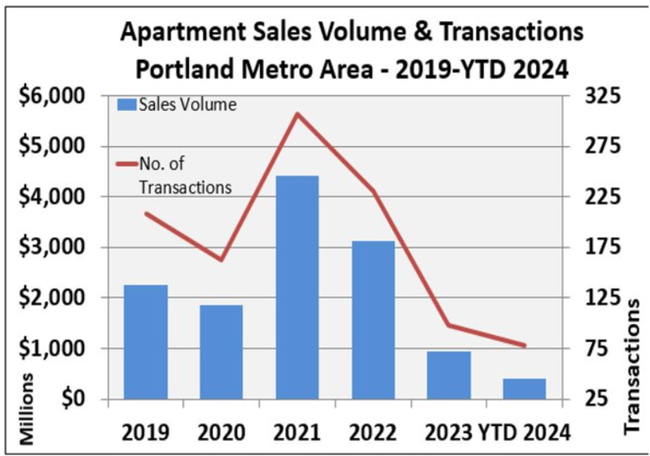
There was a general sense of optimism that the apartment market would show improvement in 2024. However, at the halfway point of the year, apartment market fundamentals (rents/vacancies) are stabilizing or improving, though the sales market remains extremely sluggish, Barry & Associates write in a report.

“We have created a one-page report summarizing how the Portland apartment [market] is faring in YTD 2024,” the report says. “While the sales market remains depressed, apartment fundamentals will likely see continued improvement based on very little proposed construction.

“Apartment sales picked up in the second quarter of 2024 and buyers/sellers appear to have accepted that lower prices seen recently are not transitory. Keep in mind that not all submarkets are equal, with certain areas faring better than others.”

Portland Apartment Market Snapshot Mid-Year 2024

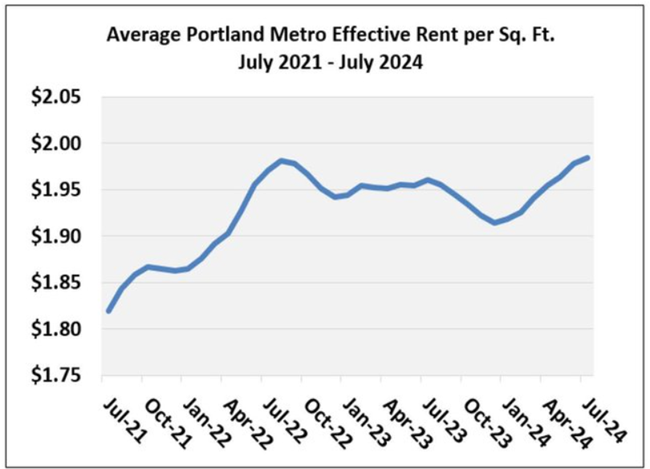
  • Rents up 1.2% year-over-year and close to the peak in mid-2022.
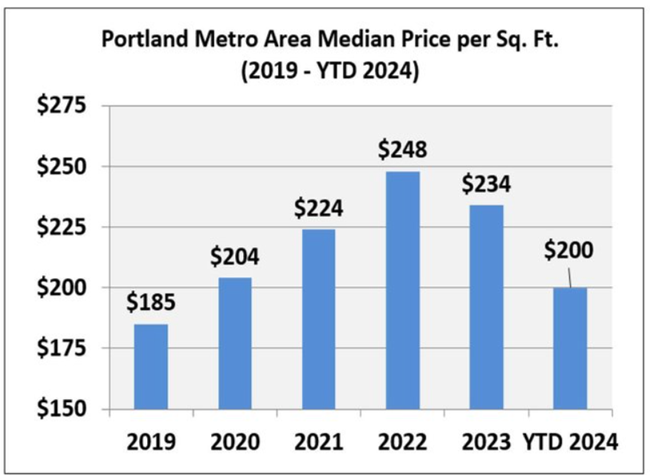
  • Median price per square foot down 14.5% year-over-year.
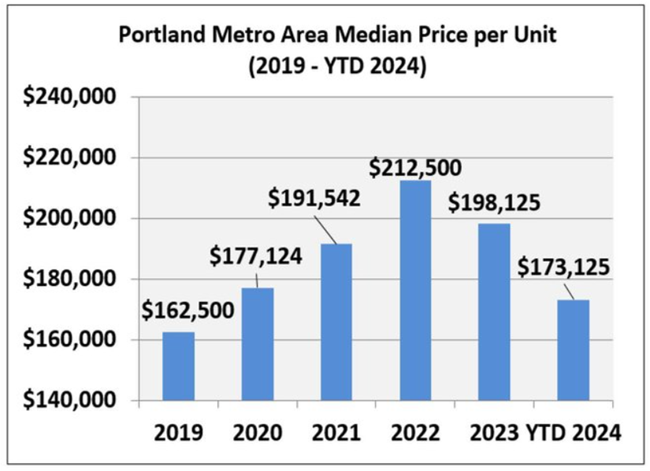
  • Median price per unit down 12.6% year-over-year.
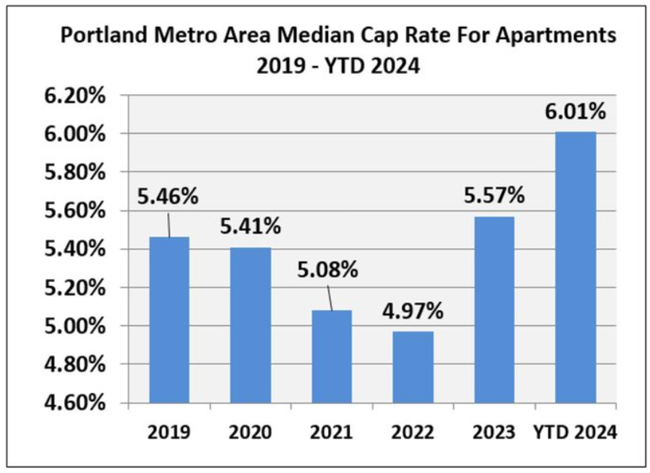
  • Cap rates up 40+ basis points.
  • Number of transactions trending below 2023, which was a 30+ year low. Through June, only 39 sales or 78 when annualized. The average number of sales from 1990-2022 was 201.
  • Numerous distressed sales year-to-date in 2024- Source CoStar.

Here is a Portland apartment market mid-year summary for 2024 that shows the Portland apartment market stabilizing or improving.

Here is a Portland apartment market mid-year summary for 2024 that shows the Portland apartment market stabilizing or improving.

Portland prices

Portland cap rates

About the author:

Patrick O. Barry is a certified general appraiser with Barry & Associates – Apartment Appraisal Specialists, 1535 SW Clifton St, 2nd Fl, Portland, OR 97201. Phone: 971-275-5345. [email protected] – www.barryapartmentreport.com

Sign Up For Our Weekly Newsletter And Get Rental Property And Apartment News And Helpful, Useful Content Each Week.

* indicates required

Landlord Needs 3-Bedroom Unit to Keep Maintenance On-Site

A landlord needs one of her currently occupied 3-bedroom apartments to keep maintenance on-site in her apartment complex.

A landlord needs one of her currently occupied 3-bedroom apartments to keep maintenance on-site in her apartment complex. That is the question this week for Ask Landlord Hank. Remember Hank is not an attorney and he is not offering legal advice. If you have a question for him please fill out the form below.

Dear Landlord Hank,

We have a property of 70 units. Out of those 70 units, only seven are 3-bedroom units.

I haven’t had a 3-bedroom available for the past seven years, and my maintenance supervisor is on the waiting list for one.

He has told me that he will move out because his family has grown. I am thinking about giving a 90-day notice to any of the tenants who are living in the 3-bedroom units. Can I legally ask them to move out in 90 days with no cause? Or is there another legal option for me? Because we need this maintenance person on-site.

– Maria

Dear Maria,

I understand the need to have maintenance nearby in a community your size.

You would need to look to your lease, under the RENEWAL clause, for the tenants that are occupying the 3-bedroom units – and then follow what the lease says.

If you don’t have current leases, you can give a 90-day notice of termination, but talk to the tenant and give them written notice. And tell them that you will give them a good recommendation, if they deserve that.

Sincerely,

Hank Rossi

A landlord needs one of her currently occupied 3-bedroom apartments to keep maintenance on-site in her apartment complex.
Landlord Hank says, “You would need to look to your lease, under the RENEWAL clause, for the tenants that are occupying the 3-bedroom units – and then follow what the lease says.”

Editor’s note. Please check to see if there are any of your local or state rules in your area regarding this issue.

Ask Landlord Hank Your Question

Ask veteran landlord and property manager Hank Rossi your questions from tenant screening to leases to pets and more! He provides answers each week to landlords.

  • This field is for validation purposes and should be left unchanged.

Ask Landlord Hank: What Should I Do If My Tenants Want A ‘Kiddie’ Pool

Do I Have to Paint and Replace Flooring for a Long-Term Tenant?

Sign Up For Our Newsletter And Get Rental Housing And Apartment News And Helpful, Useful Content Each Week.

* indicates required

Who’s Responsible For Smoke Detector Batteries In Rentals?

Can I Enter My Rental If Tenant Moves Out Early But Lease Is Still In Place?

Photo credit Nuttawan Jayawan via istockphoto.com

Short-Term Rental Operator Sentenced for Defrauding Landlords

A short-term rental operator - the “wolf of Airbnb” - was sentenced to 51 months for defrauding landlords of more than $1 million in rent

A short-term rental operator who called himself the “wolf of Airbnb” was sentenced to 51 months for defrauding landlords of more than $1 million in rent, according to a release.

Damian Williams, U.S. attorney for the Southern District of New York, said Konrad Bicher, 32, of Hialeah, Fla., was sentenced for fraudulent operation of real estate businesses, including by entering into lease agreements for residential apartment units in Manhattan on false and fraudulent pretenses and by making false statements to obtain loans guaranteed by the U.S. government.

“For years, Bicher schemed to defraud New York City landlords and the U.S. government. Bicher enriched himself by abusing government programs and tenant protections intended to benefit people and businesses in need during one of the worst economic and public health crises in history.

“He bragged about his schemes to his friends and the media, proudly referring to himself as the ‘Wolf of Airbnb,’ but the sentence underscores, those who partake in such callous and fraudulent conduct will answer for their crimes, no matter their self-given title,” Williams said in the release.

From 2019 to 2022 Bicher and his associates rented apartments in Manhattan but failed to make more than $1,000,000 in rent payments to landlords pursuant to the lease agreements, based on the estimated fair market value for the rental units. Despite leases prohibiting the units being used for short-term lease, Bicher and his associates listed them for short-term rent on Airbnb and at least one other online marketplace for short-term rentals, resulting in at least $1,170,000 in rental income to Bicher and his associates, according to the release.

During the COVID-19 pandemic Bicher submitted at least four applications for PPP loans on behalf of at least three entities and obtained over $565,000 in loan proceeds.  These PPP applications contained fraudulent documents and false information.

In addition to the prison term, Bicher was sentenced to three years of supervised release.  He was additionally ordered to forfeit $1,740,407.12 and pay restitution in the amount of $2,227,371.58.

See the full release here from the U.S. Attorney

Sign Up For Our Weekly Newsletter And Get Rental Property And Apartment News And Helpful, Useful Content Each Week.

* indicates required

Broad Coalition of Housing Providers Oppose Rent Cap

A broad coalition of housing providers and lenders released a letter to President Biden to oppose cap proposals nationwide

A broad coalition of housing providers and lenders released a letter to President Biden opposing the recent proposal to cap rents nationwide, according to a release from the National Multifamily Housing Council (NMHC).

“We understand the appeal of what appears to be a quick fix to stabilize rents, but arbitrary federal rent caps are not the answer. Rent regulations jeopardize the financial solvency of rental communities, result in lower quality housing options for renters, and severely limit their housing choices,” the letter says.

Oppose Rent Cap

“Rent control policies have proven time and again to increase rents, reduce the capital needed to boost the supply of housing, and ultimately hurt renters today and in the future.

“Imposing federal rent caps on top of what is already an overly complicated set of regulations at the state and local levels will disincentivize housing investors, thereby further exacerbating the supply shortage, and reducing housing opportunities for our nation’s renters. We urge the White House to reject rent control and instead increase subsidies for those in need and work with housing providers on proven solutions – such as those outlined in the administration’s Housing Supply Action Plan – to expand the supply of needed affordable housing.

“Rent control does not build a single home, and it ignores the real reasons for increases in housing costs, including rapidly rising insurance costs, state and local taxes, and other economic factors. Further, it disincentivizes needed housing investments, particularly in communities that already have few affordable options.

“Instead of rent control, we urge the administration to focus on leveraging federal resources to expand supply and build the housing America needs,” the coalition says in the release.

The letter concludes, “As such, we respectfully encourage your administration to refrain from implementing policies like rent control and instead focus on leveraging federal resources to build the housing America needs.”

Read the full release here.

Sign Up For Our Weekly Newsletter And Get Rental Property And Apartment News And Helpful, Useful Content Each Week.

* indicates required

Rent Cap Proposal For Landlords With 50+ Units

A plan to cap rent increases to 5% annually for landlords with 50+ units or risk losing current valuable federal tax breaks is being proposed

A plan to cap rent increases to 5% annually for landlords with more than 50 units is being proposed by the Biden administration but will face stiff opposition in Congress.

The White House announced it is asking Congress to pass legislation giving corporate landlords a choice to either cap rent increases on existing units at 5% or risk losing current valuable federal tax breaks.

Broad Coalition of Housing Providers Oppose Rent Cap

In a release, the announcement said, “Some corporate landlords have taken advantage of the shortage of available units by raising rents by more than increases in their own costs—resulting in huge profits at a time when millions of Americans are struggling to cover rent each month.

“And recent analysis showed that the six largest publicly-traded apartment companies reported large profits earlier this year, and many of these same landlords are named in pending litigation for their alleged use of proprietary algorithms to raise rents on tenants,” according to the release.

Proposed changes in depreciation rules

According to the proposal large landlords, “beginning this year and for the next two years, would only be able to take advantage of faster depreciation write-offs available to owners of rental housing if they keep annual rent increases to no more than 5% each year. This would apply to landlords with over 50 units in their portfolio, covering more than 20 million units across the country. It would include an exception for new construction and substantial renovation or rehabilitation.”

Bloomberg reports the proposal faces steep odds in Congress, where legislation would have to pass the GOP-controlled House and win a supermajority of votes in a closely divided Senate — at a time when lawmakers are squarely focused on the November election.

FHFA Announces Multifamily Tenant Protections

The Federal Housing Finance Agency (FHFA) is announcing new actions to protect renters in multifamily properties financed by loans acquired by Fannie Mae and Freddie Mac. These protections apply to future loans acquired by Fannie Mae and Freddie Mac, which have financed an average of 1.2 million multifamily rental units over the past three years. The protections include:

  • Requiring 30-day notice before rent increases;
  • Requiring 30-day notice on lease expiration; and
  • Providing a 5-day grace period before imposing late fees on rental payments.

Read the full announcement and other details here.

Rent Control Contributes To Affordable Housing Shortage

Report Cites Profits of Big Landlords Using RealPage

Sign Up For Our Weekly Newsletter And Get Rental Property And Apartment News And Helpful, Useful Content Each Week.

* indicates required