Home Blog Page 38

Problem: Upstairs Tenants Doing Drugs

A landlord is asking what is her responsibility for upstairs tenants doing drugs and disturbing the downstairs tenant

A landlord is asking what is her responsibility for upstairs tenants doing drugs and disturbing the downstairs tenant. That is the question this week for Ask Landlord Hank. Remember Hank is not an attorney and he is not offering legal advice. If you have a question for him please fill out the form below.

Dear Landlord Hank,

First, thanks for being here for all of us!

I have an upstairs tenant who we know is doing crack, meth, and so on. The downstairs tenant is an elderly woman and still very sharp, still a stock trader, etc. and she cannot get a break. They are up and running around all the time, day and night, high as a kite. They have attached a garden hose to their bathtub to fill a container that they use as a community bong; they have out-of-state “visitors” coming in carrying in backpacks full of what we believe is cocaine.

The downstairs tenant is sharp, she has pictures to prove her case. The upstairs tenant has flooded her apartment because the hose got disconnected and they were passed out from drugs and no one could wake them up.

What is my responsibility here? The downstairs tenant has threatened a lawsuit to restore her right “to the quiet enjoyment of her property” (her rented apartment)? Am I responsible because she is getting sick all the time from the meth and crack smoke and smell in her apartment? Thank you.

-Margaret

Dear Landlady Margaret,

If you think your upstairs tenants are breaking the law, check the evidence the other tenant has provided, and if you really think these tenants are druggies and criminals then do an inspection of this unit with law enforcement in attendance.

If they really are criminals and druggies, EVICT right away.  You should not put up with bad tenants, especially criminals, for one minute more than you have to.

Sincerely,

Hank Rossi

A landlord is asking what is her responsibility for upstairs tenants doing drugs and disturbing the downstairs tenant.
Landlord Hank says, “Do an inspection of this unit with law enforcement in attendance.”

Ask Landlord Hank Your Question

Ask veteran landlord and property manager Hank Rossi your questions from tenant screening to leases to pets and more! He provides answers each week to landlords.

  • This field is for validation purposes and should be left unchanged.

Ask Landlord Hank: What Should I Do If My Tenants Want A ‘Kiddie’ Pool

Do I Have to Paint and Replace Flooring for a Long-Term Tenant?

Sign Up For Our Newsletter And Get Rental Housing And Apartment News And Helpful, Useful Content Each Week.

* indicates required

Who’s Responsible For Smoke Detector Batteries In Rentals?

Can I Enter My Rental If Tenant Moves Out Early But Lease Is Still In Place?


Navigating Online Insurtechs: Innovations, Risks, and Pitfalls

An online insurtech isn't what you would consider a traditional insurance company and and there are good and bad things to consider.

By Lance Anderson

An online insurtech isn’t what you would consider a traditional insurance company. Many new online insurtechs have entered the insurance industry, and there are good and bad things to consider.

THE GOOD:

  • Insuretechs have fast and consumer friendly websites created to provide quick quotes and easy to purchase policies. This is where the good ends.

THE BAD:

  • They are not backed by traditional insurance companies with years of experience & knowledge. They are normally backed by several layers of investment companies whose number one goal is a return on their investment. You never really know who is going to pay your claim.
  • Unfortunately, these new insurtech companies have joined the industry in the most challenging insurance climate in a generation. During the years 2022 – 2024, many insurance companies failed and have withdrawn from markets, so you can only imagine how the insurtechs are struggling.

THE UGLY:

While these online insurtech websites are very easy to use, they are programmed to offer lower prices by underinsuring the structure and leaving out or limiting very important coverages.

  • Lower Dwelling Coverage: In my recent quoting experiences, I entered all of the information on one of my own rental properties. The website quoted $201,000 to rebuild a 1900-square-foot rental property, about half of the actual cost to rebuild. The disadvantage is that in the event of a claim, whether it be a total loss or even a partial loss, the policy contains language that will further penalize me for underinsuring the structure. Insurance Requirements for a Utah Commercial Lease Agreement | Anderson Insurance Group
  • No Extended Dwelling Replacement option is available. Extended Dwelling Replacement will add an additional 25% of dwelling coverage in the event of a total loss. For example, $400,000 in dwelling coverage X 125% = $500,000 max dwelling coverage. The absence of this option is a glaring weakness in Insurtech coverage.
  • Fair Rental Value/Loss of Rental Income: The “recommended” Plus coverage from this company only included $20,100, not nearly enough to cover twelve months of lost rents, the minimum amount of time it would take to rebuild this property.
  • Water Damage Sub-limit Limitation: This is perhaps the most glaring deficit in their coverage. Many insurtechs will include a sub-limit for damage from water, the most common claim received by insurance companies. Sub-limits are a new strategy to limit an insurance company’s exposure to a specific loss. Every year, we have several water losses that exceed $100,000, and these new insurtechs can have water damage sub-limits of $30,000 or less.

These are just a few of the deficiencies of the coverage offered by insurtechs. Only a seasoned and experienced insurance agent is going to recognize the coverage that the insurtech company has omitted.

Another great danger of insuring with insurtechs is that you represent yourself. You are the one who made the declaration on the application and if the coverage you need to rebuild or repair your home is not there, you are out of luck, you have been duped. When you insure with a local and knowledgeable insurance agency and an important coverage has been left off, you can pursue a claim against that agent’s errors and omissions coverage for not including that coverage.

In biblical times, they would call today’s insurtechs wolves in sheep’s clothing. These slick and impressive online proposals are programmed to omit important coverage and lead you to select inferior coverage.

Don’t get confused and duped in the insurance cyber world! For the best protection of your home or rental property, reach out to a knowledgeable and experience agent at Anderson Insurance Group today.

Anderson Insurance Group – Salt Lake City – Utah

Lance Anderson

Anderson Insurance Group

www.anderson.insure 

Call: 801-262-1551 Text: 801-758-9046
Call us for more information on renters insurance and any questions you have about land lording, we love helping our customers be successful Utah landlords. Call our office at 801-262-1551 or Click Here for a for a consultation with our experienced team. Find out more about renter’s insurance.

Avoid Costly Coinsurance Penalties with Proper Insurance Coverage for Your Investment Properties

For a full review of your apartment or rental property insurance, contact a knowledgeable Anderson Insurance Group agent today.

Secure Your Monthly Cash Flow With One Easy-to-Miss Coverage: Business Income Insurance for Utah Landlords

Avoid Costly Coinsurance Penalties with Proper Insurance Coverage for Your Investment Properties

Your Rental Criteria and The Power of Three

Think of your rental criteria as frequently asked questions for those applying to rent your property and are they written down?

Think of your rental criteria as frequently asked questions for those applying to rent your property and are they written down?

By David Pickron

Early on in my investing career I flew by the seat of my pants.  I had no real policies or guidelines; I relied on gut reactions to situations as they surfaced.  As I travel and meet with different real estate groups across the country, I always ask this critically important question;  who here uses a detailed criteria?  Rarely do I get many hands raised.

In fact you may be asking right now, what is criteria and more importantly, how do I make one?

Like any business, your rental criteria can function as your rental policy, lining out your rules and regulations.  It covers questions like:

  • Can I smoke on the property?
  • Do you rent to people with criminal history?  If yes, what kind of history would disqualify me?
  • How high does my credit need to be in order to qualify?

Think of your criteria as an FAQ for those applying for your property.  I love the fact that I have all my requirements written down for the world to see.  No surprises!  And best of all this helps me treat everyone the same and avoid even a hint of a fair housing violation.

One other important note is I always have a unique criteria for each property in my portfolio.  Factors like location, square footage, and age or condition of the home all go into the creation of the criteria.  I may require a lower credit score, less down payment, the inclusion of pets, or other things that are unique to that property.  With that being said, I give every person that views that property the same criteria for that unique property.

While having your criteria is crucial, sharing it is even more important.  I like to share with my potential tenants throughout our interactions in the following three ways.

  1. Share your criteria on your listing. Isn’t it a waste of everyone’s time to look at the listing, consider, schedule, and show a property when the applicant doesn’t even meet the criteria?  Though I would encourage you to let everyone apply, giving them your criteria in advance allows them to read it before they reach out or see the property.  If an individual reviewing your listing has three dogs and is able to  see that this property doesn’t accept pets, chances are they will move on to the next listing.  This saves you time from responding to someone who will never qualify under that properties criteria.
  2. Provide and review a copy of the criteria at the time of showing the property. Once again, if you do not allow smoking on that property, your applicant will have heard and acknowledged that, so even if you forget to mention that in the walk through, you’re still covered.  A detailed criteria lets them know you are a professional and those trying to get away with something will move on.  On the other hand, if they still apply and you have to deny them for something on the criteria, you know they took the chance, hoping you would not find out or they flat out lied to you.  Either way, this is not an individual you want to enter into business with anyway.
  3. Before you invite them to apply, the Rent Perfect system I use will attach the specific criteria for that property to the link I send them. It’s just one more chance for them to see the rules of that specific property in advance.  Simply put, if they  cannot pass my rules, they will be declined and I’ll move to the next applicant.

As a landlord, I give them three separate times to acknowledge and understand my rules before they pay the application fee.

I would rather have the tough conversations before they apply and become my tenant.

Catching a renter smoking after the fact while they are living on the property is a much more difficult (and far more expensive) situation.  By being open and sharing your criteria, you can treat everyone the same with a well-documented process if there is ever a fair housing complaint against you.  Remember, you are hoping to make this individual your business partner for the next few years.  Taking this small but critical step is just one way to help you get the right tenant the first time.

About the author:

David Pickron is President of Rent Perfect, a private investigator, and fellow landlord who manages several short- and long-term rentals.  Subscribe to his weekly Rent Perfect Podcast (available on YouTube, Spotify, and Apple Podcasts) to stay up to date on the latest industry news and for expert tips on how to manage your properties.

Think of your rental criteria as frequently asked questions for those applying to rent your property and are they written down?
David Pickron, Rent Perfect

Multifamily Growth ‘Encouraging’ in First 6 Months of 2024

Multifamily growth met expectations in the first half of the year as multifamily performance remained healthy in June.

Multifamily growth met expectations in the first half of the year, Yardi Matrix says in the June report.

While rents continued to rise in June, increases were modest compared to the post-pandemic boom.

“The first half of 2024 is in the books, and multifamily performance was encouraging,” the report says. “Given the market environment, a moderately positive result is a win.”

Highlights of the report

  • Multifamily growth and performance remained healthy in June, as strong demand is largely keeping up with rapid supply growth. The average U.S.-advertised rent increased by $4 to $1,739, while year-over-year growth fell by 20 basis points to 0.6%.
  • Although the market has headwinds such as above-trend expense growth and a large number of deliveries in some metros, absorption is steady due to strong employment gains, the low unemployment rate, foreign immigration and weak home sales.
  • The single-family rental market experienced its first hiccup of 2024, with the average advertised rent declining by $3 in June to $2,166, while the year-over-year growth rate fell 30 basis points to 1.1%. Occupancy rates remained high at 95.4% in May.

The job market continues to be strong and the housing shortage is still with us along with high interest rates, all of which means there are renters continuing to rent because they cannot afford to buy or find a house to buy.

Some cities saw modest rent gains in June

Monthly rent gains in June were led by New York (1.1%), and Chicago, Kansas City and Portland (all 0.9%).

Eight of the top 30 metros posted modest declines, with the largest drop recorded in Austin (down 0.8%).

The expense-growth challenge

The 8.1% average increase in total expenses over the last two years was more than double the 3.4% average growth rate of the previous four years.

“The upshot is that if expense growth does not moderate, consequences will include rising mortgage defaults and a curtailment of needed new development. For owners, improving operating efficiency by streamlining processes and implementing new technologies is essential,” the report says.

Read the full Yardi Matrix report here.

About Yardi Matrix

Yardi Matrix researches and reports on multifamily, office and self-storage properties across the United States, serving the needs of a variety of industry professionals. Yardi Matrix Multifamily provides accurate data on 18+ million units, covering more than 90 percent of the U.S. population. Contact the company at (480) 663-1149.

Sign Up For Our Weekly Newsletter And Get Rental Property And Apartment News And Helpful, Useful Content Each Week.

* indicates required

New Apartment Refrigerant Requirements Coming

There are new apartment refrigerant requirements coming for communities in the HVAC field for 2024 and beyond to replace R-22 and R-410a.

There are new refrigerant requirements coming for apartment communities in the HVAC field for 2024 and beyond to replace R-22 and R-410a.

By Richard Berger

For apartment communities, there is massive change ahead regarding refrigerants.

While the changes are not at the technician level yet – and won’t be until later this year regarding behavior and supplies – the financial impact is expected to be huge beginning in 2025, according to Paul Rhodes, founder, Directional Maintenance Services.

In response to regulatory changes, the refrigerant industry has been doing its best to create a refrigerant that will most adequately replace R-22 and R-410a. There are several alternatives, and each presents its challenges for apartment maintenance technicians, owners, and customers.

Last year, the Environmental Protection Agency (EPA) adopted a final rule accepting several refrigerant alternatives for use in new residential and light commercial air conditioners and heat pumps.

So, which one should you use? Well, that depends. The two main reasons refrigerants are being replaced are due to how much they deplete the ozone – measured as ozone depletion potential (ODP) – and much heat they trap in the atmosphere, measured as global warming potential (GWP).

The new refrigerants must have a low enough GWP to meet AIM Act standards.

The Most Common Apartment Refrigerant Replacement Contenders

Currently, the most common replacements to be used in systems designed for R-22 are R438A, which is also known as MO99, R422D, and R421A. These replacement refrigerants are often referred to as being  “drop ins.”

“When that term is being used it often means you must change the oil, clean the line set, change the line drier, and then make sure compatible oil is being used,” says Mark Cukro, president of Plus One, Inc.  “Think of it this way: An automobile owner could use several types of oil in a vehicle, but it is harmful to mix them or have multiple types in a system at the same time,” he says.

For systems designed to use R-410A, there is no replacement. Instead, the entire system will require replacement to be compatible with R-454B and R-32. These system changes are due to the new refrigerants being slightly flammable and require certain safety measures.

One big change is that both are listed as A2L by ASHRAE instead of the rating that R410A has (A1). The rating change means that due to increased flammability concerns, the new system is not allowed to be mixed with portions of the old system.

What’s Required by 2025

R410A is the apartment refrigerant being used in systems currently being produced. While it has no ozone layer effect, it does have a significant negative rating in terms of climate change, meaning a high GWP. There is no “drop in,” so the price of it will rise, by design, to encourage the change to the newer systems/refrigerant.

These are the systems that the AIM act requires to be no longer used after 2024 to force adoption of the new refrigerants. Parts for systems containing all refrigerant types will continue to be available if repaired, and may remain in service.

The new refrigerants found in residential systems required to be produced in Jan 2025 are either R32 or R454B. These are the A2L-listed refrigerants referenced above. They have no effect on the ozone layer and minimal impact on climate change.

Due to this distinction, there is no compatibility with R410A, which leads to the large cost that properties will need to absorb.

Example: If a straight cool/split system condensing unit is to be replaced to an A2L refrigerant system, the property is required to replace the evaporator/air handler as well. In the change from the R22 to R410A systems, if performed correctly, the property would only be required to replace the outside unit.

More refrigerant options are on the way, Cukro says. However, the industry overall has not yet really settled on one refrigerant as “the one” to be the industry-wide replacement, he says.

“Select one replacement refrigerant that suits you best and stay with that,” Cukro recommends, “so you don’t wind up with an unknown number of alternatives in the field that can’t be easily identified.

“While it may be tempting to purchase the least expensive refrigerant each time, if that leads to having six different refrigerants on the same property it may be counterproductive, very costly, and difficult to keep good records,” he said.

“R410a is still the choice refrigerant being used by contractors for new installations. So, keep everything simple to track, easy to work on and purchase, and make sure you have the correct equipment as the safety requirements are updated and change.”

On a positive note, the new refrigerants work quite well, are safer for the ozone layer and have a lower warming potential than the refrigerants being phased out.

Managing HVAC System’s Service History

The apartment industry will need to adjust and adapt as the new apartment refrigerant replacements emerge, Cukro says.

Rhodes, host of The Maintenance Mindset Podcast, says that in the short term, if maintenance teams know how to properly work with current refrigerants, the impact will be minimal procedurally because the same safe-use rules apply. The cost of materials (refrigerant and systems) will accelerate depending on the supply/demand economics.

Thinking longer-term, at the end of this summer, R410A equipment will begin to sell out as suppliers will not want overstock to carry into 2025. At the same time, manufacturing companies will transition their manufacturing lines to new refrigerants so that they have stock before January 2025. Prices will continue to increase.

Maintenance mobile work order apps such as AppWork help maintenance teams to track HVAC work-order data such as the number of callbacks, completion times, and service ratings. It automatically identifies HVAC work orders from the work-order description and uses that to categorize, prioritize, and even assign the work order, accordingly.

Technicians can include the Freon used during work orders and the Freon levels so the next time a technician works on the AC they can check the unit’s service history to see what they or another technician did the last time the unit was serviced.

About the author:

Richard Berger is a freelance journalist who has 20+ years of experience covering commercial real estate for various media sites and CRE-related associations. He lives in Northern Virginia.

Sign Up For Our Weekly Newsletter And Get Rental Property And Apartment News And Helpful, Useful Content Each Week.

* indicates required

Running Children Upstairs Disturbing Downstairs Tenant What Do We Do?

Dear Landlord Hank: Running Children Upstairs Disturbing Downstairs Tenant What Do We Do?

The problem is back, again, with tenant complaints about noisy, running children. In this week’s Ask Landlord Hank question he deals with children upstairs distributing downstairs tenant and offers some advice. Remember Hank is not an attorney and cannot offer legal advice. If you have a question for him please fill out the form below.

Dear Landlord Hank:

Our upstairs tenant has a young kid, around two-years-old, who runs around on the wood floor at random hours of the evening and into the night. The older downstairs tenant says this wakes her up. She has asked the upstairs tenant a couple of times about this issue, but the problem persists, and now she is calling us. We realize little kids run and play and understand it is loud on wood floors. Any suggestions on solving children upstairs disturbing downstairs tenant problem?
-Landlady Eileen

HI Landlady Eileen,

This is a touchy subject as babies run and fall down and make noise.

If the flooring is all solid surface, you could talk to your upstairs tenants and ask them to consider using some area rugs to dampen the noise of the little one running.

Make sure they know that the baby running can be heard by the downstairs neighbor and maybe they could control that behavior late evening.

If this doesn’t work, you could check into acoustic panels that attach to the ceiling in the unit below and will reduce the level of sound from above.

Thin walls in multifamily housing can be trying for the tenants. Good luck.

Sincerely
Hank Rossi

Ask Landlord Hank

Ask Landlord Hank Your Question

Ask veteran landlord and property manager Hank Rossi your questions from tenant screening to leases to pets and more! He provides answers each week to landlords.

  • This field is for validation purposes and should be left unchanged.

Visit the Ask Landlord Hank page here for more questions and answers

Do You Know The 5 Questions Landlord Hank Asks Tenants When They Call?

Dear Landlord Hank: My Tenant Wants To Repaint His Unit – What Should I Do?

About the author Landlord Hank:

“I started in real estate as a child watching my father take care of our family rentals- maintenance, tenant relations, etc , in small town Ohio. As I grew, I was occasionally Dad’s assistant. In the mid-90s I decided to get into the rental business on my own, as a sideline. In 2001, I retired from my profession and only managed my own investments, for the next 10 years. Six years ago, my sister, working as a rental agent/property manager in Sarasota, Florida convinced me to try the Florida lifestyle. I gave it a try and never looked back. A few years ago we started our own real estate brokerage. We focus on property management and leasing. I continue to manage my real estate portfolio here in Florida and Atlanta. “ Visit Hank’s website here.

Sign Up For Our Newsletter And Get News And Helpful, Useful Content Each Week.

* indicates required

Ask Landlord Hank: What Should I Do If My Tenants Want A ‘Kiddie’ Pool

Do I Have to Paint and Replace Flooring for a Long-Term Tenant?

Can I Enter My Rental If Tenant Moves Out Early But Lease Is Still In Place?

Rent Prices Rise in June, But Rentals Slow

Rent prices continued to rise in June but rent increases remain modest as the pace of growth slowed in what is typically the busy season.

Rent prices continued to rise in June but overall rent increases remain modest, Apartment List says in its July report.

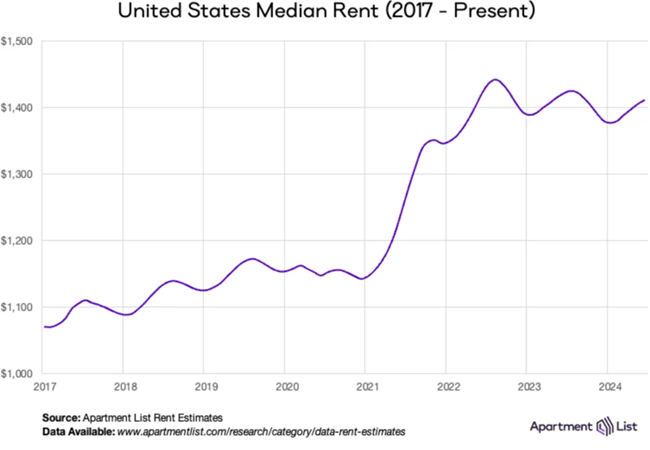
While there have been five straight months now of rent increases, the national median rent increased by 0.4% in June and now stands at $1,411 as the pace of growth has slowed in what is typically the busy season.

“We are currently in the midst of what is typically the busy season for the rental market, but this year’s peak season is not bringing elevated rent growth,” the report says.

While rent growth has slowed, the national median rent is still more than $200 per month higher than it was just a few years ago.

Rental market headed for a slow summer

“This is typically the time of year when rent growth is accelerating amid the busy moving season, so sluggish growth this month indicates that the market is headed for another slow summer,” the report says.

The report says 80 of the nation’s 100 largest cities saw rents go up in May. But on a year-over-year basis, rent growth is positive for only 46 of these cities. Many of the steepest year-over-year declines remain concentrated in Sun Belt cities that are rapidly expanding their multifamily inventory, such as Austin (-7.4 percent year-over-year), Raleigh (-5.2 percent), and Jacksonville (-4.1 percent).

Rent prices continued to rise in June but rent increases remain modest as the pace of growth slowed in what is typically the busy season.

Apartment vacancies remain elevated

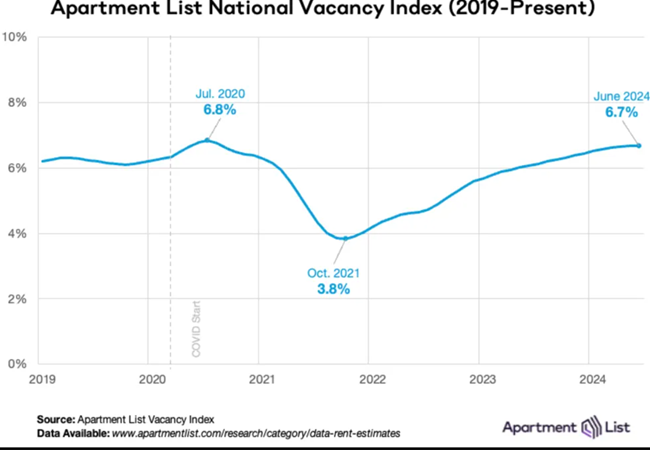
Apartment vacancies have been opening up steadily for more than two years.

“As of June, our vacancy index sits at 6.7 percent, the highest reading since August 2020. And there’s good reason to expect that it could rise even further during the remainder of the year,” the report says.

The report says that despite a recent slowdown in new permits being issued and new construction projects breaking ground, the number of multifamily units under construction remains near record levels. In 2023 the most new apartments were completed in more than 30 years, and an even greater number of new units are expected to come on the market this year.

Rent prices continued to rise in June but rent increases remain modest as the pace of growth slowed in what is typically the busy season.

Conclusion

The report’s summary says despite a small June increase, rent growth is slowing down at the time of year when the rental market activity is normally approaching its apex.

“Year-over-year rent growth is also indicative of a sluggish market, remaining negative at -0.7 percent. Rent increases are currently being moderated by a robust construction pipeline expected to deliver a decades-high number of new apartment units in 2024. Improving consumer sentiment about broader macroeconomic conditions may be driving a modest rebound in rental demand, but that bounce back has so far been outweighed by the impact of incoming supply.”

Read the full report here.

Rent Prices Up Slightly For 4th Month, but Vacancies High

Sign Up For Our Weekly Newsletter And Get Rental Property And Apartment News And Helpful, Useful Content Each Week.

* indicates required

Do New Luxury Apartments Bring Lower Rents for All?

new “luxury apartments” influence rental costs for all prices of apartments, including the lower-cost Class C apartments NMHC says

In a new research bulletin, the National Multifamily Housing Council (NMHC) says new “luxury apartments” influence rental costs for all prices of apartments, including the lower-cost Class C apartments.

But many Americans remain skeptical as to whether these new apartments – which tend to be more expensive than existing units and are often marketed as “luxury” – will aid affordability for households at the lower end of the income spectrum, says Chris Bruen, senior director of research for the NMHC.

Apartments classified as Class A tend to be both higher quality and more expensive than their Class B and Class C counterparts.

Class A apartments recorded an effective asking rent of $2,213 per month in the first quarter of 2024, according to data from CoStar.  Class B apartments rented for $1,671 and Class C apartments for $1,347.

“Even though nearly all apartment units built in 2023 were classified by CoStar as either Class A (41.3%) or Class B (56.8%), both economic theory and empirical literature suggest that this new supply should have a downward effect on rent growth for all apartments, including Class C. For instance, Myers and Park (2020) found that new apartment construction, even at higher price points, enabled older units to “filter” and house an increasing share of low-income households over time,” Bruen says.

He says there is evidence that this recent wave of Class A and B construction has led to lower rent increases among Class C units. Markets with higher rates of Class A and B deliveries tended to record lower rent increases among Class C units, providing some evidence that construction at the high end promotes affordability among all unit types.

The Takeaway

Apartment deliveries have increased to their highest level since the late 1980s, which has resulted in a significant moderation in rent growth. According to the NMHC analysis, this surge in construction – which consists almost entirely of more expensive, Class A and B units – translated to lower rates of rent increases for Class C apartment units as well, providing further evidence of apartment “filtering.”

The bottom line, according to these figures: Increased supply (of all kinds) equals improved affordability.

However, this higher level of deliveries and moderating rent growth is likely to be short-lived, since a combination of moderating rent growth, rising operating costs and a rising cost of capital have already led to a sharp pull back in new apartment construction.

Read the full report and detail here.

Sign Up For Our Weekly Newsletter And Get Rental Property And Apartment News And Helpful, Useful Content Each Week.

* indicates required

Insurance Leads Rising Rental Property Expenses

Multifamily rental property expenses continue to grow at above-trend levels, led by insurance increases, according to a special bulletin.

Multifamily rental property expenses continue to grow at above-trend levels, led by insurance increases, according to a special bulletin by Yardi Matrix.

The report cautions that rental property owners should not expect even robust income growth to outstrip the rapid increase in expense growth.

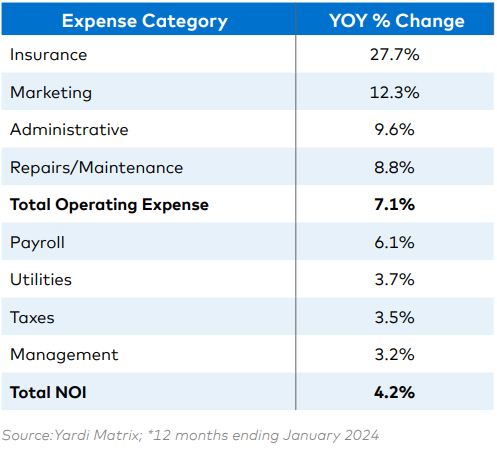
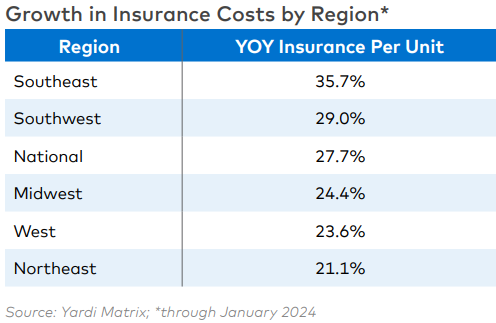
Property insurance alone was up by more than 27%, Yardi Matrix says in the study.

Using an examination of more than 20,000 properties that use Yardi operating software, Yardi says overall multifamily expenses rose 7.1% year-over-year to an average of $8,950 as of January. Here is how the expenses broke down in the study:

  • 7% insurance
  • 3% marketing
  • 6% administrative
  • 8% repairs and maintenance

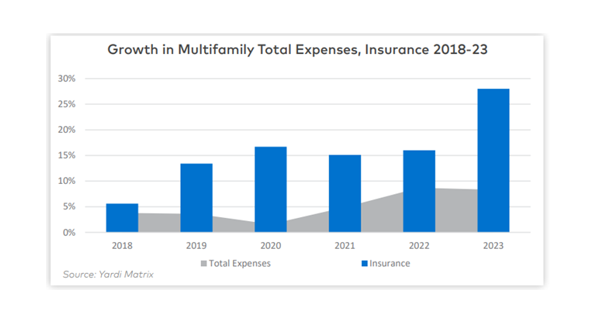
“Driven by inflationary pressures, total expenses at multifamily properties have increased rapidly in the past two years, peaking at 8.7% in 2022. Before that, the average annual expense growth rates were 4.9% in 2021, 1.6% in 2020, 3.6% in 2019 and 3.8% in 2018,” the report says.

Multifamily rental property expenses continue to grow at above-trend levels, led by insurance increases, according to a special bulletin.

Multifamily property insurance costs driving expense issues

The most recent 27.7% jump in property insurance is only the latest hit for multifamily expenses.

Property insurance costs have risen 129% nationally since 2018, to an average of $636 per unit. Property insurance premium growth rates were 16.0% in 2022, 15.1% in 2021, 16.7% in 2020, 13.4% in 2019 and 5.6% in 2018, the report says.

Weather-related insurance events in the Southeast have been a major driver of the property-insurance increases.

Multifamily rental property expenses continue to grow at above-trend levels, led by insurance increases, according to a special bulletin.

“Although property insurance is only 7% of total expenses, its share of overall costs is growing. Plus, it is becoming more difficult to obtain in areas with severe hurricanes, floods and fires,” said Paul Fiorilla, director of research, in the report.

Rental income growth is also now slowing, while multifamily expenses grow. One of the areas is the Individual inflation components.

“Service inflation is still high, a sign that the labor market continues to be tight, which feeds into high administrative and payroll costs for apartments.

“Likewise, supply chains have repaired to a great degree from the height of the pandemic, but repair and maintenance costs are stubbornly high due to increasing costs of labor and materials that are impacted by forces including energy and delays in global shipping lanes,” Fiorilla said.

Summary

Streamlining processes plus implementing new technology can help, however, “the upshot is that property owners can’t expect robust income growth to continue to outstrip rapid growth in expenses.

“Profitability will be at risk if expense increases do not moderate during a period when rent growth is forecast to remain weak,” Fiorilla says.

Read the full report here.

About Yardi Matrix

Yardi Matrix researches and reports on multifamily, office and self-storage properties across the United States, serving the needs of a variety of industry professionals. Yardi Matrix Multifamily provides accurate data on 18+ million units, covering more than 90 percent of the U.S. population. Contact the company at (480) 663-1149.

My Tenant Wants To Repaint His Unit – What Should I Do?

My Tenant Wants To Repaint His Unit – What Should I Do Landlord Hank??

When a tenant wants to repaint his unit, a question that often comes up, should we let the a new tenant repaint his unit? On his page,  Ask Landlord Hank answers questions from other landlords and property managers around the country about their rentals so fill out the form below if you have a question for him. Remember Hank is not an attorney and is not offering legal advice.

Dear Landlord Hank,

A new tenant has moved into one of my units and the tenant wants to repaint and  has asked if he could repaint. I just paid to have the unit painted white so it would go with everything. What do you think?

Dear Landlord Mike,

I would tell the tenant that he cannot make any changes to the paint.

In the past, tenants have sworn they would repaint to original color and it has never happened.

The tenants often paint some color that is difficult to cover -very bright or very dark- so when they move out it will cost you two times as much to repaint for next family.

I give tenants a nice neutral paint color

I like to give tenants a nicely painted, neutral color, normally bright white to make the units feel even larger.

But, occasionally someone asks if they can repaint. Now the answer is ‘NO.’

If you don’t like the color, I’m sorry but repainting is not an option.

In my experience, either tenants don’t repaint, as promised, or they do a poor job and get paint on carpet, or use the wrong color, etc., therefore costing even more money to fix and repair.

Tenant was a painter and it still did not work out

I even had a tenant that worked as a painter (not for me on my rentals), but promised he’d repaint.

That promise went out the window when his divorce occurred and he couldn’t find the time.

I have over 20 years of learning from my mistakes

I’ve had prospects say they will take an unpainted unit after viewing the unit prior to the current tenant leaving. I thought that I couldn’t really lose, since I would not be supplying the paint or labor.

Wrong.

These tenants added accent walls in bold colors and designs which made repaint far more work when they moved out.

Ask Landlord Hank Your Question

Ask veteran landlord and property manager Hank Rossi your questions from tenant screening to leases to pets and more! He provides answers each week to landlords.

  • This field is for validation purposes and should be left unchanged.

About the author Landlord Hank:

My tenant wants to repair his unit and this question is something that often comes up Landlord Hank, so what should we do?

“I started in real estate as a child watching my father take care of our family rentals- maintenance, tenant relations, etc , in small town Ohio. As I grew, I was occasionally Dad’s assistant. In the mid-90s I decided to get into the rental business on my own, as a sideline. In 2001, I retired from my profession and only managed my own investments, for the next 10 years. Six years ago, my sister, working as a rental agent/property manager in Sarasota, Florida convinced me to try the Florida lifestyle. I gave it a try and never looked back. A few years ago we started our own real estate brokerage. We focus on property management and leasing. I continue to manage my real estate portfolio here in Florida and Atlanta. “ Visit Hank’s website here.

Dear Landlord Hank: I Have A Tenant Couple Who Fight On A Regular Basis – What Do I Do?

Sign Up For Our Newsletter And Get Apartment News And Helpful, Useful Content Each Week.

* indicates required

Who’s Responsible For Smoke Detector Batteries In Rentals?

3 Steps For Dealing With Tenants And Frozen Pipes