What is the reason behind having this rental inspection law implemented is the opinion here from a reader of Rental Housing Journal. Here is what he says.
“My name is James E Broadus Sr. and I own Broadus Realty Inc.
“I am licensed by the State of Oregon and the State of Washington.
I have been a realtor for over 30 years.
“The first thing I think we need to understand is that when someone comes to you with a new idea, a new law, or a new way of doing things, 99 percent of the time they have their own best interest at heart first and yours is second, third, fourth or fifth down the line.
“Find out what is the economic reason for having this cost saving law implemented.
“In my OPINION this would be the starting point for solving any problem the city might actually have with the old system. IN MY OPINION.”
If you would like to write a letter to the editor or share your opinion with us, please get in touch here.
We will print letters and opinions that are on topic and of interest to the multifamily industry and our readers.
Appealing to the millennial demographic is definitely not an easy task ,and appealing to the millennial renter is a challenge for many property managers.
Whether you’re trying to bring young blood into your company and boost your employee retention rate, or if you’re attempting to attract young renters to one of your properties, the millennial generation is a peculiar bunch you need to approach in a unique way. Needless to say, the old ways of staging, designing, or promoting a property will no longer work.
Nowadays, the renters are looking for simplicity and functionality across the board. Complemented with unobtrusive aesthetics and by giving them the freedom to influence their living environment, the properties you advertise might just stand a fighting chance in the competitive market. Here’s how to appeal to the average millennial renter.
1. List the essential information first
First and foremost, the millennial demographic puts emphasis on transparency and honesty above everything else. Consider the fact that some 84% of millennials do not trust traditional advertising models, and the fact that they are apprehensive about trusting businesses in general, and you can understand the urgency to portray a trustworthy image of your listings from the get-go. If the potential renter cannot find the basic information about the property such as square footage or price, they will move on to the next best thing.
The average millennial will spend the majority of their time browsing the web for properties, and they will inspect every option thoroughly before booking a viewing. If you want to get to that stage, you will need to provide them with all of the basic information, including floorplan details, contact information, as well as photos and videos that accurately portray the state of the property.
2. Maintain a clear and clutter-free setting
Once they schedule a viewing, they will expect to be greeted by a simplistic, functional, and clutter-free interior. The millennial renter doesn’t want to pay for a place that feels messy or cluttered, nor do they want to live in a place they can’t mould into their safe haven. This is a place they need to be able to call home, so it should be designed and decorated accordingly.
This doesn’t, however, mean that it should be stripped of all soul and substance. It simply means that you should keep the space clear of clutter, and that the interior should follow a semi-minimalist design throughout. Complement this with a contemporary look in terms of furnishing and amenities, and you have yourself an interior that will catch the millennial’s eye.
3. Appeal to the millennial renter mind with technology
Be sure all of the gadgets are connected and that your millennial renter can easily control them with their smartphones.
If you are to attract the tech-savvy millennial to your property and inspire them to make the place their new home, you will need to design it with technology in mind. Every room needs to portray a contemporary image, boasting sleek gadgets throughout, smart technology, and quality entertainment units that will help create a homey vibe that’s familiar to a millennial’s heart.
With that in mind, you want to equip the kitchen with smart appliances, install an AI home assistant, and create an entertainment centre in the living room by properly mounting a TV on a wall and hooking it up with quality surround-sound speakers to create that movie-theatre feel the millennials will love. Be sure all of the gadgets are connected and that your renter can easily control them with their smartphones, and you will have no problem grabbing the attention of the tech-savvy millennial.
4. Optimise the website for mobile viewers
Without a shred of doubt, your potential renters will check out your online presentation before attempting to get in touch and schedule a viewing. For this reason, not only does your website need to be responsive, aesthetic, and functional, but it should also cater to the unique preferences of the “smartphone generation”.
Nowadays, people are increasingly using their smartphones to experience online content and find the information they need quickly, no matter where they are. They are no longer tied to their desktops or laptops, which is why your online presentation needs to be optimised for mobile use across the board. Take advantage of accelerated mobile pages to make your website more responsive and aesthetically pleasing on handheld devices.
5. Is the apartment worth the investment?
When it comes to creating a price that will appeal to the millennial demographic, cheaper is not necessarily better. The average millennial will rather pay a higher price now for the chance to make greater financial savings in the long run, so your main priority should be to offer long-term value to your tenants.
Be sure to include valuable features such as rewards and occasional discounts, the ability to pay their rent online, submit paperwork, or make long-term financial savings with passive conservation features such as green technology. Remember that going eco-friendly also means attracting more of the mindful millennial demographic.
As you can see, millennial renters are quite different than their older counterparts, and as a property manager, you will need to adapt to the unique preferences of this generation if you are to successfully market your properties. Use these tips to appeal to millennials, and inspire them to make your property their long-term place of residence.
People today get by with less space thanks to multi-purpose functionality, options for multifunctional components and a decluttering trend across the nation.
Some people might choose a smaller apartment to reduce the rising cost of rent. Others want to live a simple lifestyle and save their money for experiences such as trips to exotic locations.
Property managers may not be diving into the micro-housing trend, but as large urban centers combat limited geographic space and a growing population of renters, working to optimize smaller apartments can be beneficial for both parties.
The average apartment size is 917 square feet, down seven percent since 2009. If you’re trying to lease one of the smaller apartments in your area, one way to make it seem bigger and more attractive to tenants is to incorporate items with multiple purposes and use the space efficiently.
Consider the Apartment Layout
Property managers working with newer units or remodels should always consider an open layout for small spaces. An open plan for the kitchen and living area creates the illusion of more room. If given the flexibility, working a loft into a high-ceilinged unit allows for even more function in a smaller apartment.
Remodels are expensive, but relatively low-cost design updates can make an impact as well. Painting with clean, light colors and taking advantage of natural light are both classic design tools for opening up smaller spaces. Sunlight makes even a tiny space seem more substantial and less dark.
Install Multi-Functional Furniture
In the United States, there are around 2,600 micro-units being either built or refurbished. About half will come furnished. Furnished units rent more quickly than unfurnished ones, which can offset the expense of including furniture in a property.
Property managers who plan to offer a furnished apartment for rent can look into buying functional furniture that can either serve more than one purpose or be easily stashed away. For example, murphy beds have made a comeback in modern apartment design, allowing tenants to transition from day to night in one small space. This type of option is particularly attractive in a studio apartment.
Push the pros of a furnished space by explaining that the cost of the furniture is built into the overall price. This strategy helps those who are just getting started and may not have the funds to fill a place with furnishings. The units are also move-in ready, decreasing the risk of lengthy vacancies in between tenants.
Try Multi-Function Buildings
Managers of multi-unit apartment buildings can think about the uses of common space and how they can create more than one function for areas. Can the laundry room also host a workout area? Perhaps the lobby can also serve as a gathering place for building-wide events to promote a sense of community?
Larger apartment buildings with communal spaces offer tenants options for working, socializing and taking care of chores outside of their smaller units. Landlords can not only optimize the apartments themselves, but work more functionality into these common spaces.
Covert Unused Space
The key to optimizing a small unit is to avoid wasting any space. If there’s an extra closet in the living area, for example, landlords can opt instead to turn the closet into a workspace for their professional tenants. Adding a desk and shelves doesn’t cost a lot of money, but adds a lot of functionality to the overall design of the unit.
Define Different Areas
Property managers leasing a studio apartment find that it’s sometimes difficult for tenants to see where everything will go. For furnished apartments, including pieces such as area rugs and storage shelves can help break the room into sections for tenants. For unfurnished units, it’s helpful to walk potential tenants through some successful designs or provide pictures of previous renters’ arrangements.
A simple curtain rod separating the sleeping area from the rest of the unit or carefully placed built-in storage are more permanent options for organizing the small space and providing extra functionality.
Maximize Available Storage Space
One complaint many potential renters have is a lack of storage space. Think vertical to add additional storage. Are closets fully taken advantage of, or could shelving be installed near the top? In the kitchen, add shelves from floor to ceiling for an instant pantry or area to store dishes and other necessities.
Additionally, any piece of furniture should either have multiple purposes or provide additional storage for renters. Bed frames with built-in storage underneath and tables with drawers help tenants feel confident that their clutter will be accounted for upon move-in.
Even minimalists need places to put their winter coats and wine glasses throughout the year, after all. A property manager can make an impact on the unit’s first impressions by maximizing storage wherever possible.
Buy Smaller Appliances
Building managers can opt to order smaller than standard size appliances to create the illusion of a bigger kitchen. Especially if catering to single tenants, small apartment units benefit from correctly-sized ovens and refrigerators. Ultimately, it’s wasteful to take up valuable cooking space with a full-width stovetop when most tenants will be preparing food for one or two.
Increase Multi-Purpose Functionality
As apartment units shrink over time, landlords can make an impression by working to optimize the tenant’s available space. Whether a true micro-unit or a standard studio, multi-purpose functionality pays off for both the tenant and the landlord. A few upgrades to storage, design and furnishings can keep vacancies to a minimum and provide flexible housing for those who seek it out.
Holly Welles writes about real estate market trends from a millennial perspective. She is the editor behind The Estate Update, a residential real estate blog, and keeps up with the industry over on Twitter @HollyAWelles
Landlords gifts for tenants can change the stereotype of landlords as money-hungry people who just want their hard-earned cash. Veteran landlord and investor Larry Arth shares his story on landlords gifts for tenants.
By Larry Arth
After I was married 33 years ago, my gift-giving list during the holidays grew exponentially with all the additional mother-in-law, father-in-law, brothers, sisters and even aunt and uncle in-laws. I remember after an exhausting day of shopping and purchasing the final gifts telling my wife, “Whew, glad to have that done.”
Her reply was, “What are you doing for all the tenants?”
What, I have to buy tenants a gift?
Up to this point I had not even given it a thought. But once I thought about it, it did make sense. After all, employers give gifts to their employees to show they are thinking about them and appreciate their work. I, of course, really appreciated my tenants. Even though they periodically drove me crazy, they were an important part of my business.
I must admit, I knew I could probably gain some good mileage from remembering them during the holidays. I mean, small gifts can go a long way to show that you appreciate them. Now I just had to determine what to get them. Sending a gift card made the most sense, but to where?
As a person who likes to test and measure, I gave tenants in one building a $50 gift card to the nearby local grocery store.
And in another building, I gave a $50 gift card to the local Target. I wanted it to be a gift card that would allow them to buy something the whole family might be able to use.
The outpouring of gratitude was much larger than I could ever have expected.
Tenants were in total shock to receive a gift from the landlord. The stereotype of landlords is they are money-hungry people who just want their hard-earned cash. Funny how a little gift can change that image so quickly. While the Target card appeared to go over better, both created the same gratitude. This gift card allowed my tenants to make purchases of items the whole family needed. During times when money was extra tight, their appreciation was extra strong.
I wrote gift-giving into my business model
Seeing the great response to my Christmas gift cards, I came to the conclusion that my success in the landlord business was in direct proportion to the number of people who, when thinking of a landlord, thought of me. I had heard this statement at a conference, too.
After all, investing is all about the return on investment, and if the small investment in gift-giving creates such widespread recognition of me as a great landlord, I must keep doing this.
Landlords gifts for tenants in my business model:
Children’s birthdays: A gift certificate to McDonald’s for a free ice cream cone. This $1 investment had the children talking about me for days before and after their birthday. I remember a tenant telling me that her daughter was asking her for a week in advance if she thought Larry Landlord would remember her birthday and send her another ice cream cone certificate. Needless to say, I won over the children, and when I visited the place and asked them to keep their bikes off the sidewalk or to keep the common hallways clean, they were happy to assist. Also, moms and dads love it when you think of their children. While the return on this $1 investment may not be measurable, I believe it to be one of my best investments.
Thanksgiving gift: A simple gift card for a turkey at the neighborhood grocer. No better time to send a thank-you card letting tenants know you appreciate them than Thanksgiving itself. The interesting part is, Thanksgiving is not a typical time one expects to receive a gift, so it makes it more of a surprise. The bigger the surprise, the more they remember it.
Christmas / holiday gifts: As mentioned above, we sent Target cards as gifts for tenants, and eventually we started sending out holiday cards, too, to satisfy the masses.
Annual renewal gift: This one proved very interesting. When it was time to renew the lease, we would send out a lease renewal along with a card that said “free four-hour handyman” for their renewal anniversary. We had certain limitations here, of course. It was usually painting a room or two, or hanging shelves or a cabinet. Once, we even gave a tenant a new kitchen floor. It was always at our discretion, of course. The idea was to give the tenants things they wanted. These were mainly fair requests, as they were items that were needing attention anyway. Giving this as a gift without them having to ask for it was special to them. Spending the money only helps maintain the property and created good will to boot. This gift offset any negative reaction to the rental increase.
The return on investment:
Tenant turnover was very low, which as you know saves you, the landlord, money.
Tenants felt like they were part of a community as opposed to a meal ticket for their landlord.
They were happy tenants who always gave me referrals of other tenants looking for property.
Creating happy tenants was a very inexpensive way to keep tenants and create referrals, making for probably a better overall ROI than the investment itself.
Happy holidays and happy investing.
Larry Arth is also a real estate agent in Florida.
Multifamily market rent declines in November reflected the normal seasonal fluctuation, are no cause for alarm, and demand remains strong, according to the latest report from Yardi Matrix.
“Multifamily rent growth in 2018 stands at 3.1%, higher than most estimates coming into the year. Rents have stalled in the fourth quarter, a typical pattern, declining by $3 from their September peak,” Yardi Matrix said in a release.
Highlights of the multifamily market report
U.S. multifamily rents fell by $2 in November, dropping to $1,419, while year-over-year growth fell by 10 basis points to 3.1%. Rents are down $3 from the peak of $1,422 in September.
The small decline can be chalked up to normal seasonal fluctuation. Demand has remained strong as the occupancy rate has stayed stable for the last six months despite the growth in supply in many metros.
Rent growth continues to be strongest in the West, Southwest and Southeast. Las Vegas and Phoenix have the highest rent growth, and five of the top 10 metros are in California.“Demand continues to be the main driver of the robust market, as new household formation helps fill new multifamily supply. “It’s a testament to the economy’s strength that most of the metros with the highest supply pipelines are maintaining occupancy rates and moderate rent growth,” the report says, including:
Nashville
Austin
Denver
Miami
Year-over-year rent growth leaders for November were:
Las Vegas
Phoenix
California’s Inland Empire
Atlanta
Orlando
What is the outlook for capital in multifamily markets
“One of the strengths of the multifamily market in recent years is the availability of capital, especially debt,” Yardi Matrix says in the report.
“Despite some concerns about the durability of the economic expansion, the healthy capital environment should continue through 2019. If anything, the worries might be working in favor of multifamily, as lenders are increasingly looking to book loans on less risky assets and property types. Plus, Fannie Mae and Freddie Mac have dominated the apartment debt market since the recession, which makes other lenders more eager to originate multifamily loans.”
Capital trends in commercial real estate are likely to remain healthy, and multifamily stands to benefit.
Lenders are discriminating among property types and trying to incorporate less risky asset classes into portfolios. That means more multifamily and industrial and less retail and niche property types.
Lenders are acting much differently at this stage of the cycle than the last time around, when loan terms became ever more aggressive until the market collapsed. In the next downturn, debt sources will have much less capital at risk.
About Yardi Matrix
Yardi Matrix offers the industry’s most comprehensive market intelligence tool for investment professionals, equity investors, lenders and property managers who underwrite and manage investments in commercial real estate. Yardi Matrix covers multifamily, industrial, office and self storage property types. Email [email protected], call 480-663-1149 or visit www.yardimatrix.com to learn more. Yardi® develops and supports industry-leading investment and property management software for all types and sizes of real estate companies. Established in 1984, Yardi is based in Santa Barbara, Calif., and serves clients worldwide. For more information, visit www.yardi.com
8 ways to reduce winter slips and falls is the rental property maintenance checkup this week provided by Keepe.
In the winter, snow, ice and freezing cold temperatures create the perfect conditions for accidents like slips, trips and falls, well except for our friends in Arizona and parts of California who have to deal with wet weather at times in the winter.
These winter-related accidents are very common and can be extremely dangerous, especially for senior citizens. Use these 8 tips to ensure your tenants stay safe this winter season.
How to reduce slips and falls at your rental properties
Watch for things at your rental properties that can cause winter slips and falls.
Non-slip tapes: A simple way to add protection to your floors are by adding peel and stick non-slip tapes. These tapes are easy to apply and provide increased security on floors and stairs.
Stair Treads: Tread covers and nosing are another great preventative solution for stair-related accidents. Indoor and outdoor stairs of any material can benefit from stair tread nosings. The long-lasting material resists chips, scratches and stains.
Absorbent mats: Absorbent mats are great solutions for walkway areas and entry areas throughout the property. These mats will absorb all liquids while preventing floor stains.
Lighting: Make sure there are good lighting systems throughout your outdoor and indoor property. Use motion-sensor lights if you’d prefer an energy efficient solution.
Clean up: Keep common areas and walkways clean and tidy. Keep electric cords and telephone wires near walls and away from walking paths. Clean up indoor spills and puddles immediately.
Spot check for hazards: Identify potholes and cracks outdoors that may cause issues and arrange repairs before it snows. Check entrance steps and handrails for damage and repair accordingly.
Indoor snow removal: When snow is tracked indoors, interior surfaces can become dangerous. Use a floor fan to keep walkways dry and place “wet floor” signs in needed areas to alert incoming residents of caution areas.
Outdoor snow removal: Discuss with your maintenance staff which areas you expect snow and ice accumulation to be removed and treated. Ensure snow is piled in a low area to prevent melting and refreeze.
Snow removal at your rental properties can help reduce winter slips and falls.
Prevent winter accidents at your rental property by making your space safer with these easy and affordable solutions. Maintaining a safe place during dangerous wintry conditions will go a long way in tenant relations.
Other recent rental property maintenance Keepe posts you may have missed:
Keepe is an on-demand maintenance solution for property managers and independent landlords. The company makes a network of hundreds of independent contractors and handymen available for maintenance projects at rental properties. Keepe is available in the Greater Seattle area, Greater Phoenix area, San Francisco Bay area, Portland, San Diego and is coming soon to an area near you. Learn more about Keepe at https://www.keepe.com
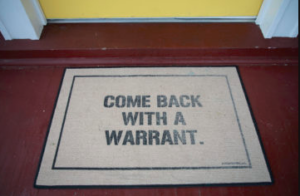
Landlords and tenants in Seattle have filed a class action lawsuit challenging the city’s use of warrantless mandatory rental inspections, according to a release from the Institute for Justice.
The lawsuit, which was filed in King County Superior Court, argues that the city’s program is a clear violation of the Washington state constitution’s mandate that “no person shall be disturbed in his private affairs, or his home invaded, without authority of law.” Yet, in Seattle, that is exactly what happens when the city forces landlords and tenants to submit to a warrantless search, according to the release.
“By subjecting tenants to random, government-mandated inspections that would not occur if that same person owned their home, Seattle is treating renters like second-class citizens,” William Maurer, the managing attorney of the Institute for Justice’s Washington state office, said in the release.
Attorney William R. Mauer
Tenants should be able to just say ‘No’ when inspector shows up
Tenants should be able to say no to mandatory rental inspections when inspectors show up.
“Your home is your castle, regardless of whether you rent or own it. It is plainly unconstitutional for Seattle to force renters to open up their homes to government inspectors when nothing is wrong inside,” Maurer said. “The lawsuit seeks to do one simple, but important, thing—allow tenants to exercise their constitutional rights and say ‘no’ when an inspector shows up without a warrant.”
“It should be up to tenants to decide whether they want a stranger entering their home” Institute of Justice attorney Rob Peccola, said in the release. “The fact that someone rents, rather than owns their home should not give the government the right to disrupt their life, invade their privacy and search their homes even when there is no evidence that anything is wrong.”
Attorney Robert Peccola
Law makes landlords to the city’s work
“The law makes landlords do the city’s dirty work when a tenant says no to an inspection,” Peccola said in the release.
“The city has never attempted to get a warrant—that would mean forcibly entering over the objections of people the law was meant to help—so instead it fines landlords upwards of $500 per day until they can coerce their tenants to allow the inspection. The city is essentially fining landlords for refusing to violate their tenants’ privacy.”
This lawsuit does not seek to stop the city from inspecting rental units where the tenants agree to the inspection or keep the city from addressing problem properties. Rather, the suit seeks to stop the city from entering the private homes of Seattle’s renters unless the city gets the tenant’s consent or obtains a warrant based on evidence of a specific problem, according to the release.
John B. Heiderich and Gwendolyn A. Lee, have owned and operated rental properties in Seattle for more than forty years. They are Keena Bean’s landlords and plaintiffs in the lawsuit.
How the Seattle inspection law works
Under Seattle’s program, each year the city randomly chooses roughly 10% of the rental units in Seattle for a mandatory inspection.
Owners of buildings with more than one rental unit may choose to have a sample of at least 20 percent of the units in a building inspected (up to 50 total units), with the city choosing which units to inspect.
Anyone renting an apartment or home chosen by the city must allow inspectors into their home to inspect it for housing code violations, even if they do not consent and the city does not have a warrant. The law offers no options for tenants or their landlords to object to the search.
For many years, Seattle addressed housing code violations in rental housing using a complaint-based system. But in 2013, Seattle, like an increasing number of municipalities, switched to a proactive rental inspection system, the Rental Registration and Inspection Ordinance, or RRIO, which took effect in 2015.
What the tenants have to say about the mandatory rental inspection law
Plaintiffs Matthew Bentley, Wesley Williams (pictured above), and Joseph Briere—along with their landlords, plaintiffs Sarah Pynchon and William Shadboldt—know firsthand that Seattle does not respect tenants’ privacy.
Earlier this year the city informed the landlord for renters Matthew Bentley, Wesley Williams, and Joseph Briere, that their home needed to be inspected. Bentley, Williams, and Briere, along with their three other roommates, have nothing to hide. But because their home is in great shape and they all value their privacy, they informed the city that they did not want their home inspected. The city responded by threatening fines upwards of $500 per day if their landlords did not somehow coerce the housemates to allow the unconstitutional inspection.
Plaintiff Keena Bean is a tenant in an apartment home that is currently subject to Seattle’s rental-inspection program. Ms. Bean is a young professional who cares about maintaining privacy in her home.
“For me, it’s not only a matter of privacy but also of security,” Keena Bean, one of the tenants who filed suit said in the release. “I’m a young woman living alone in the city, and I take my personal safety very seriously.
“Deciding whether or not to let a stranger into my home is something that should be left 100 percent up to me. Just because I rent doesn’t mean the government can force its way into my bedroom and through all of my personal belongings,” she said in the release.
Bean’s landlords, plaintiffs John B. Heiderich and Gwendolyn A. Lee, have owned and operated rental properties in Seattle for more than forty years.
“They care deeply about their tenants and cultivate long-term relationships with their renters. They are unwilling to act as the vehicle by which the city will intrude into Ms. Bean’s home without her consent and are committed to helping their tenant protect her constitutional rights,” according to the release.
About the Institute For Justice
The Institute for Justice, which has an office in Seattle, is a nationwide, public interest law firm that stands up for citizens’ constitutional rights and liberties. It has filed three previous lawsuit challenging rental inspection laws in Redwing, Minn., Golden Valley, Minn., and Pottstown, Penn. Through strategic litigation, training, communication, activism and research, the Institute for Justice advances a rule of law under which individuals can control their destinies as free and responsible members of society. IJ litigates to secure economic liberty, educational choice, private property rights, freedom of speech and other vital individual liberties, and to restore constitutional limits on the power of government
October and November now look like a short-lived two-month hiatus from rent increases as December apartment rents for one-bedrooms rose nationally by .57 percent or a modest $6, according to the Abodo National Apartment Rent report.
“Two-bedroom units rebounded slightly, also close to their January levels with a $13 or .08 percent increase. These minimally meandering prices don’t look like they are trying to break out of the 2018 doldrums, however,” the report says.
One-bedroom apartment rents recap
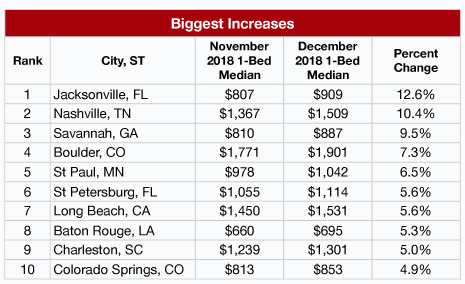
“Let’s get specific. Sometimes we see a statistical anomaly like the top ten December increaser, Jacksonville, FL, with a strong move of $102.00 or 12.6 percent. Music City Nashville, TN came in a strong second with a 10.4 percent increase.
“Savannah, GA was not far behind, moving from $810 to $887—a 9.5 percent rise. Batting cleanup was pricey Boulder, CO with a solid 7.3 percent rise to $1,901, perilously close to the magic $2000 mark.
“More reasonable St. Paul, MN followed with its $1,042 median December rent increasing by 6.5 percent, and St. Petersburg, FL and Long Beach, CA tied for sixth place both reporting 5.6 percent increases.
“Baton, Rouge, LA, Charleston, SC and Colorado Springs, CO called in increases of 5.3, 5.0 and 4.0 percent respectively. Conspicuously missing was Milwaukee WI, as WI average state rent declined in December by an average of $16,” the report says.
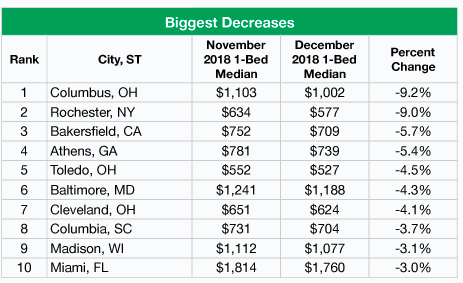
“The top losers were significant as Columbus, OH and Rochester NY lost around 9 percent. Dwight Yoakum’s favorite, Bakersfield, CA came in third with a 5.7 percent decrease to $709, and Athens, GA pulled up in fourth place as median two-bedroom rents there decreased by 5.4 percent.
“Toledo, OH, Baltimore, MD and Rock n’ Roll Hall of Fame host Cleveland OH, showed an average decrease of 4.1 to 4.5 percent, and the bottom three one-bedroom losers were Columbia, SC with a decrease of 3.7 percent, Madison, WI reporting a 3.1 percent slide, and internationally loved Miami, FL posting a 3.0 percent decline to a still stratospheric $1,760 rate per month,” the report says.
Courtesy of AbodoCourtesy of Abodo
Two-bedroom apartment rents recap
“There must be something about Nashville because like the city’s one-bedroom units, two-bedroom Nashville, TN apartments shot up significantly; the two-bedroom units rose by 12.2 percent to $1,715. Athens, GA was hot in the two-bedroom area with an increase of 10.3 percent, and college town Gainesville, FL saw two-bedroom rents rise by 5.8 percent to $1,210.
“Milwaukee two bedrooms bucked the Wisconsin trend as Brew City reported a 5.8 percent gain here.
“The next four cities were tightly bunched as Tampa, FL, Fargo, ND, Los Angeles, CA and El Paso, TX all reported increases within the 4.0 to 4.4 percent range.
“Scottsdale, AZ came in 9th with a modest 3.9 percent increase, and Colorado Springs rounded out the top ten increasers with a similar 3.8 percent rise.
“The Saints are doing well, but New Orleans two-bedroom units led the losers with a big 10.3 percent loss.
“Houston, TX and Buffalo, NY were not even close, though they posted 7.4 and 7.2 percent respective declines. Baltimore, MD, Syracuse, NY and warm Miami, FL all lost between 4.0 and 4.6 percent, although Miami’s median two-bedroom rent that clocked in at $2,211 per month is still high.
“Cleveland OH, and Memphis, TN showed almost identical 3.6 and 3.5 percent decreases, and two Texas towns—Fort Worth and Dallas—decreased by 3.2 and 2.5 percent,” the report says.
Methodology
Each month, using over 1 million ABODO listings across the United States, we calculate the median 1-bedroom and 2-bedroom rent prices by city, state, and nation, and track the month-over-month percent change. To avoid small sample sizes, we restrict the analysis for our reports to cities meeting minimum population and property count thresholds.
In a new survey 19 percent of current renters say rising mortgage rates are their biggest obstacle to buying now so many renters will now continue renting.
“Almost one in five (19 percent) renters who wish to buy said rising mortgage rates were their biggest obstacle to home buying – up from 13 percent in April, before rates hit seven-year highs,“the report says based on a Harris Poll in November.
Mortgage rates will continue to climb keeping renters as renters
Mortgage rates on 30-year, fixed rate loans have been less than 5 percent since the end of the recession, helping to buoy housing demand and keep monthly payments relatively cheap even as prices themselves rose.
But those record-low rates will come to an end in 2019, according to the Trulia report.
Housing affordability issues will keep more people as renters
Trulia says the financial impediments of homeownership are acutely felt among renters who wish to buy:
53 percent of renters say that saving enough for a down payment is the number one obstacle to homeownership.
36 percent of renters say home prices is the obstacle.
Over the past several years, home price growth has largely outpaced income growth, making for an increasingly unaffordable home-buying environment. And next year, even as growth in home prices cools, limited supply will continue to help push prices up to some degree.
“Even if inventory begins to pick up in more markets, it will be rising from multi-year lows and will take a long while to get back to a more balanced level between buyers and sellers.
“With the construction industry facing significant headwinds from the higher cost of materials and labor as well as rising interest rates, we do not expect much if any growth in new construction starts in 2019 to help alleviate inventory woes,” Trulia says in the report.
Renters summary:
“Using insights from a new Trulia survey of more than 2,000 U.S. adults aged 18 and older, conducted online by The Harris Poll, and our housing research and analysis from the past year, we are making the following predictions about the U.S. housing market in 2019:”
Nationwide housing inventory will remain tight
Worsening affordability will slow down home buying activity
Mortgage rates will continue to rise in 2019, reaching 10-year highs
Expect natural disasters to impact more communities in 2019, but have a moderate effect on the housing market overall
More millennials will become first-time homebuyers in 2019
Methodology
This survey was conducted online within the United States by The Harris Poll on behalf of Trulia from November 7-9, 2018 among 2,021 U.S. adults ages 18 and older. This online survey is not based on a probability sample and therefore no estimate of theoretical sampling error can be calculated. For complete survey methodology for this survey or previous surveys, including weighting variables and subgroup sample sizes, please contact [email protected].
A new study shows the average size of apartments has declined over the past 10 years and Seattle has the smallest apartments in the U.S.
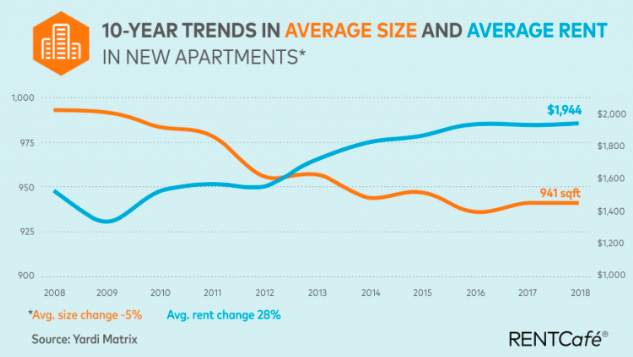
In its latest study, RentCafe, says the average apartment size has shrunk by 52 square feet over the past 10 years, now coming in at an average of 941 square feet.
Highlights of the smallest apartments in U.S. study
The average size of new apartments in the U.S. in 2018 is 941 square feet, 5 percent smaller than ten years ago, with studio apartments shrinking the most, by more than 10 percent; meanwhile, overall rents have increased by 28% over the same period of time.
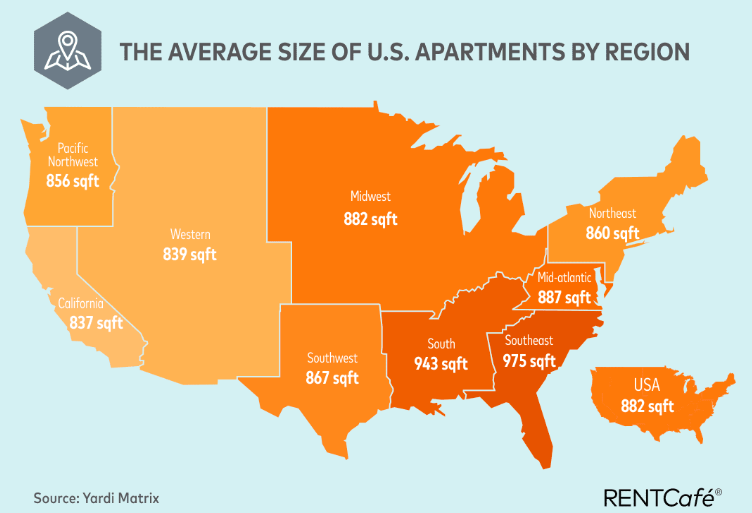
The average size of apartments regardless of year built is 882 square feet, with the largest apartments in the Southeast boasting 975 square feet of living space and the smallest in California, measuring 837 square feet.
Seattle has the smallest apartments in the U.S. with an average size of 711 square feet, Manhattan and Chicago the second smallest rentals, 733 square feet, while Tallahassee, FL offers the most spacious rentals in the U.S., 1,038 square feet on average.
Rents in newly-built apartments have increased by 28%, but their size has gotten 5% smaller compared to 2008.
Apartments in Detroit and Phoenix have suffered the biggest cuts in size over the last 10 years, 27% and 19% respectively. Los Angeles and Boston apartments are also in the top 5 in terms of size reduction.
Although rentals in San Francisco and Manhattan are among the smallest in the nation, they have been increasing in size in recent years, up by 13% and 12% respectively, compared to 10 years prior.
Denver, Colorado Springs and San Jose have seen dramatic changes in rents and size in opposite directions over the past decade. Rents here jumped 60%, while rental sizes went down between 4% and 11%.
Living habits lead to changes in apartment size
Changes in renters’ living habits are literally redrawing floor plans, according to the RentCafe study.
The largest share of apartment dwellers, millennials prefer living in locations close to restaurants and entertainment rather than having a large kitchen or living room to cook or entertain at home.
Studio apartments — the symbol of downtown living — have been cut down the most. The average studio apartment is 10% smaller than 10 years ago, reduced from 573 sqft in 2008 to 514 sqft this year.
Contrary to the growing interest in smaller units, studio apartments continue to represent a small piece of the rental market, only 5% nationally of all apartments. One-bedroom rental units make up the largest chunk of the national apartment stock (43%) and their floor plans have decreased by 4% over the last decade, while two-bedroom apartments have seen the least change in size, down by only 0.5% on average.
RentCafe ranked the top 100 cities with the largest rental stock in the country by the average size of their rental apartments.
Methodology
This report was compiled by RentCafe.com, a nationwide apartment search website that enables renters to easily find apartments and houses for rent throughout the United States. The apartment size and rent data were provided by Yardi Matrix, a RENTCafé sister company specialized in apartment market intelligence, providing up-to-date information on large-scale multi-family properties of 50 units or more in over 130 U.S. markets.
Unit types are categorized by the number of bedrooms (zero, one, two) as defined by Yardi Matrix. The regions included in this report coincide with Yardi Matrix’s market boundaries and may be different from regional boundaries as defined by other sources.