A landlord’s ability to adapt has a substantial impact on their success such as adapting to the needs of millennial renters.
Potential tenants will always choose properties that align with their interests and values, and as these interests and values change, year after year, landlords need to remain aware of shifting trends to capitalize on them.
This fact is especially true of the millennial demographic. Projections show that millennials will soon surpass baby boomers as the nation’s largest living adult population, making them an even higher priority for landlords. So what can these landlords expect from millennial renters in 2019?
Let’s consider three trends that will shape the way landlords appeal to millennial renters
No. 1 – Desire for Smart-Home Technology
Millennial renters are familiar with the range of smart-home technology available on the market today. Many of them are interested in the benefits of smart thermostats, smart lighting, smart security systems and other products that provide convenience and energy efficiency. Landlords see the appeal as well.
For example, residents can save as much as 10 percent per year on heating and cooling by turning the thermostat back seven to 10 degrees from its average setting for eight hours a day. A smart thermostat allows for this kind of regulation without input, earning considerable energy savings for a rental.
While it’s often unrealistic for landlords to purchase smart lighting systems for every unit in an apartment complex, they can invest in smaller — though no less substantial — changes, like smart security. A wireless camera system allows landlords a more extensive view of their property, and they impress upon tenants a sense of safety and security.
Tech-savvy landlords who integrate smart-home devices into their properties also enjoy a higher profit. A survey from Wakefield Research found that 86 percent of millennials are willing to pay more for a rental property if it features smart-home technology. Both landlords and tenants see the value in these products.
No. 2 – Shifting To New Life Stages
Millennials are growing older, and as they settle down and have children, finding properties with family-friendly features becomes a higher priority for them. While more urban rental markets will largely miss this trend, smaller communities may see more tenants who are starting to raise families while paying rent.
Millennials are growing older, and as they settle down and have children, finding properties with family-friendly features becomes a higher priority.
Sure, home ownership becomes much more popular at this stage in life. But research shows that millennials are entering this stage later than generations in the past, and their first children are those most likely to live in rented housing. Buying a house takes a lot of capital, and renting still makes a lot of sense for some young families.
Landlords who are located in more suburban areas can benefit from understanding a young renting family’s needs. These landlords can market elements of the surrounding area – schools and parks, for example. A space for children to play and explore catches the attention of new families, and they’ll gravitate toward properties where these features are within walking distance. Accessibility is crucial.
More widely, millennials are also searching for rentals where their pets are welcome. Many of them have a furry family member, and they don’t want to have to pass over the perfect property just because the landlord doesn’t allow cats and dogs. Landlords who prohibit pets should consider an adjustment in their policies.
In short, landlords need to adjust their perception of the average millennial. Depending on your location, you can adjust your listings and marketing to attract the interest of households with small children and pets. This can set you apart in a market that largely caters to tenants with fewer obligations.
No. 3 – Commitment to an Eco-Conscious Lifestyle
Now more than ever, millennials are aware of their impact on the planet. In the face of fluctuating temperatures, unseasonable weather and more frequent natural disasters, many have taken it upon themselves to adopt an eco-conscious lifestyle. Sustainability and environmental conservation are significant considerations.
Millennials want to rent from a landlord who shares their values. Between a progressive, eco-friendly landlord and one who hasn’t made an effort to improve their buildings, most young tenants will choose the former. This decision not only lessens their carbon footprint, but it can save money on monthly utilities.
Sustainability and environmental conservation are significant considerations.
Landlords can appeal to these young tenants in a number of different ways, such as by installing smart-home technology like the energy-efficient devices mentioned above. They can make smaller changes too, like fixing low-flow attachments to faucets and shower heads, as a comparatively inexpensive alternative.
However landlords choose to address this trend, it’s essential that they make a point to advertise their property’s eco-friendly features. Whether it’s something as simple as a set of new light bulbs or as complex and costly as solar panels, potential tenants are interested to know how their living space aligns with their belief system.
Learning to Adapt
Landlords need to at least be aware of trends to sustain interest in their properties. To attract millennial renters in 2019, they have to appeal to their desires for smart-home technology, their interest in family-friendly features and their commitment to an eco-conscious lifestyle.
As the priorities of these millennials renters continue to shift, landlords and property managers can benefit from adapting to meet their needs.
The U.S. multifamily market sector enjoyed a solid year in 2018 in which multifamily rent grew by 3.2% according to a survey of 127 markets by Yardi® Matrix, and wrapped up the eighth straight year of growth.
Since January 2011, rents nationally have increased by 31%,
while annual rent growth has been at least 2.9% in every year save 2017. Rent
growth has topped 3% in six of the last eight years.
Multifamily national
report shows calm amid the storm
U.S. multifamily rent remained at $1,419 in December, and year-over-year growth was 3.2%, also unchanged from November. Rent growth has been flat since the summer.
2018 proved to be a solid year for the multifamily sector, and 3.2% rent growth slightly exceeded going-in expectations. Despite the recent volatility in the financial markets, we foresee more of the same in 2019, with strong demand producing rent growth just shy of 3% nationally.
Las Vegas (7.3%), Phoenix (6.5%) and the Inland Empire (5.5%) are the Top 3 metros, highlighting a trend of outperformance among secondary markets.
Rent growth in 2019 will again be led by metros in the Southwest, West and South regions.
Late-stage markets Las Vegas and Phoenix remain atop our rankings, as job and population growth drive demand in the desert.
Both markets are benefiting from migration out of high-cost and tax-prohibitive areas in California and the Midwest. Job growth in tech and finance have attracted educated millennials, and warm weather and a lower cost of living continue to bring retiring Baby Boomers.
Considering the late stage of the current cycle and significant new supply that has been added in the past three years, multifamily rent growth performed quite well and exceeded expectations in 2018
While acknowledging concerns that the unusually long cycle
has played out, a report on the survey cites “reasons to believe multifamily
fundamentals will remain vigorous in 2019 and beyond,” YardiMatrix says in the
report.
Chief among those reasons is ongoing strong demand is that job growth remains
robust, and social factors—such as student loan debt that limits first-time
homebuyers, families remaining renters longer, and retirees downsizing and
moving into rentals—are also likely to maintain demand for multifamily.
Multifamily trend
similar to hotels
Multifamily could be taking a trajectory much like hotels,
which have had nine consecutive years of above-trend revenue growth.
Hotels benefit from business profitability and travel, but
also from lifestyle changes that lead individuals to spend more on experiences.
The financial market
volatility issue
Indicators in employment, supply and occupancy trends
forecast rent growth.
Volatility in the financial markets over the
last few months has been caused by concerns about a slowdown in global economic
growth and policy uncertainty that includes the potential for increasing tariff
fights.
Despite the volatility in stocks and unexpected
rally in Treasury prices, economic fundamentals such as employment and GDP
remain healthy.
Demand for real estate such as multifamily is
not likely to fluctuate much in the short term, and volatility could even bring
capital into the sector.
View the full Yardi Matrix Multifamily National Report for December 2018 for
additional detail and insight into 127 major U.S. real estate markets.
Yardi Matrix offers the industry’s most comprehensive market intelligence tool
for investment professionals, equity investors, lenders and property managers
who underwrite and manage investments in commercial real estate. Yardi Matrix
covers multifamily, industrial, office and self storage property types.
Email [email protected],
call 480-663-1149 or visit yardimatrix.com to learn more.
Rent Growth And Multifamily Trends Heading Into 2019
The annual pace of U.S. apartment rent growth accelerated to
3.3 percent in the fourth quarter, according to a release from real estate
technology and analytics firm RealPage, Inc.
The company said momentum in annual rent growth proved
substantial in the last half of the year, pushing 2018’s performance ahead of
the 2.5 percent growth recorded in 2017.
Apartment owners and operators gained pricing power due to
robust demand that drove occupancy to a fourth-quarter rate of 95.4 percent, up
from 95 percent in late 2017. The country’s occupied apartment count climbed by
323,290 units in 2018, the strongest demand realized since 2010. Demand topped
annual completions that totaled 287,007 units.
The U.S. is gaining
renters
“In contrast to the stumble seen in for-sale housing demand
in recent months, the country is gaining lots of additional renters,” RealPage
chief economist Greg Willett, said in a release.
“Job production is fueling household formation among younger
adults who tend to rent, and loss of existing renters to purchase is running at
levels below the historical norm,” he said.
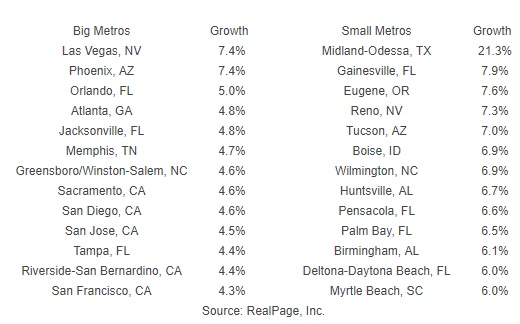
Among the country’s large metros, local rent growth leaders
are Las Vegas and Phoenix, each posting price jumps of 7.4 percent in 2018.
Rent growth reaches 5 percent in Orlando. Several California markets also are
experiencing big rent increases, with prices up 4.3 percent to 4.8 percent in
Sacramento, San Diego, San Jose, Riverside-San Bernardino and San Francisco.
Demand in the
country’s 150 largest metros hits an eight-year high
Annual rent growth
leaders in 2018
Some small metros are experiencing even stronger rent boosts. Rents are up 21.3 percent in the West Texas Oil Patch markets of Midland and Odessa, while price increases between 7 percent and 7.9 percent are occurring in Gainesville, Fla.; Eugene, Ore.; Reno, Nev., and Tucson, Ariz.
Houston’s 0.3 percent rent growth is the weakest performance among big metros. Slight rent cuts of less than 1 percent are occurring in five small markets: College Station, Texas; Corpus Christi, Texas; Davenport, Iowa; Baton Rouge, La.; and Fargo, N.D.
Building in the U.S. apartment sector remains aggressive,
the company said in the release.
Within properties
already under construction, there are 319,123 units slated to complete in 2019.
However, delivery delays largely tied to labor shortages are routine, so this
year’s new supply probably will fall a bit short of the 300,000-unit mark.
Near-term new supply leaders include Dallas, Los Angeles,
Washington, D.C., Seattle and Atlanta. Dallas has the most product on the way,
just over 27,000 units. Adding in the 7,000 or so apartments under construction
in adjacent metro Fort Worth pushes ongoing building to nearly 35,000 units
across North Texas.
“With so much high-end new product finishing in the near
term, there will be a scramble to attract resident prospects in the luxury
apartment niche,” Willett said.
“At the same time, vacant units available to lease can be
very difficult to find in properties in the middle to lower end of the pricing
spectrum. Few renters are moving around within the nation’s more moderately
priced apartment stock, in part just because there are so few housing options
available for all but the most affluent renters.”
About RealPage
RealPage is a leading global provider of software and data
analytics to the real estate industry. Clients use its platform to improve
operating performance and increase capital returns. Founded in 1998 and
headquartered in Richardson, Texas, RealPage currently serves more than 12,400
clients worldwide from offices in North America, Europe and Asia. For more
information about the company, visit http://www.realpage.com.
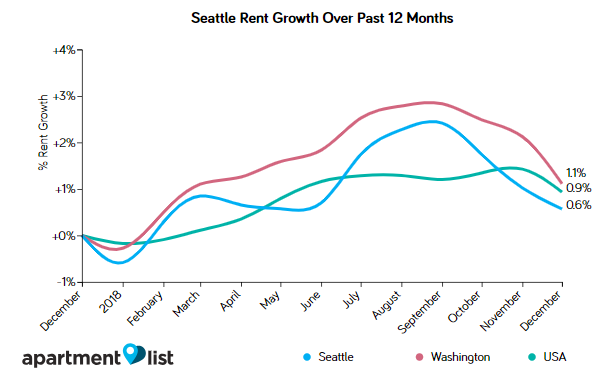
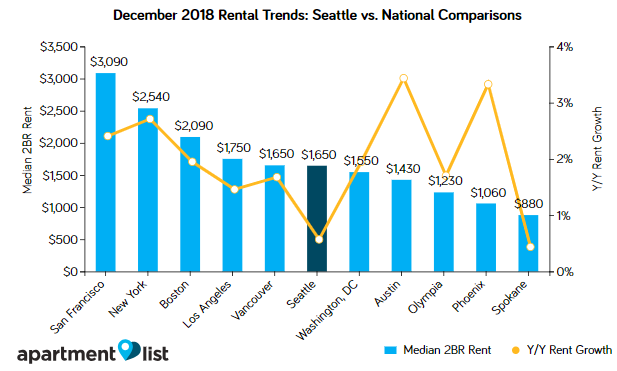
The January rents report shows Seattle rents have declined 0.4% over the past month, but have increased marginally by 0.6% in comparison to the same time last year, according to Apartment List.
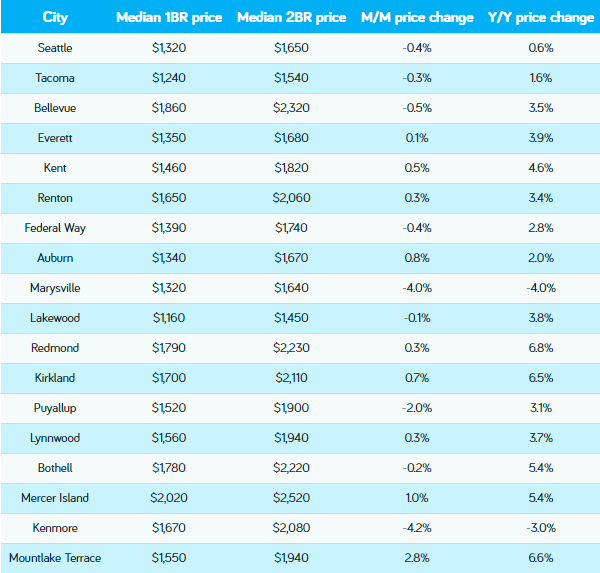
Currently, median rents in Seattle stand at $1,320 for a
one-bedroom apartment and $1,650 for a two-bedroom.
This is the third straight month that the city has seen rent
decreases after an increase in September. Seattle’s year-over-year rent growth
lags the state average of 1.1%, as well as the national average of 0.9%.
Rents rising across
the Seattle Metro
Throughout the past year, rent increases have been occurring
not just in the city of Seattle, but across the entire metro. Of the largest 10
cities that we have data for in the Seattle metro, 9 of them have seen prices
rise. Here’s a look at how rents compare across some of the largest cities in
the metro.
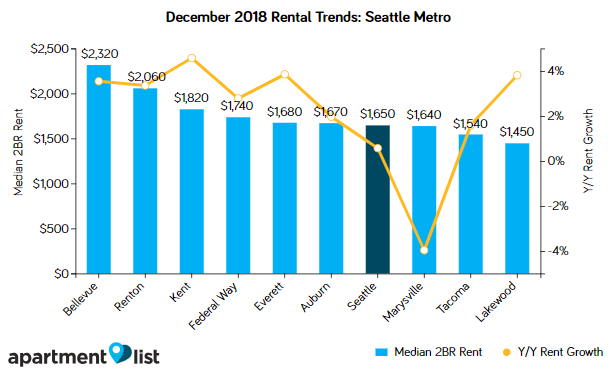
Kent has seen the fastest rent growth in the metro, with a year-over-year increase of 4.6%. The median two-bedroom there costs $1,820, while one-bedrooms go for $1,460.
Over the past month, Marysville has seen the biggest rent drop in the metro, with a decline of 4.0%. Median two-bedrooms there cost $1,640, while one-bedrooms go for $1,320.
Bellevue has the most expensive rents of the largest cities in the Seattle metro, with a two-bedroom median of $2,320; rents decreased 0.5% over the past month but were up 3.5% over the past year.
Lakewood has the least expensive rents in the Seattle metro, with a two-bedroom median of $1,450; rents fell 0.1% over the past month but rose 3.8% over the past year.
Other
large cities nationwide show more affordable rents compared to Seattle
As rents have
increased marginally in Seattle, a few similar cities nationwide have also seen
rents grow modestly. Compared to most other large cities across the country,
Seattle is less affordable for renters.
Rents increased slightly in other cities across the state, with Washington as a whole logging rent growth of 1.1% over the past year. For example, rents have grown by 1.7% in Vancouver and 0.4% in Spokane.
Seattle’s median two-bedroom rent of $1,650 is above the national average of $1,180. Nationwide, rents have grown by 0.9% over the past year compared to the 0.6% increase in Seattle.
While Seattle’s rents rose marginally over the past year, many cities nationwide also saw increases, including Austin (+3.4%), Phoenix (+3.3%), and New York (+2.7%).
Renters will generally find more expensive prices in Seattle than most similar cities. For example, Spokane has a median 2BR rent of $880, where Seattle is more than one-and-a-half times that price.
Methodology:
Apartment List is committed to making our rent estimates the
best and most accurate available. To do this, we start with reliable median
rent statistics from the Census Bureau, then extrapolate them forward to the
current month using a growth rate calculated from our listing data. In doing
so, we use a same-unit analysis similar to Case-Shiller’s approach, comparing
only units that are available across both time periods to provide an accurate
picture of rent growth in cities across the country.
Saving
water with the right landscaping is the rental property maintenance checkup
this week provided by Keepe.
How
to save water with the right landscaping at your property is becoming more and
more important. Drought, water restrictions and increasing water bills may mean
it is time for you to redesign your property landscape plan.
Here are 6 ways you can save water at your property without making drastic changes
Use these tips in your landscape plan to implement water-saving measures that will save you time and money.
No. 1 – Select the right type of grass
At your property, it’s important to incorporate grass that is compatible with your climate. Hybrid-grass such as Bermuda grass, thrives in full or partial shade, as well as sunlight. It is ideal for an extreme-climate region.
In the United States, grasses are typically divided into two groups – warm and cool season turfs. Depending on your climate and drought tolerance, grasses can survive well-throughout the year with minimal support and maintenance. Temperature extremes can add stress to grass. Avoid these issues by using the best grasses for your area.
In warm, southern climates, Bermuda, St. Augustine, Buffalo, Bahia and Zoysia Grass are the most common grasses that are suitable. For Northern regions that experience colder climates, Kentucky Bluegrass, Fine Fescue, Tall Fescue and Perennial Ryegrass are the most common grasses that survive the cold weather.
No. 2 – Use ground covers
Ground covers, such as native plants, slow the evaporation of water from soil. You can replace part of the lawn with ground covers to take advantage of the water-saving system.
Depending on your climate, the type of ground cover that works best for your climate may differ. Ground covers are easy to maintain and often improve the aesthetic look of your landscape area.
No. 3 – Xeriscaping
Xeriscape can be used in an area that will thrive without water and require very little maintenance.
Xeriscaping plants often require less maintenance.
In areas that do not have easily assessable or plentiful supplies of water, Xeriscaping is often used to landscape an area that will thrive without much water or maintenance.
For areas that are susceptible to drought, installing rock garden plantings, native wildflower or ornamental grasses can keep a lush green landscape from turning into yellow wasteland.
No. 4 – Drip-watering system
Drip irrigation is a low-pressure watering system that keeps plants moist while using less water than other irrigation techniques. In addition, installing a rain-sensing timer to your irrigation controller can prevent wasteful watering on rainy days.
Inspect your sprinkler systems and consider drip-water systems where it is appropriate.
No. 5 – Inspect sprinkler systems
Regularly inspect your existing water systems to ensure they are running efficiently. Repair leaks and replace broken sprinkler heads to prevent overwatering. Be sure to check that your sprinklers are only running in the early morning, to maximize absorption.
No. 6 – Landscape maintenance
Incorporate the best practices to ensure your space stays healthy and clean. Mow the grass on a regular routine, leave grass clippings on the lawn to return nutrients to the soil, remove weeds from the lawn, and add compost to the garden to renovate the landscape.
Other recent rental property maintenance Keepe
posts you may have missed:
Keepe is
an on-demand maintenance solution for property managers and independent
landlords. The company makes a network of hundreds of independent contractors
and handymen available for maintenance projects at rental properties. Keepe is
available in the Greater Seattle area, Greater Phoenix area, San Francisco Bay
area, Portland, San Diego and is coming soon to an area near you. Learn more
about Keepe at https://www.keepe.com
Federal Unpaid Workers Owe $438 Million In Rent And Mortgage Payments This Month
The effects of the federal government shutdown on the
housing market are wide-ranging and personal — unpaid workers still have to
pay their rent or mortgage, while aspiring homeowners might see their loans in
limbo, according
to research from Zillow.
About 800,000 unpaid workers (about 380,000 are furloughed and another 420,000 are working without pay), still must find ways to pay for their housing as the shutdown heads into its third week.
HUD letter asks
landlords to use their reserve accounts rather than evictions
The U.S. Department of Housing and Urban Development has sent
a letter to landlords, according to the Washington Post, to blunt the impact
of a lapse in funding for its multifamily programs, which were not renewed
before the government shut down on Dec. 21.
They are asking landlords to use their reserve accounts
rather than evict their tenants.
“As you are aware, the partial government shutdown continues
as the Department of Housing and Urban Development’s spending authority expired
on Friday, December 21, 2018, due to the lack of appropriated funding. Pending
appropriations needed to operate, most FHA multifamily activities must cease
for the duration of the shutdown. Separate guidance will be issued with respect
to Asset Management activities,” HUD
said in the letter.
Unpaid workers and renters owe $189 million
A recent HotPads® analysis found that renters within that
group pay about $189 million for housing each month.
Zillow estimates that
federal employees who are not being paid during the shutdown and own their
homes pay about $249 million in monthly mortgage payments.
Missed payments can
lead to eviction and foreclosure
“Like Americans in the private sector, many federal
employees rely on each and every paycheck to cover critical expenses, including
housing. In many parts of the country, housing affordability is already
stretched and a single missed payment can begin the long process toward
foreclosure or eviction – which has long term impacts on an individual’s
finances and long-term economic prospects,” Zillow senior
economist Aaron Terrazas said in a release.
“It also could
have a significant impact on the overall housing market if it continues to drag
on and furloughed workers who also are would-be buyers get cold feet in the
absence of paychecks. Buying a home is a huge leap of faith for many, as they
bet on continued job security and steady income to finance their home, and
consumer confidence is paramount,” he said in the release.
A Zillow analysis estimates that about 3,900 mortgage
originations are processed each business day for loans backed directly by
federal government agencies such as the FHA and the Rural Housing Service. It
isn’t clear what portion of those are delayed – or for how long – because of
the limited staff during the shutdown, but as many as 39,000 mortgages could
have been affected by today. When those loans are delayed, it most affects
those facing the greatest hurdles to become homeowners. FHA also won’t insure
reverse mortgages or home-improvement loans during the shutdown.
The U.S. Department of Housing and Urban Development says it
does not expect a significant impact as long as the shutdown is brief. But
“with each day the shutdown continues, we can expect an increase in the
impacts on potential homeowners, home sellers and the entire housing
market,” the agency says.
In addition, the shutdown could lead to administrative
delays associated with loans backed by Fannie Mae and Freddie Mac, two
independent agencies that insure the vast majority of mortgages. Those include
lenders unable to get verification of employment for borrowers who are federal
employees, and potential IRS delays verifying borrower incomes, which could
lead to loans being denied.
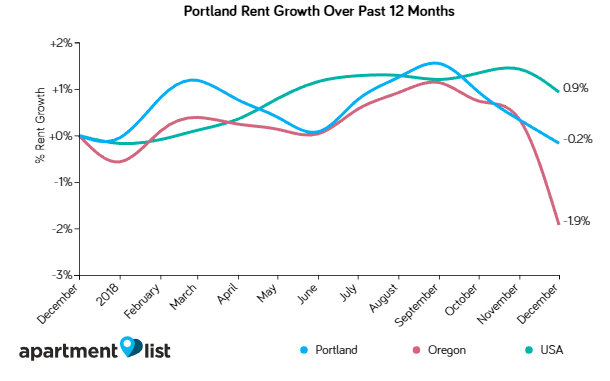
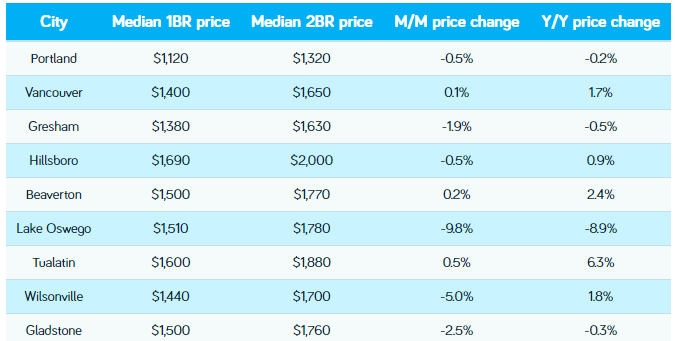
The January 2019 Portland rents report shows Portland rents have declined 0.5% over the past month, and are down slightly by 0.2% in comparison to the same time last year, according to Apartment List.
Currently, median rents in Portland stand at $1,120 for a
one-bedroom apartment and $1,320 for a two-bedroom. This is the third straight
month that the city has seen rent decreases after an increase in September,
according to Apartment List.
Portland’s year-over-year rent growth leads the state
average of -1.9%, but trails the national average of 0.9%.
Rents rising across
cities in the Portland Metro
While rent decreases have been occurring in the city of Portland over the past year, cities in the rest of the metro are seeing the opposite trend. Rents have risen in 8 of the largest 10 cities in the Portland metro for which we have data. Oregon as a whole logged rent growth of -1.9% over the past year. Here’s a look at how rents compare across some of the largest cities in the metro.
Looking
throughout the metro, Hillsboro is the most expensive of all Portland
metro’s major cities, with a median two-bedroom rent of $2,000; of the 10
largest cities in the metro that we have data for, Gresham, where a two-bedroom
goes for $1,630, is the only other major city besides Portland to see
rents fall year-over-year (-0.5%).
Beaverton,
Springfield, and Vancouver have all experienced year-over-year growth
above the state average (2.4%, 2.2%, and 1.7%, respectively).
Portland rents more
affordable than many similar cities nationwide
As rents have fallen slightly in Portland, many comparable cities nationwide have seen prices increase, in some cases substantially. Portland is also more affordable than most other large cities across the country.
Portland’s
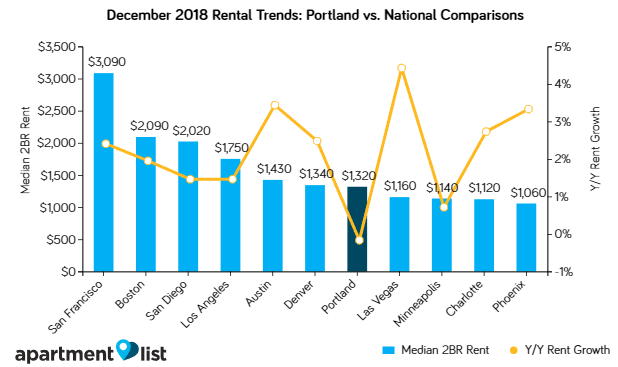
median two-bedroom rent of $1,320 is above the national average of $1,180.
Nationwide, rents have grown by 0.9% over the past year compared to the
0.2% decline in Portland.
While
rents in Portland fell slightly over the past year, many cities nationwide
saw increases, including Las Vegas (+4.4%), Austin (+3.4%), and Phoenix
(+3.3%).
Renters
will find more reasonable prices in Portland than most comparable cities.
For example, San Francisco has a median 2BR rent of $3,090, which is more
than twice the price in Portland.
Methodology:
Apartment List is committed to making our rent
estimates the best and most accurate available. To do this, we start with
reliable median rent statistics from the Census Bureau, then extrapolate them
forward to the current month using a growth rate calculated from our listing
data. In doing so, we use a same-unit analysis similar to Case-Shiller’s
approach, comparing only units that are available across both time periods to
provide an accurate picture of rent growth in cities across the country.
Some rental experts from Zumper, a full-service rental platform company, discussed what they see as the forecast for rent growth and multifamily trends in housing heading into 2019 in a question and answer sessions with Rental Housing Journal.
Natalie Cariola, Senior Vice President of Sales, Zumper:
We forecast core cities will see flat rents as tertiary markets continue to experience rent growth – Natalie Cariola, Senior Vice President of Sales, Zumper.
Q: What is the overall forecast you see for multifamily heading into 2019 at a high level?
A: We foresee new construction continuing to slow as investors and developers become concerned about a looming recession. We forecast core cities will see flat rents as tertiary markets continue to experience rent growth.
Q: Our audience is apartment owners, property managers and landlords, leasing agents and maintenance personnel – take a moment and tell us what you see happening for each of those groups in 2019?
A: 2019 interest rates will have a large impact on all of these groups. If the Fed continues to increase interest rates it will force upward pressure on rents and downward pressure on expenses. This will put pressure on-sites, leasing agents and maintenance teams to accomplish more with less.
Q: Where do you see the rent growth in 2019? Is it going to be in the B and C properties as some have suggested? New Urban Center A properties still a little flat?
A: We see rent growth coming from tertiary markets. In our December 2018 rent report the largest rent gains came from Columbus, Des Moines, St. Louis, Memphis and Shreveport. Our data also shows value add, B product, is closing the rent gap with A product. If 2019 signals larger concessions in the luxury A product it could leave little price difference between luxury product and value add B product. In that case luxury product could steal market share from value add and slow the rent growth that class is experiencing.
Q: Any specifics for our high profile markets – Seattle, Portland, Phoenix Denver metro areas?
Crystal Chen, Marketing Manager, Zumper
Phoenix and Denver markets will continue to see growth – Crystal Chen, Marketing Manager, Zumper.
Phoenix Market In 2019
Growth in 2018, 2 beds are up 8.2% year to date
Healthy job growth, people want to live here for lower rent and cost of living especially on the West Coast (1 bed $950 2 bed $1190) stimulates demand for rentals.
Vacancies will likely remain low so growing rents most likely in the New Year.
Denver Market In 2019
+8.6% year to date growth rate for 1 beds
Similar story in Aurora, +13.6% for 1 beds & Colorado Springs +8-11% for 1 & 2 beds
Hot rental market, surge of millennial migration and economic opportunities (wage growth etc.)
Though growing prices, still not as expensive as other major cities on the West Coast (like Seattle or California cities) so lower prices overall, makes for attractive market.
Most likely continue trend of growing rents 2019
Gauthier van Sasse van Ysselt, Regional Account Executive, Zumper
Housing oversupply in combination with a lack of renter demand during the fall and winter, is resulting in increased concessions – Gauthier van Sasse van Ysselt, Regional Account Executive, Zumper.
Seattle Market In 2019
When looking at the Seattle rental marketing with a short term perspective, you will see that housing oversupply in combination with a lack of renter demand during the fall and winter, is resulting in increased concessions, stagnant median rents and even decreasing rents in some submarkets.
This increase in concessions and change in median rents is most notable in the urban core of Seattle. However, from a long term perspective, we continue to see growth year over year with many submarkets experiencing double digit growth in median rents.
Crystal Chen Summary
Overall, there will be continued growth in the rental market as the U.S. is experiencing the lowest rental vacancy rate right now since the early 90’s (at 6.8%), which shows a high demand for apartments
Increased emphasis on a sharing economy, so renting instead of owning everything from cars to houses is getting more popular.
2019 will most likely continue to see a slow for-sale market, with continued interest rates hikes on the horizon, which makes buying less appealing to many.
Gauthier van Sasse van Ysselt Summary
Overall, the Seattle rental housing market has a clear oversupply in the urban core of the Greater Seattle Area. This oversupply in combination with lower renter demand during the slow season is causing landlords to push concessions and to adjust their median rents.
In the long term, there is consistent year-over-year growth. The questions is whether or not this short term trend will continue. We will have to wait and see.
About Zumper
Based in San Francisco, Zumper has raised $90 million in venture capital funding to date. Zumper is backed by world-famous investors including Kleiner Perkins, Goodwater Capital, Breyer Capital, Foxhaven Asset Management, Axel Springer, The Blackstone Group, Stereo Capital, Dawn Capital, Andreessen Horowitz, Greylock Partners, NEA, CrunchFund, xfund and Marcus & Millichap. Zumper is creating a smooth, efficient, and transparent renting process for both tenants and landlords. We’re the first rental marketplace where tenants can search for and rent an apartment on our end-to-end platform, and we’re just getting started.
Soft credit pulls can help property managers and landlords attract and engage the best renters, according to some new research from Equifax.
Unlike hard credit pulls, soft credit pulls do not impact a consumer’s credit score. This leaves renters in more competitive rental markets more likely to apply to multiple properties without worrying about harming their credit.
As a result, property managers and owners are more likely to attract better applicants and engage the renters who are most likely to pay rent on time – who may be the same renters concerned with having multiple hard credit pulls impacting their credit score.
Soft credit pulls help property managers and tenants
“In the environment today individuals looking to obtain a place to live are going to potentially have to go through the screening process a number of times,” Tyler Sawyer, Vice President of Rental and Real Estate, Equifax, said in an interview with Rental Housing Journal.
“What you’re going to see is often that, that individual might go to one, two, three, four, or five different properties that they might want to take a look at. Each of them maybe managed by a different tenant screening software, or different property managers or different landlords.”
“Often, in the world of credit, when you’re getting multiple inquiries what they’ll see is a negative hit associated to it. Not to a very large degree. But when you’re really dealing with somebody who might be on that bubble that can be very meaningful to them.
So we’ve been able to work with our teams to be able to provide the soft hit. This really gives the same information and the same score associated to an individual,” Sawyer said.
So property managers and landlords can get the information they need to get a good understanding on the prospective tenant’s background and be able to make a decision.
“But they are not going to have that credit hit the way that it works in a lot of the ecosystem here today,” Sawyer said.
Housing shortages within metropolitan areas have created an affordability gap, and as real estate prices continue to rise in markets across the U.S., more consumers are turning to the rental market to meet their housing needs.
Equifax works with tenant screening partners
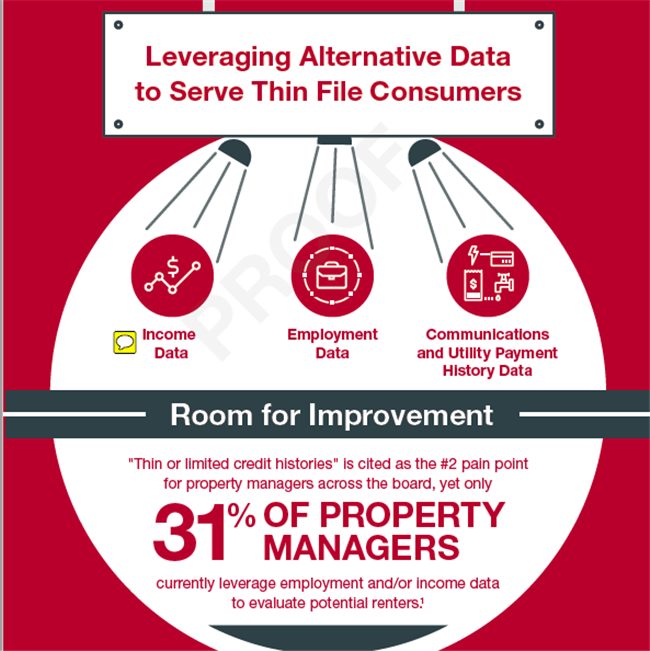
“Our primary market strategy is really centered on working with the tenant screening organizations,” Sawyer said. “What that means is we’re supplying key pieces of information, like credit scores, like verification of income and employment. Then, we’re supplying that data to the tenant screening companies where they’re really going to be able to take that and make decisions based off of the information that we’re providing to them.
“So, we really see those partnerships as a really key piece for us to be able to work on through, because we don’t have a very strong direct to landlord and property management company model in place. We really believe that being able to partner with those that already have those existing relationships from out there gives us the best visibility on out to the marketplace. Gives us the best ability to be able to push new product on out to the market successfully and impact consumers.
“At the end of the day it’s all these tenant screening organizations that have a lot of those very strong relationships. They are a very well known, strong organizations working with a number of property management companies and landlords to be able to affect change. And if we’re able to work through them successfully with something like the soft credit roll out, then we’re just going to have a much stronger base by which to work with.
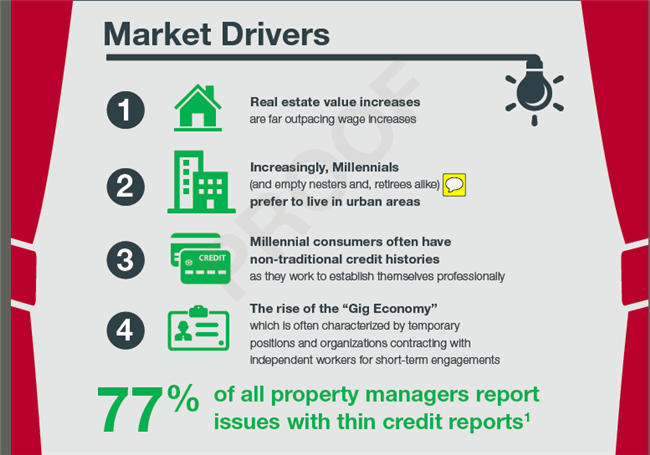
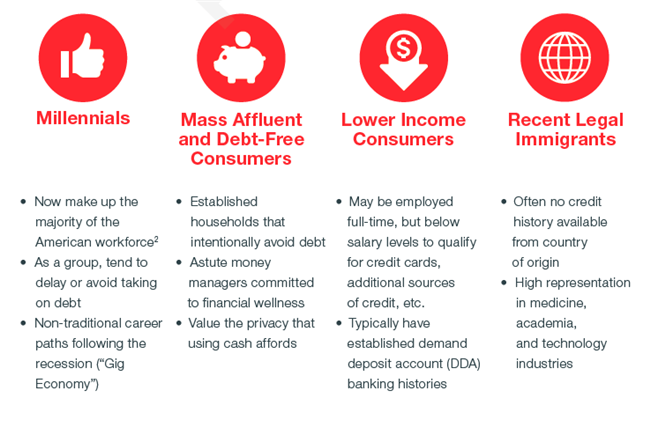
Who are the credit invisibles?
As a result, some creditworthy thin file consumers do not get rates and terms commensurate with their creditworthiness.
Property managers see same information on soft credit pulls they do on a hard credit pulls
“We’ve been asked a lot about that, with landlords are reaching out and saying, ‘Hey, am I going to have a different experience? Am I going to have to do a lot of work associated with being able to pull a soft pull versus the hard pull?’ “Sawyer said.
“Their experience remains the same. The information that they typically are going to be looking at, they’re still going to be able to view. And we even able to, kind of operationally in the background, make it a very smooth transition so that they don’t have to run through hurdles to really be able to start taking advantage of this new product.
“Our rollout strategy is centered on making this available to every single one of our customers. We have done a full migration to immediately impact all of those who were pulling credit hits within the rental ecosystem as they relate to Equifax. And so, we’ve been able to impact every single one of them. Just a couple of weeks ago during our official rollout,” Sawyer said.
Tenants can go apartment shopping without credit score impact
“They can go shopping now and not be worried about that hit and that’s really important. They don’t have to be threatened by a credit hit. And let’s face it, in a lot of scenarios consumers aren’t necessarily fully aware that they might have a credit hit associated to it, they just see it as the score going down a little bit if they’re really paying attention.
“This is something that is going to help them in the background. And it’s also helping property managers and landlords to provide solutions that do not negatively impact their potential relationship. The landlord/tenant relationship is a very important one. You’re having someone move into your home and you want to really be able to get up off on the right foot. And that’s how we’re able to positively impact the fully ecosystem, both from the consumer and from the landlord side because they’re going to have the opportunity to engage in a very positive way with the tenant right out of the gate,” Sawyer said.
About Equifax Equifax is a global information solutions company that uses trusted unique data, innovative analytics, technology and industry expertise to power organizations and individuals around the world by transforming knowledge into insights that help make more informed business and personal decisions.Headquartered in Atlanta, Ga., Equifax operates or has investments in 24 countries in North America, Central and South America, Europe and the Asia Pacific region
Multifamily investing in 2019 and the market for multifamily properties is continuously changing so here are 7 expectations and predictions for the year ahead
On account of major political, social, and economic developments, investors will have to look at the bigger picture.
Adaptation is the key to success amid an uncertain landscape. Whether to resist, or flow with the current, will still depend on what investors want to achieve in the foreseeable future.
It’s because of these fundamental reasons that investors will have to keep themselves abreast of significant disruptions in the multifamily investing field.
For that, they will have to be aware of these disruptions and how they are going to impact the profitability and sustainability of their investment portfolios.
You don’t have to look for a fortune teller to get a good glimpse of the future of the multifamily investing market. You only need to view the trends that will shape the investment market.
As we close another year and welcome a new one, let us focus on what to expect from the multifamily market and look at the trends that really matter in the long run.
No. 1 – High rent situation
Zillow notes that rents across the United States will continue to follow an upward trajectory as demands continue to rise. This would lead to a sellers’ market in which multifamily investors who had held on to their assets for quite some time will find it more practical to sell and reinvest elsewhere.
Still, the rates will vary from one location to another. The supply and demand for rental housing is also a significant determiner of rental prices. Along these lines, it helps to know where to invest and emerging markets remain as great locations for buying multifamily assets.
No. 2 – High Interest Rates
U.S. News relates in an article, RISING INTEREST RATES are having a ripple effect across the housing market as the Federal Reserve increases borrowing costs.
The Fed raised rates again in December and possibly will two more times in 2019. The effect of the Fed’s rate hikes is seen in mortgage rates, which are about 100 basis points higher compared with a year ago at nearly 4.9 percent for a 30-year fixed rate mortgage.
October housing starts data also fell short of expectations. Homebuilder sentiment is falling amid rising mortgage rates and stronger home prices, according to the most recent monthly survey by the National Association of Home Builders/Wells Fargo Housing Market Index. The survey data show that builder confidence dropped eight points to 60 this month. It was 72 at the beginning of the year.
Experts say some areas of real estate and certain regions may hold up better than others with rising interest rates.
Doug Imber, president, Essex Realty Group in Chicago, says rising rates are the topic of conversation and concern for real estate investors, but the context for why rates are rising matters just as much as the direction.
“Rates go up for different reasons, and the reason that they’re going up now, thankfully, is because we have a very strong economy and the Fed is trying to be mindful of inflation,” he says.
No. 3 – Multifamily Investing And Commercial Areas Will Remain Strong
Imber says the economy’s strength is reflected in outperforming real estate sectors. Industrial real estate distribution centers and office warehouse have been doing well.
“Generally, office (space) is having a period of lower vacancy and good rent growth,” he says.
Multifamily units, such as apartment buildings, have had a period of solid growth, and it may continue if mortgage rates continue to rise and home prices remain strong. Those two factors raise the barrier to individual homeownership, and the apartment owner is the beneficiary.
“People stay as renters for an extra year or two while they save up more money for down payments (for home buying),” Imber says. “It’s not just the rates are higher, but if I’m making X amount of dollars in salary, I don’t qualify (for cheaper rates), so I have more money to put down.”
The one caveat to multifamily housing is that supply is starting to increase, which could limit how much landlords can raise rents, he says.
Investors who use real estate investment trusts should be able to withstand higher rates, says Mauricio Gruener, founder of GFG Capital in Miami.
He says throughout the previous Fed rate hike cycles, REITs have held up well. Since 1994, REITs have outperformed stocks in every tightening cycle except last year. REITs averaged a return of 16 percent relative to the 10 percent return of stocks during the 23-year time frame between 1994 and 2017, says Gruener, who was citing data that compared the FTSE Nareit Equity REITS index with the Russell 3000 index.
No. 4 – Focus On Emerging Markets
Possibly the best part of any multifamily investing year-end outlook is a list of emerging markets that are attractive to investors. Indeed, considering the need to build a highly profitable portfolio, investors should buy at the right time and in the right place.
Let’s look at a few cities where better cash flow is expected:
One of Vinney Chopra’s multifamily investing properties in Atlanta.
Atlanta, GA
For some quite some time, the Atlanta multifamily market has remained robust. With good population growth and affordability, the city is a haven for first-time investors who are out to build their multifamily portfolios. In fact, as new constructions continue to pick up, we are seeing good indicators of a healthy jobs market in this city.
Orlando & Jacksonville, FL
Going deeper south, there’s Orlando which has always been a primary destination for cash flow-hungry investors. Even though occupancy rates remain high, we can expect new apartment units to offset the discrepancies. We can see the same situation throughout Southern Florida, where investors are leaning away from condominiums and focusing heavily on apartments due to a steady rise in demand for quite some time.
Raleigh, NC
Another southern city in our list of emerging markets for 2019, Raleigh offers more than just historical attractions. For one, the city has had a strong showing in the jobs department. Unemployment was pegged at 3.6 percent and investors remain confident that joblessness will further decline in the coming year with the passage of a new bill that will pull tax rates down and spur the creation of more jobs throughout the country.
Louisville, KY
Despite challenges to rent growth, multifamily markets in the Midwest are not clipping on new property constructions. Taking Louisville as a case in point, demand for rental housing in the city continues to surpass supply. Against this backdrop, along with a decline in the unemployment rate, more rental developments are definitely in the offing.
Fort Worth, TX
The Texas rental market isn’t showing signs of caving in. No doubt, northern Texas is seeing favorable conditions for the multifamily investing sector. As investments come flooding in and job growth is on an uptrend, there remains firm confidence over the fact that Fort Worth is performing well beyond expectations in both newly constructed and value-add investment properties. Emerging from the gains of 2018, competition will definitely boil over as the New Year approaches with optimism over the economy’s performance.
There are other areas where the job markets are strong and predicted to also do well; for example, Los Angeles, Inland areas like Fresno, Provo, Utah, Las Vegas and Phoenix, AZ. Investors are advised to do comprehensive demographic and Job growth researches before entering any market.
One of Vinney Chopra’s multifamily investing properties in Texas.
No. 5 – Catering To A Millennial And Baby-Boomer Market
The future of the multifamily sector will depend not only on economic policies, but also on the needs of the two most important demographic segments: the millennials and baby-boomers.
While it’s true that more millennials are buying single-family homes, they will have to go through a renting phase before they can fully transition into full-fledged homeowners. Nevertheless, younger sub-segments of the millennial market will definitely start out as apartment renters. Sure enough, a large swathe of this market will define emerging markets.
Along with millennials, baby-boomers are also expected to steer the multifamily market into high-opportunity areas. Many of them will be retiring and instead of buying single-family homes, they are moving into rental complexes to pursue scaled-down lifestyles.
No. 6 – The Rise Of Workforce Housing
Aside from these projected developments in the multifamily sector, investors will also have to explore emerging niches. For sure, 2019 will see segments of the market create high-value opportunities along the lines of value-add investments.
One such segment that’s sure to grow is the workforce housing market. According to HousingWire Editor Ben Lane, workforce housing – which caters to low to middle-income earners – is expected to outperform other niches in the multifamily sector. This is on account of sluggish wage growth and low inventory of housing units. These factors will definitely push demand for workforce housing further, amid a rise of people who are renting out of necessity. This, in turn, will result in new constructions and the rehabilitation of existing supply that multifamily investors should leverage in order to secure better cash flow.
Sure enough, several markets are already benefiting from the strength of the workforce housing sector. Rent growth has been fairly stable, but it’s also expected to accelerate for the better part of 2019 in areas where there is strong demand among wage-earners. Investors will only have to accommodate new renters with revitalized apartment complexes through value-adding components and repositioning.
No. 7 – Opportunity Zones
Treasury in October 2018 proposed favorable Opportunity Zone regulations that adopted many NMHC/NAA priorities that should enable multifamily investors and developers to get projects off the ground. As the regulations do not address every issue, NMHC/NAA will work with policymakers to make additional changes, including further reducing the threshold for property improvements that rehabilitation projects must meet for Opportunity Zone benefits.
Enacted as part of tax reform legislation in 2017, Opportunity Zones are designed to provide tax incentives for investments in distressed communities. Under the new program, Governors have designated over 8,700 qualified low-income census tracts nationwide as Opportunity Zones. Up to 25 percent of a state’s qualified census tracts may qualify as Opportunity Zones, with each state having to designate a minimum of 25 Zones
Now that Opportunity Zones have been designated, real estate developers and others may establish Opportunity Funds that will be eligible for two tax incentives:
First, taxpayers may defer capital gains that are reinvested in Opportunity Funds to the earlier of the date an investment in an Opportunity Fund is disposed of or December 31, 2026. Notably, gains deferred for five years are eligible for a 10 percent basis step up, while gains deferred for seven years are eligible for an additional five percent basis step up.
Second, post-acquisition capital gains on investments held in Opportunity Funds for at least 10 years may be permanently excluded from income.
The Bottom Line On Multifamily Investing In 2019
Of course, we won’t know for sure if these expectations will hold up.
But what can be gleaned from these observations is a need to address uncertainty, which has always been a prevailing condition in the multifamily property market. Nonetheless, these offer an apt starting point for investors who want to face 2019 with little to no apprehension.
About the author:
Vinney Chopra on 7 expectations and predictions for multifamily investing in 2019.
“Vinney Smiles Chopra”, a mechanical engineer, RE broker and a motivational speaker came to the US from India with $7 in his pocket. He sold encyclopedias and bibles door-to-door as a student. His hard work paid off when he graduated from George Washington University with an M.B.A. (In Marketing). He realized then that he would make his career in “Relationship Building and Networking” field. As a multifamily syndication expert, he has facilitated over 26 successful syndication deals and has acquired and manages a very successful real estate investment portfolio worth over $200 million.
Vinney has been a professional Fundraising Consultant and Motivational Speaker for over 35 years. He has given over 10,000 exciting speeches and seminars on Fundraising, Positive Thinking, Enthusiasm, Goal Setting, Balanced Living, and has been involved in Business Coaching. He travels and gives live presentations and webinars on Wealth Building. Creating Wealth with Multifamily Investing, Value-Add Win/Win Negotiations, Emerging Markets, Market Cycles, Economic Funding, Commercial Properties Analysis, Due Diligence, investing in Multifamily and the Art of Raising Private Money. You can reach Vinney by Texting the word “Syndication” to 47-47-47 or email at [email protected] to learn from his proven techniques and lectures through his educational academies- MultifamilySyndicationAcademy.com and MultifamilyAcademy.com. For more information, visit VinneyChopra.com, MoneilInvest.com and MoneilMultifamilyFund.com.