Home Blog Page 180

Bill To Ban Landlords From Charging Pet Rent Introduced In Oregon

pet rent

Saying it unfairly penalizes animal and pet owners, legislators in Oregon have introduced a bill to ban landlords from charging pet rent.

Three Oregon legislators—Reps. Rob Nosse (D-Portland), Karin Power (D-Milwaukie), and Tawna Sanchez (D-Portland)—have filed a bill that proposes to outlaw pet rent, according to The Oregonian‘s Gordon Friedman, who first spotted the bill.

“I understand the importance of deposits to account for possible tenant pet damage,” Power told Willamette Week, “but pet rent unfairly increases a tenant’s cost to rent without any causal relationship to the impact that their pet may or may not have on the premises.

Pet Rent Penalty

“Pet rent simply penalizes pet ownership by charging a premium to those tenants, and can be exorbitant—more than a few hundred dollars a year,” she said.

House Bill 2683 would prohibit landlords that allow pets from charging tenants additional rent or fees based on possession of pets.

The bill states a landlord may not increase the rent or charge to a tenant a one-time, monthly or other periodic amount based on the tenant’s possession of a pet.

If the bill passes it would “only apply to rental agreements that are entered into, renewed or modified on or after the effective date.”

The bill defines rent as “any payment to be made to the landlord under the rental agreement, periodic or otherwise, in exchange for the right of a tenant [and any permitted pet] to occupy a dwelling unit to the exclusion of others and to use the premises.” “Rent” does not include security deposits, fees or utility or service charges.

The bill also defines a security deposit  as a “refundable payment or deposit of money, however designated, the primary function of which is to secure the performance of a rental agreement or any part of a rental agreement.” “Security deposit” does not include a fee.

Outdoor Living Rooms Have Become An Important Amenity

Outdoor Living Rooms Have Become An Important Amenity

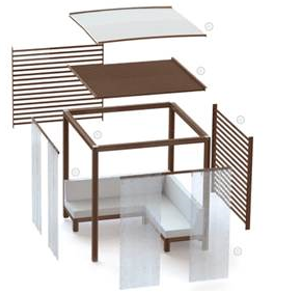
Outdoor living rooms have become an important apartment amenity and something you need to consider when attracting tenants.
Sponsored Blog

By Jeannie Flynn

Property owners are always looking for something new and exciting to offer their residents.

Pool areas play a huge role in the list of common-area amenities, which is why outdoor living rooms have become very popular.

Outdoor Living Rooms Have Become An Important AmenityOutdoor Living Rooms Have Become An Important Amenity

Outdoor Living Rooms Have Become An Important Amenity
Pre Wired outlets
Outdoor Living Rooms Have Become An Important Amenity
Built-in lights
Outdoor Living Rooms Have Become An Important Amenity
TV mounts

Outdoor Living Rooms Have Become An Important Amenity
Infrared Heaters and More!

The benefits of a “portable” product vs a building or permanent structure:

  • No building permit required
  • Easy to install
  • No down time at the pool
  • No construction mess.

When choosing a living space for your property, keep in mind there are many options out there.

Make sure the products you chose are designed for heavy commercial use and the outdoor elements.  Especially wind.

In general, any fabric should offer at least a 7- to 10-year warranty against fading or sun rot. Heavy aluminum frames normally offer a 5-year commercial warranty.  Aluminum will resist rusting and damaging pool decks.

About CMS Commercial Furniture

 CMS Commercial Furniture offers the finest selection in commercial rated outdoor furniture and accessories.  We are proud to announce our new cleaning service and repair division. Diversity and flexibility are what make CMS Commercial Furniture a leader in this industry.  We sell, service and maintain outdoor furniture.  For more information about designing the right Outdoor Living Space for your property please contact us at 480-892-3212 or visit our website at www.cmsfurniture.com


Slow Down Your Decision Making To Avoid Unconscious Bias

Slow Down Your Decision Making To Avoid Unconscious Bias

The Grace Hill training tip this week asks if you are too quick to judge sometimes and could that lead to unconscious bias in your housing decisions?

By Ellen Clark

Shortcuts can be based on social norms and stereotypes, which can lead us to form quick opinions that may not be accurate.

Unconscious bias is a phenomenon that affects almost everyone’s decision-making processes and is something we all have to some degree, although we may not be aware of it.

How does unconscious bias work?

Our past experiences affect the decisions we make, and we tend to create “mental shortcuts” to help us process new information.

Unfortunately, these shortcuts can be based on social norms and stereotypes, which can lead us to form a quick opinion about a situation or a person without really having enough information to form that opinion.

Unconscious biases can lead us to make incorrect assumptions based on flawed logic, stereotypes, and poor interpretations of data. These biases can be damaging in day-to-day interactions with others.

Fighting these biases requires first acknowledging that they exist and then employing purposeful strategies to overcome them. Here are some tips.

3 steps to avoid unconscious bias

  1. Perspective-taking: Putting yourself in another person’s shoes and focusing on how his or her experience in a situation may be different from your own may help you recognize biases you didn’t even know you had. When you can, before you make a decision, try to walk a mile in the other person’s shoes”or imagine the world from their vantage point.
  2. Creating processes: Because unconscious biases happen at lightning speed, overcoming them can be helped by slowing down our decision-making. For example, next time you are about to tell a joke or rib someone, ask yourself, “How would I feel if someone told a joke like that about me, or about something important to me, like my race, religion, or physical appearance?”
  3. Creating an inclusive environment: Think about new ways to engage, collaborate, and step out from your usual group at work. Share ideas or challenges with members of other teams—you may tap into expertise you didn’t realize was there. If you can, leave your desk and try working in a different area for a few hours. This change of perspective may lead you to interact with people you otherwise wouldn’t.
  4. Recognizing assumptions: Think of those teen movies where the shy guy doesn’t ask the girl out because he thinks she’ll say no. When he finally does, she says yes—and asks what took so long? Next time you find yourself making an assumption about someone, stop yourself. Ask the person the question so they can answer for themselves. Even if you confirm your assumption, you now have information that can help in future interactions.

Summary 

Stepping out from your usual group at work may provide a new perspective and lead you to interact with people you otherwise wouldn’t.

The topics of inclusion and diversity can seem overwhelming. But the more aware we are of our biases, and how important it is to look outside of our “group,” the more we can consciously challenge our decisions and help improve our work environment.
Remember, you are part of a larger team, and you can’t solve the inclusion problem all on your own. You do, however, play a part in minimizing the impact of biases and embracing the benefits of a diverse, and inclusive workforce.

Recent Grace Hill training tips you may have missed:

What Do You Do When Assistance Animals Break The Rules?

7 Ways To Stay Out Of Trouble When Checking Criminal History

5 Ways To Protect Applicants, Residents And Employees From Sexual Harassment

Do You Have A Smoke-Free Policy That Adequately Protects Residents?

How To Handle Suspicious Documentation For Assistance Animals

How A No Pet Policy Can Be Discriminatory

Property Management Cyber attack Risks Overlooked, Underestimated

Do You Know How To Respond To a Sexual Harassment Complaint?

Have You Reviewed Your Criminal Background Checks Policy Lately?

Multifamily Managers And Marijuana: Caught In A Pot Crossfire

Fair Housing Discrimination Against Someone You’ve Never Talked To?

4 Ways To Avoid Screening Pitfalls With Applicants

Red Flags In Evaluating Documentation For Assistance Animals

About the author:

Ellen Clark is the Director of Assessment at Grace Hill.  Her work has spanned the entire learner lifecycle, from elementary school through professional education. She spent more than 10 years working with K12 Inc.’s network of online charter schools – measuring learning, developing learning improvement plans using evidence-based strategies, and conducting learning studies. Later, at Kaplan Inc., she worked in the vocational education and job training divisions, improving online, blended and face-to-face training programs, and working directly with business leadership and trainers to improve learner outcomes and job performance. Ellen lives and works in Maryland, where she was born and raised.

About Grace Hill

For nearly two decades, Grace Hill has been developing best-in-class online training courseware and administration solely for the Property Management Industry, designed to help people, teams and companies improve performance and reduce risk. Contact Grace Hill at 866.472.2344 to hear more


Renters Typically Spend More For A Studio Apartment Than A One-Bedroom Rental

Renters Typically Spend More For A Studio Apartment Than A One-Bedroom Rental

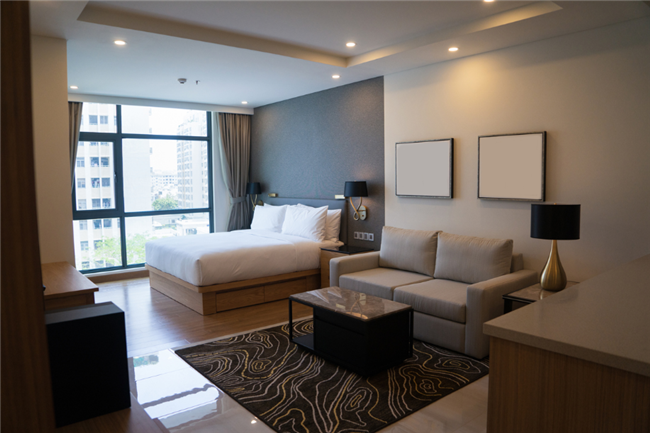
Renting a typical studio apartment costs more each month than renting a typical one-bedroom home or apartment, according to a new HotPads analysis in a release.

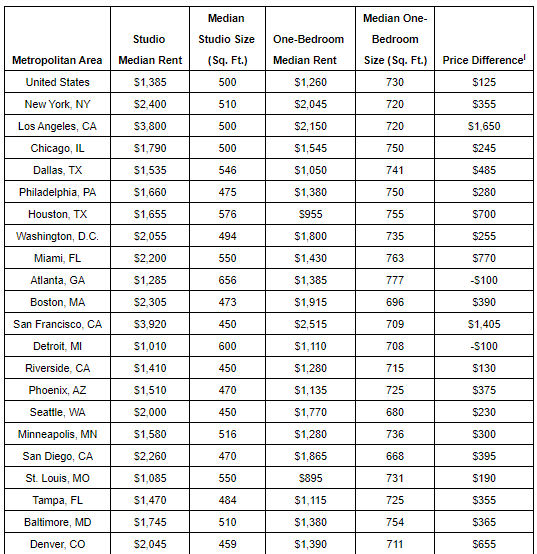
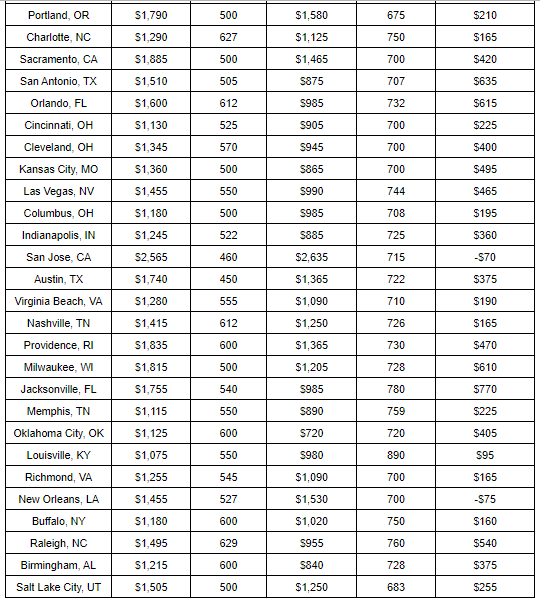
Across the United States, the median rent for a studio apartment is $1,385 per month. The median rent for a one-bedroom rental is $1,260 per month – about $125 per month less.

  • Los Angeles has the biggest price difference between studio and one-bedroom rentals – the median rent for a studio in Los Angeles is $3,800 per month, $1,650 more than the median rent for a one-bedroom unit.
  • In San Francisco, the median rent for a studio apartment is about $1,400 higher than for a one-bedroom.

Why this price difference for studio apartment?

“Many renters looking to strike out on their own assume they’ll get a rent discount if they sacrifice the privacy of a bedroom,” said Joshua Clark, economist at HotPads, in a press release.

“But when it comes down to it, location can be more important than floor plan or size when it comes to saving on rent. Renters determined to live in the heart of the city might still save by leasing a studio, but those looking for the best deal are likely better off searching for a slightly larger place farther from the middle of town,” Clark says.

One-bedrooms are typically 730 square feet, while studios are typically smaller, at 500 square feet. But the reason is location – in the metros analyzed, studios were typically a third of a mile closer to major job centers than one-bedroom rentals, and dense and desirable urban areas where studios are concentrated can yield higher rents.

One-bedroom units are more common overall, and locations range more broadly throughout a metro area and farther from a metro area’s core, where rents tend to be more affordable.

Renters Typically Spend More For A Studio Apartment Than A One-Bedroom Rental

In Detroit, Atlanta, New Orleans and San Jose, a one-bedroom rental is typically more expensive than a studio apartment. Atlanta and Detroit renters can expect to spend $100 more on a one-bedroom each month than they would on a studio, while renters in San Jose and New Orleans pay $70 to $75 more each month for a one-bedroom.

HotPads is a Zillow Group-owned apartment and home-search platform for renters in urban areas across the United States. For more information on the U.S. rental market, visit HotPads.com.

Oregon Senate Bill Aims To Set Rent Control Limits On Landlords

Oregon Rent Control Bill Moving Forward In The Senate

Oregon Governor Kate Brown has signaled her support for the bill. Brown believes those ideas “are innovative and will give renters some peace of mind,” said spokeswoman Kate Kondayen to Oregon Public Broadcasting.

Powerful house and senate leaders have lined up behind the bill, which looks to pass in this legislative session.

“Speaker Tina Kotek (D-Portland) and Senator Ginny Burdick (D-Portland) have innovative proposals that will give renters some peace of mind.  Oregon families are counting on us. They are counting on us so they don’t have to make a choice between paying the rent and staying home with their newborn,” the governor said.

House Speaker Kotek proposed in 2017 to eliminate no-cause evictions and lift the state’s 1985 ban on rent control, allowing cities to create their own rent-control policies. That effort failed in the Senate after passing in the House.

“We need to make progress here,” Kotek told OregonLive. “So, we needed to have a bill that could get support in the Senate.”

Portland Mayor Ted Wheeler has endorsed the concept of the bill but said he still has some questions about various aspects of the bill, including how it will affect affordable housing. On balance, however, he supports the Legislature pursuing it, although he said he will reserve final judgment until he sees the final version.

Oregon Senate Bill 608

  • Prohibits a landlord from terminating month-to-month tenancy without cause after 12 months of occupancy. Provides exception for certain tenancies on building or lot used by landlord as residence.
  • Allows a landlord to terminate tenancy with 90 days’ written notice and payment of one month’s rent under certain conditions. Exempts landlord managing four or fewer units from payment of one month’s rent.
  • Provides that fixed-term tenancy becomes month-to-month tenancy upon ending date if not renewed or terminated.
  • Allows landlord to not renew fixed-term tenancy if tenant receives three lease-violation warnings within 12 months during term and landlord gives 90 days’ notice.
  • Limits rent increases for residential tenancies to one per year.
  • Limits maximum annual rent increase to 7 percent above annual change in consumer price index.
  • Requires Oregon Department of Administrative Services to publish maximum annual rent increase percentage.
  • Declares emergency, effective on passage.

Read the Senate Bill here.

“Just-cause [evictions] and rent control need to go hand and hand for either to be effective,” Nicole B. Montojo, a housing research analyst at the University of California, Berkeley, told Willamette Week.

A landlord subject to rent control but not to restrictions on evictions could kick a tenant out for no reason and raise the rent, Montojo explains. “If you had a just-cause [bill] but no rent control, the landlord could just raise the rent and force someone out.”

Resources:

Everything You Need to Know About a Rent Control Bill That Oregon’s Power Brokers in Salem Have Lined Up Behind

Oregon lawmakers to hear bill on rent control, among others in legislative session

Oregon lawmakers propose unorthodox approach to rent control

Wheeler supports rent control, infill growth plan

Housing Leaders Warn of Shutdown’s Impact On Affordable Housing, Communities

Housing Leaders Warn of Shutdown’s Impact on Affordable Housing and Communities

Housing leaders are warning that the U.S. Department Of Housing and Urban Development (HUD) shutdown of most operations could be disastrous to Section 8 and other rental assistance programs, according to a release from the Council of Large Public Housing Authorities.

“Public housing authorities, which are responsible for housing over three million low-income households nationwide, are doing everything they can to keep things running during this period of tremendous uncertainty, but it is unclear how long they can continue with business as usual for residents and landlords,”  Council of Large Public Housing Authorities Executive Director Sunia Zaterman said in the release.

Shutdown unmitigated disaster for low-income families

“Without a guarantee from HUD that funding will be available in March, many PHAs will need to notify landlords and residents next month that delayed payments are a possibility. Anxious residents and landlords fearful of missed payments, combined with other cascading impacts due to lack of staffing at HUD, including program grants not being renewed and affordable housing development deals not being approved, amount to an unmitigated disaster for millions of low-income families,” Zaterman said.

Members of the Campaign for Housing and Community Development Funding (CHCDF) hosted a national call with over 2,200 registrants about the effects of the partial government shutdown on low-income people and communities and the affordable housing programs that serve them.

Experts from multiple affordable housing organizations shared information on the shutdown’s impact on federal affordable housing and community development programs and emphasized that the longer the shutdown continues, the more negatively it will impact people with the lowest incomes – seniors, people with disabilities, and families with children. Panelists spoke about the shutdown’s effects on public housing, project-based rental assistance, housing vouchers, rural housing, and housing and services for seniors, people with disabilities, the homeless, and those at risk of homelessness.

The panel encouraged listeners to contact their members of Congress and tell them to vote now—before residents in federally assisted housing experience rent hikes and evictions—to reopen the federal government and pass clean fiscal year 2019 spending bills.

700 property owners with HUD contracts and 70,000 renters at risk

“Nearly 700 property owners that have HUD contracts to operate housing affordable to the lowest-income seniors, people with disabilities, and families with children have seen those contracts expire due to the shutdown, and more will expire this month and next,” said National Low-Income Housing Coalition President and CEO Diane Yentel in the release.

“These contract suspensions put the homes of nearly 70,000 low-income renters at risk of serious rent hikes and evictions. HUD has asked owners of these properties to dip into their savings, if they have any, to cover the costs. Some will be able to do so, but not forever, and some have already communicated to their tenants that rent hikes are coming.

“The longer the shutdown goes on, the more untenable it will become for property owners to keep scraping by without their federal contracts – and the more the lowest-income renters will suffer,” she said.

HUD has not renewed 22 contracts for rental assistance

“HUD has made clear already, in December, [it has] not renewed 224 contracts for rental assistance in Section 202 Housing for the Elderly communities, and more are set to expire in January,” said LeadingAge President and CEO Katie Smith in the release. “LeadingAge’s members, all nonprofits, rely on regular and adequate funding to provide quality affordable housing to some of the nation’s lowest-income older adults.

“The average older adult in HUD’s Section 202 Housing for the Elderly program has an annual income of $13,300, an income far too little to make ends meet in any private housing market. More than 400,000 older adults rely on the Section 202 program, while another 1.2 million rely on other HUD programs for housing assistance. We urge Congress and the White House to end the shutdown so that . . . these 1.6 million older adults have the stable housing they need to age with dignity,” she said.

Private rental housing owners scrambling to cover costs

“Every day that it drags on, the needless government shutdown threatens more low-income seniors, people with disabilities, and seniors who rely on critically important federally assisted affordable housing,” said National Housing Trust Federal Policy Director Ellen Lurie Hoffman in the release.

“Private rental housing owners are scrambling to cover operating costs for which the federal government is contractually responsible, with no end in sight.”

Listen to the CHCDF national call on the impacts of the shutdown on affordable housing programs and community development at: https://bit.ly/2DersVM(link is external)   

Read NLIHC’s latest update on the shutdown at: https://bit.ly/2AzHoju(link is external)

Check out NLIHC’s interactive map(link is external) and a state-by-state breakdown(link is external) of how the shutdown is impacting some HUD-assisted housing.

About the Council of Large Public Housing Authorities (CLPHA): The Council of Large Public Housing Authorities is a national non-profit organization that works to preserve and improve public and affordable housing through advocacy, research, policy analysis and public education.


January 2019 Phoenix Metro Rent Report Shows Rents Continue Rising

January 2019 Phoenix Metro Rent Report Shows Rents Continue Rising

The Phoenix metro rent report for January shows rents continue to rise across the valley, with a couple of exceptions as Gilbert continues to lead with most expensive rents, according to Apartment List.

Phoenix rents increased slightly over the past month

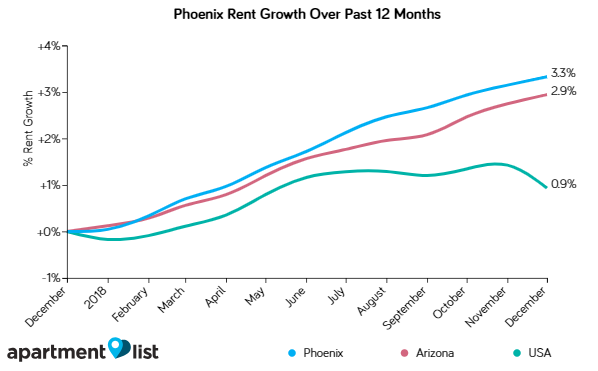
Phoenix rents have increased 0.2% over the past month, and are up moderately by 3.3% in comparison to the same time last year, according to Apartment List.

Currently, median rents in Phoenix stand at $850 for a one-bedroom apartment and $1,060 for a two-bedroom. The city’s rents have been increasing for 13 straight months – the last time rents declined was in November of last year.

Phoenix’s year-over-year rent growth leads the state average of 2.9%, as well as the national average of 0.9%.
Rents rising across the Phoenix Metro

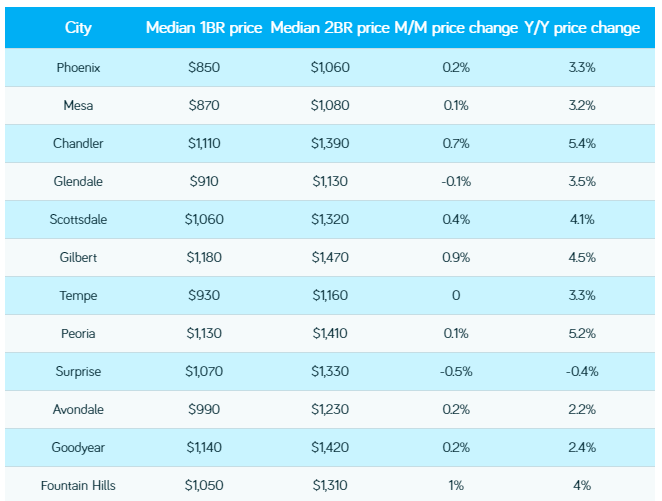
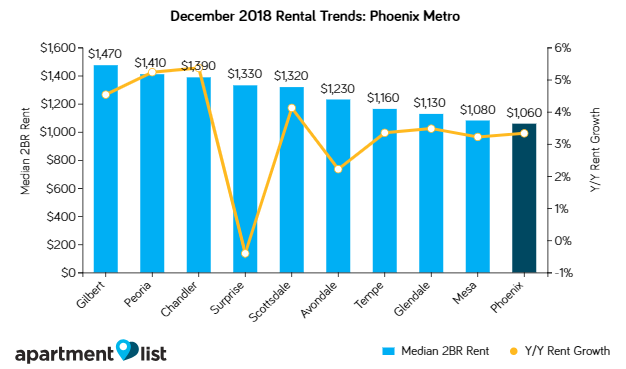
Throughout the past year, rent increases have been occurring not just in the city of Phoenix, but across the entire metro. Of the largest 10 cities that we have data for in the Phoenix metro, 9 of them have seen prices rise. Here’s a look at how rents compare across some of the largest cities in the metro.

  • Gilbert has the most expensive rents in the Phoenix metro, with a two-bedroom median of $1,470; the city has also seen rent growth of 0.9% over the past month, the fastest in the metro.
  • Over the past year, Surprise is the only city in the metro that has seen rents fall, with a decline of 0.4%. Median two-bedrooms there cost $1,330, while one-bedrooms go for $1,070.
  • Phoenix proper has the least expensive rents in the Phoenix metro, with a two-bedroom median of $1,060; rents grew 0.2% over the past month and 3.3% over the past year.

Gilbert rents increase sharply over the past month

Gilbert rents have increased 0.9% over the past month, and have increased significantly by 4.5% in comparison to the same time last year.

Currently, median rents in Gilbert stand at $1,180 for a one-bedroom apartment and $1,470 for a two-bedroom. This is the third straight month that the city has seen rent increases after a decline in September. Gilbert’s year-over-year rent growth leads the state average of 2.9%, as well as the national average of 0.9%.
January 2019 Phoenix Metro Rent Report Shows Rents Continue Rising

Scottsdale rents increased significantly over the past month

Scottsdale rents have increased 0.4% over the past month, and are up significantly by 4.1% in comparison to the same time last year.

Currently, median rents in Scottsdale stand at $1,060 for a one-bedroom apartment and $1,320 for a two-bedroom. The city’s rents have been increasing for 13 straight months – the last time rents declined was in November of last year. Scottsdale’s year-over-year rent growth leads the state average of 2.9%, as well as the national average of 0.9%.

Mesa rents increased over the past month

Mesa rents have increased 0.1% over the past month, and have increased moderately by 3.2% in comparison to the same time last year.

Currently, median rents in Mesa stand at $870 for a one-bedroom apartment and $1,080 for a two-bedroom. Mesa’s year-over-year rent growth leads the state average of 2.9%, as well as the national average of 0.9%.

Chandler rents increase sharply over the past month

Chandler rents have increased 0.7% over the past month, and have increased significantly by 5.4% in comparison to the same time last year.

Currently, median rents in Chandler stand at $1,110 for a one-bedroom apartment and $1,390 for a two-bedroom. This is the tenth straight month that the city has seen rent increases after a decline in February. Chandler’s year-over-year rent growth leads the state average of 2.9%, as well as the national average of 0.9%.

Tempe rent trends were flat over the past month

Tempe rents have remained flat over the past month, however, they have increased moderately by 3.3% year-over-year.

Currently, median rents in Tempe stand at $930 for a one-bedroom apartment and $1,160 for a two-bedroom. Tempe’s year-over-year rent growth leads the state average of 2.9%, as well as the national average of 0.9%.

January 2019 Phoenix Metro Rent Report Shows Rents Continue Rising

Glendale rents declined over the past month

Glendale rents have declined 0.1% over the past month, but are up moderately by 3.5% in comparison to the same time last year.

Currently, median rents in Glendale stand at $910 for a one-bedroom apartment and $1,130 for a two-bedroom. Glendale’s year-over-year rent growth leads the state average of 2.9%, as well as the national average of 0.9%.

Peoria rent trends were flat over the past month

Peoria rents have increased 0.1% over the past month, and have increased significantly by 5.2% in comparison to the same time last year.

Currently, median rents in Peoria stand at $1,130 for a one-bedroom apartment and $1,410 for a two-bedroom. Peoria’s year-over-year rent growth leads the state average of 2.9%, as well as the national average of 0.9%.

Tucson rents increased over the past month

Tucson rents have increased 0.1% over the past month, and are up slightly by 1.2% in comparison to the same time last year. Currently, median rents in Tucson stand at $700 for a one-bedroom apartment and $930 for a two-bedroom. Tucson’s year-over-year rent growth lags the state average of 2.9%, but exceeds the national average of 0.9%.

Phoenix rents more affordable than many comparable cities nationwide
January 2019 Phoenix Metro Rent Report Shows Rents Continue Rising

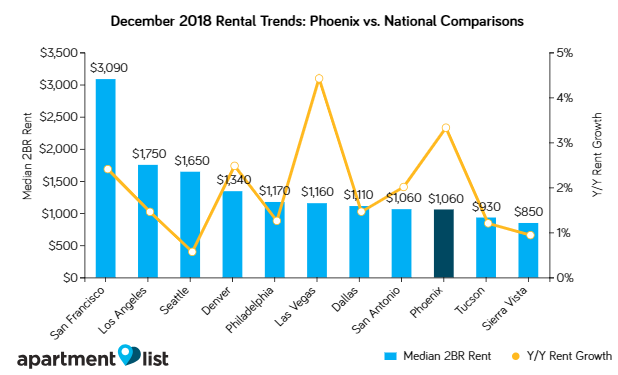
As rents have increased moderately in Phoenix, a few other large cities nationwide have also seen rents grow modestly. Phoenix is still more affordable than most similar cities across the country.

  • Rents increased slightly in other cities across the state, with Arizona as a whole logging rent growth of 2.9% over the past year. For example, rents have grown by 1.2% in Tucson.
  • Phoenix’s median two-bedroom rent of $1,060 is below the national average of $1,180. Nationwide, rents have grown by 0.9% over the past year compared to the 3.3% rise in Phoenix.
  • While Phoenix’s rents rose moderately over the past year, many cities nationwide also saw increases, including Las Vegas (+4.4%), Denver (+2.5%), and San Francisco (+2.4%).
  • Renters will find more reasonable prices in Phoenix than most comparable cities. For example, San Francisco has a median 2BR rent of $3,090, which is nearly three times the price in Phoenix.

Methodology:

Apartment List is committed to making our rent estimates the best and most accurate available. To do this, we start with reliable median rent statistics from the Census Bureau, then extrapolate them forward to the current month using a growth rate calculated from our listing data. In doing so, we use a same-unit analysis similar to Case-Shiller’s approach, comparing only units that are available across both time periods to provide an accurate picture of rent growth in cities across the country.

 

To Hub or Not To Hub? What You Should Know

To Hub or Not To Hub? What You Should Know

Sponsored blog

Sean Miller
President, PointCentral

I Started Out Against Hubs

They just seemed like an unnecessary cost and complication as part of home automation setup.

But, just as broadband internet needed WiFi routers to help permeate internet access through our households, so, too, do I now see hubs as a critical component to delivering IoT’s (internet of things) potential in the home.

Why are hubs critical to take full advantage of a smart home?

Let me start by explaining what a hub is. A hub is a device that facilitates communication between individual devices by serving as a common connection point for devices in a network. Hubs we most often use in our everyday life are WiFi routers, cell phones (just think of how many wearables, headphones and accessories communicate back and forth between our mobile devices), and cellular communication towers.

Great. There are already hubs around us. So, then, why do we need to use yet another hub for home automation? The short answer is that as home automation continues to be a bigger part of our everyday lives, we want those devices to use a communication method that fits the unique need of the devices and technology running home automation systems.

Why Do We Need Another Hub in Our Lives?

WiFi routers are the first thought many turn to as an option for a home automation hub because they are already in the vast majority of homes and thus carry upfront cost savings.

However, WiFi routers carry significant direct and indirect costs for home automation systems.

From a direct cost standpoint, once you start adding more than a couple WiFi-based devices, many routers have performance issues. The cost of buying a new router that can handle all of the home automation devices, plus the connected TVs, video game systems, tablets, computers, cell phones, and other connected devices that are now part of our everyday lives typically far outweigh the cost of a dedicated home automation hub.

From an indirect standpoint, WiFi is designed for delivering large amounts of data rather quickly, but it’s not always the most reliable (Cisco estimates that 43 percent of U.S. households have experienced an internet outage at least once a month) or secure (all it takes is a quick Google search to see the dangers of whatever is the most recent WiFi hack) communication method.

This is fine for data streams where the occasional data packet drop is inconsequential (pixelating Netflix, for example, doesn’t bug us much), but when home access or occupancy based HVAC control is reliant on the chosen communication method, you don’t want to have a communication breakdown.

There are a few hubs that use protocols designed for other applications, like Bluetooth, or proprietary frequencies, like Insteon or Lutron. These options have some benefits, but there are always concerns about the cost, long-term viability, and interoperability of proprietary technologies. Security can also be a concern when using technologies for purposes outside of their original design intent (for example, recently revealed Bluetooth vulnerabilities).

Home automation-specific hubs, such as PointCentral’s, are designed to use modern home automation-specific communication protocols, like Zwave or ZigBee.

These communication technologies allow hubs to balance security (Zwave uses the same 256-bit encryption as major banks) with performance (home automation protocols utilize mesh technology to bounce messages off the nearest device and daisy chain communication back to a hub versus having to have enough power to communicate directly back to the hub through dead spots and interference).

Factors to Consider When Buying a Hub

At one level, choosing a hub is about the method that different devices use to communicate to one another and to the internet.

But choosing a hub is also about the communication enhancements (i.e. apps, dashboards, and voice assistants that help facilitate interaction with the devices in the home) and the home automation provider.

At the end of the day, the hub is the embodiment of the greater home automation platform that is being purchased. A good platform has a lot going on but should still be easy to use and designed to leverage economies of scale to deliver a better experience than one individual or enterprise could deliver on its own.

Consider the following factors when choosing a home automation platform:

  1. Cost: Not just the upfront costs, but the recurring fees as well. While you may think you can find a solution that doesn’t require recurring fees, ask yourself how the vendor will provide updates without a revenue stream to fund software/app updates along with system enhancements and continual security improvements.
  2. Security: Nothing is completely hack-proof, but some options provide more robust hardware and software security than others. How does the hub you are considering keep communications secure within the network (between devices and the hub, and between apps and the hub/devices)? What about from the hub to the cloud? How is the cloud designed and tested for data security?
  3. Management Dashboards and End User App Experience: Different users require different things. If you are deploying home automation in a B2B or B2B2C scenario — like PointCentral’s for short- and long-term property managers and their tenants — does the system offer a dashboard tailored to business needs or is it simply a DIY hub designed for an individual homeowner? Also, for business applications, does the home automation system integrate with other systems — like property management systems — to help simplify work for staff? From an end user (or B2C), standpoint what apps and integrations are available to allow users to interact with all their devices and services via their computer, phone, tablet, wearable, and voice?
  4. Reliability: Will the vendor be here a year from now to continue providing updates and support? Do they have customer references (for business applications) or positive, unbiased customer reviews (for consumer hubs)?
  5. Installation: Does your potential home automation vendor provide adequate hardware and system training? Do they offer certified national installation partners in case you want to supplement or replace internal resources?
  6. Analytics: How is the system helping turn the data from the hardware devices into intelligence that helps improve operations? Does it have the scale to accurately test and refine algorithms to deliver accurate information? Do they have a policy to ensure customer data will not be sold without consent?

Summary

Market experts predict strong growth for hubs and the IoT. Gartner projects 20.4 billion connected devices will be in use by 2020, up from 8.4 billion in 2017.

NPD recently reported that there was a 50% increase in home automation adoption by U.S.  households between 2016 and 2017, jumping up to 15% of US households.

In the midst of all this growth, one thing will be certain — home automation (and the technologies that power it) will continue to evolve. In order to maximize your investment, make sure you choose a hub and a home automation provider that will be a long-term partner and not a short-term vendor.

Download the full PointCentral PDF On Hubs Here

Hubs

About PointCentral

PointCentral, headquartered in Portland, Oregon, and a subsidiary of Alarm.com, designs, manufactures and markets enterprise-grade Smart Home solutions for the vacation rental, residential, and multi-family property management markets. PointCentral solutions provide customers in these markets with the ability to monitor and control smart home technology across all properties in their inventory over a best-in-class secure and reliable network – reducing risk, improving security, controlling assets, reducing energy costs and improving guest/tenant satisfaction.

Efficient HVAC Systems For Multifamily Homes

Efficient HVAC Systems For Multifamily Homes

Which type of HVAC system is best for your rental property is the rental property maintenance checkup this week provided by Keepe.

The type of heating, ventilation and air-conditioning (HVAC) system that you install in your multifamily property is an important decision that will have long-term implications.

There are several options, depending on factors such as the size of the property and your energy-efficiency needs. Also do your tenants respond better to a centralized system? Or a decentralized system that gives them individual-unit control?

Consider the following centralized and decentralized HVAC systems that offer both heating and cooling as you update or begin your HVAC development.

Centralized vs. Decentralized HVAC Units

Both centralized and decentralized HVAC systems provide key elements that aid multifamily property management. HVAC systems are often easy to maintain, give tenants in-unit control that maximizes comfort, and allow for flexibility when handling peak demand.

Centralized HVAC Systems

 Centralized HVAC systems are supported from a central location such as a mechanical room in the basement of the building. Centralized systems tend to run more efficiently than decentralized HVAC systems. On the other hand, installation costs run higher, which make this ideal for a larger property that would be considered mid-rise or high-rise.

Efficient HVAC Systems For Multifamily Homes
Centralized HVAC systems installation costs run higher, which make this ideal for a larger property that would be considered mid-rise or high-rise.

Most common types of centralized HVAC systems:

  1. Four-pipe systems: This system includes four insulated pipes, two supply and two return lines. One is set to chilled water while the other is dedicated to hot. The pipes run to air handlers, which use the needed water to change the air temperature. The air handlers can be kept in mechanical rooms or in spaces above the ceiling. These systems are expensive to install, but run efficiently.
  2. Geothermal systems: Geothermal systems are one of the most efficient types of HVAC systems. This rental heating-and-cooling system transfers heat from the ground. The system relies on heat transfers between the air and the ground to provide heating and cooling to units. Geothermal heat pumps are considered a form of high-efficiency heat pump. Although the upfront costs are high, geothermal HVAC systems can cut utility bills by 30 to 70 percent.

Decentralized HVAC Systems

 Decentralized HVAC systems are compartmentalized, meaning that each unit in the building receives separate heating and cooling. Decentralized systems are more cost-effective to install, but most lack maximum efficiency.

efficient HVAC systems
Decentralized HVAC systems are easier and less expensive to install and convenient for properties with a smaller unit capacity.

Most common types of decentralized HVAC systems:

  1. Packaged thermal air conditioner: This HVAC option is a self-contained heating-and-air-conditioning system. PTCAs are designed to go through a wall, having vents and heat sinks both inside and outside the building, requiring comprehensive installation. This forced-air system unit tends to have a shorter life cycle, and is not very efficient when compared to alternatives.
  2. Self-contained systems: These systems are forced-air systems that deliver heating and cooling to individual units. These packaged systems are installed in each unit, allowing easy access in cases where HVAC services are required. In addition to being energy-efficient, these systems are easier and less expensive to install and convenient for properties with a smaller unit capacity.

In addition to a high-effect HVAC system, other factors in your property —  such as sealing heating and cooling ductwork —  can instantly optimize a system.

Smart control sensors are also a great high-tech tool to monitor HVAC performance and maintenance needs that could help you optimize your HVAC performance.

Other recent rental property maintenance Keepe posts you may have missed:

4 Outdoor Flooring Options For Your Rentals

20 Easy, Affordable Maintenance Projects To Update Your Rentals

7 Tech Gadgets For A Safer And More Efficient Rental Property

5 Maintenance Tips For Long-Lasting Rental Carpet Flooring

Is The Water Heater At Your Rental Property Ready For The Big One?

7 Types Of Kitchen Countertops For Your Apartments

Which Cooktop Is Best For Your Rental Property?

A Guide To 4 Types Of Flat Roof Systems

6 Ways To Trash Your Apartment Waste Management Issues

About Keepe:

Keepe is an on-demand maintenance solution for property managers and independent landlords. The company makes a network of hundreds of independent contractors and handymen available for maintenance projects at rental properties. Keepe is available in the Greater Seattle area, Greater Phoenix area, San Francisco Bay area, Portland, San Diego and is coming soon to an area near you. Learn more about Keepe at https://www.keepe.com


Young Adults And Retirees Continue To Choose To Live In Apartments

Young Adults And Retirees Continue To Choose To Live In Apartments

A new report analyzing the market shows that the multifamily market cycle is continuing strong as young adults and retirees choose to live in apartments.

The strong job growth plus the choice to live in apartments, Yardi Matrix says in U.S. Multifamily Outlook for Winter 2019, means “2019 should be another good year for the multifamily industry,” despite the fading impact of the 2017 tax reform and potential trade disruptions.

Rent growth trends show young adults and retirees like to live in apartments

“Fresh off another year marked by steady improvement, the rental sector looks to extend what is already a prolonged market cycle,” the report says.

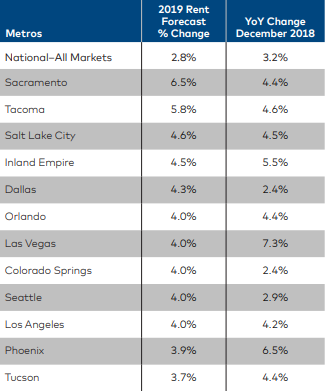
“With year-over-year growth crossing the 3.0% mark nationally in 2018—slightly above initial expectations—the multifamily sector showed that it still has some legs going into 2019. We expect rents to continue to rise in 2019, at a rate of 2.8%, marking another year of consistent improvement.

Young Adults And Retirees Continue To Choose To Live In Apartments
Information provided by Yardi Matrix. Contact them for more in depth information.

“The market is underpinned by strong demand based on household formation that tops one million annually and positive employment growth. The number of young adult households is continuing to rise, families are remaining renters longer than they did in the past, and some retirees that sell homes with expensive property tax burdens are turning into renters,” the report says.

Supply of new apartments

“Development activity will remain strong in 2019. We expect deliveries to come in at about 300,000 units this year, 2.2% of total current stock and largely in line with 2018 totals,” the report says.

“This will mark the fourth year in a row of completions in the 300,000-units range, which is entirely appropriate given the strong demand that we expect to continue for another few years

Multifamily takes a larger share of total housing construction

“Another factor boosting multifamily development is that it is taking up a larger share of total housing construction,” the report says.

“Single-family construction is lagging, in part because rising costs make it difficult for developers to build at entry-level price points, which are in more demand than large suburban homes.

“With a wider availability of rentals and fewer costs attached to renting, that dynamic is likely to continue. Millennials, which now represent the largest population cohort in the labor force, are starting to buy their first homes, but affordability is a problem due to student loans and rising mortgage rates. Their propensity for technology- and entertainment-driven markets is effectively pricing some of them out of home buying,” the report says.

About Yardi

The data presented in this outlook is provided by Yardi Matrix, the data and information service for real estate professionals. Email or call them at 480.663.1149 to learn more and schedule a demo of the industry’s most comprehensive market intelligence service.