
Home Blog Page 173

How To Handle Suspicious Documentation For Assistance Animals

The Grace Hill training tip of the week focuses on the documentation for assistance animals, service animals, and emotional support animals.

By Ellen Clark

If you suspect that documentation for assistance animals is suspicious, you may ask for more information.

Recently, you may have noticed documentation coming from websites that offer assistance animal “certifications” for a fee, but they appear to provide this documentation without firsthand knowledge of a person’s disability or what assistance or support the animal provides.

Some housing providers don’t raise questions about suspicious documentation because they fear being accused of discrimination.

It is important to know that it is ok to question suspicious documentation and ask for more information.

However, you must be very careful about the questions you ask, the statements you make, and the additional documentation that you request. Your words could be used as evidence of disability discrimination. It is advised that you involve legal counsel when following up on suspicious documentation for assistance animals.

In fact, the Virginia Department of Professional and Occupational Regulation (DPOR) Fair Housing Board recently issued informative guidance on this very topic. It is worth a read, even if you don’t have properties in Virginia.

What the Virginia fair housing board says is, “A person with a disability, or a person associated with such person, may submit a request for a reasonable accommodation to maintain an assistance animal in a dwelling. Subject to subsection B, the person receiving the request may ask the requester to provide reliable documentation of the disability and the disability-related need for an assistance animal, including documentation from any person with whom the person with a disability has or has had a therapeutic relationship.”

If documentation seems suspicious, it might be helpful to do a quick web search on the organization or individual that issued it.

Documentation for assistance animals potential red flags

Here are some things that might be red flags.

  • The site offers “official” certifications, registrations or IDs for service or assistance animals. Currently, there are no legally recognized organizations for registering service or assistance animals. Sites that claim to be certifying bodies or that offer official registrations are misleading because there is no such thing.
    • e site offers a “training certificate” as proof that the animal is an assistance animal. 
        • Under the FHA, there is no requirement that assistance animals be trained.  Documentation for assistance animals only needs to establish that the person has a disability and that the animal provides disability-related assistance or emotional support. An animal’s training is not relevant when evaluating a reasonable accommodations request.


      The site issues documentation without interacting with the person making the request.

        •  HUD states that you are entitled to documentation from a reliable third party that is in a position to know about the individual’s disability.  If the organization or person who issued the documentation has never talked to or met with the person requesting the accommodation, it is reasonable to ask for supplemental information.


Do not immediately deny the accommodation request

No matter what the source for the documentation of assistance animals, if you are suspicious, do not immediately deny the accommodation request. Instead, start a conversation with the resident to gather more information.

Evaluating a reasonable accommodation request should be an individualized process with an ongoing dialog between you and the resident.

Often people file discrimination claims because they don’t feel heard, don’t understand the process, or aren’t kept in the loop.

Don’t underestimate the importance of good communication.

Read Ellen’s full blog post here.

Recent training tips you may have missed:

How A No Pet Policy Can Be Discriminatory

About the author:


How To Handle Suspicious Documentation For Assistance Animals


Ellen Clark is the Director of Assessment at Grace Hill.  Her work has spanned the entire learner lifecycle, from elementary school through professional education. She spent over 10 years working with K12 Inc.’s network of online charter schools – measuring learning, developing learning improvement plans using evidence-based strategies, and conducting learning studies. Later, at Kaplan Inc., she worked in the vocational education and job training divisions, improving online, blended and face-to-face training programs, and working directly with business leadership and trainers to improve learner outcomes and job performance. Ellen lives and works in Maryland, where she was born and raised.

About Grace Hill

For nearly two decades, Grace Hill has been developing best-in-class online training courseware and administration solely for the Property Management Industry, designed to help people, teams and companies improve performance and reduce risk.

How To Handle Suspicious Documentation For Assistance Animals

Photo credit shironosov via istockphoto.com
 

Seattle Rents Increase for Third Month in A Row

Seattle Rents Increase for Third Month in A Row

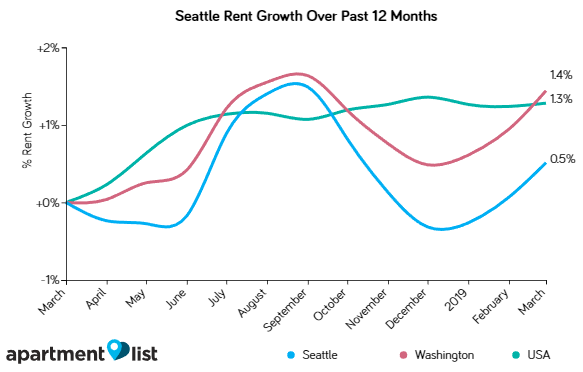
Seattle rents have increased 0.4% over the past month, and are up marginally by 0.5% in comparison to the same time last year, according to the latest report from Apartment List.

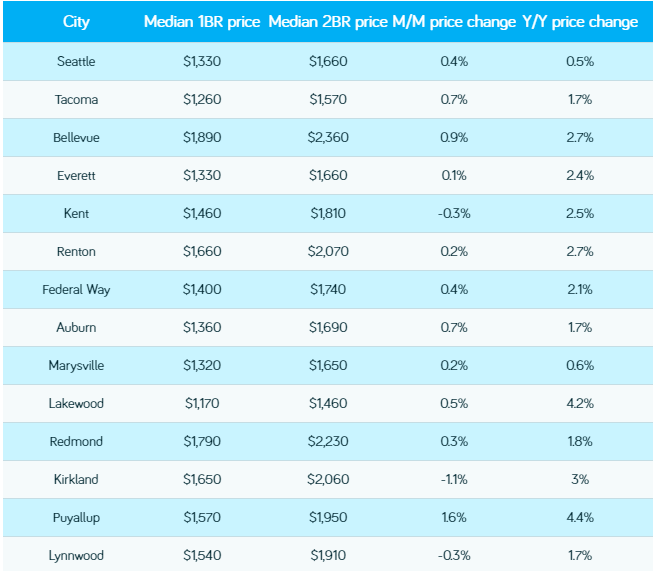
Currently, median rents in Seattle stand at $1,330 for a one-bedroom apartment and $1,660 for a two-bedroom.

This is the third straight month that the city has seen rent increases after a decline in December of last year. Seattle’s year-over-year rent growth lags the state average of 1.4%, as well as the national average of 1.3%.

Throughout the past year, rent increases have been occurring not just in the city of Seattle, but across the entire metro.

Of the largest 10 cities that Apartment List has data for in the Seattle metro, all of them have seen prices rise.

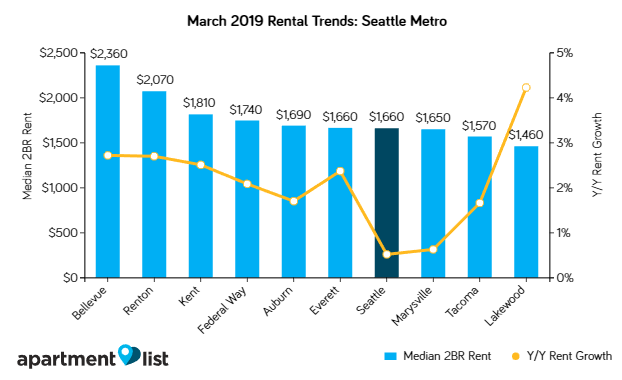
Here’s a look at how rents compare across some of the largest cities in the Seattle metro

  • Lakewood has the least expensive rents in the Seattle metro, with a two-bedroom median of $1,460; the city has also experienced the fastest rent growth in the metro, with a year-over-year increase of 4.2%.
  • Over the past month, Kent is the only city in the metro that has seen rents fall, with a decline of 0.3%. Median two-bedrooms there cost $1,810, while one-bedrooms go for $1,460.

Seattle Rents Increase for Third Month in A Row

Bellevue rent growth leads the state

Bellevue rents have increased 0.9% over the past month, and are up moderately by 2.7% in comparison to the same time last year.

Currently, median rents in Bellevue stand at $1,890 for a one-bedroom apartment and $2,360 for a two-bedroom. This is the third straight month that the city has seen rent increases after a decline in December of last year.

Bellevue’s year-over-year rent growth leads the state average of 1.4%, as well as the national average of 1.3%.

Seattle Rents Increase for Third Month in A Row

Seattle less affordable than other cities

As rents have increased marginally in Seattle, a few other large cities nationwide have also seen rents grow modestly.

Seattle Rents Increase for Third Month in A Row

Compared to most similar cities across the country, Seattle is less affordable for renters.

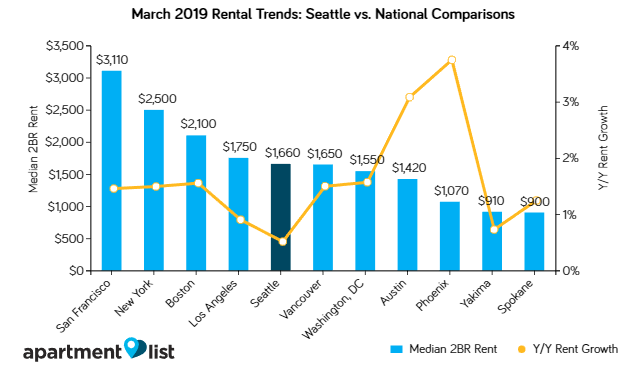
  • Rents increased slightly in other cities across the state, with Washington as a whole logging rent growth of 1.4% over the past year. For example, rents have grown by 1.5% in Vancouver and 1.2% in Spokane.
  • Seattle’s median two-bedroom rent of $1,660 is above the national average of $1,170. Nationwide, rents have grown by 1.3% over the past year compared to the 0.5% rise in Seattle.
  • While Seattle’s rents rose marginally over the past year, many cities nationwide also saw increases, including Phoenix (+3.7%), Austin (+3.1%), and Denver (+2.0%).
  • Renters will generally find more expensive prices in Seattle than in most other large cities. For example, Spokane has a median 2BR rent of $900, where Seattle is more than one-and-a-half times that price.

Methodology

Data from private listing sites, including our own, tends to skew towards luxury apartments, introducing sample bias. In order to address these limitations and provide the most accurate rent estimates available, we now start with reliable median rent statistics from the Census Bureau, then extrapolate forward based on our own rental listing data, using a same-unit analysis similar to Case-Shiller’s approach, which compares only units that are available across both time periods to provide an accurate picture of rent growth in cities across the country.

Apartment List

Apartment List is a growing online apartment rental marketplace on a mission to make finding a home an easy and delightful process.


4 Things To Do To Avoid Discrimination Against Families With Children

HUD Charges Colorado Landlords with Discriminating Against Families with Children

Families with children are protected by Fair Housing Laws so the Grace Hill training tip this week focuses on ways to avoid discrimination against families with children to help landlords and property managers better understand the issue.

By Ellen Clark

You must train employees to avoid making comments that express a preference against residents with children.

Earlier this year, the California Department of Fair Employment and Housing (DFEH) settled a familial status housing discrimination case in a which family of four alleged that a property management company refused to allow them to rent an apartment in a multi-unit community because the property manager did not consider children to be appropriate residents for the community.

The property manager allegedly made statements that the unit might be overcrowded, that neighbors might not be happy with the noise, and that the building was for “business people.”

DFEH found cause to believe a violation of the Fair Employment and Housing Act had occurred and, after an unsuccessful mediation, filed suit in Alameda County Superior Court. The case settled before trial, with the defendant agreeing to pay $12,500 to the family and $3,500 to the DFEH for fees and costs incurred in litigating the case.

4 things to consider to ensure that you don’t find yourself in violation of the Fair Housing Act

Here are some tips.

  1. Think carefully about the questions you ask prospective residents.It is ok to ask about the number of people who will live in the apartment home, but avoid questions specifically relating to children. For example, don’t say, “How many adults and children will be residing in your apartment home?” Instead say, “How many people will be residing in your apartment home?”

Every interaction is an opportunity to follow fair housing laws by providing and obtaining only the necessary information.

  1. Be careful when talking about facilities or services.Don’t post a sign that says, “Children may not skateboard on community property.” Instead say, “Skateboarding is prohibited on community property.” It is appropriate, however, to require direct adult supervision when children use community services and facilities.

However, the rules must not unreasonably restrict a child from using the amenities. So, don’t say, “Children under the age of 14 are prohibited.”  Instead say, “Persons under the age of 14 must be accompanied by an adult.”

  1. Consider your advertising language carefully.It is illegal to create, publish or distribute housing ads that discriminate, limit, or deny equal access to housing because of membership in any of the federally protected classes. When describing housing in an advertisement, do not include any limitations based on familial status, such as “no children allowed,” “couples preferred,” or “singles-friendly.”
  2. Don’t make assumptions. Do not make assumptions about what an individual may or may not be interested in viewing on your property. Offer options and solutions, but let the prospect make the final decision. Letting prospects make the decisions avoids the illegal practice of “steering.”For example, if you’re touring a mother of young children and only tell her about first-floor apartments because you assume she wants to avoid the stairs, this could be construed as steering.

Ensure that your company’s policies and training emphasize the importance of equal treatment for families with children.

And again, train your employees to avoid making comments that express a preference against residents with children.

This includes comments that express a preference for residents without children, like the stated preference for “business people” in the case above.

Read Ellen’s blog post here.

Recent Grace Hill training tips you may have missed:

Did You Know Hoarding Is A Disability Protected By Fair Housing?

What Do You Do When Assistance Animals Break The Rules?

7 Ways To Stay Out Of Trouble When Checking Criminal History

5 Ways To Protect Applicants, Residents And Employees From Sexual Harassment

Do You Have A Smoke-Free Policy That Adequately Protects Residents?

How To Handle Suspicious Documentation For Assistance Animals

How A No Pet Policy Can Be Discriminatory

Property Management Cyber attack Risks Overlooked, Underestimated

Do You Know How To Respond To a Sexual Harassment Complaint?

Have You Reviewed Your Criminal Background Checks Policy Lately?

Multifamily Managers And Marijuana: Caught In A Pot Crossfire

Fair Housing Discrimination Against Someone You’ve Never Talked To?

4 Ways To Avoid Screening Pitfalls With Applicants

Red Flags In Evaluating Documentation For Assistance Animals

About the author:

Ellen Clark is the Director of Assessment at Grace Hill. Her work has spanned the entire learner lifecycle, from elementary school through professional education. She spent more than 10 years working with K12 Inc.’s network of online charter schools – measuring learning, developing learning improvement plans using evidence-based strategies, and conducting learning studies. Later, at Kaplan Inc., she worked in the vocational education and job-training divisions, improving online, blended and face-to-face training programs, and working directly with business leadership and trainers to improve learner outcomes and job performance. Ellen lives and works in Maryland, where she was born and raised.

About Grace Hill

For nearly two decades, Grace Hill has been developing best-in-class online training courseware and administration solely for the Property Management Industry, designed to help people, teams and companies improve performance and reduce risk. Contact Grace Hill at 866.472.2344 to hear more.


Landlords Tell Portland City Council Proposed New Tenant-Screening Ordinance Unnecessary

Landlords Tell Portland City Council New Tenant-Screening Ordinance Unnecessary

Most landlords testifying before the Portland City Council on the proposed new city regulations on tenant screening and deposits were opposed to the new rules for various reasons.

Several landlords said the city would be taking away landlords’ ability to protect their investments when they cannot properly screen tenants, with one landlord saying, “It is too risky to put them in my $100,000 unit. I am not going to risk renting to someone without a government-issued ID.”

Landlords also said existing laws already cover the issues and the ordinance is not needed.

The strongest business case was stated by Clyde Holland, CEO and chairman of the Holland Partner Group which manages 56 apartment communities and more than 17,000 units in Oregon, Washington, California, Arizona and Colorado, who said he has “grave concerns” about the ordinance.

Holland, pictured above, said the U.S. Department of Housing and Urban Development (HUD), Fannie Mae and Freddie Mac, all of which are involved in the underwriting of loans for apartment construction, have requirements for tenant screening that borrowers such as apartment developers must follow, and the proposed Portland ordinance would be in conflict with those federal screening requirements.

He said those agencies “require we screen” for certain levels of tenant income in order to “be in compliance with financing” or a developer “could be held in default on their mortgages.”

“We are required to screen three-times income in order to attract institutional equity” to develop apartment projects, Holland said.

Proposed tenant-screening ordinance will increase rental rates

The cost of landlords’ compliance with the proposed regulations is something the city must consider, Holland said.

“In order to look at the compliance aspects of the very confusing pages here, our estimate is it will take one person per hundred units to be able to deal with the challenges,” Holland said. He estimated it will cost $65 per unit per month to comply with all the requirements of the proposed ordinance, or about $125 million a year in Portland.

He said the proposed ordinance, if enacted, will end up raising rental rates for renters in Portland. He said the city is not considering the cost to landlords of having to comply with the requirements of the ordinance, and that these costs will be passed along to tenants.

All the rules in Portland, including inclusionary zoning, tenant relocation requirements, registration and the proposed tenant screening have substantially “lowered the ability for us to access debt and equity. It has cost the city of Portland about $5 billion of investment in housing.”

He said 20 percent of his company’s units are set aside for affordable housing.

Holland closed his testimony by suggesting the city submit the ordinance for economic analysis before continuing to press for its passage.

Proponents of the Portland tenant-screening ordinance say it is designed to fight discrimination

Proponents for the ordinance say the lack of standardized tenant screening creates discrimination.

“Discrimination in housing is alive and well in our state and in our city,” said City Commissioner Chloe Eudaly, who proposed the ordinance. “This package, if passed, will significantly decrease incidents of housing discrimination, whether by default or design.”

Coya Crespin, Portland Metro Regional Organizer for the Community Alliance of Tenants, told the council the “wild-West style” of tenant screening is used by landlords to discriminate. “Landlords are using scare tactics to get tenants to testify against this ordinance.” She said the screening system is shutting out low-income tenants and tenants of color.

Ordinance introduces too much complexity in the process

Dan Hayes, who told the council he has 26 rental properties in Portland, said “All landlords want our units filled. We screen to give tenants the best chance of success.”

He said Portland used to provide a one-day landlord-training class. But not this year. He suggested the council take more time and simplify the proposal and “listen to more solutions from people in the industry,” then implement policy.

“If you continue to introduce complexity without providing policy, Portland will become the most expensive city to live in,” Hayes said.

Landlords Tell Portland City Council New Tenant-Screening Ordinance Unnecessary
Landlord Dan Hayes said , “All landlords want our units filled. We screen to give tenants the best chance of success.”

60 percent of Portland landlords are small investors and work with tenants

Sue Scott, a landlord, said 60 percent of landlords are small investors and that big companies have caused some of the problems.

“Rental providers have not been listened to by the city. The city has chosen to railroad this through their own agendas,” she said.

Small landlords depend on good relations with their tenants, know their tenants and work with their tenants on issues.

Landlords Tell Portland City Council New Tenant-Screening Ordinance Unnecessary
Small landlords depend on good relations with their tenants, know their tenants and work with their tenants on issues Sue Scott told the council.

“If you want more big rental companies in Portland who never bend a rule for a tenant – carry on,” Scott told the council hearing.

Another landlord, Kathy Rogers, echoed that sentiment, saying she has a regular full-time job and manages her rentals as well.

“When a tenant cannot pay rent, we rarely evict them. We allow them to move out and break the lease and we take the hit and help them find affordable housing.

“We lose rent for a month or more,” she said, noting that many owner-managers like herself do the same.

“I provide affordable housing for $850 a month. If a tenant has income twice the rent but has good credit I would rent to them,” she said.

“We are not evil landlords,” Rogers said.

Landlords Tell Portland City Council New Tenant-Screening Ordinance Unnecessary
Kathy Rogers said, “I provide affordable housing for $850 a month. If a tenant has income twice the rent but has good credit I would rent to them.”

Proposed ordinance could force more small landlords to sell

Some landlords think the city’s efforts are actually taking steps in the wrong direction, and say the new rules may force some smaller landlords out of business.

“There are a lot of property owners and landlords who are choosing to sell their properties in Portland, and move their investments to other states where there is no rent control and aren’t as many limitations on what landlords can do,”  Ilyse Ball, a Portland Realtor and landlord, told katu.com.

“It’s the mom-and-pop landlords, who are usually more lenient to these types of tenants, the ones the commission is trying to protect, that can’t take the financial hit,” Ball said.

Ball said she’s rented to people with questionable backgrounds before.

“But after meeting them, and talking to them, and deciding myself they would be good renters, I have taken a chance, but that has been my choice to take that chance. And I think it’s unfair to take that choice away from landlords,” Ball told katu.com.

When the council will consider the proposed ordinance next or vote on it is not clear.

Resources

Portland’s Proposed Rental Screening Rules: 3 Perspectives

Portland City Council hears testimony on rental reform

Chloe Eudaly FAQ: Will this proposal force landlords to rent to dangerous criminals and make other tenants unsafe?

Fate of push to loosen Portland renter restrictions won’t be known for weeks

Opinion: City’s proposed renter screening ordinance is ill-conceived, dangerous

Portland debates proposed rental reforms


Improve Energy Efficiency With Free Energy-Saving Products

energy trust of oregon

Sponsored Blog

Often the biggest challenge to improving energy efficiency at a multifamily property, is knowing where to start. Energy Trust of Oregon’s free instant savings upgrades offer an easy, no-cost entry point to significantly reduce your energy consumption and costs.

Northwest Housing Alternatives has utilized this free service at ten sites in the Portland Metro area and Salem, saving the properties 212,680 kilowatt-hours, 11,000 therms and $24,280 in estimated annual energy costs. Marie Alaniz, resident service coordinator says “with the upgraded products provided and installed by Energy Trust, my residents save on their energy bills and substantially reduce water and electricity waste. Residents love the product upgrades and are pleased to be doing their part.”

These free energy-saving products, including LED bulbs, showerheads, shower wands, faucet aerators and advanced power strips, are more efficient and longer-lasting than standard equipment. LED bulbs use 85 percent less energy than incandescent bulbs, while energy-efficient showerheads and faucet aerators not only save energy but also use up to 20 percent less water compared to standard fixtures. Advanced power strips reduce energy waste by shutting off power to devices that are not in use. These products give maintenance teams more time to tackle pressing site issues.

In addition to energy- and cost-savings, installation is quick and convenient with minimal disruption for residents. Products are typically installed in as little as five minutes per dwelling unit by Energy Trust representatives. “Energy Trust’s energy advisors were accommodating and very considerate of residents,” said Alaniz. “The whole process was very simple and well worth it.”

For more information or to schedule the installation of free instant savings upgrades, call us at 1.877.510.2130, email multifamily@energytrust.org or visit www.energytrust.org/multifamily.

About Energy Trust of Oregon
Energy Trust of Oregon is committed to delivering clean, affordable energy to qualified utility customers across Oregon. Our customer base is comprised of businesses and residences including multifamily properties looking for energy-efficient solutions to help lower energy use and reduce operating costs. We offer cash incentives for the installation of qualified energy-efficient equipment and the installation free instant savings upgrades including LED bulbs, showerheads, shower wands, advanced power strips and faucet aerators. We’ll also conduct a free walkthrough survey to identify potential energy savings at your property.

For more energy-efficiency news and stories from around Oregon, visit the Energy Trust of Oregon blog at https://blog.energytrust.org/.


Accommodating Disabled Tenants In Your Rental Property

accommodating disabled tenants in your rental property and 15 tips to help

In accommodating disabled tenants it is important for a property manager to understand the laws pertaining to disability and accessibility for prospective disabled tenants. The maintenance checkup from Keepe this week involves 15 maintenance ideas to make your property more accessible to disabled tenants.

Researching and studying actual accessibility law should be a priority to prepare and protect yourself.

The Fair Housing Act and the Fair Housing Amendments Act make it unlawful to reject a prospective tenant because of their disability as you know. However it also prohibits asking a prospective disabled tenant about whether they are disabled and about the nature of their disability, visible or not.

While such questions are unlawful, the law allows for clarifying whether a prospective tenant qualifies for demanding a rental unit designed for disabled tenants only, or for a unit designed to accommodate certain disabilities in particular.

Accommodations are a core element to accessibility law.  The law states that disabled tenants may request reasonable accommodations to be provided, added or allowed for them to use and access their living space and common areas within the property.

Disabled tenants request for accommodation should be reasonable

Accommodating Disabled Tenants In Your Rental Property

The nature of the accommodation requested should exhibit a reasonable relationship to the disability. Such reasonable requests include allowing a service animal to live on the property or a designated parking space. To handle requests properly, it is fundamental to have an open discussion with a tenant regarding their needs.

Deciding what represents a “reasonable” request can be challenging considering that it can vary from case to case and property to property: the US Department of Housing Development requires a “interactive process” for reaching a reasonable compromise between a tenant and property manager/landlord/owner, generally justifying the rejection of demands for certain accommodations only when they represent an “undue” financial burden.

Accessibility Through Property Modifications

Requesting or making changes to a property fall into the category of “reasonable” requests that may or may not be granted. Before any modifications can be made, they must be approved by a property manager/landlord/owner in charge, who can ask the tenant to provide information regarding how proposed changes are necessary and/or ideal for them.

State laws can also apply to residential requirements, and should be considered when handling a request for building modifications.

Why You Should Invest In Accessible Modifications

Accommodating Disabled Tenants In Your Rental Property

Generally, unless a property is considered to be federally assisted housing, disabled tenants are expected to arrange and pay for necessary modifications to the property. This being said, the following 15 tips have been provided to make residential units safe and accessible for prospective tenants who are disabled or who have particular needs pertaining to mobility and access.

These changes can be significantly beneficial. It can make a rental property particularly appealing for tenants who value living in an accessible and safe space.

Considering that disability law is more lax and challenging to apply uniformly for residential spaces, disabled tenants will likely also value their ability to find a welcoming space that they can trust to accommodate their needs, often becoming long-term tenants.

Finally, addressing accessibility improvements to a property in a proactive manner makes it possible to avoid being unprepared when a prospective disabled tenant makes requests down the road.

15 Maintenance Tips For Making a Property Safe And Accessible For Disabled Tenants

1. Repair or remove carpet flooring that has become loose, broken tiling and/or any kind of uneven, damaged pavement.

2. Pave all walkways and driveways to render them regular and obstacle-free.

3. Enlarge all doorways on both interior and exteriors to at least 36 in. wide

4. Consider installing automatic systems allowing remote opening of doorways, garages and gates

5. Install ramps on all multileveled access points; our experts encourage having a qualified urban planning professional inspect the property and recommend adequate placement of ramps

6. Replace door knobs with accessible flat handles

7. Install non-slip flooring in bathrooms, kitchens, exterior walkways and any other surface that is likely to become slippery when wet

8. Install grab bars in the bathroom, ensuring that they are placed at the correct height and that can support the weight of an average adult

9. Consider installing particular accessible fixtures – such as toilets and showers – or begin by lowering toilets and lavatories.

10. Accessible faucets are ideally switched on by motion sensors

11. Light switches should be lowered to be accessible for wheelchair users, or substituted for a motion-sensing lighting system

12. Mailboxes should be lowered or substituted for accessible models

13. If the unit is furnished, furniture arrangements should allow enough clearance for users of assistive devices to travel around comfortably

14. Consider implementing Smart technology home system; Smart tech automates several in-home, everyday tasks, which renders them accessible. Additionally, Smart tech is generally a worthy investment as it is a unique and practical asset for most tenants – regardless of ability.

15. Upgrade to a side-by-side refrigerator: especially if your property is due for replacing outdated appliances – which is a beneficial investment considering that most newer appliance models feature energy-saving features – side-to-side refrigerators are ideal as they allow easy access to both refrigerating and freezing compartments

About Keepe:

Keepe is an on-demand maintenance solution for property managers and independent landlords. The company makes a network of hundreds of independent contractors and handymen available for maintenance projects at rental properties.

Keepe is available in the Greater Seattle area, Greater Phoenix area, San Francisco Bay area, Portland, San Diego and is coming soon to an area near you. Learn more about Keepe at https://www.keepe.com.

5 Maintenance Tips For Long-Lasting Carpet In Your Rentals

Kitchen Range Hood Options for Your Rentals

Sign Up For Our Newsletter And Get Apartment News And Helpful, Useful Content Each Week.

* indicates required

Can Tenants Have Multiple Service Animals Or Assistance Animals?

Ultimate guide to assistance animals in rental housing

The Grace Hill training tip of the week continues the focus on the confusing issue of service animals, assistance animals and emotional support animals.

By Ellen Clark

By now you’ve probably figured out that complying with assistance animal requests is confusing and difficult.

One of the situations that many people find particularly confusing is when there are multiple animals involved and an apartment complex that may have a one-pet rule.

    • Can residents have more than one assistance animal?
    • Can residents have pets and assistance animals?

 Can a resident have more than one service animal or assistance animal?

The Fair Housing Act (FHA) and Section 504 of the Rehabilitation Act of 1973 (Section 504) do not limit the number of assistance animals one person can have.

 Consider these service animal and assistance animals scenarios:

    • A person with a visual disability and a seizure disorder may use a guide dog to get around and another animal to be alerted to oncoming seizures
    • A person might need two assistance animals for the same task, such as two dogs for stability when walking

If a resident requests multiple animals, you may request documentation to show that each animal provides disability-related assistance or emotional support.

Remember that you can only request documentation for the animals where the disability-related need is not obvious or known to you.

 What if I have a one-pet policy and a resident with a pet requests a service animal or assistance animal, too?

If a person with a disability has a pet and makes a reasonable accommodation request to have an assistance animal too, you cannot deny the request just because of your one-pet policy.

Remember, assistance animals are not pets.

If the number of animals requested becomes unreasonable or you think it presents an undue hardship to your community, consult with your legal counsel to see if you can legally deny the request.

Open communication with residents is best solution

Remember, evaluating a reasonable accommodation request should be an individualized process with an ongoing dialog between you and the resident.

Often people file discrimination claims because they don’t feel heard, don’t understand the process, or aren’t kept in the loop.

Don’t underestimate the importance of good communication as you navigate these complicated issues.

Recent training tips you may have missed:

How A No Pet Policy Can Be Discriminatory

Assistance Animals Are Not Pets, Repeat, Assistance Animals Are Not Pets

Read Ellen’s full blog post here

About the author:

assistance animals and apartments


Ellen Clark is the Director of Assessment at Grace Hill.  Her work has spanned the entire learner lifecycle, from elementary school through professional education. She spent over 10 years working with K12 Inc.’s network of online charter schools – measuring learning, developing learning improvement plans using evidence-based strategies, and conducting learning studies. Later, at Kaplan Inc., she worked in the vocational education and job training divisions, improving online, blended and face-to-face training programs, and working directly with business leadership and trainers to improve learner outcomes and job performance. Ellen lives and works in Maryland, where she was born and raised.

About Grace Hill

For nearly two decades, Grace Hill has been developing best-in-class online training courseware and administration solely for the Property Management Industry, designed to help people, teams and companies improve performance and reduce risk.

Can A Resident assistance animals? - more than one?

Capt. Robert Baldwin and 1st Lt. Gregory Caliwag, 88th Medical Center clinical nurses pet Bailey, a pet therapy dog from the Miami Valley Pet Therapy Association on July 21, 2017. Pet therapy dogs visit the medical center seven days a week to provide comfort to patients and staff members. (U.S. Air Force photo/Stacey Geiger) via creative commons.


Oregon Senate Passes Bill Extending Property Tax Exemptions for Multifamily Housing

Lawmakers Extend Oregon Eviction Moratorium Through End of September

The Oregon Senate has passed, 26-0, Senate Bill 262, which extends the sunset on a program that permits cities and counties to grant property tax exemptions for multifamily housing rentals.

Multi-unit rentals can provide affordable housing options for Oregon families. This bill extends the incentives for builders and developers to create this type of housing, according to a release from Senate Democrats.

“In Senate Bill 608, we provided greater protections against rent-gouging and no-cause evictions. At the time, we acknowledged the need for greater affordable-housing supply in our state,” said Sen. Michael Dembrow (D-Portland), who carried the bill on the Senate floor, in a release.

“This bill will encourage developers to build affordable multi-family units. Local governments get to decide whether they want to participate and how they want that to happen. It’s a tool to help local governments spur affordable housing development in their communities.”

Property tax exemptions for multifamily housing

The program is scheduled to last until Jan. 1, 2022, and this bill will extend its availability until Jan. 1, 2032. As part of the program, cities and counties can grant property tax exemptions – if they choose to do that – for multiple-unit rental housing for a 10-year period. Several counties use this tool to create housing for their residents with less than 60 to 80 percent of the median- area income. The programs are designed by local governments. After the program sunsets, the property tax exemptions won’t be available anymore.

Some officials hope that extending the sunset and providing property tax exemptions for multifamily housing will entice more cities to participate in the program, which so far has been used more often by counties. The exemption was claimed by 36 properties last year and provided an incentive of $13.7 million in waived property taxes.

“More cities are exploring a variety of options to help with the development costs of long-term affordable units, and, for some communities, this tool will help them to meet their goals,” Erin Doyle, League of Oregon Cities intergovernmental relations associate, said in her written testimony on the bill.

Housing issues aren’t just affecting families in some communities; it’s a statewide crisis. Alison McIntosh, with Oregon Housing Alliance, testified that during the last school year 21,750 of the state’s school children in kindergarten through 12th grade experienced homelessness at some point.

“Today, we simply don’t have enough affordable homes for people who need them, and vacancy rates have dropped precipitously towards zero in communities across Oregon,” McIntosh wrote in her testimony on the bill. “People – our neighbors and members of our community – are struggling with homelessness, housing instability, rent burdens and to make ends meet and put food on the table.”

Senate Bill 262 now goes to the House of Representatives for consideration.

Why Is It So Hard To Build Affordable Housing In Portland?

Real Estate Syndication Investing – 10 Things To Know

If you are thinking of investing in a real estate syndication, especially for multifamily investing, here are 10 things to know from Kim Lisa Taylor, Esq., founding attorney of Syndication Attorneys, PLLC.

By Kim Lisa Taylor, Esq.

If you have a self-directed IRA or substantial investment funds, you no doubt have considered investing in real estate, especially multifamily.

However, you may lack the funds to invest on your own or the desire to deal with the hassles of property management. A viable option for you may be to invest in a real estate “syndication” (i.e., a group real estate investment, also known as a Private Placement Offering) as a passive investor.

Real Estate Syndication – What Is It?

In a real estate syndication, a “sponsor” or “syndicator (which may be an individual or an entity) will typically identify a real estate asset, such as an existing commercial or multifamily property (or vacant land for development) or single-family fix-and-flips that will yield a sufficient return to pay themselves and their investors from cash flow during operations and/or equity on resale.

The sponsor may obtain institutional financing for a portion of the purchase price and then pool funds from private investors to finance the down payment and closing costs, or he or she may raise all of the purchase money from private investors. The sponsor’s job will consist of finding a suitable property, putting the group of investors together and managing the asset on their behalf. In exchange for these efforts, the sponsor will receive fees and/or a percentage of the “distributable cash” (i.e., profits) left after all expenses and loan obligations have been paid.

Real Estate Syndication: What Kind of Returns Do Syndications Offer?

Typical investor returns can range from 6 % to 12% (or more) annualized, calculated against the amount of money invested. The range varies, based on the type of investment and the level of risk to which an investor may be exposed. The higher the return offered, the greater the risk.

For example, an investor or self-directed IRA might take a position as a “debt partner,” in which case the returns will be calculated as interest on the amount invested. Such returns may be in the lower ranges, but the debt partnership position may be “preferred” or “secured” by a lien against the real estate, which is a lower-risk position.

Another option for investors is an “equity partnership” position, where the distributable cash is split proportionately between the group of investors and the sponsor, whose compensation can range from 25% to 50% of the distributable cash. In this case, the investor returns may be greater, but they will be dependent on the performance of the property and the sponsor’s ability to maximize returns by increasing income and minimizing expenses.

What Information Should I Get from the Syndicator?

Prior to accepting any investor funds, the sponsor is required by securities laws to provide a set of offering documents that explains the terms and discloses the risks of the offering to prospective investors.

Further, sponsors typically answer to their investors by means of periodic newsletters, financial reports and/or teleconferences. Unlike a stock investment, investors may also have some limited voting rights regarding major decisions affecting the company or their investment.

Investing In A Real Estate Syndication – 10 Things To Know

Before investing in a real estate syndication, you should carefully review all of the offering documents provided by the sponsor and look for (or ask) questions regarding the following things:

1. The Sponsor’s background, education and experience with similar investments, if any.

2. The team members involved in acquisition and operation of the property, including attorneys, CPAs, other members of the sponsor, property managers and affiliates that may receive fees, etc.

3. Cash distributions to investors during acquisition, operation and disposition of the property, including the proposed timing and anticipated percentage returns.

4. Sponsor fees and cash distributions.

5. Anticipated duration of the investment.

6. Property information, including its type and condition, the purchase price, financial history, proposed “value add” and exit strategies and pro forma financial projections.

7. Dispute resolution provisions.

8. Voting rights of investors.

9. Provisions for removal of the sponsor.

10. Information about the law firm that structured the offering and drafted the offering documents, and whether the firm is experienced with securities offerings.

Seek Professional Advice

In addition to satisfying yourself with respect to all of the items listed above, you should seek the advice of your own attorney, financial adviser or accountant regarding the investment.

Your attorney should determine whether the offering complies with applicable securities laws. A sponsor that disregards the applicable laws (or drafts its own documents) may expose itself and the entire investment to unnecessary civil or criminal liability, or it may be unaware of its fiduciary obligations to its investors.

Your CPA or financial adviser should evaluate the financial merits of the investment based on past financial statements for the property and pro forma projections provided by the sponsor, as well as its suitability for your investment portfolio.

Where Can I Meet Syndicators?

Become a member of your local real estate investment clubs and attend their meetings on a regular basis, and attend the informational seminars offered by your self-directed IRA administrator.

DISCLAIMER: The discussion herein is of a general nature only and is not to be construed as specific legal advice, which requires the establishment of an attorney-client relationship and fee agreement. An issuer represented by securities counsel should rely on his or her own attorney’s advice with respect to the matters discussed in this article.

About the Author

Real Estate Syndication Investing – 10 Things To Know

Kim Lisa Taylor, Esq., is founding attorney of Syndication Attorneys, PLLC, a boutique corporate securities law firm that helps clients nationwide with their federal real estate securities offerings. She has been licensed in California since 2002 and in Florida since 2012 and has made securities transactional law the focus of her practice since 2008. The firm employs one additional contract attorney with securities experience as well as other support staff. Kim and her team are available for consultation in St. Augustine, Florida.

Related:

How Multifamily Investors and Others Raise Private Money Legally


Affordable Housing Community in Downtown Seattle Purchased by Security Properties

Affordable Housing Community in Downtown Seattle Purchased by Security Properties

A newly constructed 160-unit affordable housing community in downtown Seattle, called HANA, at the intersection of 6th and Yesler, has been acquired by Security Properties and Pacific Life, according to a release.

“Given the well-documented demand for affordable housing in Seattle, HANA is a being delivered at the perfect time,” said Steve TeSelle, Director of Affordable Housing for Security Properties, in the release.

“HANA will provide high-end units at a significant discount to market rents in the surrounding area,” he said.

This is the third affordable housing joint-venture by Security Properties and Pacific Life.

Affordable housing community in downtown Seattle

HANA is a mixed-use, podium-style community with more than 13,000 square feet of commercial space occupied by Bright Horizons daycare, and 160 apartment units.

Apartments feature floor‐to‐ceiling windows, hard-surface kitchen countertops, and vinyl-plank flooring that is consistent with Class-A market rate product. Residents will also benefit from a 7th floor rooftop deck with community kitchen and unobstructed views of Puget Sound and downtown Seattle. The property is minutes from light-rail as well as a wide variety of restaurants, retail amenities, and the Stadium District.

Affordable Housing Community in Downtown Seattle Purchased by Security Properties
HANA is minutes from light-rail as well as a wide variety of restaurants, retail amenities, and the Stadium District.

HANA was delivered in early 2019 and is presently undergoing lease-up.

The property participates in a variety of local affordability programs, including Seattle’s Multifamily Tax Exemption (MFTE) program, which together restrict all units to households earning between 50% and 80% of Area Median Income (AMI).

This translates to affordable rents for families earning up to $80,000, for a household of 4 people.

HANA is Security Properties’ fourth affordable housing acquisition in Washington state. The company’s Affordable Housing Group maintains a national footprint with an existing portfolio of more than 8,000 units across 58 low-income housing assets. Security Properties also owns more than 13,900 conventional units across 54 properties.

About Security Properties
Security Properties is a national real estate investment, development, and operating company headquartered in Seattle, Washington. For more than 50 years, Security Properties has provided quality housing to its residents as well as excellent financial performance for its investors. Since its founding, Security Properties has acquired or developed more than 83,000 residential units at a cost of over $5.7 billion. Security Properties maintains a focused multi-family strategy supported by integrated teams of professional acquisition, development, construction, investment, and property-management specialists. For more information, visit www.securityproperties.com