Home Blog Page 150

Seattle And Washington’s Housing-Affordability Challenges

Seattle And Washington’s Housing-Affordability Challenges

The housing-affordability crisis is unfolding nationwide, hurting families and communities, according to Growing Homes Together, a project of the National Multifamily Housing Council (NMHC).

“While federal programs exist to help address the country’s housing needs, the crisis is largely being combatted at the state and local level — as communities face their own unique challenges,” the group says.

Growing Homes Together is a resource center designed to spark discussions at the state and local levels about policy solutions to improve America’s housing crisis.

Here is a chart outlining housing affordability issues in Seattle and Washington State:

WA-One-Pager

You can also download the chart here.

3 Kinds Of Rental Housing Owners And How To Work With Them

3 Kinds of Rental Housing Owners and How to Deal with Them

Chart courtesy of Buildium

Property managers have to deal with three kinds of rental housing owners, from the regular investor to the accidental landlord – and a third type, according to Buildium’s 2020 Rental Owners’ Report.

Buildium surveyed more than 600 rental owners across the country “to better understand the motivations and pressures that drive their decisions, as well as the expectations that they have of property managers. We put it all in the context of our research on the property-management industry and the rental market to help property managers turn insights into action,” the report says.

The report says the recent seller’s market in properties means there has been a change in the type of owner seeking property management. Also the number of “intentional investors” is now “55 percent of rental owners in 2019, an increase 39 percent since 2018.”

3 kinds of rental housing owners

Accidental landlords have been selling, the report says, and are being replaced by the intention investors and a third kind of owner.

“As home prices have begun to recede from the peaks they’ve reached over the last two years, interest is growing among a new generation of investors. Property managers will benefit from an ability to prove their value to not only the accidental landlords and intentional investors they’ve served in the past, but also to a new group of DIY landlords tempted to manage their rentals with apps,” Buildium says in the report.

3 kinds of rental housing owners
Chart courtesy of Buildium

Here are the 3 kinds of rental housing owners:

  • Intentional Investors bought a rental property as an investment. These are about 55 percent of the rental housing owners.
  • Accidental landlords “fell into rental-property ownership due to circumstance.” These types generally do not plan to buy additional properties. They represent about 30 percent of owners.
  • Unintentional investors “fell into rental-property ownership due to circumstance” and then added additional rental-housing properties. These are about 16 percent of owners, the report says.

How to deal with rental owners’ stress points, goals

“Finding a property manager and working with them is a consistent source of stress for rental owners, illustrating the importance of providing excellent customer service from the very first interaction,” the report says.

Maintenance is listed as the most stressful aspect of owning rental housing by the owners in the survey, followed by finding a property manager and filling vacancies.

Three out of four owners “agree that reliability and trustworthiness are the most important qualities a property manager can have,” the report says.

rental housing owners stress points
Chart courtesy of Buildium

The Buildium report also had a number of quotes from owners offering advice on how best to deal with them.

  • “Be a quick communicator, be thorough, and follow up when the owner reaches out. Trust can be broken, but if fostered, can build a great portfolio and relationship.”
  • “Show in dollars how a property manager will save me money over doing it myself.”
  • “Stay on top of market conditions to understand rent and vacancy rates. Be prepared to inspect the houses regularly to ensure they’re being cared for properly. Keep accurate financial records for cash flow and tax purposes.”
  • “Make my property inviting to good tenants, and keep them there with good service.”
rental property owners and why they hire property managers
Chart courtesy of Buildium

Property Managers Face Unprecedented Change In 2020

Sign Up For Our Newsletter And Get Apartment News And Helpful, Useful Content Each Week.

* indicates required


6 Types Of Rental Property Fencing To Consider For Your Budget

Fencing for your rental property is the maintenance checkup this week, provided by Keepe, who reports getting a record number of repair requests from property managers and tenants about weather-damaged and broken fences this winter.

When it comes to installing a fence on your rental property the kind of fencing you choose can make a serious difference on your finances, maintenance  and most of all, the safety of your tenants and your property.

Broken fencing can be an inconvenient and time-consuming expense. Being prepared against costly last-minute repairs is possible, and it begins with knowing how to best protect your investment.

6 types of fencing for your rental property

Different kinds of fencing materials have different maintenance needs, which are fundamental to explore for the purpose of selecting which fencing option really is best  for both your needs and expectations.

No. 1 – Wood fence a traditional favorite requiring maintenance

Wooden fences are a traditional favorite and have historically been an iconic component of American homes everywhere.

This is likely due to the fact that wood is a widely available material, and a great number of varieties – especially pine and cedar, two of the most commonly used for fencing – are rather inexpensive. Different cuts, grains, colorations, staining treatments and painting styles make wooden fences very versatile as they are easy to customize to match homes and gardens as desired.

The main downside with wooden fencing is the fact that it requires regular maintenance work to both last and look appealing: it can be severely damaged by weather, vegetation and parasites. The best available way of protecting wooden fencing is ensuring that the wood is regularly treated by a professional, who can apply sealants, stains and preservative coatings.

A pricier option, “Pressure Treated” (PT) fences, are made with wood that has been thoroughly treated with preservative chemicals when manufactured, and generally come with special warranties. Overall, our experts suggest to avoid letting vegetation to grow on the wood to protect it from excessive moisture, and to have it regularly treated to protect it against parasites, like termites. It’s important to keep in mind that very wet and very hot and dry climates can cause the wood to damage rapidly and crack, warp and splinter.

No. 2 – Vinyl easy to install but can be damaged

6 Types Of Fencing For Your Rental Property

A man-made material, vinyl (also called PVC) does not rot, splinter, crack or warp. The synthetic plastics utilized to craft this kind of fencing are inexpensive, and unlike wood, Vinyl can be manufactured, thus making it so that its standard market price is controlled and not likely to suddenly become more expensive.

Another benefit to vinyl is that it is often made to be extremely easy to install, consisting of lightweight pieces that can be simply snapped together. Vinyl does cost slightly more than wood, but in contrast, it is not so easily damageable and it is not demanding when it comes to maintenance. Manufacturers claim that the only maintenance issue that is likely to affect Vinyl over time is discoloration, but this can be easily resolved by simply re-painting the fence.

While those characteristics are certainly appealing, our experts point out that vinyl is not as strong as wood, and it can easily collapse due to harsh weather or impact. The plastics utilized are cold temperature-sensitive and can become brittle, which is why vinyl is not ideal for areas where cold and harsh weather is common. One last issue is that the manufacturing processes behind vinyl production are not very environmentally friendly.

No. 3 – Aluminum ideal for decorative fencing for your rental property

Aluminum is known for its malleability, which is indeed why it is widely utilized to craft decorative and elegant fencing.

Also, it is lightweight and easy to clean. Aluminum fencing is generally similarly priced to vinyl, but it is important to keep in mind that this bargain could be offset by repair costs: Aluminum is delicate, and while they’re fairly easy to repair, our experts find that bends and dents are common.

Aluminum is ideal for beautiful decorative fencing, but it is not the best option for privacy and safety as it is not made to provide significant shielding.

No. 4 – Chain-Link fencing for your rental property

Chain-link is a very simple and inexpensive kind of fencing, making it ideal for very large spaces or pens, especially for pets. Installing chain-link fencing is also simple and fast.

Chain-link is not very sturdy and does not offer much privacy, which is why it is not the best choice for residential properties where tenants and/or property managers are wanting a fence that offers protection and privacy.

When it comes to maintenance, the thin links of the fence and their junctions are vulnerable to rusting and corrosion. Vinyl coating can extend the life of chain-link, but most people opt for a complete replacement when wear and tear becomes evident.

No. 5 – Wrought iron strong and saves on maintenance

6 Types Of Fencing For Your Rental Property

Wrought iron is made to be durable while looking beautiful.

It can be molded to create elegant styles, and the natural strength of the iron makes it a good option for a secure fence that won’t need much maintenance over the years. Wrought iron can develop a patina as it ages and oxidizes, which some find appealing and some do not: if desired, this can be addressed by having a professional restore the iron with appropriate treatments.

While wrought iron makes it possible to save money on regular maintenance, in most cases it is the most expensive fencing option available. Installing heavy-duty iron fencing is also a work-intensive project that should be left to a professional.

Wrought iron can rust easily in regions where the weather climate is wet. Rust develops where the iron is most worn down, which makes it essential to fix scratches and chips as soon as one notices them.

No. 6 – Brick and stone a serious investment

Having a fence built with cement and bricks or stones is going to be one of the much pricier options available for fencing.

While those fences are unaffected by weather and most other common sources of tear and wear, they require quite a lengthy and work-intensive installation process, and they can’t be easily modified, making expansions or alterations an issue.

Our maintenance professionals point out that opting for brick and stone fencing is a lengthy commitment and a serious investment.

The Best Appliances In Rental Property

About Keepe:

Keepe is an on-demand maintenance solution for property managers and independent landlords. The company makes a network of hundreds of independent contractors and handymen available for maintenance projects at rental properties. Keepe is available in the Greater Seattle area, Greater Phoenix area, San Francisco Bay area, Portland, San Diego and is coming soon to an area near you. Learn more about Keepe at https://www.keepe.com

Sign Up For Our Newsletter And Get Apartment News And Helpful, Useful Content Each Week.

* indicates required


Seattle City Council Bans Winter Evictions

3 Areas Where Congressional Legislation Falls Short, Could Be Detrimental to Rental Housing Market

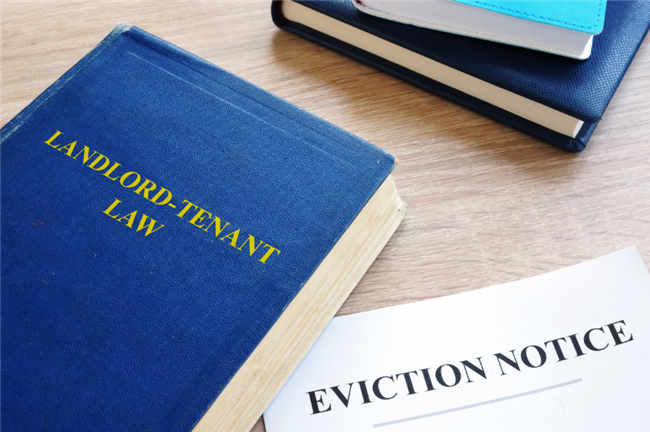
The Seattle City Council has voted to ban winter evictions from the months of December through February, shortening the original proposal from five months to three months, according to reports.

The council also added a provision exempting landlords who own four units or less.

The original proposal would have banned evictions in Seattle during the five months between November 1 and March 31. It would prevent a landlord from evicting a tenant for failure to pay rent for up to five months.

The exceptions to the proposal would be if a tenant is doing something illegal in or around the building.

To help survive potential legal challenges, council member Kshama Sawant added an amendment to position the winter months as a defense to getting evicted, rather than an outright ban, and included a few “just-cause” exemptions that include crimes by the tenant and any illegal actions from the landlord, according to SCC Insight.

Seattle Mayor Jenny Durkan and some landlord and development groups, however, have raised questions about the measure’s legality and effectiveness.  She could veto the legislation, and it takes six council votes to overcome her veto.

In a letter sent to the council Monday, a representative of the mayor’s office said they have “significant concerns that the operational, legal and policy issues associated with [the bill] will not help the city achieve those goals” of reducing eviction, according to Crosscut.

Sawant originally introduced the idea of banning winter evictions late last year. She said in a release that the City of Seattle Renters’ Commission sent a letter urging the City Council to pass an emergency moratorium – effective immediately – on evictions during the winter. In their letter, the Commissioners said, “Passing such a moratorium will keep neighbors from being displaced to the streets during the months with the harshest weather and poorest living conditions for neighbors living unsheltered.

“I am grateful to the Renters’ Commission for recommending an emergency moratorium on winter eviction,” Sawant said in the release. “I strongly agree that (the) council needs to put this into effect immediately.”

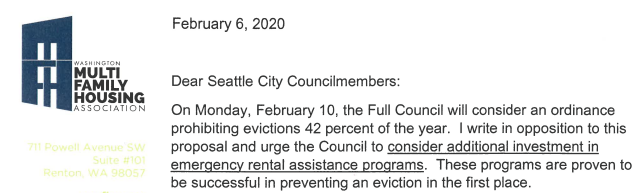
The Washington Multifamily Housing Association wrote a letter to the council opposing the ban on evictions and suggesting instead that they consider additional investment in emergency rental-assistance programs.

“It is financially prudent to invest in emergency rental assistance before an eviction is filed, than (to) wait for an eviction action to be filed, risking the tenant’s housing and increasing the cost burden on programs dedicated to preventing displacement due to eviction,” the association said in the letter.

“We support a modest increase in the emergency rental assistance to provide tenants experiencing financial hardship the opportunity to recover their tenancy prior to an eviction action starting, and ask that you consider this approach as an alternative to preventing the court from considering  evictions altogether 42 percent of the year,” the association said in the letter.

winter evictions ban passed by seattle city council
Read the full text of the letter here.

King County saw approximately 3,200 evictions in 2017, with more than 85 percent of them filed for nonpayment of rent, and more than half involving the nonpayment of one month’s rent or less, according to The Seattle Times.

The average temperatures in Seattle in the winter months according to Climate-Data.org are: November, high 51, low 40; December, high 46, low 37; January, high 45, low 35; February, high 49, low 37; and March, high 52, low 38. The average number of days per month when the temperature dips below freezing are: November, three; December, eight; January, six; February, five; March, two.

Resources:

Seattle City Council votes to limit winter evictions

Bipartisan Legislative Support To Ban Seattle’s Eviction Ban

COUNCIL VOTES BAN ON “WINTER EVICTIONS” OUT OF COMMITTEE

Sawant’s proposed ban on winter evictions voted out of committee

Winter evictions could be banned in Seattle

Letter from the Washington Multifamily Housing Association

Seattle City Council to Consider Banning Evictions In Winter

Sign Up For Our Newsletter And Get Apartment News And Helpful, Useful Content Each Week.

* indicates required


5 Steps To Get Your Property’s HVAC System Ready For Spring

HVAC System Ready For Spring

Here are 5 steps to get your rental property’s HVAC system ready for spring after going through plenty of stress this winter, the weekly maintenance tip from Keepe.

You’ll need to restore and check on your HVAC layout when the spring arrives so the unit can be ready for the rising temperatures in the summer.

 No. 1-  Replacing the filter

Start your HVAC maintenance work by replacing the filter. Every HVAC system has an air filter that prevents harmful outside particles from entering the air. The screen needs to be clean for air to move through reliably. Replacing the filter also ensures your property’s energy bills will not go up, as you will not worry about people having to run their heaters or coolers longer to get the temperatures they want.

It is best to replace a filter every month or every other month. Take time in the spring to replace yours.

No. 2 – Clean out the drainage hole

The drainage hole in your HVAC setup is located under the evaporator fins. The hole allows excess moisture to drain. The opening must stay clean for the moisture to flow out. You might have to use a small wire to clean out anything that backs up inside the hole. You can request a professional service to assist you with cleaning the spot if you’re unable to access it yourself.

No. 3 – Clean the fans

Your HVAC system includes multiple fans around your property. Not only is there an evaporator fan around the base setup, but there are also fans in the bathrooms and kitchens and other rooms in your building. You will have to clean the fans out to ensure air can move through well enough.

You can clean off each fan cover with soap and water. You can also dust the debris off of the fan blades.

Be sure the power’s off before cleaning the fans. Everything must be stationary before you start.

No. 4 – Dry the dehumidifier

Your HVAC system should include a dehumidifier; you’ll need this component during the summer season. Prepare for the warmest and most humid times of the year by drying out your dehumidifier.

You will have to remove the outside casing of the dehumidifier. Allow the system to dry, then vacuum the dirt and other debris on the inside.

No. 5 – Remove all debris

Your HVAC system will take in lots of leaves, branches, and other debris from outside during the winter. After the snow and ice melt, you will need to clean out all those things, because they can obstruct the natural mechanisms inside your HVAC setup. Clearing it out ensures all parts can move freely and will not experience problems.

Your property’s HVAC system should be ready to maintain and support during the spring season. You’ll have an easier time preparing your building for the summer when you get everything up and running. Getting the setup cleaned out as soon as possible is vital to how comfortable everyone in your property will feel in the spring and summer.

About Keepe:

Keepe is an on-demand maintenance solution for property managers and independent landlords. The company makes a network of hundreds of independent contractors and handymen available for maintenance projects at rental properties. Keepe is available in the Greater Seattle area, Greater Phoenix area, San Francisco Bay area, Portland, San Diego and is coming soon to an area near you. Learn more about Keepe at https://www.keepe.com

The Best Appliances In Rental Property

Sign Up For Our Newsletter And Get Apartment News And Helpful, Useful Content Each Week.

* indicates required


Portland’s New F.A.I.R. Housing Ordinance

Portland's New F.A.I.R. Housing Ordinance

By Ron Garcia

The City Council of Portland is now slated to pass its “Fair Access in Renting” (FAIR.) Act to become law on March 1, 2020. However, Portland landlords should instead understand this new ordinance to read as: “Forcibly Accepting Increased Risk”.

This new statute restricts and governs:

  1. How tenant screening must be conducted, as well as how vacancies must be advertised and filled, and
  2. How much landlords can collect for tenant security deposits and how those funds must be allocated towards damages upon termination, as well as new mandates on handling termination notices (including 72-hour late notifications).

The requirements in this ordinance will substantially change most industry-wide accepted practices for advertisements, screening criteria, rental and management policies, termination procedures and for the final accounting resolutions on all residential income properties in the city of Portland. The goals of this ordinance are to lower the barrier of entry to housing-burdened populations and to restrict the amount of money for which a tenant would otherwise be liable, in order to pay for damages incurred to the unit.  There is no attempt at parity between a landlord’s and a tenant’s rights within this act. There is no adjustments for any size or price of rental units. The penalty provisions of any violation in the statute include “actual damages” sought by the tenant – a provision that allows for an open-ended interpretation of potentially huge and cascading claims.

Commissioner Chloe Eudaly has been pursuing this law for nearly two years. Mayor Ted Wheeler’s Residential Services Commission (RESC) supported its progress and provided a forum for it to develop within the Portland Housing Bureau. It should be noted that the RESC is made up of 14 commissioners, only five of which are “landlord representatives. Of those five seats, two commissioners resigned in 2018 because their perspectives were summarily dismissed by the board (I was one of those members). In 2019, three more of the landlord commissioners resigned for the same reason. The result is that the Portland City Council’s housing policies are being created by stakeholders that are radically against landlord rights and whose agenda is to impose new social policies that require private citizens to fund public-housing policies. The law is cumbersome, confusing, and purposely constructed to penalize landlords for not following the very detailed procedures it introduces.

The Fair Access In Renting ordinance joins with the Portland Relocation Ordinance and the Oregon State rent-control law (HB608), each serving to limit the amount of rent increases and to prevent owners from terminating tenancies. With these new rules, the Fair Access In Renting ordinance is designed to regulate the selection of tenants and minimize the costs to repair damages, the burden of liability on Portland rental property owners has skyrocketed. And as a result, this new law fundamentally changes the basic relationship between landlords and tenants by assuming that without a host of new policies, all tenants are subject to exploitation.

The just-adopted rules of the FAIR ordinance can now be found on the city of Portland’s website. Ironically, while it is slated to become law in just weeks, a massive amount of training still needs to be conducted to sort out all of the complexities. Experts all agree that this could take months to bring all industry professionals up to date, and will certainly add to the confusion and difficulties in compliance. Cynical as it sounds, the city has been making this law up as they go, and they have added in many caveats and nuances for an array of issues that have created a tangled mess of red tape.

Provisions for refunding interest incurred on tenant security deposits (which already exist in state law) are now parsed out in a new and imposing accounting scheme. Forcing landlords to do in-home final inspections within five days of sending out a late notice for non-payment for rent is not only onerous and time-consuming, it’s also intrusive and insulting to any tenant who has ever gotten just five days behind on a rent payment. Requiring landlords to itemize and place a cost valuation on every fixture, appliance, equipment and personal property in line with a city-approved depreciation schedule, and requiring a signed mutual agreement between the tenant and landlord prior to possession, is cumbersome and arbitrary (and substantially more onerous for larger single family homes than, say a one-bedroom apartment). It also raises anticipated disputes, i.e. what if the tenant doesn’t sign the form and yet is still required (by the law) to be allowed to rent the property?

Fair Access In Renting conflicts

There are many other conflicts inherent in this ordinance. For example, carpet cleaning (as authorized and approved by state law to be a tenant expense) now must be limited to “discrete impacted areas” and not for other areas of the dwelling unit. Tell me – what does that actually mean and how will it play out in every single move-out? Requiring the rental agreement to have the name, address and phone number of the actual bank branch holding the deposit seems excessive. Which Citibank do you go to?

The increased amount of administrative oversight regulated in this ordinance is excessive. As a long-time professional property manager, I have long promoted the claim that everyone deserves affordable and safe housing. Tenant relations is an integral part of my business and our company works tirelessly to address the needs, concerns, fairness and habitability issues that rise up daily in managing rental housing. Yet even on our best days, with great tenants, we can be subject to questions, suspicions or accusations, etc. when things don’t go as well as someone likes. Creating overreaching laws that do little for the majority of people they serve and which create intimidating conflict unnecessarily just does not seem like good public policy.

At the end of the day, however, when new laws are enacted, our job is to understand them and work diligently on their compliance. The sheer volume of change and the additional requirements and restrictions inherent in this law will be challenging and it will add considerable time allocations for documentation and “risk management.” I certainly believe professional property managers will handle the process and create new best practices to adapt. However, I also believe prices to manage rental units will need to go up in order to accommodate these mandates, further burdening the rental-property owners who are shouldering the weight. Will we now start seeing every owner raise every rent to its maximum rate every year in order to recover their costs? Time will tell.

For the Property Management industry, I submit we should read this new ordinance as the City of Portland promoting “Frustrating Administrative Inflationary Rate-hikes”.

About the author:

Portland's New Fair Access in Renting Housing Ordinance
Ron Garcia is the Past President of the Rental Housing Alliance Oregon and is currently a candidate for the Oregon State House of Representative, District 37. His website it www.GoGarcia.org

Portland City Council Approves Controversial Tenant Screening Ordinance 3-1

Sign Up For Our Newsletter And Get Apartment News And Helpful, Useful Content Each Week.

* indicates required


Portland Rents Hold Steady In January Stopping Slide Over Last 3 Months

Portland Rents Hold Steady In January Stopping Slide Over Last 3 Months

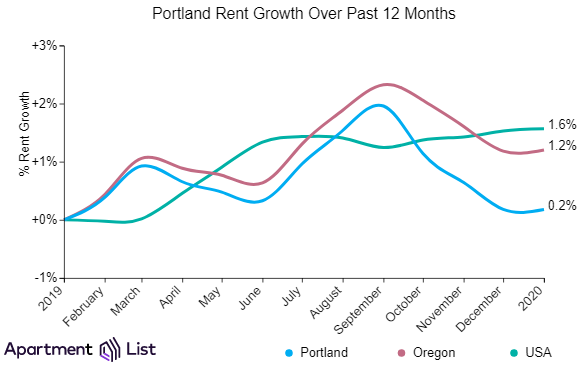
Portland rents held steady over the past month after several of months of decline, according to the latest report from Apartment List.

Portland’s year-over-year rent growth lags the state average of 1.2 percent, as well as the national average of 1.6 percent. After the last increase in September, Portland rents had declined for three months in a row until steadying in January.

Currently, median rents in Portland are $1,122 for a one-bedroom apartment and $1,324 for a two-bedroom.

Rents increase in 8 cities across the Portland metro

Portland Rents Hold Steady In January Stopping Slide Over Last 3 Months

While rents have remained steady in the city of Portland throughout the past year, cities across the metro have seen a different trend.

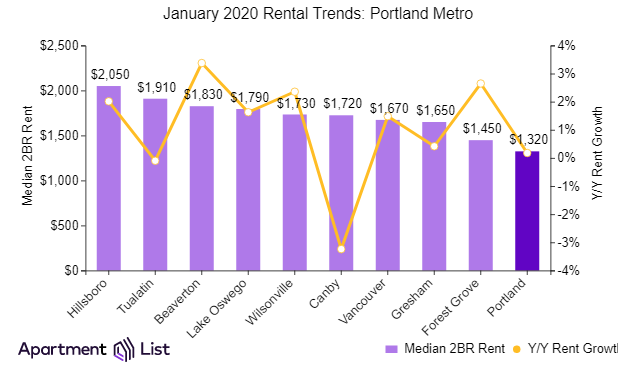
Rents have risen in 8 of the largest 10 cities in the Portland metro for which Apartment List has data.

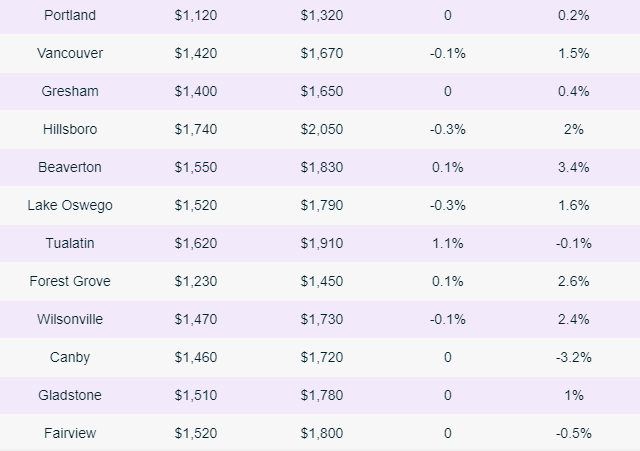
Here’s a look at how rents compare across some of the largest cities in the metro.

  • Beaverton has seen the fastest rent growth in the metro, with a year-over-year increase of 3.4 percent. The median two-bedroom there costs $1,825, while one-bedrooms go for $1,547.
  • Over the past year, Canby has seen the biggest rent drop in the metro, with a decline of 3.2 percent. Median two-bedrooms there cost $1,725, while one-bedrooms go for $1,462.
  • Hillsboro has the most expensive rents of the largest cities in the Portland metro, with a two-bedroom median of $2,050; rents went down 0.3 percent over the past month but rose 2.0 percent over the past year.
  • Portland proper has the least expensive rents in the Portland metro.

Portland Rents Hold Steady In January Stopping Slide Over Last 3 Months

Portland rents are more affordable than many large cities

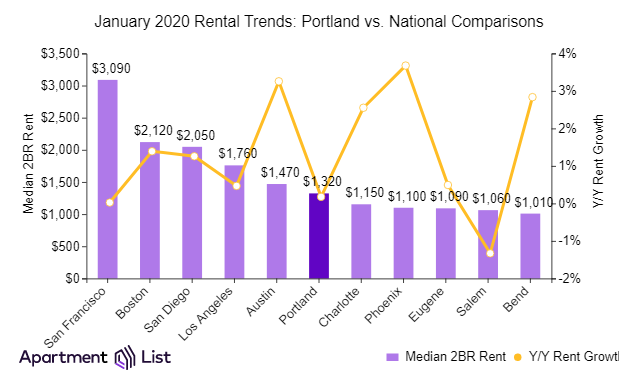
Rent growth in Portland has been relatively stable over the past year while some other large cities have seen more substantial increases.

Portland is still more affordable than most comparable cities across the country.

  • Oregon as a whole has logged 1.2 percent year-over-year growth, while rent trends across other cities throughout the state have varied. For example, rents have grown by 0.5 percent in Eugene whereas rents have fallen 1.3 percent in Salem.
  • Nationwide, rents have grown by 1.6% over the past year compared to the stagnant growth in Portland.
  • While rents in Portland remained moderately stable this year, similar cities saw increases, including Phoenix (+3.7 percent), Austin (+3.3 percent), and Las Vegas (+3.2 percent).
  • Renters will find more reasonable prices in Portland than most similar cities.

Portland Rents Hold Steady In January Stopping Slide Over Last 3 Months

Portland Rents Continue Decline for 3rd Month

Sign Up For Our Newsletter And Get Apartment News And Helpful, Useful Content Each Week.

* indicates required


Security Deposits: Common and Costly Mistakes

Security Deposits: Common and Costly Mistakes

Security deposits and many of the issues surrounding them are the topic of the article this month by veteran property manager Corey Brewer.

By Cory Brewer

In my role as a general manager, disagreements over security-deposit resolutions cross my desk more often than most other issues.

I’ve lost count of how many times a former tenant explained that they, “left the home in better shape” than they found it, while at the same time I have had numerous conversations with our landlord clients about how they are being too aggressive with their charges.  It can be a contentious issue on both sides of the table.

We all hope that a tenant treats the rental home with respect, and that we can refund most – if not all – of  security deposits quickly after they vacate.

On the landlord’s end, timing and accuracy are extremely important when dealing with security deposits.

The law in Washington state currently prescribes that a landlord must mail a statement specifying the basis for withholding of security deposit funds within 21 days of the tenant vacating – which is not  always the last day of the lease.  If a tenant were to move out two weeks early and return the keys, then the 21-day clock would start ticking two weeks sooner.  Mailing the statement to the tenant’s last known address is also crucial, so if they have provided this to you before your statement has been mailed out you need to make sure you’re mailing it to their new address.  A simple error (delivered late or to the wrong address) can be very costly in that it could a) eliminate your ability to keep any of the deposit at all, and/or b) entitle the tenant to financial damages above and beyond the full return of their deposit.

Security deposits and pet deposits

Pet deposits (particularly in Seattle) have added a new wrinkle to this process in that a landlord cannot apply pet-deposit funds to cover “people damage.”

For example, a security deposit of $1,000 is collected plus a $250 pet deposit.  At move out, there is no pet-related damage, but it is discovered that the garage door is damaged due to the tenant hitting it with their car. If the door repair costs $1,500, the landlord may apply the $1,000 security deposit toward this repair, but must refund the $250 pet deposit to the tenant.  Ultimately the tenant would owe an additional $500 in damages, not $250 (because you can’t keep the $250 pet deposit for people damage – at least not without the tenant’s consent).  So, in this situation you are simultaneously sending them a refund check and a bill for the balance of the garage door repair cost.

Every penny of security-deposit funds withheld to cover damages, cleaning, or any other unpaid amounts (back rent, late fees, utility bills, etc.) must be supported by an invoice (or copy of tenant ledger indicating delinquent amounts owed).

In addition, the withholding of funds must be supported by clear move-in and move-out inspection reports. Back at move in, you were to have completed a property-condition inspection report and had the tenant sign it in acknowledgment.  At move-out, you would review those notes and make a comparison to the current condition of the property to establish a basis for charging the tenant for damages.

While photos are not legally required, they are highly recommended – at our brokerage, we take more than 100 photos to supplement the majority of our move-in reports.  The photos can be your saving grace if you ever end up in small-claims court arguing over the validity of your charges.

When it comes to security deposits: document, document, document!

Finally, a landlord may not charge a tenant for “normal wear-and-tear,” which can often be difficult to define.

Best practice is to supply the tenant at lease signing with a list of examples of things that would be considered damage vs. wear-and-tear to set the expectation.

A landlord also may not charge a tenant for any improvements post-tenancy.

For example, if a vinyl floor was damaged, a landlord may not take advantage of the situation by charging the tenant to install porcelain tile.  The landlord may still replace the floor with porcelain tile, but may only charge the tenant the equivalent of what it would have cost to replace it with like-kind vinyl.  Depending on the damaged item, depreciation must also be considered – certain elements of the property (appliances, hardwood flooring, carpet, paint, etc.) have their own general “useful-life” spans.

So for example, if a tenant dents the door of a 25-year-old refrigerator, the landlord cannot charge the full cost of a brand new one to replace it.  The word “reasonable” is found littered throughout RCW 59.18 of the Washington state Residential Landlord-Tenant Act, and if you find yourself in front of a judge you will have to come up with a “reasonable” explanation for your actions.

So to recap on security deposits – when your tenant vacates you’ve got to act quickly, keep a clear paper trail, and make sure that you are being reasonable.  Good luck!

Cincinnati Landlords Must Give Renters Security-Deposit Options

Sign Up For Our Newsletter And Get Apartment News And Helpful, Useful Content Each Week.

* indicates required


Salt Lake City Rents Held Steady Over The Past Month

Salt Lake City Rents Held Steady Over The Past Month

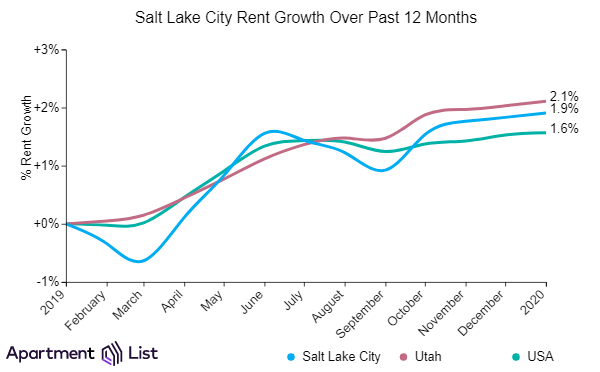
Salt Lake City rents have increased 0.1 percent over the past month, and are up slightly by 1.9 percent year-over-year according to the latest report from Apartment List.

Currently, median rents in the city stand at $879 for a one-bedroom apartment and $1,090 for a two-bedroom.

Salt Lake City’s year-over-year rent growth lags the state average of 2.1 percent, but exceeds the national average of 1.6 percent.

Salt Lake City rents more affordable than many large cities nationwide

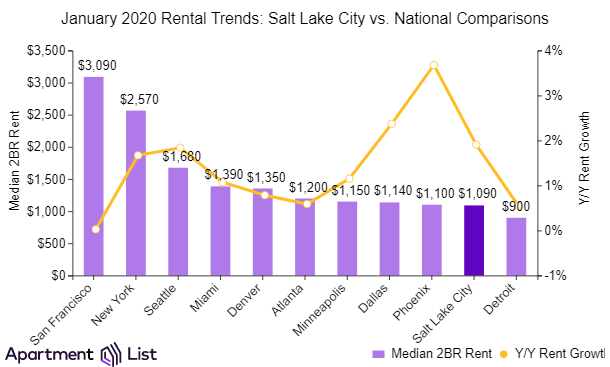
As rents have increased slightly in Salt Lake City, a few large cities nationwide have also seen rental income grow modestly. Salt Lake City is still more affordable than most large cities across the country.

  • Salt Lake City’s median two-bedroom rent of $1,090 is below the national average of $1,193. Nationwide, rents have grown by 1.6 percent over the past year compared to the 1.9 percent rise in Salt Lake City.
  • While Salt Lake City’s rents rose slightly over the past year, many cities nationwide also saw increases, including Phoenix (+3.7 percent), Dallas (+2.4 percent), and Seattle (+1.8 percent).

Utah rent

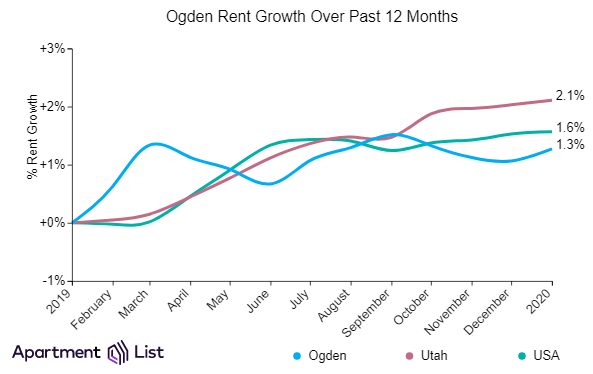
Ogden rents increased slightly over the past month

Ogden rents have increased 0.2 percent over the past month, and have increased slightly by 1.3 percent in comparison to the same time last year.

Currently, median rents in Ogden stand at $697 for a one-bedroom apartment and $893 for a two-bedroom. Ogden’s year-over-year rent growth lags the state average of 2.1%, as well as the national average of 1.6%.

ogden apartments

Salt Lake City Rents Up For Second Month In A Row

Seattle City Council to Consider Banning Evictions In Winter

Seattle City Council to Consider Banning Evictions In Winter
The legislature provided pro and con statements on the bill based on testimony.

The Seattle City Council has voted out of committee a proposed ordinance banning evictions in winter, according to reports.

The proposal would ban evictions in Seattle during the five months between November 1 and March 31. It would prevent a landlord from evicting a tenant for failure to pay rent for up to five months.

The exceptions to the proposal would be for landlords who live on their own rental property or if a tenant is doing something illegal in or around the building.

The proposed law from Seattle City Councilmember Kshama Sawant has been voted out of committee, with changes that would allow evictions in special circumstances.

To help survive potential legal challenges, Sawant added an amendment to position the winter months as a defense to getting evicted, rather than an outright ban, and includes a few “just cause” exemptions that include crimes by the tenant and any illegal actions from the landlord, according to SCC Insight.

Sawant originally introduced the idea of banning winter evictions late last year. She said in a release that the City of Seattle Renters’ Commission sent a letter urging the City Council to pass an emergency moratorium – effective immediately – on evictions during the winter. In their letter, the Commissioners said, “Passing such a moratorium will keep neighbors from being displaced to the streets during the months with the harshest weather and poorest living conditions for neighbors living unsheltered.

“I am grateful to the Renters’ Commission for recommending an emergency moratorium on winter eviction,” Sawant said in the release. “I strongly agree that Council needs to put this into effect immediately.”

The Washington Multifamily Housing Association wrote a letter to the council opposing the ban on evictions and suggesting instead that they consider additional investment in emergency rental-assistance programs.

Seattle City Council to Consider Banning Evictions In Winter
Please click here to read the full letter.

“It is financially prudent to invest in emergency rental assistance before an eviction is filed, than wait for an eviction action to be filed, risking the tenant’s housing and increasing the cost burden on programs dedicated to preventing displacement due to eviction,” the association said in the letter.

“We support a modest increase in the emergency rental assistance to provide tenants experiencing financial hardship the opportunity to recover their tenancy prior to an eviction action starting, and ask that you consider this approach as an alternative to preventing the court from considering  evictions altogether 42 percent of the year,” the association said in the letter.

King County saw approximately 3,200 evictions in 2017, with more than 85 percent of them filed for nonpayment of rent, and more than half involving the nonpayment of one month’s rent or less, according to The Seattle Times.

The average temperatures in Seattle in the winter months according to Climate-Data.org are: November, high 51, low 40; December, high 46, low 37; January, high 45, low 35; February, high 49, low 37; and March, high 52, low 38. The average number of days per month when the temperature dips below freezing are: November, three; December, eight; January, six; February, five; March, two.

Resources:

Bipartisan Legislative Support To Ban Seattle’s Eviction Ban

COUNCIL VOTES BAN ON “WINTER EVICTIONS” OUT OF COMMITTEE

Sawant’s proposed ban on winter evictions voted out of committee

Winter evictions could be banned in Seattle

Letter from the Washington Multifamily Housing Association

Sign Up For Our Newsletter And Get Apartment News And Helpful, Useful Content Each Week.

* indicates required