
Home Blog Page 144

Should I Pay The Taxes Or Defer?

Should I Pay The Taxes Or Defer?

Should I pay the taxes, or defer, and why doing a 1031 exchange may be smart financial planning now.

By Ehud Gersten
Vice President, Kay Properties and Investments, LLC

When selling real estate investment property, investors generally have two options: 1) pay the taxes on any gains from the sale, or, 2) conduct a 1031 exchange and defer the taxes owed.

Recently, because of the financial uncertainty surrounding COVID-19 and the overall state of the economy, some investors are choosing to pay the taxes on any gain from the sale of their investment properties and hold on to their cash rather than acquire replacement real estate utilizing the 1031 process.

While every investor is different and should make their own determination of their specific financial landscape and rely on the advice of their professional financial and legal counsel, there are generally two major points to keep in mind before choosing to pay the taxes rather than defer.

Point #1: the amount of taxes you might have to pay

If you choose to pay the taxes on your gain, you might be responsible for the following:

  • Long term federal capital gains tax rate may be as high as 20%, depending on your income bracket.
  • State tax can also add to the financial tax hit, depending on the State in which you live. For example, in California, an investor could possibly also pay up to 13.3% in income tax.
  • Depreciation recapture is taxed at a flat rate of 25%, which can be quite significant if you’ve held and depreciated your investment property for a long period of time.
  • Net Investment Income Tax (NIIT) applies to certain net investment income of investors that have income above the statutory threshold, at a rate of 3.8%.

Point #2: opportunity cost of any amount you pay in taxes

When an investor pays taxes, that could otherwise be deferred, they’re left with less capital that could otherwise be used for investment purposes that could generate more return for them.

Let’s use a simple example: Suppose that an investor sells an investment property for $1 million, and the total amount of taxes that they would owe on such sale is $350,000. That accredited investor then decides, for purposes of our example, that they will pay the taxes owed and take the $650,000 in cash remaining and invest it in some investment that pays 5% annual interest. That investor, based on our example, should make a return of $32,500 per year.

However, if that same investor had completed a 1031 exchange deferring all of their taxes and depreciation recapture, for example into a DST paying 5% annually, their annual return should be $50,000, a difference of $17,500. While the above is a simplified example, it helps illustrate the opportunity cost of paying the taxes rather completing a 1031 exchange.

Lastly, investors should note that if they pay their taxes the $350,000 in the above example is gone forever.  If they were to do an exchange they would have deferred their taxes, the $350,000 would be able to generate potential income for them AND when the investor passes, his or her heirs would receive a full step up in basis thereby eliminating the $350,000 of capital gains taxes forever.  So not only will the investor make $17,500 in income less per year but the investors estate would also lose $350,000 of principal.  This math above is the very reason why so many investors choose to utilize the 1031 exchange as it is one of the most tax efficient strategies that real estate investors can utilize.

Before an investor decides to pay any owed taxes on the sale of their investment property rather than completing a 1031 exchange and deferring those taxes, they should thoroughly understand the financial implications as everybody’s unique situation is different, by consulting with their professional tax advisor, CPA and attorney.

About Kay Properties and www.kpi1031.com

Kay Properties is a national Delaware Statutory Trust (DST) investment firm. The www.kpi1031.com platform provides access to the marketplace of DSTs from over 25 different sponsor companies, custom DSTs only available to Kay clients, independent advice on DST sponsor companies, full due diligence and vetting on each DST (typically 20-40 DSTs) and a DST secondary market.  Kay Properties team members collectively have over 115 years of real estate experience, are licensed in all 50 states, and have participated in over 15 Billion of DST 1031 investments.

This material does not constitute an offer to sell nor a solicitation of an offer to buy any security. Such offers can be made only by the confidential Private Placement Memorandum (the “Memorandum”). Please read the entire Memorandum paying special attention to the risk section prior investing.  IRC Section 1031, IRC Section 1033 and IRC Section 721 are complex tax codes therefore you should consult your tax or legal professional for details regarding your situation.  There are material risks associated with investing in real estate securities including illiquidity, vacancies, general market conditions and competition, lack of operating history, interest rate risks, general risks of owning/operating commercial and multifamily properties, financing risks, potential adverse tax consequences, general economic risks, development risks and long hold periods. There is a risk of loss of the entire investment principal. Past performance is not a guarantee of future results. Potential cash flow, potential returns and potential appreciation are not guaranteed. The above is not intended as tax or legal advice.

Securities offered through WealthForge Securities, LLC. Member FINRA/SIPC. Kay Properties and Investments, LLC and WealthForge Securities, LLC are separate entities.


Kay Properties Being Defensive Pays Off: Avoiding Hospitality and Senior Care

How You Can Run Maintenance Coordination at Zero Cost

How You Can Run Maintenance Coordination at Zero Cost

By Ethan Lieber

If you’ve been a property manager for long, you know that maintenance can easily be one of the biggest stressors of the business. But there are many ways to turn this stress into an opportunity. Property-management companies are beginning to utilize a new model that reduces time spent on maintenance by 80% and is not only run at zero cost, but can actually generate a new profit stream.

This model helps reallocate that time to other areas of the business, like growth. According to a recent Buildium study, 61% of property owners listed maintenance as the top pain point, and for good reason. You’re on call 24/7 and emergency maintenance not handled immediately can turn into long-term expensive property damage. On top of this, managing vendor and tenant schedules, follow-ups, and invoices can be a huge time suck.

Creating Efficiencies in Maintenance Coordination

Many property managers use a third-party service to handle maintenance coordination. Whether it’s software service, a call center, or a mix of both, these tools are meant to help ease the maintenance process. A fee is involved when you want to use a call center to handle your maintenance calls, whether it be only after hours or 24/7. There’s also a fee for utilizing a software service for scheduling, tracking, and invoicing all maintenance requests. Latchel is a maintenance-coordination service that uses both software and a U.S.-based call center to operate across over 55,000 units nationwide.

Being that now is a time of unprecedented economic struggle, Latchel has implemented a model for customers that gives maintenance coordination at zero cost to customers. How is this done?

Removing the Cost of Maintenance Coordination

Latchel packages its maintenance-coordination services into a resident benefit package, called the 24/7 Home Assistant, that gives residents a concierge-like maintenance service along with a few other financial protections and resident benefits. These benefits include:

  • A dedicated home-assistant phone line available 24/7/365 for in-home needs.
  • Easy scheduling via SMS or online portal.
  • Expedited scheduling and dispatching of vendors with 2-hour repair windows.
  • Move-out repair assistance and $50 reimbursements of tenant-caused damages.
  • Cancellation-fee reimbursement for appointments that need to be cancelled or rescheduled.

Similar to many resident-benefit packages already out there, residents pay a small monthly fee for these enhanced and added services. Residents do have the ability to opt-out of this benefit if they are not interested. Latchel is currently waiving the typical PM fees for tenants who choose to opt-out, so property managers still get maintenance coordination at zero cost.

Creating a Profit Stream from Maintenance Coordination

With customers currently using this model, Latchel has seen a 90% opt-in rate from residents, giving property managers immediate profits. Property managers can earn an additional $4 per unit for all units that opt in. A few other benefits for the property manager include:

  • Improvement in online reputation:
    • Latchel maintains a 4.7/5 star rating for tenant satisfaction; reviews are automatically pushed to the PM’s website.
  • 80% more time to re-allocate to other parts of the business operations, and freedom from maintenance headaches.
  • Added revenues of $4 per unit per month.

You can learn more about the 24/7 Home Assistant here, or schedule a call with the Latchel team. We’d love to hear about your current maintenance operations process, and chat with you about how we can help you create more efficiency and growth in your business.

About the author:

Ethan Lieber is the CEO of Latchel. Latchel is a Y-Combinator backed company that runs 24/7 maintenance coordination services for property managers and landlords. You can read about Latchel on the Wall Street Journal or on Tech Crunch.

How You Can Run Maintenance Coordination at Zero Cost

How To Handle Rental Maintenance During COVID-19

Top 50 Apartment Companies in 2019 Multifamily Industry

Top 50 Apartment Companies in 2019 Multifamily Industry

The National Multifamily Housing Council (NMHC) has released its 2020 NMHC 50, the sector’s chief ranking of the nation’s largest apartment owners, managers, developers, builders and syndicators for the year 2019.

“Before the outbreak of COVID-19 and the related economic weakening, the multifamily industry and the sector’s fundamentals were as healthy as they had been in years,” the report says. “While there is clearly going to be significant uncertainty in the days to come, the 2020 NMHC 50 highlights that the apartment industry continues to experience significant demand and is well-positioned to return to growth following the pandemic.”

“Demographic shifts and preference for renting have resulted in continued strong demand and positive performance for the apartment industry,” said Caitlin Sugrue Walter, Vice President of Research for the National Multifamily Housing Council, in a release.

“As is evident from the growth on this year’s builders and developers lists, the industry is continuing the pace of production to meet the needs of pent-up demand from years past. In addition, apartment transaction volume surpassed $100 billion for what’s now the seventh consecutive year.”

 No. 1 – Largest apartment owner

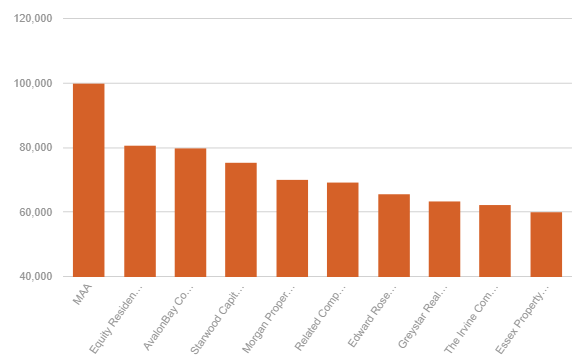
MAA (headquartered in Memphis, Tenn.) stayed atop the list of the country’s largest apartment owners with 100,031 apartment homes owned, breaking the 100,000-unit mark for the second consecutive year.

top apartment owners

 No. 2 – Largest apartment manager

Greystar Real Estate Partners (headquartered in Charleston, S.C.) remained the largest apartment manager with 492,967 apartments under their management, more than double the next firm on the list.

No. 3 – Largest apartment developer

Alliance Residential (headquartered in Phoenix, Az.) retained its place as the largest apartment developer with 8,009 apartments started in 2019 — over 1,000 more units started compared to when they first took the top spot last year.

No. 4 – Top apartment builder

Summit Contracting Group, Inc. (headquartered in Jacksonville, Fla.) kept their spot as the country’s highest-producing apartment builder, starting 9,065 apartments in 2019, nearly 1,500 more units than the next builder on the list.

No. 5 – Top syndicator

PNC Real Estate (headquartered in Portland, Ore.) also stayed on top as the nation’s largest apartment tax-credit syndicator with 132,179 apartments syndicated.

Additional Industry and NMHC 50 Highlights:

  • 2,210,931 – Number of total units owned by NMHC 50 top owners, representing 10.1 percent of the total U.S. apartment stock.
  • 3,617,624 – Number of units collectively managed by NMHC 50 top managers, breaking the record for the 12th consecutive year and representing 16.5 percent of the total U.S. apartment stock.
  • 95.8 percent – 2019 apartment occupancy rate according to RealPage, the highest since 2000.
  • 343,200 – Number of apartments completed in 2019 according to the Census Bureau, which is 7,600 units (or 2.3%) higher than in 2018.
  • 249,721 – Net absorptions in 2019 according to RealPage, a 17.3 percent drop from the highs seen the previous year.
  • $183.5 billion – Total multifamily transaction volume in 2019 according to Real Capital Analytics, a record high.

About the ranking:

This is the 31st annual edition of the NMHC 50 rankings. NMHC partners with Kingsley Associates, a leading real estate research and consulting firm, to conduct the research for the NMHC 50. All apartment owners, managers, developers, builders and syndicators are invited to answer a survey questionnaire that asks about their prior year’s activities. Apartment owners, managers and syndicators are ranked based on their portfolio holdings (either owned, managed or syndicated) as of January 1, 2020, while developers and builders are ranked based on the number of apartment units started in 2019.

84% of Apartment Households Paid Full or Partial Rent in April


Sign Up For Our Newsletter And Get Apartment News And Helpful, Useful Content Each Week.

* indicates required


6 Actions Landlords Can Take to Support Residents Now

6 Actions Landlords Can Take to Support Residents Now

On behalf of the 40 million Americans who call an apartment home and the 17.5 million jobs the industry supports, the National Multifamily Housing Council (NMHC) is suggesting six actions landlords can take to support their residents in light of the developments surrounding the coronavirus (COVID-19) pandemic, according to a release.

“This crisis is testing all of us – every industry, every family. No one should lose the roof over their head during a pandemic. That’s why our members are taking action and why NMHC proactively issued a series of principles to assist renters, including a halt to COVID-19 related evictions and the establishment of payment plans for residents who are unable to pay their rent because of the outbreak,” NMHC President Doug Bibby  said in a release.

“We welcome the Federal Housing Finance Agency’s decision  to offer mortgage forbearance to multifamily housing property owners who suspend evictions for those who have been financially impacted by this public health emergency. This is a necessary step. Most property owners are small businesses and they are committed to working with public officials and residents to keep families safe during this national crisis,” Bibby said.

6 actions landlords can take

The NMHC suggests landlords and apartment firms consider adopting the following principles to help America’s renters retain their housing during this crisis.

No. 1 – Halt evictions for 90 days for those who can show they have been financially affected by the COVID-19 pandemic. (This would not apply to evictions for other lease violations, such as property damage, criminal activity or endangering the safety of other residents of the community.)

No. 2 – Avoid rent increases for 90 days to help residents weather the crisis.

No. 3 – Create payment plans for residents who are unable to pay their rent because of the outbreak, and waive late fees for those residents.

No. 4 – Identify governmental and community resources to help residents secure food, financial assistance and healthcare, and share that information with residents.

No. 5 – Communicate to residents that it is a priority for the industry to partner with them to help them retain their housing.

No. 6 – Develop a response plan for potential COVID-19 exposure.

“We also recognize that most rental properties are owned by individuals and small businesses that have financial obligations, including mortgages, utilities, payroll, insurance and taxes,” the NMHC said in the release.

“If residents cannot pay their full rent obligations because of the COVID-19 outbreak, then owners are at risk of not meeting their own financial obligations. This puts the individual property and the larger community in which it is located at risk.

“Congress must extend mortgage forbearance to rental property owners and extend similar protections to other financial obligations such as insurance premiums, utility service payments and tax liabilities. Forbearance is needed to prevent foreclosure and other adverse actions such as lien placements, utility shut-offs, defaults, and judgments that would negatively impact the viability of the property’s continued operation and ultimately put its residents at risk of additional disruption.

“We also continue to call on Congress to provide disaster-housing assistance for renters who are suffering from income disruption as a result of the pandemic.

“At a time when many American workers are being encouraged to work from home, multifamily owners and operators are on the front lines, keeping residents cared for and safe in their apartment homes,” the NMHC said in the release about 6 actions landlords can take.

“These are trying, even desperate times, and all of us face grim uncertainty in the days ahead. However, by working together – apartment residents, owners and operators, and lawmakers at all levels of government – we can develop solutions to the evolving challenges and keep Americans housed,” the association said.

Additional materials and resources on from the NMHC on COVID-19 can be found here.

6 Actions Landlords Can Take to Support Residents Now

Based in Washington, D.C., the National Multifamily Housing Council (NMHC) is the leadership of the trillion-dollar apartment industry. NMHC provides a forum for insight, advocacy and action that enables both members and the communities they help build to thrive. For more information, contact NMHC at 202/974-2300, e-mail the Council at info@nmhc.org, or visit NMHC’s website at www.nmhc.org.

NMHC Multifamily Housing Quarterly Survey Shows Little Overall Change

Sign Up For Our Newsletter And Get Apartment News And Helpful, Useful Content Each Week.

* indicates required


Dear Landlord Hank: Who Pays for Bed Bug Removal?

bed bug removal ask landlord hank

In this week’s Ask Landlord Hank question he deals, again, with the bed bug removal question in rental property and who should pay the cost.

Dear Landlord Hank:

In the city of Aurora, Colorado, is it the tenants’ or the property manager’s (house landlords) responsibility to take care of a bed bug removal problem?

-Stefon

HI Stefon,

I would check your lease to see if pest control is mentioned. Most often, if you live in a multifamily building, the owner takes care of pest control on a regular basis, but this is normally addressed in the lease.

If you are renting a single-family home, sometimes the owner will provide exterior pest control only, sometimes both interior and exterior.

If pest control is not mentioned in your lease, then the issue is your responsibility. I don’t know if Aurora, Colorado has any special laws about this, but I would check.

Sincerely,

Hank Rossi
Ask Landlord Hank who should pay for bed bug removal in a rental property?ng: How Should We Handle An Already Slow-Paying Tenant Now?

Ask Landlord Hank Your Question

Ask veteran landlord and property manager Hank Rossi your questions from tenant screening to leases to pets and more! He provides answers each week to landlords.

  • This field is for validation purposes and should be left unchanged.

Ask Landlord Hank: How Should We Handle An Already Slow-Paying Tenant Now?

Sign Up For Our Newsletter And Get Apartment News And Helpful, Useful Content Each Week.

* indicates required
bed bug removal ask landlord hank
Photo credit mokee81 via istockphoto.com


84% of Apartment Households Paid Full or Partial Rent in April

84% of Apartment Households Paid Full or Partial Rent in April

A rent survey finds that 84 percent of apartment households made a full or partial rent payment by April 12, according to the National Multifamily Housing Council (NMHC) in its second survey of 11.5 million units of professionally managed apartment units across the country

NMHC’s Rent Payment Tracker numbers also examined historical numbers and found that 90 percent of renters made full or partial payments from April 1-12, 2019, and 91 percent of renters in March 1-12, 2020.

The report says the latest tracker numbers reflect a payment rate of 93 percent compared to the same time last month. These data encompass a wide variety of market-rate rental properties, which can vary by size, type and average rental price.

“We are pleased to see that it appears that the vast majority of apartment residents who can pay their rent are doing so to help ensure that their properties can continue to operate safely, and so apartment owners can help residents who legitimately need help,” said Doug Bibby, President of NMHC, in a release.

“Unfortunately, unemployment levels are continuing to rise and delays have been reported in getting assistance to residents, which could affect May’s rent levels. It is our hope that, as residents begin receiving the direct payments and the enhanced unemployment benefits the federal government passed, we will continue to see improvements in rent payments.”

Class A apartment properties report more rent payments

“Anecdotally, we are hearing that different parts of the industry are experiencing different levels of rent payments,” David Schwartz, NMHC Chair and CEO Chairman of Chicago-based Waterton, said in the release.

“As you would expect, more expensive Class A properties, whose resident base may be more able to work from home, are reporting much higher percentage of rent payments than operators of more affordable workforce properties whose residents are more likely to have had their incomes disrupted because of the pandemic,” Bibby said.

“History offers us no frame of reference for the truly unprecedented economic situation we find ourselves in,” he said. “With apartment firms stepping up to support their residents by waiving late fees, creating flexible payment plans and offering other creative solutions for residents impacted by COVID-19, we expected more renters to pay later in the month than has historically been the case.  The increase in this week’s number over last week’s, however, shows that apartment residents are continuing to pay rent despite the financial challenges facing them.”

The NMHC Rent Payment Tracker metric provides insight into residents’ financial health over the course of each month, and, as the dataset ages, between months.

However, noteworthy technical issues may make historical comparisons imprecise. For example, factors such as varying days of the week on which data are collected; individual companies’ differing payment collection policies; shelter-in-place orders’ effects on residents’ ability to deliver payments in person or by mail; the closure of leasing offices, which may delay operators’ payment processing; and other factors can affect how and when rent data is processed and recorded.

Total unit counts may change as units are leased or vacated and survey methodology is refined.

NMHC is partnering with the following firms on this initiative: Entrata, MRI Software, RealPage, ResMan and Yardi.

Rent-Deferral Payback Plan Guidelines & What You Need to Know During COVID-19

Sign Up For Our Newsletter And Get Apartment News And Helpful, Useful Content Each Week.

* indicates required


How Can You Get Tenants to Clean Regularly?

How Can You Get Tenants to Clean Regularly?

How can you get tenants to clean regularly is a challenge for many property managers, so this week maintenance company Keepe provides some ideas on how to get tenants to clean regularly in order to help keep your rental property in good condition.

In fact, with the coronavirus pandemic, now is the best time as a property manager to ensure that your tenants adopt regular cleaning practices.

But how do you get tenants to clean regularly?

Here are five tested ways to get your tenants to clean your rental property regularly.

No. 1 – Include cleaning as part of the lease

The truth is that most property managers fail to include this clause in the lease agreement. By not adding this requirement in the agreement, it may not be easy for you to enforce it in reality.

You should add this clause in the lease from the beginning.

Even though you can amend the contract to accommodate a new cleaning requirement, remember that the tenants are under no legal obligation to accept it at this point.

No. 2- Communicate your expectations

As a property manager, it is necessary that you communicate your cleaning expectations to your tenants.

As the American Bar Association points out, the tenant has the duty not to “commit waste.” In layman’s terms, that means a tenant can’t cause permanent and unreasonable damage to the property.

While statements such as, “When a tenant moves out, the property must be returned in original condition” are usually found in lease agreements, they unfortunately do not clearly communicate your expectations.

In your lease agreement with incoming tenants, clearly state your cleaning expectations and how they can achieve it.

No. 3 – Be very specific

Including a clause that requires your tenants to clean may be vague and confusing for them to adhere to. Your requirements must be specific and achievable.

Your cleaning requirement must cover the following:

  • When to clean
  • Where to clean
  • How to clean, and other essential aspects.

You may decide to add a clause that allows you to hire a cleaning company with the expense paid by your renters if they fail to keep the premises clean.

Check with your legal representative if it is legal to do so.

No. 4 – Document the mess

Documenting the mess created by tenants is a good way to gather evidence either when they are moving out, or you are doing inspections.

It is also advisable that you have documented proof of the mess since your tenant might challenge your right to keep their security deposit.

Taking photos and video may be the easiest way for you to document a mess at no real cost.

How Can You Get Tenants to Clean Regularly?

No. 5 – Embark on regular inspections

You must do regular inspections.  This may be at least three to five times a year.

Include a clause in the lease agreement that gives you the right to entry so you can visit regularly.

Usually, you must inform your tenants at least 24 hours before the date of the visitation. Chances are that they may step up their cleaning energy and get the property in an appealing condition before your visit.

What could be a good cleaning schedule?

According to research, it good practice to have a consistent cleaning schedule.

Whenever possible, deep cleaning every other month is strongly recommended, and this usually requires a professional in order to clean the property more thoroughly. Deep cleaning includes disinfecting less-commonly touched areas like bathroom floors, bathtubs, ceiling fans, refrigerator tops, window sills, etc.

As for more regular DIY cleaning by tenants, vacuuming and mopping commonly visited areas and disinfecting commonly touched objects once a week would be ideal.

About Keepe:

Keepe is an on-demand maintenance solution for property managers and independent landlords. The company makes a network of hundreds of independent contractors and handymen available for maintenance projects at rental properties. Keepe is available in the Greater Seattle area, Greater Phoenix area, San Francisco Bay area, Portland, San Diego and is coming soon to an area near you. Learn more about Keepe at https://www.keepe.com

Rental Property Maintenance and the Fight Against the Spread of COVID-19

Sign Up For Our Newsletter And Get Apartment News And Helpful, Useful Content Each Week.

* indicates required


Ask Landlord Hank: How Should We Handle An Already Slow-Paying Tenant Now?

Ask Landlord Hank: How Should We Handle An Already Slow-Paying Tenant Now?

In this week’s Ask Landlord Hank question he deals with how to handle an already slow-paying tenant in the COVID-19 environment.

Dear Landlord Hank,

We have a tenant who never pays her rent on time and who does not communicate with us. With COVID-19 as a world issue, it is safe to assume it will just be an excuse to not pay her rent at all. She is a health-care provider and the only tenant out of five who has not paid her rent for April. We are understanding landlords and are willing to help wherever we can. However, we do not want to be taken advantage of by a slow-paying tenant. How shall we proceed?

Sincerely,
Malik

 Dear Landlord Malik,

During this crisis, the government is changing policy frequently regarding evictions, so you need to get the latest information in your area.

I would ask your slow-paying tenant when this month’s rent will be paid.

One may assume, since your tenant is a health-care worker, that she would be employed, but I know of many in the industry that have been furloughed because medical offices are only seeing emergency patients.

Your tenant may not be working. If your tenant tells you she is not working now, I would ask for verification from her employer.

It could be that she is being “typically” late and she will pay.

I’m sure some tenants may try to get out of paying rent during the pandemic. I would not advise late fees right now, though. On March 26, 2020, the stimulus prohibited all evictions for non-payment of rent, on certain properties based upon financing and the type of property.

If you have no mortgage or your financing is not covered under the stimulus, you may be able to file eviction, but you’ll need to see if the courts are open and if the sheriff’s departments are serving writs of possession.

Here in Florida, our governor has prohibited nonpayment of rent evictions for 45 days. This is a trying and uncertain time for all of us. Hang in there.

Sincerely,

Hank Rossi

Ask Landlord Hank your questions on rental housing: How Should We Handle An Already Slow-Paying Tenant Now?

Ask Landlord Hank Your Question

Ask veteran landlord and property manager Hank Rossi your questions from tenant screening to leases to pets and more! He provides answers each week to landlords.

  • This field is for validation purposes and should be left unchanged.

Dear Landlord Hank: Does Tenant Still Have To Move?

Visit the Ask Landlord Hank page for more questions and answers

Nearly 25 Percent of Americans Couldn’t Pay Their April Housing Bill

Nearly 25 Percent of Americans Couldn’t Pay Their April Housing Bill

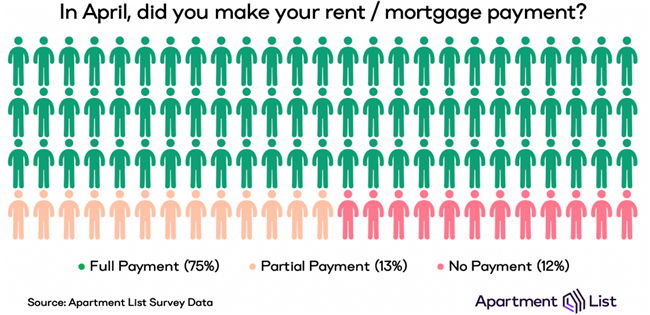
A new survey indicates that one in four Americans were not able to pay their April housing bill in full, according to Apartment List.

The survey showed half of those respondents were able to make a partial payment to their lender or landlord, while the other half made no payment at all.

And one in eight Americans who had a housing payment due this month has not yet paid any portion of it. The survey collected 4,129 responses between April 3 and April 5 across a panel of respondents that match the gender and age distribution of the United States as a whole.

“In the span of less than a month, the COVID-19 pandemic has completely upturned normal daily life throughout the country. With shelter-in-place orders having wiped out millions of jobs, at least temporarily, there was significant uncertainty around what would happen on April 1, the first time that housing payments were due amid this ongoing crisis,” said Chris Salviati, Housing Economist at Apartment List.

“In a nationally representative survey, we found that one in four Americans struggled with their April housing payments – 12 percent of survey respondents made a partial payment toward their rent or mortgage this month and an additional 12 percent made no payment at all.

“These strikingly high figures are well above normal delinquency rates, and the situation could worsen in the coming months.

“For example, even among renters who paid their April rent in full, the report finds that 27 percent are “not at all” or “not very” confident that they could continue to do so if shelter-in-place lasts through June.

“Given that the pandemic is still rapidly evolving, with continued uncertainty around when and how shelter-in-place guidelines will be lifted and what the long-term economic implications will be, it is troubling that we’re already seeing such a pronounced impact on Americans’ ability to pay their housing costs. Although eviction and foreclosure moratoriums are shielding many households from the worst outcomes in the near-term, it’s unclear how things will play out once those moratoriums are lifted,” Salviati said.

Nearly 25 Percent of Americans Couldn’t Pay Their April Housing Bill

Some April housing key survey findings include:

  • In the wake of the coronavirus, a historic number of Americans were unable to afford their rent and mortgage payments this month, as 12 percent of renters paid only part of their April rent bill, while another 12 percent made no payment at all. A similar percentage of homeowners were delinquent on their mortgage obligations.
  • One in every nine renters had their landlord or management company proactively lower their April rent. Among those missing their full payments, 45 percent of renters and 44 percent of homeowners were able to agree to reduced or deferred payments with their landlords and lenders, respectively.
  • Delinquency is correlated with a number of demographic factors. Poorer and younger households had more trouble affording their housing payments, as did those living in denser, more urban parts of the country.
  • The pandemic’s impact on housing affordability could very likely worsen in the coming months. Even among renters who paid their April rent in full, 27 percent are “not at all” or “not very” confident that they could continue to do so if shelter-in-place lasts through June.
  • For homeowners, housing security is buoyed by greater personal savings. Homeowners are over twice as likely as renters to say they could afford housing payments for six months or more if their incomes were lost indefinitely.
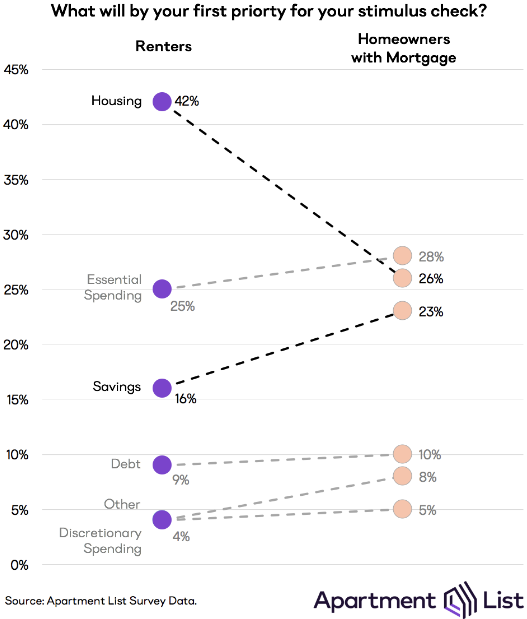
  • Consequently, many renters will prioritize housing costs when government stimulus checks get deposited into their accounts. Homeowners are more likely to prioritize other forms of essential spending, and are more likely than renters to say that they will put their stimulus checks toward savings.

Nearly 25 Percent of Americans Couldn’t Pay Their April Housing Bill

Landlords working to accommodate renters

Responses indicate that landlords and lenders recognize the financial difficulty that many are facing in these turbulent times, and have in many cases been willing to accommodate flexibility with payments, according to the Apartment List survey.

In some cases, these concessions are even being offered proactively by property owners and banks.

  • Eleven percent of all renters indicated that their landlord proactively lowered their April rent.
  • Seven percent of renters asked their landlord for a rent reduction that was approved.
  • Six percent of renters requested to delay their rent payments and had their request approved.
  • Among those who were not able to pay their full April rent, 45 percent received some sort of concession, having agreed to a reduced or deferred rent payment ahead of time.

Get the full report from Apartment List here

Rental Households May Need $7-$12 Billion a Month During COVID-19 Closures

Sign Up For Our Newsletter And Get Apartment News And Helpful, Useful Content Each Week.

* indicates required


Nearly 25 Percent of Americans Couldn’t Pay Their April Housing Bill
Photo credit dusanpetkovic via istockphoto.com

Rent-Deferral Payback Plan Guidelines & What You Need to Know During COVID-19

Rent-Deferral Payback Plan Guidelines

Selecting the right rent-deferral payback plan requires a clear, disciplined approach.

By Ellen Calmas

With April 1 in the rear-view mirror, the next big challenge for rental-housing operators is figuring out how to implement fair and effective rent-deferral payback plans for their communities.

Finding the right payment plan is critical, although the answers are quite different for smaller landlords than for larger, better-capitalized REITS or privately owned corporations that can draw down lines of credit to smooth out rough patches. Large landlords also have better access to their lenders and greater ability to receive deferred or flexible loan payments than do many small landlords.

The National Multi Housing Council and the National Apartment Association both offer a host of resources. What both associations agree on is that automated payments fit well with social distancing while providing increased assurance of payment reliability even in the uncertain times of COVID-19.

Selecting the right rent-deferral payback plan requires a clear, disciplined approach that includes defined parameters for rent deferral (percentage and duration) as well as expectations for payback for participating residents who seek relief. Consistency is key in communications and execution to avoid potential fair-housing violations while maintaining reputational equity. Relief that operators receive in the form of mortgage forbearance or government stimulus should be shared, as possible, with the understanding that we’re all in this together. Real-time insights of resident status will guide decisions throughout the crisis.

Here are some key considerations for property owners and managers in assessing and adapting deferral-payback plans in these extraordinary times:

Rent-Deferral Payback – Let the C-Suite Lead

Already over-burdened community staff aren’t in a position to review each resident’s circumstances on a case-by-case basis to determine ability to pay, and the risks of community-based strategies are many. The appearance of bias can be greatest among residents most hurt by job loss or wage reduction, which could lead to fair-housing Issues and also could cause problems with lenders.  Offers should be consistent across communities.

Cover Your Bases

Involve corporate legal teams to develop documentation to reapply security deposits and accept partial payments for participating residents. Assistance on language for lease addendums is important to ensure that residents fulfill their promises to pay with partial rent deferrals. Consider extending lease duration to give residents time to recover from the current crisis and get caught up on rent without getting further into debt. As a simple gesture of goodwill, refrain from late-rent reporting for the remainder of the year for residents participating in deferral initiatives.  These steps are being articulated by the federal government and may affect the ability to receive relief from the  Coronavirus AidRelief, and Economic Security Act (CARES ACT).

Review Vendor Services w/Scrutiny

Viable, automated payback solutions that assure timely rent delivery will provide the greatest assurance of payment protection, particularly those that accommodate automated direct deposit for payments from unemployment checks. Removing residents from management of funds for rent and getting to the front the line from payroll and special benefits is critical, so your deferral payback plan should be able to deliver on these priorities.

Insert Control Measures

Speak with your enterprise operators about custom reporting and the ability to adjust systems so that residents aren’t constantly receiving late notices.  As importantly, determine access to real-time tracking of resident payback to provide insight into when your residents lose their jobs or have a reduction in hours and wages. Your deferral payback plan should be able to integrate with your system provider.

Stay focused

While March required scrambling to make communities safer, calls for rent strikes and complete rent forgiveness can be distracting and unproductive. Stay clear of the fray. Rent should be paid. How and when is what’s up for grabs.

In this environment, where residents are fearful of being able to get a hospital bed should they need one, it’s important that the rental-housing industry communicate the intent to work together to keep a roof overhead.

About the author:

Rent-Deferral Payback Plan Guidelines & What You Need to Know During COVID-19

Ellen Calmas is Co-Founder and Executive Vice President at Neighborhood Pay Services, the company that pioneered the only rent-from-payroll platform for the rental housing industry, NPS Rent Assurance. She can be reached at ellenc@neighborhoodpayservices.com. In an effort to help landlords in deploying rent deferral/payback initiatives, NPS will defer 30 percent of fees throughout the remainder of 2020, including ongoing disbursement of funds from payroll and/or unemployment benefits.

COVID-19: Landlord/Tenant Law in the Age of Global Pandemic

Sign Up For Our Newsletter And Get Apartment News And Helpful, Useful Content Each Week.

* indicates required