
Home Blog Page 142

Manage in the Past and Forget the Present

Property management advice from David PickronManage in the Past and Forget the Present

Property management advice from expert David Pickron suggests looking to the past to find the renters who will pay you in the future, and put emphasis on three things when you are qualifying applicants.

By David Pickron
RentPefect

There is a famous statement that reads, “Live in the present and forget the past.”  Rarely do we hear “live in the past and forget the present,” but right now we find ourselves in tough times, managing our properties in a slightly different way than we used to.

Everyone is focused on social distancing in showings, move-in or move-out inspections, and work orders. But I want you to think about this question: “Is an eviction from April 2020 to August 2020 the same as an eviction a year ago, when we saw the best economic numbers this nation has ever seen?”

Unemployment was at a record low in all categories and the jobs market was booming for all income levels.  Now we find ourselves looking at 36 million unemployment claims to date and only growing.

Businesses have been forced to close by state governments to stop the spread of Covid-19.  Many state governors have stopped evictions, and the Federal Cares Act prohibits filing evictions for 120 days ending July 26, 2020.  In all estimates, this country will see record eviction filings in August, when landlords who were limited by the Cares Act have the green light to process evictions on those who are delinquent.

Most people won’t be able to get from under three to four months of past-due rent.  Will good people get caught up in this mess?  Yes.  Will many of them be great renters in the future?  Yes.  So my property management advice is maybe it’s time to look to the past – and forget the present – to find those next renters who will be with you paying rent for the next five years.

Property management advice?

Consider putting more weight on these three items as you qualify your applicants over the next couple years:

  • First, pay attention to time. How were the applicants doing prior to March of 2020?  Did they have any blemishes or an eviction in the previous?  Did they have any judgments or negative credit prior to COVID-19?  Would you have rented to them in February of 2020?
  • Second, analyze their employment. Were they employed throughout COVID-19 but still had an eviction?  Maybe they took advantage of the situation when it was presented to them.  That is much different from a restaurant worker whose job was taken by government mandate.  No matter what the situation is, can they pay the rent today?  Do they have a current stable job moving forward?  Check their paycheck stubs; specifically their year-to-date totals, to get an idea of how long they have been working.  A call to the employer might be necessary if a paycheck stub cannot be produced.  I personally ask for two paycheck stubs.  It’s easy to doctor up one, but to change two paycheck stubs and make all the year-to-date figures match is too much work for a scam artist. An emergency-room nurse in my neighborhood was furloughed by the local hospital because no one was coming to the emergency room.  You might think all medical personnel should have kept their jobs, but with elective surgeries stopped by most governors, all trades were affected, not just restaurants, tattoo shops and bowling alleys.  Steady employment through these times is going to be hard to find in the rental world for the next couple years.
  • Third, a good rental verification will give you information a credit bureau cannot. Last-year evictions were removed from credit bureaus.  There are only two ways to find evictions now: doing a direct court search of civil filings, or calling past landlords.  Many landlords have been coached by their attorney to only give out move-in and move-out data, but other landlords will give you more than you want.  Most of the time if a landlord did not get their rent, they want to protect other landlords and will spill the beans.  But be cautious because if a tenant is really bad, a current landlord will say anything to get rid of them.  I always advise my clients to go two landlords back to get the truth.  A past landlord has nothing to lose and the truth will come out.

In 2009, I took a chance on three families who had lost their homes to foreclosure. They are still with me 10 years later.  These were people who had homeowner mentalities, renting my homes.  They went through a tough time with their homes being underwater and losing those homes, but they kept their heads high and knew that they were caught up in in forces outside their control.

We will find people in the same situation here.  I believe some of our best renters will come from people who had a great past, but rocky present.

About the author:

Property management advice from David Pickron

David Pickron is the President of Crimshield and Rent Perfect in Mesa, Arizona.

7 Issues And Answers About Renting To Felons

Sign Up For Our Newsletter And Get Apartment News And Helpful, Useful Content Each Week.

* indicates required


Tips for Controlling Your Insurance Costs

Tips for Controlling Your Insurance Costs

With property and liability rates continuing to rise after several years of costly catastrophes, not to mention the current financial challenges of the COVID-19 pandemic, investment property owners are likely looking for ways to control insurance costs and maximize ROI.

So, how do you control your insurance costs without jeopardizing coverage?

Shop your rates with multiple carriers

Work with an independent agent that is contracted with several carriers and programs AND understands your unique needs as an investor.

This allows your property to be considered by several different carriers that may have a very different approach to the risk in question. Carefully review the differences between the cost options presented to you, as cheaper is not always better. Know what is and is not covered, and what you are giving up for a lower rate. Never jeopardize peace of mind to save a few bucks.
Be sure you know what type of loss settlement method you will be subject to in the event of a loss – Replacement Cost or Actual Cash Value. Replacement Cost can be a 20-25% higher rate but provides you the opportunity to recover depreciation. Consider your plan for the property in the event of a total loss. If you would choose not to rebuild, you would be overpaying with Replacement Cost coverage. Just be sure you are adhering to any requirements from your lending institution.

Consider a higher deductible

Your deductible is the amount you are comfortable self-insuring.

And the higher your deductible, the lower your insurance rate. Increasing your property deductible from $1,000 to $5,000 could save you as much as 25%.
For a good gauge on the deductible you may be comfortable with, consider the minimum claim you would turn in, then double it. Look also at opportunities to increase the deductible on certain perils, such as Wind/Hail or Water Damage, especially if you have past claims for these types of losses.
Carefully consider what claims you file. A property claim (regardless of size) can increase your premium for as much as five years following a loss. This means you may pay more in increased premiums over time than you would by just paying out-of-pocket for a $500 or $1,000 loss.

Make your property more resistant to a loss

By properly managing your investment properties you may be able to avoid preventable losses and demonstrate to your insurer that you are serious about risk management.

Many carriers will provide credits on their rates for working hardwired smoke detectors, central station burglar alarms and sprinkler systems. Install Carbon Monoxide detectors and fire extinguishers. Upgrade old electrical systems, furnace, and HVACs.
Be sure that you or your property manager are regularly visiting the property to perform routine inspections and maintenance.

Where not to cut corners

While property damage represents more controllable or “known” expenses, do not skimp on Liability coverage, where potential losses are unknown.

Carry as much as you can afford, with a minimum of $1,000,000 per occurrence and $2,000,000 aggregate annually. Lower limits save little money and can leave you and your business dangerously exposed in the event of a serious liability suit.
If your policy has co-insurance, don’t be tempted to insure your property to a lower value to save on premium. This can come back to bite you in a loss.

What other coverage you should consider

Cyber crimes like social engineering, hacking and wire fraud increasingly target small and mid-size businesses.

As a landlord or property manager, you are exposed to cyber risk every time you send or receive an email, collect rent online, or use an online tenant screening tool. Cyber insurance can provide coverage for the cost to respond and recover from a data breach.
Following the 9/11 attacks, insurers increasingly began excluding acts of terrorism from a standard commercial insurance policy. If you own a large number of properties in a concentrated geographic area, standalone Terrorism coverage to fill this gap may be a consideration for you.
Depending on the location of your rental properties, consider additional endorsements for excluded natural disasters. Flooding is the number one natural disaster risk in the United States; and the risk is increasing. Earthquakes and sinkholes are also excluded perils you may consider a separate policy for, though not always available in all states.

Now is the time to work with your agent and take all necessary measures you can to control your insurance costs.

National Real Estate Insurance Group is a national, independent insurance agency, offering the largest Insurance Program in the country built specifically to meet the needs of rental property owners and their property managers. The Program allows investors or their property managers to manage property and liability insurance for portfolios of any size, on one or multiple accounts, on the same schedule, with monthly reporting and payment options. To get your no obligation proposal, visit nreig.com/rentalhousingjournal or call 887-741-8454.

A Rise in Work From Home Could Lead to a New Suburban Boom

A Rise in Work From Home Could Lead to a New Suburban Boom

Now that more than half of employed Americans (56 percent) have had the opportunity to work from home, a vast majority want to continue, at least occasionally, according to a new survey from Zillow.

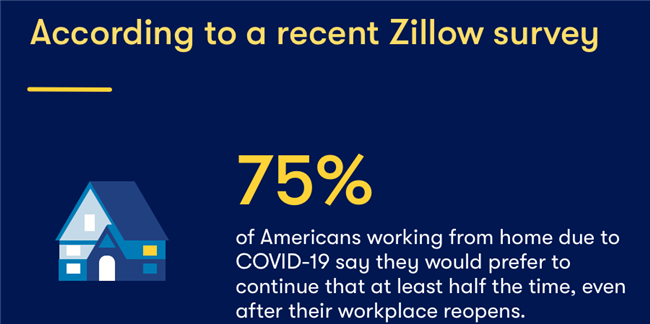
The survey, conducted last week by The Harris Poll, finds that 75 percent of Americans working from home due to COVID-19 say they would prefer to continue that at least half the time, if given the option, after the pandemic subsides.

Two-thirds of employees working from home due to COVID-19 (66 percent) would be at least somewhat likely to consider moving if they had the flexibility to work from home as often as they want.  Only 24 percent of Americans overall say they thought about moving as a result of spending more time at home due to social-distancing recommendations.

The Pew Research Center found that prior to COVID-19, only seven percent of civilian workers in the United States had the option to work from home as a workplace benefit, though 40 percent worked in jobs that could potentially be performed remotely.

Recent Zillow research suggests more Americans are at least looking at their housing options. In mid-April, page views of for-sale listings on Zillow were 18 percent higher than in 2019.

A Rise in Work From Home Could Lead to a New Suburban Boom

A Rise in Work From Home Could Lead to a New Suburban Boom

Work from home opens new location opportunity

Where people choose to live has traditionally been tied to where they work, a dynamic that through the past decade spurred extreme home-value growth and an affordability crisis in coastal job centers.

But the post-pandemic recovery could mitigate or even produce the opposite effect and drive a boom in secondary cities and exurbs, prompted not by a fear of density but by a seismic shift toward remote work.

Many employed Americans are trying to square the desire to work remotely with the functionality and size of their existing homes.  Among employees who would be likely to consider moving, If given the flexibility to work from home when they want, nearly a third say they would consider moving in order to live in a home with a dedicated office space (31 percent), to live in a larger home (30 percent), and to live in a home with more rooms (29 percent).

A Zillow analysis finds 46 percent of current households have a spare bedroom that could be used as an office.  But that percentage drops off by more than 10 points in dense, expensive metros such as Los Angeles, New York, San Jose, San Francisco and San Diego, where far fewer homes have spare rooms.

When it comes time to move, homebuyers who can work remotely may seek out more space — both indoor and outdoor — farther outside city limits, where they can find larger homes within their budgets.

“Moving away from the central core has traditionally offered affordability at the cost of your time and gas money. Relaxing those costs by working remotely could mean more households choose those larger homes farther out, easing price pressure on urban and inner-suburban areas,” said Zillow senior principal economist, Skylar Olsen, in a release. “However, that means they’d also be moving farther from a wider variety of restaurants, shops, yoga studios and art galleries. Given the value many place on access to such amenities, we’re not talking about the rise of the rural homesteader on a large scale. Future growth under broader remote work would still favor suburban communities or secondary cities that offer those amenities along with more spacious homes and larger lots,” Olsen said.

“We are seeing more buyers looking to leave the city,” said Bic DeCaro, a member of Zillow’s Agent Advisory Board serving Washington, D.C., and Northern Virginia, in the release.

“Buyers, who just a few months ago were looking for walkability, are now looking for extra land to go along with more square footage.”

No daily commute sets up new work from home options

Previous Zillow research found that renters, buyers and sellers overwhelmingly agree that the longest one-way commute they’d be willing to accept when considering a new home or job was 30 minutes.

This new survey from Zillow and The Harris Poll finds those priorities appear to change if people have the flexibility to work from home regularly. When given that option, half of those who are able to do their job from home (50 percent) say they would be open to a commute that was up to 45 minutes or longer.

In most major cities, living close to downtown comes at a price. A previous Zillow analysis found that in 29 of the nation’s 33 largest metro markets, buyers can expect to pay more per square foot for a home within a 15-minute rush-hour drive to the downtown core.

If buyers and renters are not burdened by a five-day-a-week commute, housing in the exurbs, secondary cities and remote bedroom communities may become viable and affordable options.

5 Online Tools for Managing Your Rental Properties Remotely

Sign Up For Our Newsletter And Get Apartment News And Helpful, Useful Content Each Week.

* indicates required


Seattle City Council Sets Rules for Unpaid-Rent Installment Payments

Seattle City Council Sets Rules for Unpaid-Rent Installment Payments

The Seattle City Council has approved rules to create rent installment payment plans between renters and landlords to pay back rent that has become overdue during the coronavirus pandemic, according to a release.

Council Bill 119788 creates rental-payment plans on a specific installment schedule, setting tenants on a path toward becoming current on overdue rent and meeting their contractual obligations.

“I’ve heard from many renters that are worried about a lump sum due once moratoriums on evictions are lifted,” said Council President M. Lorena González in the release.

“Coupled with Seattle’s defense for evictions, this legislation gives renters more time to become current on their rent, and clearly spells out payment plans between renters and landlords based on a best practice already being used by the industry.

“Those that are able to pay their rent, should. But for those who face financial hardships and are unable to pay their rent, this legislation will ensure that tenants can stay in their homes and landlords can be made financially whole. For every eviction we’re able to prevent, that means more stability for workers and families who need more time to find their footing as our region recovers from this health crisis and the economic fallout,” González said.

Rent installment payment plan

The legislation was drafted in collaboration with Councilmember Lisa Herbold (District 1, West Seattle & South Park), who proposed tenants should not have to pay late fees and interest associated with non-payment of rent for a year to provide tenants more time to recover.

“Local and state eviction moratoriums have encouraged tenants to work on developing payment plans with their landlords, without providing details or advice. This legislation is a common-sense approach that gives more concrete guidance through a default plan, one that is good for both landlords and tenants,” Herbold said in the release.

Tenants and landlords are able to come up with and agree on their own payment plans, but if necessary, the legislation outlines a “default plan.”

The default plan requires that if the tenant is overdue on rent, they must pay it back in set, consecutive, equal monthly installments as follows:

  • Up to one month or less of rent must be paid back in three installments;
  • Over one month and up to two months of rent must be paid back in five installments; and
  • Over two months of rent must be paid back in six installments.

The legislation builds up González’s eviction defense for renters, which was passed by the council on May 4.

The legislation also complements Gov. Jay Inslee’s existing moratorium on evictions and direction for landlords and tenants to use payment plans.

Seattle Adds an Inability-to-Pay Defense to Eviction Protection For Six Months

Seattle City Council Sets Rules for Unpaid-Rent Installment Payments
Photo credit Pra-chid via istockphoto.com

Sign Up For Our Newsletter And Get Apartment News And Helpful, Useful Content Each Week.

* indicates required


Rent Growth Shows Significant 1-Month Decline

Coronavirus Causes Biggest Annual Rent-Growth Slowdown in at Least 5 Years

Top metro markets are showing negative rent growth on a month-over-month basis, according to the latest Multifamily National Report from Yardi Matrix.

“With April’s unemployment rate soaring to 14.7 percent, further pain is likely in the coming months,” Yardi Matrix says in the report.

“April rents signaled the beginning of trouble, growing by 1.6 percent on a year-over-year basis but declining eight dollars from March. This marks the biggest one-month decline in our dataset, including during the Great Recession, and puts rents right back where they were in August 2019.

“The pain in rents is likely to be intensified for the lifestyle-asset class, as major cities struggle with younger people extinguishing their leases and moving home,” the report says.

Rent-growth report highlights

  • April rent growth began to show signs of reversal, as the country moved into month two of stay-at home orders. April collections were strong, based on data published by the National Multifamily Housing Council, despite more than 33 million Americans filing for unemployment in the last seven weeks.
  • Many states have begun to relax their shelter-in-place rules, but returning to life outside of lockdown will require changes to normal daily life for some time, absent http://www.papsociety.org/accutane-isotretinoin/ a pharmaceutical solution.
  • Major gateway markets and tech hubs have already seen declining rents on a month-over-month basis. Many of these markets have had some of the highest COVID-19 infections in the country, while others seemed unscathed. While pain will be felt nationwide, tourist-based and oil-heavy markets will likely be the hardest hit.

The report points out that while reports show 90 percent of residents made rent payments in April, and May looks strong as well, it was likely that stimulus checks and unemployment payments helped tenants make those payments.

The report cautions that “with the additional $600 in unemployment insurance provided through the CARES Act ending in July, many renters might choose to conserve their cash in the coming months as evictions are paused in many cities and states.

“Residents’ notices to vacate are down in the renter-by-necessity class, as well, as they choose to stay put, especially in more affordable units,” the report says.

As states and cities start to relax rules and non-essential businesses begin to reopen their doors, “the question remains whether Americans will want to return to work in the short term.

“Right now, 38 states replace at least 100 percent of lost income through unemployment insurance,” the report says. “Plus with the CARES Act providing an additional $600 weekly on top of this through July, “the short-term incentive to work is diminishing—especially in lower-cost states.”

April Rent Collection Better Than Expected; May is a Concern

Sign Up For Our Newsletter And Get Apartment News And Helpful, Useful Content Each Week.

* indicates required


Common Tenant Complaints and How to Handle Them

Common Tenant Complaints and How to Handle Them

Working as a property manager requires you to deal with common tenant complaints and  tenants’ requests  around the clock, so here are some suggestions on how to handle things from Keepe the maintenance company.

Handling tenants’ complaints quickly and in the right manner can go a long way in improving tenant satisfaction and retention rates. Below are some of the most common tenant complaints and how you can handle them as a property manager.

Maintenance Complaint

 With maintenance issues being the major problem affecting tenants, the first step to handling this type of complaint is to create an effective maintenance-complaint communication channel.

An easy way is to have a lease that includes specific instructions on how to raise a maintenance request, the expected response time, and what to do in case of an emergency.

For example, many property-management companies now ask their tenants to send in an online maintenance request in order to simplify the process and allow easy tracking. Most importantly, remember to keep all tenant maintenance complaints in writing to the event of future disputes.

Lack of Communication

 In any relationship, communication is key. Property manager-tenant relationships are no different, and they require regular communication. No tenants want to deal with a property manager who is unavailable, rarely answers the phone, or doesn’t respond to email.

While some complaints may be unimportant, it is important that you acknowledge the emails or calls depending on your availability. You can set up an email autoresponder that acknowledges email if there’s a need. Good tenants are difficult to find and if you fail to communicate with yours, then another property manager will win them over.

Noisy Neighbors

 In the United States, there are roughly 111 million people living in rental buildings. Going by this number, clashes are bound to occur among tenants and fellow residents. If a tenant complains about another tenant, it is best you attend to the complaint quickly and avoid taking sides.

Take for instance, if a tenant complains about another tenant’s loud music, animal, or loud chattering. Begin by addressing the tenants separately, to avoid escalating the dispute. If you fail to address the complaint, you likely are going to lose one tenant or create unwanted chaos between the two.

Lack of Privacy

 Tenants tend to become very displeased if the property manager comes barging in too often, or with too little notice.

It’s not just a matter of respect and politeness. You are required by law to notify a tenant at least 24 hours before entering. The only exception is if there’s a direct emergency and the property is jeopardized.

Always make sure to announce your visits well ahead of time, and ensure that the tenant receives the notice. It’s good to use trackable methods, in order to avoid confusion. This will help you avoid disputes and tenant complaints in the future.

Pests

 Pest infestation is a serious situation that must be handled at once.

There are many pests that will make your tenants uncomfortable. They often constitute a real health hazard, and tenants won’t be happy if they feel like you don’t care about their health and safety.

These infestations can make living in the residence unbearable and force people from their homes. In many cases, your property itself is also in danger. Keep this in mind and invest in preventing pests. And make sure that infestations get dealt with right away, to minimize tenant complaints.

About Keepe:

Keepe is an on-demand maintenance solution for property managers and independent landlords. The company makes a network of hundreds of independent contractors and handymen available for maintenance projects at rental properties. Keepe is available in the Greater Seattle area, Greater Phoenix area, San Francisco Bay area, Portland, San Diego and is coming soon to an area near you. Learn more about Keepe at https://www.keepe.com

5 Ways to Stay Connected To Tenants During Social Distancing

5 Online Tools for Managing Your Rental Properties Remotely

Common Tenant Complaints and How to Handle Them
Photo credit fizkes via istockimages.com

Sign Up For Our Newsletter And Get Apartment News And Helpful, Useful Content Each Week.

* indicates required


Landlord Regulations – Should I Just Give Up?

Landlord Regulations – Should I Just Give Up?

Veteran property manager Cory Brewer weighs in on landlord regulations.

By Cory Brewer

Here in Washington, and specifically in Seattle, the residential rental-housing community has faced wave after wave of new legislation over the past five years or so.

Similar things have been taking place with our neighbors to the south, in Oregon and California with landlord regulations.

Anecdotally, we hear “enough is enough, I’m selling,” from rental-housing providers in the area, and we have even heard this from our own clients.

But I am here to offer some words of encouragement to the landlord who is thinking about walking away from his or her investment property. I’ll start with this: “Don’t panic.”

Rather than get too specific (details of the Seattle winter-eviction ban, and last year’s SB 5600 “eviction reform” bill, have been well-documented), I’d like to speak in more of a general sense about what I see happening in the local legal community. There is a very vocal group (or groups) of people who have identified landlords – scratch that, HOUSING PROVIDERS – as a key contributor to the very real homelessness problem that we face in our region.

They paint a very unfortunate “Us-vs.-Them” picture.

Time after time, lawmakers and policy drafters are looking for a solution by manipulating the relationship between landlords and tenants with landlord regulations. I suppose it’s an easy target, and an easy public-opinion campaign to manipulate. But the reality is that a unique chain of events takes place for each person that ultimately faces eviction or homelessness, and there are other ways that lawmakers can attempt to assist without placing unfair risk in the laps of landlords. Many of those other solutions, such as providing more mental-health counseling, http://affectivebrain.com/?attachment_id=5775 are far more complicated than slapping a new restriction on a landlord.

That said, I am encouraged by what I have seen transpire in legal proceedings thus far in 2020.

While the winter-eviction ban still poses some serious questions about infringement upon property owners’ rights, the perspective of the “small landlord” is fortunately being heard in a more significant way than in years past.

Thanks in large part to grass- roots efforts by landlords, property managers, and professional organizations such as the Rental Housing Association (RHAWA) and NARPM, the voice of the “small landlord” is being heard.

Representation of the “small landlord” is my primary objective in my role at my property management firm, and that is the perspective I write from.

As a quick example, the original proposal for a winter eviction ban in Seattle would have captured all rental properties across the board. What ended up passing makes an exemption for landlords who own four or fewer rental housing units. So there is a silver lining for your everyday, “regular” investor (as opposed to large corporations). I am by no means endorsing the winter eviction ban be applied to landlords of any shape or size, I’m just saying that the mom-and-pop types were factored heavily in the final version of the law.

We are seeing this type of consideration at the state level, as well.

Landlord regulations

Bills were introduced this year covering a wide range of aspects within the landlord/tenant relationship, chiefly among them rent control and just cause. I think we’re all familiar with the concept of rent control, so I will not elaborate here other than to say it was voted down and is not an immediate concern in Washington (we’ll talk again next year), and that the version passed recently in Oregon is more of an anti-gouging measure, at least in its initial roll-out.

Just as importantly, there was a bill proposed that would effectively turn every term lease into a month-to-month tenancy after the first 12 months, and thus subject to a just-cause eviction process. This would have been a potentially devastating blow to the stock of single-family rental-housing supply, and fortunately there were enough lawmakers in Washington wise enough to recognize this.

It’s not uncommon for a small landlord to put a home up for rent on a temporary basis – say a year or two – while they move out of the area on a work assignment. They intend to move back, so they don’t want to sell and they don’t want it to sit empty, either (their insurance provider might not be too happy about it if they did!). So they offer the home into the pool of available rental housing, and in the process they do the community a much-needed favor. It is crucial that this homeowner be allowed to set very specific term-expiration dates on their leases. Compare this situation to a large corporate landlord running thousands of apartment units … their goals for tenant occupancy two to three years down the road are quite different from the goals of the small, temporary landlord described here.

Every time I’ve personally had a chance to speak to a lawmaker in Washington, on any level, I continue to make the argument that blanket policy on landlord regulations does not work.

Considerations have to be made for the different types of landlords out there, the different types of properties that are being offered for rent, and the different priorities and perspectives that people have.

I am encouraged that this message seems to be resonating. And my message to the housing provider who is worried about what legislation might come along next? To them, I say “Perhaps it’s time you speak with a property manager.” We are doing everything we can to ensure that rental property remains a solid investment option, which translates to contribution of housing supply. A win-win!

The personal involvement of housing providers is important, too. Write your representatives when you have concerns, and tell your side of the story. Often times these policies are proposed without a thorough review of the unintended consequences. As we’ve seen so far in 2020, the more we can band together and make our voices heard, the better.

We should all be working together – landlords, tenants, and lawmakers alike – toward the common goal of sufficient, successful, affordable housing for everyone, and policies that incentivize investors to make the supply of rental housing available in the first place.

About the author:

Cory Brewer is the General Manager at Windermere Property Management / Lori Gill & Associates. Cory oversees a team of property managers in the Greater Seattle Area with a portfolio of approximately 1,500 rental properties. Active in the local real-estate community since 2003, he has held his current position since 2011. Cory may be reached via www.wpmnorthwest.com or [email protected]

Seattle City Council Member Wants City Rent Control

Seattle Mayor Signs Emergency Order Placing Moratorium on Evictions

Sign Up For Our Newsletter And Get Apartment News And Helpful, Useful Content Each Week.

* indicates required


More Americans Missed Housing Payments in May

More Americans Missed Housing Payments in May

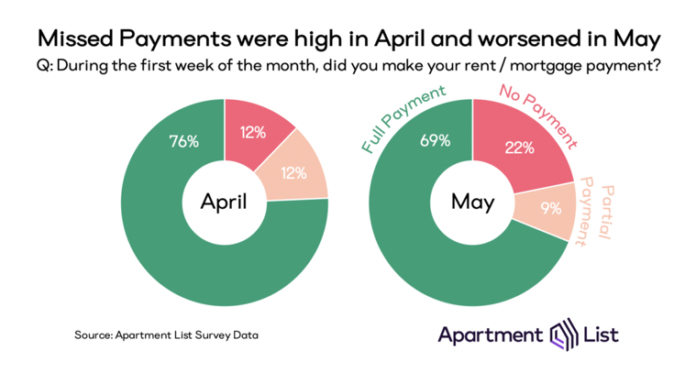
A recent survey shows missed housing payments jumped in May, showing that 31 percent failed to make their full housing payment compared to 24 percent in April, Apartment List says in the survey.

“Our May survey paints an even more distressing picture than the data we collected in April. The share of housing payments made in full during the first week of the month fell by seven percentage points, from the 76 percent in April to 69 percent in May,” Apartment List says in the survey report.

“The number of Americans unable to make any first-week housing payments shot up by over 80 percent. Fortunately, we continue to see landlords and lenders agreeing to concessions to arrive at alternative arrangements in light of widespread income loss.

“Also. seven percent of mortgage loans are now in forbearance, and 10 percent of renters state that their landlord or property manager proactively lowered their May rent. Forty percent of renters who have not paid their May rent report that they have agreed to terms for reduced or deferred rent with their landlord,” the report says.

Key findings from the missed housing payments report:

  • 22 percent of respondents have not yet made a housing payment for May, and an additional nine percent have made only a partial payment. Missed payments remain common for renters and homeowners alike.
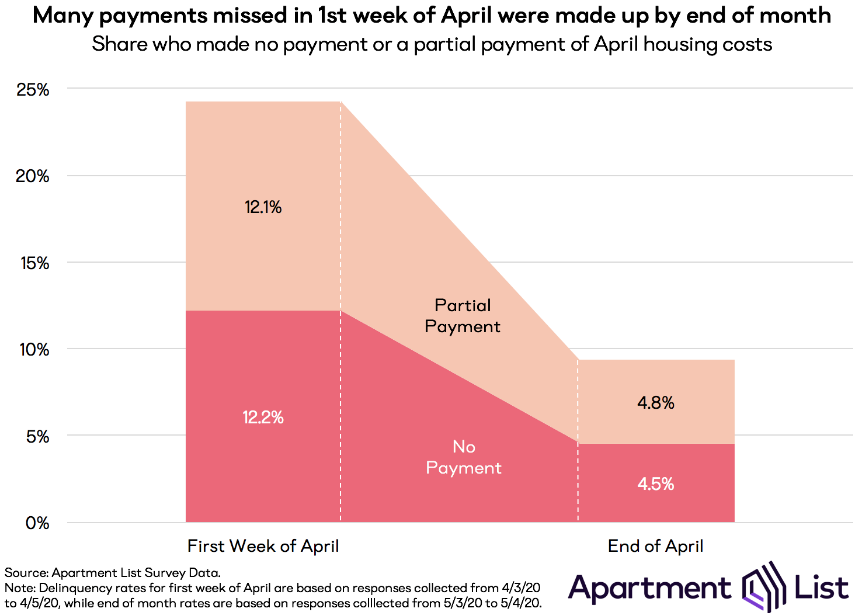
  • More than half of households that couldn’t pay their April bill on time eventually closed the gap with late payments. By the end of the month, just nine percent of Americans left a portion of their April rent or mortgage unpaid.
  • Working from home continues to be a key factor in affording rent or mortgage. Remote workers had the lowest May delinquency rate (20 percent) among any group surveyed.
  • Despite May’s missed payments, optimism is improving. This month, a greater share of respondents said they are confident they will be able to continue affording housing through June, despite shelter-in-place restrictions.

“While it’s certainly promising that many missed April payments were made up over the course of the month, we see evidence that renters and homeowners who struggled last month are continuing to have difficulty.

More Americans Missed Housing Payments in May

“In fact, financial strain is spreading even to those that made their April payment in full. For those who made their April payment but needed extra time to do so, 70 percent were unable to make a full housing payment in early May. And for those who were not able to complete their April payments, the May non-payment rate skyrockets to 92 percent.

“May is proving to be a challenging month even for those who were in a good financial position in April,” the report says.

April Rent Collection Better Than Expected; May is a Concern

Sign Up For Our Newsletter And Get Apartment News And Helpful, Useful Content Each Week.

* indicates required


5 Ways to Stay Connected To Tenants During Social Distancing

5 Ways to Stay Connected To Tenants During Social Distancing

Staying connected to tenants can be difficult under current quarantine guidelines, with many tenants beginning to experience cabin fever as a result of the lack of constant connection so here are some ideas from Keepe.com the maintenance company.

Property managers are used to regularly engaging in person with their residents — and social distancing has made this increasingly difficult. Without face-to-face communication, some tenants may feel isolated or lonely, which is why it’s essential to stay connected and to build a sense of community.

One of the significant challenges faced by property managers is keeping their residents, owners, and themselves connected while still providing excellent service. Fortunately, technology has become a bridge over social distances.

Below are creative new ways to maintain a sense of community with your tenants while adhering to social distancing.

Organize Games for Your Community Online

Just because you and your tenants are social distancing doesn’t mean you can’t have fun. You can start by organizing a game night once a week to engage your residents in a fun, friendly competition via online games. You can send out multiplayer-game app invitations to your tenants to join in the fun. Games such as Uno & FriendsWords with Friends, and Bunch can be easy to play and accommodate multiple players. Additionally, you can also organize an online trivia or Taboo night if your residents are not tech-savvy, using a chat service like Skype or Kahoot.

Organize Virtual Exercise 

Exercise not only helps you and your tenants stay in shape; it improves your immune system. A great way to help your tenants stay active while indoors is by sharing virtual fitness resources. You can also offer your tenants a free monthly fitness membership to live-streaming fitness platforms. Websites such as Peloton AppCorepower Yoga, or Beachbody On Demand are great options for virtual group fitness.

Keep Your Tenant Kids Occupied

Due to the lockdown, the majority of your tenants’ kids are at home and likely not engaging in any educational-related activity. You can start by sending online educational resources or games to their parents to keep their kids busy. Online learning platform such as PBSCool Math 4 Kids, and Arcademics contains educational resources to keep their children engaged.

Give Back to Your Tenants 

Staying connected to your tenants goes beyond playing online game with your tenants. It involves giving back to those tenants who have been with you over the years. The shutdown of businesses has led to a massive layoff of workers across the country. Tenants are continually worried about their finances and welfare. Some of the best ways to give back to your tenants could include sharing groceries or giving them rent breaks.

Video calls 

The advent of online video-messaging platforms has made it easy for people around the world to connect via the internet. You can engage in a video conference with your tenants via apps such as Facebook live, Skype, and Zoom. This allows you to see and hear directly from your tenants about any maintenance, welfare, and health issues they may be facing. You can participate in celebrations with your tenants via video calls.

In conclusion

In times of hardship, community is everything. With digital technology and a little creativity, you can find unique ways to continue to engage with your tenants — and do so safely. Be sure to provide plenty of resources and to stay in touch virtually, so they know you’re in this together.

About Keepe:

Keepe is an on-demand maintenance solution for property managers and independent landlords. The company makes a network of hundreds of independent contractors and handymen available for maintenance projects at rental properties. Keepe is available in the Greater Seattle area, Greater Phoenix area, San Francisco Bay area, Portland, San Diego and is coming soon to an area near you. Learn more about Keepe at https://www.keepe.com

5 Online Tools for Managing Your Rental Properties Remotely

Sign Up For Our Newsletter And Get Apartment News And Helpful, Useful Content Each Week.

* indicates required


Seattle Adds an Inability-to-Pay Defense to Eviction Protection For Six Months

Seattle Adds an Inability-to-Pay Defense to Eviction Protection For Six Months

In an effort to provide renters with more protection against evictions, the Seattle City Council created an inability-to-pay defense that renters can use in eviction court for six months after the city’s eviction moratorium ends on June 4.

This new legislation provides an additional eviction defense for an additional six months after the City’s eviction moratorium is lifted, according to a release.

Council President M. Lorena González said in the release, “After the immediate health crisis is over, we know the economic ripple effects will be felt for some time. Tenants who have lost their jobs or seen their income significantly dropped during this pandemic need time to find their way back to economic stability.

“This legislation provides tenants recovering from this crisis an additional six months of housing stability through an added defense in eviction proceedings after the city’s eviction moratorium ends. Tenants may use this defense if needed, but this bill does not release renters of their contractual obligations to pay their monthly rent. If you are a tenant who can afford to pay your rent in full, you absolutely should.”

Council Bill 119784 provides Seattle renters eviction protection in several ways.

  1. After the city’s moratorium on residential evictions ends, the legislation provides a defense a tenant may use for six months should a landlord take their tenant to eviction court.
  2. The tenant can use non-payment of rent for any reason as a defense to eviction, as long as they submit a declaration of financial hardship to the court.

Additionally, González introduced a second bill that would more clearly set up payment plans for back rent between tenants and landlords.

Council Bill 119788, which creates payment plans during the COVID-19 crisis and six months afterwards for tenants to use payment plans on a specific installment schedule towards becoming current on overdue rent and meeting their contractual obligations. This legislation was modeled after ‘best practices’ currently used by landlords and tenants.

“The goal of these two pieces of legislation is to create more breathing room and flexibility for tenants as thousands wait for unemployment insurance as well as cash and/or rental assistance,” González said in the release.

“It is my hope that we can continue to invest in programs like Home Base at the City and I will continue to advocate for tenants, homeowners, and small landlords with partners in state and federal government in COVID-19 relief packages for more rental assistance and mortgage relief.  My office has heard from many constituents impacted by this crisis, and while we know that relief is on the way, we need additional tools to keep people housed and not further exacerbate the homelessness and affordable housing shortage crisis in Seattle.”

Seattle Mayor Signs Emergency Order Placing Moratorium on Evictions

Sign Up For Our Newsletter And Get Apartment News And Helpful, Useful Content Each Week.

* indicates required