
Home Blog Page 12

Fair-Housing Mythbusters: ESA Denial, from Apartments to Dorms

An ESA myth housing providers have that in certain situations they can deny an emotional support -most scenarios are rooted in myth not law.

A misconception many housing providers face is the belief that certain situations justify denying an emotional support animal (ESA) request and most of these scenarios are rooted in myth rather than law.

By the Fair Housing Institute

Emotional support animals (ESAs) remain one of the most misunderstood areas of fair-housing compliance.

While property managers and housing providers often encounter resident concerns about animals, the Fair Housing Act sets clear boundaries. When a resident or student has a verified disability and a legitimate need for an ESA, housing providers must make reasonable accommodations.

This applies across the board, whether the setting is a college dormitory or a multifamily apartment complex.

The biggest misconception many housing providers face is the belief that certain situations justify denying an ESA request. In reality, most of these scenarios are rooted in myth rather than law.

Myth 1: Certain Breeds Can Be Banned

One of the most common concerns surrounds specific dog breeds, particularly pit bulls. Community fears often lead housing providers to believe they can deny an ESA based on breed restrictions.

However, the Fair Housing Act does not allow this.

What providers can and should do is ensure they carry adequate liability insurance that covers any potential incident involving animals on their property. What they cannot do is shift that responsibility onto the resident or deny an ESA solely because of breed.

Myth 2: College Housing Is Exempt

Another frequent misconception is that ESAs do not apply to college or university housing. Because dormitories operate differently from standard rental housing, some providers assume they are exempt from ESA requirements.

In truth, student housing falls under the same legal framework as other housing providers. If a student presents proper documentation verifying a disability and the need for an ESA, the institution must accommodate them. Denial based on housing type is a clear violation of the Fair Housing Act.

Myth 3: ESAs Must Be Hypoallergenic

Concerns about allergies often surface when an ESA request is made. Some housing providers may think they can deny an animal because it is not hypoallergenic.

Generally, this is not a valid reason for denial. Only in rare cases, such as communal living arrangements where another resident’s medical needs are directly at stake, might this factor be considered. Even then, careful evaluation is required to ensure compliance with fair-housing standards.

Myth 4: Multiple ESAs Are Not Allowed

Another area of confusion is the number of ESAs a resident is allowed to have. Some providers believe there is a limit, or that multiple animals are automatically unreasonable.

The truth is that each request must be evaluated on an individual basis.

If a resident can demonstrate medical documentation supporting the need for more than one animal, the request should be processed accordingly. Past acceptance of the animals or long-term residency also plays a role in evaluating the request fairly.

Myth 5: Late Disclosure Justifies Denial

A final misconception arises when residents disclose their ESA needs after moving in or after being approved for housing. Providers sometimes view this as dishonest and believe they can deny the request.

While late disclosure is not ideal, it does not invalidate the resident’s rights.

Housing providers must still process the request through the reasonable-accommodation process. Maintaining professionalism and consistency is essential in these situations to avoid the appearance of retaliation or discrimination.

Building Confidence Through Compliance

The key to addressing ESA-related concerns is not to rely on assumptions but to return to the principles of fair-housing law.

Denials based on myths or misunderstandings can quickly escalate into complaints or legal action.

For example, some residents may purchase ESA letters online to back up requests tied to these myths, such as breed restrictions, hypoallergenic requirements, or multiple animals. These letters can be misleading, and they often complicate the verification process for housing providers.

The best way forward is through training, consistency, and careful evaluation of each request.

By separating fact from fiction and staying alert to new challenges like online ESA letters, housing providers can protect themselves from costly mistakes while fostering trust and fairness in their communities.

Compliance is not just about following the law; it’s about creating housing environments where residents feel supported and respected.

About the author:

In 2005, The Fair Housing Institute was founded as a company with one goal: to provide educational and entertaining fair-housing compliance training at an affordable price at the click of a button.


Sign Up For Our Weekly Newsletter And Get Rental Property And Apartment News And Helpful, Useful Content Each Week.

* indicates required

August Rent Growth Flat in Summer Slowdown

Multifamily rent growth was flat nationally in August as demand kept up with supply, according to Yardi Matrix August report

Multifamily rent growth was flat nationally in August as demand kept up with supply, according to market research company Yardi Matrix.

“Rent growth is expected to remain lackluster through year-end. Momentum is slowing across most metros, as only a few markets recorded more than 3% year-over-year growth,” according to the monthly report.

The slowdown in rents is primarily driven by too much supply rather than demand for rentals.

“However, supply pressures are beginning to ease, with most metros past their peak supply and new starts declining sharply due to the cost of construction and tighter financing,” the report says.

Highlights of the report:

  • Multifamily rents changed little in August due to seasonality and rising uncertainty about consumers’ financial health. The average U.S. advertised rent fell $1 to $1,755 in August while year-over-year growth fell 10 basis points to 0.7%.
  • After two years of extraordinary gains following the pandemic, rents nationally have settled into a slow-growth pattern over the last three years in which increases are moderate and mostly limited to the spring. If the pattern holds, rents will change little in coming months.
  • Single-family build-to-rent advertised rates were unchanged in August, but stood at a record high of $2,208. Rent growth is at least 5% year-over-year in Chicago, Kansas City, Twin Cities and Columbus and negative in high-supply markets including Austin, Tampa, Raleigh and Denver.
  • Consumer budgets are tightening due to rising costs and the softening job market.

Interest rates and labor market

Possible interest rate cuts by the Federal Reserve are not likely to be enough to turn around the home-sale market.

“As a result, many prospective buyers will remain renters, supporting multifamily demand,” the report says.

Price increases may happen in coming months as they are filtered through supply chains and distribution networks. While layoffs remain muted, the labor market remains delicate.

Governments Are Trying to Help

  • The growth in housing costs in recent years has spurred legislators at all levels of government to act to create more housing supply.
  • Hundreds of pro-housing bills have been introduced in states this year, dozens of which are now law in states such as California, Texas and Michigan.
  • While the legislative efforts are a positive start, they come at a time when apartment starts are dropping and the impact could be years away.

Read the full report from Yardi Matrix here.

Sign Up For Our Weekly Newsletter And Get Rental Property And Apartment News And Helpful, Useful Content Each Week.

* indicates required

Trouble Finding Tenants Who Can Pass HOA Screening

How to find tenants who can pass the HOA Screening and requirements is the question this week for a condo owner with a lease up

How to find tenants who can pass the HOA Screening and requirements is the question this week for Ask Landlord Hank. Remember Hank is not an attorney and he is not offering legal advice. If you have a question for him please fill out the form below.

Hi Hank,

Our condo will be going up for lease probably on November 1st or December 1st.

We have managed the leasing ourselves for the past couple of tenants and are now considering using an agency.

One concern for us has been that the pool of people responding to our ads for the condo have been people who could not pass the screening in our HOA.

Can you tell me where you advertise properties and how you screen potential tenants?

-Camela

Dear Landlady Camela,

The most important part of the landlord/property-management business plan is to find a good quality tenant.

It sounds like you are doing an excellent job of screening tenants for your place if you know they wouldn’t pass the HOA requirements.

My requirements for a good quality tenant are someone with good credit, who makes at least three times the rent, has a clean background, has good rental history for the last 5 years, is not a sex offender/predator and not on any terror watch list.

This is strictly business, so I don’t mind turning folks down that don’t fit minimum requirements.

We advertise on MLS, our website, Zillow, Trulia, Realtor.com, Hotpads, Facebook, and about 40 other websites you never heard of like Padmapper, Apartments.com and Rental Beast, etc.

The market is very slow now in this area of Florida due to all the inventory in apartments and decreased migration to this area. Be selective; it may take time, but it’s worth it for the right tenant.

Sincerely,

Hank Rossi
Each week I answer questions from landlords and property managers across the country in my “Dear Landlord Hank” blog in the digital magazine Rental Housing Journal. www.rentsrq.com   https://rentalhousingjournal.com/asklandlordhank/

Ask Landlord Hank Your Question

Ask veteran landlord and property manager Hank Rossi your questions from tenant screening to leases to pets and more! He provides answers each week to landlords.

  • This field is for validation purposes and should be left unchanged.

How to find tenants who can pass the HOA Screening and requirements is the question this week for a condo owner with a lease up.
Landlord Hank Rossi says, “My requirements for a good quality tenant are someone with good credit, who makes at least three times the rent, has a clean background, has good rental history for the last 5 years, is not a sex offender/predator and not on any terror watch list.”

Can I Get Tenant’s Inoperable Car Towed Off My Rental Property?

How To Handle Ugly Feud Between Two Sets of Tenants?

Tenants Pouring Grease Down Sink And Flushing Paper Towels

Do You Know The 5 Questions Landlord Hank Asks Tenants When They Call?

Sign Up For Our Newsletter And Get Rental Property News And Helpful, Useful Content Each Week.

* indicates required

Photo credit AndreyPopov via istockimages

Rentana, Orion Partnership Shows Operators How To Outperform Market Downturns

Rentana, Orion partnership shows multifamily operators how to outperform market downturns and off-peak seasons to protect revenue

With seasonal leasing lulls approaching, multifamily leaders are seeking smarter ways to outperform market downturns and protect revenue while keeping teams lean, according to a release from Rentana.

Rentana, an AI-powered revenue intelligence platform that helps owners and operators turn slowdowns into growth opportunities, has announced a partnership with Orion Real Estate Partners, a tech-forward investment firm.

“Orion worked through a manual, time-consuming pricing process that was seeing rent decline by 3.5%. Digging through multiple systems and reports to assess pricing was inefficient and proving unsuccessful. Orion needed a way to boost efficiency and portfolio performance without adding headcount,” according to a release.

After evaluating the revenue management landscape, Orion chose Rentana for its real-time, personalized insights delivered through an intuitive, privacy-first platform. Within just five months, Orion achieved measurable results:

  • Return on Investment: 350% within 5 months
  • Faster Pricing Reviews: slashed 6x – from 1 hour to 10 minutes per property per day, leaving more time to find other operational opportunities
  • Accelerating Occupancy: increased by 2% enabling greater pricing power

“With Rentana, we’ve elevated our decision-making to a new level,” Mark Limpert, Principal at Orion Real Estate Partners, said in the release.

“The platform delivers intelligence and efficiency that allows us to stay ahead of market shifts and focus on driving results across our portfolio.”

Rentana combines public market data with proprietary portfolio insights to deliver real-time, actionable recommendations. Its AI-powered intelligence allows teams to anticipate market shifts, streamline renewals, and proactively set pricing before seasonal slowdown hits.

“Leasing lulls don’t have to mean lost revenue,” Julie Blanc, CEO and Co-Founder of Rentana said in the release. “Rentana gives teams personalized and immediate intelligence to move faster, scale smarter, and outperform peers, even in challenging markets.”

Earlier this year, Rentana helped 29th Street Capital drive a $4.6 million valuation boost in just 90 days, outperforming a competing system from an established industry veteran.

About Rentana:

Rentana is an AI-powered revenue intelligence platform purpose-built for multifamily owners and operators. Founded by alumni of Stripe, Airtable, and Airbnb, Rentana helps institutional real estate teams optimize revenue with real-time insights, smart pricing recommendations, and operational tools designed for modern markets. Book a demo at rentana.io/demo

Sign Up For Our Weekly Newsletter And Get Rental Property And Apartment News And Helpful, Useful Content Each Week.

* indicates required

Landlord Says Agents Broke Into Her Building, Took 6 Tenants

Landlord Says Agents Broke Into Her Building, Took 6 Tenants

A Chicago landlord says U.S. Immigrations and Customs Enforcement (ICE) agents wearing vests that said “Police” broke into her building late at night and took six of her tenants, according to news reports.

Landlord and property owner Arminda Castelin told CBS, “My tenant called me very scared. He said that, ‘Police are trying to break into our house.’ ”

Castelin said when she came in on Monday, the doors were broken and the tenants were gone.

Castelin said six people — mostly fathers and husbands — were detained. She said some of her doors were broken, and her building is almost completely empty after the rest of the tenants fled in fear. She said a mother and a baby remained in one apartment, trying to figure out the next steps after the father was taken.

Castelin said she thought the agents were police officers, since that is what their vests said.

ICE Agents Seek Tenant Info, Calling It ‘Welfare Check’

“They (tenants) say police, but they don’t even know what kind of people it is,” she said. “They are just terrorized right now.”

Castelin said she looked at her tenants’ IDs and documents before they signed leases to make sure they were legal residents.

“It’s just so sad, you know?” she said. “They keep calling me, and I’m just trying to help them.”

CBS News Chicago reached out to legal analyst Irv Miller to see if ICE agents can wear police vests. Miller said there is no law or regulation saying they cannot.

Sign Up For Our Weekly Newsletter And Get Rental Property And Apartment News And Helpful, Useful Content Each Week.

* indicates required

August Rent Growth Flat in Summer Slowdown

Accidental Landlords Growing as Home Sellers Delist Properties

The Consumer Review Fairness Act and Its Marketplace Impact

Photo credit via istockimages

Unraveling The Mystery Of 1031 Exchanges

Unraveling the mystery of 1031 exchanges and some exceptions for the taxpayer and rules on the same taxpayer.

Unraveling the mystery of 1031 exchanges and some exceptions for the taxpayer and rules on the same taxpayer.

By William L. Exeter
Exeter Trust Company

In a 1031 exchange transaction, it is often said that legal title to the real estate being sold (i.e., the relinquished property) and the real estate being purchased (i.e., the replacement property) must be held under the exact same legal title.

This is a common misconception.  Although it is generally recommended to hold legal title to properties in a 1031 exchange under the exact same legal title, there are exceptions where legal title is not required to be identical.

Same Taxpayer Requirement

The actual requirement is that the ownership (i.e., the taxpayer) of the relinquished and replacement properties in a 1031 exchange must be held by the “same taxpayer” regardless of how legal title is held. The same taxpayer must sell the relinquished properties and buy the replacement properties.

This same taxpayer requirement is an implicit requirement that is not specifically mentioned in the Internal Revenue Code or Treasury Regulations.  Legal title may vary from the sale of the relinquished property to the purchase of the replacement property if the property ownership continues to be held by the exact same taxpayer.

This is one of many reasons why investors should discuss their proposed 1031 exchange with their legal, tax and financial advisors before proceeding with their transaction.

Exceptions – Disregarded Entities

There are several ways an investor can acquire and hold legal title to real estate while still meeting the same taxpayer requirement.  Generally, this is achieved by using a disregarded entity.  Disregarded entities are entities that are ignored for Federal tax purposes (i.e., they do not file a Federal Tax Return) and are treated as if the underlying investor is the actual taxpayer.

The following are individuals or disregarded entities that will be treated as if the properties were owned or held by the same taxpayer:

  • Individual name
  • Single-member limited liability company (LLC) that has not elected partnership or corporation treatment for Federal tax purposes (i.e., it is a disregarded entity)
  • Fully revocable grantor trust (e.g., living trust)
  • Title holding trust (land trust) [Revenue Ruling 92-105]
  • Tenant-in-common (TIC) ownership structure [Revenue Procedure 2002-22]
  • Delaware statutory trust (DST) [Revenue Ruling 2004-86]

Examples Using Disregarded Entities

Lenders often require legal title of the replacement property to be held in a specific way for them to complete the financing.  Many lenders do not allow legal title to be held in a trust or a LLC, while other lenders may require legal title to be held in an LLC.

For instance, an investor may hold legal title to his or her relinquished property in an LLC, but the lender may insist legal title to the replacement property be held in the investor’s individual name to complete the financing. This will meet the same taxpayer requirement if the LLC is a single-member LLC and disregarded entity for Federal tax purposes. The LLC is ignored and treated as if the underlying individual is the owner for Federal tax purposes and therefore considered to be the same taxpayer.

Similarly, an investor may hold legal title to his or her relinquished property in a fully revocable grantor trust (i.e., living trust, title holding trust or land trust), but the lender may require legal title to the replacement property be held in the investor’s individual name to complete the financing. This will also meet the same taxpayer requirement if the trust is a disregarded entity for Federal tax purposes.  These trusts are ignored and treated as if the underlying individual is the owner for Federal tax purposes and therefore considered to be the same taxpayer.

Death of Taxpayer During 1031 Exchange

If the taxpayer dies during a 1031 exchange, the Treasury Regulations require the taxpayer’s estate to complete the 1031 exchange transaction to receive tax-deferred exchange treatment. In fact, the taxpayer’s estate must complete the 1031 exchange to receive a step-up in the cost basis.

Non-Disregarded Entities

Entities that are not classified as disregarded entities for Federal income tax purposes (i.e., they are regarded entities), include, but are not limited to:

  • Limited liability companies (LLCs) treated as partnerships or corporations
  • General partnerships
  • Limited partnerships
  • Corporations (both sub-chapter “C” and “S” corporations)
  • Irrevocable trusts

Legal title to the relinquished and replacement properties must generally be held in the exact same legal title (i.e., in the regarded entity name) when the entity is not disregarded for Federal tax purposes.

Legal, Tax and Financial Advisor Review

The requirement to have the same taxpayer vs. the way legal title is held is very complex. It is crucial for investors to have their legal, tax, and financial advisors examine their proposed 1031 exchange to ensure the same taxpayer requirement is met. If the taxpayer is not deemed to be the same, the 1031 exchange could be disallowed.

Ask Bill Exeter

Ask Bill Exeter and his team your questions about 1031 exchanges and he and his team will get back to you.

Name

About the author:

Unraveling the mystery of 1031 exchanges and some exceptions for the taxpayer and rules on the same taxpayer.

William L. Exeter is Chief Executive Officer Exeter 1031 Exchange Services, LLC Exeter Trust Company. Mr. Exeter is one of the founders of The Exeter Group of Companies and has been with the company since its inception in 2004. He is based in The Exeter Group of Companies’ national corporate headquarters office in San Diego, California. He also serves as an industry consultant, advisor, trainer, instructor, and expert witness.

Sign Up For Our Weekly Newsletter And Get Rental Property And Apartment News And Helpful, Useful Content Each Week.

* indicates required

Landlords To Pay $20,000 In Emotional Support Animal Case

Two Wisconsin landlords will pay $20,000 to settle an emotional support animal case that that accused them of discriminating against tenants

Two Wisconsin landlords will pay $20,000 to settle an emotional support animal case involving cats and rats, that that accused them of discriminating against tenants who have emotional support animals, according to the Milwaukee Journal Sentinel.

A federal complaint filed in November 2024 accused landlords Tammy Estrada and Ramiro Estrada of violating the Fair Housing Act after denying tenant Ashlee Crosno’s request to keep two cats and three rats obtained after her psychiatrist recommended emotional support animals.

The complaint alleged that the Estradas denied the request and retaliated against Ashlee Crosno and her husband, Michael, when they attempted to exercise their rights under the Fair Housing Act, among other violations.

Under the law, landlords generally must allow tenants to keep an emotional support animal if they provide documentation of a disability from a licensed health professional.

The psychiatrist recommended the emotional support animals on April 4, 2022, after which the Crosnos acquired the animals. On Jun 29, 2022, Ms. Crosno wrote to Tammy Estrada requesting the accommodation.

According to the complaint, the Estradas rejected Crosno’s request, saying that only one emotional support animal was allowed, imposing additional pet fees and fines, and later threatening eviction, even though Crosno twice provided supporting documentation from her psychiatrist. Crosno’s lease did not impose a limit on the number of animals a tenant could have, nor did it distinguish between pets and emotional support animals.

In generally, emotional support animals are not legally seen as pets, rules for pets generally do not apply, and reasonable accommodation requests can be made before or after acquiring emotional support animals.

The complaint also said Tammy Estrada called Crosno’s psychiatrist and threatened to report him for supporting her request.

The Estradas did not admit liability as part of the settlement, and the claims in the complaint remain allegations only.

The U.S. Department of Housing and Urban Development initially investigated Crosno’s complaint and issued a charge of discrimination before referring the case to the U.S. Department of Justice.

Crosno told the Milwaukee Journal Sentinel her animals help her cope with sleepless nights, panic attacks and depression. She said her rats’ playfulness motivates her and eases feelings of loneliness, while her cats’ soothing weight on her chest calms her anxiety.

As part of the settlement the Estradas must complete fair-housing training to settle the federal lawsuit that accused them of discriminating against tenants with emotional support animals.

Read the original complaint here.

Sign Up For Our Weekly Newsletter And Get Rental Property And Apartment News And Helpful, Useful Content Each Week.

* indicates required

National Rents Dip Again In August

Rents dipped again 0.2% in August, the first month-over-month rent decline nationally, according to the September report from Apartment List.

Rents dipped 0.2% in August, the first month-over-month rent decline nationally, according to the September report from Apartment List.

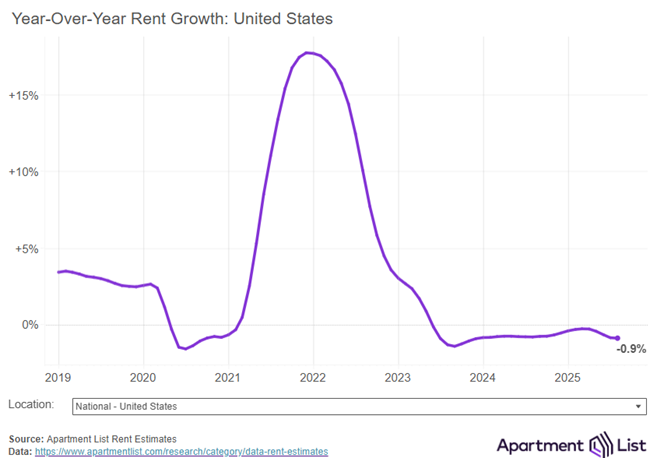
Rents are now down 0.9% year-over-year.

This marks the end of the busy season for moving activity, and it’s likely that rent prices nationally will continue to decline through the fall and winter, when fewer renters are typically looking for apartments, according to the report’s research team.

Rents dipped again 0.2% in August, the first month-over-month rent decline nationally, according to the September report from Apartment List.

“Monthly rent growth peaked at +0.6 percent in March this year, and then began to gradually trend down during the peak moving months, when rent growth is normally fastest.

“The flip to negative month-over-month growth has also come a bit earlier than what we saw in pre-pandemic years, although this is now the third straight year that prices have begun to dip in August,” the report says.

Highlights of the rent report:

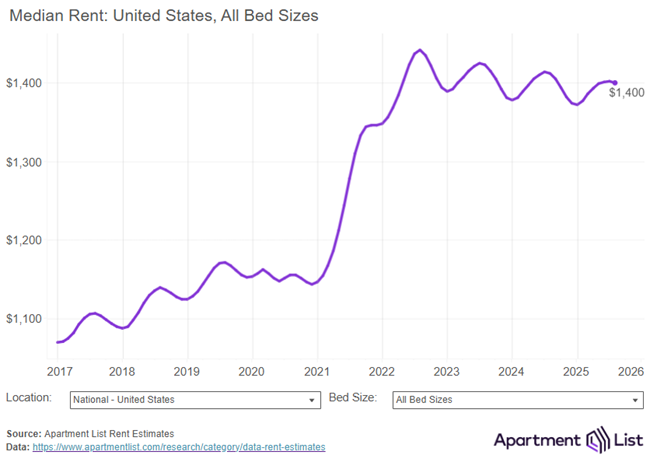
  • After the August decline, national median rent stands at $1,400.
  • Year-over-year rent growth has ticked further negative for four consecutive months and is now at its lowest level since December 2023.
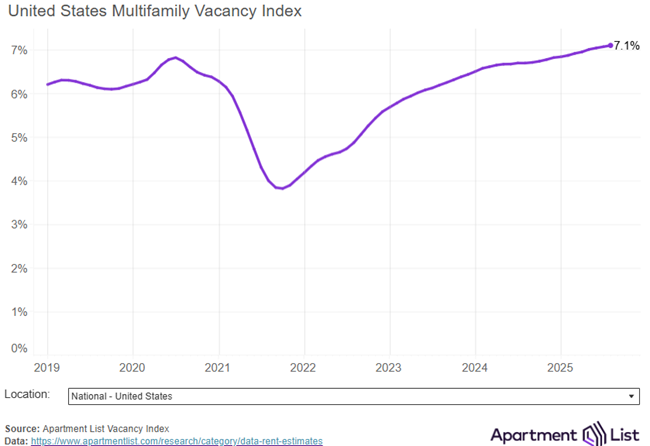
  • The national multifamily vacancy rate sits at 7.1%, a record high. We’re past the peak of a multifamily construction surge, but a healthy supply of new units is still hitting the market, and vacancies are still trending up.
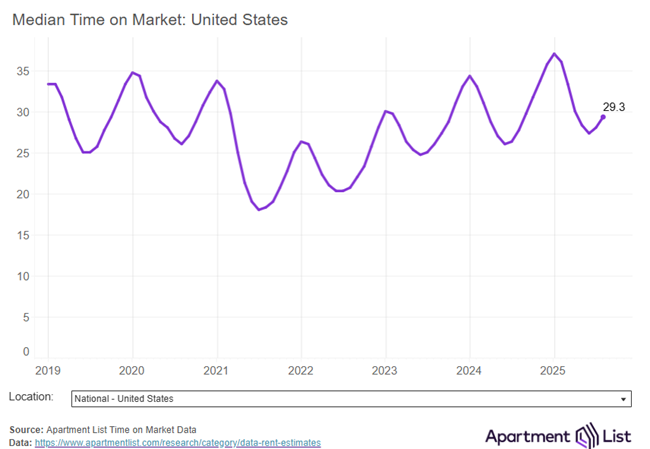
  • Units are taking an average of 29 days to get leased after being listed, up one day from last month’s reading, and down from a high of 37 days in January.

Rents dipped again 0.2% in August, the first month-over-month rent decline nationally, according to the September report from Apartment List.

Multifamily vacancy rate hits 7.1%, a new peak

The most important driver behind the soft rent growth of recent years has been a historic surge of multifamily construction.

However, while the peak of the multifamily construction surge has now passed, a healthy supply of new units is still hitting the market, and vacancies are still trending up.

Conditions are expected to tighten later this year and into next as the supply wave continues to recede, but for now the market is still absorbing a swell of new units.

Rents dipped again 0.2% in August, the first month-over-month rent decline nationally, according to the September report from Apartment List.

New supply driving falling rents in Sun Belt markets; the Bay Area heats up

The Austin metro currently has the softest conditions among the nation’s large rental markets, with the median rent there down by 6.6% over the past year.

At the other end of the spectrum, the San Francisco metro has seen the fastest year-over-year rent growth (+4.7%).

List-to-Lease time ticks up for first time this year

As more vacant units have come onto the market, those units have also been sitting vacant for somewhat longer.

The typical “list-to-lease” time peaked at 37 days nationally in January, an all-time high going back to the start of the data series in 2019.

“We have since come down from that peak, but August saw time on market tick up for the second consecutive month, increasing from 28 days in June to 29 days this month,” the report says.

Rents dipped again 0.2% in August, the first month-over-month rent decline nationally, according to the September report from Apartment List.

August Rents Conclusion

As the report saw national rents dip again, all key indicators are pointing toward ongoing sluggishness in the multifamily rental market, as rent growth is slipping and the vacancy rate is at an all-time high.

A return to tighter market conditions remains on the horizon, but the outlook has been complicated by a continued influx of new units to the market and macroeconomic whiplash being caused by tariffs and other policies being pursued by the Trump administration.

“With construction expected to slow further in the second half of this year and into 2026, conditions are likely to shift, but it will still take time for the market to metabolize the recent growth in the rental stock,” the Apartment List research team writes.

Read the full report here.

Sign Up For Our Weekly Newsletter And Get Rental Property And Apartment News And Helpful, Useful Content Each Week.

* indicates required

Personal Outreach Crucial for Apartment Prospect Follow-Up

Personal outreach is key for multifamily communities as a survey shows 6 out 7 properties don’t combine call, text, and email in follow-up.

Personal outreach is crucial as a survey of 1,100 multifamily communities found six out of seven properties don’t combine call, text, and email in their prospect follow-up.

By Richard Berger

Property management companies and software technology providers continue to emphasize the importance of striking the right balance between digital and personal interactions.

What they can agree on is that responding to leads through email, voice, text, or other means is crucial in their efforts to maintain or build occupancy.

However, a recent survey of 1,100 multifamily communities by Flair, tracking each for 30 days, found that six out of seven properties don’t combine call, text, and email in their follow-up.

Some sent instant email confirmations that read, “Thanks for your interest, we’ll be in touch soon.” But when researchers stripped out autoresponders, they found that properties took an average of 36 hours to truly follow up.

Prospects reached out for specific information: Can my dog live here? What fees are included? Is my credit high enough? The survey registered this response performance based on outreach types:

  • Email Only: 23%
  • Email + Phone: 26%
  • Email + Text: 15%
  • Email + Text + Phone: 15%
  • Zero response: 14%

Properties that incorporate texting for the first time outperform those that don’t by 600%, and texting is six times more effective at scheduling tours than via email, according to the lead- and resident-nurturing platform, Nurture Boss an AI-powered platform for multifamily.

Communities that used all three channels averaged 10.89 touchpoints over 30 days—using email-only netted just 5.58 attempts. The median across all properties was seven touchpoints, even when including auto-responders.

Nurture Boss data reveals that it takes an average of eight touchpoints to generate a tour and 10 or more to generate a lease application. Nonetheless, 47.6% of properties stopped all follow-up after 15 days.

Natalina Rettew, head of asset management at Trion Properties, utilizes a “dialer-up” feature that generates a contact card and automatically initiates a phone call from the apartment community to the prospect.

“This creates significant conversion because when the contact card is created, it is usually the time when the prospect is most engaged,” Rettew told GlobeSt.com.

“It’s beneficial that the first contact the prospect has is from a live person, and they can invite them to schedule a tour.”

Trion Properties operates 6,000 units nationwide, mainly in California, Oregon, Colorado, and Florida. Its California portfolio is mostly in Sacramento and the East Bay.

“We have done lead nurturing through bots, but we felt like in those cases, the conversations took longer to occur,” she said. “It wasn’t immediate like it is with Flair.” “The immediate connection we get with prospects through Flair has been very effective for our properties.”

Rettew is seeing a 60% answer rate and an uptick in tour scheduling.

Windell Mollenido, vice president of marketing and technology for the California-based apartment management firm The REMM Group, told GlobeSt.com that “society today yearns for authenticity and they’re even willing to pay for it. “

AI is not replacing humans, he said. “It’s enhancing a person’s ability to connect with prospects. Following up on renter prospect leads is not simply about looking at numbers on a spreadsheet.”

About the author:

Richard Berger is a freelance reporter who covers real estate.

Photo credit Diamond Dogs via istockimages.

Sign Up For Our Weekly Newsletter And Get Rental Property And Apartment News And Helpful, Useful Content Each Week.

* indicates required

Landlord Wins Ruling in Emotional Support Animal Fee Case

A federal judge has ruled a landlord did not have to automatically waive its animal fee for a tenant with an emotional support animal

A federal judge has ruled that a landlord did not have to automatically waive its emotional support animal fee for a tenant with an emotional support animal (ESA) under the Fair Housing Act (FHA), according to a report in jdsupra.com.

Judge Sarah Vance of the U.S. Eastern District of Louisiana held that a tenant with an ESA seeking to have her landlord waive a generally applicable animal fee was required to prove that the waiver was both necessary for her to use and enjoy her home and reasonable.

In reaching her ruling, Judge Vance rejected the notion that guidance issued by the U.S. Department of Housing and Urban Development (HUD) always requires housing providers to waive pet fees for people with ESAs.

She found the HUD Notice stating that a housing provider may not charge a fee or deposit for a service animal or other assistance animal “unpersuasive.”

Judge Vance rejected the argument that landlords always must waive fees for tenants with ESAs. Instead, she concluded that whether such accommodation is required is a fact-specific, case-by-case determination.

The judge said in the ruling it is the job of the courts, not agencies like HUD, to determine laws and the Constitution.

“Agency interpretations are only entitled to respect if they have the power to persuade. Ultimately, she found the HUD notice stating that a housing provider may not charge a fee or deposit for a service animal or other assistance animal ‘unpersuasive’.”

This case involved the plaintiff’s request for a reasonable accommodation under the FHA and Louisiana Equal Housing Opportunity Act (LEHOA), specifically seeking a waiver of a $400 animal fee for her dog, which she claimed was an ESA.

The defendants’ apartment complex allows animals, so there was no issue with the dog living there. The only dispute was whether the defendants had to waive the animal fee they charged all tenants for the plaintiff just because she had an ESA.

Adams & Reese attorneys representing the landlord argued that the FHA does not say housing providers must waive animal fees for ESAs.

It only says they must make reasonable accommodations that are necessary for disabled people to use and enjoy their homes equally.

The plaintiff, represented by the Louisiana Fair Housing Action Center, argued that it is always necessary to waive animal fees for people with ESAs to afford them an equal housing opportunity.

“Ultimately, Judge Vance found the plaintiff failed to prove she needed a fee waiver because she did not put forward any evidence to demonstrate that waiving the fee would alleviate the effects of her disability and the record showed the plaintiff could afford the fee, particularly if given the option to pay in installments,” judsupra.com reported.

Why This Decision Matters for Landlords

For years, HUD, the DOJ, and others have maintained that housing providers must waive fees whenever someone claims they are disabled and need a service or assistance animal, period.

Though not actually the law, this idea was perpetuated through Internet websites that have profited by promoting the sale of ESA prescriptions by advertising that purchasers may save money by avoiding animal fees. Judge Vance’s ruling clarifies that the analysis does not begin and end with the delivery of an ESA letter from a tenant to a landlord.

Instead, tenants seeking fee waivers must prove they need them and that their request is reasonable under the circumstances.

Judge Vance’s ruling provides guidance to landlords about how to assess both the need for and the reasonableness of fee-waiver requests. It also confirms that alternative accommodations, such as allowing tenants to pay over time, can be effective.

Read the full report from jdsupra.com here.

Sign Up For Our Weekly Newsletter And Get Rental Property And Apartment News And Helpful, Useful Content Each Week.

* indicates required