U.S. advertised rents slipped again in December, producing the weakest quarter in years and wiping out gains made during the first half of 2025, Yardi Matrix says in its year-end report.
Multifamily rents pretty much ended the year where they started with the weak finish to 2025.
Regional disparities that defined recent years persisted through 2025. Rent growth remained concentrated in coastal markets and the Midwest, while the weakest performance was largely confined to the Sun Belt, where elevated new supply continues to weigh on pricing.
That is not stopping investors from increasing transaction volume and paying up for multifamily properties. Demand is strong, but counteracted by pricing uncertainty. High-growth secondary markets led by Dallas, Seattle and Phoenix attracted the most investor dollars in 2025.
Highlights of the report:
2025 ended on a down note for multifamily, as a weak finish to 2025 late-year performance wiped out all the gains from earlier in the year. The average U.S. advertised rent fell $5 to $1,737 in December, with year-over-year growth dropping 20 basis points to 0.0%.
Years without growth are rare. The last one with no average national advertised rent recorded was the 2020 pandemic year. Before that, the last one without a national rent increase was the recovery from the global financial crisis in 2010. We expect modest increases in 2026.
Single-family build-to-rent units are maintaining strong occupancy, but advertised rates are weakening as well. The average BTR advertised rent declined by $4 in December to $2,180, while the year-over-year growth rate fell to -1.0%.
“Fourth-quarter performance marked the weakest showing since the global financial crisis, raising concerns about near-term multifamily demand,” the report says.
“Looking ahead, despite ongoing economic uncertainty, stronger GDP growth in the fourth quarter points to improving momentum. Greater stability in 2026 could help lift consumer confidence and support a gradual rebound in rental demand.”
As Los Angeles braces for rising eviction pressure this winter and the potential loss of federal housing funds that could push thousands back into homelessness, county leaders are moving toward a decision that has major implications for housing stability in 2026.
In the first quarter of 2026, the L.A. County Board of Supervisors is expected to consider a pet-inclusive housing ordinance, following the 2025 release of a county feasibility study.
By evaluating ways to remove barriers for renters with pets, the study lays critical groundwork for a forthcoming 2026 ordinance to codify pet-inclusive housing policies, an effort championed by Supervisor Hilda Solis. The ordinance offers Los Angeles County an opportunity to lead with compassion and common sense, ensuring families can stay housed and remain intact while recognizing the needs of housing providers.
At a moment when more than 14,500 formerly homeless households are at risk of displacement, expanding housing access for renters who have pets is a critical part of the solution.
Pets are a major, overlooked factor of housing instability. Although most rentals claim to allow pets, restrictive breed and weight limits and excessive fees frequently force renters into impossible choices.
Los Angeles ranks among the worst major cities for pet-inclusive housing access, with just 64% of properties allowing pets, and only 5% without breed and weight restrictions.
Michelson Center for Public Policy is working with county leaders to ensure the ordinance reflects real-world housing providers’ concerns while providing pet-owning renters with options beyond losing their housing or surrendering their pets to LA’s already overcrowded shelters.
“Los Angeles County’s decision to explore pet-inclusive housing is an important step toward equity and housing stability. Supervisor Solis and County leaders are taking meaningful action by recognizing that pets are part of the family, and housing policies should reflect that reality. We are confident that with thoughtful collaboration, the County can develop a balanced approach that works for both renters and housing providers and creates a true win for everyone,” said Jennifer Naitaki, Policy Director, Michelson Center for Public Policy.
Why resident feedback is key for leasing, living and renewals with targeted, short-term pulse surveys and frequent check-ins.
By Carla Alicea
Grace Hill
Every transformation begins with a few voices. In the multifamily industry, that voice belongs to a community’s residents, and it’s important to listen at the right moments. Resident surveys have evolved dramatically, going beyond the “set it and forget it” mindset to a more dynamic ecosystem. The long-standing annual survey is no longer sufficient to support the resident experience.
Think of timing resident feedback like you would a conversation in a new relationship. It’s not healthy to wait an entire year to make sure everything is going well. For the relationship to thrive, it needs regular check-ins. This is the same approach that multifamily needs to take with its residents. Creating genuine connections drives satisfaction and retention.
Pulse and Moment-Based Surveys Are Must-Have Additions
Annual surveys remain essential for benchmarking and serve as the north star for understanding a community’s overall health. They’re valuable for comparative data and long-term trend analysis. However, these resident feedback surveys are like a photograph, and communities need a system that’s more like a live feed.
This is where shorter, targeted “pulse” and “moment-based” surveys are essential. These frequent check-ins capture feedback when experiences are fresh and emotions are authentic. They serve as strategic touchpoints that help communities stay ahead of emerging trends and issues, rather than discovering problems months after they’ve taken root. Pulse surveys are periodic “health” checks on resident sentiment. Moment-based surveys are triggered during specific events along the renter journey, such as move-in or renewal.
The move-in experience is a good example of the effectiveness of moment-based surveys. A resident’s first 30 days can shape their entire relationship with the community.
Waiting for an annual resident feedback survey to gather insights into their onboarding experience means missing the opportunity to set the tone for long-term success, celebrate wins or address issues. Some of the most important moments for surveys include move-in, maintenance, renewal and move-out.
Communities may also want to introduce pulse surveys between their annuals to check in on trend directions, as well as send out ad hoc surveys after making meaningful operational changes, such as the introduction of a new policy or proposed amenity.
The Shift from Reactive to Proactive
Almost all property managers have experienced the pain of discovering a maintenance issue through an angry, one-star review or learning about a policy issue via a non-renewal notice. Real-time feedback enables onsite teams to act quickly, improving resident satisfaction before it declines.
A proactive approach transforms teams from firefighters to architects of exceptional resident experiences. Catching resident feedback at critical moments—after a maintenance request, after amenity use, or during renewal discussions—gives teams the power to address concerns while they’re still manageable, or to gauge what’s working well.
The beauty of this moment-based feedback lies in its specificity and timeliness. Instead of asking a resident to recall a maintenance experience from six months prior, teams can capture their thoughts within days. In addition, human memory is notoriously unreliable, especially over time. The proactive immediacy of pulse surveys gives more accurate data and more actionable insights.
Turning Data Into Direction
When survey insights are unified across touchpoints, like maintenance response times or renewal likelihood, property managers gain a 360° view of resident experience and can connect feedback directly to measurable outcomes.
This connectivity in data streams reveals powerful correlations that drive strategic, data-based decision-making.
For example, at move-in, “Value for Amount Paid” is one of the strongest levers behind overall satisfaction. When heading into renewal, “Management’s ability to resolve problems” becomes the make-or-break driver.
From there, trend reporting adds context over time, helping teams spot shifts early and make proactive adjustments before minor issues grow into major problems. Frequent analysis can also bring to the surface patterns that might otherwise go unnoticed, like seasonal fluctuations in satisfaction or how new policies influence resident sentiment.
Advanced analytics, including AI-powered analysis of open-ended responses, can uncover themes that traditional metrics might miss. If residents mention communication, AI can assess whether they are praising a team’s responsiveness or expressing frustration with it.
Building Long-Term Trust
Regular communication through resident feedback surveys not only solves today’s problems but also shows residents that their voices shape the community’s future. The ongoing dialog builds something that’s invaluable—trust.
This develops when residents see their feedback translated into action. Trust grows when teams communicate changes transparently, acknowledging both successes and areas for improvement. It flourishes when residents feel heard, valued, and respected as partners in creating a thriving, exceptional community.
Owners and operators may want to implement a “You Asked, We Listened” communication strategy across their portfolios, and onsite teams should regularly share how resident feedback influenced improvements. This transparency demonstrates a commitment to continuous enhancement and encourages ongoing feedback in a survey ecosystem.
Other Critical Factors of Pulse Surveys
The above covers the benefits of implementing a system of pulse or moment-based survey, but there are other factors that need consideration for a successful system of resdient feedback:
Response Rates – Reliable data typically comes from response rates of 10%-20% for resident surveys and 7%-10% for prospect surveys. Shorter surveys don’t automatically yield better response rates. This is less about survey design and more about creating a culture where feedback is encouraged and truly matters. Communities can improve their response through effective promotion and consistent communication.
Psychological Safety – Residents need to feel confident that their honest feedback won’t result in any negative consequences. This means that onsite teams need training in responding to criticism with gratitude rather than taking a defensive stance. They should always demonstrate that residents’ input drives action and positive change.
Sentiment Influences Metrics – Always remember that the correlation between resident sentiment and operational metrics is undeniable. Timely and personable communication significantly impacts renewal, referrals and reputation. Open lines of communication and responsiveness to feedback foster a sense of belonging among residents.
Multifamily can continue with traditional approaches that provide limited insights, or it can embrace a system that transforms how communities understand and serve residents.
Owners and operators can improve leasing, the resident experience, and renewals by listening with greater intention, responding more quickly and acting more decisively based on data. Residents are ready to share their experiences—is multifamily ready to listen?
About the author:
Carla J. Alicea is a customer-focused research and analytics professional with nearly 30 years of multifamily industry experience, specializing in resident and employee insights. Her work focuses on how perceptions and behaviors across both audiences shape trust, satisfaction, and performance. She is senior product manager, research and analytics, at Grace Hill. Grace Hill provides technology-enabled performance solutions that help owners and operators of realestate properties increase property performance, reduce operating risk and grow top talent.
Management company awards rent-free holiday to residents fighting health issues, financial hardship and loss of loved ones.
By Paul Bergeron
BH Management company has awarded 220 residents and households a rent-free holiday for this past December as a way of giving back to residents.
Launched in 2023, BH’s rent-free holidays program helps bring relief to residents who need it most by covering their December rent and expenses. In the first year, BH Management helped eight deserving residents, and in 2024, that number rose to 138.
Among the residents who won awards this year were those fighting health issues, financial hardships, emotional struggles, and the loss of loved ones.
For each resident selected for a rent-free holiday, BH teams presented winning residents with oversized checks, balloons, confetti, and flowers.
A BH community manager in Texas nominated long-term residents facing challenges, noting their resilience and commitment to the community despite their hardships. “This program serves as a gesture that their community stands behind them during tough times,” said the community manager.
This effort has affected the lives of many deserving residents during a time of year that can sometimes feel burdensome and overwhelming.
“Making happy moments and giving back to our communities is at the core of what we do at BH, and rent-free holidays has become one of our favorite ways to do that over the past three years,” BH CEO Joanna Zabriskie said. “We’re grateful to have caring employees and client partners who stepped up to make this our best year yet.”
Katie Vanderveen, Vice President of Asset Management at Pensam, shared her thoughts on the program, saying, “This initiative is such a powerful example of the impact Pensam and BH are making in the lives of residents. It’s not just about covering rent; it’s about giving families peace of mind, hope, and a chance to truly enjoy the holiday season.”
Zabriskie, added, “Giving back and making happy moments for our residents are part of the fabric of BH’s culture, and we are truly grateful for Pensam’s partnership in bringing the ‘Rent-Free Holidays’ program to life for the second year in a row.”
About Pensam:
Pensam is one of the country’s largest private real estate investors and capital providers specializing in the vibrant U.S. multihousing sector.
About the author:
Paul Bergeron is a freelance writer who covers rental housing issues.
A major reason landlords haven’t adopted credit freezes more widely is outdated assumptions about cost and difficulty to change.
By Scot Aubrey
With winter in full swing in parts of the country, many of us are all too familiar with freezing temperatures. While this can make it tough to be a landlord, there’s a freeze that each of us should be familiar with, and taking advantage of, beginning immediately.
I’m talking about a credit freeze. It’s not just something that consumers need to worry about; for landlords, it can be one of the smartest (and easiest) defenses you can put in place.
As an investor and someone who relies on their rental business, your personal credit is often inseparable from your ability to operate. Financing, insurance rates, even your ability to expand your portfolio, all rely on your credit. In today’s environment—where identity theft, data breaches, and sophisticated fraud are increasingly common—placing a credit freeze should be viewed as a business continuity step, not just a personal precaution.
Landlords Are Prime Targets
As a landlord you manage high-value assets and frequently share sensitive information across multiple services: mortgage lenders, banks, tenant screening platforms, maintenance vendors, online payment portals, and property management software.
Each interaction creates another potential point of exposure. Even if you run a small portfolio, your data circulates far beyond what you realize. And because most landlords have stable credit histories, you are especially attractive to fraudsters who want to exploit your good credit to open new accounts, take out loans, or rack up debt in your name.
You Must be Operational
It’s easy to assume that identity theft is just a nuisance, but for you as a landlord, the consequences can be far more damaging and disruptive.
A fraudulent loan or credit line can damage your credit score and trigger higher interest rates or reduced borrowing power right when you need it—such as refinancing a property, funding repairs, or purchasing another unit. Worse yet, you might not discover the fraud until applying for financing, at which point the timing can be catastrophic.
A credit freeze blocks lenders from pulling your credit file unless you temporarily lift the freeze. This translates to criminals being unable to open new lines of credit in your name, even if they have your Social Security number and other details.
You’ll still be able to use existing credit cards and accounts normally, but you’ll reduce the risk of new account fraud, which is the most damaging kind.
Freezing Your Credit is Free, Fast, and Reversible
A major reason landlords haven’t adopted credit freezes more widely is outdated assumptions. Many people still believe credit freezes are expensive, complicated, or hard to undo. In reality, U.S. law requires the credit bureaus to offer them for free, and most freezes can be placed online in minutes. If you need to apply for a mortgage, open a new credit card, or finance a renovation, you can temporarily lift the freeze for a set time window and then re-freeze it once the transaction is complete.
As an investor, I suggest that you do these THREE things immediately:
Use an online rent-payment system to manage your rental payments. These systems allow rent to be paid from bank account to bank account, without giving out your personal bank account numbers to your tenants. This will protect you from one more person having your personal information.
Watch what you post online. When you search for your name, what do you see? I personally write many articles, do podcasts, record videos, and have my information everywhere, so people know me. Your social media is also the perfect medium for people to grab pictures or personal information. If you find yourself with a growing online presence or increased exposure, go back to No. 1 above and make sure you freeze your credit. You don’t want to be one of those 6,000 daily reports of fraud going to the FTC.
Professional Level Protection
Landlords often invest in security systems, smoke detectors, liability insurance, and legal protections for leases.
Freezing your credit belongs in that same category: a foundational safeguard. It’s not about paranoia—it’s about recognizing that your identity is an asset, and like any asset, it deserves protection.
Taking 15 minutes today to freeze your credit can save you months of headaches later—and help ensure your rental business remains stable, scalable, and secure.
About the author:
Scot Aubrey is vice-president of Rent Perfect, a private investigator, fellow landlord and cohost of the Rent Perfect Podcast. Subscribe to the weekly to stay up to date on the latest industry news and for expert tips on how to manage your properties.
The national median rent dipped by 0.8 percent in December, closing the year with five straight months of rent decline, according to the January report from Apartment List.
While November provided the steepest drop, and over the next few months the market should creep back and reach positive rent growth in February or March, according to Apartment List researchers.
The change in rental market seasonality
In addition to steeper winter declines since 2022, we have also observed a shift in the timing of rental market seasonality.
Whereas May used to be peak rent growth, over the past three years March has been the hottest month, with rent growth trending down during what was, prior to the pandemic, the peak moving months. The flip to negative rent growth now arrives in August, whereas it used to arrive in September.
Highlights of the report
The national median rent fell 0.8% in December, and now stands at $1,356.
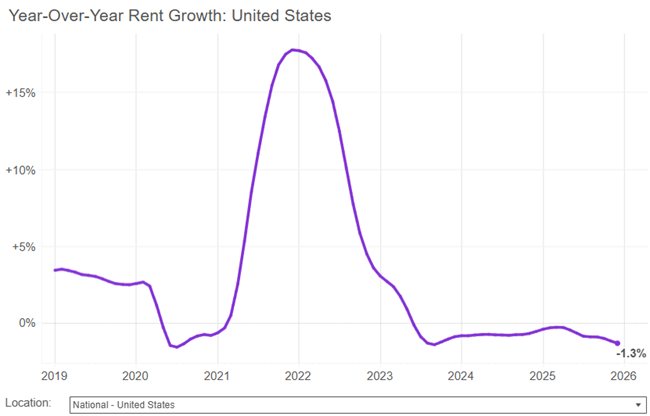
Rent prices nationally are down 1.3% compared to one year ago. Year-over-year rent growth has been slightly negative for more than two full years, and the national median rent has now fallen from its 2022 peak by a total of 5.9%.
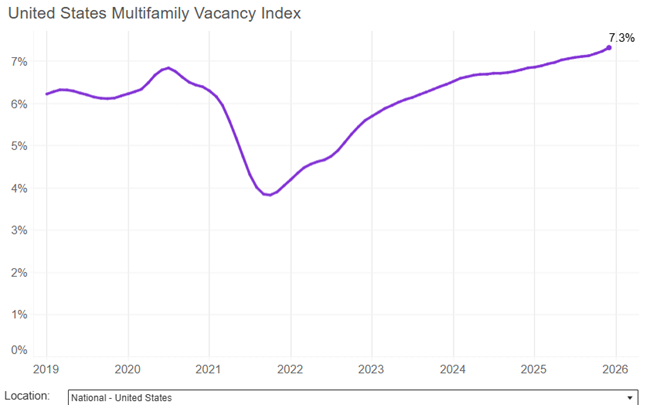
The national multifamily vacancy rate ran up to 7.3% this month, a record high for the index that started in 2017. We’re past the peak of a multifamily construction surge, but a healthy supply of new units is still hitting the market and colliding with sluggish demand, causing vacancies to continue trending up.
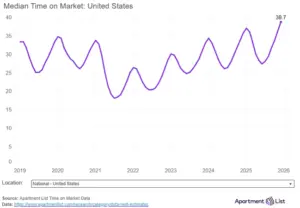
Units are taking an average of 39 days to get leased after being listed, which is three days longer than one year ago and represents another record high back to 2019.
The Austin, TX metro continues to have the softest conditions among the nation’s large rental markets, with the median rent there down by 6.6% over the past year. At the other end of the spectrum, the Providence, RI metro remains atop our rankings of fastest year-over-year rent growth at +5.6%.
Multifamily vacancy rate hits 7.3%, a new peak
As the supply wave continues to recede, these occupancy and pricing trends should begin to gradually shift, but for now the market is still absorbing a swell of new units.
At the same time, a shaky labor market seems to be putting a damper on housing demand, another factor contributing to sluggish rental market conditions persisting longer than we anticipated at the outset of this year.
List-to-Lease time also reaches a new peak: 39 days
This increase in list-to-lease time is in line with rent growth turning negative and a general off-season cooling of the rental market.
Time on market is up more than three full days compared to last December, and more than twice as long as it was in summer 2021, when the average unit was turning over in just 18 days.
Conclusion
“As we close the door on 2025, our key market indicators tell the story of a third consecutive slow year for the multifamily industry. This year rent prices continued their downward trend while vacancies and time-on-market reached new highs.
“Forward-looking data suggest this sluggishness will persist into the first half 2026, as we continue to work through a backlog of new construction. Much will depend on rental demand, whose outlook is shaky given weakness in the labor market and general economic uncertainty.
“If demand worsens, it will take longer for the market to metabolize the recent growth in the rent stock, even if the construction industry slows in tandem,” Apartment List researchers write.
The multifamily industry will be tested in 2026 as demand is weakening due to reduced immigration and weak job growth, Yardi Matrix says in its 2026 Winter Outlook.
Meanwhile, resident retention and the slowing supply pipeline are positives for rent growth, the report says. Plus, investor and lender sentiment is favorable. Transaction activity is rebounding, but slowly.
The report predicts that multifamily performance will pick up in 2026 as the economy regains its footing and excess supply gets absorbed.
The economy remains a question mark around:
Employment growth
The health of consumers in the bottom half of income distribution
Interest rates.
“Job creation and consumer confidence must improve for multifamily demand to return to robust levels. A new Federal Reserve chair will push for lower interest rates to stimulate growth, with the effect of boosting multifamily capital markets,” Yardi Matrix writes in the report.
A slow start to the year but 1.2% rent growth forecast
“Although we expect apartment demand to pick up after a slow start to the year, advertised rent growth is likely to remain modest for the third straight year,” with a forecast of 1.2% national growth.
“We expect a continuation of the regional trend that has seen moderate growth in the low-supply markets in the Northeast and Midwest, while the Sun Belt and Mountain West have strong demand and supply growth,” the report says.
The new apartment supply question
The report says a sharp drop in new apartment startups and supply “will slow and alleviate some pressure on lease-ups in rapidly growing markets.”
Matrix is forecasting that 400,500 new apartment units will be delivered in 2026, “but not enough of a decline to push rents to robust levels.”
Some final thoughts
The economy faces competing pressures, but the data does not show signs of a combing recession.
“None of the job data points to a major downturn, but flagging job growth could lead to fewer households being formed (and less multifamily demand) as young adults stay with parents or roommates longer.
Yardi Matrix researches and reports on multifamily, office and self-storage properties across the United States, serving the needs of a variety of industry professionals. Yardi Matrix Multifamily provides accurate data on 18+ million units, covering more than 90 percent of the U.S. population. Contact the company at (480) 663-1149.
The hidden cost of aging plumbing is something multifamily owners and operators need to know about before the next leak.
By Aaron Kirk Douglas
Director of Market Intelligence
HFO Investment Real Estate
Failing plumbing systems can quietly drain more money from multifamily operators than almost any other expense especially the hidden cost of aging plumbing.
Matt Doran, Senior Project Manager at Caliber Mechanical, says failing plumbing systems operational expense is a risk. Doran has been in the industry for 30 years says he has seen it all “from all sorts of piping… the changes, the technology changes, everything.”
If you’ve ever had recurring leaks, tenant complaints, or insurance headaches tied to water damage, his insight is essential. Repiping isn’t just a construction project––it’s a risk management strategy.
The Biggest Culprit: Age—But Not Always How You Expect
We tend to think building age is the singular predictor of plumbing failure. But as Doran explained, the story is more complicated. “Ninety percent of it is age and installation standards… You’ll see copper piping that just was not done very well… poor craftsmanship, fittings not cleaned, bad soldering.”
Even galvanized pipe, which many assume is doomed after 40–50 years, can outperform newer systems depending on quality and water chemistry. “Some galvanized piping has been in buildings 70–80 years and is still doing very well. Others only lasted 20.” It’s the ultimate multifamily truth: Two buildings from the same era can diverge wildly in performance.
When Owners Know It’s Time: The Cost Curve Doesn’t Lie
Asked what typically triggers a repipe, Doran said, “The biggest one is the cost of repairs… you’re having a plumber out every week, repairing the same things… that’s when it’s time.”
Add in ceiling openings, drywall patches, tenant disruption, insurance claims, and labor shortages, and it’s easy to see why owners begin to view repiping as a capital investment rather than a never-ending operating expense. Insurance companies sometimes force the decision as well: “New ownership will come in and the insurance company says: we want to see new piping.”
How Repipes Actually Happen: Stacks, Back-to-Backs, and Tenant Logistics
For owners who’ve never overseen a repipe, the process can feel mysterious. Doran described two primary patterns:
By stacks in multi-story buildings (vertical runs)
By back-to-back bathrooms (horizontal clusters)
In occupied units—always the toughest scenario—logistics multiply.
“Tenants expect water on at the end of the day. It’s doable—just a lot more planning, communication, and more plumbers.” In some cases, tenants move out temporarily. In others, crews work in tight phases to keep disruptions minimal. This is where Caliber’s experience becomes valuable: they’ve repiped everything from garden-style walk-ups to nine-story towers.
PEX vs. Copper: The Industry Has Shifted
If there’s one material defining repiping in 2025, it’s PEX. Doran noted: “It’s probably 80 to 90% PEX.” Not because copper is obsolete, but because PEX solves several labor and cost challenges:
Flexibility – PEX can snake through difficult spaces without full wall removal.
Speed – Reduces both construction timelines and tenant disruption.
Cost-efficiency – Lower material and labor costs compared to copper.
He summed it up with a field-level truth: “PEX lets you minimize how much you open the walls. With copper, you almost have to open the full stretch.” But there’s nuance. PEX fails quickly in a single, very specific scenario: hot-water recirculation lines. “Nine out of ten times, we’re going to do a copper return line… it holds up better long-term.”
Mixing PEX and Copper? Completely Normal
Owners sometimes worry about mixing materials. Doran said, “That’s not a problem. It depends on what you’re doing… we transition from copper mains to PEX in-unit all the time.” What matters more is ensuring no hidden fittings are buried in inaccessible places and verifying return-line temperatures.
Warranties: The Fine Print Owners Miss
PEX manufacturers often tout long warranties—50-year, even 100-year guarantees. But Doran warned owners not to take them at face value. “Some offer a 100-year warranty… but what does it cover? The material and labor, sure—but what about damages?” A burst pipe that floods five units isn’t solved by a free box of replacement fittings. Caliber’s process usually includes looping in insurance reps and product manufacturers to clarify what is—and isn’t—covered.
Where Repipes Get Messy: Unforeseen Conditions Behind the Walls
Every owner imagines clean, predictable wall openings. Reality is more… cinematic. Doran described common surprises:
Electrical lines hidden where they shouldn’t be
Asbestos insulation buried in walls
Ducting placed in odd locations
Drainage pipes with fixed slopes that limit reroute options
As-built drawings that don’t match real conditions
According to Doran, “There’s no shortage of unforeseen conditions… you open a wall and think, why in the world is that there?” This is where experience matters. PEX can bend around obstacles; copper cannot. A good contractor adapts quickly; a bad one increases costs through improvisation.
Pre-Purchase Pipe Assessments: A Growing Trend
Doran conducts many plumbing evaluations for buyers as part of due diligence.
His team often cuts out test sections of pipe—something cameras can’t replace. “You really need to take out sections of piping to know what’s happening. Cameras work great on sewers, not on water mains.” Buyers increasingly want a forensic understanding of hidden systems before closing on 1960s–1980s assets.
PEX Is the Future—For Now
When asked what comes next, Doran offered a grounded forecast: “PEX is the animal… I don’t know what it’ll be 10 years from now, except maybe a different compound with a better additive.” But the fundamentals remain:
Age is undefeated.
Maintenance spending eventually becomes capital spending.
Repipes protect cash flow by reducing future emergency costs.
What Multifamily Owners Should Take Away
If you own or operate properties built between the 1960s and early 2000s, you should be tracking:
Frequency of leaks
Rising repair invoices
Drywall patching patterns
Tenant complaints
Insurance pressure
Age and material of the original plumbing
Presence of hot water recirculation lines
Baseline conditions inside walls
When the signs stack up, it’s no longer a question of if you need a repipe. It’s when—and how much extra damage you can afford to absorb before acting.
“At some point, you’ve got to understand this system just needs to be replaced.” For multifamily investors, that isn’t bad news. It’s an opportunity to reduce long-term risk, extend asset life, and stabilize operations,” Doran said.
HFO Investment Real Estate is a multifamily brokerage offering apartment communities of all sizes for sale throughout Oregon and SW Washington. Learn more at www.hfore.com.
2026 will be a reckoning year for the rental market as the next 12 months will force rental property operators to rebalance tech, transparency, and affordability to meet a more cautious, value-driven renter.
By Virginia Love
After years of soaring rents and affordability pressures, the rental market is heading for what Virginia Love, a 30-year industry veteran, calls “a reckoning year.”
Income growth has finally surpassed rent growth, giving renters new leverage and putting pressure on operators to demonstrate value and transparency.
Meanwhile, Gen Z renters have burst onto the scene as the most informed, selective, and transient cohort in history, demanding value and transparency in every interaction.
Love, who is industry principal at Entrata, says the next 12 months will force operators to rebalance tech, transparency, and affordability to meet a more cautious, value-driven renter.
Her top calls for a 2026 reckoning year for the rental market include:
The return of “worth.” Renters will pay for what feels worth it, not just what’s cheapest. Operators who can tell that story clearly will win.
AI becomes a true partner: Tech and automation will finally streamline, not strain, onsite teams through smarter integration and training, while also elevating the renter experience with faster responses, proactive service, and more personalized living.
Gen Z reshapes operations: Their focus on purpose, flexibility, and authenticity will redefine community culture––sparking change not just for renters, but for Gen Z employees, too.
Amenities get personal: Expect growth in lifestyle-driven, creator-friendly spaces like podcast studios and co-working lounges.
Love did a question and answer session with Rental Housing Journal around a few key questions for the 2026 rental market:
Q: What is an example of how the value-driven renter is going to encounter higher rents and inflation in 2026?
A: “We’re heading into 2026 with the consumer still firmly in charge. Renters are smarter, pickier, and more mobile than ever, and they’re not afraid to move if the math stops making sense. Value will stay the headline, which doesn’t mean ‘cheap.’ They’ll pay for what’s worth it: transparency, convenience, and a sense that the community is actually meeting their expectations.
“As inflation lingers, I expect more renters to right-size, such as moving to different price points or smaller markets to preserve that sense of worth. Operators should prepare for a year where every renewal is a negotiation around value. You can’t just sell the price; you’ve got to sell why it’s worth it. The communities that articulate that clearly, especially when it comes to fees, will be the ones that keep occupancy stable.”
Q: What exactly does a value-driven renter want and how does it vary between an urban versus suburban apartment?
A: “Across every demographic, renters want the same fundamentals: technology that works, fast response times, a seamless leasing process, a pet-friendly community (pets are part of the family everywhere).
“Where the value conversation shifts is by ZIP code. In urban markets, renters will still pay a premium for convenience, for walkability, proximity, and a lifestyle that saves time.
“In suburban markets, value leans toward space and comfort: room to breathe, maybe a backyard for the dog, ample parking, and storage. All of it delivered without surprise fees.
“Heading into 2026, I think renters in both settings will expect more personalization with less noise. They want to feel known, not marketed to, and the best operators will make technology almost invisible, working quietly behind the curtain to deliver that smooth, reliable experience that feels worth every dollar.”
Q: Additional predictions re: luxury housing, Gen Z and technology?
A: “We’re starting to see luxury fatigue set in. Renters aren’t chasing natural stone countertops and rooftop cabanas the way they used to.
“Now, they’re chasing balance. The growth opportunity now is in what I call ‘attainable housing:’ high-quality, well-designed communities that still feel realistic. It’s about creating spaces that look good, live well, and make sense for the budget. That’s where demand, and loyalty, will come from in 2026.
“Gen Z is setting the tone for the industry. This generation values flexibility, mental health, and meaning, and it’s changing everything from how we hire and train to how we design and market communities.
“They want authenticity and purpose in the places they live and work. You’ll see that influence show up in lifestyle-driven amenities, like creator studios, co-working spaces, wellness programming, and personalized resident experiences. Operators who don’t adapt to that mindset will find themselves out of sync with both their teams and their residents.
“Technology’s about to move behind the curtain. The best systems won’t be what renters see; it’ll be what makes everything else seamless. If the tech’s working right, the renter shouldn’t even notice it. Friction-free, invisible, and fast.”
About the author:
Virginia Love, Industry Principal at Entrata, began her multifamily career 30+ years ago in leasing and has been passionate about the industry ever since. Now Industry Principal at Entrata, she helps drive innovation and strategy across multifamily. Virginia’s a NAA Lyceum graduate, twice named Globe St. Multifamily Influencer, a Connect CRE Woman in Real Estate, a recipient, and an Apartment All-Star. She’s a past Atlanta and Georgia Apartment Association Chair, and was inducted into the GAA Hall of Fame in 2025.
“No guns in my apartments” is again a point of discussion as the country struggles with gun violence in schools and other public places. How are landlords to decide whether to prohibit or allow tenants to have firearms in their apartments or single-family dwellings?
In some cases it is a matter of what state law provides. In other cases it is a matter of either personal preference that a landlord wants to say “no guns in my apartments.” However a more logical, legal analysis of negligence and case law, is important, according to Denny Dobbins, general legal counsel and vice president of Crimshield and RentPerfect.
By John Triplett
State laws vary on the issue of what landlords can mandate regarding saying, “no guns in my apartments,” and on gun possession in general by tenants in privately owned rental properties.
Landlords and property managers need to be aware of whether their state and/or local governments have specific laws, Dobbins said in an interview with Rental Housing Journal.
Only four states have specific laws regarding landlords and guns at rental properties
Minnesota: A landlord cannot restrict the lawful carry or possession of firearms by tenants or their guests. Minnesota Statute 624.714
Tennessee: A private landlord can prohibit tenants, including those who hold handgun carry permits, from possessing firearms within a leased premises. Such a prohibition may be imposed through a clause in the lease. Tennessee Statute 39-17-1307(b).
Virginia: Public housing prohibits landlords from restrictions on gun possession for tenants – Virginia Rental Housing Act 1974 Tennessee 55-248.9.6.
Wisconsin: This state has a complicated maze of where a weapon can or cannot be possessed. W Stat. § 175.60(21)(b).
All other states are generally silent on the issue, Dobbins said, meaning that private housing providers can choose what they want to do on the issue and say no guns my apartments. California, Arizona, Colorado, Oregon, Utah, and Washington are six of the states that are silent on the issue.
For instance, Virginia law says public landlords cannot use a prohibition clause in their lease, and it does not require that a gun-free zone sign be applied or present on the property.
“Now in Minnesota, they have a different law. Generally, private landlords may not restrict the lawful carry of firearms by tenants,” Dobbins said. “All the other states are silent on whether private landlords can prohibit tenants from carrying weapons or possessing weapons on the property.”
Unless your landlord is a government entity, like a city or state agency or public housing, or receives state or federal funding for rental assistance on the property, the Second Amendment is unlikely to apply. However, private housing providers saying no guns in my apartments and prohibiting tenants from possessing firearms in a residential rental unit raises other constitutional and insurance issues.
“You can stop that kind of behavior cold in the common areas altogether, so go ahead and put something in your lease to stop it in the common areas.”
Can a landlord say “no guns in my apartments” and implement a “no-firearms” provision in a lease agreement?
“Generally, the answer is yes. But, I think we need to take the most practical approaches we can for all the issues surrounding the question,” Dobbins said.
“I would simply say to private housing landlords that you have more issues to be concerned about than just whether or not you can implement such a “no firearm” policy. Look, the real issue that you want to protect against is tenants having guns willy-nilly, or just being carried around and shown off on the property common area
“You can stop that kind of behavior cold in the common areas altogether, so go ahead and put something in your lease to stop it in the common areas. Prohibiting the display of weapons in the common area, or even in the unit where handling or showing of a weapon that can be seen on the inside from the outside, will help protect against liability issues and insurance/liability issues and help avoid possible Second Amendment challenges.”
What about telling tenants no guns in my apartments and prohibiting tenants from having firearms in their apartment unit?
“Generally, a private landlord can do that too, but there are a wide variety of issues to think about when you do so,” Dobbins said.
“Most states have not made a decision whether or not to attempt to prohibit the constitutional rights of a citizen who wants to have a weapon in their rental unit for their own protection. What that means is that leaves it up to the private landlord to make a decision about their own property,” he said.
“Yes, a private landlord can say, ‘We prohibit all tenants from possessing a weapon anywhere on the property.’
“Yes, a private landlord can say, ‘We prohibit all tenants from possessing a weapon anywhere on the property.’ The private landlord can make that decision because there hasn’t been a case yet that draws the Second Amendment into the private-landlord decision-making process on the issue, as has happened with Fair Housing issues like race, color, national origin, familial status, religion, gender, age, military status and Americans with disabilities.” Therefore, government assisted housing must respect a tenant’s constitutional right to bear a firearm. However, the housing authority can still prohibit firearms in common areas.
But non-governmental landlords, with no applicable state or local laws, have the right to do want they want on their own property regarding firearms. “So, a private landlord can say, ‘No guns in my apartments’ or any weapon possession in the rented apartment unit’. But a non-government tenant can also say, ‘Well, I have a constitutional right to a weapon to protect myself.’ However, that case has not been heard yet,” Dobbins said. He believes the issue will eventually be heard because “someone is going to finally get that case to the Supreme Court.”
The predicament for any landlord on this issue is this: ”If I allow firearms and someone on the property gets hurt, am I liable?” The answer is “Maybe.” And, “If I prohibit a tenant from having a firearm on the property and that tenant or his family, occupant or invitee is hurt; and had that tenant had a firearm, they may not have been hurt, am I liable?” Again, the answer is “maybe.” Every situation is fact-specific.
“From a practical point of view on the liability issue, let’s say a landlord says, ‘No guns in my apartments’ or ‘No weapons possession in the rented apartment unit.’ The tenant moves in and he wants to possess a weapon in the rented apartment unit but he decides to live there without possessing a weapon. Now somebody breaks into his home and kills his wife and his kids and he didn’t have a weapon to protect himself and his family. I don’t want to be that landlord who says ‘No guns in my apartments’ because I don’t want to get sued because I took that personal constitutional right away,” Dobbins said.
“The landlord is going to say, ‘He agreed to it and he moved in.’ Of course, the person who had their family killed is going to say, ‘Yeah, but I still had a right and you made me not have a gun and took away my Second Amendment constitutional rights to protect my family.’
“I don’t want to be that landlord,” Dobbins said. On the other side, if weapons are allowed on the property and someone gets killed or injured by a tenant intentionally, or even negligently, from a discharge of a weapon on the property, even while inside their own apartment unit, you know the attorney for the injured person is going to go after the deep pockets of the landlord, manager and their insurance money. By the way, you better check your insurance policy and find out what is and is not covered regarding this issue.
Saying no guns in my apartments is “an ugly Catch 22,” Dobbins said.
“It is possible that if a landlord has a no-weapons policy in the lease that the landlord will immediately become a target by a victim of a tenant shooting injury claiming the landlord should have known about the tenant’s possession of the weapon and should have taken steps to remedy the possession, although not at all practical. If there is no prohibition for tenants having weapons, then all tenants know of the ‘no-prohibition’ standard, and in my opinion, the risk to the landlord diminishes not just for injuries to others, but for constitutional claims.”
Dobbins suggested looking at two Second Amendment cases that he thinks make the tenant’s right to a weapon in the tenant’s apartment unit a personal right, and thus, a protected class
Issues on how ‘no guns in my apartments’ would be applied
“You run into a few issues in terms of how the prohibition can be applied in actual practice. For instance, where you have a law that says ‘landlords can prohibit gun possession in an apartment unit in a lease,’ well, how are you possibly going to enforce that? You don’t know what a tenant brings into the property,” Dobbins said.
“You don’t know what a tenant is going to have in their home. You don’t know if they have weapons in their apartment unit. You can’t really go in and inspect for weapons. If they have a safe, you can’t go look in the safe to see if they have weapons. Even if a state has a rule that says you can prohibit weapons, there’s no practical way to enforce that prohibition.
“The second issue then becomes really important: ‘Do you really want to be the case of first impression?’ Meaning, do you really want to be the landlord who takes on some attorney and a Second Amendments rights issue because the landlord says you can’t have a gun in your own apartment unit to protect yourself? We have all seen lately that mentally ill people, criminals, and terrorists can get guns. Look at Chicago, which arguably has the toughest gun laws in the U.S. Simply put, bad guys still get guns and cause havoc,” Dobbins said. No one is going to stop a mental ill person, or an evil person from bringing a gun anywhere.
“So, why should a private landlord have a such a prohibition where concerned tenants cannot possess a gun in their rented apartment unit? A private landlord does not want to become that trial case for a tenant who says, ‘Wait a second. I have a Second Amendment right to carry and to have weapons to protect myself and my family.’
“The landlord says, ‘Well, having a weapon on a private property is not a protected class like the protected classes listed above. Having a right to possess a weapon in one’s apartment unit is not a current enumerated protected class,” Dobbins said.
“But, I tend to disagree with those people who say it’s not a protected class, because it is clear that there is a constitutional “personal right” to bear arms – period. The protected classes in the housing arena listed above are all federal mandates. Well, an enumerated constitutional right in my mind is the same thing. A court case will determine that issue in a landlord-tenant relationship at some point.”
Let’s back up and look at the issue of no guns in my apartments
Dobbins suggested looking at two Second Amendment cases that he thinks make the tenant’s right to a weapon in the tenant’s apartment unit a personal right, and thus, a protected class.
“Here’s what we know. The federal government can impose some restrictions on gun possession. There have been a lot of debates over time as to what the Second Amendment means because it has a phrase in it regarding militias and it also talks about ‘the people’s right’ as opposed to a ‘person’s right.’ There’s been this idea that the ability or the right to bear arms is not a personal right. Rather, that it is a right of the people for a prepared militia.
“This issue came up in a case in the U.S. Supreme Court in 2008. It’s called the Heller Case. It dealt with individual rights to possess weapons. The Heller case made it very clear that there is an “individual right” to possess weapons as opposed to just a right of the people for the purposes of maintaining a militia,” Dobbins said.
“Heller goes on to say that the government can impose some possession restriction such as when dealing felons and the mentally ill. Such people have no personal rights because those rights are stripped for the mentally ill and felons. There still remained a question after Heller. The question after Heller was, ‘Well, that’s great, but what about the states? How does the federal law impact state laws on the subject?’
“In 2010, the McDonald case went before the Supreme Court and that dealt with the 14th Amendment, which forbids states from passing rules to the contrary of federal law. There were basically four elements in McDonald that they dealt with: whether there could be a state prohibition against handgun ownership, whether a state could force an annual gun registration and impose a fee for annual registration, whether it could be required that guns be registered prior to acquisition, and whether a gun could be forever unable to be registered if the registration lapsed. Those state laws were struck down in the McDonald case. Basically the opinion stated that the 14th Amendment applies as to the individual right to possess guns and that states cannot pass laws that infringe upon that federal constitutional right.
“So it seems to me that private landlords forbidding tenants from possessing firearms in their apartment unit could be successfully challenged based on the Second Amendment and Fourteenth Amendment, I think, because Heller and McDonald make possession of a weapon a personal right, which I think makes it a protected class,” Dobbins said.
“I guess the simple answer is in those six states that we mentioned … private landlords in those states can choose what they want to do, but when a private landlord chooses to ban tenants’ ability to possess a firearm in their apartment unit they face the ugly music of liability issues and constitutional infringement issues,” he said.
A proposed lease clause on how landlords might walk the fine line of dealing with tenants’ possession of guns in their apartment units and homes
Dobbins said he would propose the following lease clauses for landlords to consider.
“This is a landlord-tenant relationship and the landlord has no control over your unit or the home. Tenant has sole control of the dwelling unit.
In a sad 2006 Kansas City case where a landlord rented a single-family home the lease agreement expressly gave the tenant the right to sole possession of the premises, prohibited any member of the household from engaging in any illegal activity on or near the premises, and prohibited the unlawful discharge or unauthorized possession of firearms, the tenant minor child accidentally discharged a loaded gun, killing a visitor. The tenant and the landlord were sued for damages. The court indicated that because there was a landlord-tenant relationship where the landlord had no control over the property, the landlord was found NOT liable. Thompson v. Tuggle, 183 S.W.3d 611 (Mo. App., 2006).
However, in a multifamily setting, when the landlord is aware of, or should be aware, that tenant has a weapon, and the tenant acts erratically, then the landlord must analyze the landlord’s duty to the tenants for reasonable safety and make a determination with legal counsel if the tenant’s action make it foreseeable that the tenant may cause harm to another person on the property. If so, then the landlord must take reasonable steps to remedy the situation. Lozano v. Awi Mgmt. Corp. (Cal. App., 2016). When weapons are allowed on the premises, it is imperative that the landlord always monitor the property to see that the weapons are not misused, brandished, or unnecessarily displayed. Rosales v. Stewart, 169 Cal.Rptr. 660, 113 Cal.App.3d 130 (Cal. App., 1980).
“If you have any firearms, you must keep your weapons inside your unit at all times and out of view of open windows and doors, absent legitimate self-defense or the defense of others.”
“If you openly bring a firearm onto the common areas you will be evicted. You must keep your weapon to yourself, safely tucked away in the private confines of your apartment unit or home and not visible to other tenants, neighbors or staff.”
“As a landlord, I say, ‘No weapons in the common area.’ This is something that I put in my leases and in my client leases. It provides reason, accountability and protections for the landlord, the tenants and staff. It’s a section called ‘Weapons’ for the lease and this is what it says:
“Weapons of any kind, including, but not limited to, dart guns, air guns, BB guns, slingshots, handguns, rifles, or any mechanism that could be used to propel an object that could cause harm to person or property, are not allowed in the common areas, are not allowed in the office, are not allowed anywhere on the premises outside of the actual unit, and are not allowed to be displayed, shown, exposed, demonstrated, or exhibited anywhere in the community premises, except in case of self-defense or the need for imminent and immediate protection of residents’ life or property, or for self-defense or immediate and imminent protection of resident, resident’s occupants, guests or invitees’ life, or property. If a resident desires to possess a legal weapon in resident’s unit, in that case the resident must safely and inconspicuously carry said legal weapon to and from the resident’s unit in a manner that resident ensures other residents and staff do not see said weapon. Illegal weapons are never allowed visibly on the property outside of the unit. If resident or resident’s occupants do possess a legal weapon in the unit, resident shall be responsible for the proper and safe possession, handling and storage of said weapon. Landlord is not and shall not be responsible in any way to resident, occupants, guests, or invitees for any accidental, negligent, or intentional act involving any weapon or discharge thereof on, near, or off the property.”
“That’s my clause,” Dobbins said. “It covers a lot of ground because I don’t want to take away tenants’ right under after the Heller and McDonald cases, yet we need to make sure that tenants understand, in the common areas especially, if they brandish or show a weapon they will be evicted. However, I do not think it is a good idea to take away a tenant’s right to possession in their own apartment unit or home. That is just how I personally look at it. Each private landlord has to make a decision on this subject based on an analysis of all the factors set forth in this article. I suggest you talk to your attorney and your insurance broker to make your own decision on the subject is sound,” Dobbins said.
What about restrictions on ammunition in apartments?
In addition to no guns in my apartments can the private sector and private landlords say you can only have so much ammunition? Or no ammunition at all?
“Yeah, private landlords can if they want to, but the same factors are at issue as for gun possession in a tenant-rented unit,” Dobbins said.
Can landlords restrict ammunition or ammunition boxes in apartments?
“Here’s another issue to think about. Let’s say a private landlord prohibits the possession of firearms and the private landlord calls their property now a ‘gun-free zone’ or a ‘weapon-free zone.’ In my mind, they’ve done exactly what the schools have done when you call a school a gun-free zone. You’ve just opened it up to the crazy people and you’ve said, ‘Hey, nobody here has weapons. Come over here and break in. Come over here and cause havoc to our property because no one is allowed to have weapons here and cannot defend themselves. Come in and steal from them, rob them, do whatever you want to do with them.’
“I think that sets a very bad precedent and as a premises-liability expert, I would say that by doing that you’ve now opened yourself up to say you called yourself a gun-free zone, when it is just not true. You’ve invited bad guys to your property and you intentionally, unknowingly maybe, but still intentionally put your residents at risk of harm. That’s how I look at it.
“Once you invade someone’s privacy in their home for their own protection and their own desires regarding the Second Amendment, now you’re creating some issues that you don’t really need to create. Even if a landlord has a prohibition for tenants regarding guns or ammo, it’s not going to stop someone from having weapons if they want them in their apartment unit. So why have the rule at all? Why take on extra liability and extra problems when we know that possessing a weapon in one’s apartment unit or home is practically unenforceable? A tenant should be able to possess a firearm if they want one, but if the tenant goes around bragging about it, or showing it off, that tenant needs to go.
“Now if a management company maintenance employee goes in and he sees a stockpile of ammunition or weapons, I would immediately contact the authorities and let them deal with it as they will,” Dobbins said.
Should property managers have guns?
Two property managers in Portland were shot by a tenant following an eviction.
Should property managers have guns?
“Well, I think we’re getting into that debate a little bit with one of the remedies that’s been brought up about possibly arming teachers. For many years no in Israel the government trains and allows trained teachers to be armed. Israel has no problem with gun violence in schools because everyone knows the teachers are not only armed, but they’re trained,” Dobbins said.
“Now that’s something for management companies to decide because they’re put in bad situation, for example: ‘Okay, if my managers and staff have a weapon and they use it, am I going to be sued? If they don’t have a weapon and can’t use it, am I going to be sued?’ If they have a weapon and don’t use it, am I going to get sued? They’re in a real pickle because if they do allow staff to carry they need to make sure those staff members are very well-trained, use the weapon when they need to and don’t misuse that weapon. I do not know of any management company that wants to tackle that giant,” he said.
“For me as a property owner I would not mandate my staff to possess weapons. However, I would not take my staff’s constitutional right to protection away either. If the staff lawfully carries a concealed weapon, that is their choice. However, I would not want them to carry openly. Again, you have to decide as a landlord how to handle this issue after consultation with your attorney and your insurance carrier,” Dobbins said.
Summary Of No Guns In My Apartments
“There’s something to the deterrent factor, whether you have a liberal slant on guns or a conservative slant on guns. The facts are the facts,” Dobbins said.
“We just have to deal with them in a practical way. There are no easy answers to what private landlords should do about whether or not they allow their tenants to possess a legal firearm in their own apartment unit or home in the face of constitutional rights, liability issues, insurance coverage and individual feelings about weapon possession. But, it is an issue that needs deep thought and consultation with professionals.
“I think we need to take the most practical approaches we can for all of these issues, having something in our lease that says, ‘keep your weapons inside’ and ‘if you bring a weapon in the common area we’re going to evict you.’ Or, ‘no weapon possession allowed period’ and ‘if we learn you possess a weapon on the property, we are going to evict you.’ Whatever your choice, make sure that it is in writing and cannot be misunderstood. Have something in your lease on the subject and make it crystal clear,” Dobbins said.
J.D. “Denny” Dobbins, Jr. is CrimShield’s and Rent Perfect’s general legal counsel. He brings 30 years of experience and a passion for protecting landlords, tenants, businesses, and communities to his work. Dobbins works with company attorneys, managers, landlords and businesses to develop pertinent criteria to assess risk factors regarding their duties to their tenants, invitees, and customers. He also testifies as an expert on negligence, negligent hiring and negligent retention. His job is to help CrimShield and Rent Perfect investigators understand the laws of every state, as each state has different statutes and legal terminology.
About CrimShield and Rent Perfect:
CrimShield and Rent Perfect are companies devoted to protecting companies from negligent hiring and negligent retention as well as providing tools to stop management headaches, reduce customer complaints and eliminate lawsuits. This unique preventative approach to reducing criminal activity transforms the way companies hire and monitor employees, contractors, vendors and volunteers. CrimShield and Rent Perfect help companies assess potential risk and implement easy-to-use solutions for businesses who have close interactions in the homes or offices of their customers, and for landlords of every type in landlord-tenant relationships.