

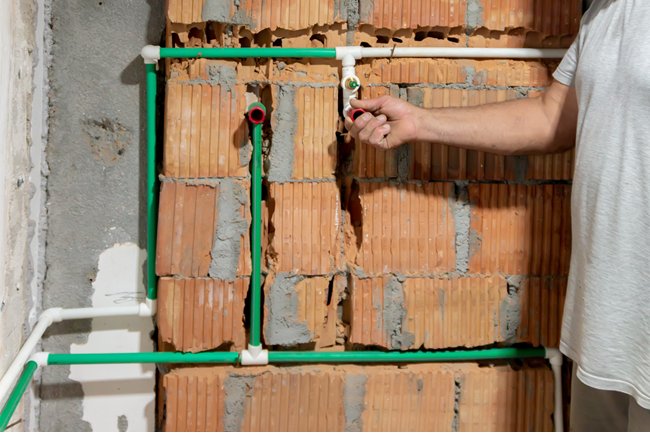
The hidden cost of aging plumbing is something multifamily owners and operators need to know about before the next leak.
By Aaron Kirk Douglas
Director of Market Intelligence
HFO Investment Real Estate
Failing plumbing systems can quietly drain more money from multifamily operators than almost any other expense especially the hidden cost of aging plumbing.
Matt Doran, Senior Project Manager at Caliber Mechanical, says failing plumbing systems operational expense is a risk. Doran has been in the industry for 30 years says he has seen it all “from all sorts of piping… the changes, the technology changes, everything.”
If you’ve ever had recurring leaks, tenant complaints, or insurance headaches tied to water damage, his insight is essential. Repiping isn’t just a construction project––it’s a risk management strategy.
The Biggest Culprit: Age—But Not Always How You Expect
We tend to think building age is the singular predictor of plumbing failure. But as Doran explained, the story is more complicated. “Ninety percent of it is age and installation standards… You’ll see copper piping that just was not done very well… poor craftsmanship, fittings not cleaned, bad soldering.”
Even galvanized pipe, which many assume is doomed after 40–50 years, can outperform newer systems depending on quality and water chemistry. “Some galvanized piping has been in buildings 70–80 years and is still doing very well. Others only lasted 20.” It’s the ultimate multifamily truth: Two buildings from the same era can diverge wildly in performance.
When Owners Know It’s Time: The Cost Curve Doesn’t Lie
Asked what typically triggers a repipe, Doran said, “The biggest one is the cost of repairs… you’re having a plumber out every week, repairing the same things… that’s when it’s time.”
Add in ceiling openings, drywall patches, tenant disruption, insurance claims, and labor shortages, and it’s easy to see why owners begin to view repiping as a capital investment rather than a never-ending operating expense. Insurance companies sometimes force the decision as well: “New ownership will come in and the insurance company says: we want to see new piping.”
How Repipes Actually Happen: Stacks, Back-to-Backs, and Tenant Logistics
For owners who’ve never overseen a repipe, the process can feel mysterious. Doran described two primary patterns:
- By stacks in multi-story buildings (vertical runs)
- By back-to-back bathrooms (horizontal clusters)
In occupied units—always the toughest scenario—logistics multiply.
“Tenants expect water on at the end of the day. It’s doable—just a lot more planning, communication, and more plumbers.” In some cases, tenants move out temporarily. In others, crews work in tight phases to keep disruptions minimal. This is where Caliber’s experience becomes valuable: they’ve repiped everything from garden-style walk-ups to nine-story towers.
PEX vs. Copper: The Industry Has Shifted
If there’s one material defining repiping in 2025, it’s PEX. Doran noted: “It’s probably 80 to 90% PEX.” Not because copper is obsolete, but because PEX solves several labor and cost challenges:
- Flexibility – PEX can snake through difficult spaces without full wall removal.
- Speed – Reduces both construction timelines and tenant disruption.
- Cost-efficiency – Lower material and labor costs compared to copper.
He summed it up with a field-level truth: “PEX lets you minimize how much you open the walls. With copper, you almost have to open the full stretch.” But there’s nuance. PEX fails quickly in a single, very specific scenario: hot-water recirculation lines. “Nine out of ten times, we’re going to do a copper return line… it holds up better long-term.”
Mixing PEX and Copper? Completely Normal
Owners sometimes worry about mixing materials. Doran said, “That’s not a problem. It depends on what you’re doing… we transition from copper mains to PEX in-unit all the time.” What matters more is ensuring no hidden fittings are buried in inaccessible places and verifying return-line temperatures.
Warranties: The Fine Print Owners Miss
PEX manufacturers often tout long warranties—50-year, even 100-year guarantees. But Doran warned owners not to take them at face value. “Some offer a 100-year warranty… but what does it cover? The material and labor, sure—but what about damages?” A burst pipe that floods five units isn’t solved by a free box of replacement fittings. Caliber’s process usually includes looping in insurance reps and product manufacturers to clarify what is—and isn’t—covered.
Where Repipes Get Messy: Unforeseen Conditions Behind the Walls
Every owner imagines clean, predictable wall openings. Reality is more… cinematic. Doran described common surprises:
- Electrical lines hidden where they shouldn’t be
- Asbestos insulation buried in walls
- Ducting placed in odd locations
- Drainage pipes with fixed slopes that limit reroute options
- As-built drawings that don’t match real conditions
According to Doran, “There’s no shortage of unforeseen conditions… you open a wall and think, why in the world is that there?” This is where experience matters. PEX can bend around obstacles; copper cannot. A good contractor adapts quickly; a bad one increases costs through improvisation.
Pre-Purchase Pipe Assessments: A Growing Trend
Doran conducts many plumbing evaluations for buyers as part of due diligence.
His team often cuts out test sections of pipe—something cameras can’t replace. “You really need to take out sections of piping to know what’s happening. Cameras work great on sewers, not on water mains.” Buyers increasingly want a forensic understanding of hidden systems before closing on 1960s–1980s assets.
PEX Is the Future—For Now
When asked what comes next, Doran offered a grounded forecast: “PEX is the animal… I don’t know what it’ll be 10 years from now, except maybe a different compound with a better additive.” But the fundamentals remain:
- Age is undefeated.
- Maintenance spending eventually becomes capital spending.
- Repipes protect cash flow by reducing future emergency costs.
What Multifamily Owners Should Take Away
If you own or operate properties built between the 1960s and early 2000s, you should be tracking:
- Frequency of leaks
- Rising repair invoices
- Drywall patching patterns
- Tenant complaints
- Insurance pressure
- Age and material of the original plumbing
- Presence of hot water recirculation lines
- Baseline conditions inside walls
When the signs stack up, it’s no longer a question of if you need a repipe. It’s when—and how much extra damage you can afford to absorb before acting.
“At some point, you’ve got to understand this system just needs to be replaced.” For multifamily investors, that isn’t bad news. It’s an opportunity to reduce long-term risk, extend asset life, and stabilize operations,” Doran said.
Read more here: HFO’s recent interview with Matt Doran, Senior Project Manager at Caliber Mechanical
Caliber Mechanical can be reached at www.calibermechanical.com or (503) 206-7591.
About the author:
HFO Investment Real Estate is a multifamily brokerage offering apartment communities of all sizes for sale throughout Oregon and SW Washington. Learn more at www.hfore.com.