Home Blog Page 47

Oregon Supreme Court Reduces Jury Award Against Landlord

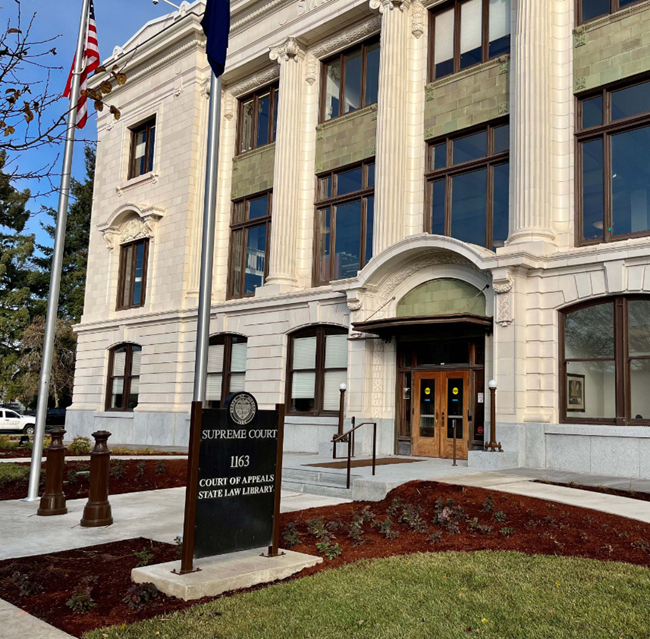
The Oregon Supreme Court has reduced a $20 million jury award against a landlord, calling it a “grossly unfair” amount of money,

The Oregon Supreme Court has reduced a $20 million jury award against a landlord, calling it a “grossly unfair” amount of money, according to reports.

According to the lawsuit, a tenant, Robert Trebelhorn, hurt his knee when his leg punched through a walkway that his apartment complex had allowed to fall into disrepair.

While Trebelhorn did undergo surgery and suffered prolonged knee pain, the court said penalizing the large corporation that owns the complex to the tune of $20 million was “grossly excessive,” Oregon Live reported.

The court reduced the jury award against the landlord to about $5.3 million in punitive damages, plus about $300,000 in compensatory damages.

Under Oregon law, only 30 percent of punitive damages “is payable to the prevailing party,” in this case Trebelhorn. The rest goes to state criminal victims’ assistance funds.

The Oregon Supreme Court has stated opposition before to what the court sees as excessive punitive damages awarded by juries.

The court has previously stated that punitive damages that so greatly dwarf a plaintiff’s compensatory damages should be reserved for “all but the most exceptional of cases,” Oregon Live reported.

Prime Wimbledon and Prime Administration own and manage the Wimbledon Square apartments, located north of Reed College in Southeast Portland.

Matthew Casey, an attorney for the apartments, argued during the trial in 2018 that there was no “evil intent” by the complex’s owners to hurt people.

“We agree that this event happened,” Casey said at the time. “We’re sorry that it happened, and we’re taking responsibility that it happened.”

In its ruling the court said that the apartment complex “was aware that the walkway and other structures at the complex had deteriorated to the point that required ‘life-safety’ repairs, but they had chosen not to repair the walkway” on which Trebelhorn was injured.

According to court documents, on the night of the incident at the apartment Trebelhorn was walking across the second-story concrete walkway connecting his apartment building to a parking structure when a portion of the concrete gave way under his right foot, creating a hole in the walkway of nine inches by 18 inches. His right leg dropped into the hole up to his thigh and he landed in a sitting position on the walkway.

Lower courts had previously reduced the award, but Trebelhorn’s lawyers appealed to the state supreme court to reinstate the full $20 million amount.

Portland Rents See Smaller Decline In January


Sign Up For Our Weekly Newsletter And Get Apartment News And Helpful, Useful Content Each Week.

* indicates required

Fair Housing Matters: Landlord Liability for Tenant-on-Tenant Discrimination

Rent Control Will Stand In New York Supreme Court Says

The U.S. Supreme Court has declined to hear challenges to New York’s rent-control laws so rent control will stand in New York

The U.S. Supreme Court has declined to hear challenges to New York’s rent-control laws, according to reports.

Two cases were brought by owners of apartment buildings or individual units that are subject to the laws. The challengers had asked the justices to overturn the rent regulations has governed more than one million units in the city for decades and provided some of the nation’s most tenant-friendly rules.

The apartment owners told the justices that the 1969 law and its related regulations “amount to the most onerous rent-control provisions the United States has ever seen” and that they lead to “an unconstitutional taking without just compensation,” according to reports.

The New York Rent Stabilization Law, which dates back to 1969, requires landlords to renew leases except in limited circumstances, including a failure to pay rent, and lets family members take over a lease if they have lived in the unit for at least two years, Crain’s New York Business reported.

The law also gives the city’s Rent Guidelines Board authority to set maximum rent increases every year. The board considers a list of factors, including the economic condition of the residential real estate industry, vacancy rates and the cost of living in the area. The law applies to buildings that were built before 1974 and have six or more units.

Justice Clarence Thomas did issue a short statement saying that the “constitutionality of regimes like New York City’s is an important and pressing question,” which could give rent-control critics some hope the court would consider the issue in the future.

Rent Control Contributes To Affordable Housing Shortage

Governor Signs Revised Oregon Rent Control Law

Sign Up For Our Weekly Newsletter And Get Apartment News And Helpful, Useful Content Each Week.

* indicates required

Fair Housing Matters: Landlord Liability for Tenant-on-Tenant Discrimination

Arizona Bill Seeks to Stop Landlord Dog Breed Discrimination

Arizona lawmakers have advanced Senate Bill 1439, which would bar landlords from dog breed discrimination against dogs such as pit bulls and German Shepherds pictured here

Arizona lawmakers have advanced Senate Bill 1439, which would bar landlords from dog breed discrimination against certain dogs such as pit bulls and German shepherds.

For landlords who allow dogs on their properties, Senate Bill 1439 requires them to allow tenants to have any type of breed.

Sen. Brian Fernandez (D-Yuma), the bill’s sponsor, said the idea was brought to him by his assistant. The bill has several Democratic and one Republican co-sponsors.

“We recently had a client of ours who’s a veteran, she actually now works with an organization that helps other veterans with housing-related issues,” Arizona Pet Project CEO Leanna Taylor told KJZZ. “When we met her, she was living in her car. She had been there for six months with her two pit bulls because she could not find housing that would accept her and her dogs.”

Dog breed discrimination by landlords

Several animal welfare groups support the bill, but the Arizona Multihousing Association opposes it.

Sen. J.D. Mesnard (R-Chandler) said he’s concerned that if the bill becomes law, landlords will stop allowing dogs altogether. “Not sure this leads to the outcome the sponsor would hope,” Mesnard said.

Rebecca Cline writes on Butterflymx that, “Breed restrictions for apartments are rules that dictate which types of dogs a resident can have in their unit. Restrictions are enforced in multifamily housing because they absolve managers and owners of liability should a type of dog become aggressive. In fact, an apartment with no breed restrictions could be vulnerable to legal repercussions if the dog attacks on the property.

“For this reason, many property insurance companies require strict enforcement of breed restrictions. These restrictions often center around a well-known list of the most aggressive dog breeds. However, this list can sometimes differ by area,” Cline writes.

Dog Breed restrictions are policy decisions at the level of the property management company, insurance company or even the city or county.

Sign Up For Our Weekly Newsletter And Get Rental Property And Apartment News And Helpful, Useful Content Each Week.

* indicates required

Rampant, Increasing Fraud Impacting Rental Housing Costs

Fraud impacting rental housing costs throughout the country is on the rise and includes incidences of fraudulent rental applications and more

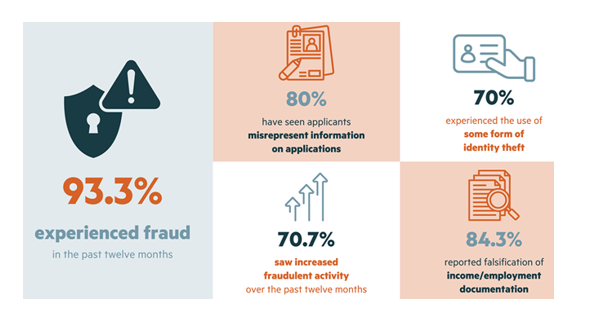
Fraud impacting rental housing costs throughout the country is on the rise and includes incidences of fraudulent rental applications, financial and identity fraud, and is often fueled by social media, the National Multifamily Housing Council (NMHC) says in a new survey.

“Driven in part by social media platforms such as TikTok and Instagram, the rise in false rental housing applications is exacerbating rental costs, fueling the housing affordability challenges facing communities across the country and undermining the credibility of eviction data. These fraudulent incidents consist of a wide range of wrongdoing, including criminal behavior,” the NMHC says in a release about the survey.

The NMHC Pulse Survey on Operational Impact of Rental Application Fraud and Bad Debt was done from November 5, 2023 to January 9, 2024 of NMHC members and National Apartment Association members representing 75 leading apartment owners, developers and managers.

Fraud impacting rental housing costs highlights of the survey:

  • 84.3% of respondents have seen applicants falsifying or fabricating pay stubs, employment references or other income documentation;
  • 80.0% observed prospective renters misrepresenting information on applications;
  • 70.0% reported identity theft, fraudulent ID documents or use of another individual’s personal information;
  • 67.1% experienced unauthorized cohabitants, illegal subletting or other actions to evade application or the leasing process; and
  • 62.9% of respondents reported the use of fraudulent checks or other payment methods.

Sixty seven percent of those who experienced an increase in fraudulent applications and payments said that this varied by jurisdiction, and many (46.9%) called out Atlanta specifically as a jurisdiction where increases in fraud were most concentrated.

Fraud impacting rental housing costs throughout the country is on the rise and includes incidences of fraudulent rental applications and more

“There has been anecdotal evidence of the rise in fraudulent activity over recent years, but now we have clear evidence of the staggering impact of these crimes on the rental housing market,” said NMHC President Sharon Wilson Géno said in the release.

“While most renters are honest, those who are not are causing the cost of rental housing to increase for everyone. Additional delays in many jurisdictions in the lease enforcement process, even when there is clear fraud, incentivizes bad actors and means that this illegal behavior costs responsible renters even more. We call on lawmakers and courts to take action that will address this problem,” she said.

See the full survey detail here.

6 Vital Tools You Need To Fight Fraud

Sign Up For Our Weekly Newsletter And Get Rental Property And Apartment News And Helpful, Useful Content Each Week.

* indicates required

Landlords Ordered To Pay $500,000 In Damages in Sexual Harassment Lawsuit

Two landlords have been ordered to pay $500,000 in damages in a sexual harassment lawsuit settlement with the U.S. Department of Justice

The U.S. Department of Justice has secured an agreement for landlords to pay $500,000 in damages in a sexual harassment lawsuit involving the sexual harassment of female tenants over a period of 20 years.

The Justice Department said in a release that Richard and Mary Donahue, landlords who own more than 100 residential rental units in and around Janesville, Wisconsin, have agreed to pay $500,000 in monetary damages and a $123,965 civil penalty to the government to resolve a Fair Housing Act (FHA) lawsuit concerning Richard Donahue’s sexual harassment of female tenants over more than 20 years.

“A home should be one’s sanctuary, not a place where you are subjected to dehumanizing and prolonged periods of sexual harassment,” said Assistant Attorney General Kristen Clarke of the Justice Department’s Civil Rights Division. “When landlords sexually harass their tenants, they deprive them of the ability to feel safe and secure in their own homes. This agreement sends a strong message that the Justice Department will continue to enforce federal civil rights laws to ensure all tenants are protected from unlawful discrimination.”

“The lengthy course of sexual harassment and retaliation against female tenants in this case is disturbing and unacceptable,” said U.S. Attorney Timothy M. O’Shea for the Western District of Wisconsin. “Our office remains committed to holding landlords accountable for violations of the Fair Housing Act.”

Under the terms of the proposed consent decree, which still must be approved by the court, Richard and Mary Donahue will pay $500,000 in monetary damages to 13 female tenants harmed by Richard Donahue.

“The defendants are also required to seek to vacate any retaliatory eviction judgments obtained against these tenants and to take steps to correct the tenants’ credit histories. The defendants are also permanently enjoined from managing residential rental properties in the future and must retain an independent property manager to manage their rental properties for the duration of the decree. Finally, the defendants must pay a $123,695 civil penalty to the government, the maximum civil penalty allowed under the FHA,” the Justice Department said in the release.

The lawsuit alleged that, since at least 2000, Richard Donahue harassed female tenants by making repeated and unwelcome sexual comments, touching tenants’ bodies without their consent, demanding sexual activity in exchange for rent and housing-related benefits and taking adverse actions against tenants who resisted his sexual advances or complained about the harassment.

The suit was filed in May 2022.

The Justice Department’s Sexual Harassment in Housing Initiative is led by the Civil Rights Division, in coordination with U.S. Attorney’s Offices across the country. The goal of the department’s initiative is to address, deter and raise awareness about sexual harassment by landlords, property managers, maintenance workers, loan officers or other people who have control over housing. Since launching the initiative in October 2017, the department has filed 38 lawsuits alleging sexual harassment in housing and recovered more than $11.8 million for victims of such harassment.

Advanced Fair Housing Training – A Professional Resolution

Sign Up For Our Weekly Newsletter And Get Rental Property And Apartment News And Helpful, Useful Content Each Week.

* indicates required

The Easiest & Least Expensive Small Landlord Hack: Require Renters Insurance

Require renters insurance as it solves a lot of problems when there has been a fire or when someone has been hurt on your property

At Anderson Insurance Group, we have been through experiences where landlords call, their rental property has been involved in a fire, their tenant has nowhere to go, no coverage for their “stuff,” and the landlord is left with the hassle of rebuilding their property and big claim on their insurance policy. A $15.00 per month renters insurance policy can solve a lot of problems when there has been a fire or when someone has been hurt on your property. We see this 1-2 times a year and the claims are normally around $250,000 which is too often and too much. Landlords need to better protect themselves by requiring their tenants to carry renters insurance.

Large apartment complexes require renters insurance, and while it may require a little more work, it’s something that every Utah landlord, large or small, should require. There are a few benefits for a landlord when you require renters insurance, here are just a few:

  1. A renters insurance policy provides a layer of liability insurance between you, the tenants and their visitors. If the tenant’s mother-in-law drops by to visit, trips and falls the renters insurance may respond before your landlords insurance providing an additional layer of liability coverage. This is especially important if your tenant has a dog. The average dog bite claim across the nation is $50,000! make sure your tenant’s policy does not limit dog bite claims or exclude certain breeds. We recommend you require your tenants to carry at least a $300,000 limit of liability coverage.
  2. Fire Legal Liability is part of every renter’s insurance policy and will pay for damage to your property if the tenant is negligent or responsible for starting a fire. Accidents happen – if your tenant leaves something cooking on the stove or their grill causes a fire, their renter’s insurance will pay for the damage. It will also pay for the damage to other structures, so if your rental is a condo or townhome, this coverage becomes even more important.
  3. Renters Insurance will help pay for your renter to relocate if the dwelling is damaged from a covered loss. As landlords, sometimes we develop relationships with our renters and feel a need to help them, and a renters insurance policy will pay for them to find a new home.
  4. Tenants with renters insurance are more responsible. Some tenants don’t care about renters insurance, so they probably also don’t care about their things or your property. Mention your requirements during the interview process to help find better renters.

The cost of renters insurance can be as low as $10.00 per month, and if your tenant combines renters insurance with their auto insurance, it normally discounts the cost of their auto insurance, so the net cost of the renters insurance is zero.

Make sure you are listed as Certificate Holder on your tenant’s renters insurance policy. A certificate holder will receive notice of the coverage limits, renewal notices and most importantly a notice if the renters insurance cancels. If your tenant cancels their renters insurance and you receive notice you should issue a three notice to comply or vacate.

Call us for more information on renters insurance and any questions you have about land lording, we love helping our customers be successful Utah landlords. Call our office at 801-262-1551 or Click Here for a for a consultation with our experienced team. Find out more about renter’s insurance.

Avoid Costly Coinsurance Penalties with Proper Insurance Coverage for Your Investment Properties

For a full review of your apartment or rental property insurance, contact a knowledgeable Anderson Insurance Group agent today.

Secure Your Monthly Cash Flow With One Easy-to-Miss Coverage: Business Income Insurance for Utah Landlords

Avoid Costly Coinsurance Penalties with Proper Insurance Coverage for Your Investment Properties

Advanced Fair Housing Training – A Professional Resolution

Advanced fair housing training looking at domestic violence, criminal history, emotional support animals and sexual harassment training.

Advanced fair housing training looking at domestic violence, criminal history, emotional support animals and sexual harassment training.

By The Fair Housing Institute

What’s your New Year’s resolution? Save money? Exercise more? Typically we focus on personal goals, but what about professional development? A career in property management is truly dynamic and requires us all to stay up to date on the latest trends as well as training. This is especially true when it comes to fair housing.

Now is an excellent time to review our team members’ and our basic understanding of the intricacies of the Fair Housing Act, along with ensuring that we all have a thorough understanding of the more complicated aspects. This article will share the top five fair housing topics that continue to be a cause of fair housing complaints and require an advanced level of knowledge and training.

Review the scenarios and questions to see if you might need to brush up on a few of the more challenging situations that can arise in property management.

Domestic Violence – A Complicated Topic

Domestic violence, unfortunately, is on the rise and is an incredibly sensitive topic.

That being said, it still needs to be addressed. First of all, when we discuss domestic violence, many will immediately think of The Violence Against Women Act. Remember, though, that the laws that protect victims of domestic violence apply to all types of housing providers. No one is exempt.

Consider the following scenarios and ask yourself how you or your company would handle them:

  • A public instance of domestic abuse has occurred on your property? What are the next steps?
  • A prospect has disclosed that they were evicted from their prior residence due to the fact that they were a victim of domestic violence. Now what?

As you can see, domestic violence raises all kinds of questions about whether you are dealing with the victim or the perpetrator. Specialized training and clear company policies will help everyone stay compliant while tactfully managing these types of situations.

Is Your Marketing Fair Housing Friendly?

Is your marketing handled in-house, or do you outsource it?

Does your company have clear marketing policies?  Is every staff member that is involved with marketing aware of how fair housing laws can affect marketing? Marketing can take a very broad range past the standard pamphlet or advertisement. It can include things like pictures in the leasing office to what employees may be posting on company social media.  Added to that, even the type of funding your property receives can impact what kind of marketing you are required to do.

As we start to move into 2023, now is a good time to review your marketing strategy and ensure that everyone involved knows how to keep it fair housing friendly.

Criminal History Screening – Can You Just Say No?

Criminal history screening has also seen a recent uptick in complaints and lawsuits due to its complex nature.

One of the more common mistakes we see when it comes to criminal history screening is when leasing agents try to dissuade a prospect from filling out an application and paying the standard fees associated with it due to their criminal history. While this may seem like they are doing the “right” thing, it can land a company in all kinds of legal trouble.

This is just one of the scenarios that might happen. Blanket policies of just saying “no” are never a good idea, and once again, every person that is involved in the application process needs to have training to help them navigate this complex and sensitive process.

Emotional Support Animals –  A Potentially Hairy Situation

“Oops, did I forget to tell you about my emotional support animal when I applied?

Meet Kujo, my one-hundred-pound furry friend.” What’s the saying… if I only had a nickel? The number of requests and subsequent complaints regarding emotional support animals only grows year after year. Hurdles like misinformation, online certification and verifiers, and many other variables create a potential minefield for most housing providers.

The best protection from a potential fair housing claim of discrimination is to make sure that everyone has received training to understand the law, the resident’s rights, and the rights of the property itself. Along with that having clear policies and specific forms will aid in handling the ever-growing reasonable accommodation requests for an emotional support animal.

Sexual Harassment Prevention Doesn’t Stop in the Office

Sexual harassment training is needed within the workplace, but it shouldn’t end there. What about training in regard to employee and resident relations? Consider some of these more common scenarios that can end in a fair housing claim if not handled properly:

  • Employees and residents are friends and socialize outside of work.
  • Employees dating residents.
  • Access to a unit is needed, but only a child is home.

To avoid a potential fair housing claim, every company needs to include additional sexual harassment training that provides clear policies regarding employee/resident relationships.

So how did you do?

These are just a few of the more complicated fair housing situations that can arise. If you found yourself struggling or unsure how to handle any of these issues, or perhaps you are personally aware of others that you are not clear on how to handle, we strongly encourage you to make continued fair housing training one of your New Year’s resolutions.

About the author:
In 2005, The Fair Housing Institute was founded as a company with one goal: to provide educational and entertaining fair-housing compliance training at an affordable price at the click of a button.

Sign Up For Our Weekly Newsletter And Get Rental Property And Apartment News And Helpful, Useful Content Each Week.

* indicates required

Record 2024 Apartment Supply Coming, May Limit Rent Growth

There is a record amount of new apartment supply coming in 2024 that will limit rent growth, Yardi Matrix says in a multifamily rent report.

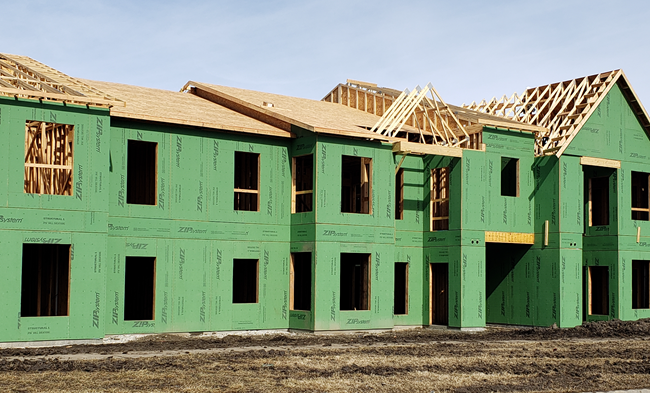
There is a record amount of new apartment supply coming in 2024 that will limit rent growth, Yardi Matrix says in a special multifamily rent report.

However, it might take a year or two for some markets that are doing well handling the new supply to absorb all the new units.

“The main story of 2024 will be one of record supply coming online that will depress rent appreciation in many of the markets that saw explosive growth during the pandemic, and a handful of markets could end the year in negative growth territory,” writes Andrew Semmes, Senior Research Analyst for Yardi Matrix, in the report.

The new apartments coming online are almost all in the higher-level, more luxury apartments called Class A properties, directly in competition with one another.

“So, we expect to see less growth in asking rents at the top of the market, and stronger growth in workforce and renter-by-necessity units,” Semmes says.

Asking rents versus in-place rents

The second trend Yardi Matrix sees coming in 2024 is the gap closing between asking rents and in-place rents.

“Asking rents are almost a perfect leading indicator of in-place rents, and most markets still have a large gap between the two, which will continue to shrink as asking rent increases remain muted in the near term,” Semmes says.

Rent increases have been tamed and supply absorption will take time

Semmes says the rent increases that occurred in 2021 and 2022 has been tamed.

“We expect modest growth of 0.8%— with large variance across markets and time—in average national asking rents in 2024 as a historically large amount of supply gets added to the housing stock.

“It will take time for that supply to be completely absorbed, but it will get absorbed, and once that occurs, we expect a return to the usual 3-4% yearly growth in asking rents that we experienced before the pandemic,” he writes.

Read the full report here.


Top 10 Cities To Watch For Rentals In 2024

Sign Up For Our Weekly Newsletter And Get Rental Property And Apartment News And Helpful, Useful Content Each Week.

* indicates required

Attracting Federal Investment to Multifamily Housing

The federal investment in multifamily housing enables multifamily affordable housing properties (MFAH) to pursue high-impact upgrades

Ravi Malhotra

The Bipartisan Infrastructure Law (BIL) and Inflation Reduction Act (IRA), signed into law in 2021 and 2022, respectively, enable multifamily affordable housing (MFAH) properties to pursue high-impact upgrades largely on the federal government’s dime. The MFAH segment can tap free money for weatherization, beneficial electrification, solar, and health and safety solutions. These kinds of green solutions can reduce operating costs; increase net operating income; and increase affordability, health, comfort, and safety for the low-income households.

However, the time to benefit from these funds is finite, and quickly disappearing. This year, many funds are moving from the federal government to the states, and then on to communities. A crucial step for MFAH stakeholders will be persuading federal and state agencies that MFAH offers a path to addressing agencies’ pain points when it comes to IRA and BIL: getting their allocations spent in a manner that is cost-effective, simple, scalable, deeply impactful, and in alignment with the federal Justice40 initiative.

At ICAST, a national 501c3 nonprofit with a 22-year history of scaling green solutions in MFAH, we are working at the same task. In the process, we have created a library of resources that the MFAH segment can utilize for its advocacy efforts. ICAST provides research, insights, and case studies, as well as key guidance including:

  • For myriad reasons, the same program design cannot serve single-family and multifamily, and MFAH is a different animal altogether.
  • Programs should take advantage of established strategies for the MFAH segment to simplify the qualification, intake, processing, invoicing, and reporting process.
  • Programs should leverage a “one-stop-shop” approach, where the program implementer offers a simple, yet turn-key solution that is hassle-free for the MFAH customers.
  • Programs should offer leveraging of funds from various programs to reduce or eliminate the investment needed from property owners.
  • Programs should have a “mass customization” approach wherein every project is tailored to drive the highest benefits based on each property’s specific needs.
  • Programs should lean on existing successful programs and partnerships.

 About the author:

Ravi Malhotra is the Founder and President of ICAST, a national nonprofit that creates holistic retrofit solutions for MFAH. He has 30+ years of experience designing, launching, and managing programs to benefit this segment.

Race Against Time: Seizing an Unprecedented Opportunity for Affordable Housing

Planning for Funding Opportunities Through the Inflation Reduction Act and Bipartisan Infrastructure Law

Accessing Solar for Multifamily Affordable Housing

Accessing Utah’s Home Energy Rebate Programs

Portland Rents See Smaller Decline In January

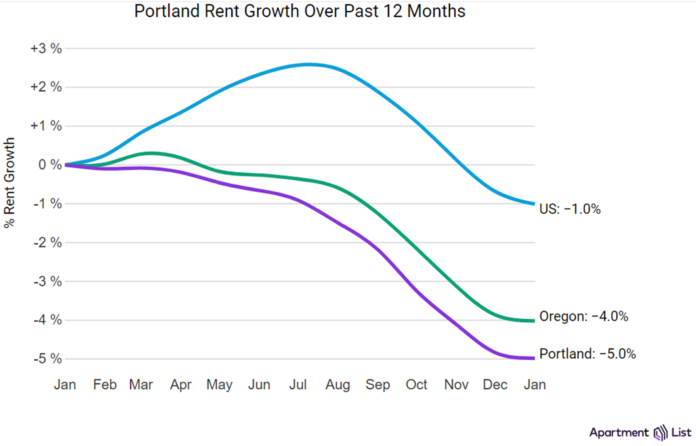
Portland rents saw a smaller decline in January, dropping a small 0.2%, after several months of larger declines.

Portland rents saw a smaller decline in January, dropping a small 0.2%, after several months of larger declines, according to the February report by Apartment List.

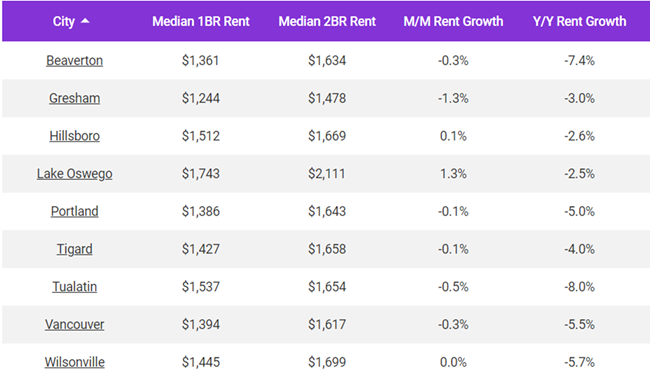
The overall median rent in the city across all bedroom sizes is $1,526, roughly the same as last month in December and prices are now down 5.0% year-over-year. Median rent for a one-bedroom in Portland is $1,386 and $1,643 for a 2-bedroom.

Portland’s rent growth over the past year has is similar to the state average (-4.0%) but has fallen below the national average (-1.0%). January rent growth in Portland ranked #35 among large U.S. cities.

Rents lower in Portland proper

Outside the city the median rent is $1,624 meaning that the median price in Portland proper ($1,526) is 6.0% lower than the price across the metro as a whole. Metro-wide annual rent growth stands at -4.5%, above the rate of rent growth within just the city.

The table below shows the latest rent stats for 9 cities in the Portland metro area that are included in our database. Among them, Lake Oswego is currently the most expensive, with a median rent of $1,990. Gresham is the metro’s most affordable city, with a median rent of $1,458. The metro’s fastest annual rent growth is occurring in Lake Oswego (-2.5%) while the slowest is in Tualatin (-8.0%).

Portland rents saw a smaller decline in January, dropping a small 0.2%, after several months of larger declines,

Portland, Metro Area Rents Continue Decline


Portland Update: Changes to FAIR Ordinance Bring (Some) Necessary Changes

Dealing with Habitability issues and Substitute Housing