Home Blog Page 43

Rent Changes Should Be Modest For Rest Of 2024

Rent changes should be modest for the rest of 2024 due to the imbalanced relationship between supply and demand

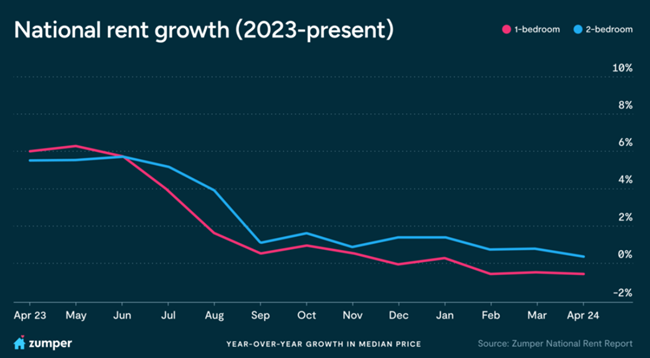
Rent changes should be modest for the rest of 2024 due to the imbalanced relationship between supply and demand, says the rental platform Zumper in its latest National Rent Report.

The report covers 100 cities nationwide, with data aggregated from over 1 million active listings, and includes a National Rent Index for one- and two-bedroom units.

“It seems we are firmly settled into the year of the renter, as people have more options now than in recent memory,” said Zumper CEO Anthemos Georgiades in a release.

“With Class A buildings marketing concessions that include up to three months of free rent, free parking, and waived deposits and application fees, this, in turn, puts pressure on Class B and C buildings to price competitively as well in order to attract tenants.

“As normal seasonality patterns return and the rental market has leveled off from the price spikes seen in the last few years, the national one-bedroom rate is now about $9 cheaper than it was last year. However, even with this cooling, the national one-bedroom rent is still nearly $250 pricier than it was in 2021,” the report says.

Highlights of the rent-changes report

  • While the level of new U.S. apartment supply is expected to peak this summer at a 50-year high, demand is still trailing behind – so changes to the national rent rates should continue to be modest for the rest of the year.
  • This April, the national rent index continued its trend of stable annual rates with one-bedrooms down 0.6% to $1,486, while two-bedrooms increased 0.1% to $1,843.
  • Meanwhile, New York City continues to buck national trends with one-bedroom rent at $4,280, which is up 20% annually and up 50% since pre-pandemic.
  • The high annual rates and prices reflect that NYC is bearing the tightest rental vacancy rate since the 1960s, currently at a mere 1.4% (the national rate is 6.6%).

Conclusion

The report says, “Changes to the national rent rates for the rest of the year, and likely into 2025 as well, should remain fairly modest due to the current imbalanced relationship between supply and demand. Even with peak demand in the summer and fall months, the new apartment inventory across the nation – as it will reach a 50-year high over the summer – will keep the overall national rates fairly restrained.”

A full discussion, as well as more from the Zumper CEO, can be found here:  https://zumper.com/blog/rental-price-data/


3 Ways to Take a New Look at Your Property Portfolio

3 ways to take a look at your rental property portfolio if you feel stuck in your current situation as a housing provider.
Forget what the so-called experts and talking heads say, this is your journey and only you can know what best works for you.

3 ways to take a look at your rental property portfolio if you feel stuck in your current situation as a housing provider.

By Scot Aubrey

Have you ever looked at your life as a housing provider, considered your property portfolio, and questioned why things just aren’t working out in your favor?

If you’ve been doing this for any period of time, the answer is a resounding yes.  If you haven’t, well at least you have that to look forward to.  Here’s the great thing, you can blame it on your brain, specifically on what scientists call cognitive dissonance.

Similar to the person who wants to be fit and healthy but refuses to eat less, eat well, or exercise, landlords who are struggling in the current market have to be willing to make some changes in order to find their success.

Here are a few things to consider if you feel stuck in your current situation as a housing provider:

No. 1 – REASSESS YOUR GOALS

When you buy a property, you better have some goals or reasons behind the purchase, otherwise what’s the point?

  • Are you buying to create an additional revenue stream?
  • Or to create a long-term appreciating asset?
  • Do you just want someone to cover the mortgage or do you want to have positive cashflow every month?
  • Are you hoping to house a long-term tenant who treats your property like their own, or are you happy having a short-term rental with a new occupant every few days or weeks?

Goals change over time and due to other circumstances in your life.

No matter where you are in your ownership journey, I suggest sitting down annually and creating or modifying your goal list so it aligns with your current needs.  I am doing that right now and have decided to unload a short-term rental that was great for a number of years but has been struggling for the last year.  I’ve enjoyed a healthy appreciation for this property and have decided it’s time to sell and hold until I can find a new property that aligns with my goals.

No. 2 – REASSESS THE MARKET

If you’re like me, you’re tired of hearing the word “rates” in every conversation.

For housing providers, rates are important, but not the only thing we should consider when determining the direction we will take with our rental property portfolio and investments.

  • What are other providers getting for rent near your property?
  • Have rents become stagnant, or worse, dropped in the last year?
  • If you are looking to sell your property, how saturated is the marketplace with homes like yours?
  • How long are those homes on the market and how much are they going for when they do sell?
  • Is there growth like retail and restaurants near your property that add to its value?
  • Are new businesses, schools or parks coming to the area that will create a greater need for rental housing?

There are no simple decisions, based on just the questions I’ve suggested here.

Taking a look at the larger market around you can help you make the next step a successful one.

No. 3 – REASSESS YOUR TIMELINES

As we age, it is critical to always consider our personal timelines and the time commitments it takes to be a housing provider.

As a younger investor, maybe the appeal of having short-term occupants and the increased fees they paid was exactly what you were looking for.  You didn’t even mind cleaning and prepping the property for the next guest; after all, it was keeping more money in your pocket.

But now you may lack the energy and motivation to process the “hands-on” management style and are looking for the stability of having a good tenant that pays on time and maintains the property.

Maybe you want to spend more time with your family or traveling, and the prospect of managing tenants doesn’t fit into your timeline.  Or maybe you are ready to exit the market altogether and your time as a housing provider has run its course.

Engage your brain by revisiting these three critical parts of your process and be confident in making the best decision for you and your property.  Forget what the so-called experts and talking heads say, this is your journey and only you can know what best works for you.

About the author:

Scot Aubrey is vice-president of Rent Perfect, a private investigator, fellow landlord and cohost of the Rent Perfect Podcast.  Subscribe to the weekly Rent Perfect podcast to stay up to date on the latest industry news and for expert tips on how to manage your properties.

Sign Up For Our Weekly Newsletter And Get Rental Property And Apartment News And Helpful, Useful Content Each Week.

* indicates required

The Changing Economy and Its Impact on Rent Collection

To improve rent collection, it is crucial to sidestep traditional concessions and get residents on board with technologies to help.

In the current economy with its impact on rent collection, it is crucial to sidestep traditional concessions and get residents on board with technologies that align with multiple business objectives.

By Andrew Ruhland

Rents are stagnant, as indicated by Radix data showing that rents are down 1.5% on a year-over-year basis, nationally. Combine that with the more than 400,000 new units that came online in 2023 and another half million anticipated for 2024, and economic conditions will continue to be challenging.

To combat stagnant rent as well as supply issues, many operators implement traditional concessions, which can be  short-sighted and more costly in the long-term. While measures such as offering free rent may fill apartment homes faster and bolster occupancy, concessions can ultimately be a slippery slope and detrimental to the bottom line and overall property performance.

In today’s economic landscape, it is crucial to sidestep traditional concessions and get residents on board with technologies that align with multiple business objectives.

Concessions versus Rewards

One of the most effective strategies operators can deploy at their communities involves digitizing the collections process and rewarding residents for positive behavior.

In doing so, they are providing the perception of concessions without having to incorporate large discounts. Instead, operators allow residents to earn discounts through acts such as making timely digital payments or posting community reviews, which helps them retain the market value of apartment homes.

By definition, the word concession means to give something up. For operators, offering concessions equates to giving up revenue in order to drive occupancy. On the flip side, by rewarding positive renter behavior, both operators and residents can benefit.

The rewards given are nominal in comparison to costs associated with concessions. Residents are able to earn points that add up to a dollar amount that is significantly less than offering free rent. For instance, 400 points earned in rewards may feel like 400 dollars to a resident even though it isn’t. Those points are of tremendous value when residents redeem them and see a discount on their next month’s rent.

Embracing Technology: A Digital Approach

The implementation of digital payment platforms embedded with a rewards program is also modernizing the rent collection process.

Via a mobile app, residents can pay monthly obligations in a convenient, secure and contactless environment that enhances efficiency and optimizes on-time payments. This type of platform simplifies the process with features such as access to payment history, upcoming payment reminders and the ability to sign up for autopay or schedule one-time payments. For residents who still prefer traditional methods of paying rent, the platform also provides access to a mobile check-pay service.

“Having access to multiple payment options is something that our residents really love, and the rapid adoption rate of digital payments at our communities speaks volumes,” said Chris Gray, president at Moss & Company. “They appreciate the flexibility in how they can pay their rent every month. With more residents using the platform, we’re seeing a more stable income stream and even increased associate efficiency.”

In addition to providing a more seamless experience when paying rent, operators that combine rewards with digital payments can realize even greater returns. Offering points for cash-back rewards for such positive renter behavior as posting online reviews, referring new residents or participating in community events can motivate residents to pay their rent on time each month. Moreover, offering resident rewards costs operators less than offering eight weeks of concessions.

According to internal data from Domuso, offering rewards for on-time payments plus the option for autopay reduces late payments by 5% annually. In terms of cash-flow, that can potentially add up to $800,000 per year.

Long-term Benefits, Sustainable Economic Success

“The rent collection process is one of the most crucial aspects of ensuring successful operations,” said Ron Klein, VP of Product for Domuso.

“In a financial climate where many factors are beyond our control, it’s essential to see the bigger picture and be proactive when possible. By streamlining the process for residents and offering rewards for positive behavior, operators can improve community satisfaction and maintain optimal occupancy rates in any economic landscape.”

Beyond increased occupancy rates and greater resident satisfaction, operators using an intuitive payment platform can drastically diminish financial risks by having 100% chargeback protection, as well as by offering certified payment options, including credit, debit and ACH transfers.

“With certified funds, we reduce our exposure to potential fraud because we know the money is there,” Gray said. “By using a platform that doesn’t charge for ACH payments, we are realizing almost $9,000 in savings every month. The platform has renewed our financial confidence, knowing that not only are rent payments more consistent and on time, but there are safeguards in place to protect both residents and ourselves.”

Although economic challenges are inevitable, they do not have to hinder rent-collection processes or damage the bottom line.

Embracing modern solutions such as digital payment platforms that streamline the process while incentivizing timely payments is one of the most effective strategies in mitigating the negative financial impacts of late payments and delinquencies. By leveraging technology and resident rewards in the rent-collection process as opposed to offering traditional concessions, operators can better navigate economic struggles, maintain occupancy rates, position their communities for long-term success and bolster NOI.

About the author:

Andrew Ruhland is an account executive and content writer for LinnellTaylor Marketing, which focuses exclusively on the rental housing industry, its trends and technology innovations.

istockphoto credit BabaImages

How Do I Prove A Tenant Is Smoking Marijuana In Violation of Lease?

How Do I Prove A Tenant Is Smoking Marijuana In Violation of Lease?

This week the question is about how to prove a tenant is smoking marijuana in violation of lease and what action to take.

Ask Attorney Brad:

Hello, I have a tenant who smokes marijuana, and the lease states no smoking at all.

How can I prove that she is smoking to prove it to the judge in court? Thanks.

-Romy

Hello Romy,

Thank you for your email. Smoking issues can prove challenging when it comes to proof.

If no one sees the tenant smoking, how can you prove it’s occurring?

Well, there’s a couple different methods you may be able to employ.

First, the complaints of smoke smell likely came from neighbors. Try to “box” the smoke in, which will assist you with pointing the finger at this tenant. In essence, if the neighbor above, the neighbor below, and the neighbors on both the left and right sides of the tenant smells smoke, and that smell is strongest towards the alleged smoker, then there’s certainly favorable circumstantial evidence to suggest that particular tenant is smoking.

Second, marijuana smoke can leave a particular odor in an enclosed area. If you inspect the property, and the place stinks of marijuana (but none of the surrounding neighbors’ premises smell like marijuana), again, there’s a favorable inference to be had there.

Finally, if you have an onsite manager, it may be appropriate to have that individual walk through the hallway (assuming it’s a multifamily building) when there’s a smoking complaint. If the manager walks by the tenant’s door, and can smell marijuana from the outside, that’s solid proof.

Ultimately, the best proof is what you can see, and have someone testify to. If you don’t have that type of proof, there’s always risk . . . but that risk must be weighed against the headaches your other tenants are currently experiencing.

-Brad

Ask Attorney Brad: How Do I Prove A Tenant Is Smoking Marijuana In Violation of Lease?
Bradley Kraus, Portland attorney

Bradley S. Kraus is an attorney at Warren Allen LLP. His primary practice area is landlord/tenant law, but he also assists clients with various litigation matters, probate matters, real estate disputes, and family law matters. You can reach him at kraus@warrenallen.com or at 503-255-8795.

The Use Of Marijuana – A Fair Housing Challenge

Sign Up For Our Newsletter And Get Rental Housing and Apartment News And Helpful, Useful Content Each Week.

* indicates required

Ask Attorney Brad: Why Can’t A Landlord Give a 30-Day Notice to Vacate?

Understanding a Landlord’s Rights, Obligations in Domestic Violence Situations

Ask Attorney Brad: Tenants Want to Know Why There’s a Dog in No-Pet Building?

New Programs and Oregon’s Archaic Landlord-Tenant Act

How new programs marketed to tenants by landlords must fit into Oregon's archaic landlord-tenant act as either rent, utilities or fees.

How new programs marketed to tenants by landlords must fit into Oregon’s archaic landlord-tenant act as either rent, utilities or fees.

By Bradley S. Kraus
Warren Allen, LLP

Given the changing dynamics between landlords and tenants, I often hear of new, exciting programs presented to my clients. The moment I hear about these programs, the wheels begin to spin, analyzing what exposure, if any, these programs present for my clients.

The Oregon Residential Landlord and Tenant Act governs landlord-tenant relationships in the state of Oregon. Enacted in the 1970s, this body of law has failed to catch up to the times regarding many issues or interactions between landlords and their tenants. As such, many new and innovative approaches to certain landlord/tenant interactions are challenging to enact without risk, given the archaic nature of this body of law. It is, unfortunately, within that archaic body of laws, that any new programs must be analyzed.

There are only three types of recurring charges recognized by the ORLTA: rent, utilities, and fees. Each has a statutory definition under the ORLTA. Any charges a landlord imposes on a tenant must fit within—and comply with the requirements of—one of those particular statutes. Many companies trying to market products for Oregon landlords have products which either (a) do not fit into one of these three categories, and/or (b) require the landlord to charge tenants illegal fees. That makes them problematic, presenting potential exposure for landlords.

What can be classified as rent?

Whether something can be classified as “rent” is the first—and easiest—portion of the analytical discussion.

If something is not “rent,” it must be either a utility—and be properly billed as such—or comply with the fee statute.

What can be classified as a utility?

A utility or service under ORS 90.315 is defined as “include[ing], but is not limited to electricity, natural or liquid propane gas, oil, water, hot water, heat, air conditioning, cable television, direct satellite or other video subscription services, Internet access or usage, sewer service, public services and garbage collection and disposal. Many services offered by out-of-state companies do not neatly fit into this definition. Even if they do, and the landlord wishes to charge back any costs to the tenant, there are required monthly billing disclosures that present additional hurdles.

What can be classified as a fee?

If any such charge is not “rent” or a “utility,” then it must be a “fee.”

The fee statute, ORS 90.302, strictly defines the fees for which a landlord can charge. This list is exclusive; if the fee is not listed in ORS 90.302 (and it is not rent or a utility), the landlord cannot charge for the same. Common examples I see are things like “notice-service fees” or “month-to-month fees.” Such fees are illegal in Oregon. Similarly, if a company provides a service that requires you to pass along a fee of some kind to your tenant, such a fee is likely illegal, and should give you pause.

As landlords continue their attempts to provide better customer service and amenities to their tenants, there will always be companies marketing new and exciting services. Those companies will try their hardest to sell you on their products. As landlords, do not fall for the “shiny red ball” trick. Carefully analyze any such services with your attorney. The potential exposure for any missteps can be costly.

How new programs marketed to tenants by landlords must fit into Oregon's archaic landlord-tenant act as either rent, utilities or fees.
Brad Kraus

About the author:

Bradley S. Kraus is an attorney and partner at Warren Allen LLP. His primary practice area is landlord/tenant law, but he also assists clients with various litigation matters, probate matters, real estate disputes, and family law matters. You can reach him at kraus@warrenallen.com or at 503-255-8795.


Portland Update: Changes to FAIR Ordinance Bring (Some) Necessary Changes

Dealing with Habitability issues and Substitute Housing


Multifamily Shows Good Early Rent Gains In 2024

The multifamily market produced encouraging rent gains in March, its strongest performance in 20 months, writes Yardi Matrix.

The multifamily market produced encouraging rent gains in March, its strongest performance in 20 months, writes Yardi Matrix in the March Multifamily Report.

“The market appears to be settling into normal seasonal patterns, as demand is holding up despite challenges posed by the economy and heavy supply growth in the Sun Belt,” the report says.

Normal seasonal patterns appear to be returning

The report says there should be some “level of comfort” now for many who had been worried about the multifamily sector’s performance in 2024.

“It appears that normal seasonal patterns are returning after several years of unconventional performance that started with the pandemic lockdowns in the spring of 2020,” Yardi Matrix says in the report. Rents are also rising, even in markets with lots of new apartments coming online, the report says.

Highlights of the report

  • S. multifamily rents in March recorded their largest gain in 20 months, signaling a normal seasonal growth pattern. The average U.S. asking rent rose $8 during the month to $1,721, while year-over-year growth increased by 30 basis points to 0.9%.
  • While 13 of the metros in the Matrix top 30 have had negative rent growth over the past year, the situation is improving. Only four metros recorded negative rent growth over the first quarter and only two were negative in March.
  • Single-family rents also had a good month, increasing by $9 in March to $2,144. However, the year-over-year growth rate fell 20 basis points to 1.2%. Similar to multifamily, high-supply markets including Austin, Orlando, Phoenix and Dallas, have seen rent growth soften.

Conclusion

“While one month of data doesn’t constitute a trend and rent growth likely will remain constrained due to affordability and new supply, the tone early in 2024 is encouraging,” the report says.

Read the full report here.

Insurance Leads Rising Rental Property Expenses

Have You Ever Had To Evict A Dog?

have you ever evicted a dog and do landlords know the facts about emotional support animals and service animals
Pictured, our dog Lolo.  We rescued this sweet Husky Terrier mix.  When my daughter needed her most, she was there.  She also tried to pick a fight with every dog in the neighborhood and thus spent most of her pampered life in the backyard.

Have you ever had to evict a dog brings to mind the acts that landlords need to be aware of when accommodating emotional support and service animals.

By Lance Anderson

Insurance companies and dogs generally don’t go together well.   Dogs bite people.  It’s the easiest $40,000 someone will ever get. That’s correct, the average dog-bite settlement is $40,000.  We lose sleep over tenants’ dogs biting people and the ensuing legal papers that are sure to follow.

When I was a young landlord, after serving all the legal RHA Utah | Rental Association of Utah Home notices, I asked Animal Control to meet me and ensure a conflict-free eviction of three pit bulls. When I arrived, animal control was there, but the pit bulls were gone. Conflict adverted and problem solved.

Have you ever had to evict a dog?

On another occasion, I stopped by a rental home to collect rent and was greeted by a German shepherd. When I asked the tenant about the new dog, they informed me that their daughter’s apartment didn’t allow dogs. I just stood there for a minute … if the apartment building does not allow a German shepherd, what makes you think I would want one on my property?  I went back to my office for the correct RHA form, returned and posted it, and the dog found a new home.

Times have changed and landlords must be aware of and follow the Utah Fair Housing Act & the Federal Fair Housing Act, which encourage and require landlords to accommodate people who have disabilities.  An Emotional Support Animal – ESA – or Service Animal may help with those disabilities.

Here are a few facts for landlords to be aware of when accommodating Emotional Support and Service Animals:

  • There must be a demonstrable relationship between the individual’s disability and the assistance the animal provides.
  • A landlord is entitled to verify the existence of the individual’s disability as well as the need for an assistance animal as an accommodation for that disability.
  • An individual proposing an assistance animal as an accommodation for a disability may be required to provide documentation from a psychiatrist, physician or other qualified healthcare professional.
  • It appears to be quite easy to obtain an ESA letter or documentation by filling out a few forms online.
  • ESAs are not subject to a landlord’s size or breed restrictions.
  • A landlord cannot charge additional rent or deposit for an ESA or Service Animal.
  • The tenant is responsible for any damage caused by the ESA or Service Animal.
  • A landlord can (and should) ask for proof of insurance for your service animal.  Are You Requiring Renters Insurance? | Anderson Insurance Group
  • If the ESA is an aggressive dog breed, make sure the renter’s insurance does not exclude coverage for aggressive breeds or an animal liability sub-limit.

The rights of renters with ESAs are clear, and landlords must and should accommodate them as long as it is reasonable.

Many landlords’ policies do not cover liability from a dog bite or exclude certain breeds. The best way a landlord can protect themselves is to 1) require renters’ insurance.  And, 2) make sure their landlord’s insurance includes Personal Injury coverage. Personal Injury can cover such things as discrimination and wrongful eviction and is an added endorsement every landlord’s policy should include.

For the most comprehensive landlord insurance coverage, call Andres Dominguez or Lance Anderson at Anderson Insurance Group today.

About the author:

Lance Anderson is the owner and CEO of Anderson Insurance Group and has been an insurance agent for more than 25 years. He attended BYU and later graduated from the University of Utah with a Bachelor of Arts degree in Interpersonal Communications. He and his wife and family live in Draper, Utah.

Sign Up For Our Weekly Newsletter And Get Rental Property And Apartment News And Helpful, Useful Content Each Week.

* indicates required

Flexible Financing for Green Projects

The TBL fund can help with flexible financing for green products and clean energy projects for your low-income multifamily housing property

ICAST’s affiliated organization, TBL Fund, recently received an award from the U.S. Dept. of Energy (DOE) for deploying innovative decarbonization financing solutions that go beyond current market practices. If you require a Bridge Loan or other financial assistance to cover the construction expenses of your solar and storage, beneficial electrification, or other clean energy project for your low-income multifamily housing property—TBL Fund can help.

TBL(Triple Bottom Line) Fund is a 501c3 nonprofit Community Development Financial Institution (CDFI) that provides funding and technical assistance for clean energy deployment in multifamily affordable housing (MFAH) and disadvantaged communities (DACs). It leverages its market expertise to develop custom financing solutions, including:

  • Power Purchase Agreements
  • Energy Performance Contracts
  • Bridge Financing
  • Energy-as-a-Service
  • Property Assessed Clean Energy
  • Debt
  • Tax Equity

Nationwide, there is a lack of financiers who understand energy financing (vs. traditional debt), which disproportionately impacts MFAH—a historically underserved market.

However, TBL Fund is a national leader in crafting innovative financing solutions for this segment, evidenced by its recognition as a “Climate Finance Innovator” through DOE’s Better Buildings Challenge. Further, it is enhancing its existing offerings by exploring the many opportunities through the Bipartisan Infrastructure Law and Inflation Reduction Act, signed into law in 2021 and 2022, respectively.

TBL Fund is determining how to braid its products with financial resources such as the expanded solar and storage Investment Tax Credit, the DOE’s new Home Energy Rebate Program funds, the Environmental Protection Agency’s Greenhouse Gas Reduction Fund, and others. It recently started offering bridge financing so that its clients could get their projects off the ground and repay the loans once the various federal incentives were paid to the project.

Learn more about TBL Fund and its work with ICAST here.

About ICAST
ICAST is a 501c3 nonprofit with a history of designing, launching, managing, and scaling programs to benefit underserved communities. Its focus is delivering clean energy upgrades to low- and moderate-income households living in MFAH and DACs.

Green Retrofits for Cost Savings and Resiliency

Attracting Federal Investment to Multifamily Housing

Race Against Time: Seizing an Unprecedented Opportunity for Affordable Housing

Planning for Funding Opportunities Through the Inflation Reduction Act and Bipartisan Infrastructure Law

Accessing Solar for Multifamily Affordable Housing

Accessing Utah’s Home Energy Rebate Programs

Tenant Refuses To Return Keys After Leaving My Rental

What should you as a landlord do if a tenant refuses to return keys after leaving your rental property is the question this week.

What should you do if a tenant refuses to return keys after leaving your rental property is the question this week for Ask Landlord Hank. Remember Hank is not an attorney and is not offering legal advice. If you have a question for him please fill out his form below.

Dear Landlord Hank:

My tenant is leaving before lease is up and he is refused to give me my house keys what do I do?

-Shari

Dear Landlady Shari,

I’d ask the tenant via email or text so you have something in writing when he is leaving.

Then on that day, I’d go to the property after he has left and do an exit walk through where you assess the condition of the property to see if there is any tenant caused damage or issues.

Then since he is refusing to turn in the keys, I’d change the locks. I suggest you contact an attorney that specializes in landlord tenant law in your area first.

Good luck!

Sincerely, Hank Rossi

Each week I answer questions from landlords and property managers across the country in my “Dear Landlord Hank” blog in the digital magazine Rental Housing Journal.  https://rentalhousingjournal.com/asklandlordhank/

What should you as a landlord do if a tenant refuses to return keys after leaving your rental property is the question this week.
On dealing with the key issues Landlord Hank says, “I suggest you contact an attorney that specializes in landlord tenant law in your area first.”

Ask Landlord Hank Your Question

Ask veteran landlord and property manager Hank Rossi your questions from tenant screening to leases to pets and more! He provides answers each week to landlords.

  • This field is for validation purposes and should be left unchanged.

Do I Have to Paint and Replace Flooring for a Long-Term Tenant?

A Tenant Poured Grease Down Drain Who Is Responsible?

Sign Up For Our Newsletter And Get Rental Housing And Apartment News And Helpful, Useful Content Each Week.

* indicates required

For Many, The Modern American Dream Involves Renting

More and more Americans are renters by choice as the modern American Dream involves renting rather than the desire to own a home.

More and more Americans are renters by choice as the modern American Dream involves renting rather than the desire to own a home.

By Virginia Love

While the American Dream might have included various components throughout the decades, one constant was the desire to own a home. For modern dreamers, however, that isn’t necessarily the case.

According to The New American Dream Report recently released by the property software management company Entrata, 41% of renters claim their American Dream has nothing to do with homeownership. In fact, 20% anticipate being lifelong renters, which represents a 33% increase from 2021.

The causes for this paradigm shift are wide-ranging, but it certainly includes the idea that skyrocketing home prices have made homeownership an unattractive option for many—even for those who can afford to take the plunge. In addition to the long-term financial commitment, property upkeep, taxes and insurance are stressors that can be avoided by renting. The report, based on a survey of 2,000 renters conducted in January, found that 23% of respondents enjoy the location flexibility provided by renting and 17% like the financial flexibility of not being tied to a mortgage.

Additionally, renting no longer carries the negative stigma of the past, when it was largely perceived as a necessity-based alternative for those who couldn’t afford a single-family home. The term “renter by choice” is more common in current times, particularly with a wide range of available rental homes with attractive amenities and an increased supply of single-family build-to-rent homes.

When you consider the price and commitment components of homeownership, contrasted with the convenience-based factors of renting, it helps underscore why homeownership is not as much of a standardized American goal as in the past. According to the study, 66% of renters say renting fits their current lifestyle more than homeownership.

Essentially, experiences and flexibility have become greater priorities to the modern American.

Preference a more prominent factor than money

 Some might make the counterpoint that it’s easy for someone to dismiss homeownership as a priority when it isn’t financially feasible.

But the perception that renters are too young or financially unequipped to purchase a home has become something of an outdated generalization. The study shows that 33% of renters say they could afford a home that meets their needs, but ownership doesn’t necessarily fit into their current lifestyle. Additionally, 25% of renters with credit scores 750 and above—those who could easily qualify for a home—never want to stop renting.

For many, renting also serves as a key component to their career paths. According to the study, 65% of renters are happy with the direction of their career and 35% believe being a renter gives them more career opportunities than being a homeowner. Additionally, a robust 63% of renters indicated that they have a similar or better quality of life than their parents at a similar age.

Other financial priorities

 The traditional notion of “I need to save to buy a house” doesn’t apply to many, as a sizable contingent of younger Americans are earmarking their funds for other financial priorities.

More than half of those surveyed (56%) say they’re currently prioritizing paying off debts rather than saving, and 43% prefer to have their savings in investments and retirement strategies rather than real estate, because they are easier to liquidate.

While homeownership does build equity where renting does not, the concept of having all of one’s income dedicated to a house is becoming an old-school thought process. Some renters are looking even further down the line with their funds, as 36% of renters prefer to invest in retirement as opposed to saving for a home.

For the majority of respondents, any discretionary money is dedicated to activities such as dining, travel and entertainment, such as concerts and sporting events. A sizable 74% indicate that they designate any extra funds toward these types of experiences. Nearly half of respondents—46%—say they have the financial means to pursue their hobbies.

Non-monetary benefits of renting

 While renting might often be more cost-effective than homeownership, many Americans also enjoy the social aspects of being part of an apartment community.

Renters also have the ability to use a property’s common areas to host their own visitors, which for many, is preferable to having a backyard.

Forty percent of renters have utilized a property’s communal spaces for social gatherings, and approximately one-third (34%) indicate that their friends or family visit at least once per month.

More than half of respondents (51%) say they enjoy the community aspect of renting, and many have fostered meaningful connections with their neighbors. To that end, 67% of renters have helped neighbors at their properties while 61% have had neighbors assist them.

In summation, homeownership no longer qualifies as a primary measure of success or fulfillment for many of today’s Americans—particularly younger generations. While a certain percentage of people will always be renters by default due to their financial situation, more and more Americans are renters by choice. That’s because flexibility, experiences and other financial priorities are increasingly more compelling than homeownership to many.

About the author:

More and more Americans are renters by choice as the modern American Dream involves renting rather than the desire to own a home.
Virginia Love

Virginia Love joined Entrata in 2019 as an industry principal. She is directly involved with marketing, product, and sales as a liaison from the industry to these departments. With nearly three decades of industry experience, Love has served on numerous multifamily committees and boards for industry organizations including the Atlanta Apartment Association, Georgia Apartment Association, National Apartment Association, National Multifamily Housing Council and Zillow Multifamily Advisory Board. She is a National Apartment Association Lyceum graduate.