Home Blog Page 41

NAA Announces 2024 Top Employers Award Winners

The National Apartment Association (NAA) has announced the winners of the 2024 NAA Top Employers Awards, which recognize member organizations

The National Apartment Association (NAA) has announced the winners of the 2024 NAA Top Employers Awards, which recognize member organizations that foster environments of collaboration, innovation and hard work.

NAA’s Top Employers Awards pay tribute to management companies and suppliers from across the rental-housing industry that have exceeded expectations in creating a culture that emphasizes growth and contribution. The awards are divided into four categories; one for suppliers and three for management companies. The management-company categories are designated for small businesses of up to 100 employees, medium businesses with 101-500 employees, and large businesses with more than 500 employees.

Employees and their satisfaction, measured through an anonymous survey, determine the award winners and finalists in each of the categories. The survey results are provided to all nominees to help organizations better understand and recognize employee sentiment.

“As we navigate the dynamic landscape of 2024, recruitment and retention remain top of mind throughout the rental housing industry,” said Bob Pinnegar, NAA president and CEO. “This year’s recipients of the 2024 NAA Top Employers Awards have gone above and beyond to cultivate exceptional workplace environments that value engagement and learning. I’d like to extend my congratulations and thanks to all of our winners and finalists for emphasizing the importance of investing in our most valuable asset –– our workforce.”

Property Management Companies

The top 10 Small Business Management Companies are:

  • MZ Capital Partners | Top Winner
  • American Communities
  • Axia by ARC
  • Becovic Management Group
  • Henssler Property Management
  • Luves Management LLC DBA City Heights Asset Management
  • Madison Communities, LLC
  • NorthPoint Management
  • RHO Residential LLC
  • Veritas Equity Management

The top 10 Medium Business Management Companies are:

  • Mills Properties | Top Winner
  • Ascentia
  • Fitzrovia
  • Marquette Management
  • Olympus Property
  • Quantum Leap Property Management
  • RealSource Properties
  • Summit Property Management
  • Stoa Group
  • Vidalta Property Management

The top 10 Large Business Management Companies are:

  • Van Metre Companies | Top Winner
  • Atlantic Pacific Companies
  • Berkshire Residential Investments
  • Bryten Real Estate Partners
  • Gables Residential
  • PeakMade Real Estate
  • Pegasus Residential
  • Picerne Real Estate Group
  • Redwood Apartment Neighborhoods
  • S.L. Nusbaum Realty Co.

Supplier Companies

The top 10 Supplier Companies are:

  • Realync | Top Winner
  • Affinity Waste Solutions
  • Apartments247.com
  • iRestify
  • J Turner Research
  • Leap
  • Legacy Apartment Staffing
  • Real Estate Business Analytics (REBA)
  • Red Elephant – Design + Architectural Signage
  • TheGuarantors

Thirty-five companies were also named “finalists” in the 2024 NAA Top Employers Awards. These organizations scored above the cumulative average of all surveys within each contest. Finalists include 4 Degrees Real Estate; Ally Waste; Artisent Floors; AVE, by Korman Communities; Belco Property Management; BetterBot; Brownlee Whitlow and Praet; Chadwell Supply; Decron Properties; DJE Properties LLC.; Emmer Management Corp.; Enfield Management; Fairlawn Real Estate; GCI Residential; Greystar Nashville Region; Horizon Management Services, Inc.; Indus Communities; Kingdom Roofing Systems; Leonardo247; NM Residential; Peak Management, LLC; Phillips Management Group; Preferred Apartment Communities; PRG Real Estate; Q10 Property Advisors; REEP Residential; Rentgrata; ResideBPG; Respage; RR Living; Tour24; Venture Communities; Wangard Partners, Inc.; WithMe, Inc.; and Zumper.

About NAA
The National Apartment Association (NAA) serves as the leading voice and preeminent resource through advocacy, education and collaboration on behalf of the rental housing industry. As a federation of 141 state, local and global affiliates, NAA encompasses more than 96,000 members representing more than 12 million apartment homes globally. NAA believes that rental housing is a valuable partner in every community that emphasizes integrity, accountability, collaboration, community responsibility, inclusivity and innovation. To learn more, visit www.naahq.org. NAA thanks its Strategic Partners: The Home Depot Pro, Lowe’s Pro Supply, Yardi and AppFolio.


Rent Growth Continues in Secondary Markets

Rent growth continues in secondary markets as new apartment construction supply continues to weigh down asking rents in pandemic boomtowns

Many midsize markets in the Midwest, Northeast and South are still experiencing strong rent growth even while new apartment construction supply continues to weigh down asking rents in pandemic boomtowns, according to Yardi Matrix’s Multifamily Research Bulletin.

“Markets that saw explosive growth over the pandemic and that are now experiencing a large influx of supply are generally seeing stagnant or falling rents. Nine of 20 markets that have had rents fall since the beginning of the year are in Florida or Texas, and other pandemic high-growth markets like Atlanta, Raleigh–Durham, Austin and Salt Lake City also have average asking rents that are lower today than they were at the beginning of the year,” writes Andrew Semmes, senior research analyst for Yardi Matrix.

Meanwhile, the secondary markets mentioned above are seeing solid growth in asking rents.

The top secondary markets, which all had over 2% rent growth so far this year, are Albany, N.Y., Milwaukee; Worcester–Springfield, Mass.; Louisville, Ky.; Cincinnati; Des Moines, Iowa.; Richmond, Va.; Madison, Wis.; Portland, Maine; Lafayette, Ohio; Youngstown, Ohio; Providence, R.I.; Northern Virginia; and Scranton–Wilkes–Barre, Pa.

Outlook for the year remains unchanged

“Our overall outlook for the year is little changed. We still expect markets with lots of supply to continue to struggle to realize gains this year, but that is only a supply issue, and once those new units get absorbed all of those markets will be back in good shape,” Semmes writes in the report.

The Federal Reserve is now expected to keep interest rates where they are for longer than originally thought. Also, the prospect for a small downturn later this year is still in the cards.

Conclusion

“Rental growth next year will be stronger than this year, and growth in 2026 will likely be a bit stronger still, as it will take some time both for the Fed’s eventual rate cuts to meaningfully impact consumer demand and for the current influx of supply to be fully absorbed,” Semmes writes in the report.

Read the full report here.

About Yardi Matrix

Yardi Matrix researches and reports on multifamily, office and self-storage properties across the United States, serving the needs of a variety of industry professionals. Yardi Matrix Multifamily provides accurate data on 18+ million units, covering more than 90 percent of the U.S. population. Contact the company at (480) 663-1149.

Sign Up For Our Weekly Newsletter And Get Rental Property And Apartment News And Helpful, Useful Content Each Week.

* indicates required

Live-in Aides and Fair-Housing Compliance

Disability is a protected under Fair Housing so if a resident asks about live-in aids be sure you know reasonable accommodation procedures

Disability is a protected class under Fair Housing so when a resident approaches you about live-in aids be sure your reasonable accommodation procedures are up to date.

By The Fair Housing Institute

A live-in aide request: For properties such as senior living communities, this is a regular request, and the procedure is memorized by many of the staff. But are your procedures up to date with the Fair Housing Act? For other properties, these requests aren’t all that common and can cause some stress due to lack of experience. What are some of the nuances you should be aware of? Let’s break it down.

Remember, Disability Is a Protected Category

When a resident approaches you asking questions about the process or even about the form to request live-in aides, you need to be aware of some pitfalls.

Remember, disability is a protected class under the Fair Housing Act. So, during conversations to assist your residents, avoiding certain questions will help you avoid a fair-housing complaint. Anything direct, such as the name of the disability or even asking if they have a disability (if they don’t have physical manifestations), should be strictly avoided.

Remember, your company’s reasonable accommodation form or an approved letter from a verifier will more than likely have answers to these questions. You should not ask such questions in your interactions with the resident. Your role in this process is to inform the resident of the proper procedure and help guide them in their request.

Check Your Forms

For management, the drafting of reasonable-accommodation forms can be tricky.

There are generic ones that you can definitely use, especially as forms aren’t required under fair-housing law. However, if your form has open-ended questions, it may be difficult to make the final decision on approving such a request. It is always recommended to employ the services of a fair-housing lawyer. Below is a list of possible questions that you may have on the form, specifically for live-in aide requests:

  • Does the resident require 24-hour care?
  • How many hours a day does the resident require care?
  • What services are needed to provide adequate care for the resident?
  • Will the live-in aide be a permanent or long-term solution?

The verifier provided by the resident should fill out your property’s provided form. If the resident has already met with a verifier—their doctor, as an example—and provided a letter answering the questions found on your form, then a form isn’t required.

Follow-Up Policy

Your resident has approached you about the need for a live-in aide, and a verified form or letter has been acquired.

How do you follow up?

Once the need for a live-in aide is confirmed and presented, your procedure must include a few things. First, remember that a live-in aide is not a resident, so while a criminal background check can be enforced, a credit check cannot. What if your resident wants a family member as their live-in aide? This can be permitted as long as it is verified that the family member is there to render necessary care to your resident. You may also need to address an additional reasonable accommodation for a larger unit depending on the current unit your resident is residing in.

As always in any procedure, ensure every interaction and all steps are thoroughly documented. This can help you prevent delays in following through with the accommodation and any miscommunication between different members of the staff. If there is a delay in the accommodation, having proper documentation will also help you give a clear answer to the resident in case of questions or confrontations.

Live-In Aide Accommodation Summary

In summary, no matter the type of property, you need to be prepared for any kind of reasonable-accommodation request, especially when it comes to live-in aides. Reviewing your procedures, whether they’re well-used or a little dusty, can help you prevent fair-housing complaints that could lead to pricey violations.

As touched on before, while generic forms are acceptable, they can make the reasonable-accommodation process longer for both parties. Employing a fair-housing lawyer to work on your own custom, in-depth accommodation forms can help you save time and avoid delays. In addition, focus heavily on proper documentation training. Especially when dealing with accommodations involving a protected category, keeping all staff informed of conversations and current steps can also aid in avoiding fair housing violations. So, the next time that a live-in aide request presents itself, you can confidently help your resident and stay fair-housing compliant.

In 2005, The Fair Housing Institute was founded as a company with one goal: to provide educational and entertaining fair-housing compliance training at an affordable price at the click of a button

Money on the Move: Accessing Incentives for Your Green Projects

ICAST is in partnership with state and regional stakeholders who have helped pave the way for Utah to capture green project funding

More funds from the Inflation Reduction Act (IRA) and Bipartisan Infrastructure Law (BIL) are working their way toward communities.

For example, Utah’s Office of Energy Development is currently preparing its applications for the U.S. Dept. of Energy’s funded Home Energy Rebate programs. The Environmental Protection Agency is considering applications under the Climate Pollution Reduction Grant Program, through which multifamily properties in Utah may be able to access incentives for electric vehicle (EV) chargers. Treasury and IRS recently announced that  applications will open at 9 a.m. ET May 28 for the 2024 program year of the low-income communities bonus program for the investment tax credit. To learn more about the funds coming to multifamily properties, follow this link.

ICAST is thrilled to be in partnership with state and regional stakeholders whose efforts have helped pave the way for Utah to capture these and other funding opportunities. Our partners include:

  • Utah Housing Coalition (UHC), which leverages education, advocacy, and partnerships to promote equitable and sustainable communities to ensure all Utahns have a safe and affordable place to call home. UHC’s Executive Director serves on ICAST’s Board of Directors.
  • Southwest Energy Efficiency Project (SWEEP), a public interest nonprofit organization advancing energy efficiency, beneficial electrification, and clean transportation in the Southwest. In 2023, SWEEP helped drive a significant expansion of incentives for energy efficiency and EVs in new affordable housing projects in Utah, and it has long been a key partner in ICAST’s efforts to deliver beneficial electrification solutions to existing multifamily properties.
  • Rocky Mountain Power (RMP), which manages Utah’s Custom Multifamily Demand-Side Management Program in collaboration with ICAST. In 2023, this program offered incentives for the installation of energy efficiency measures to 145 multifamily projects, increasing efficiency, safety, health, and comfort for 9,987 multifamily units. Overall, low-income customers received 57% of the program budget.
  • Utah Clean Air Partnership (UCAIR), a statewide clean air partnership created to make it easier for individuals, businesses, and communities to make small changes to improve Utah’s air. Partnership with UCAIR has enabled ICAST to maximize its impact in target areas to improve the efficiency, health, and quality of multifamily housing and reduce emissions of criteria pollutants that cause Utah’s poor air quality.

About ICAST
ICAST is a 501c3 nonprofit with a history of designing, launching, managing, and scaling programs to benefit underserved communities. Its focus is delivering clean energy upgrades to low- and moderate-income households living in multifamily affordable housing and disadvantaged communities.

Flexible Financing for Green Projects

Green Retrofits for Cost Savings and Resiliency

Attracting Federal Investment to Multifamily Housing

10 Items To Check in a DIY Rental Property Inspection

Here are 10 items to check in a do-it-yourself rental property inspection to both plan preventative maintenance and build tenant trust.
10 items to check in a do-it-yourself rental property inspection

Here are 10 items to check in a do-it-yourself rental property inspection to both plan preventative maintenance and build tenant trust.

By Phil Schaller

Conducting a periodic informational inspection/walkthrough of your rental property is important; we recommend at least once a year. It allows you to understand the state of your property, troubleshoot for larger issues, plan some preventative maintenance and also build trust with your tenants (more on that in a bit).

While there are hundreds of items you could inspect in a walkthrough, we’re going to focus on the low-hanging fruit and the most important boxes to check. Before we get into the list, here are a few pointers:

  • Schedule this walkthrough far in advance with your tenants – they’ll keep it on the radar and (hopefully) focus on keeping the property in good shape. Most states require at least 48 hours of written notice before anyone enters the dwelling.
  • Communicate to your tenants why you’re conducting this walkthrough. You want to know what’s going on with the property but you also want to make sure you’re providing a hospitable environment for your tenants.
  • We recommend conducting these walkthroughs with a general contractor or maintenance pro (RentalRiff can help) as an unbiased third party and someone who can easily diagnose/fix certain issues.

Without further ado, here we 10 items to check in a rental property inspection:

1. Replace furnace filters

This is an easy one. You’ll need a filter on hand but it’s easy and not expensive. Replacing a broken furnace, on the other hand, is very expensive.

2. Replace smoke and carbon monoxide alarm batteries

Here is another easy one that is a critical safety tool. Aside from the liability you’ll have on your hands if these alarms don’t work during an emergency, let’s keep everyone safe!

3. Clean out dryer vents

While cleaning out a dryer vent may require slightly more elbow grease than changing batteries, it’s another important safety precaution. If your dryer can’t ventilate, two things can happen: Your dryer breaks ($$$) or, much worse, a fire can start.

4. Switch the GFIs

We can’t tell you how many calls we get for electrical work that can be solved with the push of a button. Get ahead of these issues by switching the GFI for your tenants.

5. Run water and check for leaks under the sinks

An easy way to do this is to turn on the water and throw a baking pan under the plumbing to see if any liquid is captured. Sometimes leaks can be small, but they can cause serious damage.

6. Turn on all appliances

Checking to see that appliances are in good working order is definitely helpful. Appliances are expensive and that weird sound your dishwasher is making may indicate a new one is in your future.

7‍. Run the garbage disposal

The No. 1 maintenance request landlords receive is for garbage disposals. We recommend giving them a tighten with an Allen wrench and/or a reset. Olive pits love giving landlords a headache.

8. Test the heating and air conditioning

You’re required as a landlord to provide a humane environment for your tenants; this means a livable temperature. We like to turn the AC on full blast to check, then switch to heat – it’s easy to inspect other items while checking these systems.

9. Inspect crawl spaces and attics

Pests and water damage love the areas of your property where people don’t hang out. It’s pretty easy to spot both (poop and watermarks) and if left untreated, they can cause big problems.

10. Check ceilings, walls, floors, doors, and windows

All right, so we crammed a few into No. 10 here, but they’re all important. Any sign of water damage is a big red flag and requires an immediate solution. Walls/ceilings/floors are expensive fixes.

About the author:

Phil Schaller is an experienced landlord and the founder/CEO of RentalRiff – an alternative service to traditional property management that provides ongoing oversight and upkeep of rental properties, while serving as the main point of contact for tenants. These walkthroughs are included with our service and many of our customers will schedule several throughout the year (based on the tenants and condition of the property). If you have any questions on how to conduct these informal walkthroughs we’re happy to chat or provide some more insight – https://www.rentalriff.com/contact-us You can reach him at 541-600-3200. Phil is a Pacific Northwest native, father of two, and fly-fishing addict.

Sign Up For Our Weekly Newsletter And Get Rental Property And Apartment News And Helpful, Useful Content Each Week.

* indicates required

3 Must-Have Coverages for Landlords

The 3 most important coverages you should look for in a proper Landlord Insurance Policy are dwelling, liability and loss of rents

By Andres Dominguez III

I spent years mastering landlord insurance, but I’ll break it down for you in minutes. Landlording is rewarding, tedious, and at times a pain in the neck. The last thing you need is an insurance policy that leaves you underinsured, exposed, and lacking essential coverages. Our agency works local, regional, and national carriers to find the best combination of coverage and pricing for your unique situation. In this article I’ll break down the 3 most important coverages you should look for in a proper Landlord Insurance Policy.

1- Dwelling Coverage

The dwelling limit is the meat and potatoes of an insurance policy.

This limit is the maximum amount your carrier will pay to rebuild your property in the event of a total loss. Imagine your property burns down and you have to rebuild it from the ground up. The dwelling limit will pay for the materials, labor, and cost of construction to rebuild your property.

We have not seen this level of inflation in many years. This means that the cost to rebuild your property has also increased due to increased cost of materials and labor. And your current policy may not have enough Dwelling Limit to rebuild your property. We advise our clients to not take this coverage lightly because there is a Coinsurance Penalty that insurance carriers will charge you if your property is underinsured. More on Coinsurance Penalty in this article: How Does Coinsurance Work in a Commercial Property Insurance Policy?

2- Loss of Rents

This often overlooked coverage is crucial at the time of a severe claim.

Another name for this coverage is “Fair Rental Value.” This coverage will reimburse you for lost rents due to a covered peril. Example: Imagine your rental unit has a tragic fire that burns the property to the ground. During the period of restoration while you get the property rebuilt, this coverage will step in and reimburse you the rents you would have received during this time. This coverage will continue to pay your lost rents until the home is repaired or rebuilt or the policy limit is exhausted (whichever comes first). That is why we emphasize the importance of reviewing your policy to ensure this limit is adequate.

3- Liability

 The United States is the most litigious society in the world.

We spend roughly $310 Billion a year on tort litigation. It is more important than ever to have sufficient liability limits on your Landlord Policy. Some carriers maximum is $500K, and some will go up to $1M. Every situation is unique, however, we usually suggest going for the highest limits your carrier offers.

***Bonus–Renter’s Insurance

A Renter’s insurance policy provides a layer of liability insurance between you, the tenants, and their visitors.

If the tenant’s mother-in-law drops by to visit, trips and falls, the renters insurance may respond before dinging your Landlord Policy. This is especially important if your tenant has a dog. The average dog bite claim across the nation is $50,000, make sure your tenants policy does not limit dog bite claims or exclude certain breeds. We recommend you require your tenants to carry at least a $300,000 limit of liability coverage. More on Renter’s Insurance in this article: Are You Requiring Renter’s Insurance?

Call or click for more information on how to best protect your rental properties or any questions you have about Landlording: 801-262-1551 or Click Here for a for a consultation with our experienced team. Find out more about renter’s insurance. We love helping our customers be successful Utah landlords.

Avoid Costly Coinsurance Penalties with Proper Insurance Coverage for Your Investment Properties

For a full review of your apartment or rental property insurance, contact a knowledgeable Anderson Insurance Group agent today.

Secure Your Monthly Cash Flow With One Easy-to-Miss Coverage: Business Income Insurance for Utah Landlords

Avoid Costly Coinsurance Penalties with Proper Insurance Coverage for Your Investment Properties


A Different Kind of AI For Landlords

A caution for landlords on how to react to tenant information provided by background screening companies per the new HUD tenant screening requirements.

There is a different kind of AI for landlords – Actual Information – and a caution for landlords on how to react to tenant information provided by background screening companies per the new HUD tenant screening requirements.

By Scot Aubrey

 When it comes to artificial intelligence, it seems to be everywhere.

In fact, it probably knows you’re reading this article right now.  But did you know it’s even trying to work its way into your life as a housing provider?  Although it has some restrictions, we do believe in AI, just a different kind than you are thinking of right now.  Rather than relying on artificial intelligence, we believe that the AI we provide will change the way you manage.  That AI is “Actual Information,” and it is more important than ever that you use it in managing your properties.

Recent changes in the HUD regulations for housing providers will create new challenges for each of us in this industry.  How we use the information provided by background-screening providers will be affected, and your need to understand how you interact with information provided from your background-screening provider has been elevated to a whole new level.  Please consider the following items as you use “Actual Information” in your business.

Creating a Criteria 

 One of the areas that HUD is highlighting is the use of and creation of criteria for all of your potential tenants.

HUD warns against the use or application of certain criteria in determining who can move into one of your properties.  They indicate that you as a housing provider are solely responsible for creating and enforcing your own criteria.  It is recommended that you contact your attorney for any custom criteria creation.

Beware as you create your criteria to steer away from the many areas HUD indicates as being potentially discriminatory and only rely on “Actual Information” results as you measure against your final criteria.

Evictions 

 Per the new HUD guidelines, “tenant screening companies and housing providers should not rely on eviction records that are old, incomplete, irrelevant, or where a better measure of an applicant’s behavior is available.”

Does that sound vague or subjective to you?

The new HUD guidelines are both clear and unclear about eviction data and how you can use it as a housing provider.  One of the things you should look for with your “Actual Information” regarding evictions are the circumstances surrounding any eviction.  Factors like how long ago the eviction occurred and the reason for the eviction, if you can find one, are the two main items.

Also to consider per the HUD guidelines is the likelihood of an eviction occurring again. You must consider things like whether there was criminal activity surrounding the eviction, if the evicted person was a victim of a crime, or if the individual who was evicted was forced to commit a crime, causing the eviction.

In our opinion, this just made using eviction data harder.

Final Occupancy Determination

When you are ready to decide on who you will rent to, please keep in mind the following regarding the “Actual Information” provided by your screening company:

  • Your screening company cannot provide a pass-or-fail decision.
  • Your screening company cannot provide an accept-or-deny decision.
  • A landlord has to take all the information provided by the screening company and decide about housing. The screening company can have no role in the housing decision.
  • Your screening company cannot give a landlord a score, recommendation, or any influence (explicit or implicit) as to the relevance of any information about an applicant.

In essence, you are on your own.

In conclusion, by relying on the “Actual Information” provided by your background-screening company, you will be equipped to make the best decisions on how to manage your properties and onboard new tenants.

It would be beneficial to familiarize yourself with the new guidance from HUD by reviewing the “Guidance on Application of the Fair Housing Act to the Screening of Applicants for Rental Housing” as provided by the Office of Fair Housing and Equal Opportunity.

About the author:

Scot Aubrey is vice-president of Rent Perfect, a private investigator, and fellow landlord who manages short-term rentals.  Subscribe to the weekly Rent Perfect Podcast to stay up to date on the latest industry news and for expert tips on how to manage your properties.

Sign Up For Our Weekly Newsletter And Get Rental Property And Apartment News And Helpful, Useful Content Each Week.

* indicates required

Phoenix, Tucson Rents Flat Month-Over-Month

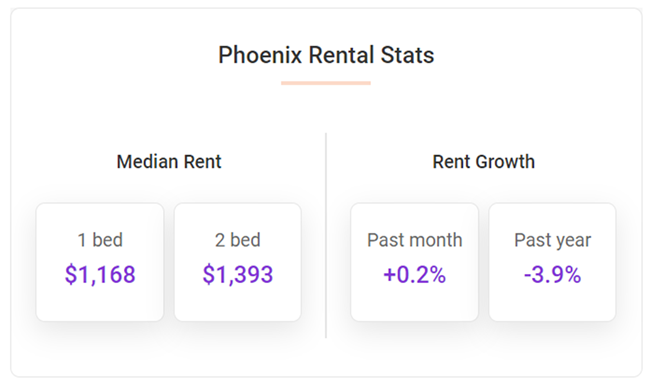
Phoenix rents are flat month-over-month and down 3.8% year-over-year, according to the May report from Apartment List.

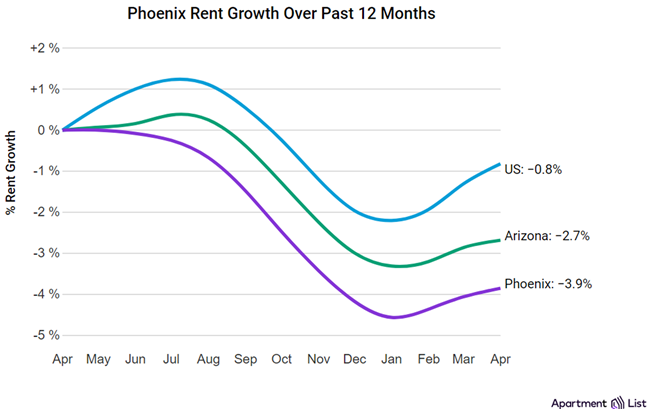
Phoenix’s rent growth over the past year has fallen behind both the state (-2.7%) and national (-0.8%) averages.

Four months into the year, rents in Phoenix have risen 0.8%. This is a faster rate of growth compared to what the city was experiencing at this point last year; from January to April 2023, rents had decreased 0.0%.

Citywide, the median rent stands at $1,168 for a 1-bedroom apartment and $1,393 for a 2-bedroom. Across all bedroom sizes (i.e., the entire rental market), the median rent is $1,363. That ranks No. 60 in the nation, among the country’s 100 largest cities.

Phoenix rents are flat month-over-month and down 3.8% year-over-year, according to the May report from Apartment List.

Phoenix rents are 5.7% lower than the metro-wide median

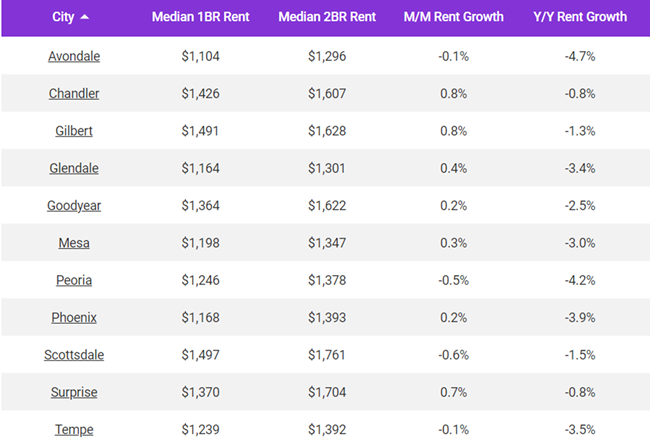
Across the Phoenix metro, the median rent is $1,446, meaning that the median price in Phoenix proper ($1,363) is 5.7% lower than the price across the metro as a whole. Metro-wide annual rent growth stands at -3.0%, above the rate of rent growth within just the city.

The table below shows the latest rent stats for 11 cities in the Phoenix metro area that are included in the Apartment List database.

Among them, Surprise is currently the most expensive, with a median rent of $1,836. Glendale is the metro’s most affordable city, with a median rent of $1,354. The metro’s fastest annual rent growth is occurring in Surprise (-0.8%), while the slowest is in Avondale (-4.7%).

Phoenix rents are flat month-over-month and down 3.8% year-over-year, according to the May report from Apartment List.

Tucson rents are flat month-over-month and flat year-over-year

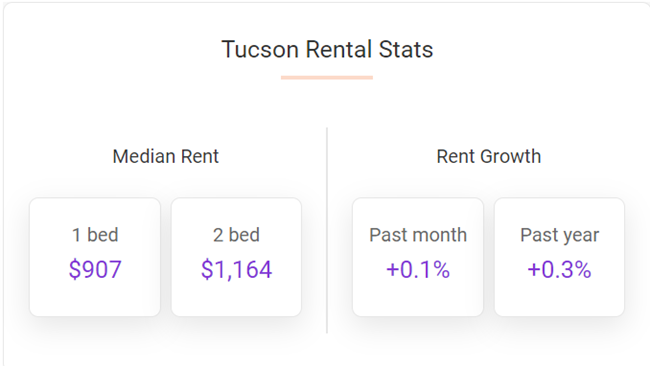
Tucson Arizona rental stats for April 2024

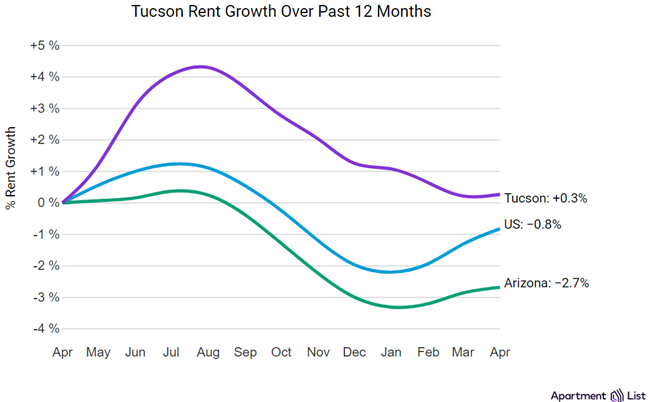
The median rent in Tucson rose by 0.1% over the course of April, and has now increased by a total of 0.3% over the past 12 months, according to the May report from Apartment List.

Tucson’s rent growth over the past year has has outpaced both state (-2.7%) and national (-0.8%) averages.

Four months into the year, rents in Tucson have fallen 0.8%. This is a slower rate of growth compared to what the city was experiencing at this point last year: from January to April 2023 rents had increased 0.5%.

Tucson rent growth flat in April

Sign Up For Our Weekly Newsletter And Get Rental Property And Apartment News And Helpful, Useful Content Each Week.

* indicates required

Portland Rents Rise in April, Decreases Over Year

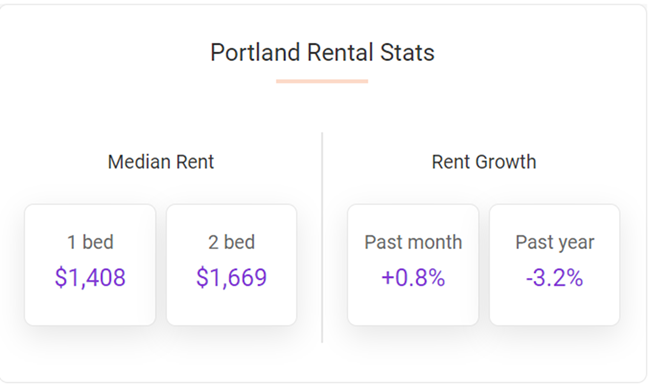
Portland rents rose 0.8% in April, making the overall median rent in the city $1,549, according to the May report from Apartment List.

Portland rents rose 0.8% in April, making the overall median rent in the city $1,549, according to the May report from Apartment List.

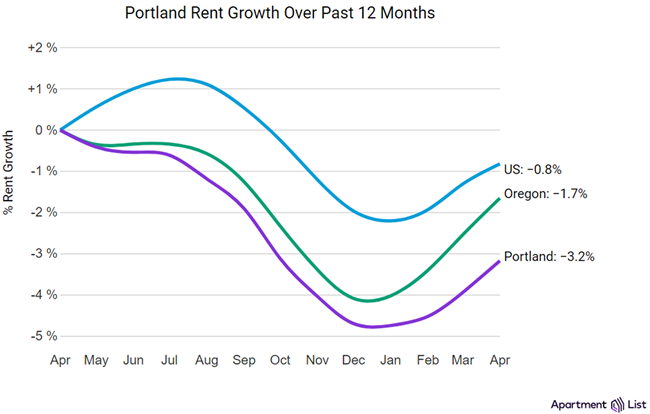
While the median rent in Portland rose over the course of April, it has decreased by a total of 3.2% over the past 12 months.

Portland’s rent growth over the past year has fallen behind both the state (-1.6%) and national averages (-0.8%).

However, so far in 2024 Portland rent increases are pacing above 2023. At this point four months into the year, rents in Portland have risen 1.6%.

April rent growth in Portland ranked No. 32 among large U.S. cities. Citywide, the median rent stands at $1,408 for a 1-bedroom apartment and $1,669 for a 2-bedroom.

Portland rents rose 0.8% in April, making the overall median rent in the city $1,549, according to the May report from Apartment List.

Portland rents are 6.7% lower than the metro-wide median

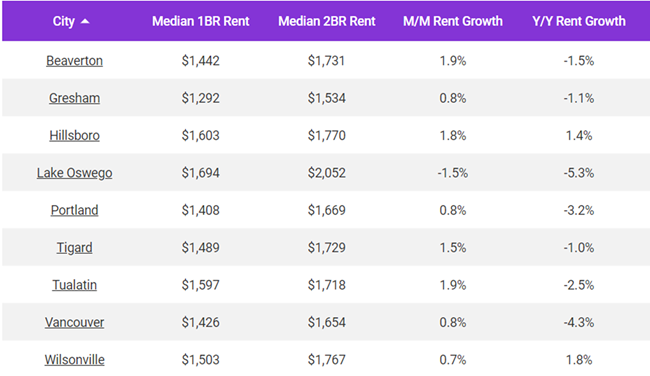
Outside the city proper, the median rent is $1,661, meaning that the median price in Portland is 6.7% lower than the price across the metro as a whole. Metro-wide annual rent growth stands at -2.3%, above the rate of rent growth within just the city.

The table below shows the latest rent stats for 9 cities in the Portland metro area that are included in our database. Among them, Lake Oswego is currently the most expensive, with a median rent of $1,935. Gresham is the metro’s most affordable city, with a median rent of $1,514. The metro’s fastest annual rent growth is occurring in Wilsonville (1.8%), while the slowest is in Lake Oswego (-5.3%).

Portland rents rose 0.8% in April, making the overall median rent in the city $1,549, according to the May report from Apartment List.

Sign Up For Our Weekly Newsletter And Get Rental Property And Apartment News And Helpful, Useful Content Each Week.

* indicates required

Salt Lake City Rents Flat In April

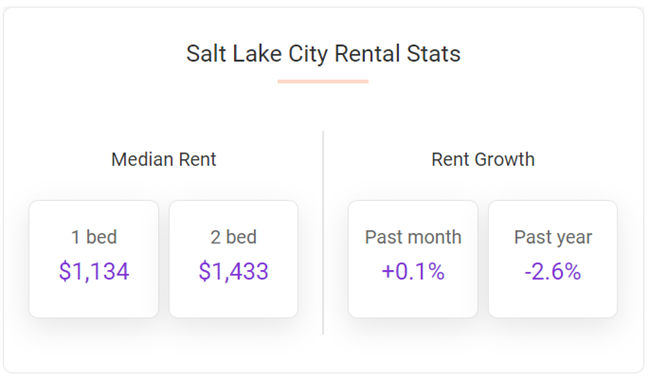
Salt Lake City rents are flat month-over-month and down 2.6% year-over-year, according to the May report from Apartment List.

Salt Lake City April rents are flat month-over-month and down 2.6% year-over-year, according to the May report from Apartment List.

The overall median rent in the city stands at $1,310, roughly the same as April.

So far this year, Salt Lake City rent growth is pacing similar last year. Four months into 2024, rents in Salt Lake City have risen 0.3%. This is a similar rate of growth compared to what the city was experiencing at this point last year as from January to April 2023 rents increased 0.5%.

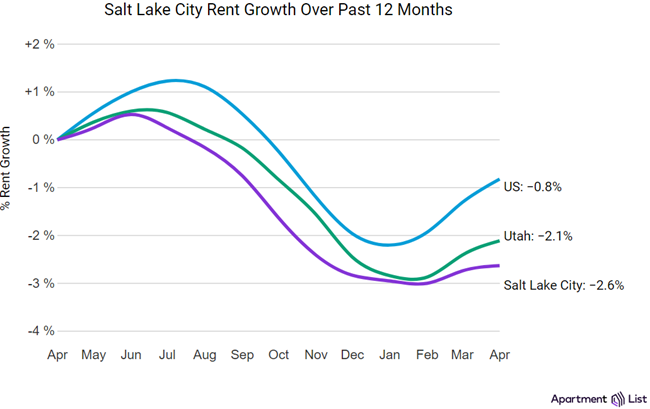
Salt Lake City’s rent growth over the past year is similar to the state average (-2.1%) but has fallen below the national average (-0.8%).

Salt Lake City rents are flat month-over-month and down 2.6% year-over-year, according to the May report from Apartment List.

Salt Lake City rents are 12.5% lower than the metro-wide median

Across the Salt Lake City metro area, the median rent is $1,497 meaning that the median price in Salt Lake City proper ($1,310) is 12.5% lower than the price across the metro as a whole. Metro-wide annual rent growth stands at -2.1%, above the rate of rent growth within just the city.

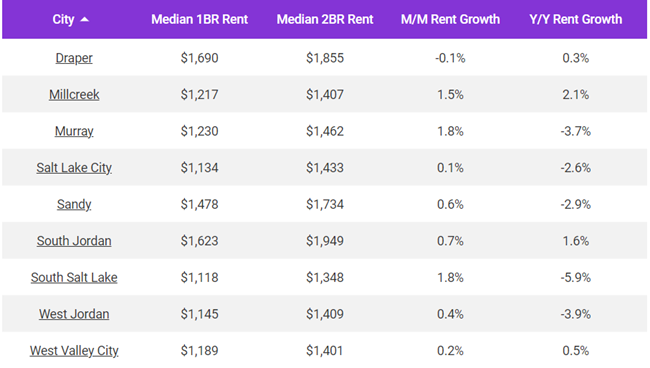
The table below shows the latest rent stats for 9 cities in the Salt Lake City metro area that are included in the Apartment List database.

Among them, Draper is currently the most expensive, with a median rent of $1,911. South Salt Lake is the metro’s most affordable city, with a median rent of $1,280. The metro’s fastest annual rent growth is occurring in Millcreek (2.1%) while the slowest is in South Salt Lake (-6.0%).

Salt Lake City rents are flat month-over-month and down 2.6% year-over-year, according to the May report from Apartment List.

Salt Lake City Rents Up Slightly In March